The Senate voted to confirm former oil-and-gas lobbyist David Bernhardt as Secretary of the Interior Thursday, despite calls from Democrats and government watchdogs to investigate his past conduct, The New York Times reported.
The confirmation vote was 56-to-41, making Bernhardt—who has so many conflicts of interests he has to write them on an index card to make sure he doesn't deal with former clients—the least popular Interior Secretary in 40 years, the Center for American Progress (CAP) told The Washington Post. The second least popular was Ryan Zinke, President Donald Trump's first pick to lead the Department of Interior (DOI), who resigned last year amidst a series of ethics investigations. A CAP analysis showed that Bernhardt bested his former boss in another respect: he has the most conflicts of interests of all 31 Trump cabinet-level nominees.
"It still amazes me," New York Democratic Senator Chuck Schumer said of Bernhardt's nomination, as The New York Times reported. "Donald Trump campaigns on cleaning up the swamp and he does exactly the opposite when in office. An oil and gas lobbyist as head of the Department of Interior? My God. That's an example of the swampiness of Washington if there ever was one. And when are Donald Trump's supporters going to understand this?"
Bernhardt worked for the DOI under President George W. Bush, contributing to efforts to open the Arctic National Wildlife Refuge to oil and gas development. He then spent seven years as a lobbyist with several fossil fuel clients including Halliburton; another of his clients was the powerful California utility Westlands Water District. Trump nominated him to serve as deputy secretary at DOI in April 2017, he was confirmed in July of that year and he has been acting as interior secretary since Zinke's resignation in December of 2018.
Democratic lawmakers and watchdogs have called for investigations into three of Bernhardt's reported actions, according to The New York Times.
While at Interior, he reportedly acted to weaken endangered species protections for a California fish, an act that would benefit Westlands Water District.
He continued to lobby on behalf of Westlands Water District up through the month of his April 2017 nomination, despite the fact that he had told the federal government he was no longer lobbying at that time, The New York Times reported.
Democratic Senator Ron Wyden said he was shocked by that last revelation, reported in March. Shortly before, Bernhardt had come to Wyden's office and promised to abide by ethical standards.
"Why would you come to my office and lie?" Wyden asked Bernhardt during his confirmation hearing, The Washington Post reported.
Three Democratic Senators broke ranks with their colleagues to approve Bernhardt's confirmation: Joe Manchin of West Virginia, Krysten Sinema of Arizona and Martin Heinrich of New Mexico.
Heinrich said that, since one-third of land in New Mexico is owned by DOI, it was important for the state to have a confirmed head of the agency, The New York Times reported.
"I need to be able to pick up the phone and talk to the Secretary of Interior on a regular basis. I'm not going to be able to get the Interior Secretary I wanted. We didn't win in 2016," he said, according to The New York Times. "But in New Mexico, I'm going to put my state and protection of public lands in my state first."
Heinrich had been the target of a campaign by the Western Values Project urging him to change his mind.
"Rushing to move forward with Bernhardt's nomination without clarification on his numerous ethical lapses and investigative requests is not only a disservice to the American people, but it also means that Interior will again be led by a secretary shrouded in scandal," Western Values Project Executive Director Chris Saeger said in a statement on Bernhardt's confirmation. "Make no mistake: a vote to confirm David Bernhardt for Interior Secretary was a vote against our American birthright and the viability of our public lands for future generations."
The group noted that Bernhardt already had a poor record on public lands. He has been instrumental in the push to open millions of acres of public lands to oil and gas development and oversaw the decision to keep national parksopen but understaffed during the government shutdown.
Rep. Tom Marino, R-Pa., has withdrawn his name from consideration as America's drug czar, President Trump said Tuesday. Marino is stepping back days after reports that legislation he sponsored hindered the Drug Enforcement Administration in its fight against the U.S. opioid crisis.
A joint report by The Washington Post and 60 Minutes found that Marino's measure "helped pump more painkillers into parts of the country that were already in the middle of the opioid crisis," as NPR's Kelly McEvers said earlier this week. The bill had been opposed by the DEA and embraced by companies in the drug industry.
As NPR's White House Correspondent Tamara Keith notes, Marino's withdrawal leaves the Trump administration without nominees for several important domestic roles, including drug czar, the director of the DEA, and secretary of Health and Human Services.
Marino was a main backer of the Ensuring Patient Access and Effective Drug Enforcement Act; among other things, the measure changed the standard for identifying dangers to local communities, from "imminent" threats to "immediate" threats. That change cramped the DEA's authority to go after drug companies that didn't report suspicious — and often very large — orders for narcotics.
After the Post and 60 Minutes report, several members of Congress called for the White House to pull Marino's nomination as drug czar.
Sen. Joe Manchin, D-W.Va., said he was "horrified" by the story, adding that he "cannot believe the last administration did not sound the alarm on how harmful that bill would be for our efforts to effectively fight the opioid epidemic."
In a letter to the president, Manchin wrote about the ability of wholesale drug distributors to send millions of pills into small communities:
"As the report notes, one such company shipped 20 million doses of oxycodone and hydrocodone to pharmacies in West Virginia between 2007 and 2012. This included 11 million doses in one small county with only 25,000 people in the southern part of the state: Mingo County. As the number of pills in my state increased, so did the death toll in our communities, including Mingo County."
After Marino's name was withdrawn, Manchin tweeted to Trump, "thanks for recognizing we need a drug czar who has seen the devastating effects of the problem."
Manchin has co-sponsored legislation that would repeal the changesmade by the 2016 law, along with Sen. Claire McCaskill, D-Mo., and Sen. Margaret Wood Hassan, D-N.H.
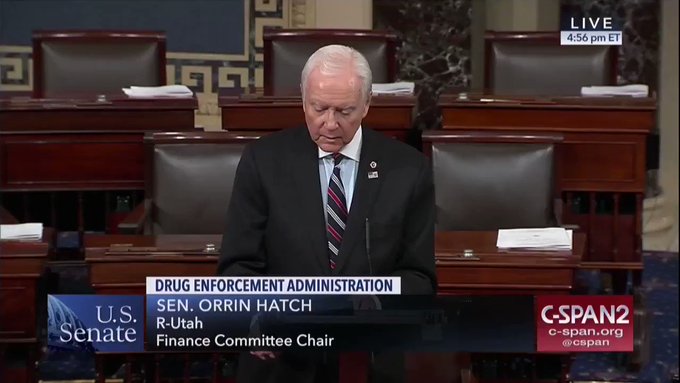
In the Senate, the drug enforcement bill was sponsored by Sen. Orrin Hatch, R-Utah — who also saw it through the markup process. In Congress and on Twitter, Hatch has defended his role this week, calling the Post story "flawed" and "one-sided."
Hatch also said the bill was supported by patient groups who "were concerned about DEA's unfettered enforcement authority."
Fourth, President Obama signed this bill into law. DEA and DOJ, who work for the President, could have urged him to veto it. They did not. pic.twitter.com/ZLE6el0I19
"I spent months negotiating with DEA and with DOJ until they were at a point where they were comfortable allowing the bill to proceed," Hatch said Monday on Capitol Hill. "If they had asked me to hold the bill or to continue negotiations, I would have done so."
Hatch noted via Twitter that "President Obama signed this bill into law. DEA and DOJ, who work for the President, could have urged him to veto it. They did not."
Tens of thousands of Americans are dying from drug overdoses each year. In its preliminary report about the opioid crisis, President Trump's Commission on Combating Drug Addiction and the Opioid Crisis said in August that "with approximately 142 Americans dying every day, America is enduring a death toll equal to Sept. 11 every three weeks."
In an interview with NPR, here's how Post reporter Scott Higham described the way in which Marino's bill became law:
"We've obtained internal memos, emails, other documents from the DEA and from the Justice Department that show that the DEA and the Department of Justice for many years was opposed to this. They had written memos. They had written emails saying this is going to upend our ability to go after these companies. Why are you doing this? And Marino had introduced this legislation in 2014, and the DEA got it killed; and in 2015, and the DEA got it killed.
"And then there was a change in leadership. Eric Holder stepped down. Loretta Lynch took over the AG's office. And then there was a new DEA administrator who came in who said that, I think that we need to work with these people. And there was also enormous amounts of pressure being placed on the DEA by Capitol Hill to pass this bill. And it was at the behest of the pharmaceutical industry. In fact, the bill was written by a pharmaceutical industry attorney [D. Linden Barber] who used to be a DEA attorney ... a senior DEA attorney. So it's, you know, the classic kind of revolving door in Washington."
The president had nominated Marino to lead the White House Office of National Drug Control Policy. In his tweet announcing Marino's decision to withdraw Tuesday morning, Trump added, "Tom is a fine man and a great Congressman!"
The opioid story was revealed by whistleblower Joe Rannazzisi, a former high-ranking DEA official, who told 60 Minutes, "This is an industry that allowed millions and millions of drugs to go into bad pharmacies and doctors' offices, that distributed them out to people who had no legitimate need for those drugs."
Rannazzisi said he was in "total disbelief" when the White House announced that Trump had chosen to nominate Marino, adding, "The bill was bad. Him being the drug czar is a lot worse."
The largest single group of asylum seekers ever to cross into the U.S. tunneled beneath the border wall near San Luis, Arizona, on Monday, voluntarily turning themselves into Customs and Border Protection, according to the agency.
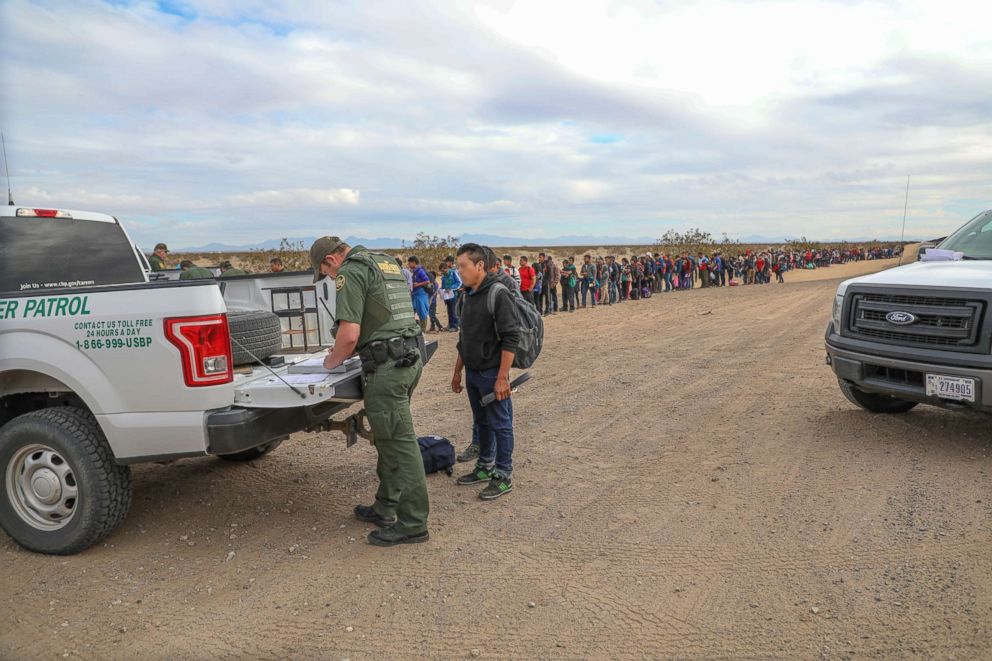
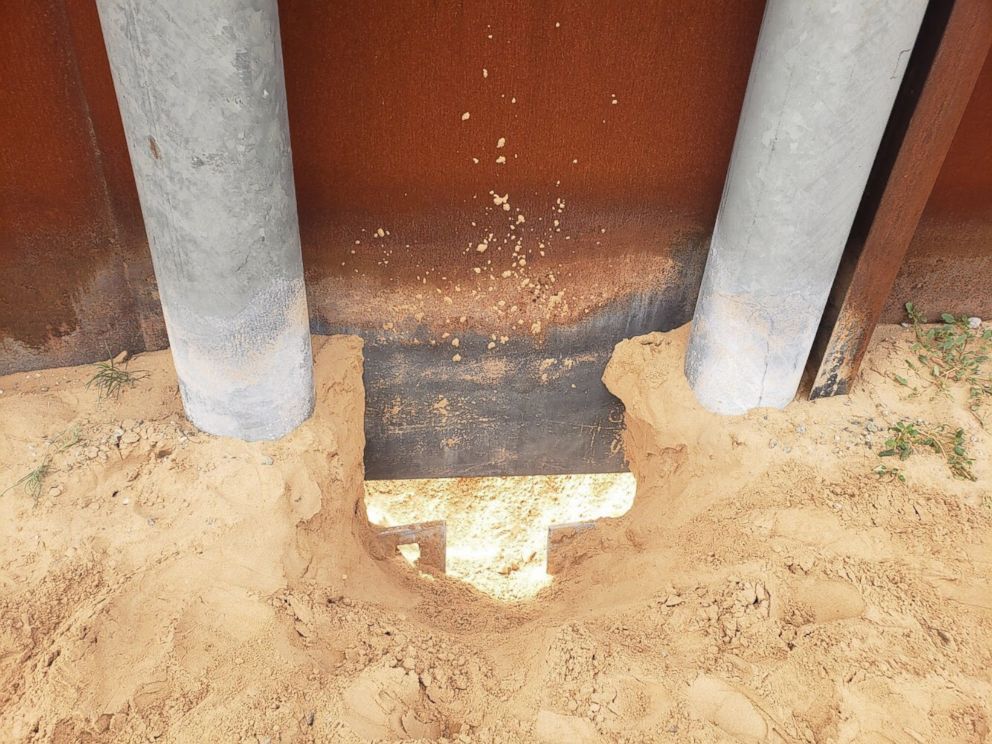
Migrants can be seen marching toward Border Patrol agents by the hundreds, according to video obtained by ABC News. Smugglers dug a series of seven holes, only a few feet long beneath the steel border fence, with hundreds going beneath the wall and a smaller number clambering over it, according to CBP.
The fresh sand and scuff marks of shoes on the rusty steel were still there when ABC News visited the site on Thursday.
Yuma Sector Border Patrol
A record large group of migrants tunneled under the border wall near Yuma, Arizona, and turned themselves in to Border Patrol officials for asylum.more +
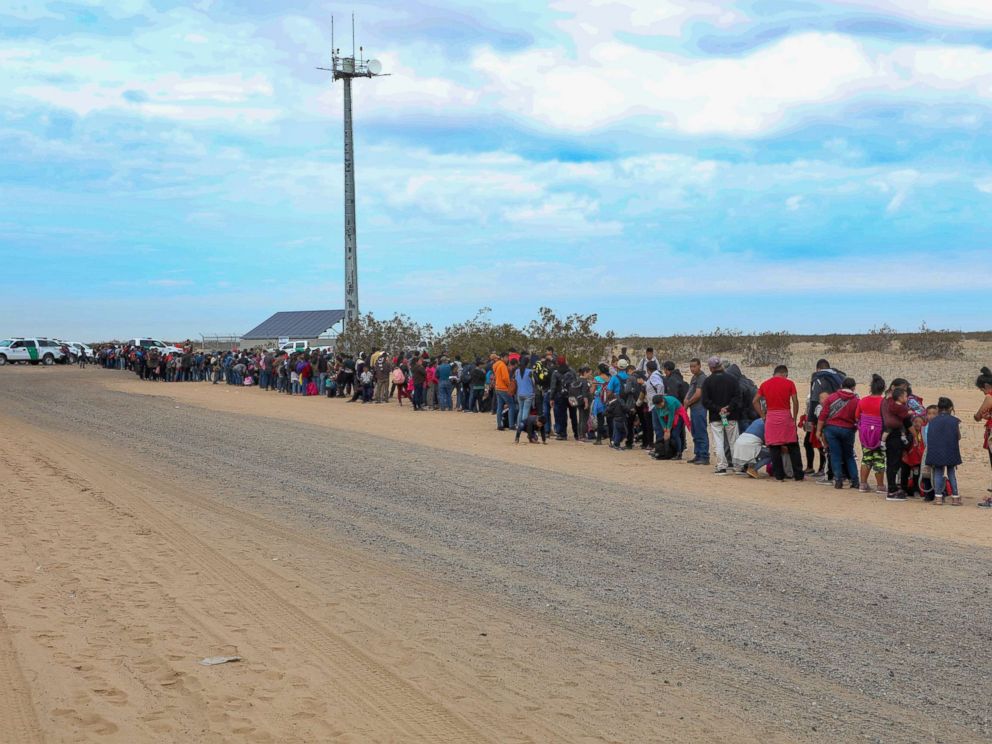
The agency says 179 of the record 376 people who crossed were children, including over 30 unaccompanied minors -- children under 18 traveling on their own.
The overall number of unauthorized crossings has plummeted since its peak in the 2001, when CBP logged about 1.6 million apprehensions, according to government statistics. However, the demography of those crossing has changed dramatically.
Parents with children now comprise over 80 percent of the total apprehensions of those crossing the 2,000-mile long border with Mexico. The vast majority of them, like the group near Yuma Monday, surrender immediately or seek out Border Patrol agents in order to begin the asylum process.
CBP Yuma Border Sector Chief Anthony Porvaznik said his unit needs better border barriers, but more urgently it needs funding to provide for these families.
"That's our No. 1 challenge that we have here in the Yuma sector, is the humanitarian problem," Porvaznik said. "As I mentioned, 87 percent of the apprehensions here are family units and unaccompanied alien children."
Yuma Sector Border Patrol
Seven tunnels were dug underneath the border wall near Yuma, Arizona, on Monday, Jan. 14, 2019, as a record group of migrants entered the U.S.more +
The mass crossing this week took place in a sparsely populated stretch of the border -- where an old model of border barrier rises about 12 feet from the sandy ground. The stretched agency only had three agents patrolling that 26-mile-long section of the border.
It took hours to process the families, most of which were sent to the area’s chronically overcrowded central processing center in Yuma.
"In my 30 years with the Border Patrol, I have not been part of arresting a group of 376 people," Porvaznik said. "That's really unheard of."
On Thursday, hundreds of asylum seekers were being held in cinderblock cells with thick glass windows that overlooked a central bullpen where CBP agents worked to process them and provide humanitarian needs. The asylum seekers were separated into cells: fathers with sons, fathers with daughters, unaccompanied minors and mothers with children.
As in all such facilities, the CBP said it works to process them as quickly as possible, and provides basic medical care. Still, detainees eat, sleep and use the bathroom in the same room. Scraps of food mingled with silvery space blankets on the floor. In one cell, several boys had balled up the blankets into a makeshift soccer ball they were kicking around.
Yuma Sector Border Patrol
A record large group of 376 migrants tunneled under the border wall near Yuma, Arizona, and turned themselves in to Border Patrol officials for asylum.more +
One man in the group said he left Guatemala eight days ago and made most of the trip by bus along with his 12-year-old daughter. They were planning to leave the processing center destined for San Diego -- plane ticket in hand.
The father said he saved about $5,000 to pay a coyote to quickly get them to the border. He left a wife and two younger daughters back in Guatemala. Next to them were a mother and two daughters on their way to Cincinnati, also from Guatemala. They too traveled by bus and the journey took about eight days.
Just two days after the group tunneled under the border wall in Yuma, the Border Patrol took in another huge group of migrants in New Mexico. The 247-person group, including unaccompanied minors, crossed near the Antelope Wells Port of Entry and immediately surrendered to authorities for processing.
The CBP said 24 large groups -- quantified as 100 or more -- have crossed the border near Lordsburg, New Mexico, just since Oct. 1, 2018.
ABC News' Ignacio Torres and Mark Osborne contributed to this report.
Editor's note: This story has been updated to say Customs and Border Protection.
I give you the republican Russian assets who have publicly outed themselves. Please show them a little love on social media. These people think that it's more important to insure that Oleg Deripaska gets his money, than that 800,000 furloughed federal workers get their paychecks.