Search This Blog

Translate

Blog Archive

Middleboro Review 2

NEW CONTENT MOVED TO MIDDLEBORO REVIEW 2

Toyota

Since the Dilly, Dally, Delay & Stall Law Firms are adding their billable hours, the Toyota U.S.A. and Route 44 Toyota posts have been separated here:

Route 44 Toyota Sold Me A Lemon


Showing posts with label MONOPOLY. Show all posts

Monday, December 9, 2019

Bernie Sanders' Broadband Plan Is Comcast's Worst Nightmare


Reader Supported News
09 December 19

Yesterday 11 Reader-Supporters Kept RSN Going
Sunday we served 21,820 readers. 11 of those people said “yes I will help.” Though their numbers were small, their impact was huge.
We are working as hard as we can to close the September funding gap.
Who can help?
Marc Ash
Founder, Reader Supported News
Sure, I'll make a donation!

Update My Monthly Donation

If you would prefer to send a check:
Reader Supported News
PO Box 2043
Citrus Hts
CA 95611


Reader Supported News
08 December 19
It's Live on the HomePage Now:
Reader Supported News


Bernie Sanders' Broadband Plan Is Comcast's Worst Nightmare
Sen. Bernie Sanders has managed to emerge from a heart attack with higher poll numbers and more momentum than he had before. (photo: Carlos Gonzales/Star Tribune/AP)
Karl Bode, VICE
Bode writes: "Sanders promises to break up media monopolies, restore net neutrality, and embrace the countless towns and cities that are building their own broadband networks."
READ MORE

Jerry Nadler listens as constitutional scholars testify before the House judiciary committee. (photo: Reuters)
Nadler May Add Mueller Counts Against Trump
Oliver Laughland, Guardian UK
Laughland writes: "The Democratic chairman of the House judiciary committee, Jerry Nadler, has not ruled out including evidence from the Mueller report in articles of impeachment against Donald Trump that could be published as early as next week."
READ MORE

Rep. Alexandria Ocasio-Cortez (D-NY) takes the stage before speaking at the Climate Crisis Summit at Drake University on November 9, 2019 in Des Moines, Iowa. (photo: Stephen Maturen/Getty Images)
Daniel Politi, Slate
Politi writes: "Rep. Alexandria Ocasio-Cortez is 'waiting on the haters to apologize' after Amazon said it would open up corporate offices in New York City to house more than 1,500 employees."
 The announcement from the internet giant came less than a year after it abruptly dropped plans to build a second headquarters in the city following backlash to the some $3 billion in financial incentives that the government had offered to woo the company. Ocasio-Cortez quickly celebrated the announcement in a series of tweets.
“Won’t you look at that: Amazon is coming to NYC anyway - *without* requiring the public to finance shady deals, helipad handouts for Jeff Bezos, & corporate giveaways,” Ocasio-Cortez tweeted. “Maybe the Trump admin should focus more on cutting public assistance to billionaires instead of poor families.” She then tweeted a photo of herself sitting on a couch saying she was waiting for apologies .
The lawmaker’s tweets came shortly after the Wall Street Journal reported that Amazon had signed a new lease for 335,000 square feet in New York City. Unlike earlier expansions, the company is setting up shop without any special tax incentives. Some had worried that when Amazon pulled out of setting up its second headquarters in New York it would scare away other large businesses. “Instead, Amazon’s continued expansion marks the latest sign that tech companies are scrambling for prime Manhattan real estate to attract the city’s large and well-educated talent pool,” reports the Journal.

Some though were quick to criticize Ocasio-Cortez, saying her claiming victory on the issue was a bit misleading considering that the new office space is far smaller than what the online giant had vowed to set up in the Queens neighborhood of Long Island City as part of its second headquarters. The company had pledged to create 25,000 new jobs as part of that expansion.


From left, Harvard Law School professor Noah Feldman, Stanford Law School professor Pamela Karlan, University of North Carolina Law School professor Michael Gerhardt and George Washington University Law School professor Jonathan Turley appear for a hearing on the constitutional grounds for the impeachment of President Trump.  (photo: Alex Brandon/AP)
From left, Harvard Law School professor Noah Feldman, Stanford Law School professor Pamela Karlan, University of North Carolina Law School professor Michael Gerhardt and George Washington University Law School professor Jonathan Turley appear for a hearing on the constitutional grounds for the impeachment of President Trump. (photo: Alex Brandon/AP)

Four Ways Democratic Presidential Candidates Can Use Impeachment to Their Advantage
Jennifer Rubin, The Washington Post
Rubin writes: "Whether that is true now, they are likely to get a 2020 gift never before handed to the party out of the White House: a month-long impeachment trial in which Trump's wrongdoing, recklessness and corruption are aired every day, all day, on every news channel. To quote Sen. Amy Klobuchar (D-Minn.), they better not screw this up."
READ MORE

Gabrielle Union. (photo: Getty Images)
The Power and Danger of Being a Difficult Woman
Rachel Sklar, Medium
Sklar writes: "In the appalling case of Gabrielle Union's removal from America's Got Talent by NBC, 'A source close to the production disputes that Union was fired,' reports Yashar Ali at Vulture, 'and specifically that she was fired for being perceived as 'difficult.'"
READ MORE

A rally near Place de la République in support of the national strike in France, one of the largest nationwide strike in years, on December 5, 2019 in Paris, France. (photo: Kiran Ridley/Getty Images)
Emmanuel Macron Wants to End France's Welfare State
Stathis Kouvelakis, Jacobin
Kouvelakis writes: "France was paralyzed by strikes on Friday, as workers from train drivers to teachers revolted against Emmanuel Macron's attack on pensions. While the liberal president fancies himself as a French 'Thatcher,' his bid to tear up France's welfare state now faces its most powerful opposition yet."
READ MORE

Air pollution. (photo: Robyn Beck/Getty Images)

Getting Rid of Pollution Improves Public Health Almost Immediately
Emily Pontecorvo, Grist
Pontecorvo writes: "After decades of steadily declining, air pollution is once again on the rise in the United States. Between 2016 and 2018, pollution of fine particulate matter - tiny particles that are emitted whenever we burn anything - rose by more than 5 percent."

That’s terrible news for Americans’ health. The researchers who identified the increase in pollution calculated that it was linked to 9,700 additional premature deaths in 2018. Worldwide, outdoor air pollution is responsible for an estimated 4.2 million deaths per year. It affects nearly every organ in the body, and can cause or contribute to stroke, heart disease, lung cancer, and chronic respiratory diseases.
The good news is that scientists have repeatedly found that improving air quality has quick and significant benefits for public health. A new analysis of the literature on pollution reduction published this week in the Annals of the American Thoracic Society shows that as soon as two weeks after a source of pollution is removed, many respiratory symptoms experienced by the surrounding community disappear and hospital visits are reduced. Within as little as two months, mortality drops as well.
The paper looks at several cases where a temporary reduction in pollution was the only change in a community that could account for major differences in health outcomes. For example, when a steel mill in the Utah Valley closed for just 13 months from 1986 to 1987, hospitalizations for pneumonia, bronchitis, and asthma went down, especially for children. School absences were reduced by 40 percent. Women who were pregnant during the year the mill was closed were less likely to have premature births than those who were pregnant before or after. And there was a 16 percent decrease in overall mortality.
When the Summer Olympics were held in Atlanta, Georgia in 1996, the city closed the downtown area to private vehicles and upped its public transportation system to run 24 hours a day, with additional bus services. The closure lasted only 17 days, but peak daily ozone concentrations went down 28 percent. Over the next month, children sought care for their asthma 42 percent less frequently, pediatric emergency room visits went down by 11 percent, and overall hospitalizations for asthma went down by 19 percent.
These numbers make a powerful case for reducing air pollution — especially because there’s next to nothing people can do personally to avoid it. That’s especially true for vulnerable populations who live near industrial zones, highways, and power plants because the real estate is affordable there, or because those big polluters set up shop in their neighborhoods because of structural racism.
There’s a range of interventions that can help, and some of them are already being implemented on a local scale, like car-free streets. San Francisco recently voted to shut down the central artery of Market Street to private cars. New York City is experimenting with doing the same to Manhattan’s 14th Street. In Oslo, Norway, the entire downtown is now basically car-free. Smoking bans, cleaner fuels for school buses, and switching out fossil-fuel burning home heating systems for electric ones have also been proven to improve health outcomes.
The federal government could help by enforcing the Clean Air Act stringently (instead of, you know, rolling parts of it back). The researchers who identified the recent reversal in air pollution found that the Environmental Protection Agency’s actions against polluters have been falling since 2009. They also attribute the increase in pollution to the rise of natural gas and an increase in driving. So developing a national climate policy to use more renewable energy and electrify buildings and cars won’t just slow global warming, it will literally save lives — and fast.






Tuesday, October 29, 2019

FOCUS: Masha Gessen | Mark Zuckerberg Doesn't Know What the First Amendment Is For


Reader Supported News
28 October 19
It's Live on the HomePage Now:
Reader Supported News


FOCUS: Masha Gessen | Mark Zuckerberg Doesn't Know What the First Amendment Is For
Mark Zuckerberg, the C.E.O. of Facebook, is symptomatic of our collective refusal to think about speech and the media in complicated ways. (photo: Andrew Caballero-Reynolds/AFP/Getty Images)
Masha Gessen, The New Yorker
Gessen writes: "What is the First Amendment for? I ask my students this every year."

EXCERPT:
The news media have traditionally borne the responsibility for insuring that the actual purpose of the First Amendment is fulfilled. Yet Americans are content to leave this essential component of democracy to profit-driven corporations with next to no regulatory oversight. We accept it as the natural order of things that the flow and volume of news is largely determined by the needs of advertisers, and that, when advertising dollars dry up, so does the news. We are so afraid of censorship—or, perhaps more accurately, we have such lazy ways of thinking about accountability—that we would rather let newspapers die and media corporations form monopolies than consider government regulation and public funding. In the past three decades, most of the public conversation about news media—as facilitated by the news media—has devolved to the level of my students’ initial, knee-jerk response to the First Amendment question. Much like Zuckerberg in his free-speech speech, or in his stubborn refusal to remove misleading political ads, we talk about rights without talking about responsibilities. This is what has allowed Facebook to evade responsibility, and to avoid even being identified as a media company.
With Facebook and other new media, technology has accelerated and amplified existing processes and problems. Facebook is not an anomaly in the American media system—it is precisely the result of rampant profit-seeking, lazy thinking, and a lack of civic responsibility. Of course Zuckerberg tells Buttigieg whom to hire. Of course he sees Warren, and not Trump, as an existential threat. Of course Facebook allows Trump to run false ads. The company doesn’t know what the First Amendment is for—and we are not making it learn.


Tuesday, July 30, 2019

The Dangerous Austerity Politics of the Washington Post


FAIR

The Dangerous Austerity Politics of the Washington Post

view post on FAIR.org

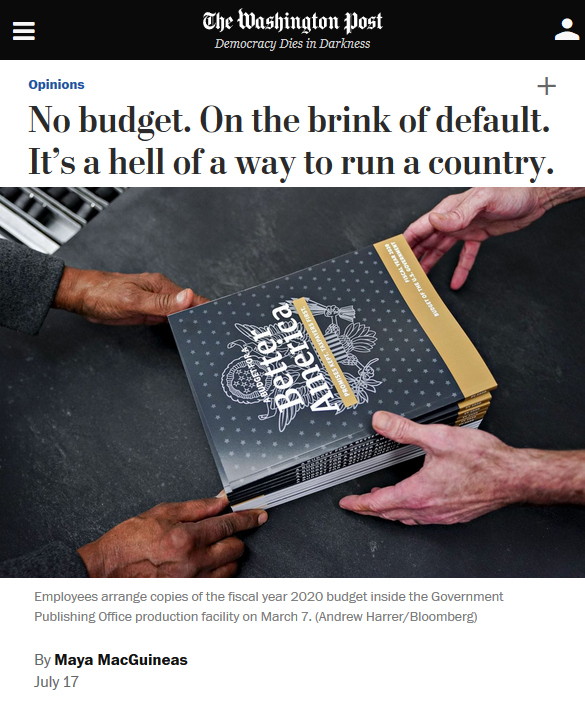
WaPo: No budget. On the brink of default. It’s a hell of a way to run a country.
Washington Post (7/17/19)
The Washington Post (7/17/19) ran a column this month by Maya MacGuineas, the president of the Committee for a Responsible Federal Budget, one of the many pro-austerity organizations that received generous funding from the late Peter Peterson. The immediate target of the column was the standoff over the debt ceiling, but the usual complaints about debt and deficits were right up front in the first two paragraphs:
At the same time, the federal debt as a share of the economy is the highest it has ever been other than just after World War II….
So our plan is to borrow a jaw-dropping roughly $900 billion in each of those years—much of it from foreign countries—without a strategy or even an acknowledgment of the choices being made because no one wants to be held accountable.
This passes for wisdom at the Washington Post, but it is actually dangerously wrong-headed thinking that rich people (like the owner of the Washington Post) use their power to endlessly barrage the public with.
The basic story of the 12 years since the collapse of the housing bubble is that the US economy has suffered from a lack of demand. We need actors in the economy to spend more money. The lack of spending over this period has cost us trillions of dollars in lost output.
This should not be just an abstraction. Millions of people who wanted jobs in the decade from 2008 to 2018 did not have them because the Washington Post and its clique of “responsible” budget types joined in calls for austerity. This meant millions of families took a whack to their income, throwing some into poverty, leading many to lose houses, and some to become homeless.
At this point, the evidence from the harm from austerity in the United States (it’s worse in Europe) is overwhelming, but just like Pravda in the days of the Soviet Union, we never see the Washington Post, or most other major news outlets, acknowledge the horrible cost of unnecessary austerity. We just get more of the same, as though the paper is hoping its readers will simply ignore the damage done by austerity.
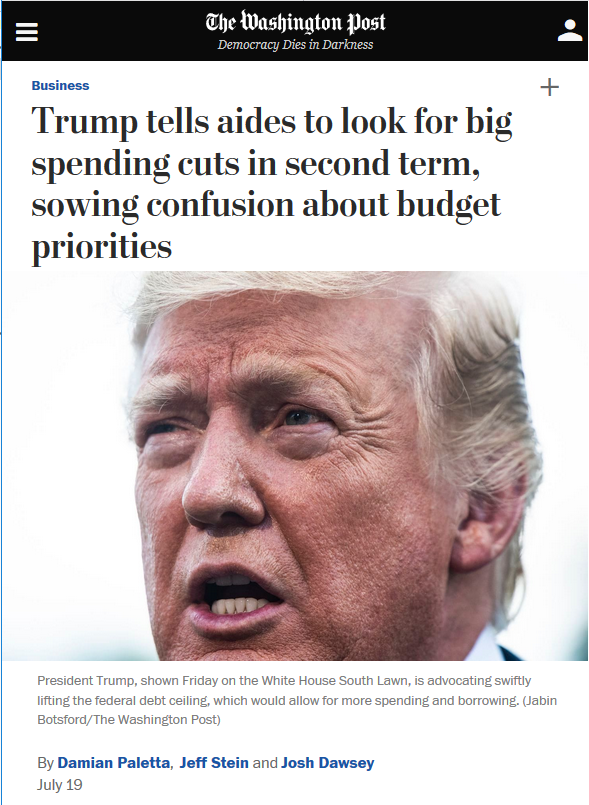
WaPo: Trump tells aides to look for big spending cuts in second term, sowing confusion about budget priorities
Washington Post (7/19/19)
And it is not just an occasion column from a Peter Peterson–funded group; the Post’s regular economic columnist, Robert Samuelson, routinely complains about budget deficits, as do the Post editorial writers. We get the same story in the news section as well; for example, a piece this month (7/19/19) told us about the need to “fix” the budget. The Post is effectively implying that a lower budget deficit, which results in lower output and higher unemployment, is “fixed.”
If the Post cared about the logic of its argument, instead of just repeating platitudes about the evils of budget deficits, it should quickly recognize that its push for austerity makes no economic sense. The argument for the evils of a budget deficit is that it is supposed to lead to high interest rates and crowd out investment. That leaves the economy poorer in the future, since less investment leads to less productivity growth, so the economy will be able to produce fewer goods and services in future years. (The implicit assumption is that the economy is near its full-employment level of output, so that efforts by the Fed to keep interest rates down by printing money would lead to inflation.)
The nice part of this story is that there is a clear prediction which we can examine: High budget deficits lead to high interest rates. Or, if the Fed is asleep on the job, high budget deficits will lead to high inflation.
The interest rate on 10-year Treasury bonds at the end of last week was just over 2.0 percent. That is incredibly low by historic standards, and far lower than the rates of over 5.0 percent that we saw when the government was running a surplus in the late 1990s. The inflation rate is hovering near 2.0 percent, and has actually been trending slightly downward in recent months. So where is the bad story of the budget deficit?
In the classic deficit-crowding-out-investment story, if we cut the budget deficit, investment rises to replace any lost demand associated with lower government spending or higher taxes. We can also see some increased consumption, mostly due to mortgage refinancing, and some increase in net exports due to a lower-valued dollar.
But what area of spending does the Washington Post and its gang of deficit hawks think will fill the gap if it could find politicians willing to carry through the austerity it continually demands? It shouldn’t be too much to ask a newspaper that endlessly harps on the need for lower deficits to have a remotely coherent story on how lower deficits could help the economy.
There is also the burden-on-our-children story that the Peter Peterson gang and the Post likes to harangue readers with: Our children will inherit this horrible $20 trillion debt that they will have to pay off over their lifetimes.
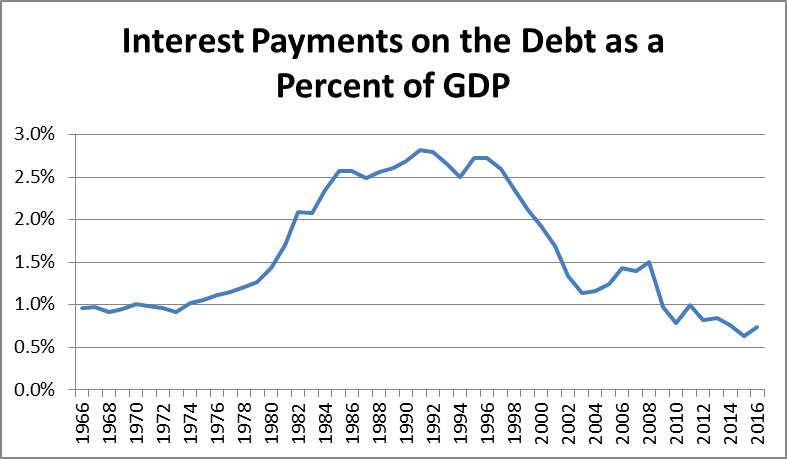
Interest Payments on the Debt as a Percent of GDP
Net interest rebated to the Treasury by the Fed (CEPR, 1/18/17)
This story makes even less sense than the crowding-out story. The burden of the debt is measured by the interest paid to bondholders, which is actually at a historically low level relative to GDP. It’s around 1.5 percent, after we subtract the interest rebated by the Fed to the Treasury. It had been over 3.0 percent of GDP in the early and mid-1990s.
And even this is not a generational burden. It is a payment within generations from taxpayers as a whole to the people who own bonds, who are disproportionately wealthy. Much of this money is recaptured with progressive income taxes. More could be captured with more progressive taxes.
But this is actually the less important issue with this sort of accounting. Direct government spending is only one way the government pays for things. It also provides patent and copyright monopolies to provide incentives for innovation and creative work. These are alternatives to direct government payments.
To be specific, if the government wants Pfizer to do research developing new drugs, it can pay the company $5–10 billion a year to do research developing new drugs. Alternatively, it can tell Pfizer that it will give it a patent monopoly on the drugs its develops, and arrest anyone who tries to compete with it.
Generally, the government takes the latter route with innovation. This can lead to a situation where Pfizer is charging prices that are tens of billions of dollars above the free market price. This monopoly price is equivalent to a privately imposed tax that the government has authorized the company to collect.
Anyone seriously interested in calculating the future burdens created by the government would have to include the rents from patent and copyright monopolies, which run into the hundreds of billions of dollars annually, and possibly more than $1 trillion. (They are close to $400 billion with prescription drugs alone.) The fact that the deficit hawks never mention the cost of patent and copyright monopolies shows their lack of seriousness. They are pushing propaganda, not serious analysis.
I got a taste of this propaganda effort firsthand earlier this year, when I was asked by an editor at the Washington Post to write a piece on Modern Monetary Theory (MMT). While I’m largely sympathetic to MMT (it’s essentially Keynesianism—that’s not an insult; the name is taken from a phrase in the Treatise on Money), I have some differences. In particular, I am not willing to give up having the Fed as a check on inflation.
I also think the proposal for a job guarantee is a very big lift. It is a good idea in principle, but one that must be moved towards gradually with smaller programs, like the one recently proposed by Sen. Chris Van Hollen. Jumping to a program that could add 20 to 30 million people to the government payroll strikes me as a recipe for disaster.
There are also Twitter MMTers who view it as meaning the government can spend whatever it wants on things like Green New Deal or Medicare for All. This is not a view that the leading promulgaters of MMT hold, but for some, this is what the theory means.
Anyhow, I was happy to make these points in a column in the Post, as I have done elsewhere. I went through a couple of rounds of edits, with the editor both times making the piece more critical. I decided to throw in the towel after round two. The editor wanted me to include a needlessly snide remark from a MMT critic, and had me referring to the theory as “dangerous.”
That comment left little doubt that they wanted a different column than the one I had written. MMT is dangerous? How much output has the austerity pushed by the Post’s regular contingent of commentators and reporters cost the country? More importantly, how many lives have been ruined by needless unemployment, and the resulting loss of income and poverty?
Seeing the needless hardship the country has endured because of austerity since the Great Recession, it really takes some nerve to refer to MMT as “dangerous.”
Anyhow, I suspect the Post’s editors are immune to criticism. Just like the millions who mindlessly pledge allegiance to Donald Trump, they will push the austerity line they have always pushed, regardless of the evidence.
But it is important to call out the Post’s austerity nonsense for what it is. This is not serious economics; it is a doctrine that imposes pain, with the only gain going to those who will get cheap help as a result of higher unemployment.

A version of this post originally appeared on CEPR’s blog Beat the Press (7/25/19). 
Messages can be sent to the Washington Post at letters@washpost.com, or via Twitter@washingtonpost. Please remember that respectful communication is the most effective. Feel free to leave a copy of your message in the comments thread of this post.


FAIR/Fairness & Accuracy In Reporting
124 W. 30th Street, Suite 201
New York NY 10001
USA


Wednesday, July 3, 2019

FOCUS: Robert Reich | Should We Abolish Billionaires?


Reader Supported News
02 July 19
It's Live on the HomePage Now:
Reader Supported News

FOCUS: Robert Reich | Should We Abolish Billionaires? 
Robert Reich. (photo: unknown)
Robert Reich, Robert Reich's Blog
Reich writes: "America now has more billionaires than at any time in history, while most Americans are struggling to make ends meet. With such staggering inequality, it's fair to ask: should we abolish billionaires?"
READ MORE

Update My Monthly Donation


Thursday, February 21, 2019

When India Tries to Regulate Amazon, US Media Qualms About Monopoly Disappear


FAIR

When India Tries to Regulate Amazon, US Media Qualms About Monopoly Disappear

view post on FAIR.org

by John C. O’Day
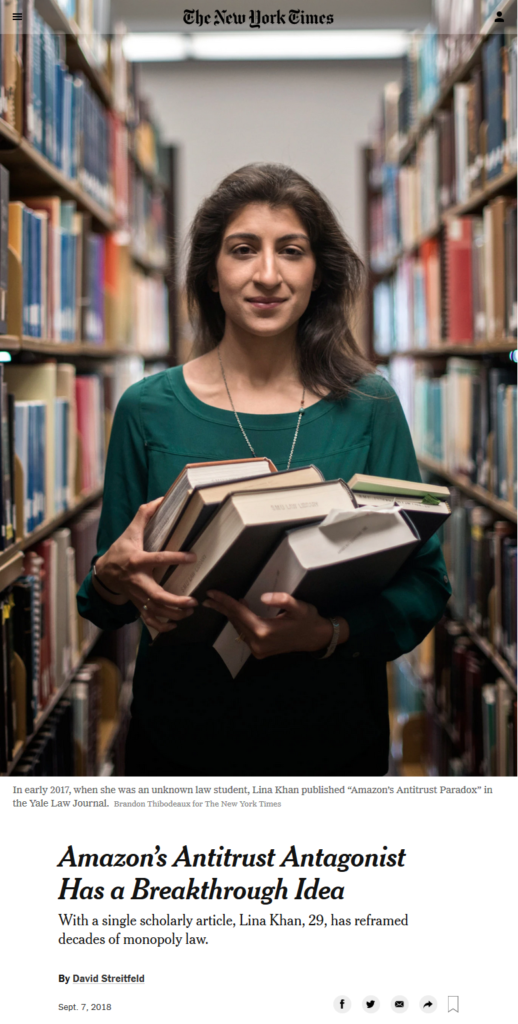
NYT: Amazon’s Antitrust Antagonist Has a Breakthrough Idea
The “breakthrough idea” heralded by the New York Times(9/7/18)–that antitrust should be about power, not just prices–was nowhere to be seen when US media reported on India’s attempt to regulate Amazon.
Last September, the New York Times (9/7/18) ran a remarkable profile on a law student who had, as the Times characterized it, “rocked the antitrust establishment” with a “runaway bestseller” essay in the Yale Law Journal (1/17). In her manuscript, Lina Khan called into question the prevailing approach to regulating retail monopolies, focusing on a potential offender that stands heads above the rest: Amazon.com, Inc.
Khan’s work and criticism of Amazon have been covered by corporate acolytes like CNBC (4/3/18), Bloomberg (7/9/18) and Forbes (1/28/19). Now an academic fellow at Columbia Law School, she argues that the current paradigm of gauging anticompetitive practices in the retail sector according to consumer welfare is “unequipped to capture the architecture of market power in the modern economy.”
“Because online platforms serve as critical intermediaries,” she writes, “integrating across business lines positions these platforms to control the essential infrastructure on which their rivals depend.”
Khan’s conclusion—that this new kind of monopoly calls for either aggressive regulation of marketplace competition, or classifying e-commerce giants as utilities and establishing checks on their power—prompted the Times’ celebrity treatment of her as a member of an emerging class of “antitrust foot soldiers,” fighting against a corporate titan that, in the paper’s own estimation, “overwhelmingly dominates online commerce.”
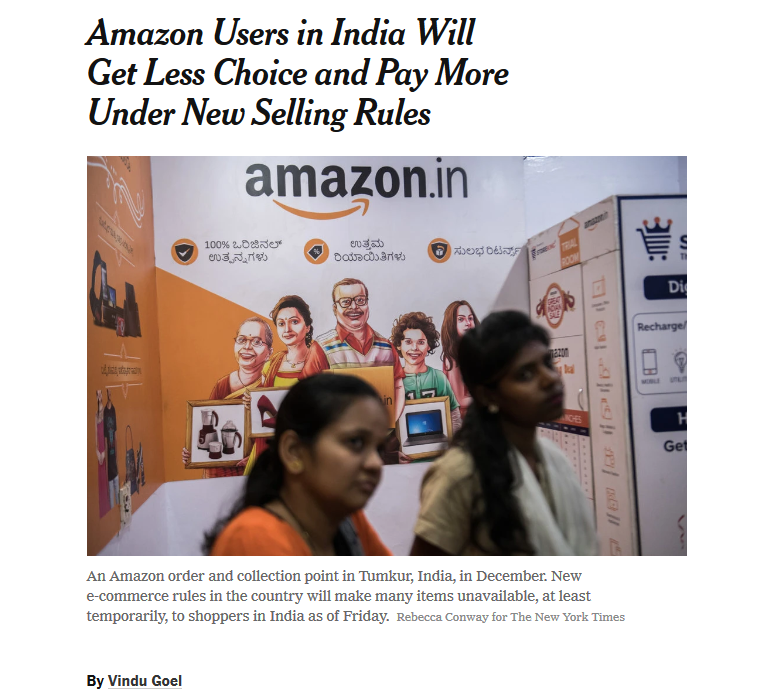
Now, as India enforces new regulations in an attempt to check the monopolistic reach of Amazon and other foreign online merchants there, the New York Times, along with most corporate media voices, sings a different tune. Having forgotten Khan’s argument that consumer welfare is a poor rubric for modern anticompetitive practices in an online marketplace, the Times (1/30/19) baldly stated that “Amazon Users in India Will Get Less Choice and Pay More Under New Selling Rules.”
Other media rang similar alarm bells. The Wall Street Journal (2/1/19) reported that products have been “yanked” from Amazon in India, which has plunged the market “into chaos,” according to Bloomberg (2/1/19). CNN (2/1/19) and CNBC (2/1/19) described the “huge threat” India now poses to Amazon and its rivals like Walmart, while The Verge (2/1/19) told readers that these corporate victims have already been “hit hard” by the new restrictions. Reuters (1/31/19) went so far as to portray India as a kind of giant spider that has “caught” unsuspecting flies like Amazon and Walmart in its vicious “web.”
So while commentators are at least beginning to worry about Amazon’s emerging monopoly here at home, this concern does not extend to countries like India, exposing the underlying neocolonial disposition of corporate media: Business practices that may be intolerable for the mother country should nonetheless be encouraged at the colonial periphery.

India’s complex investment history

NYT: Amazon Users in India Will Get Less Choice and Pay More Under New Selling Rules
The New York Times (1/30/19) leaves no doubt as to how it wants you to feel about India trying to regulate Amazon.
At issue is a modification of India’s Foreign Direct Investment (FDI) policy for e-commerce announced in December, which took effect on February 1. While allowing for 100 percent FDI in the marketplace-based model of e-commerce, in which the foreign entity merely acts as a facilitator between sellers and buyers (think eBay), India banned FDI in the inventory-based model, wherein the foreign entity sells its own products directly to consumers (think Walmart.com).
Because Amazon uses its hegemony to manipulate the market in favor of products in which it has a vested interest—the “architecture of market power” about which Khan cautioned—the Indian government, in response to complaints from industry associations, clarified its rules to prohibit the sale of products when the owner of the marketplace had “equity participation” or “control on its inventory.” The updated rules also require foreign entities like Amazon to provide their services “to vendors on the platform at arm’s length and in a fair and non-discriminatory manner.”
These events are just the latest chapter in a tumultuous history of regulating FDI since India’s independence. In 1947, after wrenching itself from nearly 200 years of British colonial subjugation, India had to balance its desperate need for capital investment in development with a well-earned skepticism about the intentions of foreign business.
The new indigenous government nationalized industries deemed critical to India’s strategic interests, such as the energy and military sectors. Niti Bhasin of the Delhi School of Economics wrote that “the prevailing mood in independent India was one of preserving and consolidating freedom, and not permitting once again any sort of foreign domination, political or economic.”
Over subsequent decades, India’s regulation of FDI in its economy fluctuated. Foreign participation was largely encouraged across economic sectors, though the government informally prodded companies to include local equity in their investments. In the late 1960s and early ’70s, however, India codified these equity requirements and began to crack down on monopolistic behavior, leading to an exodus of large multinational corporations from the Indian marketplace—including, famously, the departure of Coca-Cola in 1977.
These strict regulations on FDI were gradually relaxed over time until the Indian economy underwent a radical transformation in the 1990s, when “pressure of the IMF and World Bank to liberalize the Indian economy forced the government to accelerate the pace of liberalization,” according to Amar K.J.R. Nayak of the Xavier Institute of Management, Bhubaneswar. Coca-Cola, which re-entered India in 1993, now controls the largest share of the soft drink market there, including ownership of Thums Up, the indigenous cola brand that took Coke’s place 40 years ago when the US-based soda abandoned ship.
Hardly an anti-capitalist, Narendra Modi, the current prime minister of India, could be seen as the culmination of this more recent history. After coming to power in 2014 with the promise of continued economic liberalization, the Modi government last January instituted automatic approval for 100 percent FDI in aviation and construction, as well as single-brand retail, and is looking to do the same for theinsurance industry.
Although understanding India’s unique historical struggle to secure its political and economic sovereignty is essential to comprehending the dynamics of the present standoff, corporate media chose instead to paint a picture for readers using more familiar—but fundamentally erroneous—analogies to a Western context.

Equivocating on ‘brick and mortar’

Whenever abuses by monopolies become so egregious as to provoke popular resistance, corporate media’s shallow coverage tends to cast aside the real story in favor of a staged battle royale between moguls (FAIR.org, 8/18/17). A similar trend emerged once again as India’s position on FDI in e-commerce evolved.
Rather than forefront the concerns of India’s myriad independent retailers about the potentially devastating effect of foreign-controlled e-commerce on their livelihoods, Reuters (1/24/19) led the story as a geopolitical “tussle,” “the latest in a number of US protests over Indian government policies which impact American companies.” Fortune (1/5/19) spun a heartwarming tale of erstwhile rivals “teaming up” to fight the uppity Indian government. “It isn’t all bad for Amazon and Walmart,” they reassured readers, as there may yet be hope for finding loopholes in the new restrictions.
More common was an effort to reduce the “tussle” to a competition between US billionaires Jeff Bezos and the Walton family, on the one hand, and Indian billionaires like Mukesh Ambani, owner of Mumbai-based Reliance Industries, on the other. Bloomberg (7/5/18), the Telegraph (1/18/19) and Quartz(1/29/19) each ran profiles on Ambani in the context of India’s new FDI rules, with the latter extolling that “Reliance could not have found a better time to launch its e-commerce business.”
The New York Times (4/7/16) has explained to its readers that, “as in the United States, in India brick-and-mortar retailers have expressed alarm at the growth of e-commerce.” While for an American audience, this depiction may conjure up memories of Amazon winning out over legacy retail corporations like Barnes & Noble, in India nothing could be further from reality.
According to the Indian government’s Department of Commerce, in 2017 e-commerce represented 3 percent of India’s overall retail economy, while “organized retail,” its term for large firms, including corporate brick-and-mortar establishments akin to Barnes and Noble, took up another 9 percent. In other words, a whopping 88 percent of retail commerce in India is conducted in so-called “mom and pop” stores, the likes of which are little more than a distant memory in the United States.
The “unorganized” or “traditional” retail sector in India is defined as “unincorporated private enterprises owned by individuals or households…with less than ten total workers.” By comparison, according to the latest available US Census data, American firms with fewer than ten workers amount to just 10 percent of total retail receipts, almost the exact opposite of India.
While Mukesh Ambani certainly has a large stake in the future of Indian e-commerce, his business dwells in that meager 12 percent slice of India’s overall retail marketplace. Meanwhile, tens of millions of working Indians see their livelihoods hanging in the balance.
Recalling the decimation of American mom-and-pop shops would arouse sympathy among a US audience but, sadly, erasing the plight of ordinary Indians isn’t the only diversionary tactic that corporate media have employed to spin this story.

Universalizing Trumpism

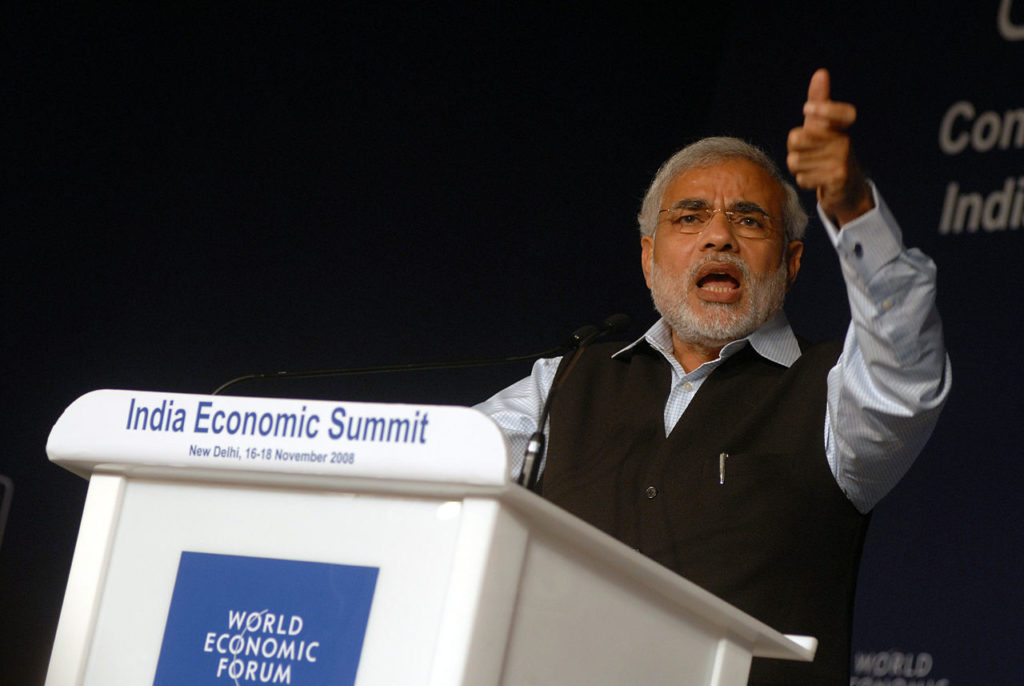
Narendra Modi (cc photo: World Economic Forum/Norbert Schiller)
Narendra Modi, who is pushing forward with regulations on foreign e-commerce, has been the subject of serious criticism, both within his country and abroad. Many hold him at least indirectly responsible for pogroms that killed upwards of 2,000 people while he was chief minister of the Indian state of Gujarat, and his tenure as PM has also seen considerable controversy.
Despite hailing from western India, Modi symbolically contested for his seat in parliament from the ancient holy city of Varanasi, sweeping his Bharatiya Janata Party (Indian People’s Party) into control on a platform of Hindutva nationalism, atop what the local press coined as a “Modi wave.” Since the 2014 national election, lynchings by right-wing “cow vigilantes” have increased , while some journalists and scholars have warned of new threats to freedom of speech there.
At the time of his ascension, Modi was described as “a corporate candidate” by Arundhati Roy, who saw the election as a contest deciding “which corporation will come to power.” Vijay Prashad, a historian at American University of Beirut, called Modi’s candidacy the “worst of all worlds” for exploiting sectarianism and anti-incumbency to advance a neoliberal economic agenda that would make even the Clintons blush (Common Dreams, 5/16/14).
Grasping as usual for the simplest possible narrative, however, Western corporate media have been content to style Modi as the Indian counterpart to a more fashionable villain, US President Donald Trump. The New York Times (10/16/16), New Yorker (1/18/17) and Atlantic (12/26/18), for example, have linked Modi and Trump as fellow “strong men” who employ “anti-bureaucracy and country-first language” to rile up their constituencies.
Albeit accurate with regard to certain rhetorical strategies, it is hard to see what relevance Trump’s political likeness to Modi bears on the Indian president’s position toward Amazon’s potential takeover of his country’s online marketplace. After all, as Reuters reported, Trump’s State Department and Office of the United States Trade Representative coordinated a lobbying effort against the new rules.
In other words, Modi’s decision to restrict FDI in inventory-based e-commerce, despite his more general openness to economic liberalization, and Trump’s support of US firms, despite his earlier threats to trust-bust Amazon, together represent a break from the very narratives corporate media are nevertheless injecting into the story.
That conceptual incongruity did not stop Bloomberg (2/4/19) from analyzing the matter in terms of Trumpism. “In India, populist fervor and fear is also working against Amazon,” they wrote, as Modi-qua-Trump “seems bent on appeasing millions of mom-and-pop store owners who make up a powerful voting block.” Euronews (1/25/19) similarly used Modi’s association with right-wing groups in a veiled attempt to discredit India’s resistance to Western economic imperialism.
With Amazon haunted by the threat of a leader “bent on appeasing” the vast majority of his country’s retail businesses in the face of potential corporate annihilation, it is little surprise that Jeff Bezos’ personal newspaper syndicated Bloomberg’s story (Washington Post, 2/4/19). As Adam Johnson documented, more broadly, US outlets lap up opportunities to render Bezos and his company in a flattering light (FAIR.org, 7/28/17). In this case, the alignment of Modi with Trump is the spoonful of sugar that helps corporate media’s Amazon apologetics go down.

Neocolonial legacies

As novel as Lina Khan’s approach to e-commerce monopolies may be, the phenomenon of US corporations taking control of “the essential infrastructure on which their rivals depend” is certainly not new, and it is a story with which India is all too familiar.
Throughout the 1950s and ’60s, Indian agriculture underwent a radical transformation as part of what is popularly called “The Green Revolution,” led by the US government, the World Bank, and the Ford and Rockefeller foundations. While the figurehead of the project, Norman Borlaug, was eventually awarded the Nobel Peace Prize for his “miracle seeds” in 1970, not everyone views the aftermath of revolutionizing India’s largest economic sector as a miracle.
The environmentalist and scholar Vandana Shiva argues that the program hoisted onto India shifted its agricultural system from “an indigenous and ecological model to an exogenous and high-input one,” by introducing crop varieties and methods developed in partnership with US corporations that relied on pesticides and fertilizers produced by those same corporations to thrive. In Shiva’s view, this new dynamic “brought violence instead of peace, dependence instead of self-reliance and autonomy.”
Writing in 1991, at the dawn of India’s rapid economic liberalization, Shiva warned of further corporate encroachment into its indigenous industries. “We can draw some lessons from history about how technological change initiated by a special interest brings development to that interest group while creating underdevelopment for others,” she reflected.
Modi likely has history on his mind as he assesses another potential foreign-sponsored revolution of his country’s economy. As Shiva foretold, India’s agricultural industry is still plagued by political and economic strife and, notwithstanding his “populism,” ongoing discontent among farmers may well be Modi’s political undoing in the upcoming national election this year.
United with Trump against sovereignty
Khan, acting in the “antitrust foot soldier” capacity acclaimed by the New York Times, weighed in on their coverage of the new e-commerce FDI rules taking force in India. “Interestingly, @nytimesdescribes India’s rule as ‘protectionism,’” she wrote on Twitter, highlighting corporate media’s tendency to lump Modi in with universal Trumpism. “But this sort of structural separation has been a key principle in US competition policy. For example, Congress in 1906 passed a law prohibiting railroads from transporting goods they owned,” she noted.
Despite their openness to a new conceptualization of antitrust that is responsive to the dynamics of modern industry in the United States, corporate media are aghast at the implementation of such an approach to forestall US monopolies in another country like India. And despite adopting a banner of vanguard resistance against Trumpism, corporate media position themselves alongside Trump in his effort to undermine India’s economic sovereignty.
The only way to explain these inconsistencies is to acknowledge the latent neocolonial attitude that governs corporate media’s treatment of familiar issues whenever they cross the US border. The potential consumers in corporate media understand the damage already wrought by retail monopolies here, as well as the risks posed by Amazon’s dominance of the online market. Nevertheless, as potential shareholders, they are eager to see Amazon tap that heretofore unexploited 88 percent of India’s retail economy (CNBC1/31/19).
What corporate media find at least questionable for the homeland, they nonetheless encourage in the colonial periphery, because Indian wealth is meant to be extracted by the West.
No one yet knows what the future will hold for India’s online retail economy, or the US corporations salivating at the chance to take a bite out of it, but it should go without saying that this future is India’s to decide for itself. US media need to quit the role of corporate cheerleader for once and leave Indians to it.


FAIR/Fairness & Accuracy In Reporting
124 W. 30th Street, Suite 201
New York NY 10001
USA