Kerry Misses the Keystone Point
By William Boardman, Reader Supported News
12 February 13

he same day that U.S. Secretary of State John
Kerry was promising a "fair and transparent" review of the Keystone XL oil pipeline from
Alberta, Canada, to the Texas Gulf Coast, the CEO of the company building that pipeline,
TransCanada's Russ Girling, was reported as saying that his company's "Plan A" was finishing a different pipeline that would take the same tar sands oil to Canada's east coast.
TransCanada's plan to establish a pipeline to the Atlantic coast has received little attention since CEO Girling's February 6
interview on Bloomberg Television and Bloomberg's later
report:
"Canada's second-largest pipeline company proposes to ship oil 3,000 miles (4,825 kilometers) to the Atlantic Coast, allowing producers to send it by tanker to the Gulf, Girling said yesterday in an interview at Bloomberg's New York headquarters.
"While he expects U.S. passage of Keystone 'very soon,' the East Coast route makes sense in any event because of rising production from Alberta, Girling said."
TransCanada presently has about $22 billion worth of pipeline
projects underway, of which Keystone XL represents about a third of the total. Asked if an East Coast pipeline was a fallback plan in case Keystone is blocked, Girling said: "It's not a Plan B, it's a Plan A, and it will go if the market supports it, along with Keystone…. Once you get on tidewater, you can get anywhere, and you don't need a presidential permit to bring oil into the Gulf Coast."
That the head of a pipeline company is more interested in getting tar sands oil to market than he is in what it may cause after that is perhaps not surprising. Girling isn't a climate change denier, he just sees change taking decades, during which TransCanada will try to make the transition to non-fossil fuels, which is why the company built three large wind farms in 2011.
Keystone Needs Presidential Permission to Proceed
But there may not be decades, there may be no time at all, according to a long National Journal story on February 7 with the headline: "The Scary Truth About How Much Climate Change Is Costing You" – costing you now, the sub-head emphasizes: "While policymakers fiddle, the threat of economic harm posed by rising sea levels, devastating storms, and drought is growing every day."
On January 22,
Greenpeace released a 60-page report called "Point of No Return," dealing with "massive climate threats we must avoid," while giving little reason to think we will avoid them:
"The world is quickly reaching a Point of No Return for preventing the worst impacts of climate change.
"With total disregard for this unfolding global disaster, the fossil fuel industry is planning 14 massive coal, oil and gas projects that would produce as much new carbon dioxide (CO2) emissions in 2020 as the entire US, and delay action on climate change for more than a decade.
"Continuing on the current course will make it difficult – if not impossible – to prevent the widespread and catastrophic impacts of climate change…."
In the United States,
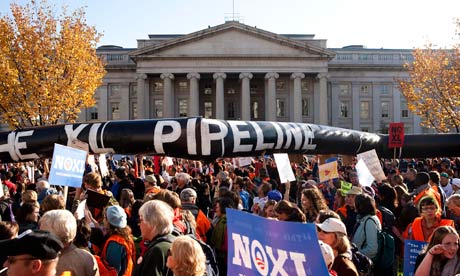
pressure is building for the president (or the secretary of state) to deny a permit to Keystone. That demand is at the heart of plans for "the largest climate rally in history" on the Mall in Washington February 17, sponsored by the
Sierra Club,
350.org, and the Hip-Hop Caucus. The promoters of the event assert:
"The first step to putting our country on the path to addressing the climate crisis is for President
Obama to reject the Keystone XL
tar sands pipeline. His legacy as president will rest squarely on his response, resolve, and leadership in solving the climate crisis."
Making much the same
argument with much greater detail on February 10 on
TomDispatch.com, Hampshire College professor Michael Klare analyzes three possible pipeline routes that would enable Alberta tar sands oil to reach world markets. The first is
Keystone, first proposed in 2008, which is still at least two years from being operational. The other two go in opposite directions --
west, where resistance is already high, and
east, where a substantial amount of pipeline is already in place. Klare analyzes each alternative in detail, arguing that:
"… the only pipeline now under development that would significantly expand Albertan tar-sands exports is Keystone XL. It is vitally important to the tar-sands producers because it offers the sole short-term - or possibly even long-term - option for the export and sale of the crude output now coming on line at dozens of projects being developed across northern Alberta.
"Without it, these projects will languish and Albertan production will have to be sold at a deep discount - at, that is, a per-barrel price that could fall below production costs, making further investment in tar sands unattractive. In January, Canadian tar-sands oil was already selling for $30-$40 less than West Texas Intermediate (WTI), the standard U.S. blend."
But Klare does not consider the different route to the Atlantic proposed by Girling, a route that could be entirely within Canada, ending at St. John, New Brunswick.
It's Not About Pipelines, It's About Tar Sands Oil
The shadow play aspects of the public posturing around the Keystone pipeline make it difficult to focus on the underlying reality that matters most: whether exploiting tar sands, not only in Canada, but in the U.S. and other countries, really will mean "game over for the climate," as
NASA scientist James
Hansen has said. The heart of his argument, as it appeared in the New York
Times, was simple:
"GLOBAL warming isn't a prediction. It is happening. That is why I was so troubled to read a recent interview with President Obama in Rolling Stone in which he said that Canada would exploit the oil in its vast tar sands reserves 'regardless of what we do.'
"If Canada proceeds, and we do nothing, it will be game over for the climate."
The game, in other words, is not about pipelines, it's about tar sands oil. And even though cancellation of the Keystone pipeline would not be a game-changer, such cancellation would be a powerful symbol that leaves open the possibility of changing the game. And it would be a signal that there is at least some political will to change the game.
The Canadian government under Stephen Harper has been
pushing hard for the Keystone pipeline, lobbying the Obama administration and responding to unsympathetic media reports in the U.S. At the same time, Canadian resistance to pipelines in both the
east and
west has grown increasingly intense, especially among the more than 630
First Nations governments of Canada's native people whose land would be directly affected.
Media Coverage Omits More Than It Says
When Sec. Kerry promises a "fair and transparent" review of Keystone, and media from
ABC News to the Washington
Post to Huffington
Post report the story with the same wire service account from AP, there's not a lot of reporting going on. Sec. Kerry's comments are value-free and allow for a possible approval, especially in the context of his "great respect" for the needs of Canada's energy industry.
What AP and those who carried the report left out included Sec. Kerry's significant oil industry holdings, which create an obvious conflict of interest, although as someone who was the
richest U.S. Senator till recently (net worth about $240 million, compared to Jay Rockefeller's $98 million), his oil holdings may not represent that great a conflict. And Sec. Kerry was "a steadfast
proponent of taking action on climate during his tenure as a
senator," according to
Reuters.
The widely distributed AP report all but dismisses "climate change," using the phrase only in the context of suggesting that the pipeline would be "a source of much-needed jobs," which
it's not, and "a step toward North American energy independence," which
it's not.
Sec. Kerry's remarks fit a context in which the State Department carries out its evaluation and approves the pipeline, giving cover for President Obama to approve it, too, since the evaluation was "fair and transparent," or will be reliably reported that way. But Sec. Kerry also mentioned "accountability" in passing, without saying (or being asked) just what that could possibly mean. If James Hansen is right, and the climate is destroyed by tar sands oil, how will anyone in the future be able to hold a long-dead multi-millionaire accountable for his lost seriousness?
Alternatively, with the boom of "light sweet oil" coming out of Texas and North Dakota, oil that is much preferable to the "heavy sour crude" from Alberta, the president may have a practical way of sidestepping Keystone approval as no longer very useful to the United States (if it ever really was).
Disruptions Continue Along Keystone Southern Leg
The active
protest and
political theatre front in recent months has been along the TransCanada Keystone Gulf Coast section in Texas and Oklahoma, where early in the morning of February 11 in Schoolton, Oklahoma, a youth pastor, Stefan Warner, chained himself to construction machinery high above a local waterway, the North Canadian River.
"I grew up in a town where the North Canadian River runs right through, and we can't let the North Canadian become another Kalamazoo," Warner said, referring to the Kalamazoo River in Michigan.
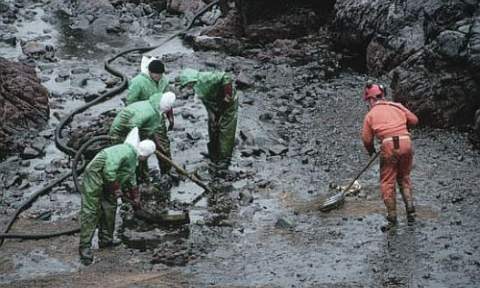
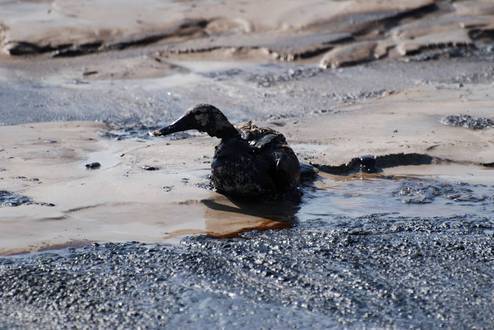
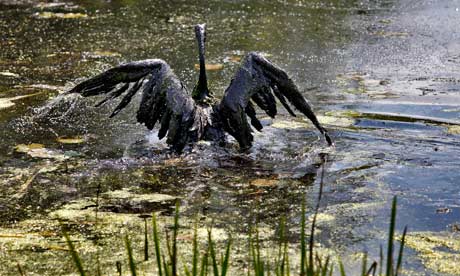
Another giant pipeline company, Enbridge Energy, had one of its pipelines
rupture there in July 2010, dumping about 900,000 gallons of toxic tar sands crude oil into the river, where the clean-up is now in its
third year.
Warner acted with other members of the
Great Plains Tar Sands Resistance, a new group that recently organized to resist the Keystone pipeline. The Great Plains web site reported the end of the action this way:
8:00AM: Direct Support for Stefan has been arrested without warning and placed in police car. Six other people on site being detained currently.
9:00AM: All Six people detained now arrested. Seven police vehicles on scene. Workers have lowered side-boom in disregard of Stefan's safety and OSHA regulations, Stefan still locked to machinery but lying painfully face-down on the lowered arm. Police obscuring Stefan from view and not allowing anyone within photographing distance.
9:15AM: Another individual arrested. This person was not initially detained but was prevented from accessing her vehicle since 8am. Stefan still holding strong….
1:00PM Earlier today, Stefan was extracted. To our knowledge, Stefan sustained no serious injuries and seems to be alright.
This action is similar to protests mounted over the past five months by the
Tar Sands Blockade, who started their
resistance in September 2012 when they set up a tree house blockade across the right of way along which TransCanada was constructing its pipeline. TranCanada skipped a section of construction to avoid the tree houses and also took members of the group to court. That action that was
settled January 25, when 19 people, also acting on behalf of 6 Jan and John Does and three organizations, agreed to a permanent injunction against interfering with Keystone people, property, or progress.
Defeating Keystone – A Victory with No Winners?
It would certainly look like a victory for environmentalists if the president denied Keystone a permit, and a low political cost would allow the political class to bask in undeserved credit – a symbolic triumph. And, at worst, an opportunity to enjoy the
illusion that something meaningful was accomplished.
But the problem of tar sands oil would be fundamentally unchanged. It would remain an underexploited asset that Canadians are eager to tap. The demand from Asian markets would continue to grow. Canada would continue to face the irrationality of importing half the oil it uses while exporting two thirds of the oil it produces. The pipeline struggle would become an all-Canada affair.
A lively and slightly hysterical imagination might envision an American war with Canada, not so much to keep tar sands oil in the ground to save the climate, but to keep the Canadians from selling it to the Chinese. More likely, the United States will revert to its traditionally torpid contemplation of planetary threat, the climate will continue to warm, and soon Alberta can have a pipeline to the north, since the Arctic Ocean is open year-round.
Huge Climate Change Rally Targets Keystone XL Pipeline
The environmental organizations
Sierra Club and 350.org, along with about 120 partner organizations are planning "the largest climate-related
rally in U.S. history" on Sunday in front of the White House. The goal of the rally, according to a
post by the
Sierra Club, is to demand that
President Barack Obama move forward on climate measures including rejecting
the Keystone XL pipeline, phasing out
fossil fuels and promoting
energy efficiency and clean-energy sources. Here are the details.
* The groups are planning to have tens of thousands of participants at the rally and have been working to organize carpools, buses and van rides, as well as phonebanks and social media campaigns.
* According to Michael Marx, Sierra Club's Senior Campaign Director of its Beyond Oil Campaign, the first steps that the groups are demanding that Obama take are finalizing strong carbon pollution standards for power plants and rejecting the Keystone XL pipeline.
* On a website for the rally, titled
Forward on Climate , organizers report that
climate change "means more severe storms, floods, and droughts, and increased illness -- and death -- from more severe heat waves and pollution."
* The website states that 40 percent of total U.S. emissions come from power plants and that fossil fuel corporations should be held responsible for their pollution.
* The organizers are calling for a halt in the expansion of fossil fuel exports, including liquefied natural gas export facilities, new coal export terminals and increased oil exports.
* May Boeve of 350.org
wrote last week that Superstorm Sandy was a "tragic sneak preview of climate change" but that climate change has slipped off the political radar.
* "That's why it's so important that we make this the biggest action we've ever had," Boeve wrote. "As a movement, we have the opportunity to move the President from words to action on the greatest challenge of our time, starting with the Keystone XL tar sands pipeline."
* In addition to co-sponsoring the rally, 350.org is also currently sponsoring an
open letter to the president asking him to end his "all of the above" energy policy.
* "Your support for fracking and drilling, coal mines and pipelines, continues to obliterate the progress you could be making with your administration's gas mileage rule, or your investments in renewable energy," the letter reads. "Even if you finally issue a carbon pollution rule that addresses existing sources of pollution, it will mean nothing if you are simultaneously lighting the fuses on carbon bombs by approving the Keystone XL pipeline, Arctic drilling, or fossil fuel export projects."
* Currently, the letter is nearing its goal of 70,000 signatures, according to the organization's website.
Is this the route?