Exclusive: House Republicans got next to nothing from their extortion strategy of taking the government and the economy hostage, but they are sure to continue obstructing programs that could create jobs and start rebuilding the middle class. What they won’t recognize is the abject failure of Reaganomics, writes Robert Parry.
By Robert Parry
Even as the Republican Right licks its wounds after taking a public-opinion beating over its government shutdown and threatened credit default, the Tea Partiers keep promoting a false narrative on why the U.S. debt has ballooned and why the economy struggles, a storyline that will surely influence the next phase of this American political crisis.
If a large segment of the American public continues to buy into the Tea Party’s fake reality, then it is likely that both the political damage and the economic decline will continue apace, with fewer good-paying jobs, a shrinking middle class and more of the bitter alienation that has fed the Tea Party’s growth in the first place. In other words, the United States will remain in a vicious circle that is also a downward spiral.

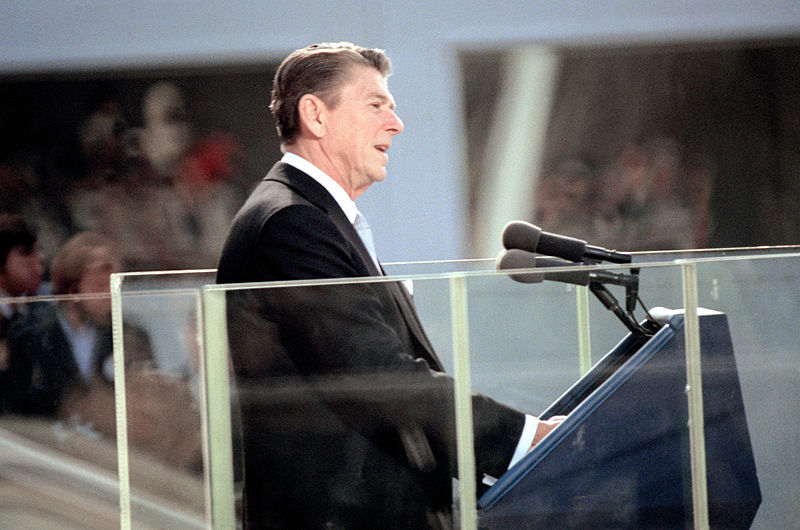
President Ronald Reagan, delivering his Inaugural Address on Jan. 20, 1981.
The pattern can only be reversed if American voters come to understand how and why their economic well-being is getting flushed down the drain.
The first point to understand is that the current $16.7 trillion federal debt is about $11 trillion more than it was when George W. Bush took office. Not only did Bush’s tax-cut-and-war-spending policies send the debt soaring over the next dozen years but it was those policies that eliminated the federal surpluses of Bill Clinton’s final years and reversed a downward trend in the debt that had “threatened” to eliminate the debt
entirely over the ensuing decade.
Amazingly, President Clinton left office in January 2001 with the federal budget in the black by $236 billion and with a projected 10-year budget surplus of $5.6 trillion. The budgetary trend lines were such that Federal Reserve Chairman Alan Greenspan began to fret about the challenges the Fed might face in influencing interest rates if the entire U.S. government debt were paid off, thus leaving no debt obligations to sell.
Thus, Greenspan, an Ayn Rand acolyte who was first appointed by Ronald Reagan, threw his considerable prestige behind George W. Bush’s plan for massive tax cuts that would primarily benefit the wealthy. In that way, Bush and the Republicans “solved” the “problem” of completely paying off the federal debt.
When Bush left office in January 2009 – amid a meltdown of an under-regulated Wall Street – there was no more talk about a debt-free government. Indeed, the debt had soared to
$10.6 trillion and was trending rapidly higher as the government scrambled to avert a financial catastrophe that could have brought on another Great Depression.
Reaganomics’ Failure
But this debt crisis did not originate with George W. Bush. It can be traced back primarily to President Reagan, who arrived in the White House in 1981 with fanciful notions about restoring America’s economic vitality through massive tax cuts for the wealthy, a strategy called “supply-side” by its admirers and “trickle-down” by its critics.
Reagan’s tax cuts brought a rapid ballooning of the federal debt, which was
$934 billion in January 1981 when Reagan took office. When he departed in January 1989, the debt had jumped to
$2.7 trillion, a three-fold increase. And the consequences of Reagan’s reckless tax-cutting continued to build under his successor, George H.W. Bush, who left office in January 1993 with a national debt of
$4.2 trillion, more than a four-fold increase since the arrival of Republican-dominated governance in 1981.
During 1993, Clinton’s first year in office, the new Democratic administration pushed through tax increases, partially reversing the massive tax cuts implemented under Reagan. Finally, the debt problem began to stabilize, with the total debt at
$5.7 trillion and heading downward, when Clinton left office in January 2001.
Indeed, at the time of Clinton’s departure, the projected ten-year surplus of $5.6 trillion meant that virtually the entire federal debt would be retired. That was what Fed Chairman Greenspan found worrisome enough to support George W. Bush’s new round of tax cuts aimed primarily at the wealthy, another dose of Reagan’s “supply-side.”
The consequences – especially when combined with Bush’s decision to rush into two major wars without paying for them – proved disastrous. The federal debt resumed its upward climb. By August 2008, just before the Wall Street crash, the debt was over $9.6 trillion, nearly a $4 trillion jump since Bush took office.
And, after the Wall Street collapse in September 2008, the federal government had little choice but to increase its borrowing even more to avert a global economic catastrophe potentially worse than the Great Depression. By January 2009, just five months later, the debt was
$10.6 trillion, a $1 trillion increase and counting.
Many of the Republican leaders who stomped their feet during the recent budget showdown, including House Speaker John Boehner, R-Ohio, were among those who favored the Bush tax cuts, the costly invasion of Iraq and bank deregulation. In other words, they were denouncing President Obama for a debt crisis that they helped create.
But the record of reckless Republican budget policies from Reagan through Bush-43 was not only destructive to the fiscal health of the government. The “supply-side,” “free-trade” and deregulatory strategies – including some facilitated by the Clinton administration – proved devastating to the nation’s ability to create good-paying jobs and to sustain the Great American Middle Class.
Zero Job Growth
During the decade of George W. Bush’s presidency, the United States experienced
zero job growth.
And zero is actually worse than it sounds since none of the preceding six decades registered job growth of less than 20 percent.
By comparison, the 1970s, which are often bemoaned as a time of economic stagflation and political malaise, registered a 27 percent increase in jobs. Yet, in part because of that relatively slow rise in jobs – down from 31 percent in the 1960s – American voters turned to Ronald Reagan and his radical economic theories of tax cuts, global “free markets” and deregulation.
Reagan sold Americans on his core vision: “Government is not the solution to our problem; government is the problem.” Through his personal magnetism, Reagan then turned taxes into a third rail of American politics. He convinced many voters that the government’s only important roles were funding the military and cutting taxes.
Yet, instead of guiding the country into a bright new day of economic vitality, Reagan’s approach accelerated a de-industrialization of the United States and a slump in the growth of American jobs, down to 20 percent during the 1980s. The percentage job increase for the 1990s stayed at 20 percent, although job growth did pick up later in the decade under President Clinton, who raised taxes and moderated some of Reagan’s approaches while still pushing “free trade” agreements and deregulation.
Yet, hard-line Reaganomics returned with a vengeance under George W. Bush – more tax cuts, more faith in “free trade,” more deregulation – and the Great American Job Engine finally started grinding to a halt. Zero percent increase. The Great American Middle Class was on life-support.
Ignoring Reality
Despite these painful statistics of the past three decades, Reaganomics has remained a powerful force in American political life. Anyone tuning in CNBC or picking up the Wall Street Journal would think that these economic policies had enjoyed unqualified success for everyone, rather than being a dismal failure for all but the richest Americans. The facts were especially stark for the 2000s, the so-called “Aughts” or perhaps more accurately the “Naughts.”
“For most of the past 70 years, the U.S. economy has grown at a steady clip, generating perpetually higher incomes and wealth for American households,” wrote the Washington Post’s Neil Irwin in
a Jan. 2, 2010, review of comparative economic data. “But since 2000, the story is starkly different.”
As the Post article and its accompanying graphs showed, the last decade’s sad story wasn’t just limited to the abysmal job numbers. U.S. economic output slowed to its worst pace since the 1930s, rising only 17.8 percent in the 2000s, less than half the 38.1 percent increase in the despised 1970s.
Household net worth
declined 4 percent in the last decade, compared to a 28 percent rise in the 1970s. (All figures were adjusted for inflation.)
Despite this record of economic failure from Bush’s reprise of Reaganomics – trillions more in government debt but no net increase in jobs or household wealth in the last decade – many Americans appear to have learned no lessons from either the Bush-43 presidency or Reagan’s destructive legacy.
Any thought of raising taxes or investing in a stronger domestic infrastructure remains anathema to significant segments of the population still enthralled by the Tea Party.
Indeed, across the mainstream U.S. news media, it is hard to find any serious – or sustained – criticism of the Reagan/Bush economic theories. More generally, there is headshaking about the size of the debt and talk about the need to slash “entitlement” programs like Social Security and Medicare.
Instead of paying heed to the real lessons of the past three decades, many Americans are trapped in the Reagan/Tea Party narrative and thus repeating the same mistakes.
‘Voodoo Economics’
The U.S. political/media process seems resistant to the one of most obvious lessons of the past three decades: Simply put, Reaganomics didn’t work. As George H.W. Bush once commented – when he was running against Reagan in the 1980 primaries – it is “voodoo economics.”
Yet, the fact that the United States has embraced “voodoo economics” for much of the past three-plus decades and refuses to recognize the statistical evidence of Reaganomics’ abject failure suggests that the larger lesson of this era is that the U.S. political process is dysfunctional, a point driven home by the recent Tea Party-led government shutdown and threatened debt default.
In the decades that followed Reagan’s 1980 election, the Right has invested ever more heavily in media outlets, think tanks and attack groups that, collectively, changed the American political landscape. Because of Reagan’s sweeping tax cuts favoring the rich, right-wing billionaires, like the Koch Brothers and Richard Mellon Scaife, also had much more money to reinvest in the political/media process, including funding the faux-populist Tea Party.
That advantage was further exaggerated by the Left’s parallel failure to invest in its own media at anything close to the Right’s tens of billions of dollars. Thus, the Right’s outreach to average Americans has won over millions of middle-class voters to the Republican banner, even as the GOP enacted policies that devastated the middle class and concentrated the nation’s wealth at the top.
So, even as American workers struggled in the face of globalization and suffered under GOP hostility toward unions, the Right convinced many middle-class whites, in particular, that their real enemy was “big guv-mint.”
Though Obama won the presidency in 2008, the Republicans didn’t change their long-running strategy of using their media assets to portray the Democrats as un-American. The Right waged a relentless assault on Obama’s legitimacy (spreading rumors that he was born in Kenya, he was a secret socialist, he was a Muslim, etc.) while a solid wall of Republican opposition greeted his plans for addressing the national economic crisis that he inherited.
The Rise of the Tea Party
Like previous Democrats, Obama initially responded by offering olive branches across the aisle, but again and again, they were slapped down. In mid-2009, Obama wasted valuable time trying to woo supposed Republican “moderates” like Sen. Olympia Snowe of Maine to support health-care reform.
Meanwhile, Republicans filibustered endlessly in the Senate and whipped their right-wing “base” into angrier and angrier mobs.
Initially, the GOP strategy proved successful, as Republicans pummeled Democrats for increasing the debt with a $787 billion stimulus package to stanch the economic bleeding. The continued loss of jobs enabled the Republicans to paint the stimulus as a “failure.” There was also Obama’s confusing health-care law that pleased neither the Right nor the Left.
The foul mood of the nation translated into an angry Tea Party movement and Republican victories in the House and in many statehouses around the country. Gradually, however, a stabilized financial structure and a slow-healing economy began to generate jobs, albeit often with lower pay.
Obama could boast about sufficient progress to justify his reelection in 2012, with most voters also favoring Democrats for the Senate and the House. However, aggressive Republican gerrymandering of congressional districts helped the GOP retain a slim majority in the House despite losing the popular vote by around 1½ million ballots.
But the just-finished budget/debt showdown has shown that the Tea Party’s fight over America’s political/economic future is far from over. Through its ideological media and think tanks, the Right continues to hammer home the Reagan-esque theory that “government is the problem.”
Meanwhile, the Left still lacks comparable media resources to remind U.S. voters that it was the federal government that essentially created the Great American Middle Class – from the New Deal policies of the 1930s through other reforms of the 1940s, 1950s and 1960s, from Social Security to Wall Street regulation to labor rights to the GI Bill to the Interstate Highway System to the space program’s technological advances to Medicare and Medicaid to the minimum wage to civil rights.
Many Americans don’t like to admit it — they prefer to think of their families as reaching the middle class without government help — but the reality is that the Great American Middle Class was a phenomenon made possible by the intervention of the federal government beginning with Franklin Roosevelt and continuing into the 1970s. [For one telling example of this reality -- the Cheney family, which was lifted out of poverty by FDR's policies -- see Consortiumnews.com's "
Dick Cheney: Son of the New Deal."]
Further, in the face of corporate globalization and business technology, two other forces making the middle-class work force increasingly obsolete, the only hope for a revival of the Great American Middle Class is for the government to increase taxes on the rich, the ones who have gained the most from cheap foreign labor and advances in computer technology, in order to fund projects to build and strengthen the nation, from infrastructure to education to research and development to care for the sick and elderly to environmental protections.
In other words, the only strategy that makes sense for the average American is to reject the theories of Ronald Reagan and the Right. Rather than seeing the government as “the problem” and higher taxes on the rich as “bad,” the American people must come to understand that, to a great extent, government has to be a big part of the solution.
Investigative reporter Robert Parry broke many of the Iran-Contra stories for The Associated Press and Newsweek in the 1980s. You can buy his new book, America’s Stolen Narrative, either in print here or as an e-book (from Amazon and barnesandnoble.com). For a limited time, you also can order Robert Parry’s trilogy on the Bush Family and its connections to various right-wing operatives for only $34. The trilogy includes America’s Stolen Narrative. For details on this offer, click here.
http://consortiumnews.com/2013/10/17/the-abject-failure-of-reaganomics/
 Ronald Reagan (Credit: AP/Doug Mills)