Search This Blog

Translate

Blog Archive

Middleboro Review 2

NEW CONTENT MOVED TO MIDDLEBORO REVIEW 2

Toyota

Since the Dilly, Dally, Delay & Stall Law Firms are adding their billable hours, the Toyota U.S.A. and Route 44 Toyota posts have been separated here:

Route 44 Toyota Sold Me A Lemon


Showing posts with label White House budget dir Mick Mulvaney LIES. Show all posts

Monday, November 20, 2017

White House Officials Just Called Losing Your Health Insurance a Tax Break


PERSONAL OPINION: REPUBLICANS continue to put LIPSTICK ON THE PIG with their WEALTHY WELFARE TAX SCAM that will add to the deficit.

Are ya dumb enough to fall for it?

How many times should we experience TRICKLE DOWN FRAUD to know it doesn't work?
Look at Kansas.


Reader Supported News
20 November 17

It’s a short month with a giant turkey in the middle of the road. If we are to make our budget for November, we’re really going to push.
With significant urgency.
Marc Ash
Founder, Reader Supported News

Become a Fan of RSN on Facebook and Twitter

If you would prefer to send a check:
Reader Supported News
PO Box 2043
Citrus Hts, CA 95611


Office of Management and Budget Director Mick Mulvaney. (photo: CNN)


White House Officials Just Called Losing Your Health Insurance a Tax Break

By Rebekah Entralgo, ThinkProgress
20 November 17

13 million more Americans will be uninsured so corporations can get a tax cut.

ffice of Management and Budget Director Mick Mulvaney told CNN’s Jake Tapper Sunday that the president “is not going to sign a bill that raises taxes on the middle class, period.” Unfortunately for Mulvaney, both the House and Senate tax bills would do just that, but he’s now trying to spin millions of people losing their health insurance as them getting a tax break.
While both plans vary as to what deductions are maintained or repealed and the timing of when certain tax breaks will be implemented, at the center of both plans is a giant tax cut for corporations. Reducing the corporate tax rate from 30 percent to 25 percent is expensive, costing an upwards of $1.5 trillion dollars over the next decade.
The Senate’s solution to pay for it includes the repeal of the individual mandate, a measure in the Affordable Care Act that requires individuals to be covered by health insurance. According to the Congressional Budget Office, this would result in both middle class tax hikes and 13 million moreuninsured Americans over the next ten years.
******


Mick Mulvaney, however, said Sunday there is a “benefit if the repeal goes away” because it is a tax on middle class families. Marc Short, the White House Director of Legislative Affairs made the same argument on ABC’s “This Week” Sunday morning. Short says the mandate harms middle-income families most and applauds the Senate’s decision to include it in their tax bill.
The White House is appearing to use a 2012 decision by the Supreme Court that deemed the Affordable Care Act constitutional to their advantage. A key part of that decision included classifying the individual mandate as a kind of tax. Republicans are now arguing that since SCOTUS ruled the individual mandate was a tax, it must be addressed in a tax bill; however this sinister maneuver will leave millions of Americans worse off so that corporations can get a tax break.
http://readersupportednews.org/news-section2/318-66/46948-white-house-officials-just-called-losing-your-health-insurance-a-tax-break

Become a Fan of RSN on Facebook and Twitter

Saturday, April 1, 2017

White House Proposes Immediate Cuts To Pell Grants, HIV Research, Food Assistance


Beyond being offensive.....
When you remove this much $$$ from the economy. there is a risk of crashing it....is there anyone with economics expertise among these clowns?


 link.
The White House is proposing an immediate $18 billion in cuts to 
programs that…

SANFRANCISCO.CBSLOCAL.COM|BY KPIX CBS SAN FRANCISCO BAY AREA


OAKLAND (CBS SF) — The Trump Administration isn’t waiting until 2018 to try to slash federal spending that it has deemed unnecessary.
The White House is proposing an immediate $18 billion in cuts to government programs that promote education, scientific research, health, job training and diplomacy, programs already approved for 2017.
On Tuesday, Rep. Barbara Lee (D-Oakland) railed against the proposal to slash discretionary spending bills in 2017 through a reduction of funding for Pell Grants, HIV/AIDS research, and many other domestic and international programs.
Lee described parts of the president’s proposal, which was sent to Capitol Hill on Friday and leaked to the public, as “morally bankrupt.” The memo was first reported by Politico on Tuesday.
Lee, a member of the U.S. House of Representatives Committee on Appropriations, drew attention to proposed cuts of nearly $350 million to the U.S. President’s Emergency Plan for AIDS Relief (PEPFAR) and HIV/AIDS programs, warning, “President Trump’s proposed reductions to PEPFAR and other HIV/AIDS programs would be a humanitarian catastrophe.”
The White House also wants Congress to cut roughly $1.2 billion in funding to the National Institutes of Health this year.
Lee said the accomplishments of Congress threaten to be undone so that “President Trump can line the pockets of defense contractors.”
The proposal to cut programs in 2017 comes roughly a week after the White House unveiled a $1.15 trillion budget for next year, FY 2018, that slashes many domestic and international programs while recommending a $54 billion increase in defense spending.
The White House’s 2017 budget recommendations includes a $1.3 billion reduction in Pell Grants, the government subsidy to help students with financial need afford college.
“This’ll make it even harder for low-income students to graduate,” Lee said on Twitter.
The Trump administration also proposes a $1.2 billion cut to a teacher grant program.
In California, the Pacific Coast Salmon Recovery Fund is also being recommended by the White House for complete defunding.
The program, according to NOAA’s website, “is essential to preventing the extinction of the 28 listed salmon and steelhead species on the West Coast and, in many cases, has stabilized the populations and contributed to their recovery course.”
Other programs that the White House is asking to be eliminated are grants to community banks and a FEMA program countering violent extremism.
Additionally, the President wants a $72 million cut in funds for United Nations peacekeeping efforts, a $50 million reduction in Teen Pregnancy Prevention Program funding, and an $11 million decrease in funding for the Minority Health Office.
Among the the most controversial items is a recommendation to cut $200 million from the Women, Infants and Children (WIC) food assistance program, which was founded in 1974 to provide a safeguard for families who are at nutritional risk.
A $500 million cut to global food programs was also proposed by the White House, which includes the Food for Peace program and the McGovern-Dole Food For Education Program.
Additionally, the White House proposed a $1.5 billion cut from Community Development Block Grants, which funds Meals on Wheels, provides disaster relief and helps people become homeowners.
A $372 million cut to the Low Income Home Energy Assistance program has also been proposed by the president, raising concerns that some families will face trouble come the winter months.
Programs including AmeriCorps and SeniorCorps would be almost completely defunded under the White House’s proposed 2017 budget.
Lee called the 2017 budget recommendations from the president “dangerous, cruel & destructive.”
Senate Appropriations Committee Vice Chairman Patrick Leahy (D-Vt.) said in a statement Tuesday that the document detailing cuts proposed by the Trump Administration for FY 2017 was not shared by the Office of Management and Budget directly with his office or the offices of other Democratic members of the Appropriations Committee.
Leahy described the cuts proposed in the document as “draconian” and said, “Cutting cancer research, slashing affordable housing and programs to protect the environment, and making middle class taxpayers pay for a wall … These may be the Trump administration priorities, but they aren’t the priorities of the American people.”
There’s no indication yet that the White House’s 2017 budget recommendations will be taken into consideration by members of Congress.
UPDATE: On 3/30/17: White House Press Secretary Sean Spicer said, “I think his funding requests and priorities are laid out in the budget that Director Mulvaney detailed and sent up for the remainder of 2017. There are some key things in that, and I think that it is going to begin a conversation that we will continue to have with the House and Senate. Obviously, we don’t want the government to shut down, but we want to make sure that we’re funding the priorities of the government.”


Sunday, March 26, 2017

Trump demands Friday health care vote


We all know how this turned out, the history is important to remember. 


These nations have UNIVERSAL HEALTH CARE: 


trump_ryan_gty.jpg
The move by President Donald Trump and Speaker Paul Ryan is an enormous gamble, setting up a real cliffhanger when the legislation hits the floor on Friday. | Getty


Trump demands Friday health care vote

The moment of truth arrives for the Republican Party’s years-long drive to repeal the health care law.
 
03/23/17 11:58 AM EDT


President Donald Trump is demanding a vote Friday in the House on the Republican plan to repeal and replace Obamacare, White House budget director Mick Mulvaney told GOP lawmakers. If the bill fails, Trump is prepared to move on and leave Obamacare in place, Mulvaney warned.

The surprise announcement by the top White House official — made with the full support of Speaker Paul Ryan (R-Wis.) and other House GOP leaders — came during a closed-door meeting of Republicans Thursday evening in the basement of the Capitol.

Mulvaney, a member of the House until a few weeks ago who now heads the Office of Management and Budget, said Trump was done negotiating and wanted an up-or-down vote now.

The move by Trump and Ryan is an enormous gamble, setting up a real cliffhanger when the legislation hits the floor on Friday.

All day Thursday, the White House and GOP leaders lacked the votes to pass the American Health Care Act. A loss on the House floor would be a glaring embarrassment for the new president and House speaker — one that could undermine other parts of the GOP legislative agenda, including tax reform.

A victory, on the other hand, would provide not just a shot of badly-needed momentum for both men, but undermine the House Freedom Caucus, the group of conservative hard-liners who've fought the GOP health care plan because it doesn't go far enough.

The group's opposition was seen as a public rebuke to both the White House and House GOP leadership. If the the Freedom Caucus loses to Trump and Ryan, its power will be curtailed. If it wins, the group will once again be able to dictate terms to party leaders.

Yet this is the showdown that many mainstream GOP rank-and-file members have sought. They want a fight out in the open with the Freedom Caucus — either the group votes against Trump, or it gives in.

Negotiations between Trump and the Freedom Caucus hit an impasse earlier Thursday its members were told recent concessions from the White House and GOP leadership represented a final offer. The group rejected that, wanting more.

The setbacks triggered another series of meetings later Thursday — between Trump and the moderate Tuesday Group, and separately between the Freedom Caucus and Ryan. That was followed by a full GOP Conference meeting where Trump played his trump card.

Trump and Ryan had found themselves playing see-saw with moderates and hard-liners: Lean too much toward one faction and they lose votes from the other. So far, they've been unable to find a sweet spot.

Ryan can afford to lose only 22 votes on the floor. The Freedom Caucus has three dozen members, many of whom have vowed to block the bill unless they get what they want. More than a dozen centrist Republicans have also come out against the bill, further endangering its prospects.

But the Trump-Ryan gambit may pay off. Freedom Caucus Chairman Mark Meadows (R-N.C.) said the move by Trump and Ryan “certainly does” put enormous pressure on the Freedom Caucus to get behind the bill. And already a handful sounded like their positions were softer than they had been before.

Rep. Trent Franks (R-Ariz.), who said he remains undecided, added that efforts by the Freedom Caucus had “improved the bill.” Rep. Mark Sanford (R-S.C.) said members will feel more pressure to vote "yes" with the bill on the floor, even if they may have felt comfortable opposing it before. Sanford said he was undecided.

Rep. Scott DesJarlais (R-Tenn.) was a "no" but is now undecided.

"I've got to decide whether this is best for my district and best for the president and best for my country. And I'm not convinced it will bend the cost curve down... but it may be as good as it gets on this one," DesJarlais said.

“We get elected to make votes, and this is a big vote,” added Rep. Joe Barton (R-Texas), a Freedom Caucus member who supports the bill and called it “the right thing to do.”

“I think it passes," he added.

GOP Rep. Tom Reed (R-N.Y.) said Mulvaney "put it completely in focus. The moment is now. Do we advance the cause so we can move forward and move on and accomplish what we said we would and repeal and replace Obamacare ... and also tax reform? It's a major test, and we're gonna pass that test tomorrow."

"If we vote it down, we will neuter Donald Trump's presidency ... We are not going to undermine the president's ability to get things done,” Rep. Dana Rohrabacher told reporters after the meeting.

A senior administration official in the room for the Freedom Caucus meeting at the White House said most members left the meeting as "no's" but suggested some flipped to "yes." While Trump did not go around the room and ask people how they would vote, it became immediately clear GOP leaders did not appear to win over enough members to put the measure over the top.

"We're down right now," the official said.

Freedom Caucus chairman Mark Meadows (R-N.C.) told reporters in the Capitol Thursday afternoon that "we have not gotten enough of our members to get to yes at this point. … However, I would say progress is being made." He called Trump's engagement in the negotiations perhaps "unparalleled in the history of our country."

There were daunting obstacles to a deal heading into the White House meeting Thursday morning. A number of Freedom Caucus members had suggested Trump’s latest concession — repealing Obamacare's mandate that insurance plans provide a minimum level of "essential" benefits — wasn't enough. The group wants a complete repeal of all Affordable Care Act regulations — including popular provisions Trump promised he would maintain.

The conservatives' target list encompasses a prohibition against discriminating against people with pre-existing conditions and a requirement that adults up to age 26 can remain on their parents’ health insurance.

“Repealing [essential health benefits], w/out making other substantial changes, would make the bill worse, not better,” tweeted Freedom Caucus member Justin Amash (R-Mich.). “It would hurt the sickest people on exchanges.”

The Freedom Caucus has been a constant thorn in the side of House GOP leadership, sinking bills its members believe were too accommodating to Democrats. The group was expected to fall in line behind Trump after he won, but it has refused to do so on the health care bill.

Now, Freedom Caucus members are threatening to trip up not John Boehner or Ryan, but a Republican commander-in-chief who remains highly popular in their districts.

Many House Republicans are furious with the Freedom Caucus, saying the group keeps moving the goal posts and that it really wants to sink the health care bill altogether.

“The president is good at negotiating, but he has to have someone who wants to get to yes,” Rep. Mike Kelly (R-Pa.), an ardent Trump supporter, told POLITICO. “I was never able to sell a car or a truck to someone who didn’t want a car or a truck. It just doesn’t work. And that’s where we are right now. I don’t think they’re really interested in getting to an ‘end.’”

Kelly then added: “Maybe the ‘end’ is: making sure it doesn’t pass.”

Jake Sherman and John Bresnahan contributed to this report.

http://www.politico.com/story/2017/03/trump-freedom-caucus-health-care-236418


Saturday, March 18, 2017

Watch Trump’s Budget Director Say That Meals on Wheels “Sounds Great” but Doesn’t “Work”


Watch Trump’s Budget Director Say That Meals on Wheels “Sounds Great” but Doesn’t “Work”


654170338-office-of-management-and-budget-director-mick-mulvaney


This guy!

Chip Somodevilla/Getty Images
White House budget director Mick Mulvaney held a press conference Thursday afternoon to defend the administration's new spending blueprint, which has been criticized for making draconian cuts to everything from environmental protection to aid for the elder poor, all in order to direct more funding to the Defense Department. There's been a particularly furious reaction to its request that Congress eliminate funding for the Community Development Block Grant program, which many states use to fund Meals on Wheels, among other popular initiatives.
After a reporter brought up the Meals on Wheels controversy, Mulvaney at first tried to subtly evade the question. But then, as is the wont of this administration, he fell head over glutes explaining that while Meals on Wheels “sounds great,” the administration couldn't keep wasting money on programs like it that “don't work.” As in, feeding the elderly apparently isn't showing strong enough empirical benefits to merit continued federal spending by this White House, which is now deeply wedded to evidence-based policymaking.
I'm not kidding. Here's the tape:


And here's the exchange, in two parts:
Reporter: Housing and Urban Development, the community development block grants aren't exclusively about housing, they support a variety of different programs, including in part Meals on Wheels. That affects a lot of Americans. In Austin, Texas, today, one organization there that delivers meals to thousands of elderly says those citizens will no longer be able to be provided those meals. What do you say to Americans losing out, not on housing but on other things that on other things that are taken out of this budget—
Mulvaney: As you know, or I think you know, Meals on Wheels is not a federal program. It's part of that community, the CDBGs, the block grants that we give to the states. And many states have made the decision to use that money on Meals on Wheels. Here's what I can tell you about CBDGs—because that's what we fund, right? Is that we've spent $150 billion on those programs since the 1970s. The CDBGs have been identified as programs since the first, actually the second Bush administration, as ones that just were not showing any results. We can't do that anymore. We can't spend money on programs just because they sound good.
OK, so at this point, it sounds like Mulvaney is just going to cannily dodge the issue of food for the elderly by discussing the efficacy of Community Development Block Grants more generally. But then:
Meals on wheels sounds great. That's a state decision to fund that particular portion, to take the federal money and give it to the states and say, look, we to want give you money for programs that don't work. I can't defend that anymore. We cannot defend that anymore. I can't defend that anymore. We cannot defend that anymore. We're $20 trillion in debt. We're going to spend money, we're going to spend a lot of money but we're not going to spend it on programs that show they deliver the promises we made to people.
As the Washington Post's Christopher Ingraham notes, research does in fact suggest that Meals on Wheels is pretty effective at its goal of, you know, feeding people.

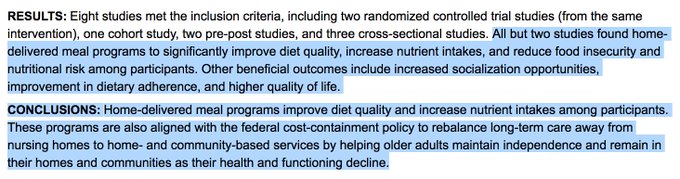
Mick Mulvaney says Meals on Wheels "not showing any results." Actual peer-reviewed research says otherwise.https://www.ncbi.nlm.nih.gov/pubmed/24916974 


When those hungry seniors would like to know where their meals went, I look forward to Mulvaney showing them a picture of Trump's big, beautiful border wall with Mexico.


Jordan Weissmann is Slate’s senior business and economics correspondent.