Here's the rest of RSN with some pretty significant stuff.....
Fight the Right-Washing of Nelson Mandela's
Legacy Joan Walsh, Salon Walsh writes: "I tried
to honor Nelson Mandela on the day of his death, and love my political enemies.
But the whitewashing of Mandela's legacy, as well as the role of the United
States in supporting both apartheid and Mandela's long imprisonment, has to be
rebutted." READ
MORE
ALEC Stands Its Ground, but
Stumbles Brendan Fischer, PR Watch Fischer reports: "As
Cruz addressed the conference, around 200 activists marched outside, waving
signs reading 'A Legislator for Every Corporation' and chanting 'you can hear us
loud and clear - we want ALEC out of here!'" READ
MORE
Global Trade Deal Condemned by Anti-Poverty
Groups Phillip Inman, Guardian UK Inman
reports: "The first global trade deal since the creation of the World Trade
Organisation (WTO) nearly two decades ago has been condemned by anti-poverty
groups as a boost for big business at the expense of developing nations." READ
MORE
Hagel Outlines
New Weapons Sale Plan for Gulf Lolita C. Baldor, Associated
Press Baldor reports: "U.S. Defense
Secretary Chuck Hagel opened the door for the U.S. to sell missile defense and
other weapons systems to U.S.-friendly Gulf nations, with an eye toward boosting
their abilities to counter Iran's ballistic missiles, even as global powers ink
a nuclear deal with Tehran." READ
MORE
The Inside Story of the Plan to Send Hazardous Materials
Straight Through the Heart of DC Emily Atkin, ThinkProgress "In the
nation's capital, commuter rails run underground and freight trains rarely stop
so the risk of a serious hazmat incident due to a derailment is relatively low.
But that risk would significantly increase under a proposal by CSX which is
currently being considered by the U.S. and D.C. Departments of
Transportation." READ
MORE
When weekend passenger train service to Cape Cod travelling through Middleboro was begun, Middleboro Selectmen, Town Departments and concerned citizens justifiably expressed grave concerns.
Middleboro and many Massachusetts communities have rail freight lines carrying hazardous cargoes that are undisclosed, may be mislabelled. How do we know?
The number of freight trains carrying oil across America has soared in the past five years, but federal officials warn that the massive steel tank cars that carry most of that oil through towns and past schools – the same cars that exploded in Quebec this summer, killing 47 -- may be unsafe and prone to rupture.
“The clock is ticking,” said Jim Arie, fire chief of the Chicago suburb of Barrington, Ill., where the number of trains that rumble across Main Street has grown from five a day to nearly one an hour. “As long as these rail cars are out there and they’re being used, potential exists for a major disaster.”
For two decades, federal officials have warned that the tank car that carries oil and ethanol, known as the DOT-111, has a serious design flaw and can split open in an accident, turning a derailment into a fiery catastrophe. At least five times since 1991, the National Transportation Safety Board (NTSB) has raised concerns about the car’s design, including its relatively thin metal skin and the possibility that cars could tear holes in each other during accidents, creating a domino effect of spills.
“If we don’t start upgrading these cars soon, my concern is that we will have a catastrophic event in the near future,” said transit safety expert John Goglia, who served on the NTSB's board from 1995 to 2004. "Even if the car doesn't crumble and get destroyed in a derailment, 66 percent of the cars are going to spill whatever product is in there, and there is some pretty hazardous material being carried around in these cars."
Yet the government has done little, allowing the industry to make some voluntary safety upgrades but leaving most of the DOT-111s in service and unaltered. Just after the Quebec crash, the agency charged with regulating tank cars, the Pipeline and Hazard Materials Safety Administration (PHMSA), put off acting for another year, though this week the agency agreed to start considering safety upgrades.
In Barrington, the people who live close to the tracks are tired of waiting.
“It’s unbelievable that something that can have this kind of impact hasn’t been addressed,” said Karen Darch, Barrington’s “president,” or mayor.
Steve Morrissey, whose window looks out on Barrington’s busy tracks, said he sleeps “with one eye open” and has prepared an emergency evacuation plan.
“I have told my family that it would not be a matter of if, but a matter of when.”
For more on oil trains, watch "NBC Nightly News with Brian Williams" tonight.
Oil train traffic is rising because the domestic oil business is booming, with production at its highest point since 1993. In a bid for freedom from foreign oil, America has stepped up ethanol production and new oil extraction methods like hydraulic fracturing, or “fracking.” North Dakota alone is now producing more than 820,000 barrels per day.
The result: the amount of crude and ethanol traveling by rail has skyrocketed. According to figures from the Association of American Railroads (AAR), just 9,500 carloads of crude and 220,000 carloads of ethanol moved by rail in 2008. Last year the combined figure for crude and ethanol was 600,000 cars. About 70 percent of North Dakota’s oil and 70 percent of the nation’s ethanol now moves by rail.
Nearly all of the cars in the swelling fleet of mile-long oil trains crisscrossing the country are DOT-111s, which hold up to 30,000 gallons apiece.
The oil train that exploded in Lac Megantic, Quebec in July, killing 47 people and destroying half the downtown, was made up of DOT-111s. Canadian authorities are investigating the tank cars, the volatility of the oil, and the handling of the train as possible factors in the tragedy.
NBC News
Steve Morrissey of Barrington, Ill., walks on the train tracks near his house. The boom in domestic oil and ethanol means that the number of freight trains rumbling through the heart of this Chicago suburb and past the window of his house has grown from five a day to nearly one an hour.
In 2009, an ethanol train comprised of DOT-111s derailed and caught flame in Cherry Valley, Ill., 50 miles west of Barrington, killing one person and injuring nine others.
In a 2012 report on the crash, NTSB investigators again criticized the cars, concluding that the “inadequate design of the DOT-111 tank cars” played a large role in the catastrophic nature of the Cherry Valley crash, illustrating their “inability ... to withstand the forces of accidents.”
Before the report was issued, however, the industry decided to take action. In order to get out in front of any new regulations, the industry convened a task force led by the AAR to weigh revisions to DOT-111 standards.
In 2011, the task force issued voluntary standards that required newly built cars carrying crude and ethanol to have thicker steel shells, improved valve coverings, and end shields to prevent punctures – all attempts to address problems the NTSB had long highlighted. The AAR also petitioned PHMSA to adopt higher federal standards for the DOT-111.
“The industry continues to look forward to action on this request from PHMSA,” said AAR spokesperson Holly Arthur in a statement, “and in the meantime has adopted the higher tank car specifications so that all new tank cars carrying … crude oil and ethanol ordered after October of 2011 are being built to these higher standards.”
The new cars are gradually being added to the existing fleet, but most cars predate the changes.
According to the AAR, about 25 percent of the approximately 32,000 cars that carry crude now meet the higher standards. Numbers for ethanol cars are less clear, but according to the Renewable Fuels Association, which represents the industry, most of the fleet of 63,000 cars is more than three years old, predating the upgrade.
The NTSB, which can only issue recommendations, not regulations, has argued that mingling the new, sturdier cars with older cars defeats the purpose of the upgrade, saying the intended safety benefits are “not realized.” The old thin-skinned cars are still vulnerable to rupture, and the newer, heavier cars can still damage them during collisions.
But the industry would prefer to replace the old-style cars by attrition. And the old-style cars can last for 40 years.
The industry has also resisted improving the existing cars via retrofitting because of technical issues.
While the industry says it's not opposed to retrofitting in principle, the AAR asserted in written comments to regulators in 2011 that retrofitting would make the cars too heavy and inhibit their movement. The group also said that derailments over the preceding five years had cost $64 million, while retrofitting all crude and ethanol DOT-111s would run $1 billion.
“There were no feasible options that could be applied to all existing and new cars,” said the AAR.
Christopher Barkan of the University of Illinois, whose extensive safety research has been used by both industry and government, agreed that making upgrades to older DOT-111s is not as simple as it may seem. “Retrofitting is the most difficult issue and it’s not just a matter of money,” Barkan said.
“These cars are complicated engineering structures that move hundreds of thousands of miles and absorb all kinds of shocks and vibrations.” The effectiveness of retrofits would vary depending on the particular car and retrofit, he said, and in some cases adding extra protection and weight to existing cars may not be technically feasible.
In the wake of July’s devastating crash in Quebec, however, both the Canadian and U.S. governments are taking a fresh look at the DOT-111. The train, carrying crude from North Dakota across Canada, derailed just miles from the Maine border, and had been set to cross back into the States.
On Wednesday, the PHMSA announced that it wanted to identify “additional safety enhancements” recommended by the industry task force two years ago and then “provide the public an opportunity to comment.” The process could take 18 months.
In a statement, the AAR emphasized its commitment to safety, and its record. “Freight railroads are always seeking to learn how to make their safety record ever stronger,” said spokesperson Holly Arthur. “Today, 99.997 percent of all rail hazmat shipments reach their destination without a release caused by a train accident.” Arthur also noted that the trade group had asked the government to institute tougher standards in 2011.
Former NTSB board member John Goglia said it was "pretty disheartening" that regulators "haven't addressed those problems. … [O]ur government has not risen to the occasion.”
Lisa Riordan Seville is a researcher with the NBC News investigative unit. Lisa Myers is the Senior Investigative Correspondent at NBC News.
Pan Am Violating Law by Not Reporting Oil
Volume in Maine
PORTLAND — One of
the two rail lines over which oil is shipped through Maine is behind on reporting the volume of oil shipments to the Department of Environmental Protection.
Pan Am Railway tanker cars that carry liquefied propane are
parked at the NGL Supply Terminal on West Commercial Street in Portland on
Monday, July 8, 2013. DEP spokesman Jessamine Logan said Wednesday that Pan-Am Railways failed to report oil volume for April and May as required by law. The monthly reports must be submitted within 30 days.
DEP spokesman Jessamine Logan said Wednesday that Pan-Am
Railways failed to report oil volume for April and May as required by law. The
monthly reports must be submitted within 30 days.
The Portland Phoenix first reported on the overdue
documents Wednesday.
Logan told The Associated press said the state grants
leeway for vacations and illnesses that cause delays. But the April report is
now more than a month overdue.
A spokeswoman for Massachusetts-based Pan-Am didn't
immediately return a call.
Logan says Pan-Am and Montreal, Maine and Atlantic Railway
are the only rail companies that regularly ship oil through Maine.
This article talks about rail companies lobbying Canadian government. Can we assume the same is happening here?
Railways have been lobbying against more stringent safety regulations
By Linda Gyulai, The Gazette July 13, 2013
A Sûreté du Québec officer stands in front of a train car carrying crude oil next to smouldering remains of buildings in the town of Lac-Mégantic Sunday: Canada has been lightening its regulatory oversight of the rail industry since the late 1990s. . (Dario Ayala / THE GAZETTE)
Photograph by: Dario Ayala , The Gazette
While the railway industry says it’s too soon to draw conclusions about the adequacy of safety regulations for the transportation of dangerous goods in the wake of the train disaster in Lac-Mégantic, federal lobbying records show that railway industry representatives recently began a campaign to convince Canadian government officials in private meetings that more stringent safety regulations aren’t necessary.
The Railway Association of Canada, which represents about 50 freight and passenger companies in the country, and the Canadian Pacific Railway have lobbied in the past year against additional regulation on freight rail in separate meetings with federal officials, including with a policy adviser to Transport Minister Denis Lebel, the lobbying disclosure records of the company and the industry association show.
The railway association and the CPR are registered as federal government lobbyists to discuss a host of policy and regulatory matters with government officials.
Representatives of the railway association had 21 meetings with about 30 civil servants and members of Parliament in the past year, the group’s lobbying record shows.
Lobbyists at the federal level are required to register and disclose to the office of Canada’s lobbying commissioner their communication with government bureaucrats, politicians and their staff, including the officials’ names and titles, the dates of meetings and the objectives and topics discussed. The information is available to the public on the lobbying commissioner’s website.
The railway association’s record shows a new topic was added to its lobbying activities at the beginning of 2013: “To inform about the movement of dangerous goods, including voluntary and regulatory requirements, volumes, customers and safety measures to assure them that current regulations for dangerous goods transportation are sufficient.”
The association has had three meetings with officials so far this year, and the matter was listed among a host of topics discussed at all three meetings, the association reported in its record of communication. Other topics included various tax laws, activities to mark the Sir John A. Macdonald bicentennial program in 2015, the association’s call for the installation of voice and video recorders in locomotive cabs and a discussion of Bill C-52, new federal legislation requiring railway companies to enter into contracts with shippers when requested.
The association had two meetings in February, one with MPs and the other with civil servants from Natural Resources Canada. The third meeting, on May 21, was with Aaron Hynes, a policy adviser to Lebel on surface transportation.
For its part, the CPR reveals in its lobbying record that it met with Hynes and another policy adviser, Nathan Cato, on April 17.
Among the topics listed for the meeting: “Participating in the review of Rail Service in Canada by Transport Canada with regard to ... Transport Canada’s review of freight rail service in Canada. Advocating for no additional regulation.”
The CPR disclosed the same topic of discussion at 22 meetings with more than 30 bureaucrats and MPs over the past year, the company’s lobbying record shows. Other topics included crossing regulations, infrastructure and rail car imports.
Mike Winterburn, who is director of communications for Lebel, said in a written response that public safety is the department’s top priority.
“We accept meeting requests from a broad range of stakeholders,” he wrote.
“Railway safety regulations exist to ensure the safety and protection of the public. If these regulations were not followed in anyway, we will not hesitate to take whatever course of action is available to us.”
A spokesperson for the department said she would be unable to answer questions about the meetings between civil servants and the railway industry lobby before Monday.
The lobbying records offer no other detail on what was discussed at the meetings.
Phone calls to two spokespeople for the railway association were not returned on Friday.
The association’s director of government relations, Dan Rogers, who was chief of staff to former federal Liberal cabinet minister Tony Valeri while he was transport minister in 2004 and later government house leader, could not be reached.
The association has said it will wait for the results of the investigation into the cause of the train disaster in Lac-Mégantic before concluding on the adequacy of safety regulations.
Association president and CEO Michael Bourque said the industry had sent specialists in dangerous goods to assist in the disaster zone and said his group is collaborating with federal authorities to establish the cause.
“The industry will wait for their results before reaching any conclusion, especially in regards to the adequacy of the existing regulatory environment designed to ensure safe railway operations,” Bourque said in the statement, which called the accident an “extremely atypical” event.
“We wish to reassure North American communities that railway operations are safe and our track record of handling regulated commodities is excellent. We are committed to learning from this accident and, if required, acting to prevent similar circumstances from occurring again.”
Bourque noted the railway association works with Transport Canada and union representatives to develop safety rules and standards.
CPR spokesperson Ed Greenberg said flatly the company will not answer questions about its lobbying activities.
“We do not have any comment at this time,” he said.
I am a tax-paying stakeholder and am deeply concerned about Global Petroleum’s proposal to bring large volumes of ethanol by train to their Revere facility (60-120-car trains, two to three times per week, 280.8 million to 468 million gallons annually).
There are hundreds of thousands of residents, businesses, organizations, churches, health care institutions, schools and other important community resources along the proposal's routes. More than fifty cities and towns are likely to be affected including Cambridge, Somerville, Everett, Chelsea, East Boston, and Revere.
Ethanol is highly combustible and an accident in densely populated neighborhoods would put thousands at risk, without possibility of evacuation from a resulting fire.
We call on you, the Governor of Massachusetts, to listen to the concerns of the Commonwealth’s taxpayers and STOP THIS PROPOSAL.
Under a plan by Waltham-based
Global Partners LP, about 1.7 million gallons of ethanol would be carried on a
freight train that is 60 cars long twice a week through two dozen communities,
including Cambridge, Somerville, East Boston, Everett and Chelsea, ending at a
waterside shipping center in Revere.
A 2011 study commissioned by the
state Department of Environmental Protection found ethanol is now the most
hazardous substance being transported by rail in the United
States.
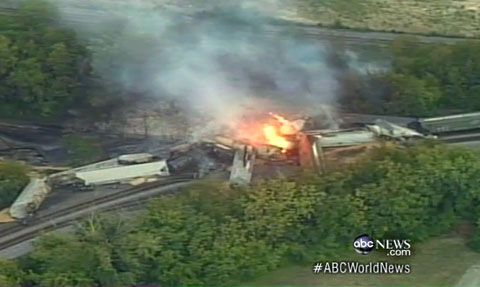
On
July 11, a 98-car train carrying ethanol partly derailed and exploded north of
downtown Columbus, Ohio. The train was reportedly traveling below the speed
limit in the middle of the night, and just two people were hurt. Investigators
are trying to determine the cause.
This isn't fantasy or a 'what if' scenario because ethanol train disasters have already happened.
Middleboro has a freight line.
Will Ethanol trains run through the community? Are there limits?
Freight line runs through many communities or near by. If plans are mandatory evacuation within one mile, how many communities are effected?
Maybe we should ask questions and understand the impacts.
I want to invite you all to a community
meeting on ethanol next Wednesday February 6th at 6:00 PM in the East
Boston High School. We’ll have a brief presentation about Global Oil’s
proposal to bring 1.8 million gallons of ethanol by train twice a week into
their facility on the Chelsea Creek. We’ll then be joined by representatives
from the Department of Transportation who will share the progress of their study
on the public safety of transporting ethanol by rail through dense urban
communities. This is our opportunity to let DOT hear about concerns from
the community about public and environmental safety!Please help spread
the word! Spread this flyer electronically far and wide; or let me know if you’d
like hard copies.
Quiero
invitarles a todos a una reunión comunitaria el miércoles 6 de febrero a las
6:00 PM en la High School de East Boston. Presentaremos información breve
sobre la propuesta de Global Oil para traer 1.8 millones de galones de etanol
por tren dos veces a la semana a sus instalaciones frente al Río de Chelsea.
Luego representantes del Departamento de Transportación compartirán algunos
resultados de la investigación de seguridad pública para transportar etanol
por tren a través de comunidades densamente pobladas.Es nuestra
oportunidad para que el DOT escuche a las preocupaciones de comunidad acerca
de la seguridad pública y ambiental. ¡Ayudenos a regar la voz, comparta
esta información! Envíe estos volantes por correo electrónico; o déjenos saber
si quiere copias.