Showing posts with label ocean dumping. Show all posts
Showing posts with label ocean dumping. Show all posts
Monday, February 12, 2018


Monday, September 5, 2016
Sperm Whales Found Dead In Germany, Stomachs FULL Of Plastic And Car Parts

Sperm Whales Found Dead In Germany, Stomachs FULL Of Plastic And Car Parts
Wednesday, September 2, 2015
Environmental News Network: Ocean plastic plague threatens seabirds, Climate Change will Cost Trillions
Below are just 2 great articles offered by ENVIRONMENTAL NEWS NETWORK.
Consider subscribing to and supporting to get the most current information.
  | |||||||||||||||
From: Bill Roth, Triple Pundit, More from this Affiliate
Published September 1, 2015 09:09 AM
Climate Change will Cost Trillions

The economic ramifications of continuing the 20th century’s economic model, where unsustainable extraction and pollution conveys competitive advantage, are coming into sharp focus.Citigroup now projects a staggering $72trillion global cost tied to man-made climate change during the 21st century. This is an almost incomprehensible scale of economic damage that is equal to losing four years of the United States’ entire gross domestic product.
The agriculture and food manufacturing industries also confront similar staggering economic consequences. The industrial fast food complex is directly tied to a global obesity and diabetes epidemic that now costs $2 trillion annually, or almost 3 percent of world gross domestic product. If this cost remains constant it will represent $170 trillion in economic cost through the rest of the 21st century.
These staggering economic costs don’t even take into account human suffering and premature death. A telling example is that 4,000 people per day, or 1.6 million per year, are estimated to die prematurely in China due to air pollution. This is a morbidity population that is 33 percent larger than the entire population of San Diego. In terms of the morbidity rate tied to our food system, in the U.S. alone over 75,000 people die each year due to diabetes.
Consumers, markets, politics and sustainable economics
The scale of the numbers tied to unsustainable human and environmental impacts are now too large to be wrong or ignored. Continued purchases of fossil fuels in the quantities now being consumed is an exceedingly poor economic decision. Health research now documents that sugary drinks are the 21st century’s tobacco, in terms of negative human health and cost consequences. The question is why consumers and the political system are comparatively unresponsive to numbers that can only be described as staggering.
Continue reading at ENN affiliate, Triple Pundit.
Ocean plastic plague threatens seabirds
From: Chris Wilcox, Britta Denise Hardesty & Erik van Sebille, The Ecologist, More from this AffiliatePublished September 1, 2015

Already 60% of seabird species have plastic in their guts, often as much as 8% of their body weight. And with ocean plastic increasing exponentially, that figure will rise to 99% by 2050, threatening some birds' survival. Unless we act.
Many of you may have already seen the photographs of albatross carcasses full of undigested plastic junk. But how representative is that of the wider issue facing seabirds?
To help answer that question, we carried out the first worldwide analysis of the threat posed by plastic pollution to seabird species worldwide.
Our study, published today in Proceedings of the National Academy of Sciences, found that nearly 60% of all seabird species studied so far have had plastic in their gut.
This figure is based on reviewing previous reports in the scientific literature, but if we use a statistical model to infer what would be found at the current time and include unstudied species, we expect that more than 90% of seabirds have eaten plastic rubbish.
Our analysis of published studies shows that the amount of plastic in seabird's stomachs has been climbing over the past half-century. In 1960, plastic was found in the stomachs of less than 5% of seabirds, but by 2010 this had risen to 80%.
We predict that by 2050, 99% of the world's seabird species will be accidentally eating plastic, unless we take action to clean up the oceans. Some areas of contain as many as 580,000 plastic pieces per square kilometre.
The surprse - it's worst in the remote Southern Ocean
Perhaps surprisingly, we also found that the area with the worst expected impact is at the boundary of the Southern Ocean and the Tasman Sea, between Australia and New Zealand.
While this region is far away from the subtropical gyres, dubbed 'ocean garbage patches', that collect the highest densities of plastic, the highest threat is in areas where plastic rubbish overlaps with large numbers of different seabird species - such as the Southern Ocean off Australia.
Seabirds are excellent indicators of ecosystem health. The high estimates of plastic in seabirds we found were not so surprising, considering that members of our research team have previously found nearly 200 pieces of plastic in a single seabird.
These items include a wide range of things most of us would recognise: bags, bottle caps, bits of balloons, cigarette lighters, even toothbrushes and plastic toys.
Continue reading at ENN affiliate, The Ecologist.
Seagull with plastic image via Shutterstock.
RSN: Up to 90% of Seabirds Have Plastic in Their Guts, Study Finds, Activists in Iran Pen Open Letter to Americans on Nuclear Deal, Bill McKibben | Physics Doesn't Negotiate
Andy Borowitz | Cutting Losses, Kochs to Sell Scott Walker

Andy Borowitz, The New Yorker
Borowitz writes: "Saying that 'things just didn't work out,' the billionaire Koch brothers have decided to put Wisconsin Governor Scott Walker up for sale."
READ MORE
Andy Borowitz, The New Yorker
Borowitz writes: "Saying that 'things just didn't work out,' the billionaire Koch brothers have decided to put Wisconsin Governor Scott Walker up for sale."
READ MORE
How the US Police Turn Drivers Into Moving Targets
Jon Swaine, Jamiles Lartey and Oliver Laughland, Guardian UK
Excerpt: "US police have fatally shot 30 people in moving vehicles this year, despite federal guidelines advising them not to. Why have police departments pulled the trigger on drivers rather than reform?"
READ MORE
Jon Swaine, Jamiles Lartey and Oliver Laughland, Guardian UK
Excerpt: "US police have fatally shot 30 people in moving vehicles this year, despite federal guidelines advising them not to. Why have police departments pulled the trigger on drivers rather than reform?"
READ MORE
Bill McKibben | Physics Doesn't Negotiate
Bill McKibben, Medium
Excerpt: "President Obama is visiting Alaska this week - a territory changing as rapidly as any on earth thanks to global warming. He's talking constantly about the danger that climate change poses to the planet. This is a welcome development given that he managed to go through virtually the entire 2012 election without even mentioning it."
READ MORE
Documents Show Ecuadorian Officials Considered a Number of Plots to Smuggle Julian Assange out of Embassy
Jamie Grierson, Guardian UK
Grierson writes: "Ecuadorian officials reportedly considered smuggling Julian Assange out of their embassy in London by disguising him in fancy dress, in one of a number of potential plots to evade police stationed outside."
READ MORE
Jamie Grierson, Guardian UK
Grierson writes: "Ecuadorian officials reportedly considered smuggling Julian Assange out of their embassy in London by disguising him in fancy dress, in one of a number of potential plots to evade police stationed outside."
READ MORE
Activists in Iran Pen Open Letter to Americans on Nuclear Deal
Nick Gass, Politico
Gass writes: "More than 50 prominent Iranian dissidents, political reformers and other civil society activists have written an open letter to the people of the United States, urging them to lobby members of Congress to support the Iran nuclear deal."
READ MORE
Nick Gass, Politico
Gass writes: "More than 50 prominent Iranian dissidents, political reformers and other civil society activists have written an open letter to the people of the United States, urging them to lobby members of Congress to support the Iran nuclear deal."
READ MORE
What the Arrest of Two Journalists Tells Us About Turkey - And Vice News
David A. Graham, The Atlantic
Graham writes: "Under Recep Tayyip Erdogan's presidency, Turkish journalists have increasingly been badgered, intimidated, threatened, and punished. Now, however, the Turkish government is going after two foreign journalists."
READ MORE
David A. Graham, The Atlantic
Graham writes: "Under Recep Tayyip Erdogan's presidency, Turkish journalists have increasingly been badgered, intimidated, threatened, and punished. Now, however, the Turkish government is going after two foreign journalists."
READ MORE
Up to 90% of Seabirds Have Plastic in Their Guts, Study Finds
Associated Press
Excerpt: "As many as nine out of 10 of the world's seabirds are likely to have pieces of plastic in their guts, a new study estimates."
READ MORE
Associated Press
Excerpt: "As many as nine out of 10 of the world's seabirds are likely to have pieces of plastic in their guts, a new study estimates."
READ MORE
Friday, February 13, 2015
RSN: We Dump 8 Million Tons of Plastic Into the Ocean Each Year. Where Does It All Go?
The high number of 'HITS' in this venue of articles from INDEPENDENT MEDIA is disappointing.
Please consider subscribing to and supporting those sites yourself.
As a nation, we have sacrificed INDEPENDENT THINKING and RESPONSIBLE JOURNALISM to Corporate Media. What you receive for FREE is worth the price you paid.
Aren't you tired of being a SHEEP following the Judas' Goat to slaughter?
PLEASE TAKE
NOTE ON FUNDING! We do not have the option of falling short on our fundraiser
for February. Last month was a down month and we are depleted. For those of you
who prefer "free content" there are other options out there. For those of you
dedicated to sustaining and building a truly publicly-funded news agency, please
turn your attention to the funding drive at this time. In earnest. / Marc Ash -
Founder, Reader Supported News
Juan Cole |
When You've Lost Bernie Sanders: How Netanyahu Destroyed the Israel
Lobby

Juan Cole, Informed Comment
Cole writes: "Senator Bernie Sanders, the most consistent and prominent progressive in the US Senate, has decided to skip the speech of Israeli Prime Minister Binyamin Netanyahu to Congress on March 3, which was orchestrated by Israel's ambassador to the US Ron Dermer and Speaker of the House John Boehner in an attempt to derail President Obama's negotiations with Iran over its civilian nuclear enrichment program. It is Bibi's Kanye West moment."
READ MORE
The Guardian
Hires Chelsea Manning
Andrew Desiderio, Mediaite
Desiderio writes: "The Guardian's U.S. editor-in-chief Katharine Viner announced the news on Twitter, adding that Manning will write about 'war, gender, freedom of information.'"
READ MORE
Andrew Desiderio, Mediaite
Desiderio writes: "The Guardian's U.S. editor-in-chief Katharine Viner announced the news on Twitter, adding that Manning will write about 'war, gender, freedom of information.'"
READ MORE
Anonymous
Threatens to Expose High-Profile Child Sex Abusers
Tom Parmenter, Sky News
Parmenter writes: "Activist network Anonymous is planning a day of action to expose establishment child abuse and cover ups."
READ MORE
Tom Parmenter, Sky News
Parmenter writes: "Activist network Anonymous is planning a day of action to expose establishment child abuse and cover ups."
READ MORE
Appeals Court
Rules That Birth Control Coverage in Affordable Care Act Doesn't Violate
Religious Group Rights
Joe Mandak, Associated Press
Mandak writes: "An appeals court has ruled that the birth control coverage required by federal health care reforms does not violate the rights of several religious groups because they can seek reasonable accommodations."
READ MORE
Joe Mandak, Associated Press
Mandak writes: "An appeals court has ruled that the birth control coverage required by federal health care reforms does not violate the rights of several religious groups because they can seek reasonable accommodations."
READ MORE
Mississippi
KKK "Salutes" Alabama Chief Justice for Gay Marriage Stance
Erin Edgemon, AL.com
Edgemon writes: "A Mississippi chapter of the Ku Klux Klan is supporting Alabama Supreme Court Chief Justice Roy Moore's stand for state's rights and called for members to protest against the legalization of gay marriage."
READ MORE
Erin Edgemon, AL.com
Edgemon writes: "A Mississippi chapter of the Ku Klux Klan is supporting Alabama Supreme Court Chief Justice Roy Moore's stand for state's rights and called for members to protest against the legalization of gay marriage."
READ MORE
We Dump 8
Million Tons of Plastic Into the Ocean Each Year. Where Does It All
Go?
Brad Plumer, Vox
Plumer writes: "The vast majority of plastic trash ends up in landfills, just sitting there and taking thousands of years to degrade."
READ MORE
Brad Plumer, Vox
Plumer writes: "The vast majority of plastic trash ends up in landfills, just sitting there and taking thousands of years to degrade."
READ MORE
Wednesday, March 5, 2014
Fishermen haul up other deadliest catch
Great effort!

Effort cleans up sea floor from old gear, preventing marine entanglements
Laura Ludwig, Provincetown Center for Coastal Studies project coordinator for the ghost gear recovery, helps unload traps at MacMillan Wharf in Provincetown.Cape Cod Times/Steve Heaslip
PROVINCETOWN — Fishing vessel crews from the All In and Miss Lilly pulled in at around 2 p.m. Tuesday to MacMillan Pier from a morning of "ghost" busting.
Both boats were loaded with old fishing gear, known as "ghost gear," that the fishermen had scraped up from the sea floor, in the third annual effort to return lobster traps to owners and rid the sea of junk.
On Tuesday, they found 47 traps, a marine battery, a toilet bowl, a mucky steel boom, and piles and piles of rope and nets.
The fishermen were part of the Fishing for Energy program, a partnership between the National Fish and Wildlife Foundation, Covanta Energy, Schnitzer Steel Industries Inc. and the National Oceanic and Atmospheric Administration. Local partners are the Provincetown Center of Coastal Studies, the Provincetown Public Pier Corp. and the Provincetown Harbormaster's Office.
Derelict gear is a problem because it continues to trap and entangle marine life, according to material distributed by the partnership. The gear can accumulate over time, creating islands of metal and rope that get moved around in storms and harm fragile habitats. The floating masses can also foul up vessels and active fishing gear, potentially affecting maritime industries.
"I think it's a good idea," Miss Lilly owner Mike Rego of North Truro said on the pier. Ghost gear program coordinator, Laura Ludwig, of the coastal studies center, had asked him to pitch in.
Tuesday's stash was added to the 98 traps that the two vessels had pulled up on Saturday and Sunday.
More than a dozen of those traps were identified and some returned to their owners. The boats had also pulled up cable, nets, an engine block and buoys.
The crews are working in areas where gear has been reported and in areas where side-scan sonar surveys have revealed gear. The recovery consists of dragging lightweight grapples along the sea floor. The gear has come primarily from around Long Point, along the shoreline near Wood End Light and to a lesser degree near the Pamet River in North Truro, Ludwig said.
The fishing crews document what they pull up and that is used to help determine the effects that lost fishing gear have on living resources. The information is logged in a regional at-sea recovery database as well, she said.
Each vessel owner is paid $650 for their efforts, which includes the cost of fuel, Ludwig said. The money comes from a grant from the National Fish and Wildlife Foundation, and allows for 12 boat trips from MacMillan Pier. On Tuesday, Ludwig expected to get in another three days with two vessels.
"I don't like the idea of human-created waste in the ocean," she said.
Wednesday, January 1, 2014
....it felt as if the ocean itself was dead....
Below is a particularly damning article of the ocean destruction caused by garbage dumping...


Ivan Macfadyen aboard the Funnel Web. (photo: Max Mason-Hubers)

 T was the silence that made this voyage different from all of those before it. See your ad here
Ivan Macfadyen aboard the Funnel Web. (photo: Max Mason-Hubers)
The Ocean Is Broken
31 December 13
T was the silence that made this voyage different from all of those before it. See your ad here
Not the absence of sound, exactly.
The wind still whipped the sails and whistled in the rigging. The waves still sloshed against the fibreglass hull.
And there were plenty of other noises: muffled thuds and bumps and scrapes as the boat knocked against pieces of debris.
What was missing was the cries of the seabirds which, on all previous similar voyages, had surrounded the boat.
The birds were missing because the fish were missing.
Exactly 10 years before, when Newcastle yachtsman Ivan Macfadyen had sailed exactly the same course from Melbourne to Osaka, all he'd had to do to catch a fish from the ocean between Brisbane and Japan was throw out a baited line.
"There was not one of the 28 days on that portion of the trip when we didn't catch a good-sized fish to cook up and eat with some rice," Macfadyen recalled.
But this time, on that whole long leg of sea journey, the total catch was two.
No fish. No birds. Hardly a sign of life at all.
"In years gone by I'd gotten used to all the birds and their noises," he said.
"They'd be following the boat, sometimes resting on the mast before taking off again. You'd see flocks of them wheeling over the surface of the sea in the distance, feeding on pilchards."
But in March and April this year, only silence and desolation surrounded his boat, Funnel Web, as it sped across the surface of a haunted ocean.
North of the equator, up above New Guinea, the ocean-racers saw a big fishing boat working a reef in the distance.
"All day it was there, trawling back and forth. It was a big ship, like a mother-ship," he said.
And all night it worked too, under bright floodlights. And in the morning Macfadyen was awoken by his crewman calling out, urgently, that the ship had launched a speedboat.
"Obviously I was worried. We were unarmed and pirates are a real worry in those waters. I thought, if these guys had weapons then we were in deep trouble."
But they weren't pirates, not in the conventional sense, at least. The speedboat came alongside and the Melanesian men aboard offered gifts of fruit and jars of jam and preserves.
"And they gave us five big sugar-bags full of fish," he said.
"They were good, big fish, of all kinds. Some were fresh, but others had obviously been in the sun for a while.
"We told them there was no way we could possibly use all those fish. There were just two of us, with no real place to store or keep them. They just shrugged and told us to tip them overboard. That's what they would have done with them anyway, they said.
"They told us that his was just a small fraction of one day's by-catch. That they were only interested in tuna and to them, everything else was rubbish. It was all killed, all dumped. They just trawled that reef day and night and stripped it of every living thing."
Macfadyen felt sick to his heart. That was one fishing boat among countless more working unseen beyond the horizon, many of them doing exactly the same thing.
No wonder the sea was dead. No wonder his baited lines caught nothing. There was nothing to catch.
If that sounds depressing, it only got worse.
The next leg of the long voyage was from Osaka to San Francisco and for most of that trip the desolation was tinged with nauseous horror and a degree of fear.
"After we left Japan, it felt as if the ocean itself was dead," Macfadyen said.
"We hardly saw any living things. We saw one whale, sort of rolling helplessly on the surface with what looked like a big tumour on its head. It was pretty sickening.
"I've done a lot of miles on the ocean in my life and I'm used to seeing turtles, dolphins, sharks and big flurries of feeding birds. But this time, for 3000 nautical miles there was nothing alive to be seen."
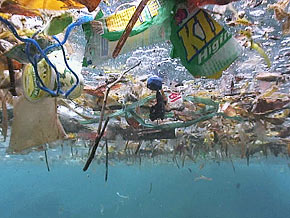
In place of the missing life was garbage in astounding volumes.
"Part of it was the aftermath of the tsunami that hit Japan a couple of years ago. The wave came in over the land, picked up an unbelievable load of stuff and carried it out to sea. And it's still out there, everywhere you look."
Ivan's brother, Glenn, who boarded at Hawaii for the run into the United States, marvelled at the "thousands on thousands" of yellow plastic buoys. The huge tangles of synthetic rope, fishing lines and nets. Pieces of polystyrene foam by the million. And slicks of oil and petrol, everywhere.
Countless hundreds of wooden power poles are out there, snapped off by the killer wave and still trailing their wires in the middle of the sea.
"In years gone by, when you were becalmed by lack of wind, you'd just start your engine and motor on," Ivan said.
Not this time.
"In a lot of places we couldn't start our motor for fear of entangling the propeller in the mass of pieces of rope and cable. That's an unheard of situation, out in the ocean.
"If we did decide to motor we couldn't do it at night, only in the daytime with a lookout on the bow, watching for rubbish.
"On the bow, in the waters above Hawaii, you could see right down into the depths. I could see that the debris isn't just on the surface, it's all the way down. And it's all sizes, from a soft-drink bottle to pieces the size of a big car or truck.
"We saw a factory chimney sticking out of the water, with some kind of boiler thing still attached below the surface. We saw a big container-type thing, just rolling over and over on the waves.
"We were weaving around these pieces of debris. It was like sailing through a garbage tip.
"Below decks you were constantly hearing things hitting against the hull, and you were constantly afraid of hitting something really big. As it was, the hull was scratched and dented all over the place from bits and pieces we never saw."
Plastic was ubiquitous. Bottles, bags and every kind of throwaway domestic item you can imagine, from broken chairs to dustpans, toys and utensils.
And something else. The boat's vivid yellow paint job, never faded by sun or sea in years gone past, reacted with something in the water off Japan, losing its sheen in a strange and unprecedented way.
BACK in Newcastle, Ivan Macfadyen is still coming to terms with the shock and horror of the voyage.
"The ocean is broken," he said, shaking his head in stunned disbelief.
Recognising the problem is vast, and that no organisations or governments appear to have a particular interest in doing anything about it, Macfadyen is looking for ideas.
He plans to lobby government ministers, hoping they might help.
More immediately, he will approach the organisers of Australia's major ocean races, trying to enlist yachties into an international scheme that uses volunteer yachtsmen to monitor debris and marine life.
Macfadyen signed up to this scheme while he was in the US, responding to an approach by US academics who asked yachties to fill in daily survey forms and collect samples for radiation testing - a significant concern in the wake of the tsunami and consequent nuclear power station failure in Japan.
"I asked them why don't we push for a fleet to go and clean up the mess," he said.
"But they said they'd calculated that the environmental damage from burning the fuel to do that job would be worse than just leaving the debris there."
The rest of RSN:
Andy Borowitz | People Who Can Still Afford to
Live in New York Praise Bloomberg

Andy Borowitz, The New Yorker
Borowitz writes: "As the curtain comes down on the Michael Bloomberg era, the three-term mayor of New York received fulsome praise last night from his most appreciative constituency: the people who can still afford to live there."
READ MORE
Andy Borowitz, The New Yorker
Borowitz writes: "As the curtain comes down on the Michael Bloomberg era, the three-term mayor of New York received fulsome praise last night from his most appreciative constituency: the people who can still afford to live there."
READ MORE
Robert Reich | A New Years
Message
Robert Reich, Robert Reich's Blog
Reich writes: "Despite do-nothing congressional Republicans, we ARE making progress around the country because Americans are organizing and mobilizing. Together we can make 2014 the year we turn the tide on economic inequality."
READ MORE
Robert Reich, Robert Reich's Blog
Reich writes: "Despite do-nothing congressional Republicans, we ARE making progress around the country because Americans are organizing and mobilizing. Together we can make 2014 the year we turn the tide on economic inequality."
READ MORE
The Most
Important Surveillance Order We Know Almost Nothing About
Alex Abdo, ACLU
Abdo writes: "Over the last seven months, we have learned an incredible amount about the government's post-9/11 surveillance efforts. But there is a crucial gap in our basic understanding."
READ MORE
Alex Abdo, ACLU
Abdo writes: "Over the last seven months, we have learned an incredible amount about the government's post-9/11 surveillance efforts. But there is a crucial gap in our basic understanding."
READ MORE
Uighur
Detainees Held for 12 Years Leave Guantanamo
Spencer Ackerman, Guardian UK
Ackerman reports: "Twelve years of detention without trial have ended for three Uighur men who have left Guantanamo Bay for Slovakia, the US Department of Defense announced on Tuesday, ending a clear mistake of the 9/11 era."
READ MORE
Spencer Ackerman, Guardian UK
Ackerman reports: "Twelve years of detention without trial have ended for three Uighur men who have left Guantanamo Bay for Slovakia, the US Department of Defense announced on Tuesday, ending a clear mistake of the 9/11 era."
READ MORE
Kathy Kelly | Afghan Street Children Beg for
Change
Kathy Kelly, Voices for Creative Nonviolence
"Kabul, Afghanistan is 'home' to hundreds of thousands of children who have no home. Many of them live in squalid refugee camps with families that have been displaced by violence and war."
READ MORE
Kathy Kelly, Voices for Creative Nonviolence
"Kabul, Afghanistan is 'home' to hundreds of thousands of children who have no home. Many of them live in squalid refugee camps with families that have been displaced by violence and war."
READ MORE
Wednesday, October 23, 2013
Yachtsman Describes Horror at 'Dead', Rubbish Strewn Pacific Ocean
A defining commentary on what we are doing to our environment......

Van MacFadyen says he was shocked by absence of sea life during his 37,000km voyage between Australia and Japan. (photo: Van MacFadyen)
Yachtsman Describes Horror at 'Dead', Rubbish Strewn Pacific Ocean
23 October 13
Ivan MacFadyen says he was shocked by absence of sea life during his 37,000km voyage between Australia and Japan
 n Australian sailor has described parts of the Pacific Ocean as "dead" because of severe overfishing, with his vessel having to repeatedly swerve debris for thousands of kilometres on a journey from Australia to Japan.
Ivan MacFadyen told of his horror at the severe lack of marine life and copious amounts of rubbish witnessed on a yacht race between Melbourne and Osaka. He recently returned from the trip, which he previously completed 10 years ago.
"In 2003, I caught a fish every day," he told Guardian Australia. "Ten years later to the day, sailing almost exactly the same course, I caught nothing. It started to strike me the closer we got to Japan that the ocean was dead.
"Normally when you are sailing a yacht, there are one or two pods of dolphins playing by the boat, or sharks, or turtles or whales. There are usually birds feeding by the boat. But there was none of that. I've been sailing for 35 years and it's only when these things aren't there that you notice them.
MacFadyen said that the lack of ocean life started at the edge of the Great Barrier Reef, describing Queensland waters as "barren" and "unquestionably overfished".
"We saw a boat come towards us and we thought they might be pirates, but they had bags and bags of fish," he said. "We said 'there's only two of us, we can't do anything with all that' and they said 'don't worry, just throw it over the side'.
"There was around 100 large fish there. But it was valueless for them because they were after tuna and nothing else. They just trawled the whole ocean and everything other than tuna was bycatch."
For the majority of the voyage to Japan, MacFadyen had to ensure that his yacht wasn't holed by clumps of rubbish he said were "as large as a house".
"There were fenders from ships, balls of net and telegraph poles with barnacles on them that were never going to sink," he said. "There was nothing like that 10 years ago. I couldn't believe it.
"We wouldn't motor the boat at night due to the fear of something wrapping around the propeller. We'd only do that during the day with someone on lookout for garbage. When you stood on the deck and looked down you'd see the rubbish shimmering in the depths below, up to 20 metres under the water.
"We went onto the US and back again. We did 23,000 miles [37,000km] and I'd say 7,000 of those were in garbage. The boat is still damaged from it. We had to free the rudder of rubbish one night, which was scary. We were terrified of something ripping a hole in the boat."
MacFadyen said that the trip had made him "very cranky" and has inspired him to encourage better monitoring of ocean rubbish to ensure governments' anti-pollution policies are working.
"Humans are such a blight on the planet that we will just trash an area because it is out of sight most of the time," he said. "It completely changed the way I look at things. I used to chuck rubbish away without thinking twice but there's no way I will do that now."
According to marine conservationists, overfishing is a global problem affecting nearly 90% of the world's fisheries.
The problem has resulted on catch quotas being placed on many species of fish, although the exact extent of overfishing in Australia is slightly unclear.
Government fisheries data shows only bluefin tuna and the school shark are dangerously overfished in Australian waters. However, the Australian Marine Conservation Society's guide to sustainable seafood places 26 species - including kingfish, snapper and tiger prawns - on a "red list" that should not be consumed due to their fragile status.
Pamela Allen, marine campaigner at the Australian Marine Conservation Society, told Guardian Australia that there have been improvements in Australian fisheries in recent years but problems remain.
"The quota for bluefin tuna has just been increased by 10%, despite there being no evidence to justify this," she said. "There are also issues in state fisheries - Queensland has no scientific observer system, for instance, and rely just on fishers' logbooks for what they catch in sensitive areas such as the Great Barrier Reef.
"Trawling the ocean results in a high level of bycatch because it's hard to be exact with what you're catching when you're dragging a gigantic net along the sea floor.
"People don't realise that flake is shark and that sharks are threatened due to overfishing. There is no single sustainable source of shark in fisheries. Consumers have a choice every day to make a small difference.
"Fish is one of the last wild foods we eat, along with mushrooms, and we have to realise that once it has gone, it is gone. Governments and fishers are making some changes but they need to move more quickly or there won't be any fish left."
Subscribe to:
Posts (Atom)


