Search This Blog

Translate

Blog Archive

Middleboro Review 2

NEW CONTENT MOVED TO MIDDLEBORO REVIEW 2

Toyota

Since the Dilly, Dally, Delay & Stall Law Firms are adding their billable hours, the Toyota U.S.A. and Route 44 Toyota posts have been separated here:

Route 44 Toyota Sold Me A Lemon


Showing posts with label police brutality. Show all posts

Monday, December 16, 2019

CC News Letter 16 Dec - Students Across India Rise Up In Anger After Jamia Milia Crack Down Against Citizenship Amendment Act


Dear Friend,

Students  rose up across India against the unconstitutional Citizenship Amendment Act after their compatriots in Jamia Milia Islamia were violently beaten up in their campus yesterday.

Kindly support honest journalism to survive. https://countercurrents.org/subscription/

If you think the contents of this news letter are critical for the dignified living and survival of humanity and other species on earth, please forward it to your friends and spread the word. It's time for humanity to come together as one family! You can subscribe to our news letter here http://www.countercurrents.org/news-letter/.

In Solidarity

Binu Mathew
Editor
Countercurrents.org


Students Across India Rise Up In Anger After Jamia Milia Crack Down Against Citizenship Amendment Act
by Countercurrents Collective


Students  rose up across India against the
unconstitutional Citizenship Amendment Act after their compatriots in Jamia Milia Islamia were violently beaten up in their campus yesterday.


Delhi Police Forcefully Enter Jamia Milia Islamia University; Many Students Injured
Co- written by Badre Alam Khan, Wakeel Ahmed and Wasim Ahsan


The Delhi Police have forcefully entered Jamia Milia Islamia (JMI) university campus without the any permission of university administration (as the Chief Proctor of Jamia has officially tweeted) and started fired tear gas inside campus and even students studying in the library of JMI. Some students were severely injured. And situations of Jamia and its vicinity are still extremely tense. 


STOP! The Police violence against students and those protesting the CAA!
by People's Union For Civil Liberties


PUCL strongly condemns the motivated, targeted and brutal attack by the CRPF and Delhi Police on students of Aligarh Muslim University and Jamia Millia Islamia University in Delhi yesterday, Sunday 15th December, 2019 causing serious injuries to over 150 students including girls, and also arrest of scores of students and youngsters. By all media reports and eye witness accounts, the brutal charge of the police forces was unprovoked and unwarranted as the students were peacefully protesting against the Citizenship Amendment Act, 2019 and the NRC.


Renegades vs the true children of Mother India
by Cynthia Stephen


Schemers who have come into power on false pretences and killings of the innocent,  are now looting the country of its wealth and enabling the flight of capital abroad, travelling
abroad on official tours while arranging to enrich their crony capitalist friends.  They are attacking students and activists who are defending our human rights and democratic institutions.


Anti CAB Protests: Hope for protecting India
by T Navin


India is witnessing a set of massive protests against the Citizenship Amendment Bill (CAB). These protests do offer a ray of hope of preserving and protecting the idea of ‘secular’ India. What the parliament sought to undo to the constitution through the majoritarian numbers is sought to be redone by the mass protests.


Citizenship Amendment Act, 2019 and the threats upon the Assamese Community
Co-Written by Bishaldeep Kakati and Pranjit Das


In the longer run, it would be really necessary for the Assamese community to somehow nullify the
impact of the Act upon the state, or it would be in complete disarray. But the bigger question that still lingers around is: When the government would wake up to hear the voices of the people and come up with better Acts for the indigenous people?


COP25 produces nothing but compromise and disappointment
by Countercurrents Collective


The longest ever UN climate talks on record – Conference of Parties (COP)25 – have finally ended in Madrid with nothing, but a compromise deal. Many of those in attendance were unhappy with the overall package, feeling it did not reflect the urgency of the science. A disappointment has overwhelmed many COP25 delegates.
The longest ever UN climate talks on record – Conference of Parties (COP)25 – have finally ended in Madrid with nothing, but a compromise deal. Many of those in attendance were unhappy with the overall package, feeling it did not reflect the urgency of the science. A disappointment has overwhelmed many COP25 delegates.
Exhausted delegates reached agreement on the key question of increasing the global response to curbing carbon.
All countries will need to put new climate pledges on the table by the time of the next major conference in Glasgow next year.
After two extra days and nights of negotiations, the COP25 delegates finally agreed a deal that will see new, improved carbon cutting plans on the table by the time of the Glasgow conference next year.
All parties will need to address the gap between what the science says is necessary to avoid dangerous climate change, and the current state of play which would see the world go past this threshold in the 2030s.
Supported by the European Union and small island states, the push for higher ambition was opposed by a range of countries including the US, Brazil, India and China.
However, a compromise was agreed with the richer nations having to show that they have kept their promises on climate change in the years before 2020.
Spain’s acting Minister for the Ecological Transition Teresa Ribera said the mandate was clear.
“Countries have to present more ambitious NDCs [nationally determined contributions] in 2020 than what we have today because it is important to address science and the demands of people, as well as commit ourselves to do more and faster.”
Next year’s big climate conference will be held in Glasgow, Scotland. Decisions on many important issues including the thorny question of carbon markets have been delayed until Glasgow.
“Thankfully the weak rules on a market based mechanism, promoted by Brazil and Australia, that would have undermined efforts to reduce emissions has been shelved and the fight on that can continue next year at COP26 in Glasgow,” said Mohamed Adow, with the group Power Shift Africa.
However, negotiators will be satisfied to have kept the process alive after these difficult and complex talks in Madrid.
After two weeks of talks, many issues remain unresolved.
Countries failed to agree on many of the hoped for outcomes, including rules to set up a global carbon trading system and a system to channel new finance to countries facing the impacts of climate change.
Australia and Brazil continued to push for a system with loopholes, which allowed initial double counting of emissions reductions and trading of Kyoto-era credits – explained below.
But other countries say this would undermine the entire market. As tensions peaked on Saturday, a group of 31 countries led by Costa Rica signed up to the “San Jose Principles”, a set of minimum standards for ensuring the integrity of the global carbon market.
Some countries, including Australia, Brazil and India, want to be able to use old, unspent CDM credits in the new system. Australia openly plans on using its 370 million CDM credits to meet its emission reduction goals.
But many countries are concerned allowing CDM carryover could flood the market with cheap credits that don’t represent real emissions reductions, undermining the integrity of the entire system. This is because CDMs represent emissions cuts made well before 2020, the year the Paris Agreement formally begins, and there serious doubts over whether many CDM-registered projects have even driven real emissions cuts.
Little consensus was found on this at the talks. The draft text proposes that Kyoto-era credits could be accounted against climate pledges until 2025, a view that many countries find unacceptable. Much of the rest of the text remains vague.
Guterres disappointed
UN Secretary General Antonio Guterres said he was disappointed by the result of the COP.
“The international community lost an important opportunity to show increased ambition on mitigation, adaptation and finance to tackle the climate crisis,” he said, quoted by AFP.
“A far cry”
Laurence Tubiana from the European Climate Foundation, and an architect of the Paris agreement, described the result as “really a mixed bag, and a far cry from what science tells us is needed.”
“Major players who needed to deliver in Madrid did not live up to expectations, but thanks to a progressive alliance of small island states, European, African and Latin American countries, we obtained the best possible outcome, against the will of big polluters.”
The pledge that was made in Paris
Countries agreed in Paris in 2015 to revisit their climate pledges by 2020. But many countries were pushing this year for a clear call for all countries to submit more ambitious climate pledges next year. This is seen as a key means of ensuring countries put a focus on improving their current pledges, as well as empowering civil society to hold them to account.
But countries such as China and Brazil opposed placing any obligation on countries to submit enhanced pledges next year, arguing it should be each country’s own decision. They instead argued the focus should be on pre-2020 action by developing countries to meet their previous pledges.
Countries such as China and India made it clear they would not support strong language on raising ambition without a similar call for rich countries to provide the finance and support promised to developing countries.
They called for the creation of a “work program” to close the gap of commitments made by rich countries before 2020.
But the EU opposed this, saying the focus needs to be on future ambition under the Paris Agreement, which applies to all countries.
Other poorer developing countries made it clear that, while they support pre-2020 action, higher ambition for the future from all countries should not be conditional on it.
As talks reached their final days, tensions grew after a draft decision removed any call for countries to “update” or “enhance” their climate plans by 2020. Instead, it only invited them to “communicate” them in 2020 – far weaker language, which put no obligation on enhanced ambition.
Reacting to this, a high ambition coalition, led by the Marshall Islands and backed by the EU Commission and a number of European countries, made it clear that final COP25 decision text must include a clear call for enhanced ambition in 2020.
Some ambitious words only
In the end, the final text added some more ambitious wording back in, pointing directly to the emissions gap between what country pledges currently add up to and what is needed to keep global temperature rise well below 2C.
It also “recalls that new climate pledges should “represent a progression” beyond previous pledges and represent the highest possible ambition. This text was an improvement on previous drafts but “still weak”, according to Naoyuki Yamagishi of WWF Japan.
In the final text, countries agreed to hold pre-2020 roundtables. The outcomes of these pre-2020 roundtables will also be rounded up in a report in 2021, which will in turn feed into a review on progress towards meeting the Paris Agreement’s “well below 2C” goal.
It did not specifically say whether the results of these roundtables would feed directly into the global stock take set to occur in 2023 under the Paris agreement.
In the end a mere two paragraphs summed up plans to continue talks in 2020. This did acknowledge the draft texts from this year’s negotiations as a basis for future talks, meaning countries will not have to start from scratch. However, none of these texts have found consensus.
“The current text preserves the possibility of carry over, which should certainly be avoided next year,” said Li.
Human rights
Indigenous and human rights groups have pushed for the new carbon market rules to require projects to respect human rights, protect indigenous peoples and other vulnerable groups, consult meaningfully with local communities and set up an independent grievance program for projects gone awry.
The current draft text has no mention of human rights, asking only that projects shall “avoid negative environmental and social impacts”. It says consultations should take place “where consistent with applicable domestic arrangements” and that further safeguards could be reviewed by 2028.
Several countries voiced support for human rights protections during the final plenary on Sunday morning.
The texts are ”woefully inadequate” in regards to protecting people on the ground from harm caused by activities under the new market mechanisms,” says Erika Lennon, senior attorney at the Center for International Environmental Law (CIEL). “Delaying the decision to Cop26 was the only responsible decision.”
Loss and damage
Some developed countries are extremely wary of language around loss and damage finance. The US was particularly resistant to any discussion about new areas of work even for existing funds. Other developed countries are more willing to engage.
A newly formed “Santiago network” will lead more work on how to minimize, avoid and recover from loss and damage.
But Sven Harmeling, climate change lead for Care International, called the loss and damage outcome “disappointing”, in particular pointing to the vague mandate for the Green Climate Fund on whether and how it should incorporate loss and damages into its remit.
A last minute fight about long-term finance meant there was no outcome on this, though talks will continue next year.
The UK is one of several European countries, which yesterday supported the ‘San Jose principles’ for environmental integrity of the new carbon market. It is also a member of the high-ambition coalition of countries, which pushed hard this year for a clear call for enhanced climate plans in 2020.
“Disastrous”
Kenyan climate campaigner Mohamad Adow called the Madrid outcome “disastrous, profoundly distressing”.
“We cannot just copy and paste the text from four years ago. We need to recognize that since then the climate emergency has got worse and public anger has got fiercer,” he said.
Strengthen political will
Carolina Schmidt, Chilean environment minister and conference president said: “The consensus is still not there to increase ambition to the levels that we need. Before finishing, I want to make a clear and strong call to the world to strengthen political will and accelerate climate action to the speed that the world needs. The new generations expect more from us.”
“Missing in action”
Alden Meyer, strategy chief at the Union of Concerned Scientists said: “Never have I seen such a disconnect between what the science requires and what the climate negotiations are delivering in terms of meaningful action. Most of the world’s biggest emitting countries are missing in action and resisting calls to raise their ambition.”
“It is extraordinarily difficult”
Sir David King, British government representative at the 2015 Paris climate talks said: “If the United States is not backing an agreement that is meaningful it is extraordinarily difficult for the rest of the world to come to an agreement. And I’m afraid as long as we have Trump in the United States with President Bolsonaro in Brazil it is extraordinarily difficult to get all of those countries to agree.”


Climate Change Accounting: The Failure of COP25
by Dr Binoy Kampmark


As Climate Home News noted, Durban still stood out as being worthier for having
“produced a deal between countries that laid the foundations for the Paris Agreement.”  In stark contrast, “Madrid produced a weak gesture toward raising climate targets and failed to agree for the second year in a row on rules to govern carbon markets.”
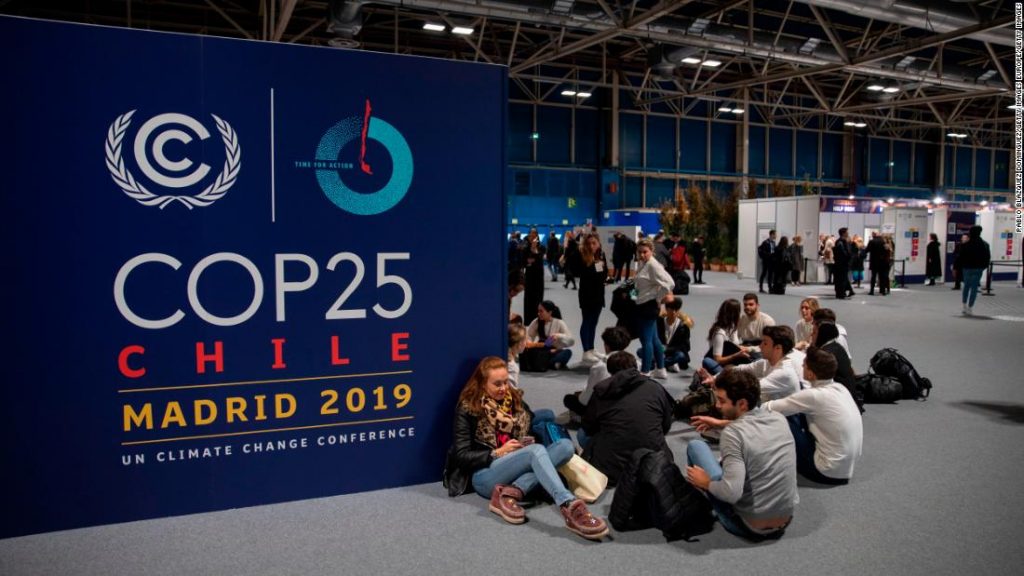
Prior to the UN Convention on Climate Change talks held in Madrid, the sense that tradition would assert itself was hard to buck.  Weariness and frustration came in the wake of initial high minded optimism. Delegates spent an extra two days and nights attempting to reach a deal covering carbon reduction measures before the Glasgow conference in 2020.  The gathering became the longest set of climate talks in history, exceeding the time spent at the 2011 Durban meeting by 44 hours.
As Climate Home News noted, Durban still stood out as being worthier for having “produced a deal between countries that laid the foundations for the Paris Agreement.”  In stark contrast, “Madrid produced a weak gesture toward raising climate targets and failed to agree for the second year in a row on rules to govern carbon markets.”
The UN Secretary General António Guterres was all lament.  “The international community lost an important opportunity to show increased ambition on mitigation, adaption and finance to tackle the climate crisis.”  He hoped that the next year would see “all countries commit to do what science tells us is necessary to reach carbon neutrality in 2050 and no more than 1.5 degree temperature rise.”
The wisdom of COP25 remains similar to that of previous gatherings on climate: politics and environment do not mix well.  Big powers and heavy polluters stuck to their stubborn positions, stressing the merits of loose, open markets to solve the problem, notably in terms of reducing carbon emissions; smaller states more concerned by their actual disappearance lobbied European, Latin American and African allies for firmer commitments and pledges.
Australia was also confirmed as one of the chief spoilers, if not outright saboteurs, at the show, noted for its insistence that it be allowed to claim a reduction of its abatement for the 2021-30 Paris Accord.  This, went the argument, was due to its own excelling in meeting the 2012-20 Kyoto Protocol period.  Previous good conduct could justify current bad and future behaviour.  What Canberra offered the globe was an accounting model of deception, exploiting a regulatory loophole in place of lowering emissions.  It lacked legal plausibility, given that both Kyoto and Paris are separate treaties.
Former French environment minister Luciana Tubiana was clear about the implications of this idea.  “If you want this carryover,” she told the Financial Times, “it is just cheating.  Australia was willing in a way to destroy the whole system, because that is the way to destroy the whole Paris agreement.”
Other states were also noted in performing roles of obstruction, including Saudi Arabia, Brazil and the United States.  These parties were particular keen to push their differences with other states over Article 6 of the Paris Agreement, a provision dealing with mechanisms and models of trading in emission reductions.  Such trade can have a habit of losing validity when put into practice; the issue of transparency remains a considerable problem in such markets.
The US statement at the conference emphasised realism and pragmatism “backed by a record of real world results.”  (Real world results tend to exclude environmental ruination for unrepentant polluters.)  Market results were primary; environmental matters were subordinate to such dictates.  Usual mantras were proffered: innovation and open markets produced wealth, but also “fewer emissions, and mores secure sources of energy.”  Despite leaving as a party to the Paris Agreement, “We remain fully committed to working with you, our global partners, to enhance resilience, mitigate the impacts of climate change, and prepare for and respond to natural disasters.”
Brazil’s President Jair Bolsonaro reconfirmed his climate change scepticism, claiming that the entire issue of COP25 could be put down to commerce.  “I don’t know why people don’t understand that it’s just a commercial game.”  The Europeans, he suggested, were merely being irksome about cash and meddling.  “I’d like to know,” he posed rhetorically to journalists, “has there been a resolution for Europe to be reforested, or are they just going to keep bothering Brazil?”
Brazil’s environment minister Ricardo Salles, known to some as Minister for Deforestation, was similarly keen to place the blame elsewhere.  He had demanded, bowl in hand, some $10 billion under the Paris Climate deal to combat deforestation in 2020.  All in all, he was not optimistic. “Rich countries did not want to pay up.”
Like Australia, Brazil’s environmental ploy is driven by creative accounting, an attempt to leverage previous supposed good conduct in the climate change stakes, playing accumulated carbon credits from Kyoto to meet those under the Paris arrangements.  Using open market rationales, Salles condemned the “protectionist vision” that had taken hold: “Brazil and other countries that could provide carbon credits because of their forests and good environmental practices came out losers.”  In an act of some spite, the minister would subsequently post a tweet featuring a photo of a platter heavy with meats.  “To compensate for our emissions at COP, a vegetarian lunch!”
Madrid will be remembered for its stalemate on carbon credits and the botched rule book on carbon trading.  An effort spearheaded by Costa Rica, including Germany, Britain and New Zealand, to convince states to adopt the San Jose principles, with a prohibition on the use of carbon credit carryover along with other Kyoto gains, was rejected.
COP25 again exposed that degree of prevalent anarchy, if not gangsterism, in global climate change policy.  The emphasis, then, is on attempts and arrangements made within regional areas: EU policy on de-carbonised economies (albeit resisted within by such states as Poland), and bilateral arrangements (the EU and China).  As these take place, the apocalyptic message led by activists such as Greta Thunberg will become more desperate.
Dr. Binoy Kampmark was a Commonwealth Scholar at Selwyn College, Cambridge.  He lectures at RMIT University, Melbourne.  Email: bkampmark@gmail.com


The Failure of the Economists
by David Anderson


Economists both in and out of academia continue to operate without ecological planetary conscience, without social conscience. In the profession there is little evidence of desire for change.


Trump Cannot Win
by Dan Lieberman


Republicans also have a dilemma – should they discard their values and need for genuine Republican leadership to support the self-serving present President of the United States (POTUS), who they believe is their preferred candidate to win the next election?


Rape  as  violent  misogyny  and  `Encounter  killing’  as 
state  lynching
by Sumanta Banerjee


It  is    ironical  that    we  have  been    observing  December  10  as  the  World  Human  Rights  day  following  two    most  egregious  incidents  of  violation  of  human    rights    in  India  –  one  by  a  gang  of    rapists  and  the  other  by  the  state  police,  each  occurring  within  a  couple  of  days.  In  Unnao  in  Uttar    Pradesh,  a  survivor  of  gang  rape  was  stabbed  and  burnt  to  death  by  the  rapists  who  had  been  earlier    released  on  bail  by    the  court.  In  Hyderabad,  the  police  killed  four    men  accused  of  raping  and    murdering  a  woman,  in  what    is  described  as  `encounter.’


Tuesday, December 3, 2019

FOCUS: Bond Set at $5,000 for Bernard Kersh, Man Slammed to Pavement by Police Officer, as Rev Jesse Jackson Condemns Police Actions


Reader Supported News
02 December 19
It's Live on the HomePage Now:
Reader Supported News

Jesse Jackson. (photo: Amr Alfiky/AP)
CBS Chicago
Excerpt: "Bond was set at $5,000 Sunday for a man facing charges of aggravated battery and resisting arrest - after he was slammed to the ground by a police officer on Thanksgiving when police said he spat on the officer."

Bernard Kersh, 29, was charged with one felony count of aggravated battery, one misdemeanor count of resisting police, and one misdemeanor count of simple assault. He also was cited for drinking alcohol in public.
The Rev. Jesse L. Jackson Sr. was in attendance Sunday for Kersh’s noontime bond hearing at the Leighton Criminal Courthouse.
“It was a case of excessive force. He was thrown to the sidewalk. He cracked his head; perhaps has a concussion because his head still hurts,” Jackson said.
Jackson said Kersh would be under 24-hour monitoring at home following the bond hearing.
“He needs mental care. But the police had no basis for throwing him down in a way that could have killed him. We’ve seen this before, and it must stop,” Jackson said. “I hope that the mayor and those involved will move immediately to deal with this police officer and those who stayed silent and did nothing.”
Cell phone video shared on social media shows a Chicago police officer lift Kersh off his feet and slam him onto the pavement at 79th Street and Cottage Grove Avenue around 4 p.m. Thursday. Kersh’s head slams against the curb, and he doesn’t move for the rest of the video.
Police said officers had stopped Kersh for drinking alcohol at a bus stop, and were writing him a ticket for drinking in public, when he spit at and licked an officer’s face. The video shows him standing against a squad car, his back to an officer, when the officer picked him up and threw him to the pavement.
CPD described the move as an “emergency takedown.” In the courthouse Sunday, civil rights attorney Andrew M. Stroth, took issue with that description.
“This was not an emergency takedown. This was a brutal and vicious attack,” he said, adding that the officer involved has experience with martial arts.
“His attack on Bernard could have killed him. Thank God Bernard is going to be OK, we hope. But it’s a pattern and practice with the Chicago Police Department and the behavior of the officers. We are demanding that Lori Lightfoot follows through and that there is an investigation into this officer, and someone is held accountable,” Stroth said.
Keshia Johnson, Kersh’s mother, was in court alongside Jackson and Stroth.
“I just want to say I think this was totally excessive. I think that the officer – I think he went about handling my son the wrong way,” Johnson said. “Like I said, he could have killed him. That was a really hard blow to the head.”
Johnson also noted that her son has mental health issues.
“I think that the police needs to find other ways of handling people, other than what he did,” she said.
Johnson said at the time of the incident, her son had a cup in one hand and his cellphone in the other – and he was actually on the phone with her when the incident happened.
Stroth said in addition to Kersh’s history of mental health issues, he is also blind in one eye and posed no threat to the officer.
But the Chicago Fraternal Order of Police said the officer was in danger and had to take action.
“Tried to deescalate, the guy was out of control, he was threatening him, and he did a takedown,” said FOP Second Vice President Martin Preib.
The officer involved has been stripped of his police powers while the incident is under investigation by the Civilian Office of Police Accountability.
Mayor Lori Lightfoot tweeted that while the video doesn’t show the entire incident, she found it “very disturbing.”


Saturday, November 23, 2019

Foster America


Reader Supported News
23 November 19

We Would Already Have Shut Down
Were it about profit, we would have shut down Reader Supported News long ago. It’s not profitable. It is something we believe in and incidentally something over a million people a month use.
At this point you understand the need for funding.
What will you do?
Marc Ash
Founder, Reader Supported News
Sure, I'll make a donation!

Update My Monthly Donation

If you would prefer to send a check:
Reader Supported News
PO Box 2043
Citrus Hts, CA 95611


Reader Supported News
22 November 19
It's Live on the HomePage Now:
Reader Supported News

Sure, I'll make a donation!

Al Franken | Foster America
Former Senator Al Franken. (photo: New York Times)
Al Franken, Al Franken's Website
Franken writes: "People ask me all the time if I miss the Senate. I miss getting things done that make a difference in people's lives."
READ MORE

Mar-a-Lago is set to host a private event for the Center for Security Policy, a nonprofit based in Washington that has espoused anti-Muslim views. (photo: Saul Martinez/The New York Times)

Far-Right Group Pushing "Islamist Infiltration" Conspiracy Theory Will Hold Banquet at Trump's Mar-a-Lago Club
David A. Fahrenthold, The Washington Post
Fahrenthold writes: "A far-right group that believes Islamists are infiltrating the U.S. government will hold a banquet Saturday night at President Trump's Mar-a-Lago Club, according to a permit issued for the event."

EXCERPT:
Earlier this year, ACT for America, a group that has labeled Islam a “cancer” and warned of plots by Muslims, Democrats and the media, also booked a banquet at Mar-a-Lago. But after the Miami Herald reported on the event, the club canceled it. The Trump Organization has not explained why.
Trump is not expected to attend the Center for Security Policy’s banquet on Saturday.
Instead, he is expected to arrive at Mar-a-Lago around Thanksgiving for his first visit of the winter social season in Palm Beach.
There are no signs that Trump’s club is in financial trouble. This year, for instance, it filed its annual applications to hire 80 foreign workers as temporary housekeepers, waiters and cooks — slightly more than last year.
Still, Mar-a-Lago was hurt by the abrupt departures in 2017 of 22 charities that rented its space. The club’s revenue fell by 10 percent last year, according to federal financial disclosures. 
This year, Trump’s club has added more events for its existing members, who already paid up to $200,000 to join. For instance, the club has added a “Gods & Goddesses Toga Party” by the pool in January, according to a members-only magazine obtained by The Post. Tickets are $135 per guest.
Trump has also benefited from a smattering of start-up events, organized by Trump supporters who have rushed to replenish his lost business. The largest is a group called Trumpettes USA, which is planning its third annual gathering at the club in February, with 700 guests.
The group says it has sold tickets totaling more than $1 million. As usual, that money isn’t intended for charity. It will be spent on the party.
“We’re not fundraisers. We never have been. That’s not what we do,” said Toni Holt Kramer, one of the leaders of the Trumpettes. She declined to say how much of that money would go to Trump’s club as opposed to other vendors.

Trump White House staffer Stephen Miller. (photo: Kevin Lamarque/Reuters)

More Than 100 Democrats Sign Letter Calling for Stephen Miller to Resign
Brett Samuels, The Hill
Samuels writes: "More than 100 Democratic lawmakers on Thursday signed on to a letter calling for President Trump to fire senior adviser Stephen Miller as a civil rights group details hundreds of controversial emails he sent prior to his time in the administration."

EXCERPT:
Democrats and civil rights groups have hammered Miller over the past week as the Southern Poverty Law Center (SPLC) publishes summaries of emails the White House aide sent in 2015 and 2016 prior to working in the White House.
The emails, roughly two dozen of which have been reviewed by The Hill, contain links and references to publications associated with white nationalism and show how Miller coordinated with Breitbart News to shape coverage around immigration and the 2016 GOP primary.
One exchange from August 2015 shows Miller expressing concern to a then-editor at Breitbart that Mexicans affected by Hurricane Patricia could be granted temporary protected status (TPS).
“That needs to be the weekend’s BIG story. TPS is everything,” Miller wrote to McHugh.
Miller shared with the former editor links to InfoWars, a far-right site that promotes conspiracy theories, and VDare, which publishes white nationalist ideology, according to the emails.
In one exchange from September 2015, Miller references “Camp of Saints,” a dystopian French novel that depicts the decay of Western civilization at the hands of immigrants. 
The White House has offered support for Miller as the SPLC has released additional emails. It has dismissed the organization as "discredited," pointing to a defamation lawsuit it settled in 2018.
White House deputy press secretary Hogan Gidley offered a personal defense of Miller in a statement last week.
“I work with Stephen. I know Stephen. He loves this country and hates bigotry in all forms – and it deeply concerns me as to why so many on the left consistently attack Jewish members of this Administration,” Gidley said.
The White House did not immediately respond to a request for comment about Thursday's letter.
Miller previously worked as an aide to former Sen. Jeff Sessions (R-Ala.) before joining the Trump campaign. In the time since, he has solidified himself as one of the president's longest-tenured and most trusted advisers, crafting policy on immigration and writing speeches.

Activists demonstrate in front of the Supreme Court in 2018. (photo: J. Scott Applewhite/AP)

Under Trump, LGBTQ Progress Is Being Reversed in Plain Sight
Kirsten Berg and Moiz Syed, ProPublica
Excerpt: "Since taking office, Trump's administration has acted to dismantle federal protections and resources for LGBTQ Americans, particularly those gained under President Barack Obama."
READ MORE

Protesters carry a portrait of Philando Castile on June 16, 2017, in St. Paul, Minnesota. (photo: AFP)

Families of African Americans Killed by Police Talk of Trauma
Jacinda Townsend, Al Jazeera
Townsend writes: "On the 5th anniversary of Tamir Rice's shooting, victims' families share the trauma that follows police brutality."

he video is short - 30 minutes - the final half-hour of Tamir Rice's life, captured by a surveillance camera on November 22, 2014.
It is grainy, so grainy that it is hard to even make out the toy gun that a 911 caller claimed Tamir was pointing at passersby. The 12-year-old paces on the pavement, then sits in the gazebo.
A police cruiser speeds onto the grass beside the gazebo.
Two seconds later, Officer Timothy Loehmann has fatally shot Tamir.
Not two minutes after that, Tamir's 14-year-old sister, Tajai, can be seen running across the snow to reach her wounded brother. She is tackled to the ground by the police.
It takes eight minutes for paramedics to arrive.
Many of us have seen at least part of the video, and know that afterwards, a grand jury declined to indict either Loehmann or Frank Garmback, the other officer on the scene. Many of us know that Tamir's family filed a wrongful death suit against Loehmann, Garmback, and the City of Cleveland, which was settled to the amount of $6m.
What few of us can possibly know, however, is the extent of the grief and post-traumatic stress Tamir's family have faced in the wake of his death.
Tamir Rice's mother - 'I'm learning how to breathe'
"We are very angry, very sad and very depressed," says his mother, Samaria Rice. "We are still experiencing it to this day."
Three of Samaria's children, Tajai, Tabon and Tasheona, were only teenagers when their younger brother was killed: the oldest among them, Tasheona, was just 18.
Tajai, who was handcuffed and detained by police as her brother lay dying nearby, developed an eating disorder after the shooting.
"PTSD causes negative behaviour, and not getting that addressed, you make bad decisions," says Samaria. "My older daughter was planning to be a paediatrician; now, she has two babies. My son was looking to get into carpentry, because he likes to build things. Now, he has a record. My younger daughter Tajai is also now a mother."
Becoming a grandmother of four children in four years was not in my plan."
Like many mothers of police brutality victims, Samaria Rice has filled her grieving process with activism.
"I never got a chance to grieve Tamir because I had to get active right away, but working with the community, and with other families surviving police brutality, I feel like part of a team. I'm trying to pace myself these days. I'm learning how to breathe."
Marshall Miles's sister - 'The police are supposed to protect us, not kill us'
Maureen Miles, whose brother Marshall died in 2018 in the custody of the Sacramento County Sheriff's office, sets her alarm for six o'clock every morning.
"I never make it," she says. "I'm always up before then."
Her brother died of cardiac arrest after being hogtied, with his wrists and ankles behind his back. On the video released by the sheriff's office, Miles can be heard telling officers he cannot breathe. Seconds after being placed on the floor of a jail cell, he stops breathing altogether.
After being comatose in a hospital for four days, Marshall died.
"At first, it was shocking, just unbelievable. It still is," she says. "I haven't had a good night's sleep since my brother died, and it's been over a year. I toss and turn all night, and wake up with my brother on my mind. My entire family is just stressed, sad and confused - if it's not me, it's my mom, or it's my sister."
Maureen Miles speaks about a special kind of grief faced by the surviving families of police brutality victims.
"I don't get to grieve in private," she says. "I have to hold it together in public, or else people will stereotype me. I'm also afraid to advocate for my brother, because if I speak out, the police might harm me. The police know me - they killed my brother - they know where I live. The police are supposed to protect us, not kill us," she says. "I don't feel safe anymore."
Anka Vujanovic, director of the Trauma and Stress Studies Center at the University of Houston, says that this type of grief response is not unusual among families of police brutality victims.
"Often, people are grappling with how the trauma changed their belief systems - not only their beliefs about themselves, but about the world around them. PTSD affects notions of trust, safety, esteem, intimacy, and power and control. Conceptualising this kind of trauma might cause a survivor to mistrust authority figures and the legal system."
With good reason: Vujanovic points to the very special intersections involved in the particular PTSD encountered by surviving families. "There was the death of the family member, but also the racial trauma, and the trauma that has been inflicted by an entity that should be there to protect everyone. If they weren't already questioning the legal system, they are now. These are complex intersections of trauma that these families are navigating."
Sherita Jackson - 'Who do we call when the police are the ones harassing us?'
Sherita Jackson, whose October 19 arrest went viral after her 12-year-old son filmed it at her request, says police have harassed her since the incident, with one officer driving by and parking his squad car in front of her house. "Who do we call when the police are the ones harassing us?" she asks.
Sherita was arrested when a Family Dollar employee called the police on her for trespassing. She was a former employee of the store and says the call arose out of a work-related dispute. When the sheriff's deputy arrived, she refused to show him identification and he tripped her, pushed her into the dirt, and sat on her while putting on handcuffs. Jackson's five-year-old, Leilani, can be heard on the video, screaming, as her brother Tyreece films the arrest.
"I could see tears running down Tyreece's face," Sherita says. "I teach him to cooperate with the law, but how do I also teach him that he has a right to stand up? I don't know. I'm so lost."
During the arrest, she says, her daughter's school counsellor drove by, and within minutes, the entire school community was standing on the side of the road.
"The teacher grabbed her off the street and put her in her van," Sherita explains, but not before Leilani witnessed the most brutal parts of the arrest. On the video, as the officer cuffs her mother and someone beckons her from somewhere off-camera, Leilani can be heard asking, "Are you going to be OK without us?"
"She's traumatised," Sherita says. "She cries over everything now. Everything in her life is a trigger. Three days after the arrest, she slipped and fell, and screamed for an hour straight. I've never heard her cry like that before. I can't get her out of my bed at night."
Tyreece has been quiet, she says, but she gave him a notebook to write down his feelings and sees him writing in it often.
As she manages her children's PTSD, Sherita must also handle her own.
"I'm dealing with a lot of things because of this situation. I still have marks on my wrist from the handcuffs, and off and on, I have pain in my lower back. I don't want to pop pills, but I have no insurance. Physically, I'm in a lot of pain. Emotionally and mentally, I'm truly wrecked. I lost my balance in my boyfriend's truck, and there was sand on the floor, and it was a trigger for when I was face down in the dirt with the officer sitting on my back. I broke down crying. It was happening all over again."
Sean Bell's mother - 'I get tired of hearing about young men and women of colour being killed'
Valerie Bell, whose son Sean was shot 50 times by undercover New York City police officers on his wedding day in 2006, speaks about the longer-term repercussions of state-actor violence.
"I still remember that day," she says. "I went to the beauty parlour to get my hair done, thinking I was going to my son's wedding. Instead, I began to prepare for his funeral. I lived each day in numbness."
Her son was 23.
"Sean died on November 25 and was buried the following Friday," she says, "but I went back to work after Christmas. I didn't give myself time to grieve. I didn't want to. I cried every day at work, and at that time I worked for Jamaica Hospital, so I went to work knowing that my son had passed through that very morgue."
Valerie says her older son, William, and her daughter Delores were affected as well.
"Delores didn't want to go back to school, so we homeschooled her. Neither of my kids likes to talk about it, but they're still proud of their brother, and proud of the life he lived. He hit a home run out of the stadium at Ozone Park at the age of six, and travelled the world playing baseball."
When Sean was killed, he had just taken the test to join the electrician's union and had a pending job interview.
Three police officers involved in the shooting went to trial but were acquitted by a judge.
Like many surviving family members, Valerie managed her grief in part by becoming politically active.
"I kept working for social justice afterwards, because I get tired of hearing about young men and women of colour being killed for no reason. I worked on this issue until 2014. I was not going to stand by and not be a voice for Sean Elijah Bell."
She recalls a big win she helped secure in 2015, when Governor Andrew Cuomo signed an executive order appointing the New York State attorney general as special prosecutor in cases where law enforcement officers are involved in civilian deaths.
"If I'd stayed home, I wouldn't have made it," Valerie says. "We just continue. We don't stop. People need to vote, and they need to know who their people are - their senators, councilmen, assemblymen. Ancestors led the way for us. We have to keep going."
Like many survivors, Valerie has not been to therapy, although she has written a book, Just 23, that details the spiritual journey she travelled after her son's death.
"I live according to the word of God," she says. "I learned through my preacher and my bishop. My bishop said Sean was a sacrificial lamb. When I meet other families, I tell them God has a purpose and a plan for our lives. We step alone on faith, and know who our children are - I didn't say were - so we can speak for them."
Like Valerie Bell, Maureen Miles speaks of the way community has helped her through: "There's a community of surviving families who know what we're going through. And the community at large is outraged. We notice, and we really appreciate the way the community has come together for us. Tanya Faison of Black Lives Matter Sacramento has been a big help."
Philando Castile's colleague - 'He was someone the community loved'
When Philando Castile, a school nutrition services supervisor at JJ Hill Montessori, was shot in his car by a Minneapolis police officer in 2016, the world took note. Philando's death had been live-streamed on Facebook by his girlfriend, Diamond Reynolds. Philando had been reaching for his wallet when he was shot.
On the video, which continues in the squad car in which Diamond is taken into custody, her four-year-old daughter can be heard comforting her. "It's OK, mommy," she says. She repeats. "It's OK."
The four-year-old has just witnessed the shooting and death of the man who was a father figure to her.
Philando's killing, at the hands of Officer Jeronimo Yanez, ignited outrage and protest across the city and left a hole in the community at JJ Hill.
"He was known for his kindness," says Jackie Turner, the chief operations officer of St Paul Public Schools. "He was someone who the community loved and respected for his humility, his meekness and his kindness, and especially for the way he treated children."
Because Philando was killed in the summer, the school had a chance to decide how to welcome students and staff back.
"We moved immediately towards offering support the first few days of school, working with the community to talk about what we could do to ensure that the great things about Mr Castile's life lived on. One thing we did was design a Good Space Mural."
The Good Space Mural, she explains, is "community art." As a travelling mural, it is now used in marches and other community projects. The school also planted a peace garden on school property, and the teacher's union donated a bench. The St Paul Federation of Educators planted a tree in honour of Philando's legacy.
"Because JJ Hill is located in an artistic district, the school chose to have an artist in residence, who can work with students and community to continue to heal through art. At the end of the day, Castile's family is first, even though he was also part of the community. We honour their wishes at all times. His concerns touched so many lives, but his family is so beautiful, and we always work with them to celebrate his life," says Jackie.
When we think of police brutality victims, we often think of those victims relationally - as other people's husbands, daughters, fathers or sisters.
But we would do well to think, too, of the victims' families; those left behind to face an intense and public grief, watching their loved ones die over and over again on courtroom video, observed in their trauma not only by the public but by the state itself.
For police brutality does not only victimise its victims, it ripples out to families, to communities and, eventually, as with any injustice, it ripples out to all of us.

Thousands of people take part in a protest during the National Strike, in the Bolivar Square of Bogota on Thursday. (photo: Diego Bauman/EPA)


Clashes in Colombia as Hundreds of Thousands Protest Against Government
Joe Parkin Daniels, Guardian UK
Daniels writes: "Hundreds of thousands of Colombians have taken to the streets in a show of support for the country's embattled peace process with leftist rebels - and to protest against its deeply unpopular government."
READ MORE

Floodwater that swept down Pigeon Creek hit Eddie Fields' home in Pie, West Virginia, and many of his neighbors' homes in May 2009. (photo: Logan Banner/The Allegheny Front)

Appalachia's Strip-Mined Mountains Face a Growing Climate Risk: Flooding
James Bruggers, InsideClimate News
Bruggers writes: "Pigeon Creek flows through a narrow mountain hollow along a string of coal mining communities, its water trickling under the reds and yellows of the changing fall foliage."
READ MORE

Update My Monthly Donation