Search This Blog

Translate

Blog Archive

Middleboro Review 2

NEW CONTENT MOVED TO MIDDLEBORO REVIEW 2

Toyota

Since the Dilly, Dally, Delay & Stall Law Firms are adding their billable hours, the Toyota U.S.A. and Route 44 Toyota posts have been separated here:

Route 44 Toyota Sold Me A Lemon


Showing posts with label starvation. Show all posts

Sunday, November 10, 2019

More than 100 elephants die amid severe drought in Zimbabwe


Yet fools dismiss climate change.
Severe drought due to climate change is causing death to wildlife and starvation to human population in Zimbabwe

About this website

CBSNEWS.COM
As temperatures soar over 113 degrees, severe conditions are also threatening 11 million people with hunger across southern Africa


In this Oct, 27, 2019, photo, an elephant walks next to a carcass of another elephant in an almost dry pool that used to be a perennial water supply in Mana Pools National Park, Zimbabwe. AP

Mana Pools, Zimbabwe — Weak from hunger and thirst, the elephant struggled to reach a pool of water in this African wildlife reserve. But the majestic mammal got stuck in the mud surrounding the sun-baked watering hole, which had dramatically shrunk due to a severe drought.
Eventually park staff freed the trapped elephant, but it collapsed and died. Just yards away lay the carcass of a Cape buffalo that had also been pulled from the mud, but was attacked by hungry lions.
Elephants, zebras, hippos, impalas, buffaloes and many other wildlife are stressed by lack of food and water in Zimbabwe's Mana Pools National Park, whose very name comes from the four pools of water normally filled by the flooding Zambezi River each rainy season, and where wildlife traditionally drink. The word "mana" means four in the Shona language.
At least 105 elephants have died in Zimbabwe's wildlife reserves, most of them in Mana and the larger Hwange National Park in the past two months, according to the Zimbabwe National Parks and Wildlife Management Authority. Many desperate animals are straying from Zimbabwe's parks into nearby communities in search of food and water.


Zimbabwe Wildlife Drought
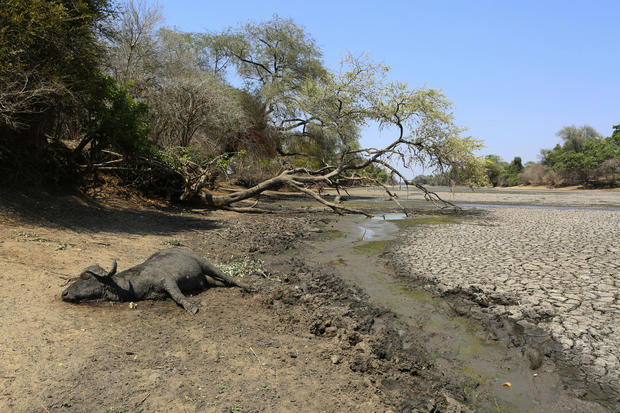
In this Oct, 27, 2019, photo, the carcass of a buffalo lies on the edges of a sun baked pool that used to be a perennial water supply in Mana Pools National Park, Zimbabwe. AP

Mana Pools, a UNESCO World Heritage Site for its splendid setting along the Zambezi River, annually experiences hot, dry weather at this time of year. But this year it's far worse as a result of poor rains last year. Even the river's flow has reduced.

The drought parching southern Africa is also affecting people. An estimated 11 million people are threatened with hunger in nine countries in the region, according to the World Food Program, which is planning large-scale food distribution. The countries of southern Africa have experienced normal rainfall in only one of the past five growing seasons, it said.
Seasonal rains are expected soon, but parks officials and wildlife lovers, fearing that too many animals will die before then, are bringing in food to help the distressed animals. The extremely harsh conditions persuaded park authorities to abandon their usual policy of not intervening.
Each morning, Munyaradzi Dzoro, a parks agency wildlife officer, prays for rain.
"It's beginning to be serious," he said, standing next to the remains of the elephant and buffalo. "It might be worse if we fail to receive rains" by early November. The last substantial rains came in April, he said.
An early end to a "very poor rainy season" has resulted in insufficient natural vegetation to see the animals through, said Mel Hood, who is participating in the Feed Mana project, which is providing supplementary feeding.
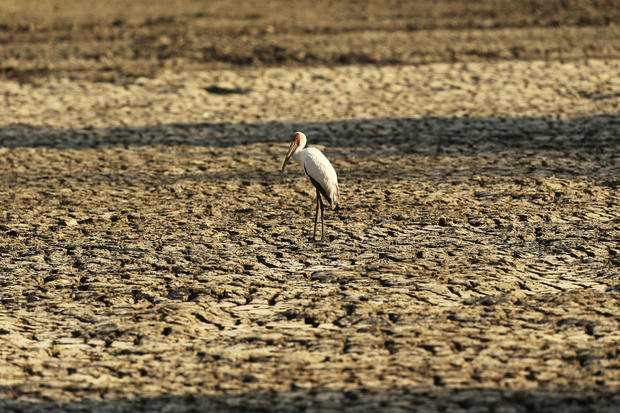


Zimbabwe Wildlife Drought
In this Oct, 27, 2019, photo, a bird stands on a sun-baked pool that used to be a perennial water supply in Mana Pools National Park, Zimbabwe.AP

Most of the animals in Mana Pools "are more or less confined to the barren flood plains," where temperatures soar to 113 degrees Fahrenheit,she said.
Separated from neighboring Zambia by the Zambezi, the region's once reliable sources of water have turned into death traps for animals desperate to reach the muddy ponds. Like the elephant and buffalo, many other animals in the park have gotten stuck in the clay while trying to reach Long Pool, the largest of the watering holes at 3 miles (5 kilometers) long.

The animals were pulled out by rangers, but they could not survive predators on the pounce for weak prey.
"The carnivores attacked it from behind," Dzoro said of the buffalo. The elephant carcass had been there for almost a week and emitted a strong stench as flies feasted on it.
At just 5% of its normal size, Long Pool is one of the few remaining water sources across the park's plains. On a recent day, hippos were submerged in some puddles to try to keep their skin from drying out in the extreme heat while birds picked at catfish stranded in the mud.
Two others of Mana's pools have completely dried up, while the third is just 20% to 30% of its usual size and dwindling, Dzoro said.
There are more than 12,000 elephants roaming Mana's flood plains as well as an abundance of lions, buffaloes, zebras, wild dogs, hyenas, zebras and elands. The animals are visibly affected by the drought. Some impalas show signs of skin mange. In addition to the land animals, the park has 350 bird and aquatic species, according to the parks agency.
In other parts of Mana, park authorities are pumping water from deep boreholes, but the supplies are barely enough, he said.
"We used to say nature should take its course," Dzoro said of the park's normal policy of not intervening and allowing the ecosystem to find its own balance.
"We are now forced to intervene, which is manipulative conservation, because we are not sure when and how we will receive the rain. To avoid losing animals we have to intervene to maintain population sizes," Dzoro said.
With the acacias, other indigenous trees and grasses that provide the bulk of food for herbivores like elephants and buffaloes also decimated by the drought, authorities began supplementary feeding in July.
Trucks and tractors ferry hay to various locations in the 2,196- square-kilometer (848-square-mile) park. In some spots, elephants, buffaloes and zebras are fed next to each other. The Feed Mana project has so far trucked 14,000 bales to the park, said Hood, the animal welfare campaigner.
The group has been appealing for "urgent" donations of items such as soy bean hay, grass and cubes made of nutritious grains and molasses.
"Although it may not be enough to stave off all the hunger pangs, it is certainly giving these animals a chance to survive until conditions improve," Hood said.
Zimbabwe has an estimated 85,000 elephants and neighboring Botswana has more than 130,000. The two countries have the largest elephant population in the world. Zimbabwe says it's struggling to cope with booming numbers of wild elephants and is pushing to be allowed to sell its ivory stockpile and export live elephants to raise money for conservation and ease congestion in the drought-affected parks.


Other African countries, especially Kenya, are opposed to any sale of ivory. And earlier this year the meeting of the Convention on International Trade in Endangered Species voted to continue the ban on all ivory sales.
At Mana Pools, saving the animals is a challenge and officials say Zimbabwe is severely affected by climate change that has changed weather patterns.


In past years, Mana Pools would get up to 24 inches (600 millimeters) of rain per year, said Dzoro, the wildlife officer. Now it's lucky to get half that.
With such a dramatic reduction, "we can't have perennial sources to sustain animals and some of the perennial springs have dried up. Climate change is affecting us. That's why the manipulative way now is the only way to rescue our fauna," Dzoro said.
"Climate change is real for sure, we are witnessing it," he said.


LINK

Wednesday, September 4, 2019

FOCUS: Juan Cole | Bernie Sanders After Saudi Prison Massacre in Yemen: "We Are Complicit in This Nightmare"


Reader Supported News
03 September 19
It's Live on the HomePage Now:
Reader Supported News

FOCUS: Juan Cole | Bernie Sanders After Saudi Prison Massacre in Yemen: "We Are Complicit in This Nightmare" 
Sen. Bernie Sanders. (photo: Joshua Lott/Reuters)
Juan Cole, Informed Comment
Cole writes: "Saudi fighter-jets bombed a makeshift prison on a college campus in Dhamar, Yemen, south of the capital of Sana'a eight times on Sunday, killing at least 100 prisoners according to the International Committee of the Red Cross." 


Wednesday, July 24, 2019

Western Media Losing Enthusiasm for Failing Coup in Venezuela


FAIR

Western Media Losing Enthusiasm for Failing Coup in Venezuela

view post on FAIR.org

by Lucas Koerner and Ricardo Vaz
When previously unknown Venezuelan opposition politician Juan Guaído stood up in an East Caracas plaza and declared himself “interim president” of the South American country, Western corporate media were ebullient.
In those heady early days, corporate journalists could scarcely conceal their love affair with the 35-year-old politician, whom they likened to Barack Obama (CNN2/7/19) and described as a “freedom fighter” (Fox Business1/29/19) and Venezuela’s “only democratically elected figure” (MSNBC1/24/19), who had “captured the heart of the nation” (New York Times, 3/4/19).
Nearly six months later, with Guaído no closer to ousting Venezuela’s elected president, Nicolás Maduro, from Miraflores Presidential Palace, the enthusiasm has dampened. Now that the honeymoon is over, it would appear that corporate journalists have been compelled to reckon with some uncomfortable truths about Guaído, US sanctions and the coup they had been vigorously endorsing.

A dying romance 

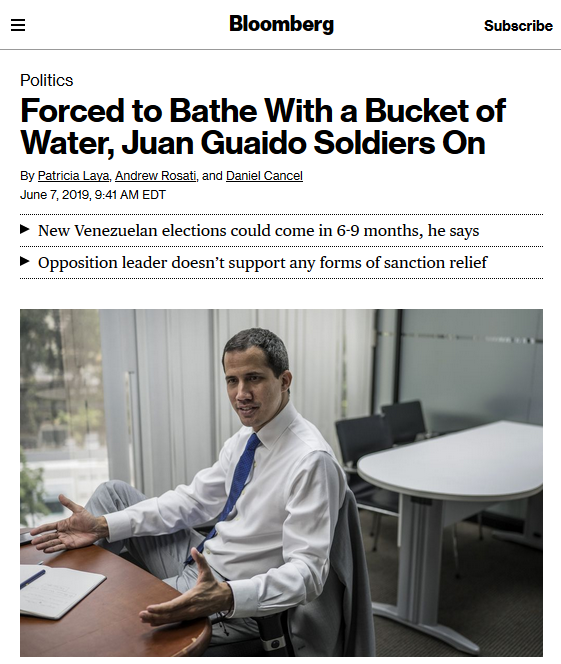
Bloomberg: Forced to Bathe With a Bucket of Water, Juan Guaido Soldiers On
What’s worse than having to bathe with a bucket? Being demoted by Western media from “interim president” to “opposition leader” (Bloomberg6/7/19).
“Disappointed Venezuelans Lose Patience With Guaído,” writes Reuters (7/1/19), in what might be read as a projection of its journalists’ own frustration with Washington’s failing coup.
After Guaído’s self-proclamation in January, the corporate outlet (1/23/19) gushingly described him as a “salsa-loving baseball fan,” who posed “the boldest challenge to socialist President Nicolas Maduro’s rule in years.”
Similarly, the CBC in January (1/23/19) labeled hard-right Popular Will party leader Guaído a long-time “activist” at the head of a “centrist social-democratic party.”  Most recently, the state network (6/29/19) declared that the opposition leader, depicted in a gloomy headshot, “has few cards to play—and not long to play them.”
There is no clearer indication of the Western media’s growing disillusionment than the gradual demotion of Guaído from “interim president” to “National Assembly president” or “opposition leader.” For example, ABC News was referring to Guaído as “interim president” (often without the “self-proclaimed” prefix) as recently as May (5/3/195/5/19). Fast forward two months, and the title is just “opposition leader” (6/26/197/5/19).
In yet another sign that the US-backed coup is running on empty, corporate journalists’ triumphalist tone that followed Guaído’s self-proclamation has given way to reports that he “remains defiant” (CNBC5/2/19), “soldiers on” (Bloomberg6/7/19) or is “under pressure” (Telegraph6/19/19).
The growing doubts from the media establishment mirror those in DC, with rumors circulating that Trump is “losing patience and interest” in Venezuela (Washington Post6/19/19). Having gone all in on a horse falling rapidly behind in the regime-change race, Secretary of State Mike Pompeo and “special representative” Elliott Abrams are now forced to take turns publicly reiterating US support for Guaído.
The opposition leader’s fading luster has not been helped by a corruption scandal that accused his appointed envoys to Colombia of embezzling “humanitarian aid” money. The story was unveiled by the Miami-based and rabidly anti-government outlet PanamPost (6/18/19), and was too big to ignore. All the media could do was try to spin it as “Guaído Calls for Probe” (Reuters6/15/19), but the damage was done.

Cracks in sanctions denial

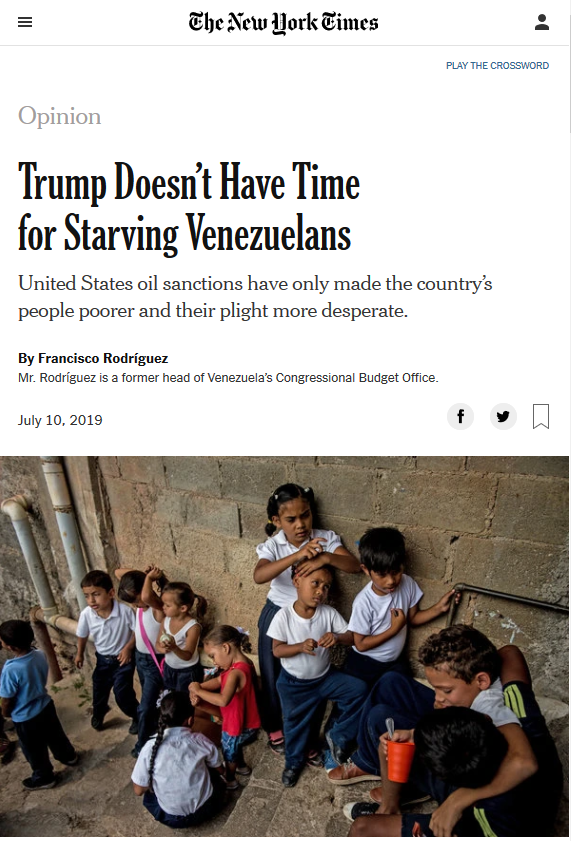
NYT: Trump Doesn't Have Time for Starving Venezuelans
That Washington’s policies are causing starvation is a crucial thing for US citizens to know, but it’s information that’s mostly confined to opinion pieces like this one in the New York Times (7/10/19).
Guaído’s failing coup has even led to a few cracks in the refusal of corporate outlets to acknowledge the devastating humanitarian toll of US sanctions on Venezuela since 2017, which were escalated in January when the Trump administration imposed an oil embargo, cutting the country off from its No. 1 cash buyer.
As Joe Emersberger reported for FAIR (6/14/19), on June 9 Reuters finally mentioned a study by economists Mark Weisbrot and Jeffrey Sachs that found US sanctions responsible for as many as 40,000 Venezuelan deaths in 2017–18.
Reuters had buried the report for over a month, and has since reverted to its standard practice of framing the humanitarian impact of US sanctions as a mere allegation by the Maduro administration.
A few exceptions notwithstanding (Financial Times7/7/19Independent7/7/194/26/19), the corporate press has all but suppressed the Weisbrot/Sachs report (FAIR.org6/26/19), with most outlets portraying Venezuela’s economic destruction as a condition preceding US sanctions, imposed first under Obama in 2014–15 and ratcheted up by Trump in 2017.
The New York Times (7/6/19) elevates this mystification into an art form, presenting the collapse of Venezuelan agriculture, largely due to sanctions-induced fuel shortages, as the culmination of “six years of economic crisis under President Nicolás Maduro, whose policies of price controls, expropriations and state-sanctioned embezzlement have wiped out the country’s private sector”—which sanctions have merely “worsened.”  Even more remarkably, the paper of record published an article (5/17/19) interviewing economists on the scale of Venezuela’s crisis that managed to avoid quoting any anti-government economists critical of sanctions, such as Francisco Rodriguez, let alone mentioning the Weisbrot/Sachs study.
On the op-ed pages, some corporate outlets have been more candid about the danger that US sanctions could cause “famine” in Venezuela (Financial Times7/3/19New York Times7/10/192/28/19).
However, only in the Times op-ed by economist Francisco Rodriguez (7/10/19) does the public encounter an acknowledgement of the 2017 sanctions’ role in Venezuela’s current economic devastation. In other cases, corporate journalists continue to deny or downplay the existence of broad-ranging US economic sanctions all-together, pretending they only affect government officials.
The Guardian (5/21/19) went the farthest, referring to coercive US measures that have hit multiple sectors of the Venezuelan economy and resulted in thousands of deaths as “financial sanctions on Venezuela’s president.”

Old habits die hard

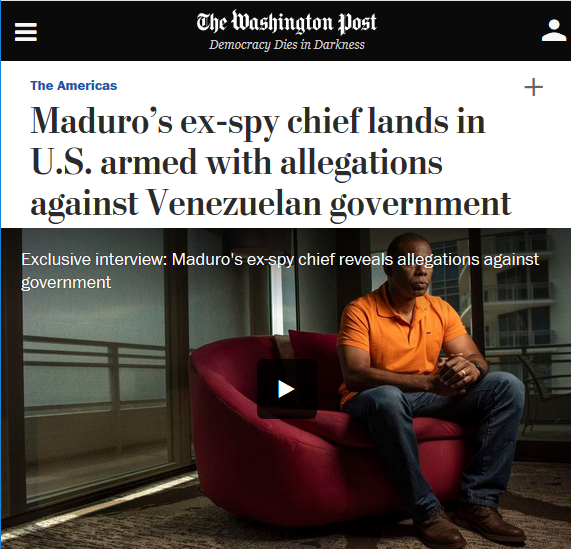
WaPo: Maduro’s ex-spy chief lands in U.S. armed with allegations against Venezuelan government
The Washington Post (6/24/19) unskeptically relays the claims of a Venezuelan defector.
Disappointed by Guaído’s fading star, Western reporters have labored to mint new pro-Washington heroes worthy of their regime change fantasies. In the wake of Guaído and Leopoldo Lopez’s botched April 30 putsch, corporate media discovered a new champion in former Venezuelan intelligence chief Manuel Cristopher Figuera, who aided in the coup attempt.
In an exclusive interview, the Washington Post (6/24/19) glowingly described Figuera as “a muscular 55-year-old [who] was one of the revolution’s true believers.” Despite defecting from his country to collaborate with a hostile foreign power, the ex-top spy is heralded as a source of indisputable veracity, whose unsubstantiated claims about Cuban capture of Venezuelan politics (FAIR.org3/26/19) or Hezbollah activity in the country (FAIR.org5/24/19 ) are to be taken at face value.
As in the case of former intelligence czar Hugo “El Pollo” Carvajal (New York Times2/21/19), currently facing extradition to the US on drug charges, no effort is made to interrogate defectors’ incentives to fabricate “information” that just happens to legitimate Washington’s casus belli. The ultimate goal is not to prove any nefarious activity, which is highly implausible, but to provide moral justification for regime-change efforts.
In its quest for new anti-Maduro stalwarts, the corporate press does not draw the line at rehabilitatingrogue spies “accused of arbitrary detentions and torture.” In a remarkable feat of historical revisionism, AP’s Joshua Goodman (6/25/19) exalts the “bravery” of former Caracas security chief Ivan Simonovis, who escaped house arrest and fled to the US last month.
Simonovis had been handed a 30-year sentence in 2009 for the death of two people when snipers opened fire at the Llaguno Bridge on April 11, 2002. A total of 19 pro- and anti-government demonstrators were killed in a massacre that Goodman falsely terms a “gunfight,” setting the stage for a coup that temporarily ousted President Hugo Chávez.
Goodman ignores that “supercop” Simonovis’ Metropolitan Police was notorious for its brutality, with even former chief Jhonny Campos casting doubt on the force’s human rights record.
“Venezuela’s Metropolitan Police was, without a doubt, the security force most reviled by the poorest members of society,” observes George Ciccariello-Maher, an expert on Venezuelan popular movements:
Associated with political repression, drug dealing, kidnapping and rape, the Metropolitan Police was so loathed that residents of working-class barrios often demanded the army be sent in to replace them.
Goodman went on to approvingly cite Simonovis’ contracting of former New York Police Commissioner William Bratton, himself accused of criminalizing poor communities with “broken windows” policing.
Western media’s newfound doubts about Guaído and reluctant admissions of the deadly effects of sanctions are not a case of journalistic standards starting to take over. Rather, this cognitive dissonance reflects the utter disorientation that has come to characterize Guaído and his US handlers’ operation. The end result is journalists, attempting to stay the US regime-change course tainted by Guaído’s serial failures, laundering the reputations of the foulest of anti-government figures in the process.

Featured image: CBC depiction (6/29/19) of Juan Guaído.


FAIR/Fairness & Accuracy In Reporting
124 W. 30th Street, Suite 201
New York NY 10001
USA


Friday, May 24, 2019

Pelosi, Hoyer: Don't Let Trump Sneak Bombs to Saudi


JUSTFOREIGNPOLICY


The History

The conflict in Yemen has been raging on for nearly half a decade since Saudi Arabia, along with the help of other Gulf powers and the US and UK, intervened in the political situation of the country. The US and UK have readily supplied the Saudi forces despite clear evidence of mass civilian casualties and purposeful starvation of the Yemeni populace akin to genocide.
Read More


Just Foreign Policy


Connecticut Senator Chris Murphy is warning that Trump may try to evade a Congressional vote that would block sending more bombs to help the Saudi regime kill civilians in Yemen, by declaring yet another fake “emergency.” Senators Rand Paul, Robert Menendez, and Lindsay Graham have stated their opposition.

But so far, Nancy Pelosi and Steny Hoyer haven’t done anything, even though they control floor action in the House.

If Trump gets away with evading a Congressional vote against arming Saudi war crimes in Yemen by declaring a fake “emergency,” it would set a terrible precedent. In the future, Trump or any President could arm anyone they want to bomb anyone they want without the people’s representatives in Congress having any say-so.
If history records that House Democrats, even though they were in the majority, did nothing to try to stop Trump from continuing to arm Saudi war crimes, it would set an even worse precedent.

Urge Nancy Pelosi and Steny Hoyer to act to block Trump from arming Saudi war crimes by signing our petition.
Thanks for all you do to help make U.S. foreign policy more just, 
Sarah Burns, Hassan El-Tayyab, and Robert Naiman

Just Foreign Policy


If you think our work is important, please make a donation to support it.
http://www.justforeignpolicy.org/donate


Please support our work. Donate for a Just Foreign Policy
© 2019 Just Foreign Policy


Monday, April 10, 2017

CounterCurrents: On Finding A Homeless Person In A Blizzard!


Dear Friend,

If you don't mind, and if you think the content of this news letter is critical for the dignified living and survival of humanity and other species on earth, please forward it to your friends and spread the word. It's time for humanity to come together as one family! You can subscribe to our news letter herehttp://www.countercurrents.org/news-letter/. 

In Solidarity

Binu Mathew
Editor
www.countercurrents.org


The U.S. Navy’s Anti-Environmental Broadside In The Gulf of Alaska 
by Dahr Jamail 


It’s war in the Gulf and the U.S. Navy is on hand to protect us. No, not that Gulf! I’m talking about the Gulf of Alaska and it’s actually mock war — if, that is, you don’t happen to be a fin whale or a wild salmon.


On Finding A Homeless Person In A Blizzard!
by Sally Dugman 


Let’s all have simple minds and not walk on by. It doesn’t take a genius to know the appropriate way to respond to suffering and misery that’s right up in your face. “Walk on by?” No, reject the status quo instead regardless of whether your passion is climate change, overpopulation, homeless people, environmental destruction, the sixth great extinction, resource shortages, starvation, warfare or any combination of these dangers. Come on. Join my sister and me. Don’t walk on by!


Syria Chemical Weapon Attack:  Truth Comes At A Cost
by Dr Arshad M Khan 


Truth would be refreshing, but it comes at a tremendous cost.  Ask some recent purveyors.


Trump’s Syria Attack Poses New Conundrums For The Anti-War Movement
by Raghav Kaushik 


The anti-war movement has rarely been so fragmented. Yet, there is an urgent need for unity within the movement. How the movement responds to this challenge will determine how effective it is.


Science Needs To Be Set Free For The Good Of Mankind
by Professor BM Hegde 


This article is based on the Presidential Speech by well-known physician, Dr BM Hegde at the 40th Annual Congress of the Indian Social Science Academy, held in Mysore, Dec 19-23, 2016. We are publishing the entire content of the speech in the light of the many brilliant and thought-provoking observations made on science and health but cannot verify all the statements made here by Prof. Hegde. We welcome a healthy debate on his ideas in the spirit of true enquiry to enhance our collective understanding of the themes he has addressed.


Australia, India And Coal Proliferation
by Shankar Sharma 


An open letter (of 5 November 2014), which was sent to the Australian political leaders highlighting the India’s true relevance of coal import from Australia by Power Policy Analyst Shankar Sharma is published here to reveal the associated problems to the Indian society.


WSS Condemns Threats By Bajrang Dal On WSS Activist In Assam
by Women Against Sexual Violence and State Repression 


Women against Sexual Violence and State Repression (WSS) strongly condemns the manner in which our member Ms Bondita Acharya, a well known women’s activist from Jorhat, Assam, is being criminally intimidated, abused in sexual language, defamed and trolled on her Facebook account only because she expressed her personal opinion regarding eating of beef, a common practice in her state of Assam, and opposed targeting of Muslims for the same.