Search This Blog

Translate

Blog Archive

Middleboro Review 2

NEW CONTENT MOVED TO MIDDLEBORO REVIEW 2

Toyota

Since the Dilly, Dally, Delay & Stall Law Firms are adding their billable hours, the Toyota U.S.A. and Route 44 Toyota posts have been separated here:

Route 44 Toyota Sold Me A Lemon


Showing posts with label FIONA HILL. Show all posts

Wednesday, November 27, 2019

Talking Turkey About Impeachment Hearings


FAIR


Talking Turkey About Impeachment Hearings


by Dorothee Benz
Congratulations, you made it through the public hearings of the impeachment inquiry, one eye on the livestream and one eye on your work email, and somehow you met your deadlines even as you followed along blow by blow. So what are you going to say about it around the Thanksgiving dinner table?
There were certainly some moments designed to stoke feelings of patriotism as we head into the heavily mythologized, uniquely American holiday this week. Alexander Vindman (New York Times, 11/19/19): “The uniform I wear today is that of the United States Army. We do not serve any particular political party; we serve the nation.” Fiona Hill (New York Times11/21/19): “I have no interest in advancing the outcome of your inquiry in any particular direction, except toward the truth.”
Perhaps you faithfully read every New York Times piece on the hearings (131 by my count as of November 22, 2019, based on their impeachment landing page). So you’re ready, maybe, to go toe-to-toe with Trump-supporting Uncle Joe about how Sondland’s story has changed and why his public testimony is the one Uncle Joe should believe.
You’re revved up by the descriptions of the “bombshell” revelations (11/20/19), “extraordinary” testimony (11/20/19) and “riveting” witnesses (11/21/19). Trump’s dealings with Ukraine, you are itching to pronounce no later than your first piece of pumpkin pie, are clearly, documentably a quid pro quo and an impeachable offense.
You’re right about that, but let me suggest a different approach to your anticipated intra-familial political discussion.

Burying the lead
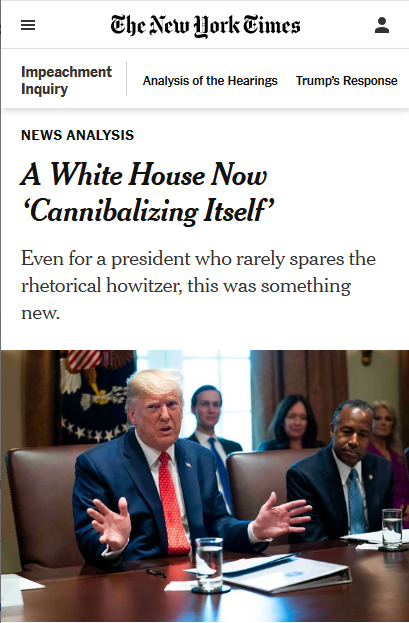
NYT: A White House Now ‘Cannibalizing Itself’
To the New York Times (11/19/19), the interesting news is that Trump was tweeting against White House staffers—not that the Army was considering moving an officer's family onto a military base because his criticisms of the president may have put them in danger.
On November 19, in a news analysis piece titled “A White House Now ‘Cannibalizing Itself,’” the Times  (11/19/19) went on at length (1,600 words) about the novelty of a sitting president publicly attacking members of his own staff. What the Times deemed “remarkable” was not Trump’s “attacks on his enemies real or perceived,” which “have become so routine that they now often pass unnoticed,” but rather that the “rhetorical howitzer” was now aimed at people who “still work for the very same White House that was publicly assailing them.”
Halfway through this article, there is this spartan description of threats to one such person, Col. Vindman:
The Army has been assessing potential security threats to Colonel Vindman and his brother Yevgeny, who also works at the National Security Council. There have also been discussions about moving the Vindmans and their families onto a military base for their protection.
But in contrast to the adjective-rich astonishment the Times expressed at Trump’s attacks on his own staff, this tidbit is unworthy of further comment for the paper of record. Sadly, threats of violence to anti-Trump witnesses are not new (think Christine Blasey Ford), but they are much more important to the story of the impeachment proceedings—and the survival of what is left of US democracy—than the new but unsurprising fact that Trump’s Twitter vomit has now landed on people inside the White House as well as outside.
House Intelligence Committee Chair Adam Schiff, the presiding officer at the impeachment hearings, had admonished Trump about witness intimidation four days earlier, when Trump assailed Marie Yovanovitch in a tweet during the former ambassador’s testimony.  The Times article (11/15/19) on that incident reported:
Mr. Trump has a history of using his platform to excoriate people who are in a position to serve as witnesses to his own potential wrongdoing, using Twitter and statements at his political rallies to criticize less well-known people by name, in humiliating and sometimes threatening ways…. The tactic functions not just as an attempt to discredit his critics, but as a warning to deter others from coming forward.
This is solid and appropriate context in the story but, once again, the article stays on the surface and avoids even hinting at the consequences of this kind of political behavior, opting instead to dive into legal definitions of witness-tampering.
At the risk of stating the incredibly obvious, I’m going to say that a society in which witnesses have to fear for their safety when they expose government corruption or other wrongdoing is a society distinctly titling more towards authoritarianism than democracy. That the New York Times hasn’t raised the alarm about that is… alarming. It is more Nazi-normalizing barf journalism.
I might also suggest that phrases like “rhetorical howitzer” are better avoided under these circumstances.

Missing the point 
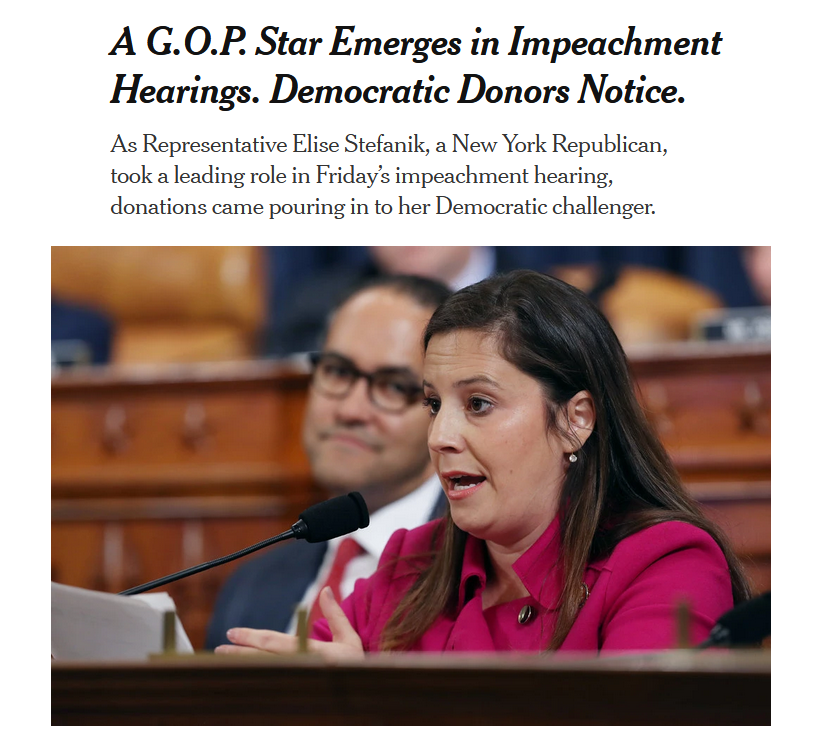
NYT: A G.O.P. Star Emerges in Impeachment Hearings. Democratic Donors Notice.
New York Times headline (11/18/19) combines politics as theater review with election coverage as fundraising horse race.
The larger problem with the Times’ coverage of the impeachment hearings is also exemplified in the “cannibalizing itself” article. Yes, Trump is an equal-opportunity bully and liar who is willing to attack his own staff. But the first half of that sentence is more important than the second. The Times’ emphasis in this piece reminds me of the time our son got drunk, went skateboarding, and ended up in the ER. What did he learn? we asked him afterwards.
“I shouldn’t ollie a full flight of stairs while drunk,” he replied.
The bigger and more important story is that Trump and the GOP are assaulting the legitimacy of the impeachment inquiry itself—it’s not that they are using one particular tactic or another. Everything—from refusing to turn over documents, to pressuring witnesses not to testify, to intimidating and smearing them when they do—is about a claim to unlimited executive power that is straight out of the authoritarian playbook.
The New York Times’ voluminous coverage of the hearings details many of the pieces that make up the overall strategy, but the vast majority of it boils down to the predictable formula of covering the whole process like a partisan horse race. A sampling of Times headlines:
  • “An Ideal Witness for the Democrats” (11/13/19)
  •  “A ‘Circus’ or an ‘Education’: How Impeachment Is Playing on the Radio” (11/14/19)
  • “How Swing State Voters Feel About Impeachment” (11/15/19)
  • “Jordan Brings Pugnacious Style to Impeachment Defense of Trump” (11/15/19)
  • “In Prime Time, Two Versions of Impeachment for a Divided Nation” (11/16/19)
  • “Republicans Shift Defense of Trump While He Attacks Another Witness” (11/17/19)
  • “A GOP Star Emerges in Impeachment Hearings. Democratic Donors Notice.” (11/18/19)
  • “House Democrats Adopt a Sharper, Simpler Vocabulary” (11/18/19)
  • “Partisan Lawyers Seize Leading Roles in Impeachment Hearings” (11/19/19)
  • “A Republican Strategy Revealed” (11/19/19)
It sounds alternately like an NFL halftime report and a review of a Broadway show.
Even the five pieces described as “news analyses” that ran during the phase of the public hearings fall short of deserving that label, and none go any deeper than the rest of the coverage. “The Impeachment Witnesses Not Heard” (11/21/19), for instance, rehashes the relevant details of the administration’s refusal to cooperate  with the investigation, and analyses the partisan considerations in GOP stonewalling and the Democrats’ decision not to go to court over it. “But it leaves some frustrated about the missing pieces,” the article says, and, folks, that’s as deep as it gets.

Less than the sum of the parts
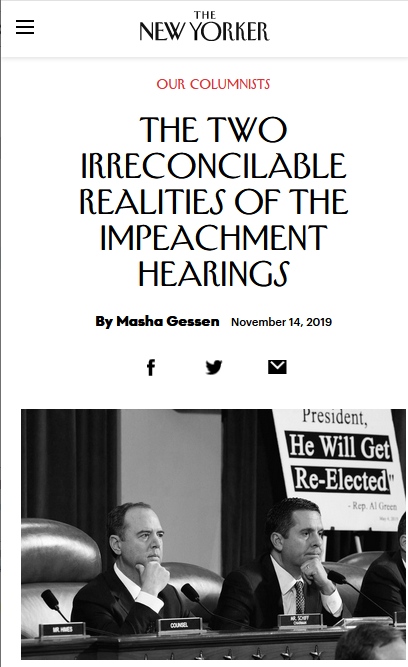
New Yorker: The Two Irreconcilable Realities of the Impeachment Hearings
Masha Gessen (New Yorker11/14/19): "To upset the equilibrium, the Democrats would have to devise a strategy that would penetrate the Republicans’ reality bubble...like an attack on all fronts."
Masha Gessen (New Yorker, 11/14/19) provided a framing analysis in a single column that the New York Times could not manage to do in its 131 articles. The impeachment hearings, they said, consist of two simultaneous realities: one where Trump “is guilty of abusing power in many ways and on many occasions, and one such occasion is being dissected and laid out in great detail,” and the other where “Democrats are out to get Trump at any cost, have latched onto a muddled and inconsequential incident, and are laying it out in great detail.”
“These two realities do not overlap,” they note.
What euphoric Reality One acolytes see as damning testimony and obvious evidence of Trump’s guilt, Reality Two adherents dismiss out of hand as further proof that Democrats/the liberal establishment/the deep state/the media are out to get Trump. Critically, what the Reality One camp doesn’t understand is that for the Reality Two camp the incoherence of Republican attacks on the evidence doesn’t matter. Gessen gets to the heart of it:
Republicans are not actually defending the president against accusations of abuse of power; instead, they are mounting an offense against the Democrats, whose very enterprise they consider illegitimate.
Gessen’s point is that the Republicans are playing a whole different game than the Democrats, and the Democrats don’t realize it and will lose as a result:
The impeachment hearings ought to lay down a record of abuses that will make future historians blush, rather than a protocol of the time that the Democrats tried to get Trump on the one obscure smoking gun they had—and failed.
Agreed. 🤦
But that the Democrats have, true to form, opted to make the whole less than the sum of its parts, is no excuse for the media to do the same.
Why exactly the New York Times is studiously keeping its impeachment coverage so superficial I don’t know. My hunch is that it has to do with the Times’ longstanding affinity for legitimizing power and, as I’ve said elsewhere, the belief that the stability of US institutions is more important than their integrity. Naming and scrutinizing the extent of the assault on democratic norms revealed in the impeachment proceedings would lay bare the fragility of those institutions. But honestly, I don’t know, and that is a speculation.
But that this approach to covering the Trump administration is deliberate is quite clear.  On Sunday, former Times copy editor Carlos Cunha (Salon11/24/19) exposed what he called the  “project of Trump-dignification” at the paper (and I call, following Bess KalbNazi-normalizing barf journalism), detailing not only how he was fired for a single edit seen as unfair to the Trumpists, but also how the Times’ upper brass has sought to placate Trump (including the refusal to call him a racist).

The myth of objective journalism 

While I can’t answer the big question of why the Times’ coverage is content to stay lost in the trees and avoid looking at the forest, I want to highlight two factors that clearly contribute to the phenomenon.
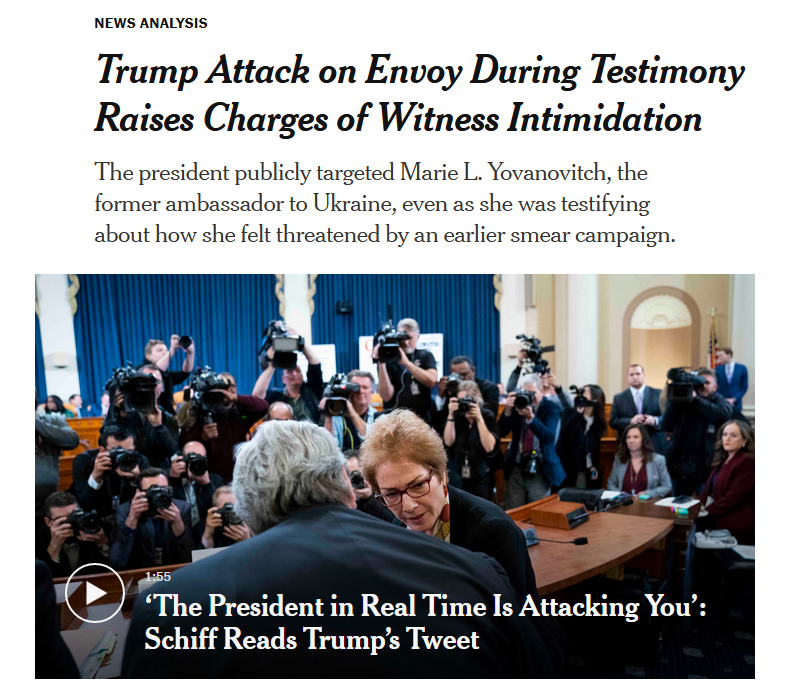
NYT: Trump Attack on Envoy During Testimony Raises Charges of Witness Intimidation
In the New York Times (11/15/19), Trump attacking a witness testifying against him isn't witness intimidation; it just "raises charges of witness intimidation."
The first is the use of false equivalencies in the name of “not taking sides” (a well-documented problem that FAIR readers are familiar with). This takes the form of he-said-she-said reporting, for instance in the pairing (11/15/19) of Adam Schiff’s statement that Trump’s tweet about Yovanovitch was witness intimidation with the White House’s statement that it was not; and also the presentation of both true and false statements as ‘so-and-so claims…’ “Democrats argued that Sondland’s testimony bolstered their case for impeaching Trump” (11/20/19), for example, could more accurately be rendered, “Sondland’s testimony bolstered the Democratic case for impeaching Trump.”
The larger problem with this approach to reporting is that it severely inhibits the ability to offer any analysis of political processes, a fact that itself reinforces the status quo and thus belies the idea that this approach is somehow objective.
The second factor clearly contributing to the Times’ narrow lens on the impeachment process is that your Uncle Joe is in fact right: The “liberal media” do hate Trump. (You say liberal, I say neoliberal… basically corporate media; not all of it, but most of it.)
Mainstream media disdain for Trump is obvious in thousands of details every day, but precisely because of the myth of objective journalism, reporters’ and editors’ views of how Trump is a bad president or a terrible human being have no legitimized expression. Rather than being clearly stated, where they can be debated, they are passive aggressively inserted in nuggets like the Times’ comment (11/20/19) on the note Trump read to reporters—“scrawled out in large block letters.”
I believe it is that same anti-Trump perspective that has led the New York Times to follow the Beltway impeachment crowd over the cliff in their pursuit of that “one obscure smoking gun,” as Gessen put it. Rather than explore the full extent of the Trumpist lurch towards authoritarianism, much of which is palpable and documentable but not necessarily “provable” in the way the Ukrainian extortion scheme is, they’ve gone all in on the obsession with the smoking gun.
It’s a bitter irony that the Times’ bias against Trump has contributed to the downplaying of the danger he poses to the US.
But it might give you and Uncle Joe something to agree on, from which, who knows, maybe you’ll convince him to start watching Democracy Now! with you.

You can send a message to the New York Times at letters@nytimes.com (Twitter:@NYTimes). Please remember that respectful communication is the most effective.


Saturday, November 23, 2019

FOCUS: Frank Rich | Republicans Are Excusing a Criminal Conspiracy


Reader Supported News
22 November 19

Can a Reader Supported News Agency Survive?
The commercialists say no, it cannot happen, that's not the way our system works, nothing survives outside the corporate mainstream. What say you?
Donating only takes a few clicks.
Thanks to all in advance,
Marc Ash
Founder, Reader Supported News
Sure, I'll make a donation!

Update My Monthly Donation

If you would prefer to send a check:
Reader Supported News
PO Box 2043
Citrus Hts, CA 95611


Reader Supported News
22 November 19
It's Live on the HomePage Now:
Reader Supported News


FOCUS: Frank Rich | Republicans Are Excusing a Criminal Conspiracy
Ranking member of the House Intelligence Committee, Representative Devin Nunes, and minority counsel Steve Castor confer during the impeachment hearing on November 13, 2019. (photo: Drew Angerer/Getty)
Frank Rich, New York Magazine
Rich writes: "How damaging is Sondland's testimony for the Republicans' defense of Trump? If the Republicans cared about the facts or the gravity of the crime being investigated, the answer would be apocalyptically damaging."

RE: JEFFREY EPSTEIN:
I’m much more interested in the repercussions for the various see-no-evil, hear-no-evil American Establishment figures who hung out with Epstein, in some cases took his money and favors or gave him money and favors, and are skating away (or trying to): Alan Dershowitz, Leslie Wexner, and Leon Black most of all in terms of documented interaction with Epstein, but also such hangers-on as Bill Clinton and Bill Gates, not to mention the Harvard retinue led by Larry Summers and Steven Pinker. Go to YouTube, watch the roughly 50-minute Prince Andrew interview in its entirety, and imagine all these American Establishment men being subjected to a similarly rigorous inquiry. It will chill the blood.


Friday, November 22, 2019

Trump went on an unhinged tirade on ‘Fox & Friends’ — here are the 5 craziest moments


What the hell just happened?

About this website

RAWSTORY.COM
President Donald Trump on Friday came completely unglued during a bonkers interview on “Fox & Friends” in which he lashed out at his own former officials,


President Donald Trump on Friday came completely unglued during a bonkers interview on “Fox & Friends” in which he lashed out at his own former officials, spouted Russian-backed conspiracy theories, and even cast aspersions on one of his most trusted advisers.
Below are the five craziest moments in Trump’s interview.
1.) Trump repeats the insane Crowdstrike conspiracy theory that has been pushed by Russia.
One day after former National Security Council official Fiona Hill testified that Republican lawmakers needed to stop spreading misinformation about Ukraine designed to help Russia, the president did just that by spouting off the debunked conspiracy theory about the Democratic National Committee’s server being located in Ukraine.
“They have the server from the DNC!” Trump fumed.
“Who has the server?” asked co-host Brian Kilmeade.
“They gave the server to Crowdstrike, which is a company owned by a very wealthy Ukrainian,” the president insisted.
At this point, even co-host Steve Doocy tried to get the president to walk back the conspiratorial chatter.
“Are you sure they did that?” he asked.
“Well, that’s what the word is,” Trump replied.
2.) Trump condemns former American ambassador to Ukraine Marie Yovanovitch for purportedly refusing to hang up his picture in her office.
The president took particular glee in attacking Yovanovitch, the former ambassador who was ousted after a concerted smear campaign run by Trump attorney Rudy Giuliani.
“This ambassador that everyone says is so wonderful, she wouldn’t hang my picture in the embassy,” the president said. “This was not an angel, this woman, okay? And there were a lot of things that she did that I didn’t like.”
He also complained that Republicans didn’t attack her enough during impeachment hearings and said they only refused to do so because of her gender.
3.) Trump blames White House counselor Kellyanne Conway for her husband’s criticisms of his presidency.
Even though Kellyanne Conway has been one of Trump’s loyalest defenders, the president couldn’t help taking a dig at her over her husband George Conway, who has been a leading conservative voice in the call for impeachment.
“She must of done a number on him,” Trump said, referring to the Conways. “She must’ve done some bad things to him, because that man’s crazy.”
4.) Trump takes sole credit for China not turning Hong Kong into a nuclear wasteland.
Although the president has taken criticism for not speaking out more forcefully on the deteriorating human rights situation in Hong Kong, he insisted to “Fox & Friends” that he was the only thing stopping Chinese President Xi Jinping from massacring the entire city.
“If it weren’t for me, Hong Kong would’ve been obliterated in 14 minutes,” the president claimed, before adding, “We have to stand with Hong Kong, but I’m also standing with President Xi.”
5.) Trump bungles his own defense by making it sound like he encourages corrupt behavior.
Trump’s biggest flub came after co-host Steve Doocy said that European Union ambassador Gordon Sondland testified that there was a quid-pro-quo arrangement in which the president would only agree to a face-to-face meeting with Ukrainian President Volodymyr Zelensky if he agreed to launch investigations into purported “corruption” that just happened to involve his political opponents.
While insisting that he’s sincerely working to fight corruption at home and abroad, Trump said, “I do want, always, corruption — I say that to anybody!”


President Donald Trump Role In Ukraine Scheme Uncontested After Hearings | Rachel Maddow | MSNBC


After five days of public witness hearings in the Donald Trump impeachment inquiry, Rachel Maddow looks at the consistency of the testimony in describing Trump's role in ordering and overseeing the Ukraine quid pro quo scheme. Aired on 11/21/19.


Russian Propaganda Seen Fusing With Republican Ukraine Narrative | Rachel Maddow | MSNBC


Rachel Maddow shares video of testimony by former National Security Council official Fiona Hill in which she describes the Russian propaganda roots of the Ukraine conspiracy theory promoted by Donald Trump and his followers and notes the dismaying fusing of Russian propaganda narratives with U.S. Republican talking points. Aired on 11/21/19.


WH Shaken After Hearings But Confident In Senate GOP | Morning Joe | MSNBC


The Morning Joe panel recaps Thursday's hearing with Fiona Hill, the president's former top adviser on Russia and Europe, and David Holmes, a counselor for political affairs at the U.S. embassy in Ukraine. Aired on 11/22/19.


'Fiona Hill Is President Donald Trump's Worst Nightmare' | Morning Joe | MSNBC


The panel discusses Fiona Hill's testimony Thursday before the before the House Intelligence Committee. Aired on 11/22/19.


Kareem Abdul-Jabbar | Are 'Harriet' and Slavery Films Good for African Americans?


Reader Supported News
21 November 19

Make no mistake about it, this project does not continue without 1% of the readers contributing on a monthly basis. We would love to be able to do more, we can’t. So far during the course of this fundraiser 300,000 people have visited RSN 206 have donated.
That is silly and wrong. Sorry.
Marc Ash
Founder, Reader Supported News


If you would prefer to send a check:
Reader Supported News
PO Box 2043
Citrus Hts, CA 95611


Reader Supported News
21 November 19
It's Live on the HomePage Now:
Reader Supported News


Kareem Abdul-Jabbar. (photo: Getty)
Kareem Abdul-Jabbar, The Hollywood Reporter
Abdul-Jabbar writes: "In the past seven years, seven high-profile movies about slavery have been released, the most recent being Harriet, chronicling the extraordinary life of slave liberator Harriet Tubman."

EXCERPT:
I also worry that so many movies about slavery risk defining African Americans’ participation in American history primarily as victims rather than as victors in a continuous battle for economic and social freedom. The thousands of black soldiers who died fighting on behalf of the country, the martyred civil rights leaders, even our many scientific innovations and inventions that transformed American society — from refrigeration to blood banks — get dismissed, diminished or ignored because all that some white Americans remember are angry black faces crying “Unfair!” This puts a heavy burden on blacks to continually prove how vigorously they support the country that once enslaved them. They are expected to ignore the current inequities and just be grateful the country unlocked the chains. We stopped beating, branding, raping and lynching you — isn’t that enough?
No, it isn’t, which is why these films are so important. After all, despite dozens of movies and TV shows about the Holocaust (including the recent brilliant film Jojo Rabbit), anti-Semitism is on the rise in Europe and the U.S., with younger Americans less likely than older ones to believe the Holocaust actually happened. People are eager to forget that average people just like them are capable of supporting a government that incinerates Jews, enslaves blacks and cages immigrant children. The more horrible the deed, the more eager we are to forget.

The first step to forgetting is muddling history. A 2018 report showed that 58 percent of teachers were dissatisfied with what their textbooks offered on slavery, while 40 percent said their state offered little or no support for teaching about slavery. In 2015, a Texas textbook taught that blacks were “immigrants” and “workers” rather than enslaved people. (The book also referred to Moses as a Founding Father, misled about scientific consensus on climate change, included racist cartoons and minimized the principle of separation of church and state.) It was changed, but only after a black student sent his mother an image of a textbook page and she posted it on Facebook. The effect on our children of this deliberate blurring of history is measurable ignorance: Only 8 percent of high school seniors knew slavery was the primary cause of the Civil War, according to a 2018 report from the Southern Poverty Law Center. Adults nationwide do better, but not good enough: A Washington Post-SSRS poll in August asked random Americans about American slavery. On average, respondents were able to correctly answer only two of five questions. Only 52 percent knew slavery was the main cause of the Civil War.


Fiona Hill, the National Security Council's former senior director for Europe and Russia, arrives to testify in the impeachment inquiry on Thursday in Washington. (photo: Chip Somodevilla/Getty)


Elliot Hannon, Slate
Hannon writes: "The White House's former top Russia expert, Fiona Hill, takes the stage in the impeachment hearings Thursday morning."

Though Hill left her post in July, days before the infamous July 25 phone call with the Ukrainian president, she is a key witness in that she was present for a number of early meetings and discussions about the Ukraine quid pro quo, which she described in closed-door testimony as “pretty blatant.” In her post as senior director for Europe and Russia on the National Security Council, Hill supervised Army Lt. Col. Alexander Vindman and can speak to his testimony and job performance. Vindman’s work has been called into question by Hill’s successor in the post, Tim Morrison, as part of the Republican pushback to Vindman’s damning testimony. Hill also directly reported to former national security adviser John Bolton and is seen as a window into Bolton’s thinking and potential testimony. 
In Hill’s opening statement, she took a direct shot at the Republicans on the committee—and one big orange one in the White House—that have mounted a muddling justification for Trump’s actions based on the false narrative around Ukraine’s made up role in the 2016 election. It’s a play taken directly from the Kremlin’s propaganda playbook and Hill explicitly says so. 
Based on questions and statements I have heard, some of you on this committee appear to believe that Russia and its security services did not conduct a campaign against our country—and that perhaps, somehow, for some reason, Ukraine did. This is a fictional narrative that has been perpetrated and propagated by the Russian security services themselves.

“The unfortunate truth is that Russia was the foreign power that systematically attacked our democratic institutions in 2016. This is the public conclusion of our intelligence agencies, confirmed in bipartisan Congressional reports. It is beyond dispute, even if some of the underlying details must remain classified,” Hill said in her opening statement. “As Republicans and Democrats have agreed for decades, Ukraine is a valued partner of the United States, and it plays an important role in our national security. And as I told this Committee last month, I refuse to be part of an effort to legitimize an alternate narrative that the Ukrainian government is a U.S. adversary, and that Ukraine—not Russia—attacked us in 2016.” 


Facebook remains a home for a number of white nationalist groups despite promising a ban in March. (photo: Megan Jelinger/Getty)

Julia Carrie Wong, Guardian UK
Wong writes: "On 7 November, Lana Lokteff, an American white nationalist, introduced a 'thought criminal and political prisoner and friend' as a featured guest on her internet talk show, Red Ice TV."

EXCERPTS:
 Critics of Breitbart News object to its inclusion in what Zuckerberg has described as a “trusted source” of information on two fronts: its repeated publication of partisan misinformation and conspiracy theories – and its promotion of extreme right-wing views.
A growing body of evidence shows the influence of white nationalism on Breitbart’s politics. Breitbart’s former executive chairman Steve Bannon called the site “the platform for the alt-right” in 2016. In 2017, BuzzFeed News reported on emails and documents showing how a former Breitbart editor had worked directly with a white nationalist and a neo-Nazi to write and edit an article about the “alt-right” movement.
This month, the SPLC and numerous news organizations have reported on a cache of emails between the senior Trump adviser Stephen Miller and the former Breitbart writer Katie McHugh showing how Miller pushed for coverage and inclusion of white nationalist ideas in the publication. The emails show Miller directing McHugh to read links from VDare and another white nationalist publication, American Renaissance, among other sources. In one case, reported by NBC News, Breitbart ran an anti-immigration op-ed submitted by Miller under the byline “Breitbart News”.
Breitbart spokeswoman Elizabeth Moore said that the outlet “is not now nor has it ever been a platform for the alt-right”. Moore also said McHugh was “a troubled individual” who had been fired for a number of reasons “including lying”.

“Breitbart is the funnel through which VDare’s ideas get out to the public,” said Beirich. “It’s basically a conduit of conspiracy theory and racism into the conservative movement ... We don’t list them as a hate group, but to consider them a trusted news source is pandering at best.”
 Facebook said that more than 160 pages and groups identified as hate groups by SPLC did not violate its community standards. Those groups included:
  • American Renaissance, a white supremacist website and magazine;

  • The Council of Conservative Citizens, a white nationalist organization referenced in the manifesto written by Dylann Roof before he murdered nine people in a black church;

  • The Occidental Observer, an online publication described by the Anti-Defamation League as the “primary voice for antisemitism from far-right intellectuals”;

  • the Traditionalist Worker party, a neo-Nazi group that had already been involved in multiple violent incidents; and

  • Counter-Currents, the white nationalist publishing imprint run by the white nationalist Greg Johnson, the recent guest on Red Ice TV.
Three weeks later, following the deadly Unite the Right rally in Charlottesville, Facebook announced a crackdown on violent threats and removed pages associated with the the Traditionalist Worker party, Counter-Currents, and the neo-Nazi organization Gallows Tree Wotansvolk. Many of the rest remained.
“We have consulted with Facebook many, many times,” Beirich added. “We have sent them our list of hate groups. It’s not like they’re not aware, and I always get the sense that there is good faith desire [to take action], and yet over and over again [hate groups] keep popping up. It’s just not possible for civil rights groups like SPLC to play the role of flagging this stuff for Facebook. It’s a company that makes $42bn a year and I have a staff of 45.”


Supporters of the Violence Against Women Act. (photo: Chip Somodevilla/Getty)

Jordain Carney, The Hill
Carney writes: "Tensions over a long-stalled Violence Against Women Act (VAWA) reauthorization spilled into public view on the Senate floor on Wednesday."

EXCERPT:
But Sen. Joni Ernst (R-Iowa), who is introducing her own VAWA reauthorization, objected to setting up the vote on the bill, arguing that the House legislation could not pass the GOP-controlled Senate. 
"Why on earth would we introduce a piece of legislation that will not make it through this body? Shouldn't we be working together to find a path forward? We should continue to work on that, and I sincerely hope that by the of this year, we can come together," she added. 
Democrats were quick to note that, under Feinstein's amendment, Republicans could have offered Ernst's version of the VAWA reauthorization as a substitute amendment — meaning that, if successful, it would become the bill that got a final vote in the Senate. 


Senate Majority Leader Mitch McConnell (R-KY) and Speaker of the House Nancy Pelosi. (photo: Matt McClain/Getty)

Congress Keeps Procrastinating on Funding the Government - Because of Trump's Border Wall
Li Zhou and Ella Nilsen, Vox
Excerpt: "Congress is once again facing an imminent deadline when it comes to approving funding to keep the government open. And the hang-up (once again) is President Donald Trump's desire for a border wall."
READ MORE

Bodies of a family killed in an Israeli airstrike in Gaza. (photo: Khalil Hamra/AP)
Israel Killed the Family Next Door. I Don't Know How to Tell My Kids They'll Never Be Safe
Mohammed Azaiza, Haaretz
Azaiza writes: "At 5:45 A.M. last Tuesday the phone rang; it was the man who drives my children to school. Good morning, he said. Today there is no school."
READ MORE


Nick Haddad heads to a swamp in search of the rare St. Francis' satyr butterfly, at Fort Bragg in North Carolina. (photo: Robert F. Bukaty/AP)

Butterfly on a Bomb Range: Endangered Species Act at Work
Seth Borenstein, Associated Press
Borenstein writes: "In the unlikely setting of the world's most populated military installation, amid all the regimented chaos, you'll find the Endangered Species Act at work."


Scenes from an Artillery Range in Fort Bragg

Biology professor Nick Haddad, talks about protecting endangered species on an artillery range inside the world most populated military installation. (AP Video)