29 November 19
The November funding-drive is nowhere close to where it should be and we are running out of time. We need a boost here any way we can get it, as soon as we can get it.
With significant urgency.
Marc Ash
Founder, Reader Supported News
Founder, Reader Supported News
If you would prefer to send a check:
Reader Supported News
PO Box 2043
Citrus Hts
CA 95611
Reader Supported News
PO Box 2043
Citrus Hts
CA 95611

29 November 19

Paul Krugman, The New York Times
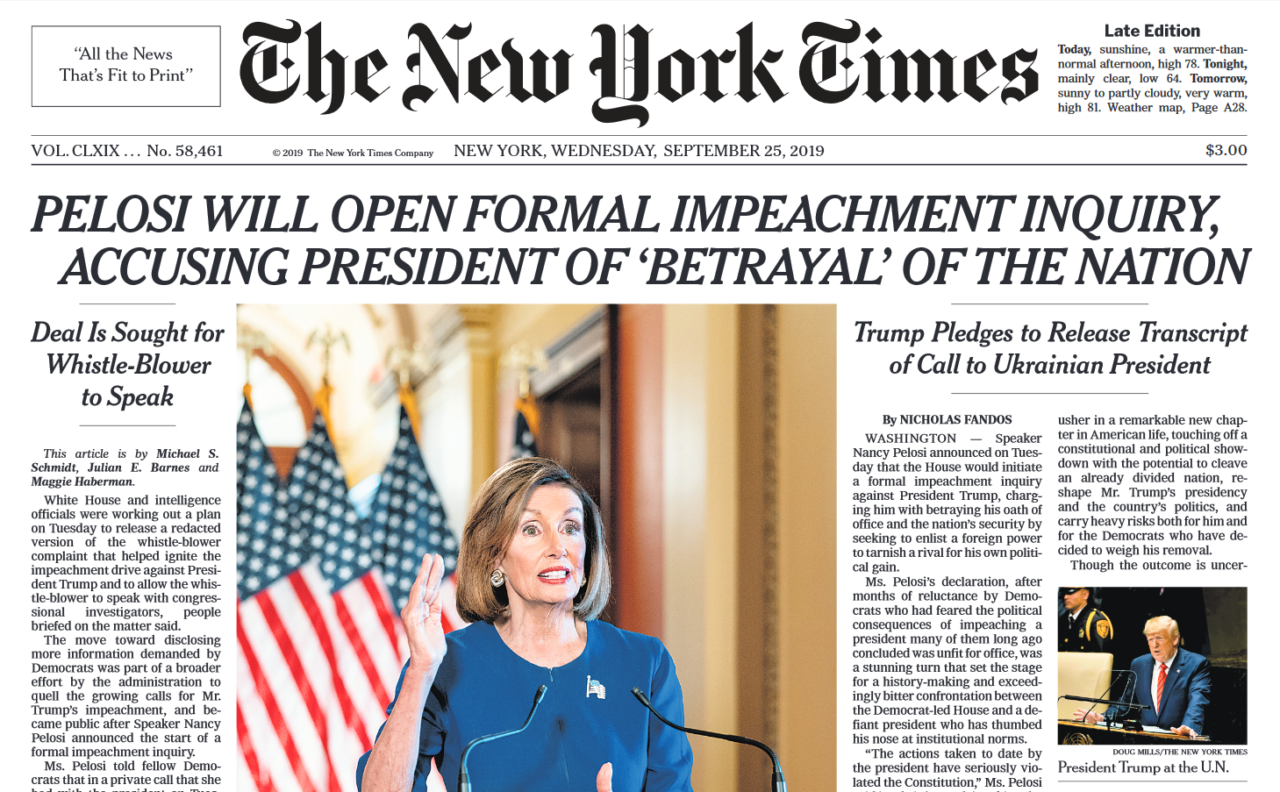
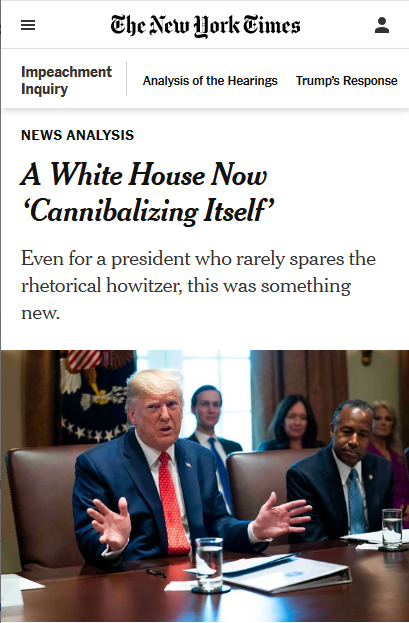
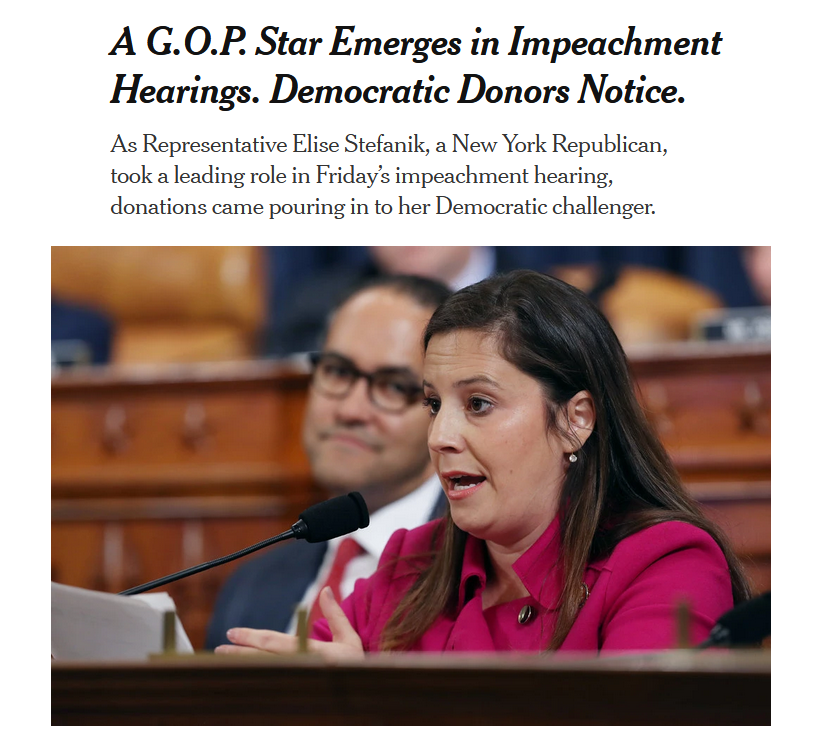
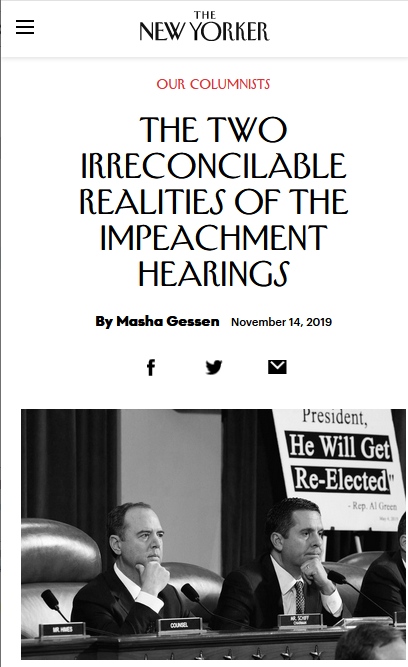
Krugman writes: "The story that has emerged in the impeachment hearings is one of extortion and bribery."
Cook’s incentive to play along was obvious. Apple assembles many of its products in China; it’s seeking exemptions from Trump’s China tariffs. And there’s every reason to believe that the allocation of such exemptions is driven by politics, not the national interest.
For example, in 2018 a company owned by Oleg Deripaska — an oligarch close to Vladimir Putin, who is supposed to be under U.S. sanctions for activities that include interference in foreign elections — received a waiver from aluminum tariffs. The waiver was withdrawn only after Democrats in Congress noticed it, with the Commerce Department claiming that it had been granted as a result of a “clerical error.” Uh-huh.
Put it this way: By using his political power to punish businesses that don’t support him while rewarding those that do, Trump is taking us along the same path already followed by countries like Hungary, which remains a democracy on paper but has become a one-party authoritarian state in practice. And we’re already much further down that road than many people realize.

Ambassador Sondland. (photo: Getty)
Trump's "No Quid Pro Quo" Statements Are Clear Evidence of His Ukraine Motives
William Saletan, Slate
Saletan writes: "A new report shows the president was launching his cover story, not telling the truth."
READ MORE
William Saletan, Slate
Saletan writes: "A new report shows the president was launching his cover story, not telling the truth."
READ MORE

ICE officer. (photo: AP)
ICE Arrests 90 More Students at Fake University in Michigan
Niraj Warikoo, Detroit Free Press
Warikoo writes: "About 90 additional foreign students of a fake university in metro Detroit created by the Department of Homeland Security have been arrested in recent months."
READ MORE
Niraj Warikoo, Detroit Free Press
Warikoo writes: "About 90 additional foreign students of a fake university in metro Detroit created by the Department of Homeland Security have been arrested in recent months."
READ MORE

Sen. Warren and Rep. Ayanna Pressley. (photo: ABC News)
Billionaire-Funded Protest Is Rearing Its Head in America
Hamilton Nolan, Guardian UK
Nolan writes: "The most straightforward way to avoid this creeping problem, of course, is to have everyone personally flog a billionaire before being granted admission to a protest."
 ast week, Elizabeth Warren went to Atlanta to give a major speech about issues of concern to black women. Her speech touched on knotty, existential topics such as the legacy of slavery, institutional racism, voter suppression, mass incarceration and reparations. But the next day’s headlines overwhelmingly focused on the fact that the speech was interrupted by a loud group of pro-charter school protesters.
READ MORE
Hamilton Nolan, Guardian UK
Nolan writes: "The most straightforward way to avoid this creeping problem, of course, is to have everyone personally flog a billionaire before being granted admission to a protest."
Recently a crowd of protesters disrupted a speech by Elizabeth Warren. The activists might have seemed grassroots, but they weren’t
ast week, Elizabeth Warren went to Atlanta to give a major speech about issues of concern to black women. Her speech touched on knotty, existential topics such as the legacy of slavery, institutional racism, voter suppression, mass incarceration and reparations. But the next day’s headlines overwhelmingly focused on the fact that the speech was interrupted by a loud group of pro-charter school protesters.
We were supposed to be talking about challenging centuries of institutional racism, but now we’re talking about charter schools. How did that happen? If you suspect that some sort of nefarious action that can be traced back to plutocratic billionaires is involved – well, of course.
The protesters themselves were, by all accounts and appearances, a group of concerned people who passionately oppose Warren’s plan to bolster public education and crack down on the charter school industry. But they did not all materialize in the crowd together in matching shirts by chance. Their existence was orchestrated by pro-charter school groups that are funded by an array of billionaires, including Netflix founder Reed Hastings, art and philanthropy titan Eli Broad and, most prominently, the Walton Foundation, controlled by the staggeringly wealthy family that owns Walmart. Thus we are all forced to deal with the spectacle of classic tactics of grassroots protest being coopted and fueled by a tiny group of the very sort of people that such tactics were developed to target in the first place.
Of course, astroturfing is nothing new – the suburbs of Washington DC are strewn with post office boxes that serve as the headquarters address for zillions of groups that all have names like Working Americans for Freedom and Reduced Taxation on Pass-Through Business Structures. And charter schools, in particular, have long been an issue that seems created in a lab to entice billionaires to pour money into groups that have as their public faces working parents or former union leaders. (A book could be written on why the ultrarich are so drawn to the charter school movement, but the short answer is that it combines the fiction that education rather than capitalism is responsible for our nation’s ills and the ability to privatize a longstanding public good, all in one.)
It would be a mistake, though, to think that this little propaganda incident is about a single issue. The real lesson of this is how well even transparently corrupt tactics like this work. One of the emotional backbones of Warren’s speech was the story of the 1881 Atlanta washerwomen strike – a relatively little known incident in labor history that she was no doubt inspired to cite by the union leader Sara Nelson’s recent speech on the same topic in front of the Democratic Socialists of America convention. Yet what should be a shining example of radical ideas rising to mainstream prominence in a presidential campaign has been pushed to the bottom of most news stories in favor of the charter school ruckus. This points to the fact that astroturf campaigns don’t have to be very sophisticated, or even very secret; they just need to make enough noise to weasel their way into a 30-second TV hit to get the job done.
And so we are all left to gaze in dread at our dystopian very near future, when an increasingly small and savvy pool of billionaires is responsible for not only the majority of businesses, political connections and wealth, but also protests. If you thought that misleading stories on Facebook were bad, imagine a horde of angry activists, staging classic protests around the country, whose existence is entirely facilitated by the richest and most powerful people on earth.
The one thing that rich people forever lust for is authenticity, that elusive quality that tends to disappear the more that your influence is bought rather than organically developed. (A huge portion of the public relations industry exists to sell rich people the illusion of authenticity, with the assumption that the rich are too insulated from reality to realize that they are being ripped off.) Nothing is perceived as more authentic than real live chanting, sign-waving demonstrators. It is a trivial matter to find people who genuinely believe in a cause. Plutocrats can supply them with organizers and resources while still maintaining plausible deniability of actually controlling them. As a side benefit, in the same way that Fox News has undermined the public’s belief in factual journalism, billionaire-funded protests will inevitably make everyone more cynical about the integrity of real protests.
There’s really no downside, from the perspective of billionaires.
The most straightforward way to avoid this creeping problem, of course, is to have everyone personally flog a billionaire before being granted admission to a protest. Until we sort out a few minor logistical problems with that system, we will have to settle for something even simpler: keeping private money out of politics, by law. The Walton family’s net worth is nearly $200bn. If they are so concerned about education, they can pick up the tab for the entire US Department of Education for the next three years and still have a few billion left over.
Perhaps ironically, getting money out of politics is one of the big ideas at the center of Warren’s campaign. But a lot of people may not have heard about it, over the shouting of all of those grassroots protesters.
READ MORE

The U.S. Attorney's Office for the Eastern District of New York has launched an opioid inquiry focusing on six companies. (photo: Carlo Allegro/Reuters)
Al Jazeera
Excerpt: "Federal prosecutors have opened a criminal investigation into whether pharmaceutical companies intentionally allowed opioid painkillers to flood US communities."

Egyptian police officer. (photo: Getty)
Egypt's Security Forces Raid Last Major Independent Newspaper's Office
Democracy Now!
Excerpt: "Egyptian security forces raided the office of Mada Masr, the country's last independent media outlet, and arrested three of its journalists this weekend."
READ MORE
Democracy Now!
Excerpt: "Egyptian security forces raided the office of Mada Masr, the country's last independent media outlet, and arrested three of its journalists this weekend."
READ MORE

Recycling bins. (photo: Chris Wattie/Reuters)
Recycling Isn't Working - Here Are 15 Ways to Shrink Your Plastic Footprint
Emily Holden, Guardian UK
Holden writes: "As plastics corporations ramp up production, they are also promoting a failing recycling system. Just 9% of plastics get recycled. Traditional plastics are made from extracted oil and gas, and they contribute to the rising temperatures behind the climate crisis."
Emily Holden, Guardian UK
Holden writes: "As plastics corporations ramp up production, they are also promoting a failing recycling system. Just 9% of plastics get recycled. Traditional plastics are made from extracted oil and gas, and they contribute to the rising temperatures behind the climate crisis."
Only 9% of plastics get recycled, and significant reductions will require systemic change – but there are easy tips for individuals to cut back
 s plastics corporations ramp up production, they are also promoting a failing recycling system.
Just 9% of plastics get recycled. Traditional plastics are made from extracted oil and gas, and they contribute to the rising temperatures behind the climate crisis.
Environment experts are increasingly calling for a reduction in plastic use, as the waste accumulates in the oceans, poor countries and even human bodies. Plastics are also burned, as China – which once accepted the bulk of America’s waste – has begun to refuse it. And more than a million Americans lived next to polluting incinerators.
Significant reductions will require systemic change, researchers say. But there are also some easy tips for individuals who want to cut back on plastics.
(If this list is overwhelming and you’re not sure where to start, collect your plastic waste for a month and conduct an audit. Cut back on what you find the most of.)
1. Carry a reusable bottle, fork/spoon and bag
Be sure to use these items as many times as possible so they are worth the resources they take to create.
2. Refuse the lid on your coffee cup
Take a few sips before you leave the shop so you can avoid spilling. (Some coffee shops will say they are required to give you a lid, citing possible liability for burns.)
3. Choose products in glass or cans if they are an option. Recycle those materials
Plastics recycling is largely failing, but you should still try to recycle your waste plastics if they are accepted in your community. Make sure you are recycling correctly with this guide.
Glass and aluminum cans are much more likely to be recycled. Glass is most efficient when reused (ie with returnable milk bottles).
4. When possible, eat in the restaurant instead of taking it to go
Unless you have a physical disability, let your server know in advance that you won’t need a straw.
5. If you order takeout or delivery, tell the restaurant you don’t want plastic utensils or straws
This is an option on some food delivery apps.
6. Opt for products with less packaging. Say no to bagged lemons, apples, onions and garlic, and tea that comes in plastic packets
Choose more fresh produce for snacks to avoid individual plastic wrappers.
7. Shop from the bulk section and use your own containers
Some grocery stores will let you use pretty much any container, as long as you verify the weight of the empty container in advance.
8. Use bars of soap (also available for shampoo and shaving) instead of bottles and skip the plastic loofah
Find bars that are wrapped in paper, and for an extra environmental benefit, avoid palm oil.
9. Use a razor that requires replacing only the individual blades
The upfront expense may be daunting, but if you can afford it, you will save money over time. Note that TSA does not allow passengers to fly with individual blades.
10. Use a bamboo toothbrush or one with a replaceable head
The market for these products is growing rapidly. Most bristles will still have synthetic fibers, but you can at least avoid throwing away the brush’s plastic arm every few months.
11. Buy concentrated cleaners that can be mixed with water in a reusable container.
You can find these in powder, gel and liquid form.
12. Choose frozen, concentrated juice that comes in cardboard tubes instead of the plastic jugs
Some of them taste good, and they are lighter to carry home.
13. Don’t buy bottled water. Filter your own
“Bottled water is no safer than filtered tap water, but the industry doesn’t have to disclose the results of its testing,” according to the Environmental Working Group. The advocacy organization’s Tap Water Database can help you select the best filter for your local water source.
14. Buy fewer clothes, or shop secondhand. Wash your clothes less so they last longer. Hang them to dry
Most clothing contains synthetic fibers made of plastic. These fibers shed in the wash and end up in waterways. Synthetic materials may have some advantages over natural ones, however, because they may last longer.
15. When shopping online, group as many items together as possible, so you can receive fewer plastic envelopes
You can also choose slower shipping times, which could reduce the climate footprint of your purchase.