Search This Blog

Translate

Blog Archive

Middleboro Review 2

NEW CONTENT MOVED TO MIDDLEBORO REVIEW 2

Toyota

Since the Dilly, Dally, Delay & Stall Law Firms are adding their billable hours, the Toyota U.S.A. and Route 44 Toyota posts have been separated here:

Route 44 Toyota Sold Me A Lemon


Showing posts with label Nuclear Regulatory Commission (NRC) FAILURES. Show all posts

Thursday, November 23, 2017

Pilgrim Nuclear: ENTERGY & Nuclear Regulatory Commission (NRC) FAILURES


“The NRC has already said Pilgrim will remain in Column 4, where it will be able to limp along to its final shutdown, or until it melts down, whichever comes first,” Lochbaum wrote. 

Latest performance report for Pilgrim lists 7 violations


By Christine Legere

Posted Nov 20, 2017

Infractions, called ‘more than minor’ by NRC, have since been addressed.
PLYMOUTH — A quarterly performance report for the problem-plagued Pilgrim Nuclear Power Station lists seven violations found by inspectors, related to procedural shortcomings and poor equipment maintenance.
The Nuclear Regulatory Commission classified all findings as “more than minor” because of their potential to compromise essential safety systems in a radiological emergency, yet of “very low safety significance” because the shortcomings did not lead to an actual emergency at the plant.
Plant opponent Diane Turco, a Harwich resident and president of the Cape Downwinders, expressed frustration at the list of problems that persist.
“This is just plain crazy,” Turco wrote in an email. “The NRC continues to document Entergy’s ongoing federal violations without consequences for enforcement of their own public safety standards. It is immoral and unacceptable that the public must live with this serious threat.”
One of the seven deficiencies involved written procedures that main control room operators follow when the air conditioning goes out, since temperatures above 120 degrees could cause the malfunction or failure of essential systems.
In mid-2016, inspectors noticed that Pilgrim’s procedures were outdated, failing to factor in several changes in equipment through the years. Entergy Corp., Pilgrim’s owner and operator, updated the procedures and resubmitted them in February.
Although the new procedures contained a long list of systems that could be shut off to address high temperatures in the control room, “No priority was made between shedding equipment that provided functions important to safety (radiation monitors, nuclear instruments, jet pump instrumentation) and control room lighting,” notes the third-quarter report.
As with several of the shortcomings in the report, released late last week, federal regulators stated this was connected to poor human performance. Entergy fixed the procedures in late April.
In another violation, Entergy failed to replace a part in a safety relief valve for 24 years — since 1993 — that exceeded required replacement frequency. The safety relief valve failed when tested in late April. Entergy has since replaced the part in all four safety relief valves.
Improper maintenance has been an ongoing problem at Pilgrim. The plant was cited in this latest report for not appropriately establishing maintenance procedures for the high-pressure coolant injection turbine exhaust valves, which were not disassembled and maintained within the required 10-year time frame. As a result, the valves failed during testing. Entergy has since addressed the problem.
Another maintenance-related violation included failure to carry out a vendor-recommended modification to address damage to the main steam isolation valve system caused by an unstable main regulator. As a result, two valves were damaged. The company has since overhauled all eight of the isolation valves.
Entergy also was cited for failure to establish appropriate procedures for filling and venting a safety system used to inject coolant into the reactor during an emergency shutdown. As a result, the system was returned to service May 21 with a 2-inch gap that rendered it inoperable. It was not successfully returned to service until June 7, which exceeded the allowable outage time.
Despite the list of infractions, NRC spokesman Neil Sheehan said, “The overall inspection record continues to indicate that Entergy is making slow progress in improving performance at Pilgrim.”
Sheehan pointed out that during refueling outages, such as the one Pilgrim underwent last spring, “it is not atypical for there to be an increased number of issues identified.”
David Lochbaum, director of the Nuclear Safety Program for the Union of Concerned Scientists, disagreed with Sheehan’s characterization of Pilgrim as improving.
“Only at a reactor mired in Column 4 would seven violations in a quarterly report be considered ‘improvement,’” Lochbaum wrote in an email. “Anywhere else, it would be a troubling sign.”
Pilgrim’s status was downgraded by federal regulators in September 2015 to Column 4, which is one step above the mandatory shutdown of Column 5. Because of its ranking as one of the three worst performers in the country, Pilgrim was required to undergo 12,000 hours of federal inspection last year.
“The NRC has already said Pilgrim will remain in Column 4, where it will be able to limp along to its final shutdown, or until it melts down, whichever comes first,” Lochbaum wrote. “There’s little incentive for Entergy to spend the money necessary to heal the limp. With the NRC fine with D-minus grades at Pilgrim, Entergy won’t likely spend the money needed to get D-plus or C grades.”
Entergy provided comment through spokesman Patrick O’Brien: “The NRC’s third-quarter inspection report represents a continuing strong focus on finding and resolving issues at Pilgrim established both by the regulator and our dedicated staff. The NRC categorized the seven findings in the report as very low safety significance, and Pilgrim’s staff is reviewing the report’s observations, with a goal of preventing recurrence.
“The quarterly inspection reports are issued after the events they describe have occurred and been successfully resolved,” the statement says. “We remain focused on safe and reliable operations and are committed to meeting our regulatory requirements through the plant’s shutdown, planned no later than June 1, 2019.”



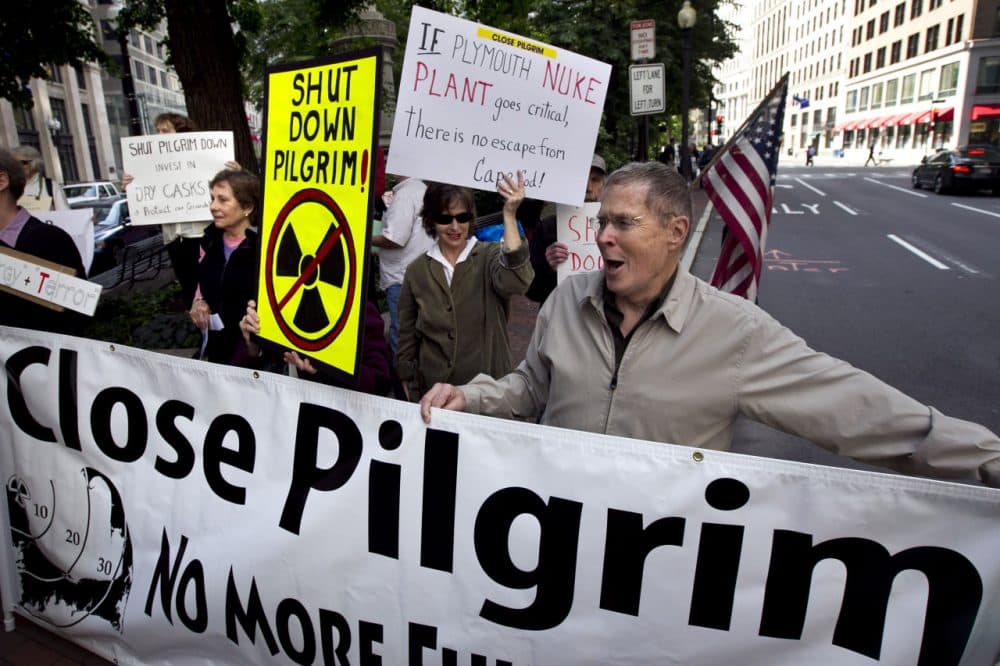
Tuesday, June 20, 2017

****IT'S FAR MORE THAN THIS! Report: Years of issues at Pilgrim nuclear plant


Dancing Clown Rick Perry is in charge of Nuclear Arms and Nuclear Power Plants....his 2 predecessors were Nuclear Physicists, one a Nobel Prize Winner.


Below are just a sampling of recent articles including several about the threats posed by AGING and CRUMBLING Nuclear Power Plants that will require taxpayer bailouts:

***Nuclear Energy is DEAD!


RSN: Harvey Wasserman | Donald Trump & Andrew Cuomo Are Brothers in Reactor Disaster


EXCERPT:
"....As Trump sabotages the dollar, watch him blame our economic death spiral on Muslims, commies, immigrants, and people of color.
Trump’s wedge between the US and Germany is a dream come true for Putin’s petro-mafia.
So is his attack on climate science as he hands our techno-future to King CONG (Coal, Oil, Nukes and Gas), the obsolete monster of a failed 20th century past.
Trump’s hatred of Solartopian technologies — solar, wind, tidal, wave, ocean thermal, geothermal, LED, efficiency, electric and hydrogen cars, advanced batteries, etc. — leaves the US out of the biggest job-creating transition in human history....."
"...No commercial reactor has liability insurance, so the next melt-down/explosion could bankrupt us all, with none of Trump/Cuomo’s industry cronies held responsible....."


RSN: New York's Cuomo Tries to Bail Out Dying Nukes


"...But now Cuomo wants to earmark more than $7 billion in public money, for starters, to keep four upstate nuclear reactors on line. One is the Ginna reactor, near Rochester; the other three—FitzPatrick, Nine Mile Point One, and Nine Mile Point Two—occupy a single site on Lake Ontario. Fitzpatrick is owned by Entergy. The rest are owned by Exelon, the nation’s largest nuclear power owner/operator.
All four reactors are in various stages of advanced deterioration and were slated for permanent closure. Without massive public subsidies, none can compete with natural gas or with wind and solar, which are rapidly dropping in price.
Entergy announced last fall that economic factors would force it to shut Fitzpatrick in January 2017. Exelon told the New York Public Service Commission that it would probably shut Nine Mile 1 and Ginna next year as well.   .."

Nuclear? Tired of PROPAGANDA?


Electric Trains Everywhere: A Solution to Crumbling Roads and Climate Crisis 
http://readersupportednews.org/news-section2/318-66/43933-electric-trains-everywhere-a-solution-to-crumbling-roads-and-climate-crisis

Harvey Wasserman | Three Mile Island Nuke Plant Closure Strengthens Call for Renewable Energy Future 
http://readersupportednews.org/opinion2/277-75/43888-focus-three-mile-island-nuke-plant-closure-strengthens-call-for-renewable-energy-future


With Age, Comes GREED from Casino Vulture Sheldon Adelson


Report: Years of issues at Pilgrim nuclear plant  

By Christine Legere
Posted Jun 19, 2017

PLYMOUTH — Pilgrim Nuclear Power Station leads the nation’s fleet of 99 reactors for incidents or conditions over the last 40 years that could have led to core damage and an accompanying release of radiation, according to a division of the Nuclear Regulatory Commission that conducts risk analysis.
While not among the 11 reactors on the 2016 list published June 8 by the NRC’s Division of Risk Analysis, Pilgrim has made the list for “accident sequence precursors” 23 times since 1980.
Such precursors are defined by the NRC as observed events or conditions that, when combined with one or more factors such as human error or equipment failure, could result in damage to the reactor’s core and a massive release of radiation.
“The accident sequence precursors are like golf scores, in that the low score wins,” said David Lochbaum, director of the Nuclear Safety Program for the Union of Concerned Scientists.
While the 45-year-old Plymouth plant, owned by Entergy Corp., was on the annual list only four times in the past 20 years, all four of the potentially dangerous incidents have been recent, occurring since 2011.
In May 2011, operators made a series of faulty judgments on power levels as they powered the reactor back up. Those failures to properly assess reactor activity ultimately triggered an automatic shutdown. The situation was judged by federal regulators as an accident sequence precursor.
The other three events — two in 2013 and one in January 2015 — involved unplanned shutdowns following electrical problems in the plant’s switchyard during storms. Contributing to those incidents were operator error and equipment failures. Short circuits in the switchyard at Pilgrim have been a recurring problem, noted the researchers in their report, involved in 13 of the 23 accident sequence precursor total.
NRC spokesman Neil Sheehan said those three recent weather-related events at Pilgrim and the plant workers’ response to those events “are a significant contributor to Pilgrim’s placement in Column 4.”
Since the fall of 2015, Pilgrim has been ranked by federal regulators in a performance category just one step above ordered shutdown, based on standards set by the Nuclear Regulatory Commission. Because of its ranking as one of the three worst performers in the country, Pilgrim was required to undergo 12,000 hours of federal inspection last year.
Lochbaum called the nature of the Pilgrim events on the accident sequence precursor list over the years “not surprising.”
“The list includes safety relief valve problems, losses of offsite power, and high pressure coolant system failures — the same problems that factored in recent Nuclear Regulatory Commission findings and sanctions,” he said.
Risk analysts began their 2016 study by scrutinizing the 350 event reports turned in to the NRC by reactor licensees during the year; they whittled that list to 63 that needed further analysis. Two of those were incidents at Pilgrim, which were eventually screened out.
A third incident at Pilgrim was not considered for the list because it is still being evaluated.
The first incident dates back to April 12, 2016, when workers took one of two emergency generators offline for maintenance, believing the second was in good working order. More than 25 hours after shutting down the first generator, a worker noticed water leaking across the floor from the second. The leak was caused by stress corrosion and the generator was declared inoperable.
The second incident, which also occurred in April 2016, involved relay tests that were done while the reactor was powered up instead of in cool shutdown, as technical standards called for. 

A third incident, which will be analyzed by inspectors after more information is provided by Entergy, involved a leaking relief valve that put one of the emergency generators out of service due to low gearbox oil.
Spokesman Patrick O’Brien said Entergy has been hard at work addressing plant deficiencies. “The events documented in this analysis have been thoroughly evaluated by Entergy and by the Nuclear Regulatory Commission through its various oversight processes,” wrote O’Brien in an email to the Times. “Corrective actions to address the causes are consistent with the station’s ongoing efforts to strengthen our performance.”
“Entergy also made a significant investment in equipment reliability improvements” during the plant’s recent refueling and maintenance outage, O’Brien said.
A look at the accident sequence precursor events over the past 10 years “reveals no statistically significant increase or decrease in trends,” the report notes. A review of the past 20 years, however, reveals two statistically significant trends: more occurrences in boiling water reactors (like Pilgrim’s), and more precursors that are related to emergency diesel generator failures.
— Follow Christine Legere on Twitter: @ChrisLegereCCT.


Sunday, February 5, 2017

OUR VIEW: Ground those planes


We all say things we don't mean from time to time. Sometimes we even hit the send button.
We all say things we don't mean from time to time. Sometimes we even hit the send button. NRC Team Lead Don Jackson's December email detailing a host of safety concerns at Pilgrim Nuclear Power Plant was accidentally forwarded to one of Pilgrim's staunchest critics, Diane Turco of the Cape Downwinders.
Now we all have a window into Jackson's observations after a week of inspection at the plant. He said he culled data from all 20 inspectors when he wrote the email, which is disturbing at best, detailing equipment violations, management problems and a staff he said seemed overwhelmed just running the plant.
It was an email we weren't supposed to read - a candid and scientific assessment of a 44-year-old nuclear power plant ranked among the three worst performers in the nation.
If only Jackson had become unreasonable or emotional during the NRC meeting Tuesday night when he and other NRC brass faced an audience of 300 at Hotel 1620. If only we could have imagined him tired and frazzled, penning an email with a little too much vigor, with a little too much hyperbole.
Sadly, this was not the case.
Jackson, who has 30 years experience in the industry, presented as reasonable, circumspect and calm in the face of fierce opposition. Some audience members accused the NRC of criminal behavior allowing the ailing plant to continue operating in spite of the myriad of issues. Jackson never flinched. He remained self-possessed, respectful and clear-headed - not at all the sort of person we could imagine throwing words around in an email, or leaping into exaggerations for effect. On the contrary, Jackson seemed like the sort of expert we want to be running things, the sort of scientific and objective person who gives us a sense of security, whose words might even count as gold. In short, Jackson's behavior, demeanor and obvious expertise exhibited during the meeting only added weight to his words in that leaked email, causing us to revisit them.
Take a look:
"We are observing current indications of a safety culture problem that a bunch of talking probably won't fix...;. The dance associated with EDG operability this week is also disturbing on many levels - poor engineering expertise, no communication with the shift manager, poor original corrective action and a senior manager stating a reluctance to assure operability due to a negative impact on maintenance rule status."
"We attempted to conduct a safety culture focus group with security and no one showed up because the security supervisor 'forgot' he needed to support it," Jackson writes. "The plant seems overwhelmed just trying to run the station."
"There is a lot of positive energy, but no one seems to know what to do with it, to improve performance, leading to procedural non compliances, poor maintenance, poor engineering practices and equipment reliability problems."
Tuesday night, Jackson said some of the issues he cited in the email have since been resolved and other, new ones, have surfaced. He said there are 10 to 15 deficiencies at the plant that will keep it in the current status it is in - one step away from shutdown.
We think former Sen. Dan Wolf, from the Cape, said it best. He runs an airline and said he would ground planes if there were this many deficiencies. He said, if he had seen an email like this one about his company, he would be extremely concerned for the safety of customers and would resolve the deficiencies before he allowed anyone to fly in his planes.
Why is the NRC allowing Pilgrim Nuclear Power Station to continue operating? In 2016, the plant experienced 18 problems and now we're being told the NRC will allow this plant to refuel and continue operating in spite of 10 to 15 deficiencies, in spite of its own experts expressing serious concerns.
We have heard that money is involved, that the closure date of 2019 isn't that far away. We have heard the "Oh, it'll be alright" argument.
It's not alright.
There is very little margin of error in a plane flying coast to coast - deficiencies can cause a plane crash, killing hundreds. The margin of error with a nuclear power plant should be even more minimal. A major incident can kill thousands and impact the five million people living in its shadow, not to mention the results of nuclear fallout years later.
We have a message for the NRC: "We are observing current indications of a safety culture problem that a bunch of talking probably won't fix."
It is time to act and act now.
Shut the plant down. Ground those planes.


Thursday, January 5, 2017

Here is the letter MA ELECTED OFFICIALS SENT TO NRC


Pilgrim Nuclear is the same age and design as Fukushima.
Entergy, the owner/operator of the Pilgrim as well as other nuclear plants continues to prove itself incapable of safely operating Pilgrim.
NRC continues to fail the public.
"This powerful joint statement by our elected officials shows they understand the clear and present dangers of Pilgrim," Turco wrote to the Times. She went on to say a meeting with the NRC would not allay growing public safety concerns.
"The email confirmed what we already know. The only responsible and legitimate action is that Attorney General Healey, Governor Baker et al. demand the NRC immediately revoke Entergy's operating license." 


Here is the letter MA ELECTED OFFICIALS SENT TO NRC
Attorney General Maura Healey
Governor Charlie Baker
U.S. Senator Edward Markey
U.S. Senator Elizabeth Warren
U.S. Representative Richard Neal
1st District
U.S. Representative James McGovern
2nd District
U.S. Representative Niki Tsongas
3rd District
U.S. Representative Joseph Kennedy III
4th District
U.S. Representative Katherine Clark
5th District
U.S. Representative Seth Moulton
6th District
U.S. Representative Michael Capuano
7th District
U.S. Representative Stephen Lynch
8th District
U.S. Representative Bill Keating
9th District
Senate President Stanley Rosenberg
Franklin, Hampshire and Worcester
Senator Vinny deMacedo
Plymouth and Barnstable District
Senator Patrick O’Connor
Plymouth and Norfolk
State Senator Julian Cyr
Cape and Islands
Representative Sarah Peake
Fourth Barnstable District
Representative James M. Cantwell
Fourth Plymouth District
Representative Randy Hunt
Fifth Barnstable District
Representative Matt Muratore
First Plymouth District
Representative Thomas J. Calter
Twelfth Plymouth District
Representative Davis T. Vieira
Third Barnstable District
Representative Josh S. Cutler
Sixth Plymouth District
Representative Timothy R. Whelan
First Barnstable District
Representative Dylan Fernandes
Barnstable, Dukes and Nantucket
January 4, 2017
THE COMMONWEALTH OF MASSACHUSETTS
OFFICE OF THE ATTORNEY GENERAL
OFFICE OF THE GOVERNOR
MASSACHUSETTS CONGRESSIONAL DELEGATION MEMBERS OF THE MASSACHUSETTS GENERAL COURT
VIA FIRST CLASS MAIL
The Honorable Stephen G. Burns Chairman
U.S. Nuclear Regulatory Commission Mail Stop O-16G4
Washington, DC 20555-0001
Re: Pilgrim Nuclear Power Station
Dear Chairman Burns:
We write to request that the U.S. Nuclear Regulatory Commission (“NRC”) convene a public meeting in Massachusetts as soon as possible to answer the public’s questions about the safety of the Pilgrim Nuclear Power Plant (“Pilgrim”). The views expressed by the leader of the NRC Pilgrim special inspection team in a December 6, 2016 e-mail have raised legitimate concerns among the public about their safety and raised serious questions about Entergy’s ability to continue to operate the plant safely. While the NRC undoubtedly regrets the inadvertent disclosure of the preliminary thoughts expressed in the December 6 e-mail, the disclosure happened, and the NRC now has the obligation to address questions raised by that e-mail to help assuage growing public safety concerns. A public meeting also will allow the NRC to outline for the public the steps the NRC may take in light of the special inspection team’s findings to date, the steps that remain in the NRC’s inspection process, and when the official results of the inspection will be released to the public.
As you know, the NRC is currently conducting a three-phased supplemental inspection process at Pilgrim. This process was triggered when the NRC determined that recurring safety issues at the aging plant required the NRC to place the plant into the Repetitive Degraded Cornerstone Column, or Column 4, which is the least safe category in which an operating reactor can be placed. At the time, NRC Region I’s Administrator remarked that the determination “highlights the continuing weaknesses in the implementation of Entergy’s program for identifying, evaluating and resolving problems at Pilgrim.”1
1 Press Release, Region I NRC, NRC to Increase Oversight at Pilgrim Nuclear Power Plant Based on New Inspection Finding (Sept. 2, 2015).
Recently, an Entergy spokesperson stated that the inspection “is the next step in Pilgrim’s process toward a return to industry excellence.”2 While the spokesperson further claimed that Entergy has “worked hard to address the issues that led to station performance decline,”3 the Company is quite clearly not working hard enough. In fact, Entergy was forced to shut the plant down again on December 15, 2016, when it discovered leaks in three of the eight main steam isolation valves, which are used to prevent radioactivity from leaking into the environment during a nuclear accident.4 These events, of course, do not signify “a return to industry excellence.” A public meeting also would allow the NRC to inform members of the community about how these leaks were discovered, the process and timeline associated with their repair, and how the public can be assured that they will not recur.
At the same time that the plant continues to experience safety-related problems, Entergy has asked the NRC to effectively exempt the company from Commission requirements to make plant modifications based on lessons learned from the March 2011 Fukushima Dai-ichi accident.5,6 While Entergy has proposed alternative approaches for meeting some of the requirements, in light of the concerns raised in the December 6, 2016 e-mail and the on-going operational issues at Pilgrim, the NRC should not exempt Entergy from any safety-related requirements.
We understand that the NRC does not typically conduct public hearings during a pending inspection and do not ask that the NRC compromise its investigation by disclosing any confidential or privileged information. However, we respectfully submit that the unique circumstances arising from the public disclosure of the December 6 e-mail and the most recent plant shut down warrant an exception from the NRC’s usual practice.
Sincerely,
Attorney General Maura Healey Governor Charlie Baker U.S. Senator Edward Markey
2 Travis Anderson, Pilgrim nuclear plant staff said to be ‘overwhelmed,’ Boston Globe, Dec. 8, 2016, https://www.bostonglobe.com/…/internal-nrc-memo-outlines-co… plant/GFRYcbdBRgwo4PulROZBYN/story.html.
3 Id.
4 Christine Legere, Pilgrim remains shut down, Cape Cod Times, Dec. 17, 2016, http://www.capecodtimes.com/…/201…/pilgrim-remains-shut-down.
5 Ltr. from John A. Dent, Jr., Entergy, to NRC, re Request for Extension to Comply with NRC Order 13-109, Order to Modify Licenses with Regard to Reliable Hardened Containment Vents Capable of Operation Under Severe Accident Conditions (June 24, 2016) (ADAMS Accession No. ML16187A325).
6 All Operating Boiling Water Reactor Licensees with Mark I and Mark II Containments, Order Modifying Licenses with Regard to Reliable Hardened Containment Vents. EA-13-109 (Effective Immediately) (June 6, 2013).
U.S. Senator Elizabeth Warren
U.S. Representative James McGovern
2nd District
U.S. Representative Joseph Kennedy III
4th District
U.S. Representative Seth Moulton
6th District
U.S. Representative Stephen Lynch
8th District
Senate President Stanley Rosenberg
Franklin, Hampshire and Worcester
Senator Patrick O’Connor
Plymouth and Norfolk
U.S. Representative Richard Neal
1st District
U.S. Representative Niki Tsongas
3rd District
U.S. Representative Katherine Clark
5th District
U.S. Representative Michael Capuano
7th District
U.S. Representative Bill Keating
9th District
Senator Vinny deMacedo
Plymouth and Barnstable District
Senator Julian Cyr
Cape and Islands
Representative Sarah Peake
Fourth Barnstable District
Representative Randy Hunt
Fifth Barnstable District
Representative Thomas J. Calter
Twelfth Plymouth District
Representative Josh S. Cutler
Sixth Plymouth District
Representative Dylan Fernandes
Barnstable, Dukes and Nantucket
Cc: Commissioner Kristine L. Svinicki Commissioner Jeff Baran
Representative James M. Cantwell
Fourth Plymouth District
Representative Matt Muratore
First Plymouth District
Representative Davis T. Vieira
Third Barnstable District
Representative Timothy R. Whelan
First Barnstable District


State, federal officials press NRC on Pilgrim safety


State, federal officials press NRC on Pilgrim safety