Search This Blog

Translate

Blog Archive

Middleboro Review 2

NEW CONTENT MOVED TO MIDDLEBORO REVIEW 2

Toyota

Since the Dilly, Dally, Delay & Stall Law Firms are adding their billable hours, the Toyota U.S.A. and Route 44 Toyota posts have been separated here:

Route 44 Toyota Sold Me A Lemon


Showing posts with label FCC. Show all posts

Wednesday, October 2, 2019

Paul Krugman | Warren Versus the Petty Plutocrats


Reader Supported News
01 October 19
It's Live on the HomePage Now:
Reader Supported News

Paul Krugman | Warren Versus the Petty Plutocrats
Economist Paul Krugman. (photo: Getty Images)
Paul Krugman, The New York Times
Krugman writes: "Remember when pundits used to argue that Elizabeth Warren wasn't likable enough to be president? It was always a lazy take, with a strong element of sexism."
READ MORE

Special Counsel Robert Mueller. (photo: J. Scott Applewhite/AP)

Trump May Have Lied to Mueller, House Democrats Say in Filing for Grand-Jury Materials
Andrew Desiderio, Politico
Desiderio writes: "Lawyers for the House of Representatives revealed on Monday that they have reason to believe that the grand-jury redactions in special counsel Robert Mueller's report show that President Donald Trump lied about his knowledge of his campaign's contacts with WikiLeaks."
READ MORE

Fired Dallas police officer Amber Guyger leaves the courtroom after a jury found her guilty of murder Tuesday. Guyger shot and killed Botham Jean, an unarmed 26-year-old neighbor, in his own apartment last year. She told police she thought his apartment was her own and that he was an intruder. (photo: Tom Fox/The Dallas Morning News/AP)

Amber Guyger, Police Officer Who Shot a Man to Death in His Apartment, Found Guilty of Murder
Bobby Allyn, NPR
Allyn writes: "A Dallas jury has found former police Officer Amber Guyger guilty of murder for fatally shooting a neighbor who lived in the apartment directly above hers last year. She had testified that she entered Botham Jean's unit after a long day at work, thinking it was her own home and that he was an intruder."
READ MORE

Since 2016, as the Democratic field has expanded, Bernie Sanders has maintained a significant fund-raising advantage among college students in Iowa. (photo: Michael B. Thomas/AFP/Getty Images)

Bernie Sanders' Fund-Raising Haul: $25.3 Million in Third Quarter
Paul Blest, Splinter
Blest writes: "In recent weeks, the Democratic primary for president has essentially turned into a three-person race between Joe Biden, Elizabeth Warren, and Bernie Sanders. But while Sanders' campaign is already being written off by some pundits, fundraising totals released on Tuesday indicate he's not anywhere close to finished."
READ MORE

Mike Pompeo. (photo: Drew Angerer/NYT)

Pompeo Says State Department Officials Won't Show Up for Impeachment Depositions
Karen DeYoung, The Washington Post
DeYoung writes: "Secretary of State Mike Pompeo fired a broadside at House Democrats on Tuesday, saying State Department officials scheduled to appear this week before committees conducting the impeachment inquiry would not be made available until 'we obtain further clarity on these matters.'"
READ MORE

The FCC's cancellation of Obama-era rules on net neutrality sparked demonstrations in 2017. (photo: Mary Altaffer/AP)

Appeals Court Upholds Trump Admin's Canceling of Net Neutrality Rules
Brian Fung, CNN
Fung writes: "A federal appeals court has largely upheld the Federal Communications Commission's controversial repeal of its net neutrality rules for internet providers, finding the agency didn't overreach when it decided in 2018 to deregulate companies such as Comcast (CCZ) and Verizon (VZ)."
READ MORE

A protestor participates in a demonstration in Washington against the Dakota Access and Keystone XL pipelines. (photo: Kevin Lamarque/Reuters)

Revealed: How the FBI Targeted Environmental Activists in Domestic Terror Investigations
Adam Federman, Guardian UK
Federman writes: "Protesters were characterized as a threat to national security in what one calls an attempt to criminalize their actions."
READ MORE


Sunday, September 29, 2019

Andy Borowitz | Obama to Produce Netflix Series About Trump's Impeachment



Reader Supported News
28 September 19

What will tomorrow bring, a day of scratching together funding, or a day of dedicating the organization's efforts to challenging the injustice that affects our daily lives? We need 700 Donations total for the drive. 700 readers visit RSN every 30 minutes.
Let’s make RSN strong.
Marc Ash
Founder, Reader Supported News


If you would prefer to send a check:
Reader Supported News
PO Box 2043
Citrus Hts, CA 95611



Reader Supported News
28 September 19
It's Live on the HomePage Now:
Reader Supported News


Andy Borowitz | Obama to Produce Netflix Series About Trump's Impeachment
Barack Obama. (photo: Jochen Zick/Action Press/Shutterstock)
Andy Borowitz, The New Yorker
Borowitz writes: "Former President Barack Obama has inked a ninety-million-dollar deal to produce a Netflix series about Donald J. Trump's impeachment, Netflix confirmed on Friday."
READ MORE


Ukrainian president Volodymyr Zelensky attends a luncheon during the United Nations General Assembly on September 24, 2019. (photo: Saul Loeb/AFP/Getty Images)

The Ukraine Timeline Shows Trump Is Lying
William Saletan, Slate
Saletan writes: "Did President Donald Trump commit an impeachable offense by using his office to solicit Ukraine's help in the 2020 U.S. election? Republicans say the evidence is insufficient."

EXCERPT:
2. The Pence cancellation. On May 11, Giuliani canceled a trip in which he had planned to lobby Ukrainian officials to investigate Biden and the Democrats. He announced on Fox News he was calling it off because he had discovered, to his dismay, that he would be “walking into a group of people that are enemies of the president, and in some cases, enemies of the United States.” What was Giuliani talking about? According to a Ukrainian journalist and a former U.S. ambassador, Giuliani canceled the trip because Zelensky had declined to meet with him to discuss the investigations Giuliani sought.
The whistleblower’s complaint reports what happened next: On May 14, Trump “instructed Vice President Pence to cancel his planned travel to Ukraine to attend President Zelenskyy’s inauguration.”
No connection has been proved, but the timing is suspicious: Zelensky stiffed Giuliani, Giulani alerted Trump, and Trump stiffed Zelensky. The whistleblower’s complaint adds evidence to this theory: It says that during this time frame, U.S. officials were told that Trump “did not want to meet with Mr. Zelenskyy until he saw how Zelenskyy ‘chose to act’ in office.” The complaint also indicates that Ukraine, based on messages it received from the administration, thought Trump’s coldness was connected to Giuliani’s pressure campaign. From late May to early July, says the whistleblower, “multiple U.S. officials told me that the Ukrainian leadership was led to believe that a meeting or phone call between the President and President Zelenskyy would depend on whether Zelenskyy showed willingness to ‘play ball’ on the issues that had been publicly aired by Mr. Lutsenko and Mr. Giuliani.”

Immigrant children in a detention center. (photo: Ross D. Franklin)

The Trump Administration Can't Detain Immigrant Children Indefinitely, a Federal Judge Has Ruled
Adolfo Flores, BuzzFeed
Flores writes: "A federal judge on Friday ruled against the Trump administration's attempt to detain undocumented immigrant children indefinitely, saying it violated the terms of a court settlement agreement."
READ MORE

Striking United Auto Workers union members. (photo: ABC News)

The GM Strike Is Heating Up
Chris Brooks, Jacobin
Brooks writes: "As the GM strike enters its second week, workers are upping the pressure on the company and its scabs - and the costs to GM are mounting."
READ MORE

Hands typing on a computer keyboard. (photo: hamburg_berlin/Shutterstock)

Study Proves the FCC's Core Justification for Killing Net Neutrality Was False
Karl Bode, VICE
Bode writes: "A new study has found the FCC's primary justification for repealing net neutrality was indisputably false."

EXCERPT:
For years, big ISPs and Trump FCC boss Ajit Pai have told anyone who’d listen that the FCC’s net neutrality rules, passed in 2015 and repealed last year in a flurry of controversy and alleged fraud, dramatically stifled broadband investment across the United States. Repeal the rules, Pai declared, and US broadband investment would explode.
“Under the heavy-handed regulations adopted by the prior Commission in 2015, network investment declined for two straight years, the first time that had happened outside of a recession in the broadband era,” Pai told Congress last year at an oversight hearing.
“We now have a regulatory framework in place that is encouraging the private sector to make the investments necessary to bring better, faster, and cheaper broadband to more Americans,” Pai proclaimed.
But a new study from George Washington University indicates that Pai’s claims were patently false. The study took a closer look at the earnings reports and SEC filings of 8,577 unique companies from Q1 2009 through Q3 2018 to conclude that the passage and repeal of the rules had no meaningful impact on broadband investment. Several hundred of these were telecom companies.
“The results of the paper are clear and should be both unsurprising and uncontroversial,” The researchers said. “The key finding is there were no impacts on telecommunication industry investment from the net neutrality policy changes. Neither the 2010 or 2015 US net neutrality rule changes had any causal impact on telecommunications investment.”
While the study is the biggest yet to do so, it’s not the first to reach this conclusion.
Last year a deep analysis of industry financial data from consumer group Free Press found some ISPs actually invested more heavily in their broadband networks while net neutrality rules were active. Journalists had similarly found no meaningful impact on network investment from net neutrality, something confirmed by the public statements of numerous ISP CEOs.

Human Rights Watch said the arrests were the most sweeping since December 2013, months after Sisi came to power in a military coup. (photo: AFP)

Over 2,000 Arrested in Egypt in Growing Protests Against Sisi, Trump's "Favorite Dictator"
Democracy Now!
Excerpt: "Demonstrations continued in Egypt Friday, with thousands taking to the streets to demand the resignation of President Abdel Fattah el-Sisi over accusations of corruption."
READ MORE

A broad array of species live in Palau's abundant protected waters, including this little goby camouflaged within the branches of a red coral. (photo: Enric Sala/National Geographic)

Many Marine Protected Areas Are Failing to Protect Ocean Plant and Animal Life
Sarah Gibbens, National Geographic
Gibbens writes: "Countries earn a lot of media buzz for announcing bold plans to section off thousands of square miles of ocean for protection. That's because scientists say these Marine Protected Areas (MPAs) are effective tools to protect the marine plants and animals facing threats from ocean acidification, heatwaves, overfishing, and pollution."
READ MORE


Wednesday, May 29, 2019

‘The Merger Would Increase Prices—and You Don’t Have to Take Our Word for It’ - CounterSpin interview with Leo Fitzpatrick on T-Mobile/Sprint merger


FAIR

‘The Merger Would Increase Prices—and You Don’t Have to Take Our Word for It’ - CounterSpin interview with Leo Fitzpatrick on T-Mobile/Sprint merger

view post on FAIR.org

Janine Jackson interviewed Leo Fitzpatrick on the T-Mobile/Sprint merger for the May 24, 2019, episode of CounterSpin. This is a lightly edited transcript.
MP3 Link
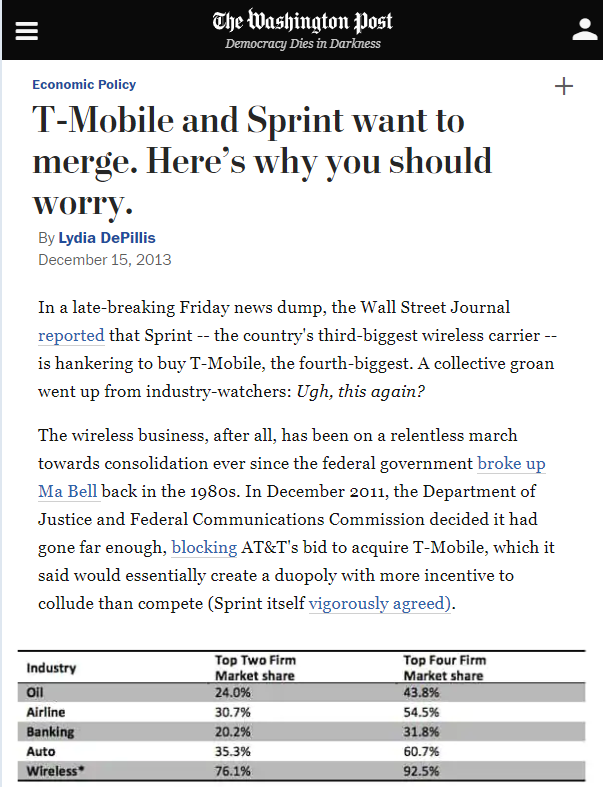
WaPo: T-Mobile and Sprint want to merge. Here’s why you should worry.
Washington Post (12/15/13)
Janine Jackson: The Washington Post headline was blunt: “T-Mobile and Sprint Want to Merge. Here’s Why You Should Worry.” The lead was also direct, with the reporter’s assertion that, at the news of a possible merger between the two big wireless carriers, “A collective groan went up from industry-watchers: Ugh, this again?
That’s because telecom companies’ urge to merge is relentless; their promises of more and better for everyone perennial, though unproven; and their public interest critics exasperated.
The Post article was, as it happens, from 2013, but it might as well have been this week. T-Mobile and Sprint still want to merge. They’re still promising benefits for all concerned, and consumer advocates are lined up to say, Ugh, this again? again.
Now, though, we have a Republican-led FCC, chaired by the cartoonishly co-opted Ajit Pai, who has just announced that the agency will approve the deal.
We’re joined now to talk about what happens next by Leo Fitzpatrick, policy counsel and C. Edwin Baker fellow at Free Press. He joins us by phone from Washington, DC. Welcome to CounterSpin, Leo Fitzpatrick.
LF: Happy to be here. Thanks for having me.
JJ: Let’s leap right in with what in particular is bad, or potentially bad, about this merger between two of the country’s four biggest wireless carriers. What would it likely mean, and for whom, if T-Mobile is allowed to acquire Sprint?
LF: I think the biggest harm that would come from this is that the merger would increase prices. And you don’t actually have to take our word for it. For instance, T-Mobile‘s own economists have sent models to the FCC, saying that their prices would go up.
There’s a whole group of companies known as MVNOs, which is a Mobile Virtual Network Operator. They don’t own any of their own cell phone towers. So they go ahead and lease some space or buy wholesale from the big carriers, and then resell them to consumers.
Essentially, those resellers tend to service what’s known as the prepaid market. Those are the people that don’t sign up for contracts, they buy their minutes on cards. It’s pay-as-you-go, essentially. The folks that rely on prepaid tend to be communities of color and low-income folks. They’re the ones that can’t sign up for a two-year contract. They’re the ones that might not be able to pass a credit check that a lot of the larger carriers require.
A lot of the maverick ethos that T-Mobile has built in itself since the rejection of the 2011 merger has been to be a very innovative brand. But that’s only been as a result of competing very directly with Sprint. Within the prepaid market, they’ve been duking it out, and it’s actually led to price decreases.
One of the innovations that T-Mobile introduced was unlimited data. And very shortly thereafter, within a couple weeks, all the other national carriers, including AT&T and Verizon, followed suit. So what would happen with a merger is that the incentives that helped create this maverick brand would evaporate.
JJ: And that sounds like the market working the way we’re told that it does, you know, companies compete with one another by offering things to consumers. But the FCC and Ajit Pai and their endorsement of this T-Mobile/Sprint merger seem to be saying, “Well, yes, but any concerns about that are going to be completely offset, because they’re going to do other stuff that’s going to make that stuff OK.”
And one of the things that they’re talking about is that this new mega-company would “close the digital divide,” because they’re going to get “5G,” whatever the heck that is, they’re going to get that to “99 percent of Americans in six years,” and that all sounds very good, but I assume that we’re right to have some questions and concerns about that promise.
LF: Well, more and more 5G is being used in a way that evokes, to me, the old Simpsons episode of the man who comes into town and utters the wonders of the monorail, where the mere utterance of an exciting opportunity somehow preempts very necessary skepticism.
Leo Fitzpatrick of Free Press
Leo Fitzpatrick: “The potential applications of 5G are very exciting. However, if we can get to the same place, without having to raise prices on folks who are going to be disproportionately affected, then we shouldn’t.”
I don’t want you to get me wrong. I’m a techie. The potential applications of 5G are very exciting. However, if we can get to the same place, without having to raise prices on folks who are going to be disproportionately affected, then we shouldn’t.
Essentially what these companies have done is, even before the merger was dreamt up, they had already a nationwide 5G deployment plan laid out. And now they are coming back and saying that, “Well, without this merger, we can’t do the same thing that we had been promising to our investors prior to the announcement of the merger.”
So one of the most important things that your listeners need to come away with is, a lot of the promises are not merger-specific—which is to say that, whether the merger happens or not, we’re still going to get 5G. There are still four national carriers who are very eagerly seeking out customers for 5G, and deploying the network that a lot of them have already planned out.
JJ: Of course, all these promises that are being offered by T-Mobile and Sprint, who’s going to be assessing whether they even hold up to these promises if this merger is allowed to go through? And who that would be would be the FCC, again, who I think listeners know have been failing, really, the public interest for a long time, but now seem to be almost sprinting away from it.
And I think if we look at the FCC’s actions with regard to Puerto Rico, post-hurricanes, which I know that Free Press has been working on, I think that that’s relevant, really, if we’re going to be talking about getting an understanding of the FCC’s priorities, and who they feel accountable to, and whether they are really going to hold carriers to their promises. What’s happening in Puerto Rico has some some relevance there; I wonder if you could tell listeners briefly what’s happening with that?
LF:  Sure. On September 20, 2017, Hurricane Maria struck the island. And what followed was, by many measures, a disaster that was quite on par with what happened in Louisiana after Hurricane Katrina.
What we’ve been trying to focus in on is, the FCC never actually followed up and conducted an independent investigation, or had the intellectual curiosity to examine this crisis that affected 3.5 million people. There was only one AM station broadcasting on the entire island 24 hours after the storm; we had first responders who had difficulty reaching out to each other. And the fact that the FCC never actually conducted an investigation is shocking to us. And I think this ties into Pai’s very ideological approach, that deregulation and the free market will be the thing that fixes everything, and that consumers will be better off when the FCC does as little as possible.
One of the things that the FCC did do after Hurricane Maria was allocate funds that would go directly to the carriers. We welcomed this investment in helping to rebuild, but they actually didn’t request, or put into place, any accountability measures. The money was supposed to accelerate the recovery and to build more resilient networks. But they didn’t come back to the carriers with accountability measures, they didn’t actually have any methods to measure—how do you know you’re accelerating the recovery if you’re not actually keeping track of it?
A lot of the work that is occurring is happening behind closed doors. And this actually hearkens back to the merger, because this past Monday, Chairman Pai came out with a statement in support of the merger.
What we’re slowly finding out is that it seems that the staff at the DoJ came up with a recommendation against the merger. And after they had made that determination, the FCC met with T-Mobile and Sprint, and came up with additional conditions, in a way to, at least apparently, preempt the announcement coming out of the Department of Justice.
And just to give you some background, telecom mergers typically need approval from both the FCC and the Department of Justice. A lot of times, they have different calculuses. The FCC reviews the mergers under what’s known as a public interest standard, and the DoJ follows more of a competition-based, will-this-increase-prices analysis.
But a lot of times they work together in unison to come up with these decisions. Typically, the Department of Justice is the one that comes out and approves the merger first, and then the FCC follows suit. So the fact that the FCC came out before the DoJ is just something that a lot of my peers have not ever seen before.
JJ: I was going to ask what happens now, does it go to the DoJ? It sounds like, as with many things under this administration, things are happening that we’re not quite prepared to calculate for. But just process-wise, the DoJ still has to officially approve this merger between T-Mobile and Sprint?
LF: Essentially the DoJ’s role is more allowing, whether they are going to come in and actively challenge the merger or not. So the FCC goes ahead and votes and comes out with an order saying, “Yes, we approve of this merger”; the DoJ can just sit back and do nothing and the merger goes through. But otherwise, they would come in, depending on whether they listened to the recommendation from the staff, and also assuming that they consider the new conditions that were introduced.
Again, I would just like to point out that this is truly unusual, in the sense that it’s moving the goalposts pretty close to the 11th hour. We might see some action in the next month or two. But we probably know only as much as your listeners do, from reading these reports and this sort of infighting of leaks from both FCC and DoJ, that’s just, again, unprecedented.
JJ: It is a weird place to be in. And I’ll just say, finally, is there a place for the public? How would we even direct our energy at this point? I mean, once an agency like the FCC fakes a cyberattack to avoid acknowledging public comments, and they then, as you’re now describing, kind of step in front of the DoJ in order to say, “Yes, we would like to pre-approve this merger.” It doesn’t seem like they care, frankly, about public input on the question. But we care about it. What should folks do with their concerns?
LF:  Well, one thing that Free Press has done is, we’ve asked our members to go ahead and call the Department of Justice to voice their concerns about the merger, and perhaps in support of the staff recommendation not to approve the merger. But also, there are a couple of state attorney generals that have been examining the issue, particularly in New York and California, and if you live in those states, contacting those Departments of Justice there and voicing the potential harms that would come from this merger might be helpful at this point.
JJ: All right, then. We’ll keep following the issue. We’ve been speaking with Leo Fitzpatrick; he is policy counsel and C. Edwin Baker fellow at the group Free Press. You can find their work on T-Mobile/Sprint, on the FCC and Puerto Rico, and on a range of other issues at FreePress.net. Leo Fitzpatrick, thank you very much for joining us this week on CounterSpin.
LF: Thank you.


FAIR/Fairness & Accuracy In Reporting
124 W. 30th Street, Suite 201
New York NY 10001
USA


Friday, May 24, 2019

Dean Baker on Trump’s Trade War, Leo Fitzpatrick on Wireless Merger


FAIR

Dean Baker on Trump’s Trade War, Leo Fitzpatrick on Wireless Merger

view post on FAIR.org

MP3 Link
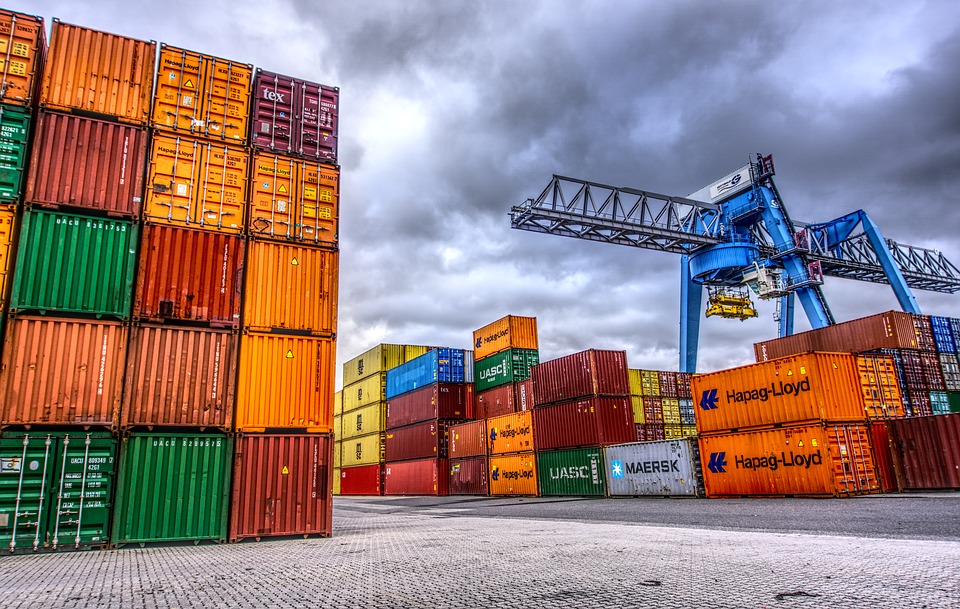
Shipping containers
(image: Pixabay)
This week on CounterSpin: Coverage of Donald Trump’s trade war on China has led to some odd writing, as when the Washington Post reported, “Dozens of US companies have complained that Trump’s earlier steel and aluminum tariffs drove up their costs and hurt more US workers than they helped. But Trump does not see it that way.” Or the New York Times says , “The president shows no signs of backing away from his stance that tariffs have helped the United States.” It’s true that the administration is both internally divided and intentionally ambiguous on trade policy and its impacts.  But what does that mean for reporters’ responsibility? Surely they can’t just throw up their hands? We’ll seek some clarity on tariffs and trade with economist Dean Baker of the Center for Economic and Policy Research .
MP3 Link
Cell phone users (cc photo: Susan Sermoneta)
(cc photo: Susan Sermoneta)
Also on the show: And then there were three? If the Republican-led FCC has its way, a horizontal merger between T-Mobile and Sprint will reduce to three the number of national wireless carriers. The Justice Department has concluded that you need at least four players to have anything like effective competition in an industry. But Ajit Pai says nah.  We’ll talk with Leo Fitzpatrick, policy counsel and C. Edwin Baker fellow at the group Free Press, about what the merger could mean for the public interest that’s of so little interest to the FCC.
MP3 Link


FAIR/Fairness & Accuracy In Reporting
124 W. 30th Street, Suite 201
New York NY 10001
USA


Sunday, April 28, 2019

Comcast-Owned MSNBC in the Tank for Joe Biden’s Presidential Run


FAIR

Comcast-Owned MSNBC in the Tank for Joe Biden’s Presidential Run

view post on FAIR.org

by Justin Anderson
Joe Biden finally announced on Thursday what everyone already knew. With the release of a three-and-a-half minute promotional video, the former vice president officially threw his name in the ever-expanding ring of Democratic primary contenders seeking to win the opportunity to challenge Donald Trump for the presidency in 2020. Biden has already seen his share of coverage, and was the second-most-mentioned Democratic candidate on cable news during the first three months of 2019.
Biden has pledged that his 2020 campaign won’t take in any direct donations from lobbyists. But on the first night of his official candidacy, Biden hit the suburbs of Philadelphia to attend a $2,800 per person fundraiser at the home of David L. Cohen, the executive vice president and chief of lobbying for Comcast.
Comcast, one of the biggest lobbying spenders in Washington, also owns MSNBC, which has showered Biden with favorable coverage both before and since his announcement.
In March, Nevada lieutenant gubernatorial candidate Lucy Flores published an article in New York Magazine (3/29/19) that described how Biden inappropriately kissed her at a campaign event. Biden has quite a long history of awkward and inappropriate touchingkissing or groping of women and girls.
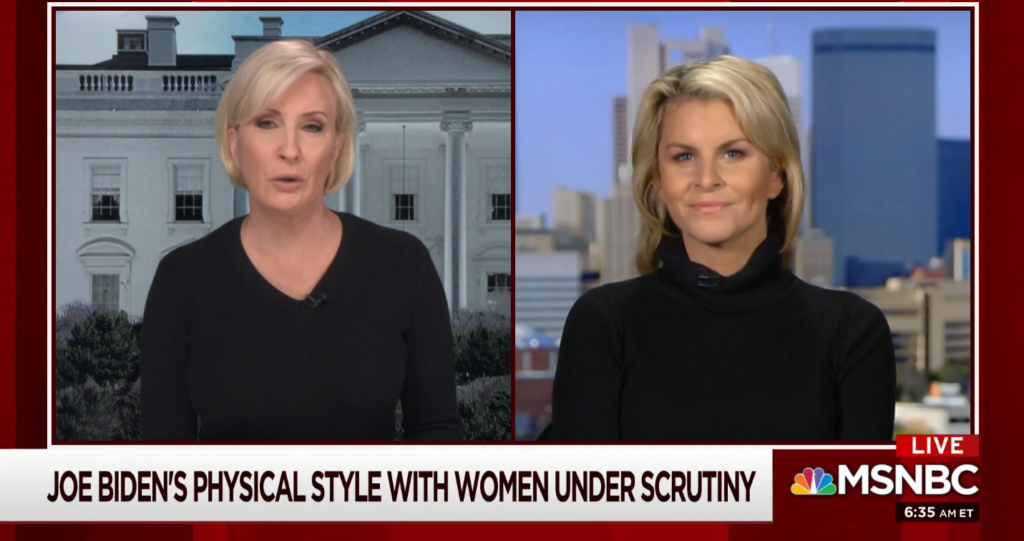
MSNBC: Joe Biden's Physical Style With Women Under Scrutiny
Mika Brzezinski (MSNBC4/1/19) defends Biden’s “physical style with women” with former DCCC staffer Adrienne Elrod.
Mika Brzezinski, co-host of MSNBC’s Morning Joe, was one of the first to defend Biden (4/1/19). Brzezinski suggested that Flores’ allegation was politically motivated, citing Flores as a “huge Bernie person,” and asking, “Are we just supposed to take all the words and the fact she said she was violated at face value?” Her guests later that day (4/1/19 ), former DCCC chief of staff Adrienne Elrod and former CIA and DoD chief of staff Jeremy Bash, seemed to agree that such #MeToo accusations against Biden were “meaningless moments,” and merely baseless finger-pointing from Biden’s political opponents.
Brzezinski continued her defense of Biden the following day and later in the week on Morning Joe, after another woman came forward with allegations of inappropriate behavior (4/2/194/5/19). Brzezinski said that the allegations were “sad,” and that Biden is a “nice guy” and “not a predator.” She continued:
This is ridiculous. The conversation has gotten out of control, and Democrats and those on the left who want to tweet me today and go nuts and get all woke, you’re eating your young. You’re eating those who can beat Trump. You’re killing the very people who have been pushing women ahead, who’ve been fighting for equal pay, who have been doing everything they can to respect women in their lives. We’re going to after Joe Biden for being affectionate to women of all ages, and to men as well? It’s ridiculous.
While he is indeed a frontrunnerdefense of Biden as supposedly the only candidate with the ability to beat Trump is frequently parroted by many corporate Democrats (and by totally, definitely well-meaning Republican Party figures as well). MSNBC contributor Mike Barnicle recently re-upped this trope (4/24/19) on the day of Biden’s announcement, though to his credit, Axios’ Jim Vandehei did push back on this narrative.
C-SPAN: Joe Biden
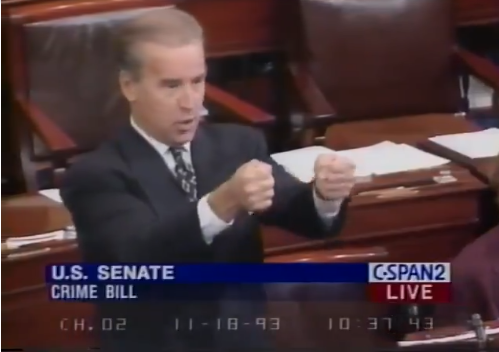
Joe Biden (11/18/93) assures the Senate: “It doesn’t matter whether or not they’re the victims of society. The end result is they’re about to knock my mother on the head with a lead pipe, shoot my sister, beat up my wife, take on my sons.”
On another Morning Joe panel (4/26/19), MSNBC correspondent Rev. Al Sharpton criticized Biden’s role in drafting and sponsoring the 1984, 1986, 1988 and 1994 crime bills, and his treatment of Anita Hill during the Clarence Thomas confirmation hearings. Biden recently issued a half-apology phone call 28 years after the fact to Hill, who told the New York Times (4/25/19) that the call “left her feeling deeply unsatisfied.” (Biden continued to dance around giving a full-throated apology to Hill in an appearance on The View—4/26/19 .) But despite Sharpton’s misgivings about Biden’s history, he maintained that Biden somehow had the “equipment despite the hurdles” to appeal to both “blue collar white workers” and “black and brown communities.”
On the same program, Joe Scarborough castigated Biden detractors, maintaining that they failed to understand the context of Biden’s past support for harsh drug laws, opposition to school integration  and support for the Iraq War. He later added that “it’s easy for you to sit there behind your laptop, drinking your soy lattes in 2019 judging [him] for trying to make the country better.” Sharpton chimed in with further attacks on so-called “latte liberators” and “limousine liberals.”
But despite his folksiness (Extra!4/13), if there is anyone who serves the interests of financial giants who spend most of their time in limousines, it’s Joe Biden. Since the late 1970s, Biden has been the chief defender of the Delaware-based credit card industry in Congress, and played a crucial role in the passage of the 2005 bankruptcy law, which made it harder for Americans to wipe out and restructure unreasonable debts through Chapter 7 bankruptcy. Indeed, credit card company MBNA (formerly owned by Bank of America) was Biden’s second-largest donor throughout his Senate career. When Biden drafted the original version of the bankruptcy bill in 2000, he was strongly opposed by then-Harvard Law professor Elizabeth Warren, who was integral in getting the Clinton administration to block its passage. Biden has also been a consistent supporter of further financial deregulation, such as the Gramm-Bliley-Leach Act, which has been pointed to as a partial cause of the 2008 financial collapse.
Yet Biden’s extremely checkered political history, where he was consistently on the wrong sides of issues like women’s rights, racial equality, financial regulation, drugs and criminal justice, surveillance and war, still doesn’t seem to be enough for the media to deem him damaged goods. In fact, outlets like MSNBC still play up Biden as the most viable candidate, despite the fact that there are others with similarly long tenures in politics who didn’t make Biden’s same mistakes.
MSNBC: 2020 Hypothetical General Election
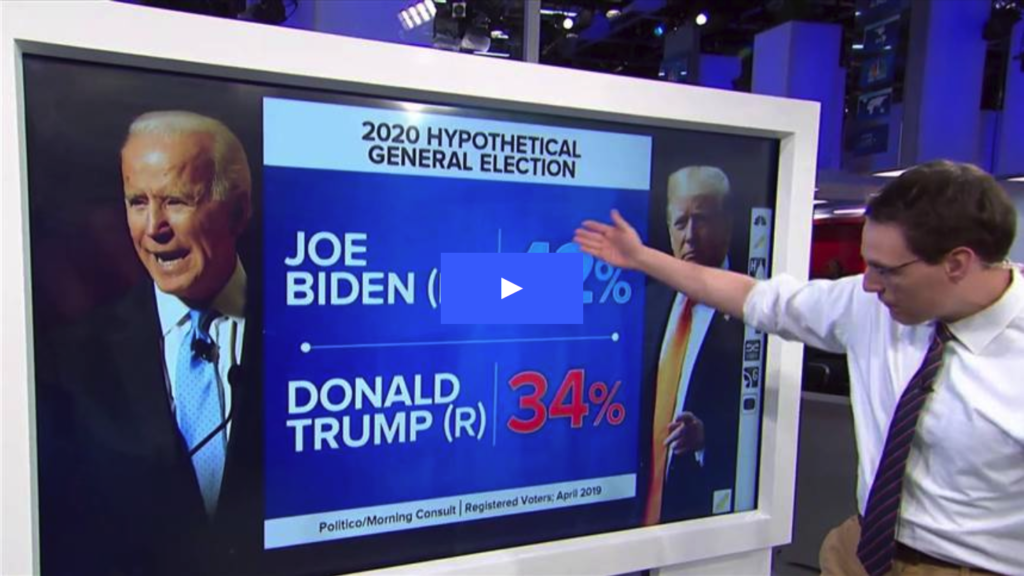
Steve Kornacki (MSNBC4/25/19) touts Biden’s electability.
Earlier in the year, Alex Altman came on MSNBC to praise Biden’s “electability” (2/21/19), while this week Steve Kornacki devoted a whole segment to prove just how “electable” Joe Biden is for the Democrats in a 2020 matchup against Trump (4/25/19). No other candidate, not even the other front runners, received such a segment from the network.
Indeed, calling Biden the most “electable” candidate is really just code for the most “moderate” or white candidate. Such a designation for Biden discounts the appeal of candidates who are left-wing, female or people of color. In particular, left-wing candidates like Bernie Sanders (the other frontrunner) and Elizabeth Warren are each frequently dogged in corporate media by accusations that they are somehow not “electable” enough.
There is perhaps an underlying logic to these attacks. Warren and Sanders have each called for heightened antitrust regulation. ( Amy Klobuchar and Corey Booker have also called for increased antitrust enforcement, but are bit more tepid on the issue than Sanders and Warren.) Big tech companies, agricultural conglomerates, food and beverage companies, banks and telecom companies like Comcast would surely come under the antitrust microscope and be targeted for breakups if one of these candidates were to win the Democratic nomination. Comcast in particular stands out as a major target, considering they have interests in both media content production as well as distribution.
Comcast, along with other internet service providers (ISPs) like Verizon and AT&T, hold what are essentially regional monopolies, where they very rarely directly compete with one another in a given area. As of 2017, almost 80 percent of US households have access to just a single ISP that offers broadband speeds of over 100 mbps. This has a striking impact on US internet users: The nation has just the 20th fastest average internet speed in the world, and, according to the FCC, US consumers pay more for broadband than most other comparable countries. Of course, ISPs are also famous for their unmatched customer service record–Comcast ranks as one of America’s most hated companies year in and year out, along with many other ISPs.
Much of the power of Comcast and other telecom companies to maintain their monopolies can be attributed to the revolving door that shuffles telecom lobbyists in and out of government positions. The current FCC chair, Ajit Pai, is the former general counsel for Verizon, while its past chair, Tom Wheeler, was a longtime telecom industry lobbyist for trade groups with connections to Comcast. Meredeth Attwell Baker, a former FCC commissioner under Obama, joined Comcast just four months after giving the greenlight for Comcast’s merger with NBC Universal. The acquisition marked the beginning of other vertical mergers between content distributors and content producers, including AT&T’s acquisition of Time Warner, which owns CNN.
During his Senate career, Biden was far from a hawk on antitrust, supporting antitrust exemptions for the soda industry after receiving donations from Coca-Cola. Judging by the Obama administration’s extremely lax antitrust approach, a hypothetical Biden administration would follow the same friendly approach towards corporate interests. Biden hasn’t stayed away from discussing the issue of antitrust so far in his campaign, but he has remarked that big corporations shouldn’t be “singled out.” At a speech last year to the Brookings Institution, he remarked, “I don’t think 500 billionaires are the reason we’re in trouble. The folks at the top aren’t bad guys.”
Such deference to massive and unpopular corporate monopolies is anathema to both a healthy economy and contrary to the views of most Americans. But potential antitrust targets like Comcast and AT&T have the ability to manufacture positive press for pro-corporate water carriers like Biden through their news properties. Powerful executives like Comcast’s David Cohen might not be shooting out daily emails to MSNBC staff ordering them to promote Biden’s candidacy, but employees will often gravitate towards what their employers want. After all, they are well aware who signs the checks.
Likewise, top MSNBC news personalities exist within the same elite circle of Washington insiders that Biden has inhabited for the past 40 years–in just about every one of the aforementioned segments, one host or guest remarked on their personal relationship with Joe Biden. The insider DC cocktail party circuit doesn’t contain very many people who want to attack their corporate benefactors.
It’s notable that even before its acquisition by ComcastMSNBC had a history of tacking to the right and a distinct reluctance to challenge entrenched corporate interests. What’s more, the network devotes little interest to economic policy, let alone antitrust, preferring to spend most of its time covering Russiagate.
However, this could change. Since entering the race, Biden has been subject to criticism from his left flank, and will likely remain a target. Sanders recently fired shots at Biden in a fundraising email, calling out his fundraiser with Cohen. Warren added to her long history of criticizing Biden by attacking  him for his support of banks and credit card companies during the financial crisis.
However, MSNBC has failed to even mention Biden’s fundraiser with Cohen. I can’t imagine why.


FAIR/Fairness & Accuracy In Reporting
124 W. 30th Street, Suite 201
New York NY 10001
USA