Search This Blog

Translate

Blog Archive

Middleboro Review 2

NEW CONTENT MOVED TO MIDDLEBORO REVIEW 2

Toyota

Since the Dilly, Dally, Delay & Stall Law Firms are adding their billable hours, the Toyota U.S.A. and Route 44 Toyota posts have been separated here:

Route 44 Toyota Sold Me A Lemon


Showing posts with label Verizon. Show all posts

Wednesday, October 2, 2019

Paul Krugman | Warren Versus the Petty Plutocrats


Reader Supported News
01 October 19
It's Live on the HomePage Now:
Reader Supported News

Paul Krugman | Warren Versus the Petty Plutocrats
Economist Paul Krugman. (photo: Getty Images)
Paul Krugman, The New York Times
Krugman writes: "Remember when pundits used to argue that Elizabeth Warren wasn't likable enough to be president? It was always a lazy take, with a strong element of sexism."
READ MORE

Special Counsel Robert Mueller. (photo: J. Scott Applewhite/AP)

Trump May Have Lied to Mueller, House Democrats Say in Filing for Grand-Jury Materials
Andrew Desiderio, Politico
Desiderio writes: "Lawyers for the House of Representatives revealed on Monday that they have reason to believe that the grand-jury redactions in special counsel Robert Mueller's report show that President Donald Trump lied about his knowledge of his campaign's contacts with WikiLeaks."
READ MORE

Fired Dallas police officer Amber Guyger leaves the courtroom after a jury found her guilty of murder Tuesday. Guyger shot and killed Botham Jean, an unarmed 26-year-old neighbor, in his own apartment last year. She told police she thought his apartment was her own and that he was an intruder. (photo: Tom Fox/The Dallas Morning News/AP)

Amber Guyger, Police Officer Who Shot a Man to Death in His Apartment, Found Guilty of Murder
Bobby Allyn, NPR
Allyn writes: "A Dallas jury has found former police Officer Amber Guyger guilty of murder for fatally shooting a neighbor who lived in the apartment directly above hers last year. She had testified that she entered Botham Jean's unit after a long day at work, thinking it was her own home and that he was an intruder."
READ MORE

Since 2016, as the Democratic field has expanded, Bernie Sanders has maintained a significant fund-raising advantage among college students in Iowa. (photo: Michael B. Thomas/AFP/Getty Images)

Bernie Sanders' Fund-Raising Haul: $25.3 Million in Third Quarter
Paul Blest, Splinter
Blest writes: "In recent weeks, the Democratic primary for president has essentially turned into a three-person race between Joe Biden, Elizabeth Warren, and Bernie Sanders. But while Sanders' campaign is already being written off by some pundits, fundraising totals released on Tuesday indicate he's not anywhere close to finished."
READ MORE

Mike Pompeo. (photo: Drew Angerer/NYT)

Pompeo Says State Department Officials Won't Show Up for Impeachment Depositions
Karen DeYoung, The Washington Post
DeYoung writes: "Secretary of State Mike Pompeo fired a broadside at House Democrats on Tuesday, saying State Department officials scheduled to appear this week before committees conducting the impeachment inquiry would not be made available until 'we obtain further clarity on these matters.'"
READ MORE

The FCC's cancellation of Obama-era rules on net neutrality sparked demonstrations in 2017. (photo: Mary Altaffer/AP)

Appeals Court Upholds Trump Admin's Canceling of Net Neutrality Rules
Brian Fung, CNN
Fung writes: "A federal appeals court has largely upheld the Federal Communications Commission's controversial repeal of its net neutrality rules for internet providers, finding the agency didn't overreach when it decided in 2018 to deregulate companies such as Comcast (CCZ) and Verizon (VZ)."
READ MORE

A protestor participates in a demonstration in Washington against the Dakota Access and Keystone XL pipelines. (photo: Kevin Lamarque/Reuters)

Revealed: How the FBI Targeted Environmental Activists in Domestic Terror Investigations
Adam Federman, Guardian UK
Federman writes: "Protesters were characterized as a threat to national security in what one calls an attempt to criminalize their actions."
READ MORE


Wednesday, May 29, 2019

‘The Merger Would Increase Prices—and You Don’t Have to Take Our Word for It’ - CounterSpin interview with Leo Fitzpatrick on T-Mobile/Sprint merger


FAIR

‘The Merger Would Increase Prices—and You Don’t Have to Take Our Word for It’ - CounterSpin interview with Leo Fitzpatrick on T-Mobile/Sprint merger

view post on FAIR.org

Janine Jackson interviewed Leo Fitzpatrick on the T-Mobile/Sprint merger for the May 24, 2019, episode of CounterSpin. This is a lightly edited transcript.
MP3 Link
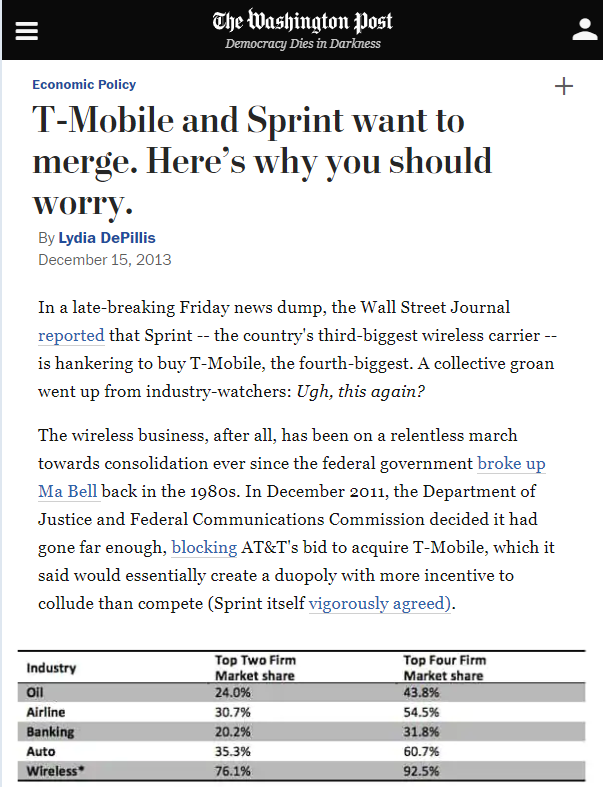
WaPo: T-Mobile and Sprint want to merge. Here’s why you should worry.
Washington Post (12/15/13)
Janine Jackson: The Washington Post headline was blunt: “T-Mobile and Sprint Want to Merge. Here’s Why You Should Worry.” The lead was also direct, with the reporter’s assertion that, at the news of a possible merger between the two big wireless carriers, “A collective groan went up from industry-watchers: Ugh, this again?
That’s because telecom companies’ urge to merge is relentless; their promises of more and better for everyone perennial, though unproven; and their public interest critics exasperated.
The Post article was, as it happens, from 2013, but it might as well have been this week. T-Mobile and Sprint still want to merge. They’re still promising benefits for all concerned, and consumer advocates are lined up to say, Ugh, this again? again.
Now, though, we have a Republican-led FCC, chaired by the cartoonishly co-opted Ajit Pai, who has just announced that the agency will approve the deal.
We’re joined now to talk about what happens next by Leo Fitzpatrick, policy counsel and C. Edwin Baker fellow at Free Press. He joins us by phone from Washington, DC. Welcome to CounterSpin, Leo Fitzpatrick.
LF: Happy to be here. Thanks for having me.
JJ: Let’s leap right in with what in particular is bad, or potentially bad, about this merger between two of the country’s four biggest wireless carriers. What would it likely mean, and for whom, if T-Mobile is allowed to acquire Sprint?
LF: I think the biggest harm that would come from this is that the merger would increase prices. And you don’t actually have to take our word for it. For instance, T-Mobile‘s own economists have sent models to the FCC, saying that their prices would go up.
There’s a whole group of companies known as MVNOs, which is a Mobile Virtual Network Operator. They don’t own any of their own cell phone towers. So they go ahead and lease some space or buy wholesale from the big carriers, and then resell them to consumers.
Essentially, those resellers tend to service what’s known as the prepaid market. Those are the people that don’t sign up for contracts, they buy their minutes on cards. It’s pay-as-you-go, essentially. The folks that rely on prepaid tend to be communities of color and low-income folks. They’re the ones that can’t sign up for a two-year contract. They’re the ones that might not be able to pass a credit check that a lot of the larger carriers require.
A lot of the maverick ethos that T-Mobile has built in itself since the rejection of the 2011 merger has been to be a very innovative brand. But that’s only been as a result of competing very directly with Sprint. Within the prepaid market, they’ve been duking it out, and it’s actually led to price decreases.
One of the innovations that T-Mobile introduced was unlimited data. And very shortly thereafter, within a couple weeks, all the other national carriers, including AT&T and Verizon, followed suit. So what would happen with a merger is that the incentives that helped create this maverick brand would evaporate.
JJ: And that sounds like the market working the way we’re told that it does, you know, companies compete with one another by offering things to consumers. But the FCC and Ajit Pai and their endorsement of this T-Mobile/Sprint merger seem to be saying, “Well, yes, but any concerns about that are going to be completely offset, because they’re going to do other stuff that’s going to make that stuff OK.”
And one of the things that they’re talking about is that this new mega-company would “close the digital divide,” because they’re going to get “5G,” whatever the heck that is, they’re going to get that to “99 percent of Americans in six years,” and that all sounds very good, but I assume that we’re right to have some questions and concerns about that promise.
LF: Well, more and more 5G is being used in a way that evokes, to me, the old Simpsons episode of the man who comes into town and utters the wonders of the monorail, where the mere utterance of an exciting opportunity somehow preempts very necessary skepticism.
Leo Fitzpatrick of Free Press
Leo Fitzpatrick: “The potential applications of 5G are very exciting. However, if we can get to the same place, without having to raise prices on folks who are going to be disproportionately affected, then we shouldn’t.”
I don’t want you to get me wrong. I’m a techie. The potential applications of 5G are very exciting. However, if we can get to the same place, without having to raise prices on folks who are going to be disproportionately affected, then we shouldn’t.
Essentially what these companies have done is, even before the merger was dreamt up, they had already a nationwide 5G deployment plan laid out. And now they are coming back and saying that, “Well, without this merger, we can’t do the same thing that we had been promising to our investors prior to the announcement of the merger.”
So one of the most important things that your listeners need to come away with is, a lot of the promises are not merger-specific—which is to say that, whether the merger happens or not, we’re still going to get 5G. There are still four national carriers who are very eagerly seeking out customers for 5G, and deploying the network that a lot of them have already planned out.
JJ: Of course, all these promises that are being offered by T-Mobile and Sprint, who’s going to be assessing whether they even hold up to these promises if this merger is allowed to go through? And who that would be would be the FCC, again, who I think listeners know have been failing, really, the public interest for a long time, but now seem to be almost sprinting away from it.
And I think if we look at the FCC’s actions with regard to Puerto Rico, post-hurricanes, which I know that Free Press has been working on, I think that that’s relevant, really, if we’re going to be talking about getting an understanding of the FCC’s priorities, and who they feel accountable to, and whether they are really going to hold carriers to their promises. What’s happening in Puerto Rico has some some relevance there; I wonder if you could tell listeners briefly what’s happening with that?
LF:  Sure. On September 20, 2017, Hurricane Maria struck the island. And what followed was, by many measures, a disaster that was quite on par with what happened in Louisiana after Hurricane Katrina.
What we’ve been trying to focus in on is, the FCC never actually followed up and conducted an independent investigation, or had the intellectual curiosity to examine this crisis that affected 3.5 million people. There was only one AM station broadcasting on the entire island 24 hours after the storm; we had first responders who had difficulty reaching out to each other. And the fact that the FCC never actually conducted an investigation is shocking to us. And I think this ties into Pai’s very ideological approach, that deregulation and the free market will be the thing that fixes everything, and that consumers will be better off when the FCC does as little as possible.
One of the things that the FCC did do after Hurricane Maria was allocate funds that would go directly to the carriers. We welcomed this investment in helping to rebuild, but they actually didn’t request, or put into place, any accountability measures. The money was supposed to accelerate the recovery and to build more resilient networks. But they didn’t come back to the carriers with accountability measures, they didn’t actually have any methods to measure—how do you know you’re accelerating the recovery if you’re not actually keeping track of it?
A lot of the work that is occurring is happening behind closed doors. And this actually hearkens back to the merger, because this past Monday, Chairman Pai came out with a statement in support of the merger.
What we’re slowly finding out is that it seems that the staff at the DoJ came up with a recommendation against the merger. And after they had made that determination, the FCC met with T-Mobile and Sprint, and came up with additional conditions, in a way to, at least apparently, preempt the announcement coming out of the Department of Justice.
And just to give you some background, telecom mergers typically need approval from both the FCC and the Department of Justice. A lot of times, they have different calculuses. The FCC reviews the mergers under what’s known as a public interest standard, and the DoJ follows more of a competition-based, will-this-increase-prices analysis.
But a lot of times they work together in unison to come up with these decisions. Typically, the Department of Justice is the one that comes out and approves the merger first, and then the FCC follows suit. So the fact that the FCC came out before the DoJ is just something that a lot of my peers have not ever seen before.
JJ: I was going to ask what happens now, does it go to the DoJ? It sounds like, as with many things under this administration, things are happening that we’re not quite prepared to calculate for. But just process-wise, the DoJ still has to officially approve this merger between T-Mobile and Sprint?
LF: Essentially the DoJ’s role is more allowing, whether they are going to come in and actively challenge the merger or not. So the FCC goes ahead and votes and comes out with an order saying, “Yes, we approve of this merger”; the DoJ can just sit back and do nothing and the merger goes through. But otherwise, they would come in, depending on whether they listened to the recommendation from the staff, and also assuming that they consider the new conditions that were introduced.
Again, I would just like to point out that this is truly unusual, in the sense that it’s moving the goalposts pretty close to the 11th hour. We might see some action in the next month or two. But we probably know only as much as your listeners do, from reading these reports and this sort of infighting of leaks from both FCC and DoJ, that’s just, again, unprecedented.
JJ: It is a weird place to be in. And I’ll just say, finally, is there a place for the public? How would we even direct our energy at this point? I mean, once an agency like the FCC fakes a cyberattack to avoid acknowledging public comments, and they then, as you’re now describing, kind of step in front of the DoJ in order to say, “Yes, we would like to pre-approve this merger.” It doesn’t seem like they care, frankly, about public input on the question. But we care about it. What should folks do with their concerns?
LF:  Well, one thing that Free Press has done is, we’ve asked our members to go ahead and call the Department of Justice to voice their concerns about the merger, and perhaps in support of the staff recommendation not to approve the merger. But also, there are a couple of state attorney generals that have been examining the issue, particularly in New York and California, and if you live in those states, contacting those Departments of Justice there and voicing the potential harms that would come from this merger might be helpful at this point.
JJ: All right, then. We’ll keep following the issue. We’ve been speaking with Leo Fitzpatrick; he is policy counsel and C. Edwin Baker fellow at the group Free Press. You can find their work on T-Mobile/Sprint, on the FCC and Puerto Rico, and on a range of other issues at FreePress.net. Leo Fitzpatrick, thank you very much for joining us this week on CounterSpin.
LF: Thank you.


FAIR/Fairness & Accuracy In Reporting
124 W. 30th Street, Suite 201
New York NY 10001
USA


Monday, April 15, 2019

POLITICO Massachusetts Playbook: NEAL’S Tax Day — MARATHON Monday — TRAHAN’s loophole — Boston’s OTHER housing crisis


NEAL’S Tax Day — MARATHON Monday — TRAHAN’s loophole — Boston’s OTHER housing crisis


Apr 15, 2019View in browser
 
Massachusetts Playbook logo
Presented by NARAL Pro-Choice Massachusetts
GOOD MORNING, MASSACHUSETTS. It's Marathon Monday!
MEETING DEADLINES — Today marks the first big deadline of the 2020 campaign cycle: Fundraising numbers for the first quarter of the year are due to the FEC. Some candidates have rolled out their totals early, among them Sen. Elizabeth Warren, who pulled in $6 million over the last several months.
In Massachusetts, a number of other big dates are just down the pike.
Rep. Seth Moulton set himself a deadline to decide whether he's running for president by the end of the month. But talking to reporters on Friday, it seemed like Moulton's would-be campaign pitch is already solidified. "I'm the only person announced or unannounced who's even talking about national security right now," Moulton said after a town hall in North Andover. Former GOP Gov. Bill Weld has set a similar end-of-April deadline for a presidential primary bid.
And today might be Tax Day, but Rep. Richard Neal set a different deadline for President Donald Trump to hand over his taxes — April 23. The Ways and Means chairman requested six years of the president's tax returns earlier this month, but the Trump administration ignored the first deadline for Neal's request. If the president skips out on the April 23 date, the next step is likely a subpoena for the documents.
Have a tip, story, suggestion, birthday, anniversary, new job, or any other nugget for the Playbook? Get in touch: smurray@politico.com.
CONGRATULATIONS TO EVERYONE MAKING THAT LEFT ON BOYLSTON, AND BE SURE TO CHEER EXTRA LOUD FOR THESE CHAMPS IF YOU SEE THEM ON THE RACE ROUTE — Lizzy Guyton, Jon Chesto, Danny Condon, Tyler O'Day, Eileen O'Connor, George O'Malley, Amy Sennett, Dan Koh, Gina Fiandacca, Heather Gasper, Nora Dohret, Gina Christo, Larry Tobin, Scott Zoback, Steve Roman, Stacy Hodes Roman, Kelsey Smithendorf, Tim O'Leary, Layth Elhassani, Emily Izzo, Jim Sweeney, Reilly McGreen, Chrissy Raymond, William Evans, Debbie Panek, Leah Potash, Jeanne Caron, Jamie Hoag, Dana Shulman, Andy Burnham and volunteer Dave Perry.
TODAY — Rep. Joe Kennedy III visits EY Technologies and attends a rally for Stop & Shop workers in Fall River. Boston Mayor Marty Walsh attends the Boston Marathon. Sen. Elizabeth Warren campaigns in South Carolina.
 
A message from NARAL Pro-Choice Massachusetts:
Abortion is key to equality. All people deserve care without shame, stigma, or unjust barriers. The ROE Act affirms the fundamental belief that living a safe and healthy life is a basic right. Abortion opponents are misrepresenting efforts to protect abortion access, using inflammatory, insulating language to score political points. Learn more
 
DATELINE BEACON HILL
- "House budget adds $30 million to help nursing homes stay open," Associated Press: "The plight of struggling nursing homes is getting the attention of state lawmakers. The House Ways and Means Committee is calling for $30 million in rate increases for nursing homes in its proposed state budget for the fiscal year starting on July 1. Along with that extra money is a plan to create an emergency task force to study the financial stability of nursing facilities. The Massachusetts Senior Care Association has warned that 35 nursing homes around the state are at risk of closing this year, on top of 20 that permanently shut their doors last year."
- "The Massachusetts Lottery Is Getting A Tech Upgrade," by Zeninjor Enwemeka," WBUR: "The Massachusetts Lottery is getting a much needed tech boost. The lottery will replace its IT system Sunday — for the first time in 20 years. It's a critical change for a system that handles millions of lottery transactions each year. The new IT system will connect with more than 7,500 new lottery terminals that have already been rolled out over the last year."
FROM THE HUB
- "For foster parents, chaotic state system makes job even harder," by Kay Lazar, Boston Globe: "But instead of doing everything possible to assist foster parents like Suzor, the state has done little to lighten their load, and in many ways has made the work even tougher. Some 2,000 families have stopped accepting foster children in the past five years — almost as many as the total number of foster families currently in the system. The departures have further strained the longstanding gap between available foster homes and the thousands of abused and neglected kids who need a safe haven."
- "In tight labor market, employers going to great lengths to attract workers," by Katie Johnston, Boston Globe: "In low-wage sectors where wages and job quality have lagged for years, pay is rising, benefits are improving, part-time hours are turning into full-time work, and schedules are becoming more flexible and stable. One restaurant chain started closing before the MBTA stopped running to accommodate workers who rely on public transportation to get home. A long-term care facility reallocated some of the physically demanding duties required of nursing assistants to allow older employees to continue working."
- "Uber, Lyft trips to airport keep rising," by Bruce Mohl, CommonWealth Magazine: "MASSPORT OFFICIALS said Uber and Lyft vehicle trips to and from Logan International Airport are up 29 percent so far this year, and indicated on Friday they are determined to deal with the congestion by moving ahead with a plan to hike ride-hailing fees at the airport and concentrate all pickups and drop-offs in the central parking garage. The rapid growth of the ride-hailing apps at Logan is astounding. They first started serving the airport on February 1, 2017, and provided 4.8 million passenger trips during the remaining 11 months. The number of trips increased to 7 million last year, an increase of 46 percent."
- RELATED: "Don't blame Uber and Lyft for congestion," by Christina Fisher, CommonWealth Magazine: "NOT LONG AGO, many of us who live and work in Boston had to plan our days around times the T would run, hope that a taxi scheduled the night before would show up in the morning to help us catch an early flight, or coordinate rides from the nearest train station to visit loved ones. Fortunately, we have more alternatives to choose from now, including ridesharing, which has transformed and simplified traveling in Boston. In a few short years, it has become an essential service that both residents and visitors rely on every day, including for trips to and from the airport. However, consumers could soon see unwelcome changes that would limit their options."
- "Boston's Other Housing Crisis: The Cemeteries," by Nora Caplan-Bricker, Boston Magazine: "To the untrained eye, Greater Boston's most illustrious cemetery, the nearly 200-year-old Mount Auburn, looks full: There are plaques, pillars, and sarcophagi in all directions and statuary posing in every copse of trees. But if you ride around the cemetery with CEO Dave Barnett, you begin to spot the once-imperceptible openings. That's because Barnett has become an expert in finding new grave space in a cemetery—and a city—that is quickly running out of room."
- "Steve who? How far Wynn Resorts is going to distance itself from its founder," by Mark Arsenault, Boston Globe: "The ancient Romans called it damnatio memoriae, the damnation of memory. It was the rather extreme act of punishing someone by attempting to erase every trace of them from the historical record, so future generations would never know they had existed. Ambitious, if that person was the emperor or some other big shot. Did it ever actually work? If it did, we wouldn't know. A couple of thousand years later, Wynn Resorts is overseeing a modern version of the memory scrub."


IT'S NOT EASY BEING GREEN
- "The Green New Deal is more than a resolution — it's a revolution," by Sen. Ed Markey, Boston Globe: "Extreme weather fueled by climate change is wreaking havoc across the country, but Senate majority leader Mitch McConnell and his Republican caucus are making a mockery of the debate on climate action. Republicans and President Trump may choose to be in denial about the consequences of climate change, but to everyday Americans the climate crisis isn't politics, it's life and death."
WARREN REPORT
- "Elizabeth Warren tells Stop & Shop shoppers, 'Do not cross the picket line,'" by Shira Schoenberg, Springfield Republican: "U.S. Sen. Elizabeth Warren, a Massachusetts Democrat running for president in 2020, delivered donuts and coffee to picketing Stop & Shop workers in Somerville on Friday, and urged shoppers to take their business elsewhere. "Do not cross the picket line," Warren said. "Understand people on the picket line are not just fighting for their families. They're fighting for all our families. They're fighting for basic fairness and equality in this country." On Thursday, the unions representing 31,000 Stop & Shop workers across Massachusetts, Rhode Island and Connecticut voted to go on strike ."
DATELINE D.C.
- "Q&A: Rep. Ayanna Pressley On Her First 100 Days In Congress," by Kimberly Atkins, WBUR: "U.S. Rep. Ayanna Pressley talked to WBUR'S Kimberly Atkins about her first 100 days in Congress, during which she questioned President Trump's former personal attorney Michael Cohen, filed or co-sponsored 115 bills and spoke on the House floor about the struggles she and her families have faced."
- "THESE HOUSE DEMOCRATS PLEDGED NOT TO TAKE CORPORATE CASH — BUT THEY'RE USING A LOOPHOLE TO DO IT ANYWAY," by Lee Fang, The Intercept: "ONE POLITICIAN WHO cited these loopholes in the pledge to take corporate money is Rep. Lori Trahan, D-Mass., who was elected last November. "I firmly believe that we need to root out the corruptive influence of money in politics which is why I refuse to take any money from corporate PACs," Trahan wrote last year, when she was a candidate, as a way to explain how she differs from others in the race. In the run-up to Election Day and in the following months, however, Trahan accepted campaign cash from trade association PACs representing beer wholesalers, as well as grocery, hotel, hospital, and cable industry groups."
MARIJUANA IN MASSACHUSETTS
- "Mass. marijuana industry is mostly corporate and white. Inside one Boston battle to change that," by Boston Globe Spotlight Team: "Massachusetts was the first state in the nation to make social justice goals a cornerstone of marijuana legalization. But two years in, those equity provisions are giving way to old inequities, small players are being squeezed by the bigger national ones, and the question of which minority entrepreneur most deserves the neighborhood's trust is proving to be hard to discern, a Spotlight Team review shows."
P.S. If you use medical marijuana or CBD (or if you're a health professional who has worked with it), we want to hear from you. Tell us your story and a reporter might reach out.
ABOVE THE FOLD
— Herald"TOLL ROAD,"  Globe"FLEET OF FEET," "Tight job market, widening benefits," "On this round of glory, Tiger finds himself," "A district takes neighborly turn."
FROM THE 413
- "Has Morse Begun to Telegraph His next Move?" by Matt Szafranski, Western Mass Politics & Insight: "On a seasonably brisk spring day, College Democrats had assembled in the basement of Clark University's student center for their annual convention. There was drama, but that did not concern their guests, including one who was a few years out of college himself, Holyoke Mayor Alex Morse. College Dems events were familiar territory for Morse. He was among several young electeds who spoke, including the area's rep David LeBoeuf and Boston City Councilor Michelle Wu. This visit came amid rising chatter here, and back in the 413, about his interest in higher office such as the seat held by US Representative Richard Neal."
WHAT A GREAT OPPORTUNITY FOR YOUNG ADULTS! COURTROOMS ARE PUBLIC AND VERY FEW AVAIL  THEMSELVES OF THE OPPORTUNITY TO VIEW. NEXT TIME YOU'RE NEAR A COURTHOUSE AND HAVE SOME TIME TO SPARE, MAYBE YOU'RE EARLY FOR AN APPOINTMENT,  CONSIDER SITTING THROUGH A SESSION. YOU MIGHT BE ENLIGHTENED. 
- "A unique civics lesson," by Joshua Solomon, Greenfield Recorder: "Walking down Main Street, a handful of Frontier Regional High School students saw the family of the deceased walking to grab a bite. Both had just left a murder trial at Franklin County Superior Court. "It's something you see in the news," Erin Senn, 16, said of the trial she and her classmates watched Wednesday. "You read about it. You watch it on TV." The students were in court on a field trip for their street law class at Frontier. The family was there in support of Amanda Glover, the 47-year-old woman who was killed in her Wendell home two years ago."
THE LOCAL ANGLE
- "How a Verizon Cell Tower Began a Furious Debate in Wayland," by Julie Suratt, Boston Magazine: "When Verizon Wireless started negotiations to build a 141-foot tower there several months earlier, they had every reason to think it would be a home run. After all, the proposed location—a nondescript, 2,000-square-foot plot of land on a heavily wooded, 15-acre property, bordered by miles of undeveloped wetlands and the Sudbury River—seemed the ideal spot to close a service gap in southwest Wayland. What could possibly be wrong with that?"
- "Councilors seek assurances as Quincy considers major land deal," by Erin Tiernan, Patriot Ledger: "As city councilors review a complicated land deal that could pave the way for the development of a state-of-the-art medical complex in Quincy Center while requiring the investment of millions in tax dollars, some are seeking assurances that residents' interests won't be overridden by those of a private developer."
- "Tensions rise as Stop & Shop talks continue," Salem News:"Tensions between Stop & Shop and unionized workers rose this weekend as police were called to several stores when tempers began to fray. Although talks between Shop & Stop officials and United Food and Commercial Workers were scheduled to resume Sunday morning, workers remained on the picket line all Sunday. Thousands of the supermarket's unionized employees walked off the job on Thursday over what they say is an unfair contract."
MEDIA MATTERS
BostInno hired Rowan Walrath to cover the city's startups. Walrath previously worked at Wired magazine in San Francisco. Link.
MAZEL! To Rachel Dec, who is headed to the University of Chicago to attend the Harris School of Public Policy this fall. Tweet.
HAPPY BELATED BIRTHDAY - to former Rep. Chester AtkinsLina Francis, Joe Rospars, founder and CEO at Blue State Digital and an adviser to Elizabeth Warren's campaign; Tom Werner, Ilya RasnerRebecca Pearcey and Laura Chester.
HAPPY BIRTHDAY - to Asher MacDonald, special assistant to Rep. Seth Moulton.
DID THE HOME TEAM WIN? Yes and yes! The Red Sox beat the Orioles 4-0. The Celtics beat the Pacers 84-74.
Want to make an impact? POLITICO Massachusetts has a variety of solutions available for partners looking to reach and activate the most influential people in the Bay State. Have a petition you want signed? A cause you're promoting? Seeking to increase brand awareness among this key audience? Share your message with our influential readers to foster engagement and drive action. Contact Jesse Shapiro to find out how: jshapiro@politico.com.
 
A message from NARAL Pro-Choice Massachusetts:
We all deserve the freedom to control our bodies, our families, and our futures. Abortion is fundamental to our equality. But even in Massachusetts, people seeking abortion care face unjust barriers every day.

The ROE Act affirms the fundamental belief that living a safe and healthy life is a basic right - as is the freedom to define our own path. Abortion opponents have been misrepresenting efforts to protect access to abortion care, using inflammatory and insulating language to score political points.

With Roe v. Wade under threat like never before, our state has a duty to lead the way in protecting access to abortion care. Together, we can ensure that all people have access to abortion care without shame, stigma, or barriers. Massachusetts must lead by passing the ROE Act! Learn more
 
 
Follow us on Twitter
Stephanie Murray @StephMurr_Jour
 
Subscribe to the POLITICO Playbook family
FOLLOW US
POLITICO, LLC 1000 Wilson Blvd. 
Arlington, VA, 22209, USA


Thursday, January 3, 2019

‘There’s a Disconnect Between DC and What People Actually Want’ - CounterSpin interview with Tim Karr on net neutrality


FAIR

‘There’s a Disconnect Between DC and What People Actually Want’ - CounterSpin interview with Tim Karr on net neutrality

view post on FAIR.org

Janine Jackson interviewed Tim Karr about the net neutrality fight for the December 21, 2018, episodeof CounterSpin. This is a lightly edited transcript.
MP3 Link
Ajit Pai (photo: FCC)
Janine Jackson: When last we checked on the FCC, agency chair and former Verizon lawyer Ajit Pai was admitting what everyone already knew: that he straight-up lied when he told lawmakers that public comments in favor of net neutrality couldn’t get through because the FCC was suffering an online attack that tied up their servers. In fact, the agency’s Republican majority simply overrode clearly stated public support for net neutrality rules in their decision to repeal them.
That Pai has an agenda, to allow telecommunication industry titans to basically write policy to their liking, is obvious; whether he’ll be able to turn a federal agency tasked with representing the public interest so thoroughly against that purpose is what’s being contested, including by our next guest. Timothy Karr is senior director of strategy and communications at the group Free Press. He joins us now by phone from New Jersey. Welcome back to CounterSpin, Tim Karr.
Timothy Karr: Hi, Janine. How are you?
JJ: I’m very well. Well, listeners understand net neutrality as the rules that seek to keep the internet a more or less level playing field, and in so doing, make possible a great deal of person-to-person organizing and communication. We saw the repeal, over the overwhelming opposition of internet users. And then we saw some pushback to the repeal at state and municipal levels.
Now we’ve got a new Congress. What’s the state of play on net neutrality?
TK: Well, the state of play is uncertain. As you mentioned, in 2017, the chairman Ajit Pai, who was appointed by President Trump, repealed the net neutrality protections that we won in 2015, and that happened at the end of 2017.
So 2018 was really a year where we’re trying to get these rights back, we’re trying to protect everyone’s right to go online and connect with whomever they want to who’s online. And in order for us to do that, we have to restore the Federal Communications Commission’s authority, under a somewhat arcane rule called Title II of the Communications Act, that allows them to treat internet service providers as these conduits, common carrier conduits, that cannot block or throttle or in any way deprioritize online content that people want to see.
So it’s been a long fight. The good news is that we won what’s called a resolution of disapproval in the Senate in May; we had a majority of senators vote to throw out the rules. That process is now switched to the House, which has almost closed its session for the year, where we have more than 180 members who signed on to this resolution. So it’s an ongoing process. We’ve managed to get more people in Congress, more of our elected representatives and lawmakers, on the record in support of net neutrality than we have in any time in the history of this issue. So there’s momentum, and it’s good momentum that will lead us into a new Congress, where we have even more champions of net neutrality. So we’re looking ahead to 2019 with a great measure of optimism.
Heartland Institute: One Year Later, The Left’s Net Neutrality Lies Look Even Dumber
Heartland Institute (12/18/18)
JJ: Right. Well, I got something…what did I see…from the Heartland Institute, I think, that told me that “none of the liberal lies came true.” In other words, net neutrality was repealed, and look, nothing negative happened, so what’s the big deal?
TK: Well, for one, we think that the internet service providers have been on their best behavior, because they know there’s an effort to put these rules back in place. But even given that, there have been instances where Sprint has throttled access to Skype, where we’ve seen them starting to make inroads into this kind of two-tiered internet that we’ve been warning about, where they actually give prioritizations to the sites and services that they like, and the rest of us lose that choice.
This is something that these very large phone and cable companies—companies like AT&T and Comcast and Verizon—have wanted to do for more than a decade now, because they saw that the future of the media was the internet. And the future of internet media was video. And they wanted really to control the way video streaming is used online, to really become the gatekeepers of the future of television, just like large media companies have been the gatekeepers to the past of television, when you had a very few conglomerates controlling what went on television. So they are very aggressively moving into the space, with the hope that absent net neutrality rules, they can control what we watch on the internet as well.
JJ: We have to wonder why industry would fight so hard for something that wasn’t going to make any difference. Why would they fight so hard to get rid of these rules if their repeal would have actually no impact on what they do?
Well, the group MapLight released research showing how two telecom trade groups,  CTIA, who has members including AT&T and Comcast and Verizon, and the Internet and Television Association, that they gave more than $3 million to groups like ALEC, the “bill mill” that pushed for net neutrality’s repeal. It seems like following the money is as important a rule here as on any other issue.
Tim Karr, Free Press
Tim Karr: “We’re talking about millions and millions of dollars that have gone from the phone and cable lobby to elected representatives to lobbyists to lawyers, to try to get net neutrality off the books.”
TK: Yeah, and that’s just the money that we know about, right? Because you have to report lobbying expenditures, because you have to report campaign contributions to federally elected officials, we do have a paper trail. And even looking at that, we’re talking about millions and millions of dollars that have gone from the phone and cable lobby to elected representatives to lobbyists to lawyers, to try to get net neutrality off the books.
There’s a whole other dark economy there that we don’t know as much about. And those are the kind of contributions that are made to PACs, the kind of contributions that are made to PR firms and think tanks. And there’s a whole slew of think tanks, for example, in Washington, DC, that generate these reports on net neutrality, that make up these sorts of lies that, you know, net neutrality has hampered investment, that it’s heavy-handed government regulation of the internet, both of which are untrue.
But you give money to think tanks to generate reports, and then someone like Chairman Ajit Pai, who’s looking for evidence to support his decision to repeal net neutrality, points to a report by an organization like the American Enterprise Institute, and says, “See, proof that I was right.”
And this is all part of this influence economy, that is controlled by these very powerful corporations—again, companies like AT&T and Verizon—who create this kind of false reality around net neutrality inside Washington, DC, when people outside of the Beltway—in overwhelming numbers, and there are a number of polls out there that show Democrats, Republicans, registered voters, registered independents, all by strong majorities—support keeping the net neutrality rules.
So there’s a disconnect between what’s going on in Washington, DC, where rulemakers are held captive to this industry, and what the people of the country actually want. So as we go towards a new Congress, we’re hopeful that with some of the new people that were elected in November, we’ll gain even more traction on Capitol Hill to put in place legislation that will restore these net neutrality rules.
JJ: Speaking of that disconnect, there’s a new Communications Marketplace Report that Karl Bode, I was reading, says, if you read it, it suggests that broadband “is awash with vibrant competition.” And it just sounds so strange for those of us who think, “Well, wait, I only have Comcast, you know, I only have one option.” Are we really on different planets? How can the FCC be putting out information that says that we really have a competitive field when it comes to broadband?
TK: There’s a number of ways that they do that. When they talk about broadband, sometimes they like to include wireless connectivity options; but anybody who has a cell phone and even a 5G connection knows that you can’t replicate a high-speed internet connection that you have in your home through your cell phone device. And another way that the FCC has tried to make broadband seem more plentiful is by lowering the standards. This lowering the speeds for uploads and downloads, so that as they create a slower standard for broadband, it allows them to even include some internet service providers that have pretty crappy, slow services as broadband providers.
But you’re right. At the end of the day, the type of broadband that people want, there are very few choices in the United States. And it’s driven prices higher than any other developed country around the world. We paid more for wireless internet connections, for landline internet connections, than most any other country in the world. So that’s what happens when you have a very small number of companies controlling the industry. And in addition to controlling the industry, controlling the policy-making process.
JJ: Well, you touched on it earlier. I know Free Press put out a list of positive moments from the year. There are good things happening, and I think we have to remember that media organizing, like any organizing, is a marathon and not a sprint, and there’s work that’s going on. What would you have folks think about, who are just surveying the the media landscape at the moment? What kinds of things is Free Press up to?
TK: The things that we’re doing to get net neutrality back is that we’re actually suing the FCC. We’re challenging its decision to reverse this definition of broadband, to reverse the authority that it had over broadband. So that’s a court case that’s going to be heard in the US Court of Appeals for the DC circuit on February 1. We’re very confident that we have a strong legal argument to make that would reverse this net neutrality decision.
The FCC is also now under investigation. There’s an investigation into a number of fake comments that were filed in the net neutrality proceeding; when the FCC made this decision in 2017, they opened up what they call a docket for public comments, and there are nearly 10 million comments that appear to be faked.
There’s an investigation into whether that was—and that’s illegal activity—whether that crime was committed by people working at the behest of the phone and cable lobby.  There’s also been a lot of questions about the FCC chairman’s reluctance to open up the docket to investigators and reporters who want to figure out who are the culprits behind this decision. So there’s some questions about the process itself.
And you know, again, I mentioned Congress; we have increasing bipartisan support all around the country, but we also have a number of new members of Congress who campaigned with net neutrality as an issue and won,  who are looking to doing something legislatively in 2019. You could see something as early as spring, where we have legislation that would put a strong legal standard for net neutrality. And given the new composition of Congress, and given the bipartisan nature, at least in the grassroots level, of support for net neutrality, we’re also hopeful that we can get these protections back through legislative means.
JJ: All right then, we’ll keep our eyes on it. We’ve been speaking with Tim Karr, senior director of strategy and communications at Free Press. You can find them and their work online at FreePress.net. Tim Karr, thank you so much for joining us this week on CounterSpin.
TK: My pleasure.


FAIR/Fairness & Accuracy In Reporting
124 W. 30th Street, Suite 201
New York NY 10001
USA