Donald Trump Hired Me As An Attorney. Please Don’t Support Him For President.
Bullies will always exist somewhere, but the White House should not be that somewhere.

I think a prosperous middle class is the key to the American success story, both economically and politically, and that lobbyists have way too much sway. I am very much a pragmatist, so much so that I like compromise more than I like ideology. I like deals, especially those that are win-win.
So Donald Trump is my candidate, right? He is NOT!
In 1987, when I was 35 years old and he was 41, Donald Trump hired me to be his attorney on a major northern New Jersey project, a shopping center, which like everything else, was to bear his name, Trump Centre. It was a big deal that he picked me and a high honor for me just a couple of years after I started my law firm, which is now over 30 years old. This was at a time when Trump still built things, having recently finished Trump Tower.
[I’ll never forget when] my married client sought to regale me with the number and quality of eligible young women who in his words “want me.”
He seemed to me smart, business savvy, decisive. He had a very impressive office, a fancy and very big boat, an airline, a helicopter shuttle and several casinos. Within a few years, virtually all of this would be lost because of bad business decisions. Lots of lawyers have worked for Donald Trump; lots and lots. I am no Roy Cohn ― neither as aggressive nor (hopefully) nearly as ethically-challenged ― but I did know well how to get very tough land use matters through an always challenging application process in New Jersey. I was thrilled when he hired me.
After the initial interview, my client contact with Donald was actually not very much. One low point I do remember (actually will never forget) is a limousine ride to a meeting with the editorial board of a New Jersey newspaper in which my married client sought to regale me with the number and quality of eligible young women who in his words “want me.” I was just plain shocked and embarrassed, but I kept smiling. I wanted and needed this client happy.
While I was working for Donald, various press reports had Trump and his then-wife Ivanna living in a personal apartment in the Trump Tower of 8, 16 and even 20 or 30 rooms. Genuinely curious, I once asked him how many rooms the apartment actually had. I will never forget his response to me: “However many they will print.”
Donald Trump was then, as he is now, larger than life, particularly in his own eyes, and at the same time frighteningly small, with very little moral grounding. He was then, and still is, all ego and show.
I once asked him how many rooms [his] apartment actually had. I will never forget his response to me: “However many they will print.”
I have thought about this a lot, and I want to share my humble insights of why we cannot elect Donald Trump as president of the United States. To me, it is more about character than politics. Because of lack of the former, the latter ― the actual politics of Donald Trump ― are not that easy to discern.
Once I got going with my reasons why Donald would not be good for our country, it was hard to stop. I did stop, however, when I hit 20, about 4,000 words from here. Read on if you are interested.
1. The man lies all the time.
Like the skilled liar he is, he does it with impunity. “I watched in Jersey City, NJ when thousands and thousands of people were cheering as the World Trade Center collapsed.” “The last quarter the gross domestic product was less than zero.” “The number of illegal immigrants in the United States is 30 million, it could be 34 million.” “ The Mexican government forces bad people into our country.” “The unemployment rate may be as high as 42 percent.”
All these things have been said by Donald, actually often yelled by him, and many times over and over in front of large crowds. How about the whopper, “Crime statistics show blacks kill 81 percent of white homicide victims”? One has to wonder why this lie would be conceived, much less told. Donald Trump says all of these things forcefully, so they must be true. But they are not!
Unambiguously, they are what is described as “pants on fire” untruthful, as in, not a shred of truth. In passing, you have to ponder whether yet another of Donald Trump’s oft made statements about the fervor of his Christianity and the Bible being his favorite book are also not grounded in truth. Clearly, “thou shall not lie” is not his favorite of the Ten Commandments.
2. It is actually not all about the candidate.
“It’s amazing how often I am right?” “I alone can fix this.” “I have a big brain.” “I advise myself.” “I am very, very rich.”
Donald really said all these things. His ego seems to know no bounds. When Donald feels insulted by someone, he obsesses without control. He fusses, he fumes, and he says unbelievably inappropriate things. He is in his glory when he can bully his way to a result he covets.
His ego seems to know no bounds. When Donald feels insulted by someone, he obsesses without control.
Did you ever notice that those real people stories other candidates are always telling about someone they just met, struggling with a difficult problem, are just not in the Trump lexicon? He keeps telling us he is all about winners. I guess these folks don’t qualify. Said another way, Donald Trump doesn’t play well in the sandbox with others.
First, he has his own ideas as to who can be in the sandbox with him. He also wants to run the sandbox. He is the kid who gets his way or stomps off in a huff. What happens when he figures out, even our nation’s highest office is not all about him? Do we want him with the codes to nuclear weapons?
3. U.S. presidents are by design not kings.
The Constitution makes them share power. Donald Trump who uses the “I” word more than anyone who has ever aspired to the job, has a brazenly authoritarian bent. He wants to be a “strongman,” not a president.
One has to wonder what would happen if he actually had to govern or make one of his deals in a zero sum world of politics where the other side just says no. What then of his notoriously short attention span, temper or non-stop need to tweet his every frustration?
4. The devil IS in the details.
JONATHAN DRAKE / REUTERS
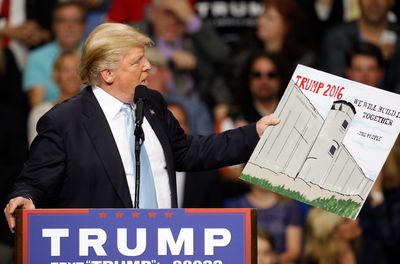
“Winning so much we will get tired of winning,” “Make good deals with China,” or even “Make America great again” are slogans that don’t actually say anything. We are not stupid; share some details with us, so we can figure out whether you know what you are talking about. For Donald, however, in the few instances when specifics do follow, like perhaps the 1,000-mile, 35-55 foot wall or the deportation of 11 million immigrants, the details never come.
Never are we told that to build the wall, even to the lower 35 feet, (by actual construction estimates) would cost $25 billion dollars, even if you could get the land to build it (most of the border Trump wants to wall is in the middle of a river and land in many cases could not even be secured for a fence).
His magic to make Mexico pay for it? The only suggestion I have heard is take it out of remittances from folks mailing money back home or one of his “45 percent tariffs.” How is that going to work for the Americans sending the money to relatives or all of us paying 45 percent more for Mexican-made merchandise or the American company doing the manufacturing? How about the fact that the wall would do little to stop illegal immigration, more of which is “overstays” of visitors than “over the border” and likely will generate few, if any, jobs for the folks Trump has whipped up into a xenophobic frenzy.
Then let’s take the deportation and just focus on the big stuff. How exactly do you round up and deport 11 million people? Is he going to use stadiums and nationalize cruise ship lines? Who will be doing the rounding up, certainly not the police, the army perhaps? The children left behind? How about the fact that American farms, restaurants, not to mention landscaping and construction labor jobs will go unattended? Vital jobs for sure, but are these the jobs that Trump plans to provide for his “real Americans” to make America great again?
5. Words matter.
Everything is not a “disaster,” “stupid” or a “disgrace.” Neither is it “tremendous,” “huge,” “fantastic” or “amazing.” Everyone is not a “loser,” “low energy” or a “bimbo.” Talk of former presidents being liars ― or his favorite, “a disaster” ― and foreign dictators being great leaders does not advance the discourse.
Americans are mostly not prudes, but vulgarity from the dais, penis size allusions, reveling in sexual conquests, menstruation-based criticism and crass insults of every shape and form just does not cut it from a president. We have children.
6. Reading is good. So is studying.
Donald Trump recently told us that he does not read much. We know from the recent revelations by Tony Schwartz, his ghost writer on The Art of the Deal (yes, I do have my copy from when it first came out, autographed with Donald telling me to “keep up the great work”), which Donald says is second only to the Bible as the must-read book, that he certainly has not written a book ― at least not that one.
It is a special and unique form of arrogance to think you could even consider being literally the leader of the free world without doing the work to deeply understand the job.
Even though for many years I owned a bookstore and would not let my kids watch TV on weekdays to help them become readers, I do not believe you must read to lead. I do believe, however, that those who seek to lead us need to study hard, seek to gain wisdom from others, and try to master very complex ideas and relationships. I think being president is hard. I am glad that after a long day, President Obama retreats to his private study almost every night for 3 or 4 hours of quiet study... and reading.
Any fair interpretation of Trump’s many bizarre statements and flip-flops makes it clear he has not the slightest inclination to read or study. In his own words, he makes decisions “with very little knowledge other than the knowledge I already had, plus the words ‘common sense,’ because I have lots of common sense and I have a lot of business ability.” It is a special and unique form of arrogance to think you could even consider being literally the leader of the free world without doing the work to deeply understand the job.
7. The new vocabulary we are adjusting to is not a good one.
Xenophobe (intense dislike or fear of people from foreign countries); misogynist (strong prejudice against women); nativist (preference for established inhabitants as opposed to immigrants); fascist (authoritarian and dictatorial); bigot (intolerance for those with a different opinion); demagogue (inflaming passions based on popular desires not on rationale arguments); dystopian (describing a place, typically totalitarian, where everything is unpleasant and squalid); racist (oh, you know what this one is).
We have all had to get the dictionary out to understand many of the not household terms that had to find their way into print to describe the unique phenomenon that is Donald Trump. The scary thing is that these strange words are at least close to the mark. What happened to statesmanlike, well-qualified, or even brilliant, as words we can use to describe people we want to elect to high office? Haven’t heard any of these associated with the Donald.
8. We need to be careful with “tough.”
*****
******
Donald Trump said of a protester at one of his rallies, “in the good old days they would have carried him out on a stretcher.” His world reveres this brand of toughness. This toughness is not about the strength it takes to use restraint or to make really hard decisions. It is about “punching that guy in the face,” or at a minimum, saving face ― his.
I will resist the temptation to belabor the nuclear codes point again, and rather just query do we really want a thin-skinned president who, as he suggested, if a government leader (Castro) was not on the tarmac to meet his plane, “would turn around Air Force One and come home.” Or one who when confronted with the fact that whether or not his careless re-tweet of a white supremacist-created Jewish star and dollar bill-backed attack of Hillary Clinton was anti-Semitic, can’t even just give one of those non-apology-apologies, “I am sorry if I offended anyone.” A “tough-guy” who instead declares major newscasters stupid and sick and makes it all about the media who dare to criticize him, with never a word to David Duke and the ugly element high-fiving him and resending his initial offensive post.
Whether or not the post was intended to even more firmly entrench this segment of support, Trump demonstrates his version of tough, one that glorifies his opinion and his being right over all else. Nowhere in his world can tough be humble, respectful, restrained or diplomatic.
9. Success does matter.
Donald Trump’s business success is greatly exaggerated and his skills limited. Donald Trump is a great salesman and a showman/promoter in a league only with PT Barnum. This we can give him. He has also been very good at making his name a brand and selling its use. For a while, he had some pretty high TV ratings by telling out of work celebrities they were fired. However, even in his own playing field, ask any large New York real estate developer, of which—surprise, surprise—he is not one, at least not as to large (14th in New York City on the latest list), and you will learn his successes are few.
Four business bankruptcies (1991, 1992, 2004 and 2009), the Plaza Hotel, Trump Air, all three casinos (a couple times) the steaks, the water, Trump Centre in New Jersey that I worked on, Manhattan’s West Side rail yards (where buildings do bear his name as a consolation), the much-hyped $35,000 get-rich scheme Trump University ― all failures by any measure except of course to Donald, who “has no regrets, whatsoever.”
Then there are basic business ethics: 3,500 lawsuits, the fact that he has penchant for not paying bills fully or on time, or that he calls himself the “King of Debt” ― a king made rich by running up debt, then renegotiating it. Is this the skill set we want for the president?
Even with Trump’s fabled net worth, always exaggerated by billions more than others calculate, one has to wonder if his true net worth wouldn’t be just as much if he took his considerable inheritance from father Fred and just passively invested it. We’ll never know from Donald ― certainly not from those tax returns he won’t release.
10. We could not be the great country we are without the First Amendment, but our media may kill us.
The media is not Donald’s enemy as he keeps announcing from the stage. It may be the enemy of the rest of us, however. It sure feels like it lately. The air time Donald gets, and his ability to phone in his rants (especially with the cable media) is nothing short of, to use one of his words, “disgusting.”
Donald, who lives by polls and ratings, understands it is ratings and not news worthiness that dictates what is on the airwaves. Donald dominates almost every news cycle, simply by being more outrageous than anyone or anything else. The “false equivalency” created by point-counterpoint talking heads then makes over-the-top positions seem legitimate. It is reality TV writ large and it is very out of control.
11. Temperament, demeanor and character are important.
In many ways, Donald represents the very worst in all of us, or at least many of us. He is all about continuous gratification. He is the petulant child who wants his way. He is the selfish teenager with no big picture yet. He is the spoiled young man of privilege with the “right” race and religion, education, good looks, and family fortune to succeed easily, and who looks down on others lacking in any of the above who do not.
He is the spoiled young man of privilege with the “right” race ... and family fortune to succeed easily and who looks down on others lacking in any of the above who do not.
He is a man who thinks it is okay to call someone fat or ugly or stupid or to make fun of a person with a disability. He is the collector of trophy wives and trophy properties, the guy who wins, or so he thinks, because he has the most toys.
12. The emperor and his clothes.
Donald says he knows more about the military than anyone else. Why? Because he went to an expensive prep school where they wore uniforms and sometimes marched? How about, “I know more about ISIS than the generals.” Please, can some real soldiers evaluate this?
Donald says America never wins anymore. Compared to whom, and at what? No doubt we have problems. Democracy is messy. Witness the present campaign, and the long slow recovery from the 2008 recession has not included the middle class nearly enough. And, yes, trade in a world that is now fully connected and integrated is hard to figure out. But by what measure is America, as Donald tells us, a “disaster”?
How do you actually say and believe, “This country is a hell-hole. We are going down fast.” Compared to whom? Mexico, China or his most bizarre new favorite, Russia, that he tells us “beat us all the time ... because our leaders are stupid”? Give us a break.
13. Sophomoric speech tricks don’t work ― at least not with most of us.
Says Donald, “I am not going to talk about” the libertarian VP candidate’s alcoholism. “I refuse to say... I cannot stand to say... that I cannot stand the sound of Clinton screaming into the microphone all the time.” You just did, Donald. We get it that with these statements, even you know you are on shaky ground so you are trying to play it both ways. Doesn’t work. Nor does your even more insidious, not-so-clever trick of attributing to others wild accusations that even you are afraid to make, but that you want to advance.
How about when discussing the Orlando massacre, “there are a lot of people that think [President Obama] doesn’t want to get it. A lot of people think maybe he doesn’t want to know about it I happen to think he just doesn’t know what he is doing, but there are many people that think maybe he just doesn’t want to get it. He doesn’t want to see what’s really happening. And that could be.”
Who are these “people” who have placed the president on the side of the terrorists? Perhaps the same people who, with Trump, saw the masses in New Jersey celebrating the destruction of the twin towers, or those convinced Hillary Clinton murdered Vince Foster, that Ted Cruz’s father was working with Lee Harvey Oswald to kill President Kennedy, or that President Obama was not born in the United States nor did he graduate from Harvard or Columbia.
Two possibilities. The likely one: “lots of people are saying” is just Trump code for “I want to now float something so outrageous” even red-faced Donald can’t get it out without this qualifier. Or perhaps the “lots of people” is a select group, the closed loop of the loyalists who attend his rallies that heard it from him!
14. A thin skin does not work for a president.
“The politicians have again chosen this presidential pigmy as their nominee.” So said the long-defunct New York Herald about Abraham Lincoln, now nearly everybody’s choice for our nation’s best president. Consider the statement when George Washington left office: “the time is now arrived for the source of all misfortune of our country… [to be] reduced to a level with his fellow citizens.”
U.S. presidents, all of them, have had their critics, and in our land of wonderful free speech, the critics get to have their say. Thank goodness. That Donald does not do well with criticism is not really open to debate. Ask Megyn Kelly (“third-rate talent”), Rosie O’Donnell (“nice little fat Rosie,” “total loser”) or Elizabeth Warren (“Pocahontas”) or for that matter virtually any of his recently vanquished adversaries: Cruz, Kasich, Rubio or Bush, in just the first tier. Even the one most like him (now apparently looking for a post-New Jersey job with him), Chris Christie felt his sting when he suggested Donald was “thin-skinned.” He just can’t let anything go ever. He obsesses even when he wins.
Republicans who broke “the pledge” to support him, they “should not be allowed to run for office again.” In Donald’s world, disagreeing with him has to have a consequence ― a serious one ― and pursuing this goal is worthy of effort and energy, even when it makes no difference.
Do we really think our president has time for this? Do we really want a man with such sensibilities and such an authoritarian bent in charge of, say, the FBI or the IRS? Does the concept of “secret police,” a favorite of leaders of this type elsewhere, seem too extreme? Probably, yes. But if I was Donald, I would float it with one of his “people are saying” declarations. There, I just used his trick. See how easy it is.
15. Bullies will always exist somewhere, but the White House should not be that somewhere.
What does a bully do? Most of all he or she seeks to intimidate, physically or at least verbally. So far this character trait of Donald’s has been exclusively verbal and aimed at business adversaries and more recently politicians and journalists ― and, of course, then ex-ghost writer of his book and ex-employees or contractors he cheated (those who do not have anti-disparagement contractual handcuffs) who dare to candidly assess his conduct.
What happens when this guy gets the world’s strongest army at his disposal, and a bully pulpit that guarantees him notice? Seem like a bad idea to anyone else?
16. Law and order.
Before it was an Emmy-winning TV show, “law and order” was a campaign theme used by Richard Nixon in 1968 to get himself elected in a year when our country had two very public assassinations and destructive demonstrations, even riots, in 110 U.S. cities. Nixon sought to mobilize what he called the “silent majority” around the need for more police. He also tapped into the racial and economic divide between black and white and working class and “elite Eastern liberals,” and the evil media that his vice president, Spiro Agnew, called “nattering nabobs of negativism.” Is Donald Trump seeking to bring this back? Of course yes, yet no.
Yes, he wants to separate and mobilize angry voters who feel left behind by an increasingly diverse culture. No, because his dystopian version of lawless, besieged, pitifully weak America is not what Nixon preached, nor for that matter Ronald Reagan. It is unique to him, at least in our country. It is, however, a textbook version of the rallying cry of countless dictators and strongmen. It is a demagogue’s basic tool, to gin up a problem then declare he is the “only one who can fix it.”
As bad as all this rhetoric is, what next? He tells us, “On January 20, 2017, the day I take the oath of office, Americans will finally wake up in a country where the laws of the United States are enforced... crime and violence that today afflicts our nation will soon―I mean very soon―come to an end.” How’s this work, Donald? Martial law? Does he honestly believe President Obama, and for that matter all of his 44 predecessors, would not have liked to have all laws effective and fully followed? If only wishing could make it so! However, since the states, not the federal government, hold sway over most criminal law, the president acting alone has no Constitutional power to do any such thing. What then? More of the water boarding and killing families of terrorists logic? “I alone can fix it!”
17. Incoherent rants, often contradictory, does not a foreign policy make.
Convince Japan and South Korea to seek nuclear arms. Eliminate NATO. Crush ISIS but do it without Muslim allies and no troops on the ground. Sometimes attack Libya, sometimes not. Sometimes attack surgically, but don’t let it come out the way it did. Sometimes it’s good we attacked Iraq, sometimes not. Do not nation build, but fix Syria. Stop Iran by making better deals.
In fact, come to think of it, that is the solution to almost everything: “just make better deals” everywhere. Oh, yes and never apologize for anything. We are America, very, very rich and beholden to no one. Like us or else. Sound like someone we know?
18. How will anyone effectively be president if we don’t at least respect the office?
In the 1960s during an unpopular war, we all endured a president adorning himself with a flag pin and declaring anyone who did not agree with him (which include a heck of a lot of young people on campuses all across America, including me) somehow un-American. Although political opposition is as old as our nation, we begin to slide down the slope of dangerous disrespect when disagreement is replaced with vilification.
This Republican nominee for the presidency thinks it is okay to accuse a former president of his own party of intentionally going to war on false pretenses and the current President of being in conspiracy with Muslim terrorists. Any thoughtful American of either party or no party, of any political philosophy must see that this must stop.
Truth, or at least a semblance of some, has to come back. Outrageous lies just have no place in meaningful discourse ― outrageous liars even less so. They cannot become the backbone of a point-counterpoint talking-head media circus that is so much more about ratings than truth.
19. Rich and powerful guys have to play by the rules, too.
Let’s not kid ourselves. Trump University was not an academic institution, far from it. It was a get-rich-quick scheme by a guy selling a get-rich-quick scheme. It is not the first or the last of its type. Late night, cheap-advertising-time-television will always feature this fare. Donald’s efforts, however, were on so much a grander scale ― $35,000... “a university.” Really? What this was is an out-and-out fraud scheme by a man now trying to become the leader of our country and the free world.
We all know, or at least have read, that suckers are born every minute. But can’t we at least disrespect those who prey on these poor folks, and when they really go too far, sue them? “No,” says Donald Trump. The court case brought by a whole class of plaintiffs against his scam is only still in court, Donald says, because the long-time and distinguished federal judge is a “hater” not capable of giving him justice because his parents are from Mexico.
In Donald’s world, the only individual capable of judging him would not be Mexican or related to anyone from Mexico, likewise folks of the Muslim faith, and, oh yeah, likewise women. In this world rich, entitled, egotistical, ethically-challenged older white men should then only be judged by rich, entitled, egotistical, ethically-challenged older white men.
20. We must stand for something.
Donald Trump’s version of America does not include folks not like him. Instead, he is all about what Sarah Palin labeled “real Americans.” The fact that all us others seem to be utterly expendable is deeply troubling. Targeting an entire religion ― Islam, with 1.6 billion adherents, 3.3 million being U.S. citizens ― for extra scrutiny or worse is patently inconsistent with traditional American values, if not those of the “real Americans.”
It is also unconstitutional, and, beyond all this, incredibly counterproductive as it hardens the lines of controversy by wholesale moving of the allies we need to solve terrorist problems into the enemy camp. Other similar strategies championed by Donald, like waterboarding and other forms of torture, not to mention targeting families of an enemy, are not just illegal. They are, to use another one of his words, “stupid”. They do not work, very likely making situations worse and our enemies more numerous and passionate.
One has to wonder, what does the America of the “real Americans” look like? A bunch of intolerant, hyper aggressive, folks behind a big wall, isolated (not trading with anyone and thus with a sick economy and very expensive goods) and with a lot of enemies. No “Shining City on the Hill,” for sure. Hard to see anything but ruin ahead for such a place.
We can do so much better! For me, better comes easily in the form of former Senator and former Secretary of State Hillary Clinton. For those who do not come to that conclusion easily (I get it), this year it will have to be the lesser of two evils. No matter what, don’t even think about taking us into the abyss that is Donald Trump.


https://saveourpublicschoolsma.com/governor-baker-refuses-to-commit-to-funding-charter-school-reimbursements/
Michael Moore: How I Moved from Supporting Bernie Sanders to Hillary Clinton for President
STORYNOVEMBER 04, 2016
v