Search This Blog

Translate

Blog Archive

Middleboro Review 2

NEW CONTENT MOVED TO MIDDLEBORO REVIEW 2

Toyota

Since the Dilly, Dally, Delay & Stall Law Firms are adding their billable hours, the Toyota U.S.A. and Route 44 Toyota posts have been separated here:

Route 44 Toyota Sold Me A Lemon


Showing posts with label FAIRNESS & ACCURACY IN REPORTING. Show all posts

Wednesday, January 22, 2020

The US’s Inalienable Right to Violence


FAIR


The US’s Inalienable Right to Violence


by Gregory Shupak
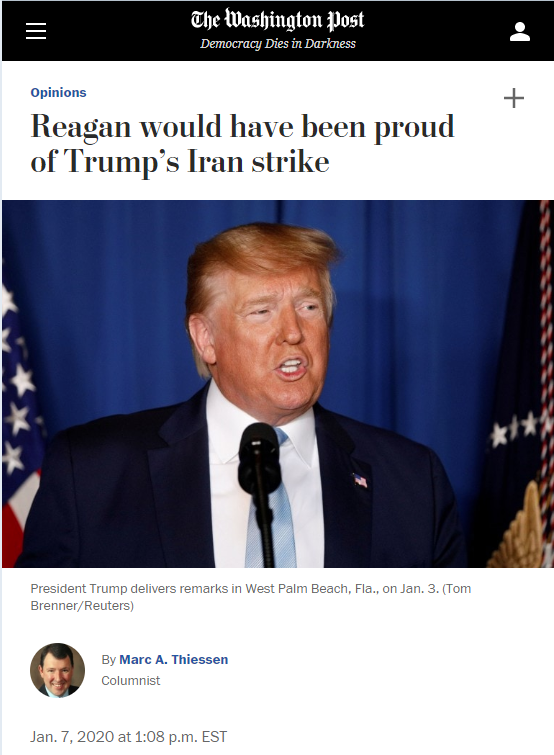
WaPo: Reagan would have been proud of Trump’s Iran strike
This Washington Post headline  (1/7/20) is probably true.
Even when critical of US actions, media commentary on recent US bombings and assassinations in the Middle East is premised on the assumption that the US has the right to use violence (or the threat of it) to assert its will, anytime, anywhere. Conversely, corporate media coverage suggests that any countermeasure—such as resistance to the US presence in Iraq—is inherently illegitimate, criminal and/or terroristic.

Iranian puppeteers

One step in this dance is depicting US military forces in Iraq as innocent bystanders under attack by sadistic Iranian puppetmasters. Media analysis of the US murder of Iranian Gen. Qassem Soleimani consistently asserted that he was “an architect of international terrorism responsible for the deaths of hundreds of Americans” (New York Times1/3/20) or “a terrorist with the blood of hundreds of Americans on his hands” (Washington Post1/7/20). According to Leon Panetta (Washington Post1/7/20), a former Defense secretary and CIA director,
The death of Soleimani should not be mourned, given his responsibility for the killing of thousands of innocent people and hundreds of US military personnel over the years.
There is little evidence for this contention that Iran in general or Soleimani personally is responsible for killing hundreds of Americans. When the State Department claimed last April that Iran was responsible for the deaths of 608 American servicemembers in Iraq between 2003 and 2011, investigative journalist Gareth Porter (Truthout7/9/19) asked Navy Commander Sean Robertson for evidence, and Robertson “acknowledged that the Pentagon doesn’t have any study, documentation or data to provide journalists that would support such a figure.”
Porter showed that the US attribution of deaths in Iraq to Iran is an unsubstantiated government talking point from the Cheney era, one that was exposed at the time when Lt. Gen. Ray Odierno admitted that, though the US had attributed Iraqi resistance fighters’ weapons to Iran, US troops found many sites in Iraq at which such weapons were being manufactured.
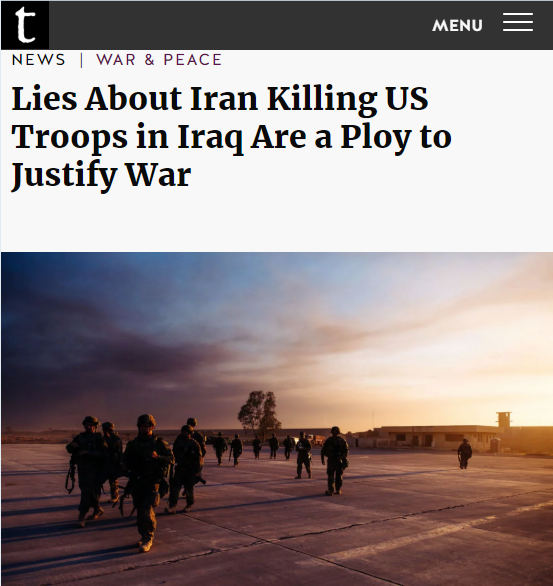
Truthout: Lies About Iran Killing US Troops in Iraq Are a Ploy to Justify War
Gareth Porter reported in Truthout (7/9/19) that "the myth that Tehran is responsible for killing over 600 US troops in the Iraq War is merely a new variant of a propaganda line that former Vice President Dick Cheney used to attempt to justify a war against Iran more than a decade ago."
Scholar Stephen Zunes (Progressive1/7/20) similarly demonstrated the lack of evidence for the idea that Iran is behind the killing of US forces in Iraq. Zunes noted that the National Intelligence Estimate on Iraq, compiled by America’s 16 intelligence agencies, downplayed Iran’s role in Iraq’s violence at roughly the same time that the Bush administration was saying that Iran was culpable.
As Porter pointed out, there was a much simpler explanation for American deaths in the period: The US targeted Muqtada al-Sadr’s Mahdi Army and the Mahdi Army fought back, imposing more casualties on US troops.
That the pundits dusted off 13-year-old propaganda to rationalize killing Soleimani is a clear indication that they were desperately grasping for any imperialist apologia within reach. If the American public is led to believe that Soleimani killed hundreds of Americans, large swathes of it are likely to regard his assassination as justified, necessary, or at worst a feature of the tit-for-tat ugliness inherent to war.
The narrative also ideologically shores up the US war on Iran in the American popular consciousness by presenting Iranians as primordially violent savages out to spill the blood of Americans, notably those in the military who are in the Middle East, presumably doing nothing but minding their own business. Presenting Iran as the reason for attacks on US forces in Iraq also implies that Iraqis had little objection to the US invasion, legitimizing the US’s ongoing military presence in the country. The most obvious point about the deaths of US soldiers in Iraq is that they wouldn’t happen if US soldiers weren’t in Iraq.

When violence isn’t violence

Another media dance move is to condemn anti-imperial violence while naturalizing imperialist violence. An editorial in the New York Times (1/3/20) said that Soleimani
no doubt had a role in the campaign of provocations by Shiite militias against American forces in Iraq that recently led to the death of an American defense contractor and a retaliatory American airstrike against the militia responsible for the attack.
Having US troops in Iraq, a country in which the US is responsible for the deaths of hundreds of thousands, is not a “provocation,” in the Times’ perspective; opposition to their presence is the provocation.
The December 27 attack that killed the US contractor did not occur in a vacuum. In 2018, the US was suspected of bombing affiliates of Kataib Hezbollah, the group the US blames for killing the contractor. Israel is suspected of carrying out a string of deadly bombings of the Iraqi Popular Mobilization Forces, of which Kataib Hezbollah is a key component, between July and September, a scenario at which Israeli Prime Minister Benjamin Netanyahu hinted.
The US reportedly confirmed that Israel was behind at least one of the bombings, and said it supports Israel’s actions while denying direct participation. In any case, the US’s lavish military support for Israel means that the former is effectively a party to the latter’s bombing. Thus, the Kataib Hezbollah attack that killed the contractor can be seen as “retaliatory,” which complicates the notion that the subsequent US attack was as well.
Another Times editorial (1/4/20) describes Soleimani as “one of the region’s most powerful and, yes, blood-soaked military commanders.” At no point is Trump or any other US leader described as “blood-soaked” or anything comparable—here, or in any of the mainstream media coverage I can find—even as he and his predecessors are sopping with that of AfghansIraqisLibyans and Syrians, to cite only a few recent cases. Evidently imperial violence is so righteous it leaves no trace behind.
Stephen Hadley, national security adviser in the George W Bush administration, wrote in the Washington Post (1/5/20):
What is clear is that one of the PMFs, Kataib Hezbollah, has been behind the escalating violence over the past several months as part of a campaign (assuredly with Iranian approval) to force out US troops. The campaign culminated in the December 31 attack on the US Embassy in Baghdad. (The head of Kataib Hezbollah, Abu Mahdi al-Muhandis, was killed with Soleimani.)
By expelling US forces, the Iraqi government would be falling into Kataib Hezbollah’s trap: rewarding the militia’s violent campaign, strengthening the Iranian-backed PMFs, weakening the Iraqi government and state sovereignty, and jeopardizing the fight against the Islamic State.
Kataib Hezbollah’s actions are called “violence” twice in these three sentences, with their apex apparently being “the December 31 attack on the US Embassy in Baghdad.” Remarkably, the author makes no mention of the December 29 US airstrikes on five sites in Iraq and Syria that the US says belong to Kataib Hezbollah, bombings that reportedly killed 25 and injured 55. Those, it would seem, do not constitute “violence.” Iraqis damaging the embassy of the country whose economic sanctions killed half a million Iraqi children is “violence,” but the US’s lethal air raids are not. And expelling foreign armies weakens state sovereignty!
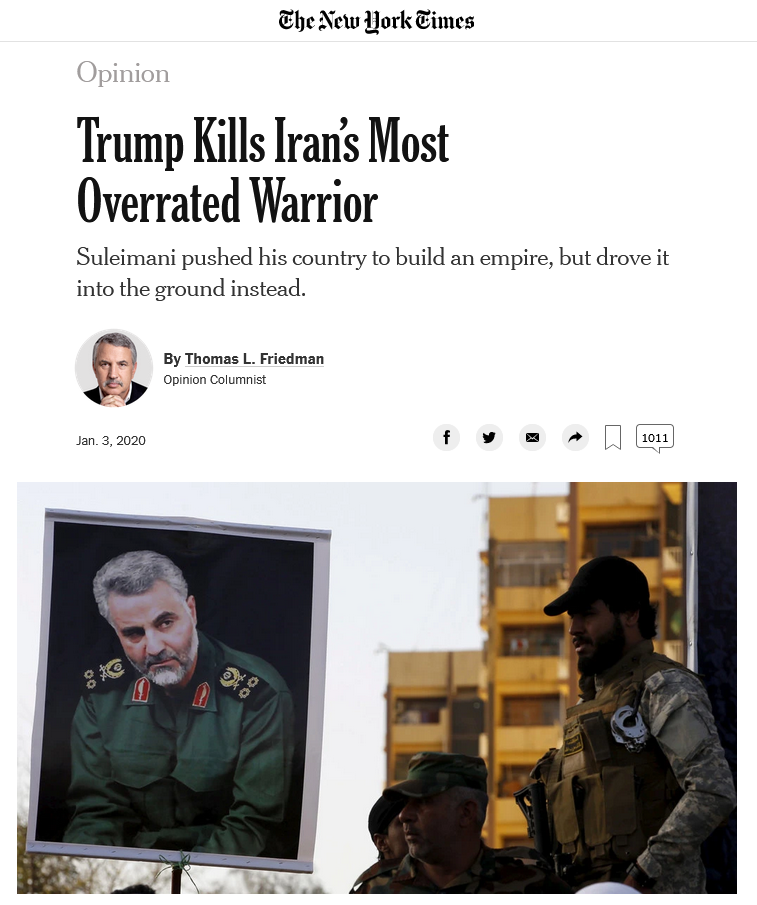
NYT: Trump Kills Iran’s Most Overrated Warrior
"No one in Baghdad was fooled" by anti-US protests in Iraq, which were "almost certainly a Soleimani-staged operation to make it look as if Iraqis wanted America out," declared Thomas Friedman (New York Times1/3/20). (In a 2016 poll, 93% of young Iraqis said that they perceived the US as an "enemy.")
Thomas Friedman’s Times article (1/3/20) on Soleimani’s murder was bad even by Thomas Friedman standards. He dismissed the protests at the US embassy:
The whole “protest” against the United States Embassy compound in Baghdad last week was almost certainly a Soleimani-staged operation to make it look as if Iraqis wanted America out when in fact it was the other way around. The protesters were paid pro-Iranian militiamen. No one in Baghdad was fooled by this.
In a way, it’s what got Soleimani killed. He so wanted to cover his failures in Iraq he decided to start provoking the Americans there by shelling their forces, hoping they would overreact, kill Iraqis and turn them against the United States. Trump, rather than taking the bait, killed Soleimani instead.
That there were thousands of protesters at the US embassy and that the Iraqi security forces stood aside to allow them to demonstrate suggests that what happened at the embassy cannot be reduced to a hoax stage-managed and paid for by Iran. Furthermore, the US did kill Iraqis two days before the protests, and that’s what ignited them (to say nothing of the longer term record of the US devastating Iraq). Like Hadley, however, Friedman pretends that the US’s December 27 bombings didn’t happen.
In the imperial imagination, the US has the right to violently pursue its objectives wherever it wants, and any resistance is illegitimate.


Saturday, January 11, 2020

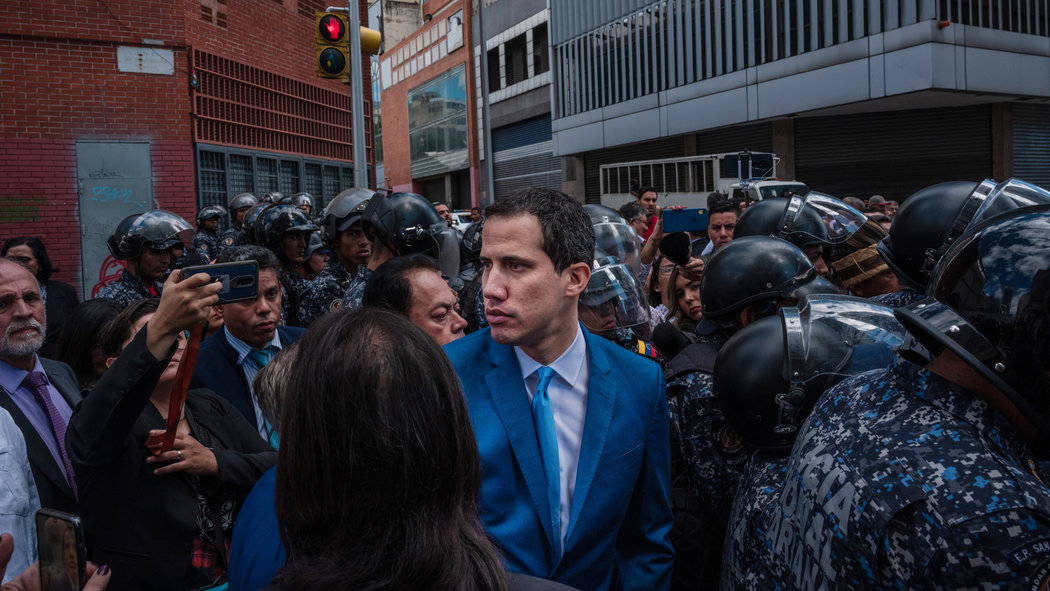
For Western Press, the Only Coup in Venezuela Is Against Guaidó


View this email in your browser

FAIR

For Western Press, the Only Coup in Venezuela Is Against Guaidó 


by Lucas Koerner
WaPo: Venezuela’s last democratic institution falls as Maduro attempts de facto takeover of National Assembly
The Washington Post (1/5/20) described Venezuelan lawmakers voting against someone other than Washington's chosen candidate to head the assembly as "sedition within the opposition."
The international corporate media have entered crisis mode following the replacement of Venezuelan opposition leader Juan Guaidó as head of the country’s National Assembly.
In headline after headline, Venezuelan President Nicolás Maduro “Takes Over” (NBC1/6/20), “Claims Control of” (New York Times1/5/20CNBC1/6/20) or “Seizes” (Reuters1/5/20NPR1/6/20) parliament, and “Ousts” Guaidó (Wall Street Journal1/5/20) in the process.
The Washington Post (1/5/20) takes this hysteria to another level, hyperbolically proclaiming that “Venezuela’s Last Democratic Institution Falls as Maduro Attempts De Facto Takeover of National Assembly.”
Such headlines obscure the elementary if inconvenient fact that Guaidó failed to secure the necessary votes from his own coalition’s deputies to continue as president of the legislature, leading him to convene a parallel, ad hoc session in the offices of the right-wing El Nacional newspaper.

Serving up state propaganda

Corporate journalists repeat unceasingly the US State Department talking point that the January 5 assembly election, which chose Luis Parra as the legislative body’s new president, was “phony” because Guaidó and his loyalists were barred from attending the session, rendering the vote void.
“Venezuela’s socialist government installed a new head of Congress on Sunday after armed troops blocked opposition legislators from entering parliament,” Reuters (1/5/20) misinformed readers.
As Venezuelanalysis (1/5/20) reported, this narrative was refuted by pro-Guaidó lawmaker William Davila, who, after strolling in to the legislature, told press that with few exceptions, virtually all deputies were permitted to take their seats. Other senior opposition lawmakers, including the outgoing first and second vice presidents of the body, were visibly present inside the parliament.
NYT: Venezuela’s Maduro Claims Control of National Assembly, Tightening Grip on Power
New York Times
Moreover, video evidence reveals that Guaidó was not himself “prevented,” as the New York Times (1/5/20) had it, from entering the legislature, but rather refused to do so except in the company of fellow lawmakers whose parliamentary immunity had been revoked for alleged criminal offenses. Likely knowing he did not have the votes to secure reelection, Guaidó appears to have declined to attend the session, going as far as to scale a fence in a publicity stunt widely reported by Western outlets that all but ignored the crucial facts behind the day’s events.
Corporate media followed up their lie that the pro-Guaidó opposition was banned from parliament with the dubious claim that the subsequent vote held in the offices of El Nacional was “official.” The Washington Post (1/5/20) matter-of-factly stated, “In a 100-to-0 tally — enough to put him over the top in a full session of the 167-seat chamber — those present reelected Guaidó as head of the legislature.” The reporters evidently neglected to inspect the actual vote tally, which contained glaring irregularities such as votes by legislators abroad fleeing criminal charges, as well as those cast by substitutes for deputies who had already voted for Parra. As even hard-right, Miami-based journalist Patricia Polea highlighted, Jose Regnault Hernandez, the substitute for newly sworn-in National Assembly Second Vice President Jose Gregorio Noriega, was allowed to vote for Guaidó despite Noriega having himself stood for election on a rival ticket earlier that afternoon.
It is also deeply ironic that Western outlets would rush to declare the legitimacy of an irregular vote held in the offices of a local newspaper, given the lengths they have gone to deny the existence of press freedom in Venezuela (FAIR.org5/20/19).

Why isn’t Guaidó in jail?

Procedural formalities aside, the real question, which corporate journalists will never ask, is why an opposition figure who arbitrarily declared himself “interim president” with the backing of hostile foreign powers, and who urged the military to rise up to install him in the presidential office, would be permitted to set foot outside a jail cell in Venezuela, let alone stand for reelection as head of parliament?
The answer would require admitting that this naked violation of sovereignty is only tolerated because of the constant threat of lawless imperial violence, which US corporate media enthusiastically cheerlead against other independent Global South states like Iran.
Instead, Western journalists continue to whitewash the US-sponsored coup--the sixth major attempt since 2002--impugning Maduro’s democratically elected government as “authoritarian” or a “dictatorship” (FAIR.org4/11/19;  8/5/19), which is newspeak for “legitimate target for bombing and/or murderous sanctions.”
Throwing to the wind any semblance of neutrality, the New York Times (1/5/20) reported:
Venezuela’s authoritarian leader, Nicolás Maduro, moved on Sunday to consolidate his grip on power by taking control of the country’s last independent institution and sidelining the lawmaker who had staked a rival claim to the presidency.
“The political chaos comes at a time when Venezuela is facing economic collapse,” the paper of record added, bolstering the rationale for Maduro’s overthrow. “Hunger is widespread, and millions have fled the country.”  Like most corporate media (FAIR.org6/26/19), the Times reflexively avoided mention of US economic sanctions’ role in severely exacerbating the crisis and killing tens of thousands since 2017, writing off the illegal, inhumane measures as “sanctions on Mr. Maduro’s government.”
For the corporate press, it would appear that the only “coup” is that perpetrated by Maduro in insisting on serving out his elected mandate (Washington Post1/6/20Wall Street Journal1/6/20Forbes1/7/20).

Concealing corruption

In their elegies to the “last democratic institution in the authoritarian South American state” (Washington Post, 1/5/20), Western journalists rarely attribute Guaidó any significant blame for the perceived debacle.
Despite acknowledging Guaidó’s falling popularity, following his utter failure to oust Maduro, mainstream outlets have turned a blind eye to the opposition leader’s string of humiliating scandals. Guaidó has been linked to Colombian paramilitary drug lords, while his inner circle has been accused of embezzling hundreds of thousands of dollars in aid funds, among other illicit acts.
CBC: Venezuela's new would-be congress leader shrugs off accusations
The CBC (1/6/20) has never referred to Juan Guaido as a "would-be president."
Tellingly, the only corruption allegations mentioned in the latest corporate coverage are those against Parra and his dissident opposition colleagues. Making little effort to conceal its bias, CBC (1/6/20) describes the new National Assembly president as “a previously unknown backbencher mired in accusations of bribe-taking,” whose “rambling comments” were challenged by journalists.
The double standard is striking, given that Western media have devoted strenuous efforts over the past year to anointing a “previously unknown backbencher” as president of Venezuela. The attacks on Parra comes amid threats of US sanctions against him and other opposition politicians who broke with Guaidó. The blatant imperial blackmail recalls similar US threats reportedly issued against opposition presidential candidate Henri Falcón, who defied the opposition’s 2018 electoral boycott that paved the way for the current coup efforts.
Corporate journalists’ discouragement over Guaidó’s failures (FAIR.org7/23/19) is becoming ever more pronounced (e.g., Reuters12/3/19Washington Post12/17/19New York Times1/6/20). But at the end of the day, they have simply invested too much in this smooth, technocratic figure to fundamentally fault him, let alone actually question the imperial regime-change machinery that produced him and his elite coterie.


Trump's Iran Assassination... Joe Biden's Foreign Policy... Venezuela Crisis....


View this email in your browser

Weekly Alert: January 10, 2020

FAIR's year-end fundraising drive is finished--thanks to all who gave for their generosity!

Here are the stories FAIR has been working on this week. Please help us spread the word by forwarding this email to friends and by sharing our stories on social media like Facebook and Twitter.
FAIR’s ad-free, content-rich site
is supported by contributions from
our loyal band of media activists.


Please donate today!

FAIR's Website


Thursday, January 9, 2020

Steady Hand Joe


FAIR


View this email in your browser

Steady Hand Joe


by Julie Hollar
Election Focus 2020For pundits, what makes a politician strong on foreign policy? Apparently doing something for a long time matters more than honesty and good judgment—and it helps if the bad choices made are the same ones corporate media have cheered.
With Donald Trump's recent assassination of Iranian Gen. Qasem Soleimani, foreign policy has taken the spotlight in the presidential race. But despite Democratic candidate Joe Biden's prominent role in leading the US into the disastrous Iraq War, and his recent stream of lies and equivocations about why he supported it and when he began to reverse his position, many pundits continue to uncritically paint Biden as "mature" or a "steady hand" on foreign policy.
It shouldn't exactly come as a surprise: When Barack Obama tapped Biden as his running mate in 2008, pundits lauded the choice as "shoring up" Obama's "weakness" on foreign policy. It was precisely because of Biden's initial support for the Iraq War (which Obama had opposed) that media observers saw him as a serious foreign policy thinker, given that those same media observers likewise initially supported the war (FAIR.org8/27/08).
In recent days on the campaign trail, Biden has touted his years on the Senate Foreign Relations Committee, while Bernie Sanders has hammered Biden on his Iraq vote. (Sanders voted against the war authorization.) On NBC's Meet the Press (1/5/20), Chuck Todd contrasted Biden and Sanders, wondering if
voters are going to look at this on the Democratic side of the aisle and say, “Steady hand, Joe Biden,” or, how about the guy who was always against the interventions here? I don't think we know how Democratic voters are going to react.
Perhaps not—though more Democratic voters are troubled by Biden's past support for the Iraq War than reassured by it. But by uncritically labeling Biden—who changed both his position on the Iraq War and his story about that position—as a "steady hand" on foreign policy, Todd certainly boosts the narrative Biden is hoping for.
That same sort of uncritical framing of experience as strength came out on the PBS NewsHour (1/6/20), where the New York Times' Lisa Lerer opined:
But I do think this could strengthen the hand of two men that have been leading the polls for a while, that have been rising in the limited data we have since the holidays, which is Joe Biden, who can run very strongly on his experience in foreign policy, and Sen. Bernie Sanders, who's really staked out ground as the liberal messenger, sort of the anti-interventionist face of the party.
Later in the show, when Judy Woodruff asked David Brooks and Mark Shields which candidates benefit from the escalation with Iran, both named Biden; Shields argued that Biden "offers stability and maturity and knowledge."
On MSNBC (1/3/20), Steve Kornacki asked Mieke Eoyang of the centrist think tank Third Way:
Is there an advantage, perhaps, for Joe Biden, just given his depth of experience in the United States Senate and as vice president, compared to, say, Pete Buttigieg, who's only been the mayor of South Bend, which hasn't necessarily dealt with these many foreign policy issues?
Teed up nicely, Eoyang took the shot for Biden:
He's actually been very thoughtful about how American national security policy can target people who are bad while not trying to get us dragged into full-on wars. I don't think there are other candidates who have that kind of experience. And so if the American electorate is really concerned about the president's reckless moves, and are looking for someone who's a steadying, grown-up hand on foreign policy, that's Joe Biden. That's, frankly, why Barack Obama picked him as his vice president.
How Iraq—arguably the biggest foreign policy issue of his career—fits into Biden's thoughtfulness about not getting us "dragged into full-on wars" is far from clear.
Sen Joe Biden
Then-Sen. Joe Biden speaking in favor of the resolution authorizing force against Iraq (CSPAN210/10/02).
The problem with the media coverage of Biden on foreign policy isn't limited to thoughtless boosting; since at least July, Biden has been trying to rewrite his Iraq War history, with only sporadic and halfhearted media pushback. In the July debate, Biden was asked about his October 2002 vote authorizing the use of force in Iraq; he responded with an outlandish claim: "From the moment 'shock and awe' started, from that moment, I was opposed to the effort, and I was outspoken as much as anyone at all in the Congress."
It was an obvious falsehood; Biden continued to defend his vote until more than three years later (Meet the Press11/27/05), when he first called it a "mistake"—and even then, not because the war itself was wrong, but because "we went too soon. We went without sufficient force. And we went without a plan." (At that point, support for the war had tanked to the point where people who believed the Iraq War wasn't worth it outnumbered those who thought it was by 2-to-1.)
But the media silence was remarkable. In one of the few post-debate references to the Iraq discussion, the Washington Post's Anne Applebaum (8/4/19) complained that Iraq was old news:
The glancing references to the Middle East mostly involved posturing about the past—specifically about how the candidates did or didn't support the Iraq War more than 16 years ago.
Biden upped the ante on his tall tales in interviews in early September (e.g., RealClearPolitics9/11/19NPR9/3/19), and brought the even more brazen revision to the national stage in the September debate, claiming he only voted for the war authorization "to allow inspectors to go in to determine whether or not anything was being done with chemical weapons or nuclear weapons."
That finally prompted a few media factchecks (e.g., Washington Post9/9/19Slate9/4/19) that challenged Biden's blatant fabrication (though the Post generously suggested that Biden "would be on more solid ground if he simply called himself a war critic.") In fact, Iraq had announced in September 2002 its willingness to allow in inspectors without conditions—almost a month before Biden cast his vote. Inspections began in November, and the inspectors were not pulled out until March, when Bush announced he was about to launch his war.
But Biden was also never interested in letting inspectors do their work; when former chief UN inspector Scott Ritter testified before the Senate Foreign Relations Committee in 1998 about his work—telling the committee that the US was undermining inspections—Biden scoffed:
I think you and I believe, and many of us believe here, as long as Saddam's at the helm, there is no reasonable prospect you or any other inspector is ever going to be able to guarantee that we have rooted out, root and branch, the entirety of Saddam's program relative to weapons of mass destruction. And you and I both know, and all of us here really know, and it's a thing we have to face, that the only way, the only way we're going to get rid of Saddam Hussein, is we're going to end up having to start it alone.
It’s difficult, of course, for corporate media to scrutinize Biden too carefully on the inspectors issue—with a long record of garbling the inspection story (Extra! Update10/02), of letting politicians lie about inspections (FAIR.org12/2/08) and of hiding behind the inspectors to excuse their own role in leading the country into war (Extra! Update10/06).
NYT: Biden and Sanders Differ on Foreign Policy. They’re Happy to Tell You So.
The New York TimesSydney Ember and  (1/6/20) report that Bernie "Sanders’ dovish stances and his emphasis on domestic matters could...weaken his standing among Americans who are clamoring for an experienced hand in the international arena at a moment of global turmoil"—whereas Joe Biden is "perhaps at his most fluent and comfortable when discussing international affairs."
The occasional media factchecks fail to substantially shift the coverage, as media outlets seem to view factchecking as relieving journalists of the obligation to routinely test the veracity of sources’ statements (Extra!11–12/04). To the New York Times (1/6/19), Biden's changing stories don't get in the way of their judgment that he "is perhaps at his most fluent and comfortable when discussing international affairs"; near the very end, the paper allowed that Biden's "remarks about when his opposition to the [Iraq] war began" were found by CNN to "be misleading."
In a piece headlined "Biden Touts His Foreign Policy Credentials, but Faces Doubts," the Washington Post (1/6/20) only meekly challenged Biden's claim to have opposed the Iraq War “from the very moment” it started, noting that "the record suggests he supported it initially." The article went on to take at face value Biden's recent claim about Bush promising Biden he only wanted to get authority to send in inspectors,  though labeling it an answer that "seemed to undercut his argument about how savvy he is on the international stage."
The Post was not alone: the Associated Press (1/7/20) and LA Times (1/8/20) also repeated that recent Biden claim without challenge.
If journalists were consistently calling out Biden's Iraq War lies—not to mention reminding viewers and readers that the war cost hundreds of thousands of human lives, aside from a financial cost in the trillions of dollars—their worn-out tropes about Biden's foreign policy “steadiness” would be incredibly difficult to sustain.


Tuesday, January 7, 2020

'Say No to Stealing Our Social Security Benefits'


View this email in your browser

FAIR

'Say No to Stealing Our Social Security Benefits'


Janine Jackson interviewed Social Security Works’ Alex Lawson about Social Security and disability for the January 3, 2020, episode of CounterSpin. This is a lightly edited transcript.
NBC: Retirement savings, Social Security and Medicare: These are the changes coming in 2020
NBC (12/30/19)
Janine Jackson: Corporate media's image of Social Security is, at times quite literally, a gray-haired couple stacking pennies and smiling. Silly in multiple ways, that image, along with much of the accompanying reporting, renders invisible the millions of Social Security recipients who have a disability, not all of whom are seniors.
Media marginalization of disabled people partly explains the near lack of coverage when, just in time for the holidays, the Trump administration proposed a rule change that would make accessing Social Security Disability Insurance and Supplemental Security Income benefits even harder than it already is. The agency offered no medical or scientific justification for the departure from past practice, but they did suggest that they will get billions of dollars from it—somehow.
Alex Lawson is the executive director of the group Social Security Works. He joins us now by phone from Washington, DC. Welcome to CounterSpin, Alex Lawson.
Alex Lawson: Thanks for having me.
JJ: We know that there's more at work here than this one rule change. It's bad enough on its own, but it's part of something bigger. First of all, though, what's the nature of this change that is being pushed right now?
AL: Basically, it's putting up bureaucratic hurdles in front of people who are already faced with proving their eligibility for their own earned benefits in an incredibly difficult system, which is the Disability Insurance portion of Social Security.
We have incredibly stringent requirements on the disability benefits that are part of Social Security. What this would do is make people who have received the benefits, they've proven their eligibility, reprove themselves over and over and over again, sometimes as much as every six months. And this is an incredibly arduous process. So, that's what they do; but the goal of it is actually to get people to give up. That's exactly what happened when Ronald Reagan did this. And it led to tens of thousands of people dying.
And when they were kicked off their benefits, their benefits were ripped out of their hands—when that was looked at, around 60% of the people who had their benefits stolen from them were found to have wrongly had their benefits stolen from them, and were put back on. But in the meantime, you had tens of thousands of people die.
Now if you're being really generous, you could say that Ronald Reagan didn't know what was going to happen when he did this. But now? That's why Mick Mulvaney is pushing Donald Trump to do it. Mick Mulvaney is a student of Ronald Reagan, and he's the architect of this policy in the Trump White House.
JJ: Yeah, I mean, stories say the changes "might possibly" lead to people losing benefits, or that "critics say" they would. And that time’s past, you know: The sun's gonna rise in the east, and increasing barriers to benefits is not going to weed out people illegitimately taking benefits, but it will kick people off of the rolls who need them to live. We don't need to talk about that as a maybe, possibly, questionably, might be a side effect, right?
AL: Exactly. And I think you can even go a little bit further—we've been putting in our demands, and I would encourage your listeners to as well—you mentioned that the administration says that this would “save” billions of dollars.
Well, the way you calculate billions of dollars is you know how many people's benefits are going to be ripped out of their pockets. And we’re demanding: "How many people are going to lose their benefits, according to your projections, that will 'save' X billions of dollars?” They're giving it in dollar figures, but behind those dollar figures are people. And we're saying we want this administration to knowingly say that they are taking benefits away from hundreds of thousands of people.
Talk Poverty: The Trump Administration Has a New Stealth Approach to Kicking People Off Disability
Talk Poverty (12/19/19)
JJ: It seems relevant to note, as I learned from Talk Poverty, that thanks to a 2017 rule change, it's already easier for Social Security to say that a person is medically improving and therefore no longer needs benefits, because now the agency can disregard evidence from the beneficiaries’ own doctors. They've been working on this for a while.
But I did want to say, there are plenty of problems with Social Security coverage in general, which I know you understand: It's presented as pitting old people against young people; we’re told it's about to go bankrupt.... But for those who aren't living it themselves, or their family or their friends, there's an additional fog around Social Security Disability.
And in that fog, I think, two big presumptions thrive: that somehow those benefits cost a lot to the country, or to “taxpayers.” And then also that it's easy to qualify for those benefits, and therefore there's a lot of fraud. I don't want you to waste a lot of time on it, but can we put paid to those myths?
AL: Definitely. The first one is really important, because what they generally—“they” being the corporate media and the greedy liars on Wall Street, who are the ones who are always after our Social Security—they just can't stand that they can't get their greedy little hands on our Social Security. There is only one Social Security. It's a suite of insurance products that we pay for during our working lives. We pay for it; no one gives us anything when it comes to Social Security. We pay for it, we see it coming out of our paycheck. It protects us against the loss of wages, a lot of people fully understand, when we retire; most people sort of visualize that portion when they think Social Security.
But the truth is, about a third of the benefits are actually, we are also insured—workers are insured, and their families—against the loss of wages due to a life-altering event, if a person becomes disabled and can no longer work, or, in the case of the death of a breadwinner of a family, for the surviving minor children. And those two portions of Social Security Insurance are just part of the whole thing. So you can't say, “Oh, we’re just going after the disability portion”; that's Social Security. They see it as the weakest part, they see it as the part that people don't understand well enough to know that if we let Washington, DC, take our benefits away at all, it means they can take all our benefits away in the future. And let me be clear: That's exactly what they want to do.
This is part of a decades-long campaign to either steal, in so-called privatization, or to destroy the Social Security system, so that there's no other alternative besides Wall Street. And that's what it all comes down to: greedy liars on Wall Street can't stand how well Social Security works.
Less than one penny of every dollar that goes into the system pays for administering the entire thing. So 99 cents of every dollar paid in comes back in the form of benefits. A Wall Street hedge funder, private equity guy, looks at that and says, “I would tack on another 25-30% as my fee, so that I could buy a golden yacht,” or another golden yacht, or whatever they do with their money. They see the efficiency of Social Security and they want to destroy it.
JJ: When you say “steal,” that's not hyperbole, because, again, this is what we pay into. If you just read it as ideology—and sometimes media present it as though it's just about your worldview—it makes it sound like, “Oh, people are saying, folks who have a lot should give to folks who don't have.” That's not what's happening. This is, in fact, our money.
AL: This is our money. We earned it. And if we let our benefits be taken away, if we let them cut our benefits, if we let them alter the COLA, the Cost Of Living Adjustment, down, all of that is literally reaching into our pockets and stealing our money. Nobody is giving us anything when it comes to Social Security.
Tennessean: Doctors speed through disability claims, make millions: 6 takeaways from our investigation
Tennessean (1/6/19)
JJ: I've seen some good reporting on it. The Nashville Tennessean did their own investigation of some of the doctors that are hired to review these disability claims, and they found them racing through the paperwork at what is called an “implausible” pace. In other words, they were reviewing them so fast that they couldn't help but be wrongfully rejecting claims.
But continuing on media, and finally, I just saw a Philadelphia Inquirer story that talked about what we're talking about, and then said, “Social Security officials declined to comment.” And, you know, they don't have to comment. If no one pays attention, it's going to go through without their comment. But doctors are commenting, recipients are commenting, advocates are commenting, and the public comment period has been extended from January 17 to January 31.
You're talking about, in the Reagan Era, when pushback worked—public pushback is what's going to work. So what do we need to know about that?
Alex Lawson
Alex Lawson: "The more we can drag it into the sunlight, the more we can force them to defend the fact that they're proposing stealing our benefits, the less they're going to want to do it."
AL: That's exactly right. We know exactly what happened in the Reagan Era is that it was because of people raising their voices that this was rejected. It was overruled unanimously by the Congress.
So what we want to do is stop it before it's even implemented. And to do that, we want people to write in their comments in the public comment period on the rule, you can just go to SocialSecurityWorks.org, and there's a link right there to take you directly to where you should go to put in your comment.
We also want everyone to contact their members of Congress. Also, we think the comment period should be extended, because something you said is absolutely true: They're trying to do this in the dead of night, behind closed doors, so that no one knows what's going on.
And the more we can drag it into the sunlight, the more we can force them to defend the fact that they're proposing stealing our benefits, the less they're going to want to do it. And we think that we can defeat them if we can extend the comment period, if we can flood the comments with real people's voices saying “No,” and if we can get our members of Congress—and, again, this is both parties. Social Security is not a partisan issue.
JJ: Right.
AL: So whoever your members of Congress are, contact them, and tell them, “Say no to stealing our Social Security benefits.”
JJ: We've been speaking with Alex Lawson of Social Security Works. You can find their work on this latest attack, as well as a link for you to publicly comment on it, at SocialSecurityWorks.org. Alex Lawson, thank you so much for joining us this week on CounterSpin.
AL: Thanks for having me.