Search This Blog

Translate

Blog Archive

Middleboro Review 2

NEW CONTENT MOVED TO MIDDLEBORO REVIEW 2

Toyota

Since the Dilly, Dally, Delay & Stall Law Firms are adding their billable hours, the Toyota U.S.A. and Route 44 Toyota posts have been separated here:

Route 44 Toyota Sold Me A Lemon


Showing posts with label Lakeville. Show all posts

Monday, December 2, 2019

Redevelopment underway at former Lakeville Hospital; Russell & Pica funeral home planned for the long-unused site


Redevelopment underway at former Lakeville Hospital; Russell & Pica funeral home planned for the long-unused site


Russell & Pica funeral home is planned for the long-unused property
LAKEVILLE — Land-clearing is underway on the first portion of the former Lakeville Hospital campus on Main Street to be redeveloped in more than a decade.
A Brockton-based funeral home chain is planning to build its third facility on the 70,134 square foot parcel.
Site plans for the property located across from the Walgreen’s store on Bridge Street, and a 65-by-104-foot wooden building featuring traditional New England architecture were approved by the Planning Board this spring.
Russell & Pica Funeral Homes recently expanded from its original Brockton location with a second facility in West Bridgewater. Owner David Russell told the Planning Board at its April 25 meeting that he recently moved to town, and was looking forward to expanding his business here.
“I am a new Lakeville resident, and a lot of our employees have moved down here, and I know the need of the community” for a second funeral home in town, he said. “I would not be doing this project if I could not provide a beautiful building, a beautiful parking area, and great service at a reasonable price,” he added.
Consulting engineer Larry Silva of Silva Engineering Associates provided the board with site plans including a concept drawing for a Cape Cod style building with multiple dormers and a synthetic clapboard front. With a peaked canopy over the front entrance, and white trim, it will fit into the rural character of the town nicely, he said.
“We’re looking for this to be an asset to the community itself, and look good from Main Street,” the engineer said.
The site plans called for 87 parking spaces on three sides of the building, more than adequate for the large crowds that wakes and funerals generate. The West Bridgewater funeral home only has 58 parking spaces, Russell noted, saying he was thrilled to have so much room for parking at the Lakeville site.
Planning Board Chair Brian Hoeg thought the site plans and building plans were well designed and would fit the neighborhood. “I think this is a very good proposal, and I think it’s a very good complimentary use for this property,” he told Russell.
Most members agreed with that opinion, but there was some discussion of the amount of traffic generated by such businesses, and concerns whether the single access point – a two-way driveway for cars entering from and exiting onto busy Route 105 – would create more congestion at the busy intersection with Bridge Street.
Member Barbara Mancovsky suggested a second driveway be added to the plans, but Silva said that Mass DOT (Department of Transportation) seldom approves two curb cuts on property fronting state roads. He also noted that a second access point is not required by zoning bylaws.
A second drive was one of the recommendations filed by the fire department after their review of the plans, members noted. The department’s concern was about emergency vehicle access to the property when a wake or funeral was taking place; the Planning Board required the engineer to work out the issue with the fire chief and report back to them before voting its final approvals.
Russell said that any temporary congestion problems would certainly be handled by the police details that the company hires for all wakes and funerals. His engineer pointed out that the other funeral home in town, located on Route 18, only has one access drive on Crooked Lane; other businesses in the neighborhood only have one driveway, he said.
Member Peter Conroy suggested that Russell consider adding a walkway from a nearby crosswalk to the front of the building to accommodate pedestrians, and remove foot traffic from the driveway. The owner said he would consider that option in the final landscaping plans.
Speaking in support of the business plans was hospital redevelopment company owner Derek Maksy, who called it “a great thing for this location.” It was, he noted, “the first project that’s going on at the Lakeville Hospital... property that’s been idle since, what, 1990?”
Maksy noted that some of the outlying land along Rhode Island Road which was included in his redevelopment company’s purchase was being laid out for house lots.
Other potential buyers were interested in some of the other commercial parcels that made up the hospital campus, he said, but no firm plans were in the works at the moment, he said in April.
Just five months later, most of those parcels were in fact purchased by new owners in a public auction following a bank foreclosure on most of the properties.
Although the commercial properties have access to a Middleboro water line, large scale development is somewhat hampered by that town’s abandonment of the sewer line that once served the site.




Wednesday, November 20, 2019

Number of confirmed cases of whooping cough in Lakeville rises


Number of confirmed cases of whooping cough in Lakeville rises


LAKEVILLE - A fourth case of pertussis has been confirmed at Freetown-Lakeville Middle School, according to Freetown-Lakeville Superintendent Richard Medeiros.
As of Thursday, there were four confirmed cases of pertussis, more commonly known as whooping cough, and there have been no changes to that number since then, Medeiros said via email on Monday.
Parents and guardians at Freetown-Lakeville Middle School were notified on Nov. 7 that there were two confirmed cases of the disease among students at the school.
A letter sent from Lakeville Public Health Nurse Lori Desmarais to Principal John Higgins shortly before that information was disseminated to parents and guardians said in addition to the two confirmed cases there were also “several suspect cases and two students with cultures pending.”
A third case of pertussis was confirmed a few days after that.
The advisory that was sent home describes pertussis as a “cough illness” that usually begins with cold-like symptoms including a dry cough that lasts for a week or two then slowly gets worse. The next stage of the contagious disease could last from four to six weeks and includes uncontrollable coughing spells often followed by vomiting.


Sunday, March 10, 2019

Jack Spillane: Finding a way out of Massachusetts transportation hell


Image result for MASSACHUSETTS ROUTE 24


Jack Spillane: Finding a way out of Massachusetts transportation hell


By Jack Spillane
Posted Mar 9, 2019

“If the people cannot trust their government to do the job for which it exists — to protect them and to promote their common welfare — all else is lost.”
— Barack Obama
Thirty-years on, we’re all hoping that Charlie Baker has finally gotten the state’s act together on South Coast Rail.
During the past couple of months, we’ve read that the so-called Middleboro route — or the long route as it may be come to be called — is close to 100 percent designed and that the train connection from New Bedford to Boston will finally be built by 2022. It may be indirect, and there may not be enough room at South Station to accommodate trains very often, but at least it will be something for those who have had enough of the highways.
Almost 70 years on, Route 24, the main highway artery connecting Southeastern Mass to Boston was recently dubbed the “Highway from Hell” in this newspaper. Built as a narrow interstate with long straightaways, its entrances and exits don’t work safely and development has grown up so thick there is little room to fix them.
We are rapidly approaching transportation gridlock in eastern Massachusetts and instead of coming up with a thoughtful plan to fix the problem at a macro level, we seem to be continuing to squabble about who’s going to pay for what and whether we can afford to do this or that. Building an incremental patch here; and coming up with a temporary plan there. But no overall design for a 21st century transportation plan.
Winston Churchill is famous for saying Americans will always do the right thing, but only after they’ve tried every other option.
And that seems to be where we are as far as transportation planning in Massachusetts. We’re determined to try every other option except directly fixing the problem.
So the Baker administration floats a proposal to raise fees on the MBTA and the immediate reaction from the people who use the service most is loud opposition unless the dysfunctional system is first greatly improved. They’ve argued that rapid-transit users should not pay for all the improvements when many highway motorists and Uber and Lyft users continue to enjoy a mostly free ride. Maybe more would use rapid transit if motorists paid their fair share of what it really costs to operate the state’s roads and bridges.
While we’re on the subject of equity of transportation costs, why is that those who live in the suburbs west and north of Boston have forever paid tolls while those who live in some of the wealthiest communities in the state just south of Boston have paid nothing? Why is it that in 2019 you can’t take a train from south of Boston and continue on through northern New England without getting off and having to take a taxi or subway so you can get back on that same train to go north?
You may say these things are just too expensive for America, but Europe and China and Japan, all with smaller economies, seem to be able to afford state-of-the-art, efficient transportation systems. But for our government, it is said to be an insoluble problem.
Three years into the Trump administration, we’ve yet to see a bill pass Congress to fix America’s aging infrastructure. The current battle between philosophical conservatives and progressives is about whether transportation upgrades should extend and renew the current federal inter-state system, or begin to move to a privatized system. Gov. Baker’s administration has let the word out about possibilities for a privatized road system alongside the Southeast Expressway. Which, of course, has always been a long way from an expressway.
I’m skeptical about turning over the ownership of the nation’s roads, bridges and trains to a private sector that ends up as just another monopoly. But maybe that’s just me — it seems like a recipe for taking the cable television approach and applying it to the highways and rail systems.
But whatever we do, we’ve got to fix the transportation system in Massachusetts. It is holding the state back. It is tying up all of our lives.
Jack Spillane is the Sunday and editorial page editor of The Standard-Times and SouthCoastToday.com

https://www.southcoasttoday.com/opinion/20190309/jack-spillane-finding-way-out-of-massachusetts-transportation-hell

FROM 2016: 

Route 24 bus lane debated as South Coast rail alternative


One approach state transportation officials discussed includes buses that may require a special lane along Route 24.
BOSTON – As the MBTA wrestles with expensive and involved options for extending commuter rail train service to Fall River and New Bedford, members of the T’s governing board urged a creative approach that could include buses.
“I’m trying to make sure at the end of the day we don’t discriminate against bus,” said MBTA Fiscal and Management Control Board Chairman Joe Aiello.
The region has for decades sought South Coast Rail, a project endorsed by the Legislature that would bring the Boston-based rail service further south to the cities along the state’s southeastern coast.
Rep. Bill Straus, a Mattapoisett Democrat who is House chairman of the Transportation Committee, argued that rather than incorporating buses to the region, the T should instead settle on a route for rail service and then begin a “starter service,” mirroring how commuter rail was introduced to Worcester.
State transportation officials pushed back against the urging of Aiello and control board member Lisa Calise to consider buses, saying traffic along Route 24 and other highways to the South Coast would require the addition of a special bus lane.
Calise said traffic does not develop until the ring of Interstate 495 around Boston’s suburbs and told the News Service her suggestion is buses that would not require special lanes and would link up with a commuter rail stop along the existing routes.
“The traffic is everywhere today,” Straus told reporters, arguing any plan incorporating buses would require adding a lane because of existing congestion. He said, “Adding another lane is not practical.”
Disputes remain over the two potential train routes for linking Taunton, Fall River and New Bedford by rail to Boston’s South Station. One would require contentious environmental permitting and carries a cost estimate of $3.4 billion; the other envisions a major overhaul of the Southeast Expressway and the railways that now run alongside it.
“We should be willing to look at tricky, complicated investments for bus alternatives,” Aiello said.
Before the routing issue resurfaced this summer, the state had settled on a route that would require for the first time electrifying commuter rail engines, routing them through Stoughton and the Hockomock Swamp, which the state deems an “irreplaceable wildlife habitat,” in southeastern Massachusetts.
After determining that path would cost $3.4 billion with start of service pushed out to 2029 or so, state transportation officials dusted off another plan to extend rail service from near its current terminus in Lakeville. That route would avoid the complicated permitting of adding rail to a protected swamp and might not include the Army Corps of Engineers’ requirement for electrification. The commuter rail is a diesel fleet.
Straus prefers the Middleborough-Lakeville route, but that plan would require southbound trains to head west somewhat north of the existing Middleborough-Lakeville station, home to a transit-oriented residential development.
“I’m absolutely not in favor of moving the Middleborough-Lakeville Station,” said Lakeville Republican Rep. Keiko Orrall, who told the control board the T could “hopscotch” trains to keep the existing rail station. She said, “We have created housing around that station. It’s a smart-growth area.”
Straus told reporters the Middleborough-Lakeville route would involve a more straightforward permitting process and allow for a faster start as train track exists along the entire route.
“To keep two options out there seems to me a diversion of Commonwealth resources,” Straus said, setting December as the time when the state should settle on one route for South Coast Rail.
A presentation by the MBTA’s director of energy and environmental affairs, Andrew Brennan, said the Middleborough-Lakeville route could take six-to-eight years, the same timeframe that permitting would cost for the Stoughton route.
“This stuff is pretty complicated,” said Aiello. “Six to eight years can easily turn into seven to nine, eight to 10.”
The MBTA faces a capacity problem if it adds service on the Middleborough-Lakeville route, as there is a bottleneck on the tracks along the Southeast Expressway just south of South Station. Straus said only running a few trains to and from South Coast cities during rush hour would be an acceptable way to start service.
T officials have suggested the capacity problem could be solved by adding lanes to the expressway and building a rail tunnel under the highway – to house two commuter rail lines, double the existing single commuter rail track.

Related content


Sunday, March 3, 2019

Middleboro rail route is close to 100 percent design


Middleboro rail route is close to 100 percent design


By Susan Sudborough
Posted Mar 2, 2019

BOSTON — Everything seems to be falling into place for construction of the South Coast Rail, state officials say, although some locals remain concerned about launching the project in phases.
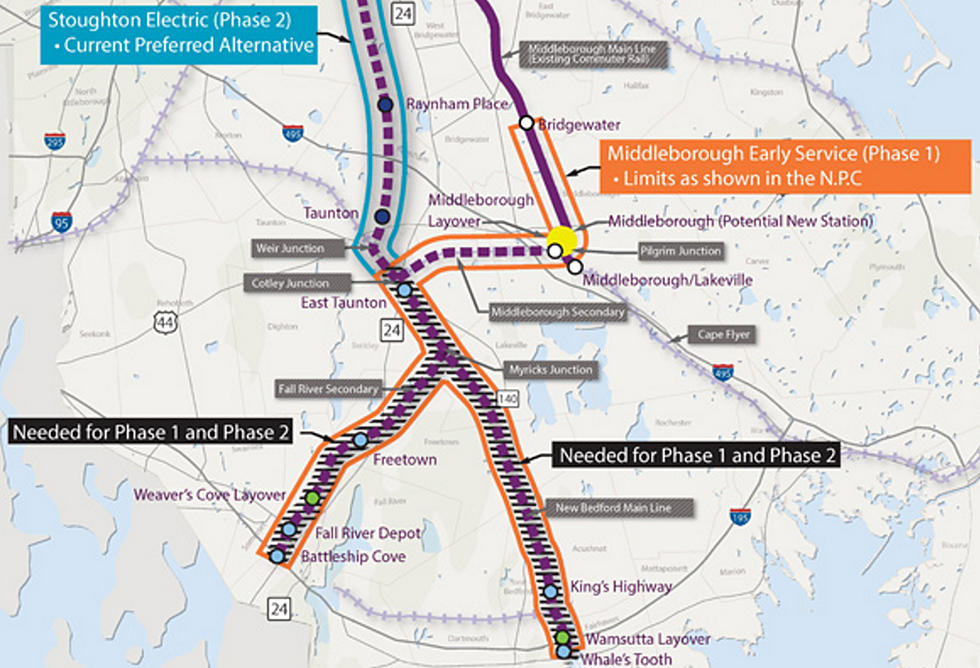
Preparations for Phase 1, which will connect commuter rail service to New Bedford and Fall River through Middleboro and is set to be completed by 2022, is well underway, according to MassDOT spokeswoman Jacquelyn Goddard. She wrote in an email that design is at 90 to 100 percent completion.
Goddard noted nearly every necessary construction permit has been issued and an $18 million contract was approved for the cleaning, replacement, and removal of culverts in areas planned for the project. In addition, she said, MassDOT has started purchasing infrastructure materials that cannot be quickly manufactured, such as special track work and turnouts. Lastly, real estate acquisitions necessary for station areas and easements are being pursued.
Goddard wrote that other expected developments in the near future will include bids for the repair or replacement of the last four bridges on the New Bedford Main Line, likely by the end of March, along with the issuance of final permits including a U.S. Army Corps of Engineers permit. Construction is expected to begin soon on early-action culverts and bridges.
Perhaps most notably, Goddard said a management team is being created to ensure the crucial transition from MassDOT to the MBTA, which will operate the railway system.
Another major step forward is likely to be seen in the next month or two, said Rep. William Straus, D–Mattapoisett, House Chair of the Legislature’s Committee on Transportation. The full billion dollar budget for the project is expected to be released in March and will be made part of the Capital Investment Plan, enabling constituents to see where the money for the project is coming from.
According to Straus, $100 million of the $1 billion meant for the project was already spent this fiscal year on permits and construction, something he deems a worthwhile investment.
“If you’re going to build the South Coast Rail, you have to build this [Phase 1], no matter what track options you think are better or worse,” said Straus.
Some other local legislators are not as confident.
Sen. Marc Pacheco, D–Taunton, said he is opposed to implementing the project in phases, believing all parts should be built at once. He fears construction will never reach Phase 2, which would leave Taunton without service.
“Phase 1 does not include a train station in downtown Taunton so residents would have to drive to the closest station in Middleboro. There is skepticism that Phase 2 will never be built because it is estimated to cost several billion dollars.”
“They [officials] can’t answer how Phase 2 will be funded or when it will happen, and in my world that means it’s not funded and it won’t get funded unless people demand it,” said Pacheco.
Phase 2 includes the “Stoughton Route,” which would bridge service between Stoughton and Taunton. Phase 1, which would connect the South Coast to Boston through Middleboro, is also called the “Middleboro Route.”
Pacheco said he thinks completion of just the Middleboro Route will not allow for the most trips to and from Boston and will not allow as many South Coast residents to access public transit.
“With the Middleboro Route there will be some service, but it won’t be the best or complete version for the citizens of Southeastern Massachusetts,” said Pacheco. “We need to do it the right way to bring the most economic benefit.”
Allin Frawley, a Middleboro selectman, is also concerned about completing the South Coast Rail in phases. In addition to sharing Pacheco’s skepticism about whether Phase 2 will be completed, Frawley opposes the plan to abandon the current Middleboro station and build a new one close by. He said that the new station will provide 300 less parking spaces, reducing Middleboro residents’ access to public transit, and will be built next to one of the worst intersections in the state.
Frawley also said he feels that MassDOT is not responsive enough to his and others’ concerns and said that the proposed plan has not changed since it was enough.
“MassDOT hasn’t worked with Middleboro to make a plan that works for us,” said Frawley. “We’re not being included in this process.”
All officials agree that South Coast Rail should bring significant economic gains to the region, as well as make transportation to Boston and within the region more convenient.
“It’s a basic notion of equity in how people have access to Boston for work,” said Straus. “We’ve been cut out of that equation for decades.”
According to the South Coast Rail website, Taunton, Fall River and New Bedford are the only major cities within 50 miles of Boston that do not currently have commuter rail access to Boston.
“The automobile trip time to Boston has doubled over the last two decades and made the lack of access to the Boston economy unacceptable,” said Straus.
In addition to allowing more area residents to seek job opportunities in Boston, Pacheco said, the South Coast Rail would enable reverse commuting from the Boston area to economic opportunities within the South Coast. Currently, he said, it is difficult in travel between cities within the South Coast, something the rail project is designed to fix.
The region would also benefit economically from opportunities to increase daytime tourism, said Pacheco.
“People want to study the history of the state, they want to visit Battleship Cove and historic downtown Taunton,” said Pacheco.
This, lawmakers believe, is why South Coast Rail is widely supported by their constituents.
“I’ve seen few projects get as high level of support as this from residents and local officials,” said Straus.
Straus said that some concerns have come up when talking with residents, such as how parking lots might be configured, whether there will be enough trips made, where railroad crossings will go, but that he sees this as a positive.
“These are the kinds of concerns you want to hear about a project,” said Straus.
Goddard wrote that at the implementation level, engineering and design teams have worked closely with local municipalities and other key stakeholders.
Straus said that as chair of the Transportation Committee, he is committed to being an advocate for the project and ensuring it remains a priority for the state. Both Goddard and Straus agreed that Phase 1 is on track to be completed by 2022.
“Communities in this area are eagerly awaiting completion of this project and the many benefits it will provide,” Goddard wrote.


https://www.southcoasttoday.com/news/20190302/middleboro-rail-route-is-close-to-100-percent-design


Saturday, February 9, 2019

Flooding fears front & center in Freetown, Lakeville and Middleboro


Flooding fears front & center in Freetown, Lakeville and Middleboro


By Daniel Schemer / Middleboro Gazette


MIDDLEBORO — With worries fresh on everyone’s minds, officials from Middleboro, Lakeville and Freetown are discussing preparations and solutions for the high pond and river levels, which could make for a wet and hazardous season.
Designated members from each town’s emergency management, police and fire departments and Select Board offices, and heads from various public works departments were on hand for a recent meeting.
Middleboro Fire Chief Lance Benjamino opened with news that the water levels at Assawompsett Ponds Complex are 3 feet over targeted levels for this time of year, similar to the levels right before the 2010 floods. Recent photographs, displayed on the overhead projector, at key junctions along the Nemasket River, “show us just how choked up the river is,” Benjamino said.
Each of the three towns shared their experiences in 2010 with the floods, which took over neighborhoods, destroyed hundreds of homes and caused billions of dollars in damage.
“It was the worst disaster in Massachusetts in the last 15 years in terms of federal dollars that came into the state,” said James Mannion, Southeastern Regional manager for Massachusetts Emergency Management Agency.
Benjamino explained how emergency staff had to divide the 72 square miles of Middleboro into four command center divisions in order to maximize response and relief efforts. Several of the dams in town overflowed or failed. Eventually, the National Guard was called in.
“We had to evacuate many homes and entire neighborhoods. Woloski Park had to be evacuated by airboat and canoes. We got over 500 sandbags for dams and streets. Fifteen roads were blocked off at one point,” said Benjamino.
Lakeville Town Administrator Rita Garbitt described similar evacuation conditions for neighborhoods along Staples Shore Road and Parkhurst Drive, and how officials had to cut the town into two sections during this period for response and relief. Flooding on Route 18 was so bad that the state Department of Transportation had to close off sections for two to three weeks.
Freetown Fire Chief Gary Silvia said the town lost the Elm Street Bridge, and access was lost to Assonet from Route 79, as well as East Freetown from Route 140. In addition, dams, such as the former one at Forge Pond, collapsed and were never replaced.
“Any agency you can think of, we had them here,” said Silvia.
Since the 2010 floods each town has gone through its own list of mitigation measures preparing for the future. Besides updating flood maps, Middleboro used grant funding to purchase an Emergency Management trailer, as well as a 50-person shelter trailer for people being evacuated.
Freetown Fire Chief Silvia concurred that similar purchases and preparations were made as well.
Middleboro DPW Director Chris Peck described drainage upgrades, such as multiple culverts replaced to improve water flow under key roadways. He also said dams were and continue to be inspected.
When it comes to immediate preparations and short-term solutions, the consensus in the room was maintaining open lines of communication with the surrounding towns, especially when it comes to mutual aid agreements. The problem, as Benjamino puts it, is calling for assistance from other towns when they’re dealing with the exact same things.
“We need to seek outside resources not immediately impacted by conditions. We need to go out further for resources, outside the initial circle,” he said.
MEMA is one of these outside sources meant for such a crisis, especially when it comes to dwindling supplies.
“We can get pallets of water to anywhere in the state in a matter of hours,” said Regional Director Mannion.
Several officials pointed out the usefulness of MassMap and the Health and Medical Coordinator Coalition for setting up local plans, short-term facilities, and overall assistance with seniors and other groups of people with special care needs.
When it comes to supplies, each town is readily inventoried with non-perishable food, bottled water and emergency Red Cross kits for residents in need. Each town has designated emergency shelters, such as Nichols Middle School in Middleboro.
An important piece of information was the acknowledgment that all shelters, under state law, must be pet-friendly.
Each town and region has its own early notification system when it comes to flooding conditions and evacuations. Benjamino highlighted the Code Red or Reverse 911 system which allows emergency forces to geo-fence and direct warnings, through phone or text, to specific areas. In recent years, social media has also proven to be a valuable tool for immediate communication.
While most of the meeting was spent on discussing measures for dealing with the symptoms, some time was spent debating how to eventually cure the worsening conditions.
“These 100-year events are occurring more frequently than 100 years,” said Allin Frawley, Middleboro selectman.
All contributing bodies of water — Assawompsett Ponds Complex, Long Pond, the Nemasket River and the Taunton River — are connected, influence one another and are suffering from the same problems with invasive weeds, debris, and other kinds of blockages hindering water flow and detrimentally impacting ecosystems and waterfront properties.
Beside the invasive vegetation, Frawley said he believes the issues with the Nemasket stem from all the man-made obstructions along the river, which constrict the water at key junctions and produce “mini-ponds.” He added:“It’s important to find out how much water is going where. Understanding the water levels and flow rate at each junction, as well as what goes into the Assawompsett, is especially important.”
Ymane Galotti, superintendent for the New Bedford Water Department, said: “we can’t exclude extreme amounts of rainwater and higher-than-average ground water levels from consideration. We’re all in agreement that drainage is an issue.”
Lakeville Selectman Mitzi Hollenbeck seemed to unify the audience when she indicated the region needs to seek state aid for any real remedies.
“We need to push the political realm for any long-term solutions,” she said.

https://www.southcoasttoday.com/special/20190209/flooding-fears-front-amp-center-in-freetown-lakeville-and-middleboro


Saturday, January 5, 2019

Debate begins over redevelopment of Island Terrace site


Image result for island terrace lakeville

Debate begins over redevelopment of Island Terrace site

By Robert Barboza, Contributing Writer
Posted Jan 4, 2019

LAKEVILLE — The Zoning Board of Appeals recently got its first official look at a concept plan for the redevelopment of the closed Island Terrace Nursing Home, where a potential buyer is proposing to construct 84 condominium units limited to residents 55 and over on the 8.2 acre site off Long Point Road.
Attorney William Pezzone, representing First Colony Development Company, Inc., laid out the initial proposal for the redevelopment of the parcel, indicating the company would be seeking several variances from zoning regulations to construct eight buildings on the site. The variances needed are for exceeding maximum lot coverage and density restrictions, he indicated, as well as height limits.
Most of the condos would be located in four large, three-story residential structures 45 feet tall, the attorney said. The concept plan also showed four smaller buildings on the site, including a clubhouse for residents and a maintenance building.
Pezzone noted the property is “unique” because of its “environmentally sensitive” location beside a public water supply, and the massive septic system put in place a few years ago to handle the wastewater generated by 77 nursing home residents, and the 110 employees who worked three shifts at the facility when it was operational.
First Colony Development would also need a special permit from the ZBA since town zoning bylaws do not include any provisions for age-restricted housing, according to Appeals Board Chair Donald Foster. He said the board will need to consult with legal counsel to determine if it has the authority to issue a special permit for the project.
Pezzone said the proposed project qualifies as “housing for the elderly” under state law, which would allow it to be constructed under the town’s special permit guidelines.
That elderly housing designation would allow planners to use a 150-gallon per day per resident wastewater output for each condominium, keeping the total output under the 13,000 gallons per day capacity of the existing septic system, the attorney indicated.
He also noted that the company would be willing to scale back the development a bit if the town’s consulting engineers or the state Department of Environmental Protection (DEP) feels the proposed density is too great for the site.
First Colony Development principal Jon Delli Priscoli, known locally as the owner of Edaville Railroad, said he has a purchase agreement in place with Provident Bank, which recently foreclosed on the property.
He said he believes that the high density is needed “to make the economics work” for the site, but noted the concept plan could change some if town officials and the DEP feel that number of residents might overburden the site or threaten the nearby pond.
“My interest is to bring a high-quality development to the community” that meets a local demand currently not available in Lakeville, Delli Priscoli told the Appeals Board. The condos will be a great option for aging current residents looking to downsize out of larger homes, he suggested.
If the town tries to scale back the project in any significant way, his company would probably walk away from the redevelopment effort, he said.
Foster said the first step has to be a legal ruling from town counsel. “I want to find out if we should even be considering this or not,” he told fellow members. “I want to be sure this (special permit) process is legitimate.
Offering a free legal opinion on the matter at the Dec. 20 ZBA meeting was Chairman of Selectmen Aaron Burke, who suggested that First Colony Development cannot meet the hardship provisions required for variances, and the ZBA doesn’t have the authority to issue a special permit for a use not allowed by zoning bylaws.
Selectman John Powderly took the opposite tack, speaking in support of the project. The proposed use would be less dense than a Chapter 40B affordable housing development, and not impact the school system by bringing more children into town, he said.
Also speaking in favor of the plan was former Island Terrace Nursing Home owner Carol Tolles, who said she considers it the best use of the property she has heard so far.
Veteran Planning Board member Sylvester Zienkiewicz was more cautious, suggesting careful consideration was needed by town officials because it would be “the biggest special permit you’ve ever wrote” for a housing development.
Foster said the concept plan filed that night would be passed on to a consulting engineer for a peer review, since definitive site plans are still in the works.
One important consideration would be the access road leading to 57 Long Point Road. Several attendees noted that there is only a longstanding easement to the property, used by the owners for the past six decades.
The ZBA’s review of the preliminary plans will continue at their January meeting.

https://www.southcoasttoday.com/special/20190104/debate-begins-over-redevelopment-of-island-terrace-site


Wednesday, February 7, 2018

SouthCoast Rail service to Boston could start in 2022 or Charlie Baker's $935 MILLION Brain Fart!


Charlie Baker's $935 MILLION Brain Fart!

MassDOT spent GOBS of taxpayer dollars amending Route 105 in Middleboro - the results are a poorly conceived DISASTER! 

This is Charlie Baker Up For Re-Election Carrot that failed to notify or consider the impacts on Middleboro/Lakeville. 

Before rallying around a flawed plan, think about the costs and consequences. 


SouthCoast Rail service to Boston could start in 2022


By Steve Urbon
Posted Feb 6, 2018

NEW BEDFORD — Commuter rail from SouthCoast to Boston took a leap closer to reality Wednesday as the Mass. Department of Transportation issued a draft Supplemental Environmental Impact Report (DSEIR) on a phased-in project.
This postpones the full build-out originally proposed. The new report estimates the Phase 1 construction will take just three years rather than more than a decade; DOT predicts that should all go well, construction starting next year, service on the Middleboro route can begin in 2022.
The Middleboro Phase 1 option will be up and running at least 10 years before the full build-out route through Stoughton, costs under a billion, a fraction of the $3.5 billion build-out route, and presents far fewer environmental obstacles.
Transportation Secretary and CEO Stephanie Pollack quoted Gov. Charlie Baker from his State of the Commonwealth speech, “After more than three decades of lip service, we’re going to make commuter rail from Fall River and New Bedford to Boston a reality.”
“With the filing of the DSEIR and other documents, the day gets closer when people will be able to have a one-seat ride on a train between Boston and the South Coast, connecting them to jobs, schools, businesses, and cultural opportunities, and taking vehicles off the highways to help reduce greenhouse gases,” she said.
New Bedford Mayor Jon Mitchell said in a statement, “Re-establishing passenger rail service to Boston is one of the key infrastructure investments that will enable Greater New Bedford to become more economically competitive.
“I applaud the Baker-Polito Administration’s thoughtful approach to this complex and long-anticipated project, which will offer more reasons to live, work and invest in our city.”
The DSEIR document analyzes only the new elements proposed as part of Phase I that were not previously analyzed in the Final Environmental Impact Statement (FEIS)/Final Environmental Impact Report, said the DOT announcement.
Central Transportation Planning Staff (CTPS) performed ridership analyses, finding that the projected ridership at the new stations under Phase 1 will be 41 percent of the Full Build ridership at one-third of the cost. 

“It is estimated that Phase 1 riders will save a total of approximately 60 minutes each weekday traveling by train when compared to traveling by automobile to and from Boston,” said the announcement. The trip is predicted to take 91 minutes each way. 

The Draft DSEIR willl be the subject of a public meeting at 4 p.m., Wednesday, Feb. 21, at the UMass Dartmouth campus. Project Manager Jean Fox said that a 45-day comment period ends March 23.

The Phase 1 announcement was applauded by the region’s political leaders, but with Sen. Mark Montigny, D-New Bedford, who released the original announcement, guarded about the news. The news echoed former Gov. Bill Weld’s promise that if the rail wasn’t running by 1997, “sue me,” he noted. 

“Several hurdles remain before we can finally rest assured that construction can commence and be completed in time for hardworking taxpayers and commuters to board a train in 2022, but today is a major step in the right direction,” Montigny said.

The report also says that ridership on Phase 1 would result in about 40 percent fewer riders than Phase 2. Many of the concerns revolve around a 91-minute ride. 

“They’ve gotta address that,” Montigny said. “They’ve got to find if there’s ways to speed that up.”  

One of the biggest details revealed includes a $935 million price tag in a five-year capital plan.  

“That’s not a pipe dream 20 years from now,” Montigny said. “That means we have benchmarks every month, which I will hold them accountable for.”

He said the public should do the same.

 State Rep. Antonio Cabral, D-New Bedford, said the report is encouraging in a number of areas. “It is clear what the service will look like. And it’s encouraging that the state will continue the planning and design for full-service through Stoughton while adhering to the timeline for Phase 1.”  

Other officials also weighed in with statements:

Rep. William M. Straus, D-Mattapoisett: “The data in this filing shows that providing interim service now for our region by using the Middleborough Line puts people on trains at least ten years sooner, at one-third the cost and without a single wetlands variance being required. This is a creative approach and one which Governor Baker has been willing to take in order to provide the South Coast with the transportation choices we are entitled to.”   

Sen. Michael J. Rodrigues, D-Westport: “This signals a tremendous move forward for a long-awaited project in a deserving region. The economic development potential will be realized much sooner with Phase 1. I applaud the Baker-Polito Administration’s commitment to the South Coast Rail Project, and its recognition of the impact this will have on our community.”   

Rep. Chris Markey, D-Dartmouth, told The Standard-Times that the 90-minute ride to and from Boston is less time than the highway, and riders can get work done along the way, unlike driving.