Showing posts with label MUELLER REPORT. Show all posts
Showing posts with label MUELLER REPORT. Show all posts
Tuesday, November 5, 2019
Previous Trump, Ukraine Transactions Mirrored Later Quid Pro Quo | Rachel Maddow | MSNBC
Rachel Maddow looks at new reporting in the New York Times that suggests that there was an earlier, successful quid pro quo between Donald Trump and Ukraine that served to quash cases related to the Robert Mueller investigation. Aired on 11/04/19.


Friday, October 25, 2019
FOCUS: Paul Krugman | The Day the Trump Boom Died

25 October 19
This may not be easy and it may not be fun, but this organization needs some cash to continue operation. This is where we need to meet the challenge. Right here right now.
Time to get onboard.
Marc Ash
Founder, Reader Supported News
Founder, Reader Supported News
If you would prefer to send a check:
Reader Supported News
PO Box 2043
Citrus Hts, CA 95611
Reader Supported News
PO Box 2043
Citrus Hts, CA 95611
 25 October 19 It's Live on the HomePage Now: Reader Supported News Sure, I'll make a donation!
FOCUS: Paul Krugman | The Day the Trump Boom Died
 Paul Krugman, The New York Times Krugman writes: "Last spring Donald Trump and the people around him probably thought they had a relatively clear path to re-election."
EXCERPTS:
However, important parts of the economy are lagging. Manufacturing production is down over the past year; combined with weakness in shipping and very hard times in agriculture, around a fifth of the economy is effectively in recession. In particular, manufacturing employment has been falling in Michigan, Wisconsin and Pennsylvania, states that chose Trump by tiny margins in 2016, giving him a win in the Electoral College despite losing the popular vote.
And overall growth, while still positive, is definitely slowing: “nowcasts,” which use partial data to estimate what official economic data will say when it’s eventually released, suggest an economy growing at an unimpressive annual rate of less than 2 percent. Since elections turn more on the economy’s growth rate than on things like the level of unemployment — unemployment was still more than 7 percent when Ronald Reagan won his 1984 landslide — this is not good news for Republicans.
Probably even more significant, there has been a dramatic decline, almost a collapse, in business confidence.
And 10-year bond rates have plunged, from more than 3 percent last year to 1.75 percent as I write this. The last time we saw this kind of plunge was 2010-11, when investors finally realized that recovery from the Great Recession was going to be slow and painful, not a repeat of “morning in America.”
So what happened to the Trump boom? The collapse in confidence began late last year, when it became clear that Trump was serious about waging trade war on China; it continued as evidence accumulated that the 2017 tax cut was a big fizzle, doing basically nothing to boost business investment and providing at most a brief sugar high to overall growth.
But the truth is that even pessimists expected the tax cut to do more good, and the trade war less harm, than they did. Why have things turned out so poorly? One answer, to which I’ve subscribed, is that in addition to its direct impacts on U.S. exports and businesses that rely on Chinese suppliers, the trade war has created damaging uncertainty. Businesses that rely on global supply chains won’t invest for fear that the trade war will get even worse; but businesses that might move in to replace imports also won’t invest for fear that Trump will eventually back down.
I suspect, however, that there’s even more to the story. Business interests spent a long time in denial, but now even they are facing up to the reality that Trump and his team are very strange people who have no idea what they’re doing — and the uncertainty that reality implies.
I mean, considering that trade confrontation with China is the centerpiece of Trump’s economic policy, it’s not reassuring to learn that his trade war czar, Peter Navarro, has an imaginary friend — a source named “Ron Vara” whom he has repeatedly cited in his books, but who doesn’t exist, and whose name is in fact just an anagram of “Navarro.”
Next year’s election should be about Trump’s betrayal of his oath of office. Realistically, however, it also matters that the economy probably won’t be his friend.
Update My Monthly Donation |
Bar Association Threatens Trump’s Attorney General Bill Barr
The NY Bar Association is about to sanction Barr

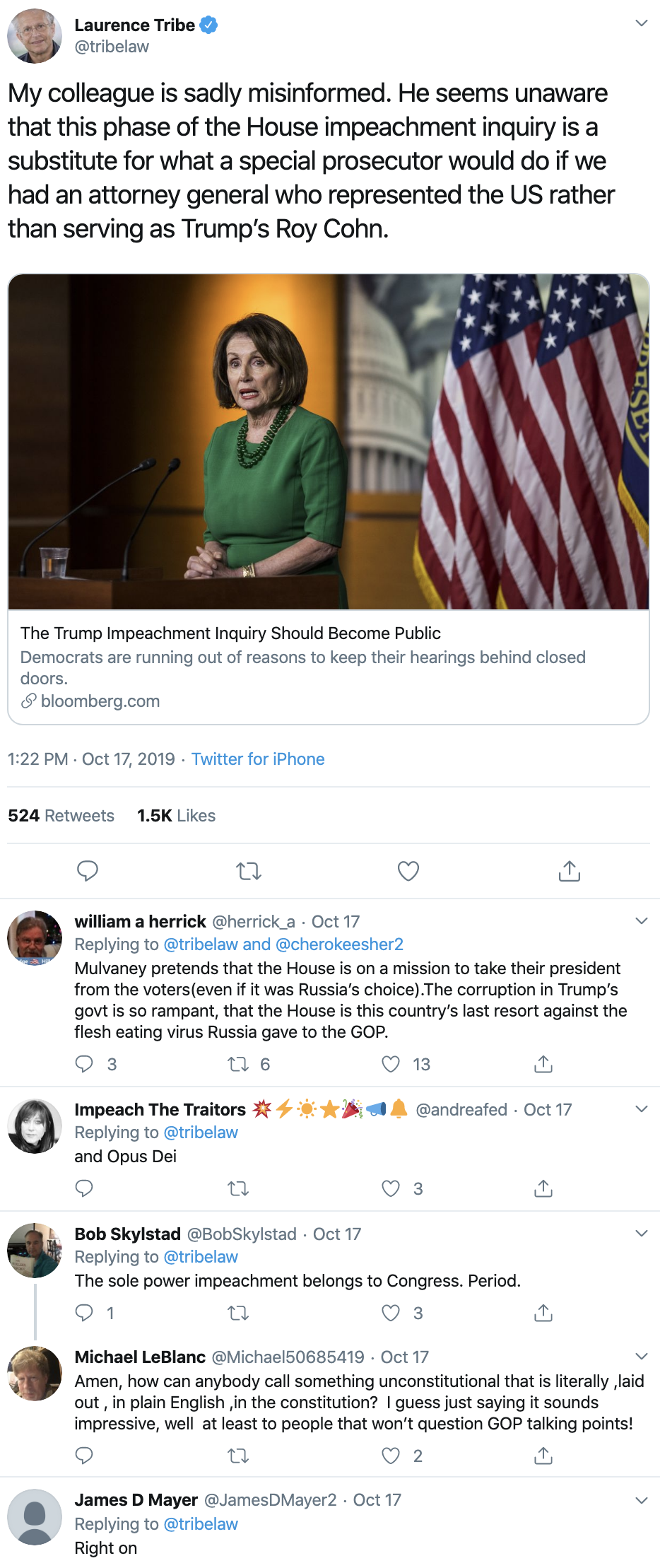
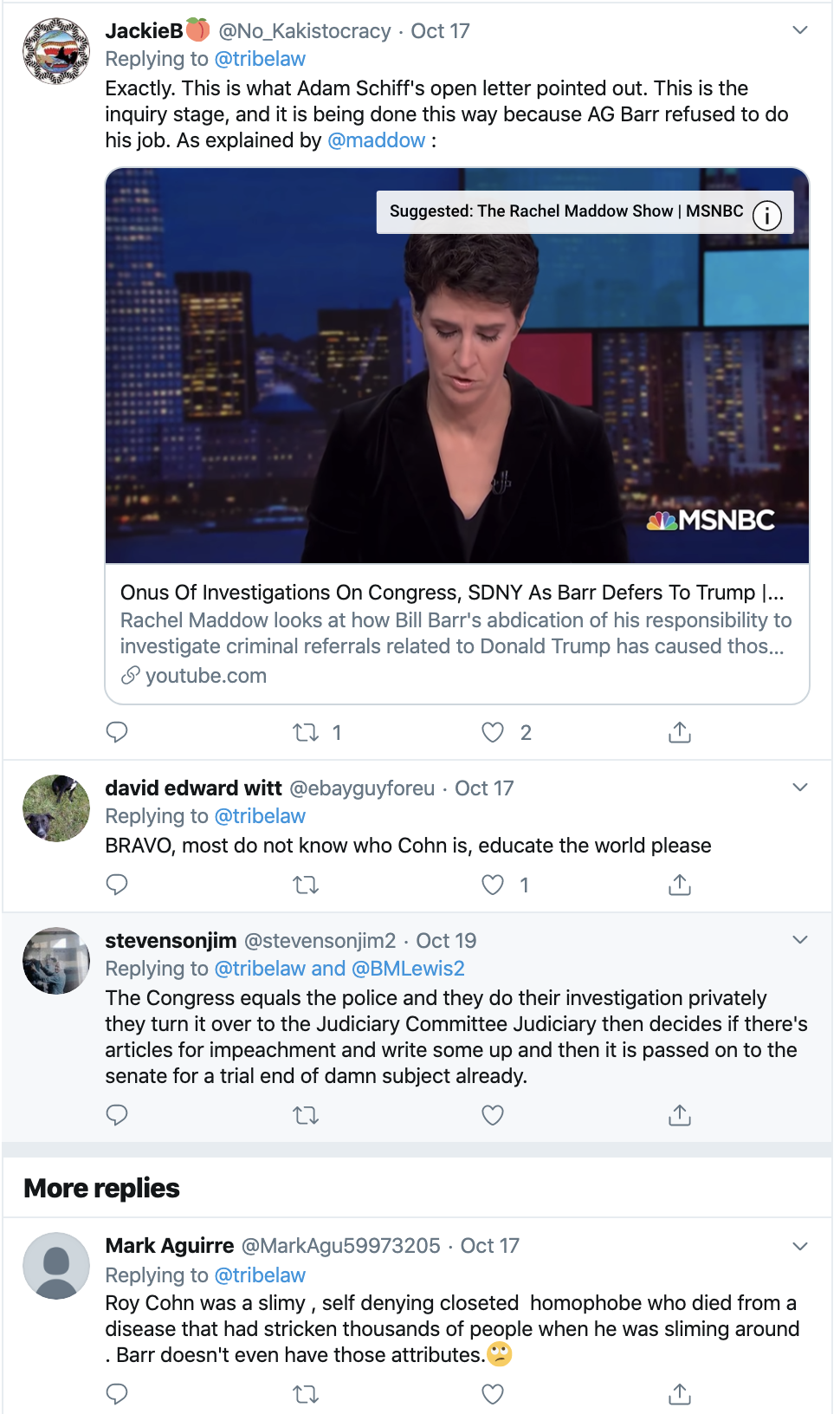
Donald Trump famously asked his former Attorney General Jeff Sessions “Where is my Roy Cohn?” The man POTUS reference was one of Senator Joseph McCarthy’s top attorneys during his hunt for Communists and later worked for Trump. Then, he was disbarred, but it appears the president has found his Roy Cohn again.
The United States Department of Justice (DOJ) has always been defined by the Constitution. The New York City (NYC) Bar Association just called for Attorney General (AG) William Barr to recuse himself in the Ukraine investigation.
In its statement, the bar indicated that the AG was “allegedly involved.” Should that not appeal to Barr, the statement suggested he resign. If the AG did not want to resign, the NYC bar said he should be sanctioned “including possible removal by Congress.”
‘SINCE OUR DEMOCRACY’S INCEPTION IN 1789, ITS FOUNDATION HAS BEEN THE RULE OF LAW. OUR LEADERS ARE SELECTED AND EXERCISE THEIR POWERS UNDER LAW, BEGINNING WITH OUR CONSTITUTION. ALTHOUGH OUR COURTS HAVE PRIMARY RESPONSIBILITY FOR INTERPRETING AND APPLYING OUR LAWS, BOTH THE CONGRESS AND THE EXECUTIVE – INCLUDING THE PRESIDENT – ARE SUBJECT TO, AND ACCOUNTABLE UNDER, THE CONSTITUTION AND THE LAWS ENACTED THEREUNDER.’
The associated said the attorney general’s responsibility was to “see that our laws are justly administered for the benefit of the American people.” Therefore, the AG has to be a role model for advising the president. In addition, he must:
‘[D]DEMONSTRATE AN UNQUESTIONED COMMITMENT TO COMPLIANCE WITH LAW BY ALL WHO EXERCISE THE POWERS OF GOVERNMENT…[T]HE ATTORNEY GENERAL’S OBLIGATIONS ARE NOT OWED SOLELY TO “THE GOVERNMENT AS HIS CLIENT,” THEY ARE NOT OWED TO THE PRESIDENT IN HIS INDIVIDUAL CAPACITY.’
The statement said that the AG:
‘M]UST ENSURE THAT THE ADMINISTRATION OF JUSTICE, THE ENFORCEMENT OF THE LAW IS ABOVE AND AWAY FROM POLITICS. NOTHING COULD BE MORE DESTRUCTIVE OF OUR SYSTEM OF GOVERNMENT, OF THE RULE OF LAW OR THE DEPARTMENT OF JUSTICE AS AN INSTITUTION THAN ANY TOLERATION OF POLITICAL INTERFERENCE WITH THE ENFORCEMENT OF THE LAW.”’
The Bar Association reminded Barr that he took an oath as Attorney General:
‘”[THE AMERICAN PEOPLE HAVE TO KNOW THAT THERE ARE PLACES IN THE GOVERNMENT WHERE THE RULE OF LAW, NOT POLITICS, HOLDS SWAY AND WHERE THEY WILL BE TREATED FAIRLY BASED SOLELY ON THE FACTS AND THE EVENHANDED APPLICATION OF THE LAW. THE DEPARTMENT OF JUSTICE MUST BE THAT PLACE.”‘
Then, the statement went into Barr’s performance. The organization did not give him a passing grade:
‘MR. BARR’S ACTIONS IN OFFICE HAVE FAILED IN PRECISELY THE ROLE THAT HE DESCRIBED WITH ELOQUENCE WHEN NOMINATED. THAT FAILURE HAS JEOPARDIZED THE CONFIDENCE THAT THE PUBLIC CAN REASONABLY HAVE IN THE DOJ AS THE PLACE “WHERE THE RULE OF LAW, NOT POLITICS, HOLDS SWAY.” ‘
The statement continued, noting that he has expressed “loyalty to the president:”
‘HIS ACTIONS DURING HIS BRIEF TENURE IN OFFICE HAVE DEMONSTRATED TO US THAT, CONTRARY TO THE RESPONSIBILITIES OF HIS OFFICE, HE APPEARS TO VIEW HIS PRIMARY OBLIGATION AS LOYALTY TO THE PRESIDENT INDIVIDUALLY RATHER THAN TO THE NATION. IN SERVING THE PRESIDENT, HE HAS BEEN WILLING TO TAKE OR COUNTENANCE ACTIONS THAT ARE CONTRARY TO THE PROFESSIONAL STANDARDS OF THE DOJ, HIS OATH OF OFFICE AND HIS OWN OBLIGATIONS AS AN ATTORNEY.’
However, what sealed the deal for the organization was:
‘MR. BARR’S FAILURE TO RECUSE HIMSELF FROM THE DOJ’S REVIEW—ITSELF OF UNCERTAIN PROPRIETY—OF THE ONGOING “WHISTLEBLOWER” COMPLAINT WITH RESPECT TO THE PRESIDENT’S EFFORTS DURING HIS JULY 25, 2019 TELEPHONE CALL TO REQUEST THE REPUBLIC OF UKRAINE TO INVESTIGATE MR. TRUMP’S ALLEGATIONS OF UKRAINIAN INTERFERENCE IN THE 2016 U.S. ELECTIONS AND FORMER VICE-PRESIDENT BIDEN AND HIS SON (THE “UKRAINE MATTER”).’
Then, the NYC Bar gave its evidence:
‘AS WHITE HOUSE RECORDS MADE CLEAR, THE PRESIDENT TOLD HIS UKRAINIAN COUNTERPART, VOLODYMYR ZELENSKY, THAT MR. BARR “WOULD BE IN TOUCH WITH HIM” TO FOLLOW UP ON THE PRESIDENT’S REQUESTS. THE WHISTLEBLOWER FOUND THIS TELEPHONE CALL TO BE OF “URGENT CONCERN” BECAUSE OF THE PRESIDENT’S APPARENT INTERMINGLING OF U.S. FOREIGN POLICY INTERESTS WITH HIS PERSONAL POLITICAL INTERESTS IN APPARENT VIOLATION OF U.S. LAW.’
Following that, the statement read that Barr should have “recused himself from any participation, direct or indirect.” It encouraged:
‘ATTORNEY GENERAL TO RECUSE HIMSELF FROM ANY PARTICIPATION, DIRECT OR INDIRECT, IN DOJ’S REVIEW OF THE WHISTLEBLOWER COMPLAINT. REGARDLESS OF WHETHER MR. BARR WAS IN FACT AWARE OF OR PART OF THE PRESIDENT’S PLANS, EITHER BEFORE, AT THE TIME OF, OR AFTER THE JULY 25, 2019 TELEPHONE CALL, IT IS CLEAR THAT MR. BARR WAS OBLIGATED TO RECUSE HIMSELF FROM ANY INVOLVEMENT IN DOJ’S REVIEW OF EITHER THE WHISTLEBLOWER COMPLAINT OR THE SUBSTANCE OF THE PRESIDENT’S ACTIONS ONCE THE PRESIDENT OFFERED MR. BARR’S SERVICES TO PRESIDENT ZELENSKY. ‘
The statement continued, going in to further evidence detail for its case:
‘FEDERAL REGULATIONS (28 CFR 45.2) FOR DOJ PROSECUTORS REQUIRE RECUSAL WHENEVER A LAWYER “HAS A PERSONAL OR POLITICAL RELATIONSHIP WITH ANY PERSON . . . SUBSTANTIALLY INCLUDED IN THE CONDUCT THAT IS THE SUBJECT OF THE INVESTIGATION.” THE DOJ MANUAL FOR U.S. ATTORNEYS REQUIRES (SECTION 3-2.170, 2.220) RECUSAL OF U.S. ATTORNEYS AND ASSISTANT U.S. ATTORNEYS WHERE “A CONFLICT OF INTEREST EXISTS OR THERE IS AN APPEARANCE OF A CONFLICT OF INTEREST OR LOSS OF IMPARTIALITY.” EXECUTIVE BRANCH ETHICS RULES ALSO PROVIDE (5 C.F.R. 2635.502) THAT RECUSAL IS APPROPRIATE IF “A REASONABLE PERSON WITH KNOWLEDGE OF THE RELEVANT FACTS WOULD BE LIKELY TO QUESTION THE EMPLOYEE’S IMPARTIALITY IN THE MATTER.”’
The Mueller Report Adventures: In Bite-Sizes on this Facebook page. These quick, two-minute reads interpret the report in normal English for busy people. Mueller Bite-Sizes uncovers what is essentially a compelling spy mystery. Interestingly enough, Mueller Bite-Sizes can be read in any order.
https://bipartisanreport.com/2019/10/24/bar-association-threatens-trumps-attorney-general-bill-barr/?fbclid=IwAR0Y4Pv79vvZTzpxwBfhJxWJ9YzTdE9w0gqXQgDb6XN3iHUZ2bjuIxhkg4M
Tuesday, October 22, 2019
RSN: Marc Ash | Pardoning Trump for Obstruction Would Be a Big Mistake

21 October 19
Simply put, this is an organization that lives and dies with the support of it's readership. We are asking for your support to continue our work.
Thank you sincerely.
Marc Ash
Founder, Reader Supported News
Founder, Reader Supported News
If you would prefer to send a check:
Reader Supported News
PO Box 2043
Citrus Hts
CA 95611
Reader Supported News
PO Box 2043
Citrus Hts
CA 95611

22 October 19
RSN: Marc Ash | Pardoning Trump for Obstruction Would Be a Big Mistake

Marc Ash, Reader Supported News
Ash writes: "House Speaker Nancy Pelosi is reportedly adamant that the case for impeachment should be focused solely on issues related to Ukraine-gate. There are however voices in Democratic leadership that are arguing for articles that would include the acts of obstruction in the Mueller Report."
READ MORE

Hungary's Prime Minister Viktor Orban. (photo: Eva Plevier/Reuters)
Marc Ash, Reader Supported News
Ash writes: "House Speaker Nancy Pelosi is reportedly adamant that the case for impeachment should be focused solely on issues related to Ukraine-gate. There are however voices in Democratic leadership that are arguing for articles that would include the acts of obstruction in the Mueller Report."
READ MORE
Hungary's Prime Minister Viktor Orban. (photo: Eva Plevier/Reuters)
Putin and Hungary's Orban Helped Sour Trump on Ukraine
Jessica Campisi, The Hill
Campisi writes: "Days before a key meeting with White House advisers about Ukraine, foreign leaders including Russian President Vladimir Putin and Hungarian Prime Minister Viktor Orban reportedly urged President Trump to take a hostile view of Kiev."
READ MORE

Hands typing on a computer keyboard. (photo: hamburg_berlin/Shutterstock)
Jessica Campisi, The Hill
Campisi writes: "Days before a key meeting with White House advisers about Ukraine, foreign leaders including Russian President Vladimir Putin and Hungarian Prime Minister Viktor Orban reportedly urged President Trump to take a hostile view of Kiev."
READ MORE
Hands typing on a computer keyboard. (photo: hamburg_berlin/Shutterstock)
Facebook Discloses Operations by Russia and Iran to Meddle in 2020 Election
Julia Carrie Wong, Guardian UK
Wong writes: "Facebook on Monday disclosed it had taken down four new foreign interference operations originating from Iran and Russia, including one targeting the US 2020 presidential elections that appears to be linked to the Russian troll agency, the Internet Research Agency (IRA)."
READ MORE

Mike Pompeo. (photo: OZY)
Julia Carrie Wong, Guardian UK
Wong writes: "Facebook on Monday disclosed it had taken down four new foreign interference operations originating from Iran and Russia, including one targeting the US 2020 presidential elections that appears to be linked to the Russian troll agency, the Internet Research Agency (IRA)."
READ MORE
Mike Pompeo. (photo: OZY)
Pompeo and Mulvaney Beclown Themselves
Jennifer Rubin, The Washington Post
Rubin writes: "Secretary of State Mike Pompeo is either the most ill-informed and incurious secretary of state in history or the most partisan and dishonest."
READ MORE

Mark Zuckerberg. (photo: B&T)
Jennifer Rubin, The Washington Post
Rubin writes: "Secretary of State Mike Pompeo is either the most ill-informed and incurious secretary of state in history or the most partisan and dishonest."
READ MORE
Mark Zuckerberg. (photo: B&T)
Mark Zuckerberg Has Quietly Recommended Campaign Hires to Pete Buttigieg
Tyler Pager and Kurt Wagner, Bloomberg
Excerpt: "Mark Zuckerberg has privately recommended several potential hires to Pete Buttigieg's presidential campaign, a rare example of direct political involvement from one of tech's most powerful executives."
READ MORE

Supporters of the Tamil family seeking asylum hold placards outside the Australian Federal Court on September 4, 2019 in Melbourne, Australia. (photo: Asanka Ratnayake/Getty Images)
Tyler Pager and Kurt Wagner, Bloomberg
Excerpt: "Mark Zuckerberg has privately recommended several potential hires to Pete Buttigieg's presidential campaign, a rare example of direct political involvement from one of tech's most powerful executives."
READ MORE
Supporters of the Tamil family seeking asylum hold placards outside the Australian Federal Court on September 4, 2019 in Melbourne, Australia. (photo: Asanka Ratnayake/Getty Images)
Don't Forget the Tamil Genocide
Lee Rhiannon, Jacobin
Rhiannon writes: "Ben Hillier's Losing Santhia, which details the Tamil national struggle in Sri Lanka, explores the colonial backstory and the deeply personal stories entwined with genocide."
READ MORE
Lee Rhiannon, Jacobin
Rhiannon writes: "Ben Hillier's Losing Santhia, which details the Tamil national struggle in Sri Lanka, explores the colonial backstory and the deeply personal stories entwined with genocide."
READ MORE

Cleanup costs for abandoned oil and gas wells once the producers have moved on could fall heavily on the public. (photo: Susan Vineyard/iStock/Getty Images)
Will the Public End Up Paying to Clean Up the Fracking Boom?
Justin Mikulka, DeSmogBlog
Mikulka writes: "Increasingly, U.S. shale firms appear unable to pay back investors for the money borrowed to fuel the last decade of the fracking boom."
Justin Mikulka, DeSmogBlog
Mikulka writes: "Increasingly, U.S. shale firms appear unable to pay back investors for the money borrowed to fuel the last decade of the fracking boom."
"It's starting to become out of control, and we want to rein this in," Bruce Hicks, assistant director of the North Dakota Oil and Gas Division, said in August about companies abandoning oil and gas wells. If North Dakota's regulators, some of the most industry-friendly in the country, are sounding the alarm, then that doesn't bode well for the rest of the nation.
In fact, officials in North Dakota are using Pennsylvania as an example of what they want to avoid when it comes to abandoned wells, and with good reason.
The first oil well drilled in America was in Pennsylvania in 1859, and the oil and gas industry has been drilling — and abandoning — wells there ever since. Pennsylvania's Department of Environmental Protection (DEP) says that while it only has documentation of 8,000 orphaned and abandoned wells, it estimates the state actually has over a half million.
"We anticipate as many as 560,000 are in existence that we just don't know of yet," DEP spokesperson Laura Fraley told StateImpact Pennsylvania. "There's no responsible party and so it's on state government to pay to have those potential environmental and public health hazards remediated."
According to StateImpact, "The state considers any well that doesn't produce oil and gas for a calendar year to be an abandoned well."
That first oil well drilled in Pennsylvania was 70 feet deep. Modern fracked wells, however, can be well over 10,000 feet in total length (most new fracked wells are drilled vertically to a depth where they turn horizontal to fracture the shale that contains the oil and gas). Because the longer the total length of the well, the more it costs to clean up, the funding required to properly clean up and cap wells has grown as drillers have continued to use new technologies to greatly extend well lengths. Evidence from the federal government points to the potential for these costs being shifted to the tax-paying public.
The Government Accountability Office (GAO) released a report this September about the risks from insufficient bonds to reclaim wells on public lands. It said, "the bonds operators provide as insurance are often not enough to cover the costs of this cleanup." The report cited a Bureau of Land Management (BLM) official's estimate of $10 a foot for well cleanup costs.
StateImpact Pennsylvania noted that costs to reclaim a well could add up to $20,000, and DEP spokesperson Fraley said they could be "much, much higher." The GAO report noted that "low-cost wells typically cost about $20,000 to reclaim, and high-cost wells typically cost about $145,000 to reclaim."
In North Dakota, where state regulators have raised concerns about this growing problem, one of the top industry regulators, State Mineral Resources Director Lynn Helms, estimated that wells there cost $150,000 to plug and reclaim.
And this problem isn't just in the U.S. Canada is facing a similar cleanup crisis.

We always talk about the oil biz in Canada as BIG MONEY on the one hand, environmental issues on the other. But this episode taught me that cleaning up abandoned oil wells will soon COST Canada $50 Billion+. So....? canadalandshow.com/podcast/crude-…
Financial Bonding Requirements for Well Cleanup
Legally, oil and gas companies are required to set aside money to pay for well cleanup costs, a process known as bonding. These requirements vary by state and for public lands, but in all cases, the amounts required are so small as to be practically irrelevant.
The GAO report reviewed the bonds held by the Bureau of Land Management for wells on public lands and found that the average bond per well in 2018 was worth $2,122.
The Western Organization of Resource Councils summarized bonding requirements by state, and none of them came even close to being adequate to cover estimated costs to deal with old wells. In North Dakota, a $50,000 bond is required for a well. But a $100,000 bond can cover up to 6 wells, which comes out to $16,667 per well — or approximately one tenth of the estimated cost to reclaim a well in that state.
North Dakota has a history of bending to oil and gas industry pressure when it comes to regulations. While North Dakota's bonding rules fall far short of what's needed to actually cover full cleanup costs, the reality on the ground is much worse. Regulators allow companies to "temporarily abandon" wells, which requires no action from companies for at least seven years. Wells can hold this "temporary status" for decades. And another practice in the state allows a company to sell old, under-performing wells to another company, passing along the liability but not the bonding funds.
By any measure, the amount of private money currently allocated in the U.S. to plug and reclaim oil and gas wells is a small fraction of the real costs. That means oil and gas wells — and the U.S. had one million active wells in 2017, and even more abandoned — will either be left to fail and potentially contaminate the surrounding water, air and soil, or the public will have to pick up the tab. This represents just one of the many ways the public subsidizes the oil and gas industry.
Statewide, 639 oil wells are considered abandoned.
The fund has a balance of $22 million, yet Helms estimates the state could potentially be on the hook for a far greater amount.bismarcktribune.com/bakken/regulat…


A South Dakota Case Study
South Dakota allows companies to post a $30,000 bond for as many wells as the company chooses to drill. Spyglass Cedar Creek is a Texas-based company that was operating in South Dakota and recently abandoned 40 wells, which the state has estimated will have a cleanup cost of $1.2 million.
However, there is a twist to this story. That $30,000 bond doesn't really exist. The owners of the company had put $20,000 of it into a Certificate of Deposit. But when the state went looking for that money, the owners said they had cashed it in 2015 because, as reported by the Rapid City Journal, "company officials did not remember what the money was for."
Spyglass Cedar Creek does not have the money set aside that was required to clean up these wells, the state does not have recourse to get that money, and some of the wells are reportedly leaking. So, what can be done?
According to Doyle Karpen, member of the South Dakota Board of Minerals and Environment, the answer is for the taxpayers of that state to cover the cost.
"I think the only way we can correct this is go to the Legislature and ask for money," Karpen said earlier this year.
Following the Coal Industry Business Model
What is starting to unfold with the oil and gas industry is very similar to what has already been playing out with the U.S. coal industry.
According to a Center for Public Integrity investigation, more than 150 coal mines (and dozens of uranium mines) have been allowed to idle indefinitely, enabling their owners to avoid paying for the costs of cleanup.
In April, the Stanford Law Review published the paper, "Bankruptcy as Bailout: Coal Company Insolvency and the Erosion of Federal Law," which notes that almost half the coal mined in the U.S. is done so by companies that have recently declared bankruptcy.
The paper notes how the bankruptcy process is used by coal companies to rid themselves of environmental cleanup liabilities and pension costs "in a manner that has eviscerated the regulatory schemes that gave rise to those obligations."
Yet coal company executives often receive healthy bonuses, even as they are driving companies into bankruptcy.
This summer, Blackjewel famously failed to pay its coal miners, and even pulled funds out of their bank accounts, after the company suddenly declared bankruptcy in July. That prompted workers to sit on train tracks in Kentucky, blocking a $1 million shipment of coal, in a two-month protest. And Blackjewel is poised to leave behind thousands of acres of mined land in Appalachia without adequate reclamation.
Privatize the Profits, Socialize the Losses
The mineral extraction business model in the U.S. is set up to maximize profits for executives, even as they lose investor money and bankrupt their companies. That is true of the coal industry and that is true of the shale oil and gas industry.
At the same time, the regulatory capture by these industries at both state and federal levels allows private companies to pass on environmental cleanup costs to the public, and the inadequate bonding system for oil and gas well reclamation represents just one more example.
The so-called fracking revolution in America has resulted in many new records: record amounts of U.S. oil and gas exported (to the detriment of a livable climate), new levels of human health impacts on surrounding communities, record numbers of industry-induced earthquakes, record amounts of flaring natural gas in oil and gas fields, and record-breaking depths and lengths of wells.
And the cleanup costs for the fracking boom are also poised to be staggering.
Abandoned Texas oil wells seen as "ticking time bombs" of contamination texastribune.org/2016/12/21/tex… via @TexasTribune


Subscribe to:
Posts (Atom)


