Search This Blog

Translate

Blog Archive

Middleboro Review 2

NEW CONTENT MOVED TO MIDDLEBORO REVIEW 2

Toyota

Since the Dilly, Dally, Delay & Stall Law Firms are adding their billable hours, the Toyota U.S.A. and Route 44 Toyota posts have been separated here:

Route 44 Toyota Sold Me A Lemon


Showing posts with label anaplasmosis. Show all posts

Sunday, August 18, 2019

Tick test helps identify Harwich woman’s illness


Tick test helps identify Harwich woman’s illness


By Cynthia McCormick
Posted Aug 17, 2019


HARWICH — When stricken with high fever, nausea and headaches, not many people would suspect a tick-borne disease as rare as miyamotoi.

Only a handful of cases of the disease similar to tick-borne relapsing fever have been reported in Massachusetts.

But Melissa Davey of Harwich already knew the tiny deer tick that bit her was carrying the pathogen that causes miyamotoi when she started coming down with symptoms July 9.

The results of a tick report from the University of Massachusetts Amherst, where Davey had mailed a tiny tick she pulled off her right leg, showed that the tick was negative for a number of known pathogens, including the bacteria that causes Lyme disease, but was positive for miyamotoi.

Davey remembered this result eight days after receiving the report, when she started feeling queasy and experiencing fevers and drenching sweats.

“At first I thought, ‘Is this the flu?’” said Davey, 52. “Then I remembered the tick report.”

Having the report enabled her physician to order the right tests, said Davey, who went on 30 days of doxycycline after testing for miyamotoi.

“My doctor thought it was fantastic I did the tick report,” Davey said.

“It’s good data to have in hand,” said Larry Dapsis, entomologist and tick project coordinator for the Cape Cod Cooperative Extension.

Having a positive tick report doesn’t mean the person who was bitten will get sick — and having a negative one is no guarantee of good health — since the individual could have missed a bite by a different tick, Dapsis said.

Davey said the nymphal tick she found on her lower right leg June 25 was the size of a poppy seed.

But the information is still helpful to doctors, Dapsis said.

“Now you can show (the tick report) to your physician and say, ‘Hey, I’ve been exposed to this pathogen,’” Dapsis said.

It’s not just patients making the link between their tick report and possible illness.

Scientists at the tick report lab at UMass increasingly are looking for links between the pathogens found in ticks and the emergence of diseases including Lyme, miyamotoi, babesiosis and anaplasmosis in the humans that the ticks fed upon.

The lab is referring tick report clients whose ticks carry miyamotoi to a scientists in New Haven, Connecticut, attempting to develop an FDA-approved test for miyamotoi.

Currently labs use polymerase chain reaction tests to detect DNA from the miyamotoi borrelia bacteria, according to officials from the Massachusetts Department of Public Health.

Another test detects a person’s antibodies to the bacteria, but neither one is approved by the FDA yet, said Michel Ledizet, senior research scientist at L2 Diagnostics LLC in New Haven.

Ledizet said in an email that he has received several dozen blood samples for the study since he started working with Stephen Rich, the microbiologist who runs the UMass lab, in 2016.

“We probably need 50 to 100 samples from people who became infected by Borrelia miyamotoi,” Ledizet said.

“However, we need to collect many more samples because the tick does not always transmit the bacteria while it feeds. In fact, transmission appears to occur less commonly than we expected,” said Ledizet, who said the final report to the National Institutes of Health is due later this year.

There are still a lot of unknowns about miyamotoi, first identified in 1995 in ticks from Japan and reported in humans six years later, in Russia. Miyamotoi infection was first identified in U.S. citizens in 2013, two years after the first human cases were reported in Russia.

Reported human cases in the U.S. are low, with the Centers for Disease Control saying there have been fewer than 60 well-documented cases in the U.S., while the number of confirmed and probable cases of Lyme disease across the country reach a record 42,743 in 2017.

State DPH officials also report low figures of miyamotoi, with 12 cases in Barnstable County in 2017, two in 2018 and two so far in 2019.

Detection rates in ticks tested at Rich’s lab are minuscule compared with cases of Lyme disease. Out of nearly 10,000 ticks tested over a year’s time, 132 were positive for miyamotoi compared with nearly 3,000 for for Borrelia burgforferi, the spirochete that causes Lyme disease.

“The number of cases is so low you can’t derive a trend,” Dapsis said.

“We continue to see miyamotoi in the tick population (in Barnstable County) at an average of 2%. There is some risk out there,” Dapsis said.

“But it’s not nearly as high as Lyme disease,” he said.

It’s important to keep learning about the disease, said Ledizet, who said he hopes to continue with his study and better experimental results and ultimately an FDA-approved test that is widely available commercially.

Falling ill with miyamotoi was scary, said Davey, whose temperature spiked to 103 degrees.

“I was miserable. I was having uncontrollable shaking chills and terrible, terrible headaches, body aches, confusion,” Davey said.

She suspects she picked up the tick while walking her family’s puppy in Hawksnest State Park, adjacent to her property.

She found the tick on her lower right leg, just below her knee.

“I’m usually very good about checking,” Davey said. “But this one got away from me.”

The tick test is subsidized by Cape Cod Healthcare for Barnstable County residents at $15.

Davey said she emailed Rich’s lab a note of appreciation for helping her make the connection between the tick that bit her and her illness.

“I just wanted to let them know, ‘What you do does matter,’” Davey said.


Friday, March 22, 2019

US invaded by savage tick that sucks animals dry, spawns without mating


US invaded by savage tick that sucks animals dry, spawns without mating

Eight states reporting the little suckers. No evidence they're carrying disease—yet.


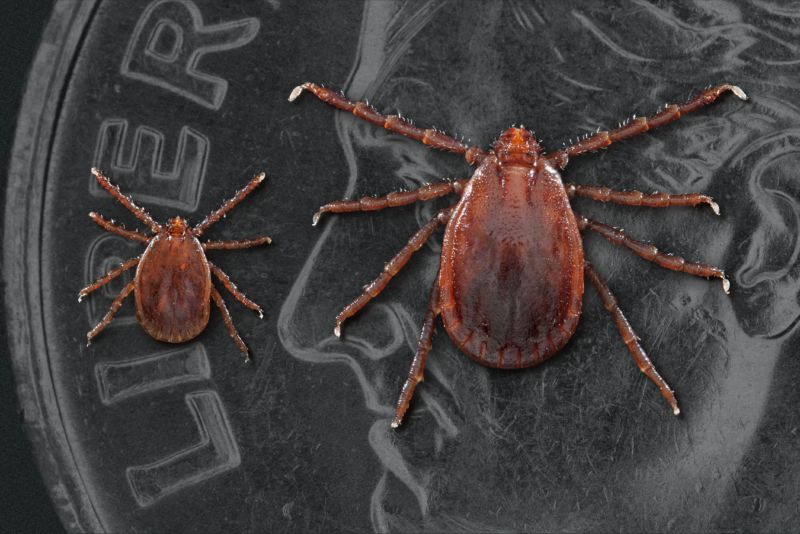
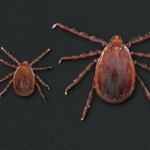
Two arachnids are so small they can fit on the face of a US dime.
Enlarge / Two Haemaphysalis longicornis on a US dime.

A vicious species of tick originating from Eastern Asia has invaded the US and is rapidly sweeping the Eastern Seaboard, state and federal officials warn.
The tick, the Asian longhorned tick (or Haemaphysalis longicornis), has the potential to transmit an assortment of nasty diseases to humans, including an emerging virus that kills up to 30 percent of victims. So far, the tick hasn’t been found carrying any diseases in the US. It currently poses the largest threat to livestock, pets, and wild animals; the ticks can attack en masse and drain young animals of blood so quickly that they die—an execution method called exsanguination.
Key to the tick’s explosive spread and bloody blitzes is that its invasive populations tend to reproduce asexually—that is, without mating. Females drop up to 2,000 eggs over the course of two or three weeks, quickly giving rise to a ravenous army of clones. In one US population studied so far, experts encountered a massive swarm of the ticks in a single paddock, totaling well into the thousands. They speculated that the population might have a ratio of about one male to 400 females.
Yesterday, August 7, Maryland became the eighth state to report the presence of the tick. It followed a similar announcement last Friday, August 3, from Pennsylvania. Other affected states include New York, Arkansas, North Carolina, Virginia, and West Virginia.

Plagued paddock

It all started last August in New Jersey, the first state to identify the bloodsuckers. In a case report recently published in the Journal of Medical Entomology, infectious disease and tick experts reported the sad state of a 12-year-old Icelandic sheep housed alone in a paddock amid manicured lawns and large houses in the state’s wealthy Hunterdon County. No other animals were located on the property, and the sheep had never traveled outside of the country. Yet the beast was besieged, covered by hundreds of feasting ticks of all life-stages.
Just stepping foot in the paddock, the owner and health investigators were inundated with thirsty ticks that instantly began clawing up their pant legs. DNA analysis ultimately determined that the ticks were H. longicornis. Investigators found only one male out of 1,058 ticks collected.
To fight back the swarms, the owner doused the sheep in a wash of the insecticide permethrin. By November, it was cleared of ticks, and population levels in the vegetation around the paddock seemed to be dying down, although that was likely due to several nights of below-freezing temperatures.
In April, New Jersey’s Department of Agriculture confirmed that the population had successfully overwintered in the state, suggesting that it has now become established there.

Spreading scourge

So far, it’s unclear how, when, or where H. longicornis first arrived in the country. According to a regional consortium of vector-borne disease experts, archived tick samples suggest the species arrived several years prior to 2017. In the past, researchers have occasionally intercepted the ticks in US quarantine stations, including finding a tick on a quarantined horse at a station in New Jersey in 1969.
H. longicornis is native to parts of East Asia, namely China, Japan, the former USSR, and Korea, living in meadows and grassy areas near forests. They’re also an established invasive pest of cattle in New Zealand, parts of Australia, and several Pacific islands. They’ve been known to feed on livestock like sheep, goats, cattle, and horses as well humans, dogs, cats, birds, and a range of wild animals, including bears, foxes, raccoons, rabbits, deer, and opossum.
In Asia, the longhorned tick is known to carry a variety of pathogens, including Rickettsia japonica, the bacteria behind Oriental spotted fever, and Theileria orientalis, a parasite that causes cattle theileriosis. It has also been found harboring relatives to pathogens present in the US, including bacteria that cause anaplasmosis and ehrlichiosis, the parasite that causes babesiosis, and the Powassan virus. ​
Additionally, H. longicornis may harbor a newly emerging virus that causes SFTS, which is short for severe fever with thrombocytopenia syndrome. SFTS was first identified in China in 2009 and is marked by fever, vomiting, hemorrhaging, and organ failure. Reported fatality rates fall between 6 percent and 30 percent. Several studies have pointed to the longhorned tick as being a reservoir and source for the virus.
Journal of Medical Entomology, 2018. DOI: 10.1093/jme/tjy006  (About DOIs)

https://arstechnica.com/science/2018/08/us-invaded-by-savage-tick-that-sucks-animals-dry-spawns-without-mating/?fbclid=IwAR1OQl95ejxmZEFUtwzwTMV0VNIhDnrj87sMn3BybkrnVFsEwZlYVhMu6HM

ADDITIONAL INFORMATION:


https://academic.oup.com/jme/article/55/3/757/4840594


Saturday, February 22, 2014

Free Lyme testing coming this spring


Free Lyme testing coming this spring
 
Cape Codders bitten by deer ticks will be able to have the insects tested for Lyme and two other diseases for free starting this spring.
 
The testing will take place at the Laboratory of Medical Zoology at the University of Massachusetts Amherst and is being funded by a $111,000 Governor's Community Innovation Challenge program.

TICK DISEASES

Figures are for confirmed or probable cases for 2012, the latest year available from the state Department of Public Health.
 
Disease Cape and Islands Statewide Local percentage
  • Lyme 438 5050 9%
  • Babesiosis 103 223 46%
  • Anaplasmosis 43 237 18%

Local boards of health and the Cape Cod Cooperative Extension will have prepaid mailers addressed to the UMass laboratory of microbiologist Stephen Rich, said Larry Dapsis, Cape Cod Cooperative Extension deer tick program coordinator. The plan is to have mailers available sometime in April, he said.
 
"We're working out the details," he said. Individuals should receive the results of their tests within one week, and towns and the county will track data for their communities, Dapsis said.
 
The ticks will be tested for Lyme disease, as well as anaplasmosis and babesiosis, said Dapsis, who is also the Barnstable County entomologist.
 
The tests for all three at UMass would normally cost individuals $140, he said.
 
This is the first time the state is funding a regional surveillance of the kinds of disease carried by deer ticks with which people have come into contact, Dapsis said.
 
The information will be used to track what tick-borne pathogens people are exposed to in the 32 towns covered by Barnstable, Nantucket, Middlesex and Franklin counties, he said.
 
The number of ticks tested for free in each town will be capped at 100, Dapsis said.
 
It's going to create awareness about disease patterns, he said. People know about Lyme disease, but they "might be kind of surprised" what else they are exposed to, Dapsis said.
 
The Cape and Islands have long been hot spots for Lyme disease and now face a growing prevalence of babesiosis and anaplasmosis, potentially fatal diseases also transmitted by the deer tick.
 
In 2012, the last year for which the state Department of Public Health has figures, there were 438 confirmed or probable cases of Lyme disease on the Cape and Islands — about 9 percent of the state total of 5,050 cases.
 
The Cape and Islands had 103 cases of babesiosis in 2012, nearly half of the state total of 233, as well as 43 cases of anaplasmosis, out of a statewide total of 237.
 
The Cape and Islands Cooperative Extension runs another type of surveillance program, dragging for ticks at 14 sites on the Cape and Islands and sending them for testing to Rich's UMass lab.
 
The lab has tested 2,000 ticks over the past five years, but they were ticks picked up by researchers dragging white cloths in designated nature areas — not deer ticks picked off people, Dapsis said.
 
"What's really exciting about the project we're doing now (is that) it sort of makes the connection between where the ticks are, who is getting bitten, when they are getting bitten and what they are getting bitten with," Rich said.
 
"We don't intend this to be a medical diagnosis or a substitute for seeing your doctor if you are feeling ill," he said. "Our tick tests are telling something about risk."
 
Ron Gangemi, one of the founders of Lyme Awareness of Cape Cod, said the more information people can learn about deer ticks and disease incidence and patterns the better.
 
"I think it's an awesome thing they're doing," he said.
 
Gangemi plans to open the Lyme Disease Health and Wellness Center at an office condominium he purchased in Mashpee by May.
 
He said he will volunteer to be a dropoff site for ticks to be tested at UMass.
 
The grant lasts for one year and was proposed by the town of Bedford Health Department and Rich's lab at UMass.


Sunday, December 22, 2013

The Lyme Tick Yuk and How to Protect Yourself


State: Tick bite can be deadly
 
Top Photo
Public health officials report that at least 10 people in Massachusetts died
last year after contracting diseases carried by the freckle-sized tick.
Steve Heaslip/Cape Cod Times
 
It wasn't long ago that the tiny deer tick that transmits Lyme disease was seen as dangerous — but not a killer.
 
That view is changing. Public health officials report that at least 10 people in Massachusetts died last year after contracting diseases carried by the freckle-sized tick.

Battling tick-borne disease

Doctors treat babesiosis with atovaquone, which goes under the brand name Mepron in the U.S. It is combined with an antibiotic such as azithromycin.
  • Anaplasmosis, a bacterial infection, is treated with the same antibiotic used to knock down Lyme disease, doxycycline.
  • It's important for Cape residents to reduce exposure to ticks by using repellents on clothing and skin and doing tick checks, according to Dr. David Pombo, an infectious disease specialist with Cape Cod Healthcare.

 
One was a young adult who, as reported last week by the Centers for Disease Control and Prevention, collapsed in November 2012 after suffering a rare cardiac event known as Lyme carditis.
 
In addition, at least nine other people were felled by two emerging tick-borne illnesses heavily concentrated on the Cape and Islands, according to the Massachusetts Department of Public Health.
 
Babesiosis, also known as Nantucket fever, was responsible for taking the lives of five people in 2012, according to the DPH. Health officials did not release where the people lived or where they may have contracted the disease.
 
And at least four other people in the state died that year after contracting anaplasmosis, caused by a bacteria carried by the same black-legged deer tick that passes on Lyme spirochetes and the babesia parasite, the DPH says.
 
"The issue is that both of these diseases can occasionally cause severe illness that can lead to death," said Dr. Catherine Brown, DPH state veterinarian.
 
This is the first year the state has included death statistics for the two tick-borne diseases with its latest surveillance data, which is for 2012.
 
While less common than Lyme disease, babesiosis and anaplasmosis cases have more than quadrupled since 2008.
 
Last year, nearly half of the state's 233 babesiosis cases — 103 — were on the Cape and Islands.
 
In the young and healthy, babesiosis might seem like nothing more than a mild flu or be barely noticeable.
 
But for those with compromised immune systems, including cancer patients, individuals who have lost their spleens and senior citizens, the malarial-like disease can prove dangerous — and sometimes fatal.
 
Nearly 60 percent of confirmed babesiosis cases last year occurred in people over age 60, the DPH said. Thirty-nine percent were hospitalized.
 
Patients frequently report fatigue, malaise, fevers, shaking, chills, drenching sweats and sometimes discolored urine.
 
"Babesiosis destroys your red blood cells," Brown said. "You may have trouble catching your breath."

Difficult to detect

The majority of cases occur in the summer months, but only 25 percent of people stricken with babesiosis recall getting a tick bite, the DPH says.
 
That's a frightening statistic to Joyce McConnell of Brewster, whose 77-year-old husband, Lewis "Sandy" McConnell died in 2008 after contracting the disease.
 
"He was in good health," McConnell said of her husband. The last time he recalled getting bitten by a tick was two years before his death, she said.
 
The couple enjoyed working in the yard of their house abutting Nickerson State Park and taking off in the car with pencil sketch kits to look for inspiration in other natural settings.
 
"We had fun years," McConnell said.
 
After experiencing extreme fatigue in August 2008, her husband consulted with a cardiologist, who said his heart looked fine, McConnell said.
 
But "he was just getting weaker," she said. He had the sweats but no fever, she said. "I'm talking profuse sweating, clothes being wet, sopped."
 
The morning of Aug. 14, McConnell said, her husband fell and hit his head as the couple prepared to take a visiting grandson to summer camp.
 
Doctors in the emergency room at Cape Cod Hospital diagnosed her husband with babesiosis and said his red blood cell counts were dangerously low, McConnell said.
 
Her husband died a few hours after arriving at the hospital, McConnell said. She said babesiosis was not listed as the cause of death.
 
"You do get weak from the illness due to anemia," said Dr. David Pombo, medical director of infection prevention for Cape Cod Healthcare.
 
In addition, platelet counts can drop so low that blood has trouble clotting after a traumatic injury such as a fall, he said.
 
Despite the recent wintry weather, Pombo said in the past two weeks he has seen three cases of babesiosis and another of anaplasmosis in November.
 
Like malaria, which is also caused by a parasite, babesiosis can be relapsing and require additional treatment, Pombo said.
 
"I'm still struggling to get rid of it," said Lisa Freeman of Brewster.
 
Freeman, who also suffers from Lyme disease and anaplasmosis, said she was first diagnosed with babesiosis in 2006.
 
Four years later a test showed its staying power, said Freeman, a nurse and patient advocate with Lyme Awareness of Cape Cod. "I'm still suffering with drenching night sweats, chills, neck pain," she said. Freeman said her doctor is talking about treating her with a medicine called Coartem that is supposed to be good for resistant babesiosis.

Island origins

 
The type of babesiosis transmitted by ticks to humans was first diagnosed in a previously healthy person in 1969 on Nantucket, according to Peter Krause of Yale University and Edouard Vannier of Tufts Medical Center.
 
With more cases popping up in the 1970s, the illness became known as "Nantucket fever," the two reported in the New England Journal of Medicine in June 2012.
 
In addition to tick bites, babesiosis can be transmitted through blood transfusions.
 
Brown said that workers at transfusion centers now ask patients if they've ever had babesiosis and are working on developing a screening method.
 
Last year six Massachusetts residents came down with babesiosis after receiving a blood transfusion or tissue or organ donation, according to the DPH.
 
Concerns about transfusion are growing as babesiosis cases increase.
 
Between 2008 and 2012 the number of babesiosis cases statewide shot up more than four times while cases on the Cape and Islands have more than tripled, the DPH says.
 
Anaplasmosis also is on the increase. In 2008 there were nine cases on the Cape and Islands, compared with 43 cases in 2012, according to state health officials. Statewide numbers rose about the same amount, going from 41 confirmed cases of anaplasmosis in 2008 to 237 in 2012, the DPH reports.
 
Anaplasmosis has the distinction among tick-borne illnesses of being most prevalent in the Berkshires rather than the humid coastal areas.
 
The incidence rate in the western part of the state is almost 23 percent per 100,000 people, compared to about 18 percent on the Cape and Islands, which comes in second for prevalence.
 
Anaplasmosis is a bacterial infection that attacks white blood cells. Symptoms include headache, muscle ache, fatigue, fevers, chills and weakness, Pombo said.
 
"I've seen people come in with gastrointestinal symptoms like diarrhea and vomiting," he said.
Babesiosis and anaplasmosis are diagnosed through tests including blood smears, serology studies and polymerase chain reaction analyses of DNA, Brown said.
 
Labs report positive tests to the DPH, which then direct local boards of health to follow up on patient conditions, she said.
 
It's possible there are more deaths from anaplasmosis and babesiosis than the state has reported, Brown said. "We don't always have complete information on that."
 
Over the past five years, McConnell said she has met many people diagnosed with babesiosis, including a woman she employed to help with her garden.
 
McConnell herself was treated for the illness for six days at Cape Cod Hospital in August 2012 — four years to the day after her husband's death.

She said she called an ambulance after a doctor dismissed her health complaints as "the summer flu."
 
"Everybody should be more aware. Nobody has to be afraid," McConnell said. "The later you are diagnosed the more at risk you are. I was diagnosed in time, and I didn't die."