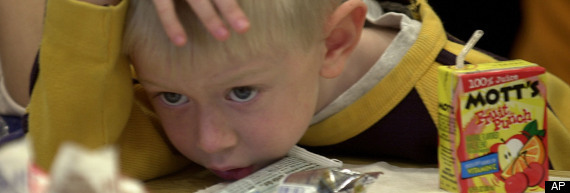
This defines the Moral Bankruptcy of a Nation!

It's a fair question.
 | |
|
 |
We were homeless.
My mom. My big sister and me. We slept in the car. . . We went to IHOP and we only got one pancake and we shared it. That was our breakfast... When I was tired of sitting in the car, I would talk to my mom. She would always say a prayer so we could have a better life. We should buy kids good food when they are homeless. We should help them out.
-- Jasmine, age 7
|
|
There are six people in our
family.
But only five sit down to dinner. That’s because my mom doesn’t eat. She wants to make sure we have enough food. |
|


![Please like this page ➳ @[540176322666035:274:- Police the Police -]
☞ Americans Killed by Cops Now Outnumber Americans Killed in Iraq War ▶▷ Read more HERE: http://bit.ly/1ecCQ0Y
☞ US Citizens: 29 Times More Likely to be Killed by Police Than Terrorists ▶▷ Read more HERE: http://bit.ly/1dwiBdm](https://scontent-b-iad.xx.fbcdn.net/hphotos-prn1/t1/p320x320/1619111_10152148626853189_1934567475_n.jpg)


Jason Olsen, a Salt Lake City District spokesman, said the district’s child-nutrition department became aware that Uintah had a large number of students who owed money for lunches.
As a result, the child-nutrition manager visited the school and decided to withhold lunches to deal with the issue, he said.
But cafeteria workers weren’t able to see which children owed money until they had already received lunches, Olsen explained.
The workers then took those lunches from the students and threw them away, he said, because once food is served to one student it can’t be served to another.


"SNAP eligibility rules require that participants be at or below 130% of the Federal Poverty Level. Recent studies show that 49% of all SNAP participants are children (age 18 or younger), with almost two-thirds of SNAP children living in single-parent households. In total, 76% of SNAP benefits go towards households with children, 16% go to households with disabled persons, and 9% go to households with senior citizens.2. Is it true that most food stamp payments are being abused? Actually, no:
According to demographic data, 43% of SNAP participants are white, 33% are African-American, 19% are Hispanic, 2% are Asian, and 2% are Native American."
"According to a recent USDA analysis, SNAP reached a payment accuracy of 96.19% in 2012 (the highest that the program has ever seen). Trafficking rates—the number of benefits exchanged for cash—are at 1%. There is always room for improvement, but the integrity of the SNAP program is currently functioning at the highest level it has ever seen."3. Food stamps are actually keeping people out of poverty:
"In addition to keeping some people out of poverty, SNAP also made tens of millions of people less poor in 2012. For these individuals, the program reduced the gap between their income and the poverty line and made them better able to afford a basic diet.4. People aren't living the "high-life" like the GOP claim:
SNAP is highly effective in reducing the extent and depth of poverty and reducing hunger, but millions of Americans still struggle to afford food. Data released earlier this month by the U.S. Department of Agriculture showed that 17.6 million American households lacked access to adequate food at some point in 2012 because they didn't have enough money or other resources to meet their basic food needs."

For more on how food stamps benefit Americans, check out this Center for American Progress and Half in Ten infographicProverbs 14:31 - “He who oppresses the poor shows contempt for their Maker, but whoever is kind to the needy honors God.” Proverbs 22:16 - “He who oppresses the poor to increase his wealth and he who gives gifts to the rich – both come to poverty.” Proverbs 29:7 - “The righteous care about justice for the poor, but the wicked have no such concern.”

At the Capital Area Food Bank, a 100,000-square-foot warehouse facility—a kind of Sam’s Club for food pantries in the metro Washington area—officials say food-stamp funds typically last recipients two and a half weeks. After the benefits run out, many go to food pantries to help make ends meet, according to the Food Bank’s Brian Banks.Republicans like to talk about SNAP as being plagued by fraud (even though its fraud rates are vanishingly low) and, even with unemployment high and the minimum wage so low that many who work still qualify for food stamps, to stigmatize recipients. They like to pretend its easy to live on a food stamp budget. But in reality, this is an economy where too many are unemployed or stuck in part-time work when they want full-time work. It's an economy where you can work full-time at minimum wage and still be poor, still need food assistance. And SNAP benefits can be the difference between having some fruits and vegetables occasionally and eating nothing but processed foods. For instance, for one family first displaced by Hurricane Katrina, then left without work by the BP spill:
With the program’s help, her daughters Michelle, 17, and Denise, 15, ate fresh fruits and vegetables for snacks, and Elizabeth could make everyone’s favorites for dinner, albeit on a budget: spaghetti for Kenny Robert, roast for Michelle, and “anything you put on a plate” for Denise. Without the assistance, “we just learned how to eat hot dogs and biscuits and called them pigs-in-a-blanket,” she said.
 Too many Americans are still going hungry. Proven programs that help are still not helping as much as they should.