Horrifying! And we're paying the costs!
Aviva Shen
Published: Sunday 13 October 2013
The outbreak has sickened at least 300 people in 17 states, and 42 percent of the victims have been hospitalized.
As an especially vicious
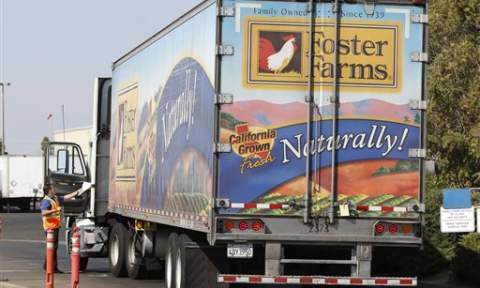
salmonella outbreak sickens hundreds across the country, U.S. Department of Agriculture regulators have declined to crack down on the poultry processing plants that spread the pathogen. On Monday, the USDA threatened to close the California-based Foster Farms facilities, but decided to
keep the plant open under scrutiny on Thursday night after Foster Farms submitted a plan for “immediate substantive changes to their slaughter and processing to allow for continued operations.”
The outbreak has sickened at least 300 people in 17 states, and 42 percent of the victims have been hospitalized — twice the normal hospitalization rate for salmonella. Yet neither state nor federal regulators have issued a recall order, stating the chicken is safe if
fully cooked.
Industry publication Meating place
interviewed Daniel Engeljohn, a USDA Food Safety and Inspection Service official, about the decision to keep the infected meat on the shelves. Engeljohn pointed to a federal court decision in 2001 that crippled the USDA’s ability to take meaningful action against meat processors that violate food safety standards. The notoriously conservative Fifth Circuit Court of Appeals ruled that the USDA did not have the authority to shut down Supreme Beef, a meat processing plant that
repeatedly flunked tests for salmonella contamination. The justification for this ruling was that the meat was safe if it was cooked properly. Thanks to this decision, the USDA has only the power to ask the company at fault to recall their products voluntarily.
Left toothless against dangerous meat operations, the USDA has instead launched
several public health campaigns to teach people how to cook the
almost-certainly pathogen-riddled meat without getting sick. Companies face no incentive to change sketchy food safety practices — but warnings to cook meat fully, use a meat thermometer, and wash any dishes that have come into contact with raw meat have become the new norm for American meat consumers.
The latest outbreak is a stark example of this dynamic. Foster Farms’
official statement asks consumers to see their tainted chicken as a learning experience: “The alert that regulators issued based on illnesses over the past seven months emphasizes the need to fully cook and properly handle raw poultry.”
Similarly, the California Department of Public Health has
asked consumers to take on the risk rather than ask Foster Farms for a recall that would cost the company millions: “The CDPH has not requested Foster Farms to recall chickens because, with proper handling and preparation, this product is safe for consumption…Provided that consumers do not cross-contaminate fully cooked chicken with raw chicken juices, it is safe to consume.”
Meanwhile, the poultry industry lobbied for drastically weakened poultry inspection rules. The USDA’s proposed poultry plant rule
replaces federal food inspectors with internal inspectors who work for the company, and speeds up the assembly line so that inspectors will only have
a third of a second to examine each chicken. Inspectors in test plants said they observed many poultry plant employees ignoring birds covered in fecal matter, and were reprimanded if they tried to remove diseased birds, and the U.S. Government Accountability Office found that the USDA’s justification for this rule was based on
inaccurate and antiquated data.
http://www.nationofchange.org/why-usda-isn-t-recalling-salmonella-contaminated-chicken-s-sickening-hundreds-1381673772


