Search This Blog

Translate

Blog Archive

Middleboro Review 2

NEW CONTENT MOVED TO MIDDLEBORO REVIEW 2

Toyota

Since the Dilly, Dally, Delay & Stall Law Firms are adding their billable hours, the Toyota U.S.A. and Route 44 Toyota posts have been separated here:

Route 44 Toyota Sold Me A Lemon


Showing posts with label debt crisis. Show all posts

Tuesday, April 10, 2018

The Post Most: Syria says strike on military base carried out by Israeli warplanes


The Post Most: Syria says strike on military base carried out by Israeli warplanes


MORE TRUMP LIES! NO OTHER PRESIDENT HAD TO BE FACT CHECKED.
Fact Checker • Analysis
Two Trump speeches, two dozen dubious claims
The president seems to enjoy going off-script, and perhaps as a result, we have a lot to unpack.
By Salvador Rizzo  •  Read more »

FOX NEWS = FAKE NEWS - ARE VIEWERS FINALLY FIGURING IT OUT?

Fox News mistakenly posts graphic showing it lags in trust
Fox News inadvertently posted a graphic showing it lagged other cable news networks in trustworthiness.
By Associated Press  •  Read more »


CLICK ON LINK FOR MORE OR SUBSCRIBE FOR YOURSELF


Wednesday, February 12, 2014

The Hostage is Free!


The Progress Report Banner

The Hostage is Free!


Feb 11, 2014 | By CAP Action War Room

Debt Limit Games Are Over


For nearly three years now, Republicans have been periodically taking the entire U.S. economy hostage and threatening a catastrophic default on our obligations in an attempt to extract various unpopular policy concessions and draconian cuts to Medicare, Social Security, and other vital programs from Democrats.

After a months-long debacle in 2011, President Obama agreed to a deal with the Republicans that ultimately resulted in the sequester kicking in after Republicans refused to agree to a balanced package of cuts and new revenues from the wealthy and corporations. That 2011 showdown dealt a deep blow to our economy just when the recovery was taking hold.

No more and never again.

In late 2012, during yet another budget crisis manufactured by Republicans, President Obama declared that he would never again negotiate on the debt ceiling because Congress needs to pay the bills it already racked up. Period. End of story.

What happened between then and now? President Obama didn’t negotiate on the debt limit ever again and Republicans caved and raised the debt limit twice with no significant concessions from Democrats.

Today, after a half-hearted attempt to pair a debt limit increase with a minor policy item (that Democrats and President Obama also support), Speaker Boehner announced that there was not enough support among Republicans (aka the Default Caucus) to pass such a bill. Instead, he would allow a debt limit increase with no strings attached to pass with almost exclusively Democratic votes. The New York Times correctly called this move a “complete capitulation” by Republicans.

The hostage is now free, forever.

Since Republicans also recently agreed to a two-year budget deal and partial repeal of the sequester, it means that their government shutdown games are also over for the foreseeable future.

BOTTOM LINE: The era of careening from manufactured crisis to manufactured crisis is over. Now it’s time for Republicans to join Democrats and progressives and focus on creating greater opportunities for all Americans by voting to raise the minimum wage, funding early childhood education, supporting equal pay for women, and backing other policies that will help create an economy that works for everyone, not just the wealthy few.

Sunday, December 8, 2013

Time for a Progressive Budget Plan

Wonder how long folks will continue to blindly follow Failed Economic Policy promoted by Republicans?
Sign Sen. Sanders' petition to support a progressive budget plan: http://www.sanders.senate.gov/budget/


Sign Sen. Sanders' petition to support a progressive budget plan: http://www.sanders.senate.gov/budget/


Saturday, October 19, 2013

The Abject Failure of Reaganomics

Although economics for many is uninteresting, without understanding what caused the current climate, we are destined to fall for the false promises of the Tea Party.

Food for thought......

The Abject Failure of Reaganomics

October 17, 2013
Exclusive: House Republicans got next to nothing from their extortion strategy of taking the government and the economy hostage, but they are sure to continue obstructing programs that could create jobs and start rebuilding the middle class. What they won’t recognize is the abject failure of Reaganomics, writes Robert Parry.

By Robert Parry

Even as the Republican Right licks its wounds after taking a public-opinion beating over its government shutdown and threatened credit default, the Tea Partiers keep promoting a false narrative on why the U.S. debt has ballooned and why the economy struggles, a storyline that will surely influence the next phase of this American political crisis.

If a large segment of the American public continues to buy into the Tea Party’s fake reality, then it is likely that both the political damage and the economic decline will continue apace, with fewer good-paying jobs, a shrinking middle class and more of the bitter alienation that has fed the Tea Party’s growth in the first place. In other words, the United States will remain in a vicious circle that is also a downward spiral.
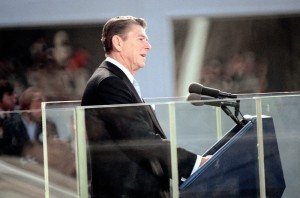
President Ronald Reagan, delivering his Inaugural Address on Jan. 20, 1981.

The pattern can only be reversed if American voters come to understand how and why their economic well-being is getting flushed down the drain.

The first point to understand is that the current $16.7 trillion federal debt is about $11 trillion more than it was when George W. Bush took office. Not only did Bush’s tax-cut-and-war-spending policies send the debt soaring over the next dozen years but it was those policies that eliminated the federal surpluses of Bill Clinton’s final years and reversed a downward trend in the debt that had “threatened” to eliminate the debt entirely over the ensuing decade.

Amazingly, President Clinton left office in January 2001 with the federal budget in the black by $236 billion and with a projected 10-year budget surplus of $5.6 trillion. The budgetary trend lines were such that Federal Reserve Chairman Alan Greenspan began to fret about the challenges the Fed might face in influencing interest rates if the entire U.S. government debt were paid off, thus leaving no debt obligations to sell.

Thus, Greenspan, an Ayn Rand acolyte who was first appointed by Ronald Reagan, threw his considerable prestige behind George W. Bush’s plan for massive tax cuts that would primarily benefit the wealthy. In that way, Bush and the Republicans “solved” the “problem” of completely paying off the federal debt.

When Bush left office in January 2009 – amid a meltdown of an under-regulated Wall Street – there was no more talk about a debt-free government. Indeed, the debt had soared to $10.6 trillion and was trending rapidly higher as the government scrambled to avert a financial catastrophe that could have brought on another Great Depression.

Reaganomics’ Failure

But this debt crisis did not originate with George W. Bush. It can be traced back primarily to President Reagan, who arrived in the White House in 1981 with fanciful notions about restoring America’s economic vitality through massive tax cuts for the wealthy, a strategy called “supply-side” by its admirers and “trickle-down” by its critics.

Reagan’s tax cuts brought a rapid ballooning of the federal debt, which was $934 billion in January 1981 when Reagan took office. When he departed in January 1989, the debt had jumped to $2.7 trillion, a three-fold increase. And the consequences of Reagan’s reckless tax-cutting continued to build under his successor, George H.W. Bush, who left office in January 1993 with a national debt of $4.2 trillion, more than a four-fold increase since the arrival of Republican-dominated governance in 1981.

During 1993, Clinton’s first year in office, the new Democratic administration pushed through tax increases, partially reversing the massive tax cuts implemented under Reagan. Finally, the debt problem began to stabilize, with the total debt at $5.7 trillion and heading downward, when Clinton left office in January 2001.

Indeed, at the time of Clinton’s departure, the projected ten-year surplus of $5.6 trillion meant that virtually the entire federal debt would be retired. That was what Fed Chairman Greenspan found worrisome enough to support George W. Bush’s new round of tax cuts aimed primarily at the wealthy, another dose of Reagan’s “supply-side.”

The consequences – especially when combined with Bush’s decision to rush into two major wars without paying for them – proved disastrous. The federal debt resumed its upward climb. By August 2008, just before the Wall Street crash, the debt was over $9.6 trillion, nearly a $4 trillion jump since Bush took office.

And, after the Wall Street collapse in September 2008, the federal government had little choice but to increase its borrowing even more to avert a global economic catastrophe potentially worse than the Great Depression. By January 2009, just five months later, the debt was $10.6 trillion, a $1 trillion increase and counting.

Many of the Republican leaders who stomped their feet during the recent budget showdown, including House Speaker John Boehner, R-Ohio, were among those who favored the Bush tax cuts, the costly invasion of Iraq and bank deregulation. In other words, they were denouncing President Obama for a debt crisis that they helped create.

But the record of reckless Republican budget policies from Reagan through Bush-43 was not only destructive to the fiscal health of the government. The “supply-side,” “free-trade” and deregulatory strategies – including some facilitated by the Clinton administration – proved devastating to the nation’s ability to create good-paying jobs and to sustain the Great American Middle Class.

Zero Job Growth

During the decade of George W. Bush’s presidency, the United States experienced zero job growth.

And zero is actually worse than it sounds since none of the preceding six decades registered job growth of less than 20 percent.

By comparison, the 1970s, which are often bemoaned as a time of economic stagflation and political malaise, registered a 27 percent increase in jobs. Yet, in part because of that relatively slow rise in jobs – down from 31 percent in the 1960s – American voters turned to Ronald Reagan and his radical economic theories of tax cuts, global “free markets” and deregulation.

Reagan sold Americans on his core vision: “Government is not the solution to our problem; government is the problem.” Through his personal magnetism, Reagan then turned taxes into a third rail of American politics. He convinced many voters that the government’s only important roles were funding the military and cutting taxes.

Yet, instead of guiding the country into a bright new day of economic vitality, Reagan’s approach accelerated a de-industrialization of the United States and a slump in the growth of American jobs, down to 20 percent during the 1980s. The percentage job increase for the 1990s stayed at 20 percent, although job growth did pick up later in the decade under President Clinton, who raised taxes and moderated some of Reagan’s approaches while still pushing “free trade” agreements and deregulation.

Yet, hard-line Reaganomics returned with a vengeance under George W. Bush – more tax cuts, more faith in “free trade,” more deregulation – and the Great American Job Engine finally started grinding to a halt. Zero percent increase. The Great American Middle Class was on life-support.

Ignoring Reality

Despite these painful statistics of the past three decades, Reaganomics has remained a powerful force in American political life. Anyone tuning in CNBC or picking up the Wall Street Journal would think that these economic policies had enjoyed unqualified success for everyone, rather than being a dismal failure for all but the richest Americans. The facts were especially stark for the 2000s, the so-called “Aughts” or perhaps more accurately the “Naughts.”

“For most of the past 70 years, the U.S. economy has grown at a steady clip, generating perpetually higher incomes and wealth for American households,” wrote the Washington Post’s Neil Irwin in a Jan. 2, 2010, review of comparative economic data. “But since 2000, the story is starkly different.”

As the Post article and its accompanying graphs showed, the last decade’s sad story wasn’t just limited to the abysmal job numbers. U.S. economic output slowed to its worst pace since the 1930s, rising only 17.8 percent in the 2000s, less than half the 38.1 percent increase in the despised 1970s.

Household net worth declined 4 percent in the last decade, compared to a 28 percent rise in the 1970s. (All figures were adjusted for inflation.)


Despite this record of economic failure from Bush’s reprise of Reaganomics – trillions more in government debt but no net increase in jobs or household wealth in the last decade – many Americans appear to have learned no lessons from either the Bush-43 presidency or Reagan’s destructive legacy.

Any thought of raising taxes or investing in a stronger domestic infrastructure remains anathema to significant segments of the population still enthralled by the Tea Party.

Indeed, across the mainstream U.S. news media, it is hard to find any serious – or sustained – criticism of the Reagan/Bush economic theories. More generally, there is headshaking about the size of the debt and talk about the need to slash “entitlement” programs like Social Security and Medicare.

Instead of paying heed to the real lessons of the past three decades, many Americans are trapped in the Reagan/Tea Party narrative and thus repeating the same mistakes.

‘Voodoo Economics’

The U.S. political/media process seems resistant to the one of most obvious lessons of the past three decades: Simply put, Reaganomics didn’t work. As George H.W. Bush once commented – when he was running against Reagan in the 1980 primaries – it is “voodoo economics.”

Yet, the fact that the United States has embraced “voodoo economics” for much of the past three-plus decades and refuses to recognize the statistical evidence of Reaganomics’ abject failure suggests that the larger lesson of this era is that the U.S. political process is dysfunctional, a point driven home by the recent Tea Party-led government shutdown and threatened debt default.

In the decades that followed Reagan’s 1980 election, the Right has invested ever more heavily in media outlets, think tanks and attack groups that, collectively, changed the American political landscape. Because of Reagan’s sweeping tax cuts favoring the rich, right-wing billionaires, like the Koch Brothers and Richard Mellon Scaife, also had much more money to reinvest in the political/media process, including funding the faux-populist Tea Party.

That advantage was further exaggerated by the Left’s parallel failure to invest in its own media at anything close to the Right’s tens of billions of dollars. Thus, the Right’s outreach to average Americans has won over millions of middle-class voters to the Republican banner, even as the GOP enacted policies that devastated the middle class and concentrated the nation’s wealth at the top.

So, even as American workers struggled in the face of globalization and suffered under GOP hostility toward unions, the Right convinced many middle-class whites, in particular, that their real enemy was “big guv-mint.”

Though Obama won the presidency in 2008, the Republicans didn’t change their long-running strategy of using their media assets to portray the Democrats as un-American. The Right waged a relentless assault on Obama’s legitimacy (spreading rumors that he was born in Kenya, he was a secret socialist, he was a Muslim, etc.) while a solid wall of Republican opposition greeted his plans for addressing the national economic crisis that he inherited.

The Rise of the Tea Party

Like previous Democrats, Obama initially responded by offering olive branches across the aisle, but again and again, they were slapped down. In mid-2009, Obama wasted valuable time trying to woo supposed Republican “moderates” like Sen. Olympia Snowe of Maine to support health-care reform.

Meanwhile, Republicans filibustered endlessly in the Senate and whipped their right-wing “base” into angrier and angrier mobs.

Initially, the GOP strategy proved successful, as Republicans pummeled Democrats for increasing the debt with a $787 billion stimulus package to stanch the economic bleeding. The continued loss of jobs enabled the Republicans to paint the stimulus as a “failure.” There was also Obama’s confusing health-care law that pleased neither the Right nor the Left.

The foul mood of the nation translated into an angry Tea Party movement and Republican victories in the House and in many statehouses around the country. Gradually, however, a stabilized financial structure and a slow-healing economy began to generate jobs, albeit often with lower pay.

Obama could boast about sufficient progress to justify his reelection in 2012, with most voters also favoring Democrats for the Senate and the House. However, aggressive Republican gerrymandering of congressional districts helped the GOP retain a slim majority in the House despite losing the popular vote by around 1½ million ballots.

But the just-finished budget/debt showdown has shown that the Tea Party’s fight over America’s political/economic future is far from over. Through its ideological media and think tanks, the Right continues to hammer home the Reagan-esque theory that “government is the problem.”

Meanwhile, the Left still lacks comparable media resources to remind U.S. voters that it was the federal government that essentially created the Great American Middle Class – from the New Deal policies of the 1930s through other reforms of the 1940s, 1950s and 1960s, from Social Security to Wall Street regulation to labor rights to the GI Bill to the Interstate Highway System to the space program’s technological advances to Medicare and Medicaid to the minimum wage to civil rights.

Many Americans don’t like to admit it — they prefer to think of their families as reaching the middle class without government help — but the reality is that the Great American Middle Class was a phenomenon made possible by the intervention of the federal government beginning with Franklin Roosevelt and continuing into the 1970s. [For one telling example of this reality -- the Cheney family, which was lifted out of poverty by FDR's policies -- see Consortiumnews.com's "Dick Cheney: Son of the New Deal."]

Further, in the face of corporate globalization and business technology, two other forces making the middle-class work force increasingly obsolete, the only hope for a revival of the Great American Middle Class is for the government to increase taxes on the rich, the ones who have gained the most from cheap foreign labor and advances in computer technology, in order to fund projects to build and strengthen the nation, from infrastructure to education to research and development to care for the sick and elderly to environmental protections.

In other words, the only strategy that makes sense for the average American is to reject the theories of Ronald Reagan and the Right. Rather than seeing the government as “the problem” and higher taxes on the rich as “bad,” the American people must come to understand that, to a great extent, government has to be a big part of the solution.

Investigative reporter Robert Parry broke many of the Iran-Contra stories for The Associated Press and Newsweek in the 1980s. You can buy his new book, America’s Stolen Narrative, either in print here or as an e-book (from Amazon and barnesandnoble.com). For a limited time, you also can order Robert Parry’s trilogy on the Bush Family and its connections to various right-wing operatives for only $34. The trilogy includes America’s Stolen Narrative. For details on this offer, click here.

http://consortiumnews.com/2013/10/17/the-abject-failure-of-reaganomics/


Saturday, October 12, 2013

Democrats Must Stop Ted Cruz's Hollywood Ending

Love it!


Democrats Must Stop Ted Cruz's Hollywood Ending

POSTED:


Senator Ted Cruz

Senator Ted Cruz


Having lived in the former Soviet Union for 10 years, I will forever have plastered to the back of my cerebellum the commemorative bumper sticker: "WWSD?"

What Would Stalin Do? It's a useful question to ask sometimes, because it offers valuable perspective. What would Stalin have done with Britney Spears? Have her declared a People's Artist of the Soviet Union, with the Leningrad-Murmansk train line named after her. Dan Dierdorf would have been made Secretary of the Sverdlovsk Region. Shepard Smith would probably get to head up the Press Ministry to start, then maybe work his way up to Foreign Affairs. It's hard not to look at the American cultural landscape and see all sorts of people the old seminarian would really have liked.

But the main reason I'm thinking of this now is the debt ceiling/government shutdown issue. How would Stalin have handled all of this? Reflexively, I can't help but wonder.

I'm guessing he would have taken Tea Party Sen. Ted Cruz's caucus members, loaded them onto cattle cars, and relocated them to a piece of woodsy wilderness in Alaska's Chugach National Forest. Once there, guards would have handed saws and hammers to the esteemed legislators (still dressed in suits and heels – no wasteful government spending on parkas!) and instructed them to build new congressional "branch offices" out of the still-living trees surrounding them. Always conscious of cost, Stalin preferred, whenever possible, to relocate pesky populations to remote deserts and taigas rather than waste bullets liquidating them. Tea Party congresspersons would naturally be one of the first nationalities moved.

Leaders of movements were a different matter. Of those, one had to make very public examples. In this instance, with Cruz and company, Old Koba would likely go the "Kirov's Assassins" route. First, he'd have someone like Ted Yoho bite an exploding apple during a live CNBC broadcast. Then he'd immediately send Eric Holder out for a massive impromptu press conference in which the White House, furious over the loss of so great a patriot, would announce a sweeping, coast-to-coast search for Yoho's killers.

Eventually, the chief suspects would be arrested, and they would be everyone you would expect – the Koch Brothers, Rand Paul and of course Cruz himself, who, weeping and begging for forgiveness, would confess in lurid detail to the crime in a live televised trial. He got Michelle Bachmann to design the exploding apple! They conspired to have it delivered on-set by Maria Bartiromo! And they all removed Yoho out of jealousy (he was getting too much ink for out-dumbing the field, saying a default would "bring stability to world markets")!

Not making any value judgments at all, but that's what Stalin would do. What is Barack Obama doing? Well, something much less than that. Much, much less, to the point where it's getting a little weird.

The Obama White House has rightly refused to negotiate with the Cruz-ians, but there's still a strange lack of urgency in some of the administration's public statements, and that lack of urgency is beginning to draw notice. Kevin Drum the other day wrote about Jack Lew's muted, yawning refusal to predict a catastrophe if we do default on Meet the Press last weekend:

Administration officials have a fine line to walk, trying to make sure they have well and truly warned everyone about how disastrous a debt ceiling breach would be, but at the same time not sending markets into a tailspin unnecessarily. I'm not sure what the answer is, but… Lew pushed the balance a little too far into yawn inducing territory yesterday. He needs to be clearer about what exactly would happen once we finally get to the day when we can't pay our bills.

Here's the problem with this entire situation. Every minute that Cruz presses forward sinks the Republicans into a deeper political hole, and the Democrats know this. Despite the seemingly impenetrable advantage the Republicans have gained through gerrymandering over the years (retaining their House majority in 2012 despite a two million-plus popular vote deficit), the party is now in serious danger of losing the House in 2014. Moreover, the shutdown debate has caused a massive schism within the Republican ranks, one symbolized by the open verbal combat that reportedly broke out between Cruz and other, less lunatic GOP Senators last week when the "reality caucus" discovered that Cruz had no exit strategy for this blow-it-all-to-hell stunt he's pulling.

That schism is also setting the party up for almost certain failure in the 2016 presidential race. Cruz's gambit – it sounds like a chess opening, doesn't it? Only one that begins with white snapping its king in half and throwing the pieces across the room – is galvanizing an unstoppable primary-season demographic that will trample anyone who tries to circumvent it on the way to the nomination.

One thing that gives solace is that Cruz himself, if he plans on being that nominee, must have some kind of plan here. If he pushes this too far, and we actually default, and millions of jobs are lost as most economists predict, he must know he'll have a hell of a time doing a whistlestop tour through the post-nuclear landscape he's going to leave behind in Middle America.

So one would think he's playing some kind of game, and that his real exit strategy is to be suddenly and ruthlessly defeated at the last minute by other mainstream Republican Quislings. Such a move would be at least half-smart. It would make him a supreme martyr within the party, and formalize his status as the de facto leader of this new Tea Party/Third Party movement that is devouring the old GOP like Streptococcus pyogenes.

On the other hand, if Cruz really is as dumb as he seems to be, and thinks that delivering on his crazy promise to bring the whole grid down is actually in America's best interests, then we're about to witness a radical reshaping of the political landscape. Because if we default and it causes anything like the worldwide financial catastrophe many serious economists expect, the Cruz demographic will be routed and the Republican Party will be forced to rebuild from scratch.

The modern Democrats may be morally suspect cynics who have failed the country on issue after issue, from the NSA to torture abroad to their refusal to fight corruption in the financial markets. But politically, they are not stupid. They surely see that there is no immediate political downside to letting Cruz play this out. Polls show the Republican Party approval rating has already dropped ten points, from 38 percent to an all-time low of 28 percent, and will only go lower from here unless disaster is avoided.

But the Democrats have to be big enough to resist the temptation to let the Republicans destroy themselves. They should be bringing every conceivable kind of pressure to save Cruz from himself and educate the public about the dramatic consequences of a default.

The 2008 crash was triggered by the failure of one investment bank, Lehman Brothers, and when that bank collapsed, the world discovered that it was now so interconnected financially that one significant and unexpected failure could start a nuclear chain-reaction of losses. The Lehman impact stunned everyone. The average American family lost 18 percent of its wealth within months. The stock market lost half its value. The repo market collapsed, freezing economic activity and leading to massive declines in asset prices. Unemployment soared past 10 percent almost instantly.

And that was just one bank failure. Can one imagine the consequences of the failure of the United States? The $12 trillion in outstanding government debt is 23 times bigger than the $517 billion Lehman owed when it went under in September 2008. In every way that Lehman's failure played havoc with the economy, the failure of U.S. debt would repeat the disaster, only it would do it on an almost inconceivably huger scale.

The entire world financial system revolves around the notion that the U.S. will never default, because under normal, rational circumstances, it can't. (It can always print enough money to meet its obligations, as even Alan Greenspan conceded two years ago.) Before this latest political madness, no one could ever have conceived of a sovereign state intentionally defaulting. But we're, like, a week away from this happening, and where's the emergency mobilization?

I'm not saying that this is the case, but one wonders whether the Democrats have made a miscalculation here, based upon their own narrow, transactional, materialistic view of politics. The Democrats may be sitting back just a little bit, content to let this felicitous political situation develop just a little longer, perhaps (and I have no proof of this) convinced that the other party will come to its senses and stand down at the last minute.

But Cruz and his people are something we never see in Washington – believers. His caucus is not doing this for Redskins tickets and PAC money. They're going for the Thelma and Louise ending.

One last tender moment, holding hands and all. I have no idea what the Democrats can do to stop them, but we better hope they're trying everything, and not seeing a huge future political win as their ace card.


Read more: http://www.rollingstone.com/politics/blogs/taibblog/democrats-must-stop-ted-cruzs-hollywood-ending-20131011#ixzz2hX7CUQSw
Follow us: @rollingstone on Twitter | RollingStone on Facebook


Monday, September 30, 2013

Rock Bottom

The Republican Party used to stand for something.


The Progress Report Banner

Rock Bottom


By CAP Action War Room on September 30, 2013 at 6:20 pm

GOP Prepares to Take Us Over the Brink

In just a few hours the federal government will shut down for the first time in 17 years unless House Republicans stop wasting time on anti-Obamacare ransom notes and instead agree to a real compromise — a short-term funding bill at sequester spending levels — that will keep the government open.

Unfortunately, Republicans appear to care far more about more dead-end votes on Obamacare than about avoiding a damaging government shutdown.

Late Saturday, the House passed a measure that demanded a one-year halt to Obamacare in return for keeping the government open for just over two months. It also included a repugnant attack on women’s access to affordable birth control that would allow employers to deny birth control coverage to their female employees.

The Senate rejected this ransom note earlier this afternoon, but it appears that House Republicans are simply readying another equally unacceptable anti-Obamacare measure instead of a serious bill to keep the government open.

Sadly, we don’t have to wait for midnight to come to understand how damaging a government shutdown will be. Republican brinksmanship is already hurting the economy, just as it did during their manufactured debt limit crisis in 2011.

The New York Times reported today that “stock markets fell worldwide on Monday as political disagreements in Washington made a shutdown on Monday night increasingly likely.” “Investors are worried that even a temporary government shutdown could endanger an already weak economic recovery,” the Times added.

The Business Roundtable, a group representing corporate CEOs,surveyed its members and found that “half of top executives said the budget fights were crimping their hiring plans.”
The worst for the economy is of course yet to come:
  • A shutdown lasting three-to-four weeks could directly cost the government more than $2 BILLION, not including billions in more in costs to the economy thanks to plunging confidence among consumers and investors. Indeed, a shutdown could cost the economy $10 BILLION per week.
  • A government shutdown along with threats of an unprecedented default on our obligations, which Republicans are also threatening, is “corrosive on the economy,” according to Mark Zandi, chief economist of Moody’s Analytics. Moody’s estimates that a shutdown lasting three-to-four weeks could slash economic growth by as much as 1.4 percentage points.
  • The Washington Post notes that a shutdown lasting longer than a week “would suck money out of the economy and spread anxiety among consumers and businesses in a way that is likely to hold back economic activity.”

  • Fears over the impact to the economy led the GOP-leaning U.S. Chamber of Commerce and more than 230 other business groups to write to lawmakers last week “urging them to keep the government open.”
    Shutting down the government tonight will kneecap the economy and hurt millions of Americans, but ironically it will do nothing to actually stop Obamacare. Indeed, tomorrow marks the opening of insurance marketplaces that will allow millions of Americans, many of whom are currently insured or who have never had insurance, to shop for a quality, affordable health plan.
    “An important part of the Affordable Care Act takes effect tomorrow no matter what Congress decides to do today,” said President Obama late this afternoon. “The Affordable Care Act is moving forward. That funding is already in place. You can’t shut it down. ”
    Given the Republicans’ spiteful fixation on denying health care to millions of Americans, it’s no wonder that a poll out today found that the approval rating of Congress has dropped to just 10 percent — an all-time low. Other recent polls have found overwhelming disapproval for the GOP and its actions:
  • Just 7 percent of Americans back the GOP’s plan to delay and defund Obamacare. And less than one-third of Americans (26 percent) support the GOP’s ultimate and oft-stated goal of completely repealing Obamacare.
  • A whopping 68 percent of Americans want the law to move forward as is or with improvements.
  • More than two-thirds of Americans (68 percent) agree that shutting down the government for even a few days is “a bad thing for the country.”
  • Six in ten Americans also agree that it is more important for Congress to avoid shutting down the government than preventing Obamacare from moving forward.
  • An overwhelming 80 percent of Americans agree that threatening a government shutdown is not an acceptable way to negotiate.
  • Just 19 percent of Americans believe that it’s worth shutting down the government in order to defund Obamacare. That means that about half of the small minority of Americans who actually favor defunding Obamacare still oppose shutting down the government in order to do so.
  • More than two-thirds of Americans (69 percent) say Republicans in Congress “have acted mostly like spoiled children during the recent debate over the federal budget.”
  • Another poll found that just 26 percent of Americans approve of how Republicans in Congress have handled negotiations over the federal budget.

  • It’s also no wonder then that if the government shuts down tonight, the public will, correctly, blame Republicans. One poll out today found that a majority of Americans (51 percent) say they will blame Republicans in Congress “a lot” if the government shuts down, which is consistent with the findings of other recent polls.BOTTOM LINE: It’s sadly once again clear that Republicans will do anything — including shutting down the government and sabotaging the economy — in order to stop millions of Americans from gaining the security of quality, affordable health care.

    http://thinkprogress.org/progress-report/rock-bottom/


    Thursday, October 11, 2012

    Debt Crisis


    Paul Ryan: Mitt Romney is uniquely qualified.....

    Oh? Does anyone remember what Romney did in Massachusetts? Empty suit!