Showing posts with label endless wars. Show all posts
Showing posts with label endless wars. Show all posts
Saturday, January 18, 2020


Tuesday, January 7, 2020
FOCUS: As Sanders and Warren Vow to Block War With Iran, Biden and Buttigieg Offer Better-Run Wars

06 January 20
FOCUS: As Sanders and Warren Vow to Block War With Iran, Biden and Buttigieg Offer Better-Run Wars

Robert Mackey, The Intercept
Mackey writes: "Sens. Bernie Sanders and Elizabeth Warren described the drone strike ordered by Trump as a dangerous escalation and promised to end American wars in the Middle East."
Robert Mackey, The Intercept
Mackey writes: "Sens. Bernie Sanders and Elizabeth Warren described the drone strike ordered by Trump as a dangerous escalation and promised to end American wars in the Middle East."
 he legacy of the Iraq war, and the prospect of a bloody sequel sparked by Donald Trump’s assassination of a senior Iranian official in Baghdad this week, has the potential to transform the Democratic presidential primary, offering voters radically different visions of how the next commander in chief proposes to deal with the ongoing chaos caused by the 2003 invasion.
Sens. Bernie Sanders and Elizabeth Warren described the drone strike ordered by Trump as a dangerous escalation and promised to end American wars in the Middle East. Joe Biden, the former vice president, and Pete Buttigieg, the former mayor of South Bend, Indiana, offered more muted criticism, suggesting that the killing of Maj. Gen. Qassim Suleimani might have been justified if a more responsible commander in chief was in charge.
“We must do more than just stop war with Iran,” Sanders tweeted on Friday. “We must firmly commit to ending U.S. military presence in the Middle East in an orderly manner. We must end our involvement in the Saudi-led intervention in Yemen. We must bring our troops home from Afghanistan.”

Warren, who faced criticism from the left for initially prefacing her alarm at the threat of “another costly war” with the statement that Suleimani was “a murderer, responsible for the deaths of thousands, including hundreds of Americans,” amplified Sanders’s anti-war message more clearly on Friday. “Donald Trump is dangerous and reckless,” she wrote. “He’s escalated crises and betrayed our partners. He’s undermined our diplomatic relationships for his own personal, political gain. We cannot allow him to drag us back into another war. We must speak out.”
Biden also criticized the killing of the general as needlessly provocative, but issued a statement that embraced the Trump administration’s argument that Suleimani, who orchestrated deadly attacks on U.S. soldiers during the post-war occupation of Iraq, “deserved to be brought to justice for his crimes against American troops.” The former vice president — who voted to authorize the use of military force in Iraq when he was still in the Senate, and later authored a bizarre plan to partition the country along ethnic and sectarian lines — was critical mainly of what he called Trump’s failure to explain his “strategy and plan to keep safe our troops and embassy personnel” and Trump’s lack of a “long-term vision” for the U.S. military’s role in the region.
(Trump offered a glimpse of his addled vision on Saturday, threatening to strike 52 targets in Iran, including cultural sites, representing, he tweeted, “the 52 American hostages taken by Iran many years ago.”)
Buttigieg’s initial statement also endorsed Trump’s claim that killing an Iranian general who supported Iraqi militias that oppose the ongoing presence of U.S. troops in their country was in line with the commander in chief’s responsibility “to protect Americans and our national security interests.” “There is no question that Qassim Suleimani was a threat to that safety and security, and that he masterminded threats and attacks on Americans and our allies, leading to hundreds of deaths,” Buttigieg wrote. “But there are serious questions about how this decision was made and whether we are prepared for the consequences.”
Like Biden, and to a lesser extent Warren, Buttigieg seemed to glide past the contradictions inherent in describing the killing of 603 American troops in Iraq by Iraqis as a crime akin to terrorism, but of course those soldiers were only there because of the invasion Sanders has repeatedly called on the campaign trail “the worst foreign policy blunder in the modern history of the United States.”
“‘Yeah but what’s your strategy?’ is the safest, lamest, most DC criticism possible,” Sanders foreign policy adviser Matt Duss observed on Twitter. “Trump’s Iran policy is foolish, dangerous, and driven by hardline ideologues who’ve been pushing for war for years. Who cares what the strategy is for achieving it. The policy needs to change.”
If the ongoing calamity in Iraq does factor into the decisions of Democratic primary voters, it won’t be the first time.
Then-Sen. Hillary Clinton’s 2002 vote to authorize the invasion played a pivotal role in the 2008 Democratic primary, contrasting sharply with Barack Obama’s opposition, as a state senator at the time, to what he called, “A dumb war. A rash war. A war based not on reason but on passion, not on principle but on politics.”
Four years earlier, the capture of Saddam Hussein just one month before the 2004 Iowa caucuses had seemed to tilt the Democratic contest in the opposite direction. That year, as President George W. Bush’s approval rating surged 9 points following Hussein’s arrest, Iowa voters turned away from an insurgent critic of the war, Vermont Gov. Howard Dean, in favor of a more hawkish senator and decorated veteran, John Kerry, who was seen as more electable in wartime.
In the aftermath of Trump’s strike on Iran’s leading military figure, Biden and Buttigieg, egged on by conservative commentators, appear to be vying for the mantle of John Kerry 2.0 as each man argues that his prior experience with national security makes him the best alternative to Trump in the general election. On the campaign trail and in social media ads, Biden has stressed his foreign policy credentials and familiarity with the intricacies of Iran’s military capabilities.
Biden told voters in Iowa on Friday that he doubts Trump is capable of handling Iran’s likely retaliation.

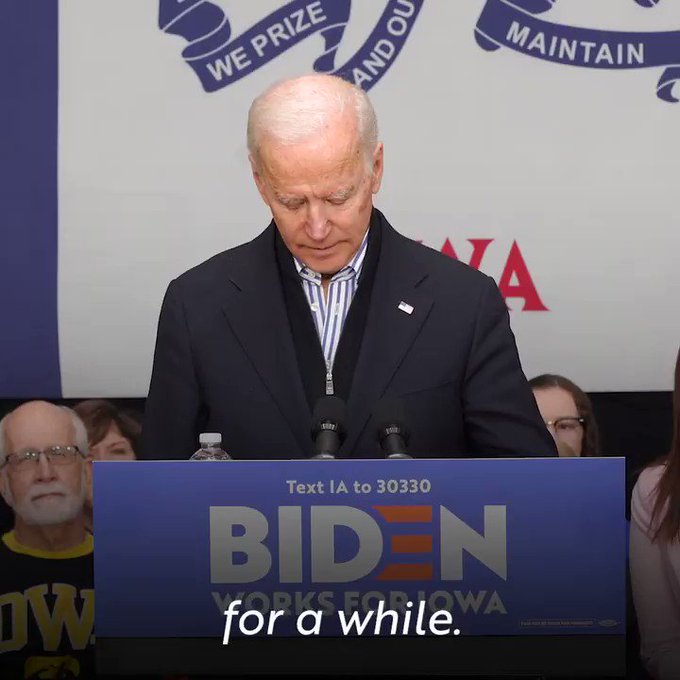
His campaign shared an ad on social networks in which Biden described himself as a prospective commander in chief who would be “ready on day one to pick up the pieces of Donald Trump’s broken foreign policy and repair the damage he has caused around the world.”
Buttigieg also suggested that he would be better equipped to prosecute American wars than Trump, telling voters in New Hampshire that “taking out a bad guy is not a good idea unless you are ready for what comes next, so there’s a lot of questions that Americans are asking today.”

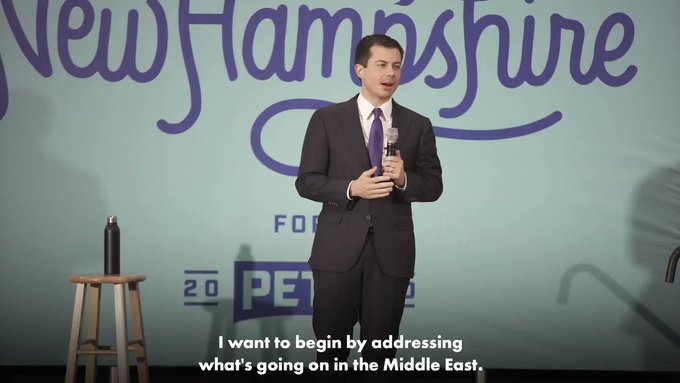
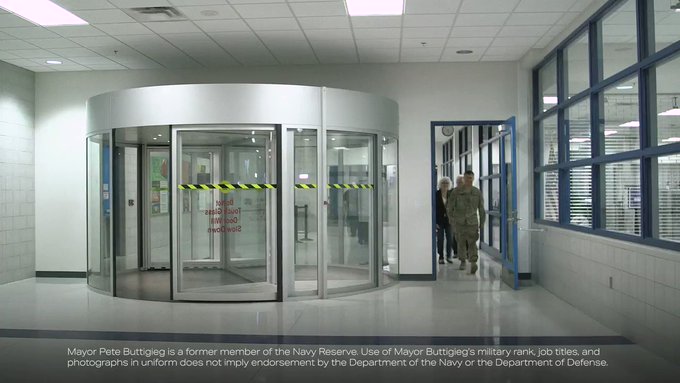
In an online ad, Buttigieg stressed his own military service as an intelligence analyst in Afghanistan to argue that he would be more strategic and responsible about the use of military power than Trump.
“America deserves a Commander-in-Chief who knows what that sacrifice means and who will honor the sacred promise we make to our veterans.”
—@PeteButtigieg

But what makes the 2020 primary campaign fundamentally different from 2004 is that two leading Democrats have already established themselves as skeptics of American military power in a way that Howard Dean — who later lobbied for regime change in Iran — never did.
Speaking in Iowa on Friday, Sanders connected his opposition to a new war with Iran to his vote against the Iraq war in 2003.
Bernie Sanders addresses Iran tensions after killing of top Iranian military leader Qassem Soleimani: "This is a dangerous escalation that brings us closer to another war in the Middle East." cbsn.ws/2ugFS5C

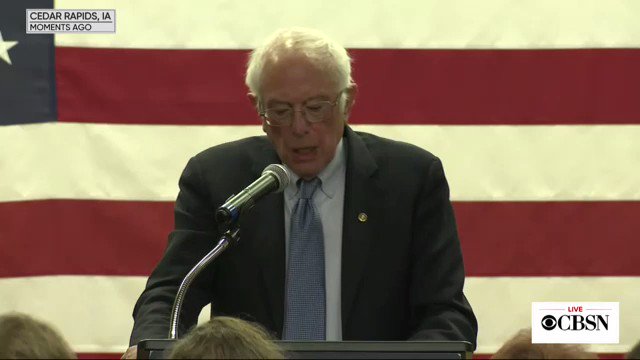
His campaign also resurfaced a video they produced of Sanders laying out his long record of anti-war activism.

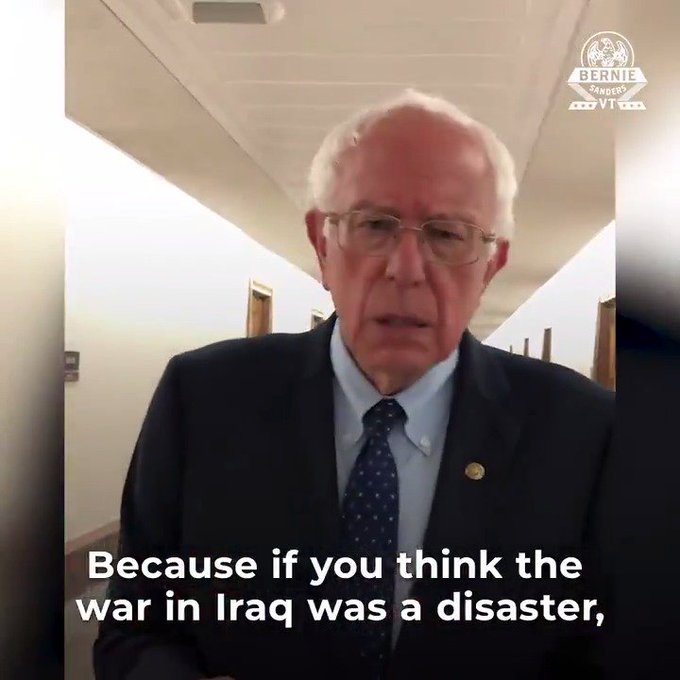
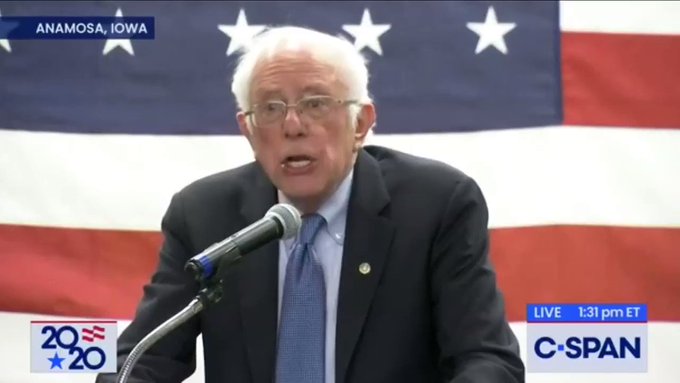
The senator’s supporters shared clips from his speech on Friday, in which he observed that “it is rarely the children of the billionaire class who face the agony of reckless foreign policy,” and from an interview he did with CBS in June, when he scoffed at the idea that Trump deserved credit for having not yet started a catastrophic war with Iran.
"I know that it is rarely the children of the billionaire class who face the agony of reckless foreign policy, it is the children of working families." @BernieSanders #NoWarWithIran


After Warren was hammered on social networks by Sanders supporters for not being outspoken enough in her initial statement, she posted comments on Twitter making her opposition to a war with Iran much more clear.
“We’re on the brink of yet another war in the Middle East — one that would be devastating in terms of lives lost and resources wasted,” Warren wrote. “We’re not here by accident. We’re here because a reckless president, his allies, and his administration have spent years pushing us here.”
“Donald Trump ripped up an Iran nuclear deal that was working,” she added. “He’s repeatedly escalated tensions. Now he’s assassinated a senior foreign military official. He’s been marching toward war with Iran since his first days in office — but the American people won’t stand for it.”
Donald Trump ripped up an Iran nuclear deal that was working. He’s repeatedly escalated tensions. Now he’s assassinated a senior foreign military official. He’s been marching toward war with Iran since his first days in office—but the American people won’t stand for it.

Warren has previously been outspoken in her commitment to end the war in Afghanistan. Asked at a debate in September if she would withdraw American troops from that country even in the absence of a peace deal with the Taliban, Warren replied, “Yes.”
.@DavidMuir on the war in Afghanistan: "Would you keep that promise to bring the troops home, starting right now, with no deal with the Taliban?"
Elizabeth Warren: "Yes." abcn.ws/DemDebate #DemDebate

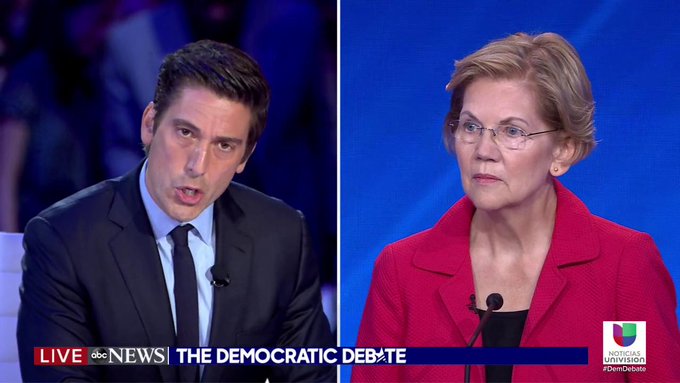
“And I’ll tell you why,” she added. “What we’re doing right now in Afghanistan is not helping the safety and security of the United States, it is not helping the safety and security of the world, it is not helping the safety and security of Afghanistan. We need to bring our troops home and then we need to make a big shift: We cannot ask our military to keep solving problems that cannot be solved militarily. We’re not going to bomb our way to a solution.”
Some Sanders campaign aides and supporters, eager to draw votes from the left, cast Warren as insufficiently anti-war, even claiming that her proposal, last May, for the Pentagon to achieve net zero carbon emissions and her vote in favor of a recent military budgets was evidence that she is a secret warmonger.
While Warren appeared eager to focus on other issues on Saturday, with her Twitter feed turning to issues like the rights of disabled workers, the threat of white nationalists emboldened by Trump, and prosecuting bankers, Sanders stressed his plan to work with Rep. Ro Khanna on a bill that would cut off funding for any offensive action against Iran or Iranian officials.
Speaking on Saturday in Iowa, Sanders was met with cheers from supporters when he said that the first course of action when lawmakers return to Washington next week should be “for the Congress to take immediate steps to restrain President Trump from plunging our nation into yet another endless war.”
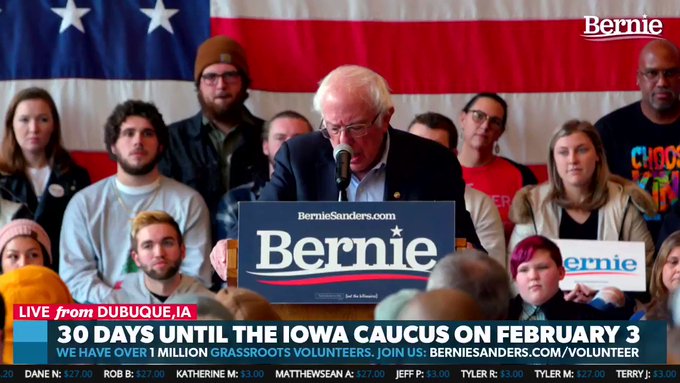
“This country needs a whole lot of things, but one thing that we do not need is another war,” Sanders added. “We’ve got enough of those.”
Warren, unlike Sanders, routinely takes questions from reporters after her campaign appearances, pausing for a “gaggle” before taking selfies with supporters. On Saturday in Iowa, she said that, by killing Suleimani, “Donald Trump has taken us to the brink of war. We don’t need more war in the Middle East, we need to stop endless war in the Middle East.”
WATCH: @ewarren’s first on-camera reaction to the killing of Soleimani. @cheyennehaslett follows up by asking why the shift away from calling him a murderer. Warren pivots to instead talk about where Trump is taking this country, calling him “reckless”.

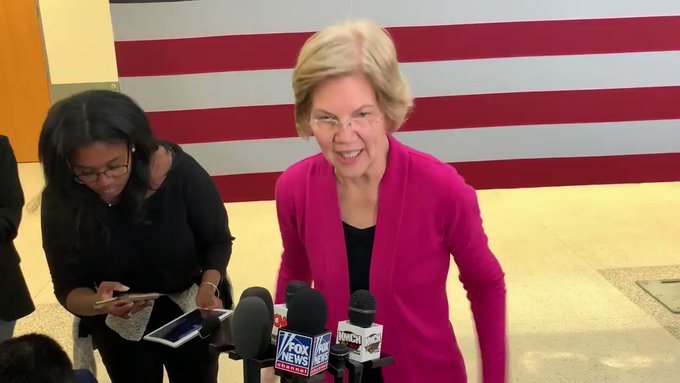
“We have been at war in this region for 20 years now, and it has meant thousands of American lives lost and huge costs imposed on our country,” Warren added. “It also means millions of people in the Middle East who have lost their lives, been injured, or displaced. We need to stop this endless war.”
Asked by Daniella Díaz of CNN if she would have given the order to assassinate the Iranian general, Warren said no and added that she would never have precipitated the current crisis, as Trump did, by withdrawing from the multinational nuclear agreement with Iran negotiated by Obama’s secretary of state, John Kerry.
To @DaniellaMicaela’s Q whether she would‘ve ordered the strike, @ewarren continued: “Even though the Iranians had been certified as adhering to the terms of the deal, even though our allies all stayed in the deal and wanted us to stay in the deal...Trump went off on his own...” twitter.com/daniellamicael…
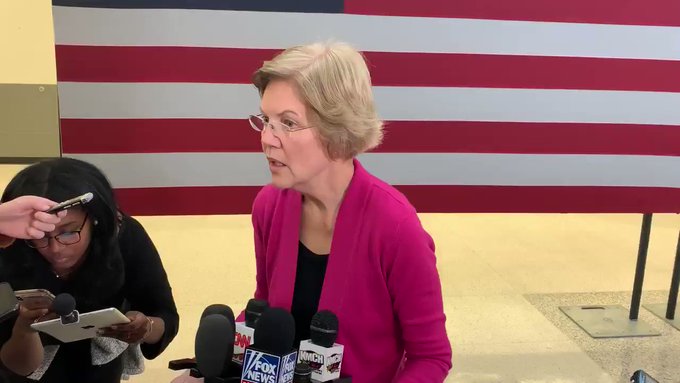

Warren also defended her description of the killing of the Iranian government official an “assassination,” one day after Mike Bloomberg, the former New York mayor, described Sanders’s use of the word as “an outrageous thing to say.”
Warren took question after question on Soleimani after not referencing the killing once during her town hall. When pushed on why she called it an assassination, @ewarren responds: “Yes, it is...he has ordered the assassination of a high-ranking gov official in the gov of Iran.”
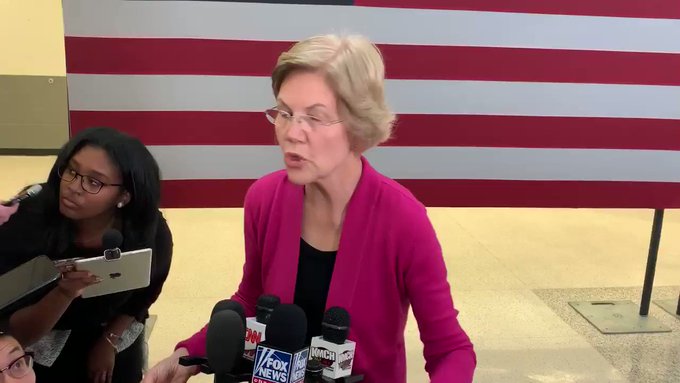
According to Dave Weigel of the Washington Post, Warren dismissed unsourced claims from senior State Department officials that they had intelligence of an imminent threat to American lives posed by Suleimani, saying: “The administration has no credibility in truth-telling, either at home or around the world.”
Subscribe to:
Posts (Atom)


