Search This Blog

Translate

Blog Archive

Middleboro Review 2

NEW CONTENT MOVED TO MIDDLEBORO REVIEW 2

Toyota

Since the Dilly, Dally, Delay & Stall Law Firms are adding their billable hours, the Toyota U.S.A. and Route 44 Toyota posts have been separated here:

Route 44 Toyota Sold Me A Lemon


Showing posts with label fish kill. Show all posts

Wednesday, July 13, 2016

CorpWatch: Formosa Plastics [TEXAS] Admits Vietnam Steel Plant Caused Massive Fish Kill


Great guide! Bookmark this site:

GOOD GUIDE


The company, which is the second largest producer of poly vinyl chloride in the world, has often been criticized for its environmental record. Good Guide rates the company in the top 10 percent of environmental violators in the U.S.


Formosa Plastics Admits Vietnam Steel Plant Caused Massive Fish Kill
by Richard Smallteacher, Special to CorpWatch
July 4th, 2016

Twitter photo by Dan Vineberg.
Vietnam has asked Formosa Ha Tinh Steel Corporation to pay $500 million in compensation for dumping toxic waste in Ky Anh that resulted in a massive fish kill on a 120 mile stretch of Vietnam's central coast in the provinces of Ha Tinh, Hue, Quang Binh and Quang Tri.

Formosa Steel, a subsidiary of Formosa Plastics Group, built the steel plant in 2011 on 1,000 hectares of land after relocating 1,500 households. The plant was part of a $10.6 billion industrial complex that also included a power plant and a deep sea port. At the time the company also constructed a massive sewage pipe that discharged 12,000 liters of wastewater a day without informing the local community.

The company, which is the second largest producer of poly vinyl chloride in the world, has often been criticized for its environmental record. Good Guide rates the company in the top 10 percent of environmental violators in the U.S.
In early April 2016, tens of tons of dead fish started to wash up on beaches prompting alarm. "If you sail just three miles offshore, you can see dead fish all over the ocean floor," local fisher folk told Tuoi Tre newspaper.

Government officials issued a ban on fishing in the region and made daily payments of 50,000 dong ($2.20) to affected fish workers and distributed bags of rice in compensation.

Initially the government dismissed claims that Formosa Steel was responsible for the fish kill. "Our test results indicate there is no evidence to conclude that Formosa in Ha Tinh province is behind the mass fish deaths," Vo Tuan Nhan, the deputy minister of Natural Resources and Environment told the media at a press conference. "The environmental indicators do not exceed the regulatory threshold."

Locals were outraged. "If we knew who put the poison in the ocean, we would like to kill them," Pham Thi Phi, a fisherwoman in Nhan Trach told the New York Times. "We really need to have an answer from the government on whether the ocean is totally clean and the fish are safe to eat."

Soon fishing communities started to organize protests but the Vietnamese government quickly cracked down, arresting hundreds that in turn prompted widespread criticism.

"It's appalling that the authorities cracked down and detained peaceful protesters in Hanoi and elsewhere instead of providing even the most basic answers about the massive fish kills," Phil Robertson, deputy director for Human Rights Watch in Asia, told Voice of America news service. "The Vietnam government should let the people express their views and hold their public assemblies rather than continuing this campaign of harassment, intimidation and detention."

In late June, the government finally acknowledged that Formosa Steel was responsible. Eventually the company also admitted that it had dumped cyanide, iron hydroxide and phenols into the sea.

But at first the company was defiant saying it had done nothing wrong. "Before we built the plant, we got the permission from the Vietnamese government," Chou Chun Fan, the head of the Hung Nghiep Formosa Ha Tinh Steel Company office in Hanoi told reporters. "You want the fish, or the steel plant? You have to choose. If you want both, I will tell you that you can’t, even if you are the prime minister."

Fan's remarks incited a firestorm of criticism and the company backed down. "We deeply hope the Vietnam people can forgive us," Tran Nguyen Thanh, chairman of the board of Formosa Plastics said in an video statement.

Vietnamese scientists say that the coral reefs in central Vietnam could take 50 years to recover.


Saturday, January 23, 2016

Study: Climate change causes 4 degree rise in Buzzards Bay


Study: Climate change causes 4 degree rise in Buzzards Bay

A sailboat on Buzzards Bay passes between pedestrians June 4 at Fort Tabor.A sailboat on Buzzards Bay passes between pedestrians June 4 at Fort Tabor. Michael Smith/Standard-Times File

By Eric Bosco 

Posted Jan. 22, 2016 at 7:29 PM 

Climate change has caused a four-degree rise in water temperature and a decline in water quality over the past two decades in Buzzards Bay, according to a study by the Woods Hole Oceanographic Institution and the Buzzards Bay Coalition.
"We have seen a widespread and rapid increase in water temperature from 1992 to 2013 and this agrees with other regional studies so we are fairly confident that this is related to climate change," said Jenny Rheuban, a research associate at WHOI and lead author of the study.
The study — which involved data collected by more than 1,000 trained citizen scientists involved with the coalition over 22 years — also revealed an increase in algae growth, a cause of poor water quality.
"Algae like phytoplankton are the reason that when you go to the beach the water is murkier and not as clear as you'd like," said Rachel Jakuba, science director for the Buzzards Bay Coalition and co-author of the study.
The levels of chlorophyll, an indicator of phytoplankton or algae, in the water nearly doubled, according to the study, despite the fact that nitrogen levels remained relatively constant.
Algae forms the base of the marine food chain and is essential for a healthy ecosystem but too much can have consequences — including reducing sunlight and oxygen levels and making it harder for certain species to survive.
"It's harder for eelgrass to grow, and eelgrass is important for species like shellfish and others. Scallops need it for their lifecycles, and species like stripers use it in their juvenile stages," Jakuba said.
The most extreme consequence of low levels of oxygen in the water is what scientists call a "fish-kill," or the dying off of fish populations in a certain area.
And this is something that has happened periodically in Buzzards Bay and as recently as last fall with fish-kills occurring in the Acushnet River and Nasketucket Bay, according to Jakuba.
The increase in algae growth means that water quality is worse with nearly the same nitrogen concentration, the study said, which will have serious implications for cleanup plans.
"Much of what we do is try to reduce the nitrogen levels and work with towns to ensure septic systems and wastewater treatment sites are upgraded to limit nitrogen pollution, but the results suggest we'll have more of a challenge improving water quality," Jakuba said.
Though the data shows a significant warming of the water in recent decades, it is unclear if the trend will continue.
"We wouldn't necessarily want to take these trends and project them for the future because this is based off of historical data, so I wouldn't expect a rapid increase like this going forward," Rheuban said.
But the effects of the warming and increasing algae levels will take a toll on the marine ecosystem.
"In areas with less oxygen and higher levels of nitrogen, there are fewer, less diverse species and more murky, muddy waters," Rheuban said.

http://www.southcoasttoday.com/article/20160122/NEWS/160129711/101061/NEWSLETTER100


Saturday, September 14, 2013

Shark attacks feared in Hawaii after molasses spill


Shark attacks feared in Hawaii after molasses spill

Swimmers and surfers warned to stay out of the water near Honolulu harbour after pipeline leak kills hundreds of fish

Molasses spill in Honolulu, Hawaii
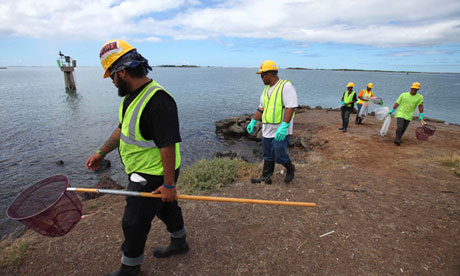
An environmental cleanup crew looks for dead marine life in Keehi Lagoon after the huge molasses spill in Honolulu, Hawaii. Photograph: Hugh Gentry/Reuters


Hawaii health officials have warned swimmers and surfers to stay out of the waters near Honolulu harbour after a leak of 1,400 tons of molasses killed hundreds of fish, potentially attracting sharks.

The Hawaii department of health deployed three boats to remove the dead fish, and they were expected to remove thousands more in the coming weeks, said a spokeswoman, Janice Okubo.

A brown plume of sweet, sticky liquid was spotted seeping into Honolulu harbour and Keehi lagoon on Monday after a leak was discovered in a pipeline used to load the molasses on to ships operated by Matson Navigation Company, the health department said. Matson Navigation is a subsidiary of Matson Inc, which has provided Pacific-wide shipping services since 1882.

Roger Smith, a dive shop owner who went under water on Wednesday to survey the damage, said it was unlike anything he had seen in 37 years of diving, with brown-tinted water and a layer of molasses coating the sea floor.

"Everything that was underwater suffocated," Smith said. "Everything climbed out of its hole and the whole bottom was covered with fish, crabs, lobsters, worms, sea fans – anything that was down there was dead."

The health department said in a statement that while molasses was not directly harmful to humans, it was polluting the water, causing fish to die, and could lead to an increase in predator species such as sharks, barracuda and eels. Molasses is a byproduct of the refining of sugar cane.

Okubo said crews were monitoring molasses levels in the waters to help predict the spread and overall impact of the 223,000-gallon spill.

Matson acknowledged in a statement that the spill was caused by a faulty pipe, which it said had been fixed. It said the sugar product would dissipate on its own.

The company said it regretted the incident and was working with authorities to take steps to ensure it did not happen again.
"We take our role as an environmental steward very seriously," the statement said. "We have a long history in Honolulu harbour and can assure all involved that this is a rare incident."

The health department said an unusual growth in marine algae and harmful bacteria was another environmental danger posed by the spill.

The department posted signs on beaches warning people to stay out of the water and not to consume any dead fish found in the area. The brown plume was expected to remain visible for weeks while natural tides and currents slowly flush the area, it said.

Tourism officials said they were monitoring the situation but did not believe it would hurt Hawaii's primary source of income.

"At this time, we do not foresee any immediate impact on our visitor industry," said Mike McCartney, president and chief executive of the Hawaii Tourism Authority, in a statement.


http://www.theguardian.com/world/2013/sep/13/shark-attack-feared-hawaii-molasses