While the post-election analysis has mushroomed, Frank Rich's comments are worthy of note. As Rich points out, what is ominous is that so many believed the fantasies, and that so many voted against their own best interests, having no comprehension of the platform or its implications.
That a political party can conspire to promote widespread voter suppression, voter fraud, Jim Crow laws and voter purges defines the depths to which they will sink that should be particularly worrisome.

Fantasyland
Denial has poisoned the GOP and threatens the rest of the country too.
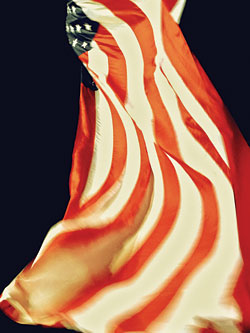 |
(Photo: Christopher Anderson/Magnum Photos/New York Magazine)
|
some 48 percent of the popular vote, is no small accomplishment. The American weakness that Romney both apotheosized and exploited in achieving this feat�our post-fact syndrome where anyone on the public stage can make up anything and usually get away with it�won’t disappear with him. A slicker liar could have won, and still might.
All politicians lie, and some of them, as Bob Kerrey famously said of Bill Clinton in 1996, are �unusually good� at it. Every campaign (certainly including Obama’s) puts up ads that stretch or obliterate the truth. But Romney’s record was exceptional by any standard. The blogger Steve Benen, who meticulously curated and documented Mitt’s false statements during 2012, clocked a total of 917 as Election Day arrived. Those lies, which reached a crescendo with the last-ditch ads accusing a bailed-out Chrysler of planning to ship American jobs to China, are not to be confused with the Romney flip-flops. The Etch-A-Sketches were a phenomenon of their own; if the left and right agreed about anything this year, it was that trying to pin down where Mitt �really� stood on any subject was a fool’s errand. His biography was no less Jell-O-like: There were the still-opaque dealings at Bain, and those Olympics, and a single (disowned) term in public service, and his churchgoing�and what else had he been up to for 65 years? We never did see those tax returns. We never did learn the numbers that might validate the Romney-Ryan budget. Given that Romney had about as much of a human touch with voters as an ATM, it sometimes seemed as if a hologram were running for president. Yet some 57 million Americans took him seriously enough to drag themselves to the polls and vote for a duplicitous cipher. Not all of this can be attributed to the unhinged Obama hatred typified by Mary Matalin’s postelection characterization of the president as �a political narcissistic sociopath.�
As GOP politicians and pundits pile on Romney in defeat, they often argue that he was done in by not being severely conservative enough; if only he’d let Ryan be Ryan, voters would have been won over by right-wing orthodoxy offering a clear-cut alternative to Obama’s alleged socialism. In truth, Romney was a perfect embodiment of the current GOP. As much as the Republican Party is a radical party, and a nearly all-white party, it has also become the Fantasyland Party. It’s an isolated and gated community impervious to any intrusions of reality from the �real America� it solipsistically claims to represent. This year’s instantly famous declaration by the Romney pollster Neil Newhouse that �we’re not going to let our campaign be dictated by fact-checkers� crystallized the mantra of the entire GOP. The Republican faithful at strata both low and high, from Rush’s dittoheads to the think-tank-affiliated intellectuals, have long since stopped acknowledging any empirical evidence that disputes their insular worldview, no matter how grounded that evidence might be in (God forbid) science or any other verifiable reality, like, say, Census reports or elementary mathematics. No wonder Romney shunned the word Harvard, which awarded him two degrees, even more assiduously than he did Mormon.
At the policy level, this is the GOP that denies climate change, that rejects Keynesian economics, and that identifies voter fraud where there is none. At the loony-tunes level, this is the GOP that has given us the birthers, websites purporting that Obama was lying about Osama bin Laden’s death, and not one but two (failed) senatorial candidates who redefined rape in defiance of medical science and simple common sense. It’s the GOP that demands the rewriting of history (and history textbooks), still denying that Barry Goldwater’s opposition to the Civil Rights Act of 1964 and Richard Nixon’s �southern strategy� transformed the party of Lincoln into a haven for racists. Such is the conservative version of history that when the website Right Wing News surveyed 43 popular conservative bloggers to determine the �worst figures in American history� two years ago, Jimmy Carter, Obama, and FDR led the tally, all well ahead of Benedict Arnold, Timothy McVeigh, and John Wilkes Booth.
The good news for Democrats this year was that the right’s brand of magical thinking (or non-thinking) bit the GOP in the ass, persuading it to disregard all the red flags and assume even a figure as hollow as Romney could triumph. (Retaking the Senate was once thought to be a lock, too.) The books chronicling what happened in 2012 will devote much attention to the failings of Romney’s campaign and to the ruthlessness and surgical rigor of Obama’s. But an equally important part of this history is the extraordinary lengths to which the grandees of the GOP�not just basket cases like Dick �Landslide!� Morris and Glenn Beck, but the supposed adults regarded by the Beltway Establishment and mainstream media as serious figures�enabled their party’s self-immolating denial of political reality. This was the election in which even George Will (who predicted a 321 Electoral College win for Romney) surrendered to the cult of the talk-radio base and drank the Kool-Aid without realizing it had been laced with political cyanide. If a tea-party voter in Texas was shocked that Obama won, he was no less thunderstruck than the Romney campaign, or Karl Rove. Rove’s remarkably graphic public meltdown on Fox News�babbling gibberish about how his Ohio numbers showed a path for Romney even after the election was lost�marked not just the end of his careers as a self-styled political brainiac and as a custodian of hundreds of millions of dollars in super-PAC money. It was an epic on-camera dramatization of his entire cohort’s utter estrangement from reality.
The most histrionic indicator of the GOP Establishment’s enlistment in the post-fact alternative universe was the pillorying of Nate Silver, whose FiveThirtyEight statistical model (and accompanying blog) in the Times analyzing all major national and state surveys on a daily basis consistently found Obama a fairly prohibitive favorite in the race. Conservative commentators disgorged thousands and thousands of words to impugn Silver as a liberal hack, accusing him of slanting the facts to fit a political bias. Freud couldn’t have imagined a clearer case study in projection. For backup, the anti-Silver forces turned to the likes of Jay Cost of The Weekly Standard, whose learned, lengthy, and chart-laden explanations of why Silver and the polls were wrong could be considered scientific in the same way creation science is. An even sadder case was Michael Barone, the once-respected co-author of The Almanac of American Politics who in 2008 compared Sarah Palin to FDR and who this year abandoned his fact-based standard for a faith-based standard underestimating minority turnout; he predicted a 315 electoral-vote victory for Romney. Like Rove, Barone called nearly every battleground state wrong. (The professional pollster most admired by the right, the GOP-leaning Rasmussen, didn’t bat much higher.) Silver got all 50 states right.
Some of Silver’s detractors didn’t bother to concoct their own bogus analyses but just tried to defame and bully him. In the waning days of October, Joe Scarborough of MSNBC’s Morning Joe discounted FiveThirtyEight’s finding that Obama had (then) a 73.6 percent probability of victory by ranting that �anybody that thinks that this race is anything but a toss-up right now is such an ideologue they should be kept away from typewriters, computers, laptops, and microphones for the next ten days, because they’re jokes.� Dean Chambers, a conservative blogger who gained popularity on the right by setting up a junk-science Romney-boosting site called UnSkewed Polls, implied that FiveThirtyEight was skewed by Silver’s sexual orientation. Chambers wrote that Silver is �of very small stature, a thin and effeminate man with a soft-sounding voice that sounds almost exactly like the �Mr. New Castrati’ voice used by Rush Limbaugh on his program.� (To which Silver responded with a classic Tweet: �Unskewedpolls argument: Nate Silver seems kinda gay + ??? = Romney landslide!�) Scarborough’s and Chambers’s efforts to discredit FiveThirtyEight mirrored their party’s attempts to demonize the nonpartisan organizations that questioned Romney and Ryan’s voodoo economics as well as Jack Welch’s assault on the Bureau of Labor Statistics. You challenge the imaginary numbers of the post-fact GOP at your peril.
The GOP’s wholesale retreat from reality perhaps found its ultimate expression in a Peggy Noonan blog at Rupert Murdoch’s Wall Street Journal that may achieve �Dewey Defeats Truman� immortality. Writing on Election Eve, she informed the faithful that �Romney’s slipping into the presidency� and will win. �All the vibrations are right,� she explained, citing such numerical evidence as crowd sizes in Pennsylvania and Ohio (both of which Romney would lose the next day) and yard signs. In Florida, she �saw Romney signs, not Obama ones,� adding that she’d heard tell of similar visitations in both Ohio and �tony Northwest Washington, D.C.�
The most histrionic indicator of the GOP Establishment’s enlistment in the post-fact alternative universe was the pillorying of Nate Silver, whose FiveThirtyEight statistical model (and accompanying blog) in the Times analyzing all major national and state surveys on a daily basis consistently found Obama a fairly prohibitive favorite in the race. Conservative commentators disgorged thousands and thousands of words to impugn Silver as a liberal hack, accusing him of slanting the facts to fit a political bias. Freud couldn’t have imagined a clearer case study in projection. For backup, the anti-Silver forces turned to the likes of Jay Cost of The Weekly Standard, whose learned, lengthy, and chart-laden explanations of why Silver and the polls were wrong could be considered scientific in the same way creation science is. An even sadder case was Michael Barone, the once-respected co-author of The Almanac of American Politics who in 2008 compared Sarah Palin to FDR and who this year abandoned his fact-based standard for a faith-based standard underestimating minority turnout; he predicted a 315 electoral-vote victory for Romney. Like Rove, Barone called nearly every battleground state wrong. (The professional pollster most admired by the right, the GOP-leaning Rasmussen, didn’t bat much higher.) Silver got all 50 states right.
Some of Silver’s detractors didn’t bother to concoct their own bogus analyses but just tried to defame and bully him. In the waning days of October, Joe Scarborough of MSNBC’s Morning Joe discounted FiveThirtyEight’s finding that Obama had (then) a 73.6 percent probability of victory by ranting that �anybody that thinks that this race is anything but a toss-up right now is such an ideologue they should be kept away from typewriters, computers, laptops, and microphones for the next ten days, because they’re jokes.� Dean Chambers, a conservative blogger who gained popularity on the right by setting up a junk-science Romney-boosting site called UnSkewed Polls, implied that FiveThirtyEight was skewed by Silver’s sexual orientation. Chambers wrote that Silver is �of very small stature, a thin and effeminate man with a soft-sounding voice that sounds almost exactly like the �Mr. New Castrati’ voice used by Rush Limbaugh on his program.� (To which Silver responded with a classic Tweet: �Unskewedpolls argument: Nate Silver seems kinda gay + ??? = Romney landslide!�) Scarborough’s and Chambers’s efforts to discredit FiveThirtyEight mirrored their party’s attempts to demonize the nonpartisan organizations that questioned Romney and Ryan’s voodoo economics as well as Jack Welch’s assault on the Bureau of Labor Statistics. You challenge the imaginary numbers of the post-fact GOP at your peril.
The GOP’s wholesale retreat from reality perhaps found its ultimate expression in a Peggy Noonan blog at Rupert Murdoch’s Wall Street Journal that may achieve �Dewey Defeats Truman� immortality. Writing on Election Eve, she informed the faithful that �Romney’s slipping into the presidency� and will win. �All the vibrations are right,� she explained, citing such numerical evidence as crowd sizes in Pennsylvania and Ohio (both of which Romney would lose the next day) and yard signs. In Florida, she �saw Romney signs, not Obama ones,� adding that she’d heard tell of similar visitations in both Ohio and �tony Northwest Washington, D.C.�
Noonan’s revealing summation of her thought process was this: �Is it possible this whole thing is playing out before our eyes and we’re not really noticing because we’re too busy looking at data on paper instead of what’s in front of us? Maybe that’s the real distortion of the polls this year: They left us discounting the world around us.� Thus is the post-fact worldview of today’s GOP boiled down to its essence. It assumes that any �data on paper� must be distorted, and yet doesn’t look at what is in front of its very own eyes either. Otherwise, Noonan might have wondered if the neighborhood in Florida with Romney signs, not Obama ones, was not representative of either Florida or the country but was instead a white enclave. Otherwise, Noonan’s fellow conservative honchos might not have taken until November 6, 2012, to recognize that you can’t alienate every minority group in the country (blacks, Latinos, Asian-Americans, gays)�not to mention the majority group, women�and hope to win a national election. It’s not as if these rapidly changing demographics have been classified information. Bill O’Reilly’s astonished Election Night revelation that �the white Establishment is now the minority� was almost pathetic in its naïveté. Next to him, Rove, and Noonan, even Pat Buchanan was ahead of the curve.
The rude jolt administered by the election does not mean that the GOP will now depart from its faith-based view of reality�though it will surely heed Laura Ingraham’s postelection call for changing �the language of dealing with Latinos.� (Marco Rubio��Él habla español!�is already suiting up to lead the karaoke.) No sooner did Obama win reelection than Charles Kraut�hammer laid down the new party line for denying reality, asserting that the president had �no mandate� despite his large victory in the Electoral College and his clear-cut margin in the popular vote (a victory not achieved by modern presidents as varied as JFK in 1960 and George W. Bush in 2000). Two days after the election, Rove was already blaming the defeat in part on �the anonymous New York Times headline writer� who supposedly twisted Romney’s suicidal stand on the auto-industry bailout and the �hotel employee with a cell-phone camera� who had the gall to capture Romney’s candid take on the �47 percent.�
Nor, for all the panicked Republican talk about trying to make the party more inclusive and rational, is there any evidence that the GOP base wants to retreat a whit, whether on immigration or gay marriage or reproductive rights or the reinstatement of Jim Crow�era roadblocks to voting in states like Florida and Ohio. Or that any Republican leaders with actual power (as opposed to the out-of-office Jeb Bush) want to, either. The right is taking solace from exit-poll findings that more Americans still label themselves conservative than liberal and still think government does too much. A moderate putsch led by Olympia Snowe in exile, or David Frum, David Brooks, and Michael Gerson from op-ed pages, or Meghan �McCain on Twitter, is not going to get very far.
But that’s the Republicans’ plight. The country has a larger problem��intellectual nihilism,� as the writer Noam Scheiber recently labeled it. Since 9/11, often but not always under the right’s aegis, truth has been destabilized in America. The Bush administration’s contempt for what it dismissed as the �reality-based community� was vindicated when it successfully ginned up a war by convincing Americans that the 9/11 hijackers were Iraqis and that Saddam Hussein had weapons of mass destruction. Our susceptibility to elaborate, beautifully wrought myths remains intact�whether we’re being spun by politicians, captains of finance pumping up a bubble, or sports heroes like Lance Armstrong and Joe Paterno. The news business, which we once counted on to vet hoaxes and fictions, is now so insecure about its existential future that it was cowed to some extent by the Scarboroughs, Noonans, and Roves, with most of the networks, not just Fox, ignoring the statistical data of Silver and others and instead predicting a long, nail-biting Election Night. (In reality, the election was called for Obama at 11:12 p.m. EST on NBC, just twelve minutes after it had been in 2008.) Our remaining journalistic institutions have even outsourced what used to be the very core of their craft, fact-checking, to surrogates relegated to gimmicky sidebars (awarding Pinocchios and �pants on fire�). The fact-checkers have predictably become partisan targets, only further destabilizing the whole notion of what is meant by �news.�
Daniel Patrick Moynihan might be surprised to learn that he is now remembered most for his oft-repeated maxim that �everyone is entitled to his own opinion, but not his own facts.� Yet today most Americans do see themselves as entitled to their own facts, with one of our two major political parties setting a powerful example. For all the hand-wringing about Washington’s chronic dysfunction and lack of bipartisanship, it may be the wholesale denial of reality by the opposition and its fellow travelers that is the biggest obstacle to our country moving forward under a much-empowered Barack Obama in his second term. If truth can’t command a mandate, no one can.
This article has been updated since its original publication.
http://nymag.com/news/frank-rich/gop-denial-2012-11/#print
The rude jolt administered by the election does not mean that the GOP will now depart from its faith-based view of reality�though it will surely heed Laura Ingraham’s postelection call for changing �the language of dealing with Latinos.� (Marco Rubio��Él habla español!�is already suiting up to lead the karaoke.) No sooner did Obama win reelection than Charles Kraut�hammer laid down the new party line for denying reality, asserting that the president had �no mandate� despite his large victory in the Electoral College and his clear-cut margin in the popular vote (a victory not achieved by modern presidents as varied as JFK in 1960 and George W. Bush in 2000). Two days after the election, Rove was already blaming the defeat in part on �the anonymous New York Times headline writer� who supposedly twisted Romney’s suicidal stand on the auto-industry bailout and the �hotel employee with a cell-phone camera� who had the gall to capture Romney’s candid take on the �47 percent.�
Nor, for all the panicked Republican talk about trying to make the party more inclusive and rational, is there any evidence that the GOP base wants to retreat a whit, whether on immigration or gay marriage or reproductive rights or the reinstatement of Jim Crow�era roadblocks to voting in states like Florida and Ohio. Or that any Republican leaders with actual power (as opposed to the out-of-office Jeb Bush) want to, either. The right is taking solace from exit-poll findings that more Americans still label themselves conservative than liberal and still think government does too much. A moderate putsch led by Olympia Snowe in exile, or David Frum, David Brooks, and Michael Gerson from op-ed pages, or Meghan �McCain on Twitter, is not going to get very far.
But that’s the Republicans’ plight. The country has a larger problem��intellectual nihilism,� as the writer Noam Scheiber recently labeled it. Since 9/11, often but not always under the right’s aegis, truth has been destabilized in America. The Bush administration’s contempt for what it dismissed as the �reality-based community� was vindicated when it successfully ginned up a war by convincing Americans that the 9/11 hijackers were Iraqis and that Saddam Hussein had weapons of mass destruction. Our susceptibility to elaborate, beautifully wrought myths remains intact�whether we’re being spun by politicians, captains of finance pumping up a bubble, or sports heroes like Lance Armstrong and Joe Paterno. The news business, which we once counted on to vet hoaxes and fictions, is now so insecure about its existential future that it was cowed to some extent by the Scarboroughs, Noonans, and Roves, with most of the networks, not just Fox, ignoring the statistical data of Silver and others and instead predicting a long, nail-biting Election Night. (In reality, the election was called for Obama at 11:12 p.m. EST on NBC, just twelve minutes after it had been in 2008.) Our remaining journalistic institutions have even outsourced what used to be the very core of their craft, fact-checking, to surrogates relegated to gimmicky sidebars (awarding Pinocchios and �pants on fire�). The fact-checkers have predictably become partisan targets, only further destabilizing the whole notion of what is meant by �news.�
Daniel Patrick Moynihan might be surprised to learn that he is now remembered most for his oft-repeated maxim that �everyone is entitled to his own opinion, but not his own facts.� Yet today most Americans do see themselves as entitled to their own facts, with one of our two major political parties setting a powerful example. For all the hand-wringing about Washington’s chronic dysfunction and lack of bipartisanship, it may be the wholesale denial of reality by the opposition and its fellow travelers that is the biggest obstacle to our country moving forward under a much-empowered Barack Obama in his second term. If truth can’t command a mandate, no one can.
This article has been updated since its original publication.
http://nymag.com/news/frank-rich/gop-denial-2012-11/#print


