Search This Blog

Translate

Blog Archive

Middleboro Review 2

NEW CONTENT MOVED TO MIDDLEBORO REVIEW 2

Toyota

Since the Dilly, Dally, Delay & Stall Law Firms are adding their billable hours, the Toyota U.S.A. and Route 44 Toyota posts have been separated here:

Route 44 Toyota Sold Me A Lemon


Showing posts with label indian casinos. Show all posts

Saturday, October 26, 2019

Regulators want briefing on Mashpee Wampanoag Tribe’s casino status


Image result for REEL WAMPS


ADDITIONAL INFORMATION:

REEL WAMPS

WAMPALEAKS

GLADYS KRAVITZ

carverchick

Regulators want briefing on Mashpee Wampanoag Tribe’s casino status


By Colin A. Young / State House News Service
Posted Oct 24,2019


Gaming Commission appears in no hurry to act on Region C license.
BOSTON — Gaming regulators want to know the exact status of federal litigation around the Mashpee Wampanoag Tribe’s quest to secure land in trust before making a decision about the state’s third casino license, although Gaming Commission members appeared in no rush Thursday to begin accepting applications for a Southeastern Massachusetts casino.
The state commission agreed to have its executive director and legal team work up a comprehensive briefing on the ongoing legal wrangling over the decision to grant the tribe land in trust, which was approved by the Obama administration but overturned and thrown into doubt by the Trump administration. The tribe planned to build its $1 billion First Light Resort and Casino on tribal land in Taunton, a project that would have a significant impact on the state’s commercial casino industry.
“The commission’s staff, our legal department, have been following the status of the federal legislation and litigation that relates particularly to the complicated tribal matter ... I think it’s probably a good time to actually update us more formally through a memorandum. It’s very complicated,” Chairwoman Cathy Judd-Stein said. “I do think probably that needs to be formalized, because it’s an important part of the overall Region C evaluation and discussion.”
The uncertainty of Region C — the commission’s name for Bristol, Plymouth, Barnstable, Dukes and Nantucket counties — has been an issue for years. In 2016, when it appeared a tribal casino in Taunton was likely, regulators rejected a proposal for a commercial casino in Brockton. A federal judge’s ruling later that year nullified the decision to grant the Wampanoag a 320-acre reservation on which the tribe planned to construct a resort casino, and President Donald Trump’s administration last year officially reversed the Obama-era declaration.
Since then, the tribe’s efforts to secure its land-in-trust status have been tied up in federal court. U.S. Rep. William Keating, who represents Mashpee, has pushed legislation that would use the power of Congress to reaffirm the 2015 decision by the Interior Department to take land into trust for the tribe, though Trump has opposed it.
On Thursday, Sen. Marc Pacheco told the commission he has been trying to get clarity on where things stand with the tribe’s legal battles and the congressional efforts to address its concerns.
“I made a call before I came over to try to figure out what was happening at the federal level, and my sources tell me we probably won’t know too much until the end of the year,” Pacheco said.
Pacheco, who lives in and represents the city where the tribe hopes to build its casino, said he supports the commission’s plan to gather more information before making a decision one way or the other.
“I’m here to ask the commission to continue with your thoughtful deliberation about everything that is going on and to not make a decision, even though it may be in our best interest, because it’s within your jurisdiction under existing law to go out for a commercial casino if the commission chooses to,” he said. “If I know that there is absolutely no way that a Native American casino can come to be in Region C, I’d be one of the first people here to urge you to do so. But if that uncertainty still looms out there at any level, it will have a significant effect on those that even bid.”
The concern, as expressed by Pacheco and others, is that commercial casino operators might not be willing to invest the minimum $500 million in a project that would have to compete with a nearby tribal casino. If the Gaming Commission opts to go ahead with licensing a commercial casino in Region C and the tribe is allowed to open its own casino under federal law, Massachusetts would receive no tax revenue from the tribal casino.
Although the commission took no formal vote related to Region C, the decision to seek more information suggested it is in no hurry to make a ruling on the one remaining casino license.
Commissioner Enrique Zuniga stressed that it will be crucial for the commission to conduct its own economic analysis of the Region C market, noting that the two resort casinos that already have opened in other regions of the state are coming up short of their own revenue projections.
“I currently feel no sense of urgency ... if we have not seen the levels that the applicants themselves predicted, because they did predict certain revenues from year one and they’re not currently seeing those revenues,” Zuniga said. “I would rather, frankly, see how it goes, do more analysis and understand better how they’re competing in the market. It’s early, in my opinion.”
A spokeswoman for the Mashpee tribe did not respond to a request for comment Thursday night.


ICYMI FROM REEL WAMPS: 


Federal investigations stop everything

Cedric was not alone in selling us out. His Council cronies voted with him on every money transfer and bad deal ever made.
The tribe’s outside auditors had some bad news for the Council.  They were not able to complete their audit because of the federal grand jury investigation.  The current Treasurer, Gordon Harris, former treasurer Robbie Hendricks and according to our sources Cromwell business partner and former treasurer Mark Harding have all been subpoenaed to appear before a federal grand jury and it has possession of tribal  financial records. The auditors do not have access to those documents. And the auditors querries got a donut from the feds
IT GOT WORSE
That tricky Gaming Commission.  It was a dumping ground for millions of dollars each month.  NO ONE EVER KNEW WHAT HAPPENED TO THAT MONEY or How it was spent.
So now the bill comes due. The auditors couldn’t get much intell out of the feds…actually nothing.  But they
Yvonne, 30 years a council member never used her education or experience to help. Her silence was lethal as ever. Slithering into her hiding place like an eel.
know about these things.  There’s a clause in the financial agreement with the investors that says that if there’s  “bad faith” actions (and the auditor put it like this) :
” I’m not saying it happened, but let’s just say someone  in the gaming commission took between $100,000 and $1m….then the tribal assets are at risk.”
That means what land we own etc. would go to Genting for payment. A drop in the bucket compared to what we owe them. Cedric and his ouncil Cronies knew about the fine print so why didn’t the tribal attorneys or any of them tell us? Well, they had to keep getting that money…at any cost.
So now we’re in a really bad place.  Reel Wamps has to confess that pounding on Cedric Cromwell was not
enough.  He didn’t create this horror show alone.  He had a lot of help from the Council cronies. A really sorry lot. Jess$e Big Doe and  Mark(ie) Poo Harding leading the parade.  The ancestors are spinning in their graves. Everything Cedric did came with their vote of approval.  Their complicity was tantamount to their participating in the felony murder of the Tribe.  Just because you didn’t pull the trigger does not absolve the guilt. You must  have proof that you tried to stop the crime. They were cowards all the way.  They should be held accountable.
If we know the feds do too.


Thursday, September 5, 2019

Current, former Mashpee Wampanoag Tribe treasurers subpoenaed


REEL WAMPS

WAMPALEAKS

GLADYS KRAVITZ

carverchick

Current, former Mashpee Wampanoag Tribe treasurers subpoenaed


By Tanner Stening
Posted Sep 4, 2019

Tribal Council votes to hire lawyers for both in federal grand jury probe.
MASHPEE — The Mashpee Wampanoag Tribe’s chief financial officer and his predecessor have been subpoenaed in recent weeks, according to sources familiar with the matter and documentation provided to the Times.
Treasurer Gordon Harris and former Treasurer Robert Hendricks were issued subpoenas, prompting Tribal Council, the tribe’s executive decision-making body, to hire legal counsel for them, according to meeting minutes provided by council member Aaron Tobey Jr.
The minutes mention subpoenas without elaboration, and Tobey declined to discuss the nature of the court orders.
Another source, however, said the subpoenas were connected to a federal grand jury investigation. A spokeswoman for the U.S. Attorney’s Office in the District of Massachusetts said “we can neither confirm nor deny investigations” pertaining to the tribe.
Harris, council Secretary Ann Marie Askew, Vice Chairwoman Jessie “Little Doe” Baird and members Rita Pocknett Gonsalves, David Weeden and Yvonne Avant voted in favor of hiring legal counsel for Hendricks during a recent meeting, according to the minutes. Members Brian Weeden and Carlton Hendricks Jr. abstained, and Tobey was opposed.
Askew, Baird, Gonsalves, Tobey, Avant, David Weeden and Brian Weeden voted to approve legal counsel for Harris at a later meeting, according to the minutes. Carlton Hendricks Jr. opposed and Harris recused himself.
Tribal Council Chairman Cedric Cromwell votes only to break a tie.
Tobey said he voted to hire counsel for Harris and not Hendricks because Harris is a sitting official. Asked if he knew if anyone else currently or formerly in tribal government had been issued a subpoena, Tobey said, “I wouldn’t be surprised if there were.”
It is unclear if Harris or Hendricks have appeared in court in connection with the subpoenas. Robert Hendricks did not respond to questions about his court order, and Harris did not respond to a request for comment through a tribal spokeswoman.
Grand jury proceedings are largely secret. Roughly two dozen citizens serve as jurors, empowered to examine documents and hear testimony — usually presented only by government attorneys — to determine whether there is probable cause that someone committed a crime.
The legal probe comes amid growing political turmoil within tribal government in connection with a credibility crisis affecting the top leadership. Tribe members have tried to expel Cromwell, Baird and Harris for, among other reasons, the secrecy surrounding tribal finances, and the amount they receive in salaries. Several petitions that circulated within the tribal community earlier this year garnered enough signatures to set in motion a “recall” process — outlined in the tribe’s constitution — for Cromwell and Harris.
The tribe’s Election Committee certified 120 signatures on the petition to remove Harris and 104 signatures on a petition to remove Cromwell. The petition to remove Baird fell short of the 100 required.
The recall election is set for Sept. 15, according to the tribe’s website, although the notice does not mention Cromwell or Harris by name.
The tribe has paid Cromwell more than $1 million since he took office in 2009, that petition says. Since then, the tribe has incurred more than $500 million in debt with “very little to show for it; no casino, no jobs,” and a mortgaged property in Taunton, where the tribe’s $1 billion casino-resort would be located, according to the petition. The gaming project has been halted since a 2016 injunction granted as part of a lawsuit filed by neighbors of the project.
A robocall that circulated within the tribal community in June alleged that $250 million of the money handled by the Mashpee Wampanoag Tribal Gaming Authority is unaccounted for. The gaming authority is a five-member board governing the tribe’s long-stalled gaming operation. A 2016 financial audit of the tribe described the entity as a “discretely presented component of the tribe.” During that year, the authority transferred more than $17 million in cash and real estate to tribal operations.
“To date, we as tribal members do not know how this money is spent,” the robocall said. “Only Chairman Cromwell and Treasurer Gordon Harris have knowledge and access to how our $250 million has been spent.”
The Times could not confirm the source of the call.
In January, Cromwell was temporarily stripped of his fiduciary powers after news surfaced of the $37,000 he and his wife, Cheryl Frye-Cromwell, owe the IRS, and business interests that were subpoenaed during the course of their divorce proceeding. The Tribal Council has since reversed itself, voting to restore Cromwell’s fiduciary responsibilities and to rescind a vote of no confidence in his leadership.


Related content


Friday, July 12, 2019

Parties in tribe lawsuit agree to timeline


REEL WAMPS

WAMPALEAKS

GLADYS KRAVITZ

carverchick

Parties in tribe lawsuit agree to timeline

By Tanner Stening
Posted Jul 9, 2019

Schedule gets challenge to Interior Department’s land trust decision underway.
MASHPEE — The parties in the Mashpee Wampanoag Tribe’s lawsuit against the U.S. Department of the Interior have agreed to a timeline that could see the case briefing wrapped up by the middle of October, according to federal court filings.
The joint scheduling order — supported by the tribe, Interior Department and a group of Taunton residents opposed to the tribe’s planned casino — was filed July 1, documents show, charting the steps in the case for the next few months.
The order states that the Interior Department must by July 19 file the evidence associated with its Sept. 7 decision that the tribe did not qualify for land in trust. The tribe must respond to that filing — the administrative record — by July 26.
The administrative record includes the federal government’s interpretation of the tribe’s historical and anthropological evidence, demonstrating its centuries-long presence in the region and ties to the federal government in 1934 — the time the Indian Reorganization Act was passed.
The Sept. 7 decision reversed the Interior Department’s original determination under the Obama administration that stated the tribe qualified under that act to have land taken into trust. The tribe sued the department within days of its about-face.
The federal government has long acted as trustee for tribes, holding land deeds in trust for the purpose of self-government. Tribal officials have said that without trust protection on 321 acres of reservation land in Mashpee and Taunton, the properties would be subject to state and local taxation and regulation, effectively stripping the tribe of its ability to self-govern.
A group of Taunton residents, led by David and Michelle Littlefield, originally sued the federal government in 2016 in response to the tribe’s $1 billion casino proposed for their city, which precipitated the now-dueling lawsuits. The Littlefields successfully intervened in the tribe’s suit earlier this year and sought to transfer the case back to U.S. District Court in Massachusetts, where the first case sits dormant on appeal.
Judge Rosemary M. Collyer of the federal court for the District of Columbia denied the transfer request last month, noting the tribe’s case has national implications and “public interest factors,” among other things.
David Tennant, an attorney for the Littlefields, had argued both cases deal with the same “narrow legal question” of whether the tribe was under federal jurisdiction at the time of the Indian Reorganization Act’s passage, a requirement codified in a 2009 Supreme Court decision known as Carcieri v. Salazar.
On Monday, Tennant said he had no concerns with the scheduling order, noting it was based on a joint submission.
The Interior Department has until Aug. 9 to answer the tribe’s response to the administrative record filing. If there are no objections, the tribe must file a motion for summary judgment by Aug. 17. The department and the Littlefields would then file combined cross-motions for summary judgment by Sept. 13, according to the court files.
The tribe may file its summary judgment reply by Sept. 30, followed by the Interior Department and the Littlefields by Oct. 15.
Mashpee Wampanoag Tribal Chairman Cedric Cromwell was not available for comment through a tribal spokeswoman.


Saturday, September 8, 2018

Interior Department deals blow to Mashpee Wampanoag Tribe


Image result for middleboro remembers mashpee wampanoag


PLEASE ALSO READ REEL WAMPS

Interior Department deals blow to Mashpee Wampanoag Tribe


By Tanner Stening
Posted Sep 7, 2018

MASHPEE — The Trump administration on Friday delivered an unprecedented and potentially crushing blow to the Mashpee Wampanoag Tribe.
After more than two years of legal uncertainty, the U.S Department of the Interior — the agency charged with protecting tribal trust assets — issued a finding that it could not keep 321 acres of land taken into trust for the tribe under the Obama administration, casting an ominous shadow on the Cape tribe’s future and its proposed $1 billion casino in Taunton.
The Interior Department was sued in 2016 by neighbors of the planned casino-resort after the agency took the tribe’s land into trust in 2015. A federal judge ruled that the Secretary of the Interior did not have the authority to take the land into trust because the tribe was not under federal jurisdiction at the time of the passage of the Indian Reorganization Act in 1934 and therefore did not qualify under a definition of Indian used by Interior officials.

Since the 2016 U.S. District Court ruling, the agency has been considering whether Massachusetts had exercised authority over the Mashpee tribe in a manner that could be viewed as a surrogate for the federal jurisdiction requirement under the 1934 law.

That law remains the primary governing tool over Indian affairs, promoting self-determination and self-government.
The lawsuit, as in similar cases, rested on the interpretation of four words: “now under federal jurisdiction,” a phrase that has vexed tribes seeking trust status for newly acquired land with the federal government over the years, most notably the Narragansett Tribe’s efforts in Rhode Island, which culminated in the Supreme Court decision known as Carcieri v. Salazar.
But the Carcieri decision never established the criteria by which a tribe could demonstrate it was under federal jurisdiction, prompting the Interior’s solicitor to issue an interpretation of the ambiguous phrase in 2014.
In a letter sent Friday to Mashpee Wampanoag Tribal Chairman Cedric Cromwell, Assistant Secretary of Indian Affairs Tara Sweeney wrote that after reviewing the evidence and submissions, the state’s history of exercising authority over the tribe provides no indication of federal authority sufficient to prove it was “under federal jurisdiction.”
While the evidence “demonstrates a federal awareness of the Massachusetts Indians and the Commonwealth’s regulation of their affairs, it does not establish or reflect any federal actions taken on behalf of, or for the benefit of, the Mashpee Tribe or its members as such,” Sweeney wrote. “Because the Tribe was not ‘under federal jurisdiction’ in 1934, the Tribe does not qualify under the IRA’s first definition of ‘Indian.’ Nor does it qualify under the second definition, as that definition has been interpreted by the United States District Court for the District of Massachusetts.”
Having struck out in federal court and with the executive branch, the tribe’s road to maintaining its land and the resulting economic benefits are narrowing. Hopes for the future of the tribe’s land now rest with legislation pending before Congress that would reaffirm the reservation outright, ending the ongoing litigation and preventing future legal challenges to it in court.
That legislation was introduced by U.S. Rep. William Keating, D-Mass., and a twin bill has been introduced in the Senate. Keating said Friday’s ruling was what congressional leaders feared, blaming Trump administration officials for “turning their backs” on the historic tribe, which traces its roots back some 12,000 years in the region.
“This tribe held the first Thanksgiving,” he said. “This is clearly on the doorstep of the Trump administration.”
Keating said Trump’s Justice Department “should be appealing” the ruling.
“We’ll be moving forward with our legislation,” Keating said.
In a statement, Cromwell said the ruling was a “tremendous blow” to the tribe and a “grave injustice initiated by an out-of-state casino developer,” referring to Chicago-based Neil Bluhm, who is backing a competing casino proposal in Brockton and who had initially thrown financial support behind the lawsuit brought by neighbors of the tribe’s planned Taunton casino
“I am asking people of good will and all those concerned with justice for the indigenous people of this land — the first Americans — to stand with us in calling on Congress to protect our reservation and ensure we are don’t become the first Tribe since the dark days of the Termination Era to lose its land,” Cromwell said.
Federal Indian law experts have said the Interior Department must seek congressional approval to take the land out of trust. The federal government issued a proclamation of the tribe’s reservation after it was taken into trust and it is unclear what the removal of trust status would mean for the reservation, according to the experts.
“All of this is unsettled because there’s not much precedent here,” said Gregory Ablavsky, professor of law at Stanford University Law School.
The removal of trust status must come through federal legislation, he said.
Robert Anderson, director of the Native American Law Center at the University of Washington School of Law, previously said a ruling against the tribe “would be totally inconsistent with federal Indian policy since the 1950s.”
Within Indian Country, the ruling is telling regarding the current administration’s land policies toward Indians, according to Derrick Beetso, general counsel for the National Congress of American Indians.
Michelle Littlefield, a plaintiff in the 2016 lawsuit, wrote in a text message that Keating’s legislation would reaffirm “a no decision,” suggesting the Interior Department’s original decision had been voided by Friday’s ruling.
“It’s over,” she wrote. 


Tuesday, September 27, 2016

From the Archives: Trump & the Indians


From the Archives: Trump & the Indians

Casino mogul Donald Trump’s 1993 campaign to prevent New Jersey’s Ramapough people from rolling the dice.


By  | September 26, 2016


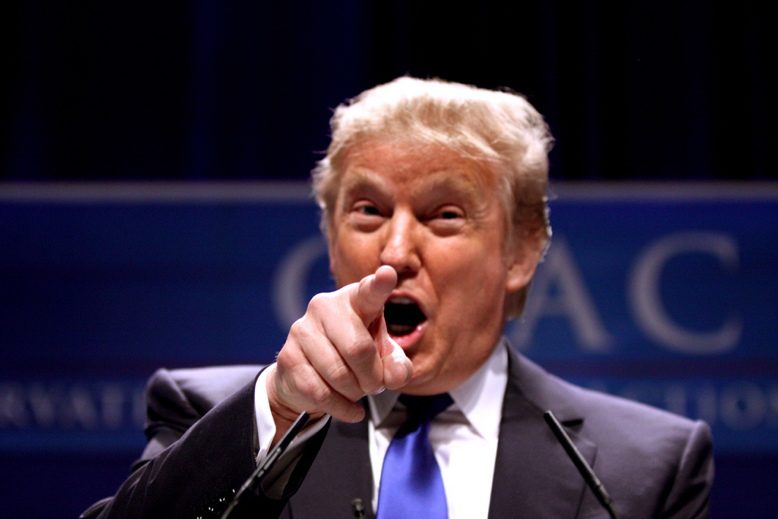
Donald Trump speaking at CPAC 2011 in Washington, D.C.
 
Photo courtesy of Flickr Creative Commons: Gage Skidmore.
Editor’s Note: This story first appeared in the November 1993 issue of New Jersey Monthly under the headline “Casinos and Indians.”
“Why is everybody talking about casinos?” asks a clearly annoyed John Running Deer, treasurer for the board of the New Jersey American Indian Center. “Why aren’t people interested in something positive about Indian culture?” Running Deer has spent twenty years promoting and enriching the study of Native American culture in New Jersey, and now people are calling him to ask about casinos. It is almost as if a rude tourist stopped Yeats on his way through Sligo town 70 years ago, while a poem about the ancient Celts rumbled through his brain, to ask him about his race’s supposed affinity for the drink.
But there is no avoiding the issue, even though the earnest and well-intentioned Running Deer prefers to focus the world’s attention on his people’s glorious and grief-stricken culture. American Indians, long stymied in their hope for a piece of the great American dream, have turned the tables on some of the wealthiest and most powerful interests in the nation. Those tables, as it happens, are blackjack tables, and the house is on a winning streak. The next victory may come in New Jersey.
Indian casinos are all the rage these days, thanks to federal legislation allowing Native Americans to run the establishments on their generally impoverished reservations. About 150 federally recognized tribes have some sort of gambling operations, and more are expected to follow, perhaps coming to a county near you. This does not sit well with some people in the Garden State, including a certain Atlantic City mogul named Donald Trump, who has filed a lawsuit against the Bureau of Indian Affairs seeking to overturn the federal law allowing Indian gaming. The suit was filed earlier this year in U.S. District Court in Newark.
Trump’s goal is to protect his turf. For there is in the Washington office of the Bureau of Indian Affairs 600 linear feet of genealogical data designed to prove that a small band of Passaic and Bergen County residents—The Ramapough Mountain People—are descendants of American Indians and are therefore entitled to federal recognition as a tribe. The Ramapoughs and two other New Jersey tribes already have state recognition, thanks to an act of the Legislature and the governor. But acknowledgement by the federal government is more coveted, because with official tribal status could come land. And upon that land in the Ramapo Mountains, some think, will rise the sort of gambling supermarkets that already are in operation in Connecticut and upstate New York.
The prospect has Atlantic City’s supporters talking as though they have had a vision of the Apocalypse, one in which the Four Horsemen are Native Americans carrying playing cards and bingo markers. To be sure, the stakes are enormous. Atlantic City’s casinos bring in $3 billion a year, and last year they generated $391 million in state and local tax revenue—a huge chunk of Trenton’s annual budget. Even if casinos have failed to return the city to its former glory, they still account for tens of thousands of jobs, and there are plans for a $700 million tourist corridor to link the casinos with downtown. All of that could be wiped out, casino advocates say, if Indians begin opening their own casinos in New Jersey.
By November 11, the Bureau of Indian Affairs must release its proposed finding on the Ramapoughs’ application for tribal status. Once that happens, all interested parties have 120 days to comment—either for or against the decision. The bureau’s assistant secretary will review the data and issue a final determination 60 days later. The bureau hands out one or two decisions each year.
But no matter what the federal government ultimately decides, someone is apt to appeal in this case, and the issue will then get another hearing before a review board. (Only three decisions have ever been appealed; one was decided for the tribe, one for the group that appealed, and one is still being heard.) Given the lengthy decision and appeals process and the slow wheels of government bureaucracy, the Ramapoughs probably won’t know for sure where they stand until some time next summer.
In the meantime, as the various parties await the federal government’s finding, the possibility of high-stakes bingo and blackjack coming to Passaic County, less than 25 miles from New York City, hasn’t inspired a particularly elevated public debate. Trump, until recently not known for his interest in anthropology, has taken to the airwaves to discredit the Ramapough people’s ancestral claim. In a conversation with radio wild man Don Imus in late spring, Trump said that he himself “might have more Indian blood than a lot of the so-called Indians that are trying to open up reservations. It’s a joke.” But after Imus said he was against Indian casinos in New Jersey, Trump couldn’t resist showing his sensitive side. “General George Custer was against it also, and look what happened to him,” Trump said.
A few weeks after the on-air conversation, U.S. senators Daniel Inouye (D-Hawaii) and John McCain (R-Arizona) ordered that a transcript be printed in the Congressional Record. Mind you, the two senators were not seeking to memorialize Trump’s wit, but were citing the interview as an example of “the kind of misinformation and misunderstanding…which have characterized discussions about Indian gaming,” according to McCain.
A touchy subject? No doubt about it. The timing couldn’t be worse, either. For just when mainstream America is finally beginning to show signs of acknowledging Native American culture and its unhappy history since the days of Columbus, along comes the casino dispute to muddy the waters. Thanks to the controversy over gambling, a claim to Indian blood is now suspect.
A growing number of New Jersey residents apparently have discovered their roots in the New World only recently. In the 1980 census, 8,176 residents claimed American Indian ancestry. In 1990, there were 14,500—an increase of 77 percent. Experts in ethnic studies attribute the increase to a greater appreciation and pride in Indian ancestry, thanks, no doubt, to the Dances With Wolves version of how the West was won. But Trump and others see a more insidious factor at work. They see not ethnic pride, but a scheme to make lots of money tax free. And there is a lot of money to be made. An Indian-built casino in remote Ledyard, Connecticut, featuring high-stakes poker and bingo is now among the nation’s most profitable, earning $20 million last June. A new casino near Syracuse hopes to duplicate the Connecticut success story, and it certainly has a chance. It is the only casino in the state of New York.
The Indian casinos in nearby states are, by Atlantic City and Las Vegas standards, pretty drab affairs. You won’t find Wayne Newton crooning a tune in some vulgar palace of pleasure. These casinos are strictly utilitarian. You don’t go to an Indian casino for light entertainment; you go there to gamble, usually in a hall the size of a shopping mall, with all the attendant charm.
There is a proposal to build such a facility in Vernon, near the Vernon Valley/Great Gorge resort. Great American Recreation Inc., which operates the resort, has offered to donate land to the Oklahoma-based Delaware tribe, whose roots are in New Jersey and other Northeastern states. The tribe would set up a reservation, and Great American Recreation would take care of the rest. Not surprisingly, critics, including U.S. representative Marge Roukema (R-Fifth District), see the proposal as just the sort of shady deal that Indian gaming encourages. The tribe’s former chief, Charles Keechi, was an enthusiastic proponent of Indian gaming, arguing that casinos bring in revenues which make up for the federal government’s neglect. “We tribes have to find ways to make up the shortfall, and gaming has provided much-needed money that we’re not getting from the government,” he said.
It is almost too glib to suggest that casinos may be to the long-suffering American Indians of the late twentieth century what firewater was a hundred years ago—an intoxicant designed to keep the native people pacified. Representative Robert Torricelli (D-Ninth District) has emerged as one of Washington’s leading opponents of the spread of Indian casinos, and he is among those who have drawn the firewater analogy. He has introduced legislation in Congress that will make it impossible for Indian casinos to open in New Jersey, unless the Indians wish to build in Atlantic City—an unlikely prospect. “New Jersey has 75,000 employees in casinos,” the congressman said. “It’s a $5 billion investment, and that employment and investment are at risk.”
Torricelli argued that Indian tribes not only enjoy a competitive advantage over the Trumps of the world—tribes are not taxed on the profits from casinos—but also are not subject to the stringent background checks and audits to which Atlantic City casino owners must submit. “There are no regulations to ensure that the games [on reservations] are honest,” Torricelli said.
American Indian reservations have hardly been economic-development engines, however. President Clinton himself has said, “Indian reservations have been kept dependent too long”—although he went on to describe gambling as a “lousy basis for an economy. Atlantic City would testify to the President’s opinion.
Still, with reservations scandalously neglected and often beset with chronic unemployment, the prospect of jobs and money is irresistible. In the case of the Ramapough people, though, the issue of casinos has been mixed up with a long-standing dispute over ancestry, and there seems to be no separating the two.
The Ramapough people played host last summer to the New Jersey American Indian Center’s annual powwow, which took place on a hard-baked field near the Ringwood Manor in the Ramapo Mountains. For a few dollars, which go to benefit Native American medical students, curious white folks got a chance to put themselves in Kevin Costner’s moccasins, wandering around a festival of Indian crafts, music and culture. The powwow had to overcome the resistance of locals, who anticipated “a big drunken party,” according to John Running Deer. When they discovered it was nothing of the kind, he says, residents and state officials welcomed them and invited the Indians to participate in other ethnic festivals around New Jersey.
As Running Deer—looking like Nehru in his plain brown suit, cornered cap, and sunglasses—explained the steps of dances handed down through generations, a contingent of New Jersey Indians gathered around a smoky fire to perform what looked like a conga line. Feathers flew, shawls swirled, and, in the distance, two visitors in shorts, polo shirts, gym socks, and sneakers captured the moment on their camcorders. Representatives of the Ramapough people came forward to accept gifts from Running Deer’s group, and in the glare of a noonday sun, the Ramapoughs—a spectacle of feather and buckskin—certainly looked like Indians.
The camcorders followed the dancers as a child, speaking Spanish to his parents, pointed to the curl of smoke rising from the fire. Beside him, a young couple gathered in front of a stroller; a yarmulke was perched on the father’s head. It was multiculturalism in action, and when Running Deer invited onlookers to join the Indians in a dance of friendship, there was a great rush followed by lots of laughter.
“You know,” said one of the guys, squinting through the lens of a video camera, “all these people ever did was fight for their homes. And look what happened to them.”
Are the Ramapough authentic Indians? The 3,000 people living in the hills above Mahwah and Ringwood say they are, and indeed use what they claim is an ancient spelling of Ramapo. Scholars have filled reams of paper attempting to answer the question, and the most prominent studies have not pleased the Ramapough leadership. The most commonly cited work on the subject, a book by historian David Cohen published nineteen years ago, concluded that the Ramapoughs were not direct descendants of New Jersey Indians but were, in fact, black or of mixed black-white ancestry.
The Ramapough people were furious, and it is interesting to note that a more recent, though much less exhaustive newspaper report described some of the Ramapoughs as blond-haired and blue-eyed.
Despite the controversy, the Ramapough Mountain People had a claim on Indian ancestry long before it became fashionable, not to mention potentially lucrative. That’s a point made by Roger Joslyn, a New York genealogist hired to help put together part of the Ramapough application to the Bureau of Indian Affairs, in defense of the Ramapoughs’ motives. “They began the application process in the 1970s,” he says, noting that the federal Indian Gaming Regulatory Act was passed in 1988. Joslyn worked for a year on the tribe’s genealogy, tracing individual roots back to the 1700s through personal records, government documents, and the like. He contends that the Ramapoughs are the descendants of the Munsee Indian tribe.
“It’s clear what happened,” Joslyn says of the Ramapough people. “As the Europeans grabbed up the land and didn’t find agreeable terms of living with the Indians, they forced them off the land by whatever means possible. But some [Indians] stayed behind and took to the hills in Ramapo. They were the ancestors of the present-day tribe.”
Not everybody agrees. Academics such as Herbert C. Kraft, director of Seaton Hall University’s Archaeological Research Center and Museum, have questioned the Ramapoughs’ claim on historical and anthropological grounds—an opinion that may carry weight in the federal government’s proceedings. The bulk of the New Jersey congressional delegation is opposed to the Ramapough application, and they made public their position during the summer. The timing was critical: The Bureau of Indian Affairs was finishing up its work and preparing to announce its proposed finding in the fall.
The Ramapough people fired back in kind, producing a letter to Interior Secretary Bruce Babbitt from eight congressmen (six of them from New York State) in support of the Ramapoughs. Two New Jersey representatives, Donald Payne (D-Tenth District) and Robert Menendez (D-Thirteenth District) broke with their colleagues and came out on behalf of the Ramapoughs.
Such clout and political savvy might seem incongruous with the public image of a neglected and poor would-be Native American tribe, but bear in mind that the Ramapoughs have retained the powerhouse, high-priced lobbyist Murphy and Associates to represent their cause. John Barry, a Newark-based attorney representing Trump in the federal lawsuit, did not let the lobbying firm’s work pass without comment. “It’s clear that somebody is behind the Ramapoughs. They have no money of their own,” he says. His observation is based on some precedent, since the Malaysian Gaming Group bankrolled the building of the Ledyard, Connecticut, casino. “Why is Murphy and Associates backing them all of a sudden?” Barry asks. Spokespeople for the lobbyist and the tribe would not talk about the case.
Barry says that Trump is not trying to prevent Indians from establishing casinos. He simply wants them to abide by the same rules that apply to other casino operators. And, Barry adds, Trump is ready to take his case to the Supreme Court if necessary. Meanwhile, he has become a lightning rod for Indian-gaming proponents, who call Torricelli’s legislation the Donald Trump Protection Act.
Congress, meanwhile, was preparing to consider the issue in the fall. A midsummer article in the National Journal, that Bible of the Beltway, anticipated a great struggle on Capitol Hill as gaming advocates and opponents wrestled with the proposed federal legislation.
While the battle rages in Washington, the buses still come rolling into Atlantic City, disgorging passengers who turn their eyes skyward at the neon-tipped monoliths along the Boardwalk beckoning them and their dollars. Two-thirds of these people are from out of state, says Tom Carver, president of the Casino Association of New Jersey, and about a third of them come from North Jersey—the potential customers for a casino in the Ramapo Mountains. Carver describes the Ramapoughs’ application as a “great concern,” as well it might be. “If casinos opened and they were not regulated as we are and paid no taxes as we do, it would undermine the entire northern part of our market,” he says. “In addition, it would force pressure on the New York Legislature to have casinos in the Catskills.”
Still, watching the Atlantic City crown strolling the Boardwalk between sessions in the gaming rooms, it is hard to imagine that they would settle for Indian-style gambling halls when they can mingle amid the glitz of Atlantic City. No Indian casino could hope to match the flashing signs advertising the likes of Barry Manilow and Johnny Mathis, or the bells and whistles of the giant gaming room of the gaudy Taj Mahal, where women in skimpy I Dream of Jeannie outfits fetch drinks.
Atlantic City, for all its faults, is an experience, and one not likely to be replicated. Where else can you sample the diverse delights of saltwater taffy, an all-you-can-eat buffet, Don Rickles, and blackjack within a matter of hours? Where else would you see a woman with no arms or legs playing “Amazing Grace” on a keyboard, flawlessly, using her tongue? Where else would a dark, windowless room be filled to capacity on a lovely summer’s afternoon?
Meanwhile, 150 miles or so to the north, the Ramapough people wonder if the federal government will recognize their claim to tribal ancestry. Their neighbors are left to speculate about how the remote Ramapo Mountains might change if the Ramapoughs get their wish. And the sleep of many an Atlantic City mogul is interrupted nightly by the specter of tour buses lining the narrow roads of Passaic County.
Read more Just For the Web, NJM Classics articles.