Search This Blog

Translate

Blog Archive

Middleboro Review 2

NEW CONTENT MOVED TO MIDDLEBORO REVIEW 2

Toyota

Since the Dilly, Dally, Delay & Stall Law Firms are adding their billable hours, the Toyota U.S.A. and Route 44 Toyota posts have been separated here:

Route 44 Toyota Sold Me A Lemon


Showing posts with label transfer of wealth. Show all posts

Saturday, September 12, 2015

Are Republican Voters this dumb?


A number of years ago, Greg Palast wrote a very simple explanation of Milton Friedman's flawed 'Trickle Down" economic theory [subsequently included on one of his great books]. 

I don't know how much simpler you could make it, yet a poorly educated Tea Bagger still sputtered with excuses. 

HERE: 

Tinker Bell Pinochet and the Fairy Tale Miracle of Chile


Paul Krugman. (photo: David Levene/eyevine/Redux)

Dynamic Voodoo

By Paul Krugman, The New York Times
12 September 15

e have a first score on the Jeb! tax plan — in answer to Matt O’Brien, I think we refer to this as the Bush! tax! cuts! It’s $3.4 trillion in lost revenue. But most of this will be made up through higher growth, Bush’s advisers, led by Glenn Hubbard, assure us.
And that’s highly credible, right? After all, Hubbard was a big booster of the Bush (as opposed to Bush!) tax cuts, which he assured everyone would lead to much faster growth and 300,000 jobs a month. He was especially proud of the 2003 tax cut.
And just look at the chart above, which compares private sector job creation after that pro-growth tax cut and after the job-killing 2013 Obama tax hike. As you can see — hmm, that doesn’t seem to go the right way, does it?


Data covering taxes and private sector jobs. (photo: The New York Times)


http://readersupportednews.org/opinion2/277-75/32355-dynamic-voodoo


It's Live on the HomePage Now:
Reader Supported News

FOCUS: Robert Reich | Jeb's Tax Plan: Welfare for the 1%
Robert Reich. (photo: Richard Morgenstein)
Robert Reich, Robert Reich's Facebook Page
Reich writes: "I've finally had a chance to review Jeb Bush's tax plan in detail. Frankly, I have never seen proposed such a huge transfer of income and wealth to the very top."
READ MORE


When do you abandon a Political Party that continues to screw you? 


Monday, December 9, 2013

Three Ways the Super-Rich Suck Wealth Out of the Rest of Us

And that doesn't consider the promotion of Predatory Gambling, the ultimate SCAM!

Published on Monday, December 9, 2013 by Common Dreams

Three Ways the Super-Rich Suck Wealth Out of the Rest of Us

 
The facts are indisputable, the conclusion painful. The wealthiest people in the U.S. and around the world have used the stock market and the deregulated financial system to lay claim to the resources that should belong to all of us.

This is not a matter of productive people benefiting from their contributions to society. This is a relatively small number of people extracting massive amounts of money through the financial system for accomplishing almost nothing.

1. They've Taken $1.6 Million Per Family in New Wealth Since the Recession
The richest 5% of American families each gained at least that much in five years, mostly from the stock market. Using data from Credit Suisse, the Economic Policy Institute, Pew Research, and the Census Bureau and two separate analyses (shown here and here), this extraordinary wealth grab can be calculated.

To briefly summarize, the richest 5% (six million households) own about two-thirds of the wealth, or about $10 trillion of the $15 trillion in financial wealth gained since the recession. That's $1,667,000 per household. Calculations based on alternate sources resulted in a gain of over $2 million per household.

It is noteworthy that most of their windfall came from stock market gains rather than from job-creating business ventures. The stock market has, once again, been forming an overblown bubble of wealth that does not reflect the relative degrees of productivity of workers around America. The market has more than doubled in value since the recession, and the richest 5% own about 80% of all non-pension stocks.

2. They Create Imaginary Money That Turns Real
The world's wealth has doubled in a little over ten years. The financial industry has, in effect, created a whole new share of global wealth and redistributed much of it to itself.

In the U.S., financial sector profits as a percentage of corporate profits have been rising steadily over the past 30 years. The speculative, non-productive, and fee-generating derivatives market has increased to an unfathomable level of over $1 quadrillion -- a thousand trillion dollars, twenty times more than the world economy.

With the U.S. driving the expansion of this great bubble of wealth, our nation has become the fifth-most wealth-unequal country in the world, while global inequality (between rather than within countries) has become even worse than for any one country. Just 250 individuals have more money than the total annual living expenses of almost half the world - three billion people.

3. They've Stopped Payment on Productive Americans
Reputable sources agree that the working class has not been properly compensated for its productivity, and that the "rent-seeking" behavior of the financial industry, rather than changes in technology, is extracting wealth from society.

As a result, our median inflation-adjusted household wealth has dropped from $73,000 to $57,000 in a little over 25 years. We've lost another five percent of our wealth since the recession.

Shockingly, only one out of four Americans, according to a survey by Bankrate.com, "have six months' worth of expenses for use in emergency, the minimum recommended by many financial
planning experts."

The End Result? That suction-like sound is the financial industry soaking up our country's wealth.

Monday, May 13, 2013

Beware of this Orwellian-named bill

Just when you think the Republicans in the House can't get more regressive, they disguise a plan that will eliminate overtime pay!


Please add your name in opposition to new a bill passed by House Republicans that would end overtime pay for American workers. Click here to sign the petition opposing the bill from Daily Kos and the Democratic Senatorial Campaign Committee.

In the latest shameful chapter of their war on workers, House Republicans passed the Orwellian-named “Working Families Flexibility Act,” which gives business owners the flexibility of not paying hourly workers a higher wage for overtime work.

This attempt to line the pockets of employers at the expense of workers is outrageous. When workers need to save money for health care, education, or other major life expenses, they often do it by putting in extra hours. Giving employers the opportunity to take away overtime pay could wreak havoc on our already struggling economy and minimize opportunities to enter the middle class.

Please click to here to sign the petition from Daily Kos and the Democratic Senatorial Campaign Committee opposing the end of mandatory overtime pay, and shaming House Republicans for passing such an offensive bill.

Keep fighting,
Chris Bowers, Daily Kos

Monday, January 7, 2013

The Charade

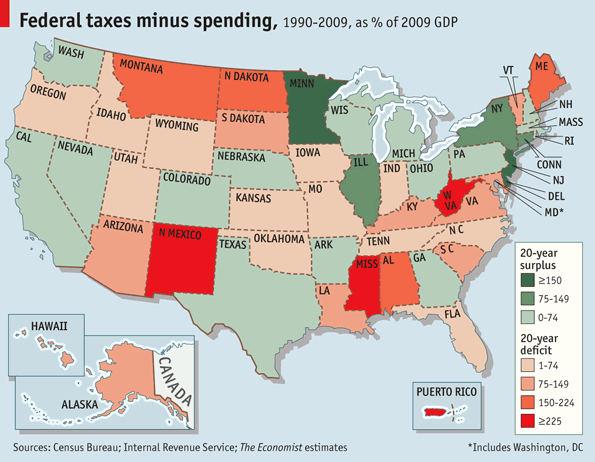
Even as Red States are voting against their best interests with their hands out and voting Tea Baggers into office, the charts below reveal the paradox.

It's always interesting to keep in mind when the Obstructionists stymie progress.


Most Red States Take More Money From Washington Than They Put In

Even as Republicans gripe about deficit spending, their states get 30 cents more federal spending per tax dollar than their Democratic neighbors.

States receiving the most federal funding per tax dollar paid:

1. New Mexico: $2.63
2. West Virginia: $2.57
3. Mississippi: $2.47
4. District of Colombia: $2.41
5. Hawaii: $2.38
6. Alabama: $2.03
7. Alaska: $1.93
8. Montana: $1.92
9. South Carolina: $1.92
10. Maine: $1.78


America's fiscal union

Blithe acceptance

Jun 25th 2012

IN A blogpost on Friday, Paul Krugman pointed out that income gaps between euro-members are no greater than income gaps between American states. The difference, he writes, is that
we think of ourselves as a nation, and blithely accept fiscal measures that routinely transfer large sums to the poorer states without even thinking of it as a regional issue
About a year ago The Economist had a go at calculating quite how large those blithe transfers were. We added up the federal taxes each state paid less the federal spending it received from 1990 to 2009. The results are here. Over a couple of decades, many states have indeed accumulated colossal nominal 'debts' to the union.

The state-by-state spending figures came from the Census Bureau's Consolidated Federal Funds report. Do you want to know which states got the lion's share of federal spending in the last fiscal year? Well if so, tough. The Consolidated Federal Funds report is no more. It was abolished to save cash. It seems the federal government does not have enough money to find out where its money is spent. That blithe acceptance is now blind.

http://www.economist.com/blogs/freeexchange/2012/06/americas-fiscal-union

http://www.economist.com/blogs/dailychart/2011/08/americas-fiscal-union


Tuesday, December 25, 2012

Bank rate-fixing scam

The LIBOR scandal may seem distant and unrelated, yet the 3 sentences below place the scam in perspective. The derivative market is more than 4 times World GDP that jeopardizes us all.

World GDP is around $70tn. The market in interest rate derivatives is worth $310tn. The idea that this has grown to such a scale because of the demands of the real economy better to manage risk is absurd.

Bank rate-fixing scandals reveal the rotten heart of capitalism

The magnitude of the banking scam must be realised and tough action taken

Will Hutton
  •  
     Swiss bank UBS  in Zurich
    The UBS building in Zurich. Photograph: Michael Buholzer/Reuters
     
    This is the year the consensus changed. Around the world, policy-makers, regulators and bankers recognised that the legacy of the 20-year credit boom up to 2008 is more corrosive than all but a few realised at the time. The bankers – and the theorists who justified their actions – made a millennial mistake. Navigating a way out of the mess was never likely to be easy, but it is made harder still by not recognising the magnitude of the disaster and the necessary radicalism involved if things are to be put right.

    If there were any last doubts they were dispelled by the record $1.5bn fine paid by the Swiss bank UBS for "pervasive" and "epic" efforts to manipulate the benchmark rate of interest – Libor – at which the world's great banks lend to each other. The manipulation was at the behest of the traders who buy and sell "interest rate derivatives", whose price varies with Libor, so that cumulatively billions of pounds of profits could be made. Nor was UBS alone. What is now evident is that all the banks that made the daily market in global interest rates in 10 major currencies were doing the same to varying degrees.

    There was a complete disdain for the banks' customers, for the notion of custodianship of other people's money, that was industry wide. It is hard to believe this culture has evaporated with the imposition of a fine. No banker falsifying the actual interest rates at which he or she was borrowing or lending, or trader who requested that they did so, had any sense that there is something sacred about banking – that the many billions flowing through their hands are not their own. It was just anonymous Monopoly money that gave them the opportunity to become very rich. The UBS emails, which will be used to support criminal charges, could hardly be more revealing. This was about making money from money for vast personal gain.

    Interest rate derivatives are presented as highly useful if complex financial instruments – essentially bets on future interest rate movements – that allow the banks' customers better to manage the risks of unexpected movements in interest rates. Whether a multinational or a large pension fund, you can buy or sell a derivative so you will not be embarrassed if suddenly interest rates jump or fall. Bookmakers lay off bets. Interest rate derivatives allow buyers to lay off the risk that their expectations of interest rate movements might be wrong.

    What makes your head reel is the size of this global market. World GDP is around $70tn. The market in interest rate derivatives is worth $310tn. The idea that this has grown to such a scale because of the demands of the real economy better to manage risk is absurd. And on top it has a curious feature.

    None of the banks that constitute the market ever loses money. All their divisions that trade interest rate derivatives on their own account report huge profits running into billions. Where does that profit come from?

    The answer is it comes largely from you and me. Global banking, intertwined with the global financial services and asset-management industry, has emerged as a tax on the world economy, generating much activity and lending that has not been needed, but whose purpose is to make those who work in it very rich. The centre-left thinktank IPPR reports that people with identical skills earn on average 20% more in financial services than in other industries, with the premium rising the higher the seniority. That wage premium does not come from virtuous hard work or enterprise. It comes from how finance is structured to deliver excessive profit.

    The Libor scam is an object lesson in how finance taxes the rest of the economy. Plainly, the final buyers of the mispriced interest rate derivatives could not have been other banks, otherwise they would have lost money and we know that they all made profits. In any case, they were part of the scam. The final buyers of the mispriced derivatives were their customers. Some must have been large companies, but many were those – ranging from insurance companies and pension funds to hedge funds – who manage our savings on our behalf.

    Here a second scam kicks in. One of the puzzles of modern finance is why the returns to those who buy shares in public stock markets are so much lower than the profits made by the companies themselves. One of the answers is that there are so many brokers, asset managers and intermediaries along the way all taking a cut. Sometimes it is through excessive management fees, but another way is not doing honest to God investing – choosing a good company to invest in and sticking with it – but through churning people's portfolios or unnecessarily buying interest rate derivatives to protect against interest rate risk, while charging a fee for the "service". Many of those mispriced interest rate derivatives will have ended up in the investment portfolios of large insurance companies and pension funds or, more sinisterly, in the portfolios of the banks' clients.


    Bank managements are presented as ignorant dolts, fooled by rogue traders. They were no such thing.

    The interest rate derivative market is many times the scale than is warranted by genuine demand precisely because it represented such an effective way of looting the rest of us. The business model of modern finance – banks trading on their own account in rigged derivative markets, skimming investment funds and manipulating interbank lending, all to underlend to innovative enterprise while overlending on a stunning scale to private equity and property – is not the result of a mistake. It represents a series of choices made over 30 years in which finance has progressively resisted any sense it has a duty of custodianship to its clients or wider responsibilities to the economy. It was capitalism allegedly at its purest. We now understand it was capitalism at its most rotten. It needs wholesale reform.

    The government's proposals to ringfence investment banking from the rest of a bank's activities, following the proposals from Sir John Vickers, is a start. But it is only that. Last week, Conservative MP Andrew Tyrie's cross-party parliamentary commission proposed " electrifying" the ringfence with the threat of full separation if malpractice continues. It also considered banning banks from trading in derivatives on their own account. But while tough, the commission should extend its brief.

    The issue is to create a financial system in its entirety that serves individuals and business alike, makes normal profits and, above all, embeds its public duty of custodianship in the bedrock of what it does. The government fears that more upheaval will unsettle banking and business confidence. It could not be more wrong. Reform is the platform on which a genuine economic recovery will be built.

    http://www.guardian.co.uk/commentisfree/2012/dec/23/banking-reform-ubs

    Friday, November 30, 2012

    Fast Food Forward

    These include LOW WAGE JOBS created by the Gambling Industry and supported, endorsed and promoted by short-sighted politicians.

    Gambling is simply a massive transfer of wealth and poor fiscal policy.
    Through social media, regular people across the nation made history by targeting Walmart for its anti-worker practices. After 6 weeks of sharing posts, photos, and memes, the Black Friday strike became the biggest MSM story and covered by Jon Stewart.

    Now we are focusing on the equally abusive fast-food industry as workers in NYC demand a living wage.
    SHARE if you stand in solidarity with fast-food workers and help make history!
    [020] Through social media, regular people across the nation made history by targeting Walmart for its anti-worker practices.  After 6 weeks of sharing posts, photos, and memes, the Black Friday strike became the biggest MSM story and covered by Jon Stewart. 

Now we are focusing on the equally abusive fast-food industry as workers in NYC demand a living wage.
SHARE if you stand in solidarity with fast-food workers and help make history!
Get connected to the campaign by liking the page @[430475173680811:274:Fast Food Forward]!!
    ‎[020] Through social media, regular people across the nation made history by targeting Walmart for its anti-worker practices. After 6 weeks of sharing posts, ...
    photos, and memes, the Black Friday strike became the biggest MSM story and covered by Jon Stewart.

    Now we are focusing on the equally abusive fast-food industry as workers in NYC demand a living wage.
    SHARE if you stand in solidarity with fast-food workers and help make history!
    Get connected to the campaign by liking the page Fast Food Forward!!