Search This Blog

Translate

Blog Archive

Middleboro Review 2

NEW CONTENT MOVED TO MIDDLEBORO REVIEW 2

Toyota

Since the Dilly, Dally, Delay & Stall Law Firms are adding their billable hours, the Toyota U.S.A. and Route 44 Toyota posts have been separated here:

Route 44 Toyota Sold Me A Lemon


Showing posts sorted by relevance for query nuclear power. Sort by date Show all posts

Saturday, March 12, 2011

There are no words of solace

that can be offered in the wake of the earthquake and tsunami that have devastated Japan. Untold numbers have been killed and families, lives, villages destroyed.

The rescue is overwhelming.

Our thoughts and prayers go out to those who have suffered and rescuers working to save those who may be trapped.

What we do know is that the nuclear reactors, proclaimed as 'safe' and capable of withstanding calamity of this magnitude, threaten us all by spewing invisible clouds of contaminants far and wide.


Official: 'We see the possibility of a meltdown' --Radioactive cesium, radioactive iodine in the air Saturday night 13 Mar 2011 A meltdown may be under way at one of Fukushima Daiichi's nuclear power reactors in northern Japan, an official with Japan's Nuclear and Industrial Safety Agency told CNN Sunday. "There is a possibility, we see the possibility of a meltdown," said Toshihiro Bannai, director of the agency's international affairs office, in a telephone interview from the agency's headquarters in Tokyo. "At this point, we have still not confirmed that there is an actual meltdown, but there is a possibility." Though Bannai said engineers have been unable to get close enough to the core to know what's going on, he based his conclusion on the fact that they measured radioactive isotopes in the air Saturday night.


Japan's TEPCO preparing to release radiation from second reactor

Tokyo Electric Power Co has begun preparation to release radioactive steam from a second reactor at its quake-struck Fukushima Daiichi nuclear power facility, a spokesman said on Sunday. The TEPCO spokesman said preparation work for the release began at 7:30 a.m. (5:30 p.m. EST). An official from Japan's nuclear safety watchdog said earlier on Sunday that it had received a report from Japan's largest power producer at 5:10 a.m. that the facility's No. 3 reactor had completely lost its emergency cooling function.

Emergency at second reactor, Japan's nuclear agency reports

Japan's nuclear safety agency is reporting an emergency at a second reactor in the same complex where an explosion had occurred earlier. The Nuclear and Industrial Safety Agency said early Sunday that the cooling system malfunctioned at Unit 3 of the Fukushima Dai-ichi nuclear plant. The agency said it was informed of the emergency by Tokyo Electric, the utility which runs the plant.

Second nuclear reactor at Japanese power plant loses emergency cooling --Authorities scrambling to prevent possible meltdown, radiation release

A new danger arose late Saturday at the nuclear power plant damaged by the strongest earthquake in Japan’s history when a second reactor lost its emergency cooling system, widening the possibility of a core meltdown and radiation release. That came as government and power company officials were resorting to an unprecedented measure -- flooding it with seawater -- to stabilize the reactor that had lost its emergency cooling system earlier Saturday local time.

Meltdown Caused Nuclear Plant Explosion: Safety Body --

Cesium and iodine, by-products of nuclear fission, were detected around the plant. 13 Mar 2011 The Nuclear and Industrial Safety Agency (NISA) said Saturday afternoon the explosion at the Fukushima No. 1 nuclear plant could only have been caused by a meltdown of the reactor core. The same day, Tokyo Electric Power Co., which runs the plant, began to flood the damaged reactor with seawater to cool it down, resorting to measures that could rust the reactor and force the utility to scrap it. An explosion was heard near the plant's No. 1 reactor about 3:30 p.m. and plumes of white smoke went up 10 minutes later. The ceiling of the building housing the reactor collapsed, according to information obtained by Fukushima prefectural authorities.

Meltdown May Be In Progress At Fukushima No. 1 Nuke Plant

A meltdown of the reactor core may be in progress at Tokyo Electric Power Co.'s No. 1 nuclear power plant in Fukushima Prefecture, which was hit by a devastating earthquake on Friday, the Japan's nuclear safety agency said at 2 p.m. Saturday. The Nuclear and Industrial Safety Agency made the announcement as cesium and iodine, two by-products of nuclear fission, were detected near the plant. If a meltdown of the reactor core is confirmed, it would be the worst-ever nuclear accident in Japan and the first time a meltdown has occurred in the country.

Up to 160 may have radiation exposure in Japan nuclear accident

The number of individuals exposed to radiation from the quake-hit Fukushima nuclear power plant in northeastern Japan could reach as high as 160, an official of Japan's nuclear safety agency said on Sunday. Nine individuals had already shown possible exposure to radiation from the plant, based on information from tests by municipal authorities and other sources, and estimates from the authorities suggested the figure could rise as high as 70 to 160, the official from the Japan Nuclear and Industrial Safety Agency told a news conference.

Japan to distribute iodine among people

Japan has informed the UN nuclear body that following an explosion in a nuclear power plant, it plans to distribute anti-radioactive medicine to the people in the area. Earlier on Saturday, an explosion occurred in Fukushima Daiichi nuclear power plant, blowing the roof off one facility and destroying its walls. The explosion led to the increase of radiation leak and has caused fears of a meltdown as the radioactivity in the area is now 20 times higher than normal levels.

Moment we feared another Chernobyl: Thousands undergo radioactive screening after explosion in nuclear power station

Thousands undergo radioactive screening after explosion in nuclear power station --Three workers treated for radiation sickness after explosion in reactor building --Authorities evacuate thousands of people from 12-mile radius of plant --People offered iodine to help protect against radiation exposure --Plant's cooling systems damaged by earthquake 12 Mar 2011 People were evacuated within a 12-mile radius after an explosion at one of Japan's nuclear power plants. The building housing one of Fukushima Dai-ichi's reactors was destroyed in the blast and a cloud of white smoke could be seen pouring from it. Four workers suffered fractures in the explosion, and three were treated for the symptoms of radiation sickness.

Japan evacuees scanned for radiation

Evacuees are scanned to check for possible exposure to radiation resulting from an explosion at the Fukushima Daiichi nuclear power plant in Japan, after an 8.9 magnitude earthquake shook the region. (CBS News video)

Agency forecasts 10% chance of radioactive fallout hitting Taiwan

The chances of radioactive fallout from two Japanese nuclear power plants crippled by Friday's massive earthquake are not high, the Cabinet-level Atomic Energy Council said yesterday in a statement. If two plants in Japan's Fukushima prefecture release large amounts of radiation, the probability of it reaching Taiwan is only 10 percent, the council predicted. The area most likely to fall victim to radiation from Japan would be Taiwan's northeastern coast and Monday would be when it would most likely arrive, the council said.

Exodus from Japan nuclear plant
An estimated 170,000 people have been evacuated from the area around a quake-damaged nuclear power station in north-east Japan that was hit by an explosion, the UN atomic watchdog says. A building housing a reactor was destroyed in Saturday's blast at the Fukushima No.1 plant... On Sunday morning, concerns were raised about the safety of a second reactor at the plant after operator Tokyo Electric Power (Tepco) said the cooling system of another reactor had failed.

Japan evacuates 50,000 after nuclear power plant explosion --NHK:
At least three residents among 90 tested showed excess exposure to radiation 12 Mar 2011 More than 50,000 people were evacuated Saturday after an explosion at a Japanese nuclear plant hurled plumes of smoke over the Pacific Ocean... Japanese authorities hastened to assure the public there was no danger of a meltdown at the Fukushima Daiichi plant along the lines of the 1986 disaster at the Chernobyl nuclear plant in Ukraine, but they were unable to explain why excess levels of radiation were detected outside the plant's grounds. Japan's NHK television reported that at least three residents among 90 tested at random showed excess exposure to radiation.

Japan expands evacuation around nuclear power plant
The Japanese government said on Saturday it has expanded the evacuation area around the Fukushima Daiichi nuclear power plant to a 20 kilometre radius from 10 km.

'1,000 dead' in Japan quake; nuke plants overheat
More than 1,000 people were feared dead and authorities scrambled to prevent meltdown at two nuclear plants after a monster tsunami devastated a swathe of northeast Japan. Reactor cooling systems failed after Friday's record 8.9-magnitude earthquake hit, unleashing a terrifying 10-metre (33-foot) high wave that tore through coastal towns and cities and destroying all in its path. Radiation 1,000 times above normal was detected in the control room of one nuclear plant, although authorities said levels outside the facility's gates were only [!?!] eight times above normal.

Monday, March 18, 2013

Nuclear Makes No Sense!

In the shadow of the local publicity Pilgrim Nuclear is gathering, the articles below appeared, highlighting the power, risks and short-sighted folly of Nuclear Energy.

We already know wind and solar are much cheaper than Nuclear and don't present the inherent risks.


Record cesium level detected in fish caught near Fukushima nuclear plant 16 Mar 2013 Tokyo Electric Power Co. said Friday it detected a record 740,000 becquerels per kilogram of radioactive cesium in a fish caught in waters near the crippled Fukushima Daiichi Nuclear Power Station, equivalent to 7,400 times the state-set limit deemed safe for human consumption. The greenling measuring 38 cm in length and weighing 564 grams was caught near a water intake of the four reactor units in the power station’s port on Feb. 21 during the utility’s operation to remove fish from the port. Tepco has installed a net on the sea floor of the port exit in Fukushima Prefecture to make it hard for fish living near the sediments of contaminated soil to go elsewhere.

Obama announces $2B corporate welfare for nuclear power and 'green' technology research 15 Mar 2013 President Barack Obama returned to Chicago Friday to push an energy policy aimed at weaning the country off of oil by using revenues from increased oil and gas production. In a roughly 20-minute speech at Argonne National Laboratory, Obama touched on research into batteries, natural gas, wind, solar and nuclear power that he deemed vital to America having a long-term healthy economy and environment. As part of his administration's overall plan, Obama also formally introduced a proposal to establish a $2 billion trust from royalties the government receives from offshore drilling [to turn over to his nuclear power corpora-terrorist cronies].


Nuclear boss wants to cut family fuel aid --Chief of French company poised to build reactors in Britain also argues against European subsidies for renewable energy 17 Mar 2013 The boss of a company set to build two nuclear reactors in Somerset has been demanding cuts to renewable energy subsidies and to help for people in fuel poverty while quietly lobbying the European Commission for financial help for new nuclear power stations. Areva, which is part owned by the French state, has signed a contract to build nuclear reactors for EDF, another French company, at Hinkley Point. If it goes ahead, it will be the first new nuclear power plant in Britain for a generation.


Sealed 'black cells' stall radioactive waste cleanup at Hanford nuclear reservation 16 Mar 2013 In the late-1990s, the Hanford nuclear reservation's British contractor designed the world's largest nuclear waste treatment plant around a fateful feature: "black cells." Fifteen years, a new set of contractors corpora-terrorists and $8 billion of construction later, the U.S. Department of Energy is still trying to figure out whether they'll work. The cells, enormous concrete boxes lined with stainless steel, will hold mixing silos to process waste from 44 years of making plutonium for nuclear bombs. They'll be highly radioactive and inaccessible to humans for the treatment plant's life. They're also central to Hanford's [insane] plans to treat 56 million gallons of nuclear waste stored in 177 underground tanks. Recent disclosures of fresh leaks in six of those tanks, a half-dozen miles from the Columbia River, has brought renewed urgency to finishing the treatment plant, already delayed by two decades.

US Nuclear Regulatory Commission to hold public meeting on Pilgrim Nuclear April 2

Pilgrim's safety performance in 2012 is topic of discussion

Tuesday, June 24, 2008

Nuclear: A Solution?

A number of people have suggested that nuclear is the solution to our energy problems and global warming. RMI offers the following (full reports available on links):

RMI :
Nuclear Power
RMI's position on nuclear power is that:


It's too expensive. Nuclear power has proved much more costly than projected — and more to the point, more costly than most other ways of generating or saving electricity. If utilities and governments are serious about markets, rather than propping up pet technologies at the expense of ratepayers, they should pursue the best buys first.

Nuclear power plants are not only expensive, they're also financially extremely risky because of their long lead times, cost overruns, and open-ended liabilities.

Contrary to an argument nuclear apologists have recently taken to making, nuclear power isn't a good way to curb climate change. True, nukes don't produce carbon dioxide — but the power they produce is so expensive that the same money invested in efficiency or even natural-gas-fired power plants would offset much more climate change.

And of course nuclear power poses significant problems of radioactive waste disposal and the proliferation of potential nuclear weapons material. (However, RMI tends to stress the economic arguments foremost because they carry more weight with decision-makers.)
.
Forget Nuclear
Nuclear power, we’re told, is a vibrant industry that’s dramatically reviving because it’s proven, necessary, competitive, reliable, safe, secure, widely used, increasingly popular, and carbon-free—a perfect replacement for carbon-spewing coal power. New nuclear plants thus sound vital for climate protection, energy security, and powering a growing economy.

There’s a catch, though: the private capitalmarket isn’t investing in new nuclear plants, and without financing, capitalist utilities aren’t buying. The few purchases, nearly all in Asia, are all made by central planners with a draw on the public purse. In the United States, even government subsidies approaching or exceeding new nuclear power’s total cost have failed to entice Wall Street.

This non-technical summary article compares the cost, climate protection potential, reliability, financial risk, market success, deployment speed, and energy contribution of new nuclear power with those of its low- or no-carbon competitors. It explains why soaring taxpayer subsidies aren’t attracting investors. Capitalists instead favor climate-protecting competitors with less cost, construction time, and financial risk. The nuclear industry claims it has no serious rivals, let alone those competitors—which, however, already outproduce nuclear power worldwide and are growing enormously faster. RMI

Wednesday, October 16, 2013

Updated: Pilgrim Nuclear Station taken offline Monday night

Because of the Republican Government Shutdown, information about the Pilgrim Nuclear shutdown remains vague.

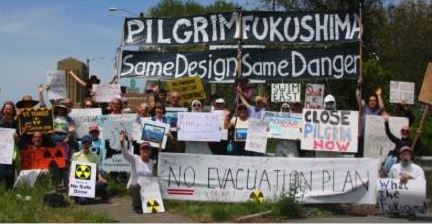
Pilgrim Nuclear and Vermont Yankee, both operated by Entergy, are of the same age and same General Electric design as Fukushima.

No evacuation plan exists for Pilgrim.


Plymouth nuke plant offline after electric line goes down
 
PLYMOUTH — The Pilgrim Nuclear Power Station ran on generator power after one of two power lines went down Monday night but NStar's equipment was expected to be brought back online by 8:30 p.m. Tuesday, according to an NStar spokesman.
 
The plant automatically went offline at 9:21 p.m. Monday after it lost one of its two 345-KV lines, owned by NStar, which provides off-site power to the plant, according to a statement from Carol Wightman, the spokeswoman for Entergy, the company that owns and operates the Pilgrim plant.
 
The shutdown occurred after an NStar pole at a substation in Carver, which was installed in May, broke, NStar spokesman Michael Durand said.
 
A large area of eastern Massachusetts, including some customers on Cape Cod, experienced flickering power after the pole went down, but there were no power outages. The transmission lines and equipment damaged Monday were expected to be fixed by 6:30 p.m. Tuesday and brought back on line by 8:30 p.m., Durand said.
 
Last week, NStar removed the other line from use as part of a coordinated "routine, seasonal" maintenance project with Pilgrim and National Grid, he said.
 
Wightman would not comment on the operating level of the plant while it was under maintenance.
 
But a spokesman for the federal Nuclear Regulatory Commission told the Times he believed the plant reduced power output to below 50 percent while it flushed organic material off the water condensers for the reactor in a process called "thermal back-washing."
 
The plant was running on its emergency diesel generators, which "immediately started and are safely powering the plant," Wightman's statement Tuesday read. There is no impact on the health and safety of employees or the public from the shutdown, she added.
 
While the plant is shutdown, workers will "take advantage of this time to perform maintenance that cannot be done while the plant is operating," she said.
 
Pilgrim has been shut down several times in the past few months for various reasons.
 
A heat wave in July reduced the plant's output by 15 to 25 percent when water temperatures in Cape Cod Bay, which is used to cool Pilgrim's systems, went above those allowed under the plant's federal license.
 
Then, starting Aug. 22, there was a monthlong trend of shutdowns and partial power-downs. The plant wasn't restored to full service until Sept. 18.
 

Pilgrim Nuclear Station taken offline Monday night

Auto shutdown occurred after offsite power to plant was lost

Wednesday, October 14, 2015

Finally rid of Pilgrim Nuclear?


Entergy president: decision to close Pilgrim 

was "an agonizing one"

Plans move attend to shutdown and eventually decommission the Plymouth nuclear facility
- See more at: https://www.capecodtoday.com/article/2015/10/13/226590-Entergy-president-decision-close-Pilgrim-was-agonizing-one#sthash.mijZimt8.dpuf

Entergy, the Louisiana-based company that owns the Pilgrim Nuclear Power Plant followed up the announcement that they will be closing the facility with a press conference Tuesday afternoon. Entergy Wholesale Commodities President Bill Mohl opened the press conference by calling the decision to close the nuclear power plant both difficult and agonizing. "The economics are too challenging to keep the plant operating," Mohl said.
Mohl said Entergy first notified ISO New England, Inc. last night that they will no longer participate as a capacity resource proving power to the grid. Monday was the deadline imposed by ISO New England, Inc. if Entergy would not be recontracting for June 2019. According to Mohl, the 633 employees of Pilgrim were the next to be informed of the company's decision to shutdown the plant before June 2019. 
Before setting a start of shutdown date, Entergy will first have to decide if the Spring 2017 refueling outage will take place. Should the company decide to not go through with the biennial refueling outage, the plant could be shutdown even sooner.
Changes in pricing and rules in the energy market are the greatest contributors to Entergy's decision. Mohl cited the dropping price of natural gas and the state and federal governments's failure to acknowledge the clean energy provided the nuclear power. Mohl also said Massachusetts subsidizes other energies at the expense of Pilgirm, which undermines a competitive market and continually puts Pilgrim on the losing end.
Entergy maintains that the recent drop from Column 3 to Column 4 in the Nuclear Regulatory Commission's Action Matrix and the resulting enhanced oversight mandated by the federal agency are not the reasons for the closure. 
According to Mohl, current staffing levels will remain approximately the same until the shutdown. Once the shutdown occurs, the staff will be reduced by half and as the decommissioning process begins, the staff will continue to shrink. Following the shutdown at the Vermont Yankee Nuclear Power Station in 2014, some employees retired, while roughly 100 employees were transferred to other Entergy-owned facilities including Pilgrim. 
When asked if there is anything that could make Entergy reconsider the shutdown, Mohl said the notification to ISO New England eliminated the possibility of reversing the decision.
Following shutdown, spent fuel will be removed and stored onsite in the dry cask system. Entergy will then wait to see if the government makes a decision regarding the Yucca Mountain Nuclear Waste Repository. As mandated by the NRC, Entergy will have 60 years to decommission the Pilgrim site. A completed decommissioning includes the disassembly of the entire site. 
Following Entergy's initial announcement, Governor Charlie Baker said, "Our Administration will work closely with Pilgrim’s leadership team and federal regulators to ensure that this decision is managed as safely as possible, and we will continue to work with ISO and the other New England Governors to ensure that Massachusetts and New England has the baseload capacity it needs to meet the electric generation needs of the region," Governor Charlie Baker said in a statement Tuesday morning.
The decision to close the plant will also have a significant impact on the Town of Plymouth. According to the Pilgrim website, a study conducted by the University of Massachusetts showed the station pays almost $10 million in state and local taxes and makes $10 million in direct payments to the Town of Plymouth each year in addition to other economic contributions to the community.
- See more at: https://www.capecodtoday.com/article/2015/10/13/226590-Entergy-president-decision-close-Pilgrim-was-agonizing-one#sthash.mijZimt8.dpuf


Pilgrim Nuclear Power Plant to close by June 2019

- See more at: https://www.capecodtoday.com/article/2015/10/13/226571-Pilgrim-Nuclear-Power-Plant-close-June-2019#sthash.VQAdaZjy.dpuf

Entergy announced today that it will close the Pilgrim Nuclear Power Plant in Plymouth no later than June 1, 2019. In a release, the energy company cited poor market conditions, reduced revenues and increased operational costs. Entergy informed ISO New England, Inc, the independent system operator of the electric grid of their plans, saying Pilgrim would no longer participate as a capacity resource in the market.
The exact date of the shutdown will depend on several factors and will be decided early in 2016, the release said. The Pilgrim facility generates enough electricity to power more than 600,000 homes.
"The decision to close Pilgrim was incredibly difficult because of the effect on our employees and the communities in which they work and live," said Entergy Chairman and Executive Officer Leo Denault. More than 600 people are employed at the plant.
Last month, the United States Nuclear Regulatory Commission announced that Pilgrim had slid from Column 3 to Column 4 of the NRC's Action Matrix. The plant was downgraded following an inspection report. The plant has experienced several unplanned shutdowns or scrams over the past year prompting increased oversight by the NRC. Recently, on two separate and unrelated occasions, Pilgrim employees failed fitness-for-duty tests.
Pilgrim and its owner Entergy continue to be hounded by several grassroots organizations and politicians including the very vocal State Senator Dan Wolf who has called for the plant's closure. Tuesday morning, the group Cape Downwiders announced a speak out against Pilgrim at the State House in Boston on October 22, the focus of which will undoubtedly change.
Following shutdown, the plant will transition to decommissioning, the release said. Entergy closed the Vermont Yankee Nuclear Power Station in Vernon, VT in December 2014. At that time, the company cited similar reasons to those given for the anticipated Pilgrim closure. Many of the employees at the Yankee plant were transferred to Pilgrim.
“Our Administration will work closely with Pilgrim’s leadership team and federal regulators to ensure that this decision is managed as safely as possible, and we will continue to work with ISO and the other New England Governors to ensure that Massachusetts and New England has the baseload capacity it needs to meet the electric generation needs of the region," Governor Charlie Baker said in a statement Tuesday morning. "Losing Pilgrim as a significant power generator not only poses a potential energy shortage, but also highlights the need for clean, reliable, affordable energy proposals which my administration has put forward through legislation to deliver affordable hydroelectricity and Class-I renewable resources.  The closure of Pilgrim will be a significant loss of carbon-free electricity generation and will offset progress Massachusetts has made in achieving the 2020 greenhouse gas emission reduction goals, making it more challenging to hit these targets.  I look forward to working with the legislature to make our proposal for clean, base-load generation law, as it represents a diversified and balanced approach that will be needed to achieve the commonwealth's greenhouse gas goals.”
Entergy will hold a press conference in Plymouth at noon today to discuss their decision. Entergy Wholesale Commodities President Bill Mohl will address the media at that time.
- See more at: https://www.capecodtoday.com/article/2015/10/13/226571-Pilgrim-Nuclear-Power-Plant-close-June-2019#sthash.VQAdaZjy.dpuf

When one fails to comprehend a complex issue that better educated people, especially 'experts,' are proposing, it is always wise to consider that just maybe, rather than attacking those people, you conduct some research.
Asteroid Miner, You are grossly mistaken about nuclear never killing anyone in the US.
The cost of protection is a pittance compared to some of the major repairs required.
In addition, it might seem that Entergy's safety record is questionable. 
Entergy owns and operates other facilities equally as challenged.
Entergy has had problems at Indian Point and lost fuel rods at Vermont Yankee. 
How do you loose fuel rods?
Pilgrim Nuclear is an antique of the same design and age as Fukushima. 
It was constructed to last 25 years and that in itself should give one pause.
Recently, funding was cut to study health risks of those living within close proximity of a nuclear power plant. Why? To conceal the truth?
Too much has been written about the costs and risks of nuclear power.
Nuclear Energy is 100% tax payer guaranteed, subsidized and protected. 
The Nuclear Industry has spent GAZILLIONS to assure that generous protection. 
They got what they paid for!


Below is an excerpt from an article posted in 2013. 
The cost figures for Wind and Solar have significantly changed.

From Nuclear:

Consider this -- Nuclear Energy costs

$7,500 per kilowatt to buildThat’s more than double the capital costs for solar power and three and a half times the cost for wind.

the most heavily subsidized industry in the energy sector.

In 2005, Congress handed the nuclear power industry $13 billion in federal aid, and two years later went on to approve an additional $20.5 billion in loan guarantees, making U.S. taxpayers the cosigners on loans for new nuclear projects -- half of which are expected to end in defaults.

Wind is already more competitive than electricity generated from new nuclear and coal-fired power plants.

Tuesday, June 28, 2011

Japan’s Meltdowns Demand New No-Nukes Thinking

Another perspective on nuclear power:

Japan’s Meltdowns Demand New No-Nukes Thinking

http://www.truthdig.com/report/item/japans_meltdowns_demand_new_no-nukes_thinking_20110621/

By Amy Goodman

New details are emerging that indicate the Fukushima nuclear disaster in Japan is far worse than previously known, with three of the four affected reactors experiencing full meltdowns. Meanwhile, in the U.S., massive flooding along the Missouri River has put Nebraska’s two nuclear plants, both near Omaha, on alert. The Cooper Nuclear Station declared a low-level emergency and will have to close down if the river rises another 3 inches. The Fort Calhoun nuclear power plant has been shut down since April 9, in part due to flooding. At Prairie Island, Minn., extreme heat caused the nuclear plant’s two emergency diesel generators to fail. Emergency-generator failure was one of the key problems that led to the meltdowns at Fukushima.

In May, in reaction to the Fukushima disaster, Nikolaus Berlakovich, Austria’s federal minister of agriculture, forestry, environment and water management, convened a meeting of Europe’s 11 nuclear-free countries. Those gathered resolved to push for a nuclear-free Europe, even as Germany announced it will phase out nuclear power in 10 years and push ahead on renewable-energy research. Then, in last week’s national elections in Italy, more than 90 percent of voters resoundingly rejected Prime Minister Silvio Berlusconi’s plans to restart the country’s nuclear power program.

Leaders of national nuclear-energy programs are gathering this week in Vienna for the International Atomic Energy Agency’s Ministerial Conference on Nuclear Safety. The meeting was called in response to Fukushima. Ironically, the ministers, including U.S. Nuclear Regulatory Commission (NRC) Chairman Gregory Jaczko, held their meeting safely in a country with no nuclear power plants. Austria is at the forefront of Europe’s new anti-nuclear alliance.

The IAEA meeting was preceded by the release of an Associated Press report stating that consistently, and for decades, U.S. nuclear regulators lowered the bar on safety regulations in order to allow operators to keep the nuclear plants running. Nuclear power plants were constructed in the U.S. in the decades leading up to the Three Mile Island disaster in 1979. These 104 plants are all getting on in years. The original licenses were granted for 40 years.

The AP’s Jeff Donn wrote, “When the first ones were being built in the 1960s and 1970s, it was expected that they would be replaced with improved models long before those licenses expired.” Enormous upfront construction costs, safety concerns and the problem of storing radioactive nuclear waste for thousands of years drove away private investors. Instead of developing and building new nuclear plants, the owners—typically for-profit companies like Exelon Corp., a major donor to the Obama campaigns through the years—simply try to run the old reactors longer, applying to the NRC for 20-year extensions.

Europe, already ahead of the U.S. in development and deployment of renewable-energy technology, is now poised to accelerate in the field. In the U.S., the NRC has provided preliminary approval of the Southern Company’s planned expansion of the Vogtle power plant in Georgia, which would allow the first construction of new nuclear power plants in the U.S. since Three Mile Island. The project got a boost from President Barack Obama, who pledged an $8.3 billion federal loan guarantee. Southern plans on using Westinghouse’s new AP1000 reactor. But a coalition of environmental groups has filed to block the permit, noting that the new reactor design is inherently unsafe.

Obama established what he called his Blue Ribbon Commission on America’s Nuclear Future. One of its 15 members is John Rowe, the chairman and chief executive officer of Exelon Corp. (the same nuclear-energy company that has lavished campaign contributions on Obama). The commission made a fact-finding trip to Japan to see how that country was thriving with nuclear power—one month before the Fukushima disaster. In May, the commission reiterated its position, which is Obama’s position, that nuclear ought to be part of the U.S. energy mix.

The U.S. energy mix, instead, should include a national jobs program to make existing buildings energy efficient, and to install solar and wind-power technology where appropriate. These jobs could not be outsourced and would immediately reduce our energy use and, thus, our reliance on foreign oil and domestic coal and nuclear. Such a program could favor U.S. manufacturers, to keep the money in the U.S. economy. That would be a simple, effective and sane reaction to Fukushima.

Denis Moynihan contributed research to this column.

Amy Goodman is the host of “Democracy Now!,” a daily international TV/radio news hour airing on more than 900 stations in North America. She is the author of “Breaking the Sound Barrier,” recently released in paperback and now a New York Times best-seller.

© 2011 Amy Goodman

Distributed by King Features Syndicate

Saturday, May 26, 2012

Congressman Bill Keating responds to Pilgrim relicensing


Keating calls for a moratorium on nuclear power plant licenses, license extensions

The Nuclear Regulatory Commission (NRC) announced today that it has authorized the relicensing of Pilgrim Nuclear Power Plant. Below is Rep. Bill Keating’s statement in response in a press release today:

His legislation also calls for a moratorium on nuclear power plant licenses, license extensions, and new nuclear reactor designs until an overhaul of nuclear safety to address the inadequacies exposed by the Fukushima meltdowns is completed. “I am disappointed that the NRC took a vote to relicense Pilgrim Nuclear Power Plant despite the fact that there are unresolved administrative proceedings and judicial appeals outstanding. It sets a dangerous precedent and highlights the fact that our current system for relicensing our nuclear power plants is in desperate need of reform. The men and women who work to keep Pilgrim operational and safe are undoubtedly some of the best, but what does today’s vote say for the plants across the nation that have yet to go through Post-Fukishima upgrades and have been operational for decades now? While it is not safe for a nuclear plant to be under extended operation status without a renewed license, it is equally unsafe to relicense when ongoing issues exist or without updates being fully implemented. Our current relicensing process allows for both scenarios to happen.
The current license for Pilgrim Nuclear Power Station expires in June 2012, and Entergy Nuclear Operations, Inc., the operator of the facility, has requested permission to continue operating the plant for another 20 years.
On May 4, 2012, Reps. Keating and Markey sent a letter to NRC Chairman Greg Jaczko urging the Commission not to move forward with its decision on whether to issue the twenty-year license extension for Pilgrim until there is a final resolution on all related administrative proceedings and judicial appeals. In their letter to the NRC, Reps. Markey and Keating wrote that “To do otherwise would send an alarming message to all residents living near America’s 104 nuclear power plants who are attempting to have an impact on a critical decision that will affect their lives for decades.”

Rep. Keating is also a cosponsor of H.R. 1242, The Nuclear Power Plant Safety Act. The legislation calls for the NRC to ensure that nuclear power plants and spent nuclear fuel pools can withstand and adequately respond to earthquakes, tsunamis, strong storms, long power outages, or other events that threaten a major impact.

The legislation also calls for a moratorium on nuclear power plant licenses, license extensions, and new nuclear reactor designs until an overhaul of nuclear safety to address the inadequacies exposed by the Fukushima meltdowns is completed.

http://www.capecodtoday.com/news/headlines/2012/05/25/congreessman-bill-keating-responds-to-pi

Sunday, July 15, 2018

Pilgrim seeks exemption from post-closure emergency plans


Pilgrim Nuclear Power Plant in Plymouth Massachusetts is the same age and same design as Fukushima.
Image result for pilgrim nuclear protesters


Pilgrim seeks exemption from post-closure emergency plans


By Christine Legere 
Posted Jul 14, 2018 


PLYMOUTH — The owner of Pilgrim Nuclear Power Station is looking to eliminate the 10-mile emergency planning zone around the reactor less than a year after it powers down for the final time, shrinking the radius under its protection to its property line.
Entergy Corp. plans to permanently shut down the Plymouth plant by June 1, 2019, after 46 years of operation.
The company submitted its request to the Nuclear Regulatory Commission for an exemption from the federal requirements to maintain an emergency planning zone beginning April 1, 2020, saying the requirements are expensive and unnecessary.
“Entergy currently provides in excess of $2.25 million to fund Emergency Management programs in the state and local communities,” said Joseph Lynch, senior government affairs manager for Entergy. “At least for the EPZ (emergency planning zone) communities, they will get the same level of funding for approximately one year after the plant is shut down.”
Plymouth, Kingston, Marshfield, Duxbury and Carver have sections falling within Pilgrim’s 10-mile radius.
In its letter to federal officials, Entergy states the company performed an analysis that shows 10 months after shutdown, the radioactive fuel rods in the spent fuel pool will have cooled sufficiently to significantly reduce the risk of a fire that could release radioactivity into the environment.
The pool will hold more than 3,000 spent fuel rods, tightly racked, once the reactor is defueled.

Trump memo on struggling power plants raises concerns

Directive to boost coal and nuclear operations comes as Pilgrim shutdown nears.
PLYMOUTH — Pilgrim Nuclear Power Station is now the worst-performing reactor in the country under the standards set by the Nuclear Regulatory Commission, the only one out of the nation’s fleet of 99 to sit in Column 4 — one step above forced shutdown.
Citizens groups and state and federal legislators are counting on the Plymouth plant’s fast-approaching permanent shutdown date of June 1, 2019, remaining firm, but a memo from President Donald Trump to Energy Secretary Rick Perry on Friday has stirred up concern, since the president cites the need to keep coal and nuclear plants set for retirement online.
Entergy Corp., Pilgrim’s owner-operator, has been known to reverse its plans for shutdown before. Management had been working toward shutting down its Fitzpatrick nuclear power plant in New York but instead sold it to Exelon Corp. in 2017.
Fitzpatrick has a federal license that expires in 2034.
Read previous stories about the Pilgrim Nuclear Power Station: capecodtimes.com/pilgrim.
Pilgrim’s federal license runs until 2032, if anyone is interested in keeping the reactor online, but Entergy announced in 2015 the Plymouth plant would shut down permanently in 2019 because it was a financial loser.
Asked whether Entergy might change its mind, spokesman Patrick O’Brien said the company had no comment on the president’s memo.
Mary Lampert, president of Pilgrim Watch, makes no assumptions when it comes to Pilgrim. “I’ve always said I’m not going to order a case of Champagne yet to celebrate May 31, 2019.”
In his memo, Trump directs Perry to take “immediate steps” to bolster struggling coal-fired and nuclear power plants to keep them open, calling it a matter of national and economic security.
Impending retirements of coal-fired and nuclear power plants are harming the nation’s electric grid and reducing its resilience, and the president wants immediate action “to stop the loss of these resources,” White House press secretary Sarah Huckabee Sanders said in a statement Friday.
The directive comes as the Trump administration considers a plan to order grid operators to buy electricity from coal and nuclear plants to keep them open for two years to ensure grid reliability, “promote the national defense and maximize domestic energy supplies.”
U.S. Rep. William Keating, D-Mass., said there is no final plan yet, but the fact that measures to subsidize coal and nuclear industries are being discussed is concerning. “President Trump’s intention is to prevent the retirement of plants like Pilgrim,” Keating said in a written statement. “This is a terrible idea. Plants like Pilgrim do not need bailouts; they need to be decommissioned safely and swiftly.”
State Rep. Sarah Peake, D-Provincetown, has historically been a strong voice calling for Pilgrim’s shutdown.
“With the Trump administration, you never know from moment to moment what they are thinking,” Peake said Monday. “I think it’s time to shutter this antique plant that’s been limping along marginally working and has the lowest rating.”
Pilgrim had been among the three lowest-ranked nuclear reactors in the country, but the NRC recently upgraded the two other plants, both in Arkansas, leaving Pilgrim alone in Category 4.
Mike Jacobs, senior energy analyst for the Union of Concerned Scientists, issued a statement saying the Federal Power Act, aimed at ensuring a reliable power supply after sudden emergencies, “is not meant to insulate uneconomic power plants from market forces.”
Jacobs said it abuses the authority the act provides.
“The Trump administration is trying, once again, to fleece ratepayers by giving coal and nuclear power plants billions of dollars in guaranteed profits,” Jacobs said in his statement.
Not everyone opposes a plan to give the nuclear industry a financial lift.
“Once a nuclear power plant closes, it begins decommissioning and will not be reopened,” Maria Korsnick, president and CEO of Nuclear Energy Institute, a lobbying organization for the nuclear industry, said in a written statement. “This finality is why it is critically important to preserve the fuel security offered by nuclear plants under threat of premature closure. This fuel security is an essential element of national security.”
U.S. Sen. Edward Markey, D-Mass., called on the Trump administration to stop bailing out coal and nuclear plants. “When he isn’t rolling back fuel economy standards at the behest of oil companies, President Trump is trying to bail out coal and nuclear power plants that can’t turn a profit,” Markey said in a statement issued Friday.
And a spokeswoman for state Attorney General Maura Healey said, “Our office has consistently argued that any ratepayer-funded bailout of aging and uneconomic power plants would be illegal and unjustified. Earlier this year, (the Federal Energy Regulatory Commission) agreed with our office and our partner states in finding that the industry’s dissatisfaction with its declining profits does not constitute an emergency.


“We will continue to work to protect customers from the costs and public health risks associated with an unwarranted bailout, while also working to protect the important investments we’ve made in a clean energy economy,” spokeswoman Chloe Gotsis said via email.
After its annual capacity auction in February, ISO-New England said there were sufficient resources to meet regional demands for power through May 31, 2022. The not-for-profit organization oversees the transmission of electricity in New England.
ISO-New England predicted in a study done in January that there could be power shortages in 2024 and 2025 in extreme weather because of current limitations of pipeline capacity and difficulties in importing liquefied natural gas. That factored out new sources of electricity coming online.
David Lochbaum, director of the Nuclear Safety Program for the Union of Concerned Scientists, thinks it is unlikely Pilgrim will remain operational.
“I have a better chance of winning the lottery than Pilgrim operating past June 2019, and I don’t even buy lottery tickets,” Lochbaum said.
It would just be too costly, Lochbaum said. “The NRC agreed to delay many safety and security upgrades at Pilgrim due to its pending retirement,” he said. “If Entergy or a subsequent owner reneges on the planned shutdown, the NRC will renege on the waiver of these upgrades.”
— Material from The Associated Press was used in this report. Follow Christine Legere on Twitter: @ChrisLegereCCT.