Search This Blog

Translate

Blog Archive

Middleboro Review 2

NEW CONTENT MOVED TO MIDDLEBORO REVIEW 2

Toyota

Since the Dilly, Dally, Delay & Stall Law Firms are adding their billable hours, the Toyota U.S.A. and Route 44 Toyota posts have been separated here:

Route 44 Toyota Sold Me A Lemon


Showing posts with label AT&T. Show all posts

Thursday, November 7, 2019

Paul Singer of Elliot Management, STOCK BUYBACKS, AT&T


What will they do next??? VOTE BLUE
Occupy Democrats

ENOUGH TRUMP-SINGER CORRUPTION! Tell Congress: Support the Stock Buyback Reform and Worker Dividend Act of 2019!


Wednesday, May 29, 2019

‘The Merger Would Increase Prices—and You Don’t Have to Take Our Word for It’ - CounterSpin interview with Leo Fitzpatrick on T-Mobile/Sprint merger


FAIR

‘The Merger Would Increase Prices—and You Don’t Have to Take Our Word for It’ - CounterSpin interview with Leo Fitzpatrick on T-Mobile/Sprint merger

view post on FAIR.org

Janine Jackson interviewed Leo Fitzpatrick on the T-Mobile/Sprint merger for the May 24, 2019, episode of CounterSpin. This is a lightly edited transcript.
MP3 Link
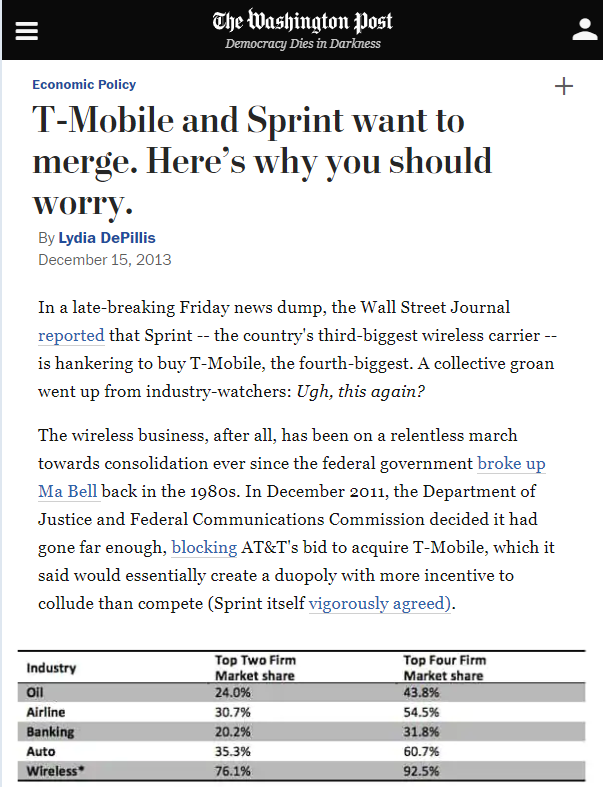
WaPo: T-Mobile and Sprint want to merge. Here’s why you should worry.
Washington Post (12/15/13)
Janine Jackson: The Washington Post headline was blunt: “T-Mobile and Sprint Want to Merge. Here’s Why You Should Worry.” The lead was also direct, with the reporter’s assertion that, at the news of a possible merger between the two big wireless carriers, “A collective groan went up from industry-watchers: Ugh, this again?”
That’s because telecom companies’ urge to merge is relentless; their promises of more and better for everyone perennial, though unproven; and their public interest critics exasperated.
The Post article was, as it happens, from 2013, but it might as well have been this week. T-Mobile and Sprint still want to merge. They’re still promising benefits for all concerned, and consumer advocates are lined up to say, Ugh, this again? again.
Now, though, we have a Republican-led FCC, chaired by the cartoonishly co-opted Ajit Pai, who has just announced that the agency will approve the deal.
We’re joined now to talk about what happens next by Leo Fitzpatrick, policy counsel and C. Edwin Baker fellow at Free Press. He joins us by phone from Washington, DC. Welcome to CounterSpin, Leo Fitzpatrick.
LF: Happy to be here. Thanks for having me.
JJ: Let’s leap right in with what in particular is bad, or potentially bad, about this merger between two of the country’s four biggest wireless carriers. What would it likely mean, and for whom, if T-Mobile is allowed to acquire Sprint?
LF: I think the biggest harm that would come from this is that the merger would increase prices. And you don’t actually have to take our word for it. For instance, T-Mobile‘s own economists have sent models to the FCC, saying that their prices would go up.
There’s a whole group of companies known as MVNOs, which is a Mobile Virtual Network Operator. They don’t own any of their own cell phone towers. So they go ahead and lease some space or buy wholesale from the big carriers, and then resell them to consumers.
Essentially, those resellers tend to service what’s known as the prepaid market. Those are the people that don’t sign up for contracts, they buy their minutes on cards. It’s pay-as-you-go, essentially. The folks that rely on prepaid tend to be communities of color and low-income folks. They’re the ones that can’t sign up for a two-year contract. They’re the ones that might not be able to pass a credit check that a lot of the larger carriers require.
A lot of the maverick ethos that T-Mobile has built in itself since the rejection of the 2011 merger has been to be a very innovative brand. But that’s only been as a result of competing very directly with Sprint. Within the prepaid market, they’ve been duking it out, and it’s actually led to price decreases.
One of the innovations that T-Mobile introduced was unlimited data. And very shortly thereafter, within a couple weeks, all the other national carriers, including AT&T and Verizon, followed suit. So what would happen with a merger is that the incentives that helped create this maverick brand would evaporate.
JJ: And that sounds like the market working the way we’re told that it does, you know, companies compete with one another by offering things to consumers. But the FCC and Ajit Pai and their endorsement of this T-Mobile/Sprint merger seem to be saying, “Well, yes, but any concerns about that are going to be completely offset, because they’re going to do other stuff that’s going to make that stuff OK.”
And one of the things that they’re talking about is that this new mega-company would “close the digital divide,” because they’re going to get “5G,” whatever the heck that is, they’re going to get that to “99 percent of Americans in six years,” and that all sounds very good, but I assume that we’re right to have some questions and concerns about that promise.
LF: Well, more and more 5G is being used in a way that evokes, to me, the old Simpsons episode of the man who comes into town and utters the wonders of the monorail, where the mere utterance of an exciting opportunity somehow preempts very necessary skepticism.
Leo Fitzpatrick of Free Press
Leo Fitzpatrick: “The potential applications of 5G are very exciting. However, if we can get to the same place, without having to raise prices on folks who are going to be disproportionately affected, then we shouldn’t.”
I don’t want you to get me wrong. I’m a techie. The potential applications of 5G are very exciting. However, if we can get to the same place, without having to raise prices on folks who are going to be disproportionately affected, then we shouldn’t.
Essentially what these companies have done is, even before the merger was dreamt up, they had already a nationwide 5G deployment plan laid out. And now they are coming back and saying that, “Well, without this merger, we can’t do the same thing that we had been promising to our investors prior to the announcement of the merger.”
So one of the most important things that your listeners need to come away with is, a lot of the promises are not merger-specific—which is to say that, whether the merger happens or not, we’re still going to get 5G. There are still four national carriers who are very eagerly seeking out customers for 5G, and deploying the network that a lot of them have already planned out.
JJ: Of course, all these promises that are being offered by T-Mobile and Sprint, who’s going to be assessing whether they even hold up to these promises if this merger is allowed to go through? And who that would be would be the FCC, again, who I think listeners know have been failing, really, the public interest for a long time, but now seem to be almost sprinting away from it.
And I think if we look at the FCC’s actions with regard to Puerto Rico, post-hurricanes, which I know that Free Press has been working on, I think that that’s relevant, really, if we’re going to be talking about getting an understanding of the FCC’s priorities, and who they feel accountable to, and whether they are really going to hold carriers to their promises. What’s happening in Puerto Rico has some some relevance there; I wonder if you could tell listeners briefly what’s happening with that?
LF:  Sure. On September 20, 2017, Hurricane Maria struck the island. And what followed was, by many measures, a disaster that was quite on par with what happened in Louisiana after Hurricane Katrina.
What we’ve been trying to focus in on is, the FCC never actually followed up and conducted an independent investigation, or had the intellectual curiosity to examine this crisis that affected 3.5 million people. There was only one AM station broadcasting on the entire island 24 hours after the storm; we had first responders who had difficulty reaching out to each other. And the fact that the FCC never actually conducted an investigation is shocking to us. And I think this ties into Pai’s very ideological approach, that deregulation and the free market will be the thing that fixes everything, and that consumers will be better off when the FCC does as little as possible.
One of the things that the FCC did do after Hurricane Maria was allocate funds that would go directly to the carriers. We welcomed this investment in helping to rebuild, but they actually didn’t request, or put into place, any accountability measures. The money was supposed to accelerate the recovery and to build more resilient networks. But they didn’t come back to the carriers with accountability measures, they didn’t actually have any methods to measure—how do you know you’re accelerating the recovery if you’re not actually keeping track of it?
A lot of the work that is occurring is happening behind closed doors. And this actually hearkens back to the merger, because this past Monday, Chairman Pai came out with a statement in support of the merger.
What we’re slowly finding out is that it seems that the staff at the DoJ came up with a recommendation against the merger. And after they had made that determination, the FCC met with T-Mobile and Sprint, and came up with additional conditions, in a way to, at least apparently, preempt the announcement coming out of the Department of Justice.
And just to give you some background, telecom mergers typically need approval from both the FCC and the Department of Justice. A lot of times, they have different calculuses. The FCC reviews the mergers under what’s known as a public interest standard, and the DoJ follows more of a competition-based, will-this-increase-prices analysis.
But a lot of times they work together in unison to come up with these decisions. Typically, the Department of Justice is the one that comes out and approves the merger first, and then the FCC follows suit. So the fact that the FCC came out before the DoJ is just something that a lot of my peers have not ever seen before.
JJ: I was going to ask what happens now, does it go to the DoJ? It sounds like, as with many things under this administration, things are happening that we’re not quite prepared to calculate for. But just process-wise, the DoJ still has to officially approve this merger between T-Mobile and Sprint?
LF: Essentially the DoJ’s role is more allowing, whether they are going to come in and actively challenge the merger or not. So the FCC goes ahead and votes and comes out with an order saying, “Yes, we approve of this merger”; the DoJ can just sit back and do nothing and the merger goes through. But otherwise, they would come in, depending on whether they listened to the recommendation from the staff, and also assuming that they consider the new conditions that were introduced.
Again, I would just like to point out that this is truly unusual, in the sense that it’s moving the goalposts pretty close to the 11th hour. We might see some action in the next month or two. But we probably know only as much as your listeners do, from reading these reports and this sort of infighting of leaks from both FCC and DoJ, that’s just, again, unprecedented.
JJ: It is a weird place to be in. And I’ll just say, finally, is there a place for the public? How would we even direct our energy at this point? I mean, once an agency like the FCC fakes a cyberattack to avoid acknowledging public comments, and they then, as you’re now describing, kind of step in front of the DoJ in order to say, “Yes, we would like to pre-approve this merger.” It doesn’t seem like they care, frankly, about public input on the question. But we care about it. What should folks do with their concerns?
LF:  Well, one thing that Free Press has done is, we’ve asked our members to go ahead and call the Department of Justice to voice their concerns about the merger, and perhaps in support of the staff recommendation not to approve the merger. But also, there are a couple of state attorney generals that have been examining the issue, particularly in New York and California, and if you live in those states, contacting those Departments of Justice there and voicing the potential harms that would come from this merger might be helpful at this point.
JJ: All right, then. We’ll keep following the issue. We’ve been speaking with Leo Fitzpatrick; he is policy counsel and C. Edwin Baker fellow at the group Free Press. You can find their work on T-Mobile/Sprint, on the FCC and Puerto Rico, and on a range of other issues at FreePress.net. Leo Fitzpatrick, thank you very much for joining us this week on CounterSpin.
LF: Thank you.


FAIR/Fairness & Accuracy In Reporting
124 W. 30th Street, Suite 201
New York NY 10001
USA


Tuesday, May 14, 2019

AT&T promised 7,000 new jobs to get tax break—it cut 23,000 jobs instead


AT&T promised 7,000 new jobs to get tax break—it cut 23,000 jobs instead

AT&T also cut capital spending despite promising $1 billion capital boost.


About this website

LINK


Thursday, January 3, 2019

‘There’s a Disconnect Between DC and What People Actually Want’ - CounterSpin interview with Tim Karr on net neutrality


FAIR

‘There’s a Disconnect Between DC and What People Actually Want’ - CounterSpin interview with Tim Karr on net neutrality

view post on FAIR.org

Janine Jackson interviewed Tim Karr about the net neutrality fight for the December 21, 2018, episodeof CounterSpin. This is a lightly edited transcript.
MP3 Link
Ajit Pai (photo: FCC)
Janine Jackson: When last we checked on the FCC, agency chair and former Verizon lawyer Ajit Pai was admitting what everyone already knew: that he straight-up lied when he told lawmakers that public comments in favor of net neutrality couldn’t get through because the FCC was suffering an online attack that tied up their servers. In fact, the agency’s Republican majority simply overrode clearly stated public support for net neutrality rules in their decision to repeal them.
That Pai has an agenda, to allow telecommunication industry titans to basically write policy to their liking, is obvious; whether he’ll be able to turn a federal agency tasked with representing the public interest so thoroughly against that purpose is what’s being contested, including by our next guest. Timothy Karr is senior director of strategy and communications at the group Free Press. He joins us now by phone from New Jersey. Welcome back to CounterSpin, Tim Karr.
Timothy Karr: Hi, Janine. How are you?
JJ: I’m very well. Well, listeners understand net neutrality as the rules that seek to keep the internet a more or less level playing field, and in so doing, make possible a great deal of person-to-person organizing and communication. We saw the repeal, over the overwhelming opposition of internet users. And then we saw some pushback to the repeal at state and municipal levels.
Now we’ve got a new Congress. What’s the state of play on net neutrality?
TK: Well, the state of play is uncertain. As you mentioned, in 2017, the chairman Ajit Pai, who was appointed by President Trump, repealed the net neutrality protections that we won in 2015, and that happened at the end of 2017.
So 2018 was really a year where we’re trying to get these rights back, we’re trying to protect everyone’s right to go online and connect with whomever they want to who’s online. And in order for us to do that, we have to restore the Federal Communications Commission’s authority, under a somewhat arcane rule called Title II of the Communications Act, that allows them to treat internet service providers as these conduits, common carrier conduits, that cannot block or throttle or in any way deprioritize online content that people want to see.
So it’s been a long fight. The good news is that we won what’s called a resolution of disapproval in the Senate in May; we had a majority of senators vote to throw out the rules. That process is now switched to the House, which has almost closed its session for the year, where we have more than 180 members who signed on to this resolution. So it’s an ongoing process. We’ve managed to get more people in Congress, more of our elected representatives and lawmakers, on the record in support of net neutrality than we have in any time in the history of this issue. So there’s momentum, and it’s good momentum that will lead us into a new Congress, where we have even more champions of net neutrality. So we’re looking ahead to 2019 with a great measure of optimism.
Heartland Institute: One Year Later, The Left’s Net Neutrality Lies Look Even Dumber
Heartland Institute (12/18/18)
JJ: Right. Well, I got something…what did I see…from the Heartland Institute, I think, that told me that “none of the liberal lies came true.” In other words, net neutrality was repealed, and look, nothing negative happened, so what’s the big deal?
TK: Well, for one, we think that the internet service providers have been on their best behavior, because they know there’s an effort to put these rules back in place. But even given that, there have been instances where Sprint has throttled access to Skype, where we’ve seen them starting to make inroads into this kind of two-tiered internet that we’ve been warning about, where they actually give prioritizations to the sites and services that they like, and the rest of us lose that choice.
This is something that these very large phone and cable companies—companies like AT&T and Comcast and Verizon—have wanted to do for more than a decade now, because they saw that the future of the media was the internet. And the future of internet media was video. And they wanted really to control the way video streaming is used online, to really become the gatekeepers of the future of television, just like large media companies have been the gatekeepers to the past of television, when you had a very few conglomerates controlling what went on television. So they are very aggressively moving into the space, with the hope that absent net neutrality rules, they can control what we watch on the internet as well.
JJ: We have to wonder why industry would fight so hard for something that wasn’t going to make any difference. Why would they fight so hard to get rid of these rules if their repeal would have actually no impact on what they do?
Well, the group MapLight released research showing how two telecom trade groups,  CTIA, who has members including AT&T and Comcast and Verizon, and the Internet and Television Association, that they gave more than $3 million to groups like ALEC, the “bill mill” that pushed for net neutrality’s repeal. It seems like following the money is as important a rule here as on any other issue.
Tim Karr, Free Press
Tim Karr: “We’re talking about millions and millions of dollars that have gone from the phone and cable lobby to elected representatives to lobbyists to lawyers, to try to get net neutrality off the books.”
TK: Yeah, and that’s just the money that we know about, right? Because you have to report lobbying expenditures, because you have to report campaign contributions to federally elected officials, we do have a paper trail. And even looking at that, we’re talking about millions and millions of dollars that have gone from the phone and cable lobby to elected representatives to lobbyists to lawyers, to try to get net neutrality off the books.
There’s a whole other dark economy there that we don’t know as much about. And those are the kind of contributions that are made to PACs, the kind of contributions that are made to PR firms and think tanks. And there’s a whole slew of think tanks, for example, in Washington, DC, that generate these reports on net neutrality, that make up these sorts of lies that, you know, net neutrality has hampered investment, that it’s heavy-handed government regulation of the internet, both of which are untrue.
But you give money to think tanks to generate reports, and then someone like Chairman Ajit Pai, who’s looking for evidence to support his decision to repeal net neutrality, points to a report by an organization like the American Enterprise Institute, and says, “See, proof that I was right.”
And this is all part of this influence economy, that is controlled by these very powerful corporations—again, companies like AT&T and Verizon—who create this kind of false reality around net neutrality inside Washington, DC, when people outside of the Beltway—in overwhelming numbers, and there are a number of polls out there that show Democrats, Republicans, registered voters, registered independents, all by strong majorities—support keeping the net neutrality rules.
So there’s a disconnect between what’s going on in Washington, DC, where rulemakers are held captive to this industry, and what the people of the country actually want. So as we go towards a new Congress, we’re hopeful that with some of the new people that were elected in November, we’ll gain even more traction on Capitol Hill to put in place legislation that will restore these net neutrality rules.
JJ: Speaking of that disconnect, there’s a new Communications Marketplace Report that Karl Bode, I was reading, says, if you read it, it suggests that broadband “is awash with vibrant competition.” And it just sounds so strange for those of us who think, “Well, wait, I only have Comcast, you know, I only have one option.” Are we really on different planets? How can the FCC be putting out information that says that we really have a competitive field when it comes to broadband?
TK: There’s a number of ways that they do that. When they talk about broadband, sometimes they like to include wireless connectivity options; but anybody who has a cell phone and even a 5G connection knows that you can’t replicate a high-speed internet connection that you have in your home through your cell phone device. And another way that the FCC has tried to make broadband seem more plentiful is by lowering the standards. This lowering the speeds for uploads and downloads, so that as they create a slower standard for broadband, it allows them to even include some internet service providers that have pretty crappy, slow services as broadband providers.
But you’re right. At the end of the day, the type of broadband that people want, there are very few choices in the United States. And it’s driven prices higher than any other developed country around the world. We paid more for wireless internet connections, for landline internet connections, than most any other country in the world. So that’s what happens when you have a very small number of companies controlling the industry. And in addition to controlling the industry, controlling the policy-making process.
JJ: Well, you touched on it earlier. I know Free Press put out a list of positive moments from the year. There are good things happening, and I think we have to remember that media organizing, like any organizing, is a marathon and not a sprint, and there’s work that’s going on. What would you have folks think about, who are just surveying the the media landscape at the moment? What kinds of things is Free Press up to?
TK: The things that we’re doing to get net neutrality back is that we’re actually suing the FCC. We’re challenging its decision to reverse this definition of broadband, to reverse the authority that it had over broadband. So that’s a court case that’s going to be heard in the US Court of Appeals for the DC circuit on February 1. We’re very confident that we have a strong legal argument to make that would reverse this net neutrality decision.
The FCC is also now under investigation. There’s an investigation into a number of fake comments that were filed in the net neutrality proceeding; when the FCC made this decision in 2017, they opened up what they call a docket for public comments, and there are nearly 10 million comments that appear to be faked.
There’s an investigation into whether that was—and that’s illegal activity—whether that crime was committed by people working at the behest of the phone and cable lobby.  There’s also been a lot of questions about the FCC chairman’s reluctance to open up the docket to investigators and reporters who want to figure out who are the culprits behind this decision. So there’s some questions about the process itself.
And you know, again, I mentioned Congress; we have increasing bipartisan support all around the country, but we also have a number of new members of Congress who campaigned with net neutrality as an issue and won,  who are looking to doing something legislatively in 2019. You could see something as early as spring, where we have legislation that would put a strong legal standard for net neutrality. And given the new composition of Congress, and given the bipartisan nature, at least in the grassroots level, of support for net neutrality, we’re also hopeful that we can get these protections back through legislative means.
JJ: All right then, we’ll keep our eyes on it. We’ve been speaking with Tim Karr, senior director of strategy and communications at Free Press. You can find them and their work online at FreePress.net. Tim Karr, thank you so much for joining us this week on CounterSpin.
TK: My pleasure.


FAIR/Fairness & Accuracy In Reporting
124 W. 30th Street, Suite 201
New York NY 10001
USA


Thursday, August 16, 2018

FOCUS: The Wiretap Rooms


Reader Supported News
14 August 18
It's Live on the HomePage Now:
Reader Supported News


FOCUS: The Wiretap Rooms 
People walk by an AT&T store. (photo: Getty)
Ryan Gallagher and Henrik Moltke, The Intercept
Excerpt: "The secrets are hidden behind fortified walls in cities across the United States, inside towering, windowless skyscrapers and fortress-like concrete structures that were built to withstand earthquakes and even nuclear attack."
READ MORE

Become a Fan of RSN on Facebook and Twitter


Friday, February 19, 2016

Best Democracy Money Can Buy: In Black Caucus, a Fund-Raising Powerhouse


In Black Caucus, a Fund-Raising Powerhouse


Part Political, Part Charitable


From 2004 to 2008, the Congressional Black Caucus’s political and charitable wings took in at least $55 million in corporate and union contributions, according to an analysis by The New York Times, an impressive amount even by the standards of a Washington awash in cash. Only $1 million of that went to the caucus’s political action committee; the rest poured into the largely unregulated nonprofit network. (Data for 2009 is not available.)


Congressional Black Caucus members at a gospel event at the September 2007 conference.
The caucus says its nonprofit groups are intended to help disadvantaged African-Americans by providing scholarships and internships to students, researching policy and holding seminars on topics like healthy living.

But the bulk of the money has been spent on elaborate conventions that have become a high point of the Washington social season, as well as the headquarters building, golf outings by members of Congress and an annual visit to a Mississippi casino resort.

In 2008, the Congressional Black Caucus Foundation spent more on the caterer for its signature legislative dinner and conference — nearly $700,000 for an event one organizer called “Hollywood on the Potomac” — than it gave out in scholarships, federal tax records show.

At the galas, lobbyists and executives who give to caucus charities get to mingle with lawmakers. They also get seats on committees the caucus has set up to help members of Congress decide what positions to take on the issues of the day. Indeed, the nonprofit groups and the political wing are so deeply connected it is sometimes hard to tell where one ends and the other begins.

Even as it has used its status as a civil rights organization to become a fund-raising power in Washington, the caucus has had to fend off criticism of ties to companies whose business is seen by some as detrimental to its black constituents.

These include cigarette companies, Internet poker operators, beer brewers and the rent-to-own industry, which has become a particular focus of consumer advocates for its practice of charging high monthly fees for appliances, televisions and computers.

Caucus leaders said the giving had not influenced them.

“We’re unbossed and unbought,” said Representative Barbara Lee, Democrat of California and chairwoman of the caucus. “Historically, we’ve been known as the conscience of the Congress, and we’re the ones bringing up issues that often go unnoticed or just aren’t on the table.”

But many campaign finance experts question the unusual structure.

“The claim that this is a truly philanthropic motive is bogus — it’s beyond credulity,” said Meredith McGehee, policy director at the Campaign Legal Center in Washington, a nonpartisan group that monitors campaign finance and ethics issues. “Members of Congress should not be allowed to have these links. They provide another pocket, and a very deep pocket, for special-interest money that is intended to benefit and influence officeholders.”

Not all caucus members support the donors’ goals, and some issues, like a debate last year over whether to ban menthol cigarettes, have produced divisions.

But caucus members have attracted increasing scrutiny from ethics investigators. All eight open House investigations involve caucus members, and most center on accusations of improper ties to private businesses.

And an examination by The Times shows what can happen when companies offer financial support to caucus members.

For instance, Representative Danny K. Davis, Democrat of Illinois, once backed legislation that would have severely curtailed the rent-to-own industry, criticized in urban districts like his on the West Side of Chicago. But Mr. Davis last year co-sponsored legislation supported by the stores after they led a well-financed campaign to sway the caucus, including a promise to provide computers to a jobs program in Chicago named for him. He denies any connection between the industry’s generosity and his shift.

The caucus started out 40 years ago as a political club of a handful of black members of Congress. Now it is at the apex of its power: President Obama is a former member, though he was never very active.

Its members, all Democrats, include the third-ranking House member, Representative James E. Clyburn of South Carolina; 4 House committee chairmen; and 18 subcommittee leaders. Among those are Representative Charles E. Rangel, chairman of the Ways and Means Committee, and Representative John Conyers Jr., chairman of the Judiciary Committee.

There are hundreds of caucuses in Congress, representing groups as disparate as Hispanic lawmakers and those with an interest in Scotland. And other members of Congress have nonprofit organizations.

But the Congressional Black Caucus stands alone for its money-raising prowess. As it has gained power, its nonprofit groups — one an outright charity, the other a sort of research group — have seen a surge in contributions, nearly doubling from 2001 to 2008.

Besides the caucus charities, many members — including Mr. Clyburn and Representative William Lacy Clay Jr. of Missouri — also have personal or family charities, which often solicit donations from companies that give to the caucus. And spouses have their own group that sponsors a golf and tennis fund-raiser.

The board of the Congressional Black Caucus Foundation includes executives and lobbyists from Boeing, Wal-Mart, Dell, Citigroup, Coca-Cola, Verizon, Heineken, Anheuser-Busch and the drug makers Amgen and GlaxoSmithKline. All are hefty donors to the caucus.

Some of the biggest donors also have seats on the second caucus nonprofit organization — one that can help their businesses. This group, the Congressional Black Caucus Political Education and Leadership Institute, drafts positions on issues before Congress, including health care and climate change.

This means, for example, that the lobbyists and executives from coal, nuclear and power giants like Peabody Energy and Entergy helped draft a report in the caucus’s name that includes their positions on controversial issues. One policy document issued by the Black Caucus Institute last year asserted that the financial impact of climate change legislation should be weighed before it is passed, a major industry stand.

Officials from the Association of American Railroads, another major donor, used their board positions to urge the inclusion of language recommending increased spending on the national freight rail system. A lobbyist for Verizon oversaw a debate on a section that advocated increased federal grants to expand broadband Internet service.

And Larry Duncan, a Lockheed Martin lobbyist, served on a caucus institute panel that recommended that the United States form closer ties with Liberia, even as his company was negotiating a huge airport contract there.

“Our charitable donations are charitable donations,” said David Sylvia, a spokesman for Altria, which has given caucus charities as much as $1.3 million since 2004, the Times analysis shows, including a donation to a capital fund used to pay off the mortgage of the caucus headquarters.

Elsie L. Scott, chief executive of the Congressional Black Caucus Foundation, acknowledged that the companies want to influence members. In fact, the fund-raising brochures make clear that the bigger the donation, the greater the access, like a private reception that includes members of Congress for those who give more than $100,000.

“They are trying to get the attention of the C.B.C. members,” Ms. Scott said. “And I don’t think there is anything wrong with that. They’re in business, and they want to deal with people who have influence and power.”

She also acknowledged that if her charity did not have “Congressional Black Caucus” in its name, it would gather far less money. “If it were just the Institute for the Advancement of Black People — you already have the N.A.A.C.P.,” she said.

Ms. Scott said she, too, had heard criticism that the caucus foundation takes too much from companies seen as hurting blacks . But she said she was still willing to take their money.

Caucus members accepting a donation to the foundation from Eli Lilly, the pharmaceutical giant and a major contributor.

“Black people gamble. Black people smoke. Black people drink,” she said in an interview. “And so if these companies want to take some of the money they’ve earned off of our people and give it to us to support good causes, then we take it.”

The biggest caucus event of the year is held each September in Washington.

The 2009 event began with a rooftop party at the new W Hotel, with the names of the biggest sponsors, the pharmaceutical companies Amgen and Eli Lilly, beamed in giant letters onto the walls, next to the logo of the Congressional Black Caucus Foundation. A separate dinner party and ceremony, sponsored by Disney at the National Museum of Women in the Arts, featured the jazz pianist Marcus Johnson.

The next night, AT&T sponsored a dinner reception at the Willard InterContinental Washington, honoring Representative Bobby L. Rush, Democrat of Illinois and chairman of the House subcommittee that oversees consumer protection issues.

The Southern Company, the dominant electric utility in four Southeastern states, spent more than $300,000 to host an awards ceremony the next night honoring Ms. Lee, the black caucus chairwoman, with Shaun Robinson, a TV personality from “Access Hollywood,” as a co-host. The bill for limousine services — paid by Southern — exceeded $11,000.

A separate party, sponsored by Macy’s, featured a fashion show and wax models of historic African-American leaders.

All of this was just a buildup for the final night and the biggest event — a black-tie dinner for 4,000, which included President Obama, the actor Danny Glover and the musician Wyclef Jean.

Annual spending on the events, including an annual prayer breakfast that Coca-Cola sponsors and several dozen policy workshops typically sponsored by other corporations, has more than doubled since 2001, costing $3.9 million in 2008. More than $350,000 went to the official decorator and nearly $400,000 to contractors for lighting and show production, according to tax records. (By comparison, the caucus spent $372,000 on internships in 2008, tax records show.)

The sponsorship of these parties by big business is usually counted as a donation in the caucus books. But sometimes the corporations pay vendors directly and simply name the caucus or an individual caucus member as an “honoree” in disclosure records filed with the Senate.

(The New York Times Company is listed as having paid the foundation $5,000 to $15,000 in 2008. It was the cost of renting a booth to sell newspapers at the annual conference.)

Foundation officials say profit from the event is enough to finance programs like seminars on investments, home ownership and healthy living; housing for Washington interns; and about $600,000 in scholarships.

Interns and students interviewed praised the caucus.

“The internship for me came at a very critical moment in my life,” said Ervin Johnson, 24, an intern in 2007, placed by the Justice Department. “Most people don’t have that opportunity.”

Still, Ms. Scott, the foundation’s chief executive, said that members of the caucus’s board had complained about the ballooning bills for the annual conference. And some donors have asked that their money go only toward programs like scholarships. She blamed the high prices charged by vendors mandated by the Washington Convention Center.

The companies that host events at the annual conference are engaged in some of the hottest battles in Washington, and they frequently turn to caucus members for help.

Amgen and DaVita, which dominate the kidney treatment and dialysis business nationwide, have donated as much as $1.5 million over the last five years to caucus charities, and the caucus has been one of their strongest allies in a bid to win broader federal reimbursements.

AT&T and Verizon, sponsors of the caucus charities for years, have turned to the caucus in their effort to prevent new federal rules governing how cellphone carriers operate Internet services on their wireless networks.

But few of these alliances have paid off like the caucus’s connection to rent-to-own stores.

Some Democrats in Congress have tried to limit fees charged to consumers who rent televisions or appliances, with critics saying the industry’s advertisements prey on low-income consumers, offering the short-term promise of walking away with a big-screen TV while hiding big long-term fees. Faced with rules that could destroy their business, the industry called on the caucus.

In 2007, it retained Zehra Buck, a former aide to Representative Bennie Thompson, Democrat of Mississippi and a caucus member, to help expand a lobbying campaign. Its trade association in 2008 became the exclusive sponsor of an annual caucus foundation charity event where its donated televisions, computers and other equipment were auctioned, with the proceeds going to scholarships. It donated to the campaigns of at least 10 caucus members, and to political action committees run by the caucus and its individual members.

It also encouraged member stores to donate to personal charities run by caucus members or to public schools in their districts. Mr. Clay, the Missourian, received $14,000 in industry contributions in 2008 for the annual golf tournament his family runs in St. Louis. The trade association also held a fund-raising event for him in Reno, Nev.

“I’ll always do my best to protect what really matters to you,” Mr. Clay told rent-to-own executives, who agreed to hold their 2008 annual convention in St. Louis, his home district. Mr. Clay declined a request for an interview.

On a visit to Washington, Larry Carrico, then president of the rent-to-own trade association, offered to donate computers and other equipment to a nonprofit job-training group in Chicago named in honor of Mr. Davis, the Illinois congressman who in 2002 voted in favor of tough restrictions on the industry.

Mr. Davis switched sides. Mr. Carrico traveled to Chicago to hand over the donations, including a van with “Congressman Danny K. Davis Job Training Program” painted on its side, all of which helped jump-start a charity run by Lowry Taylor, who also works as a campaign aide to Mr. Davis.

In an interview, Mr. Carrico said support from caucus members came because they understood that his industry had been unfairly criticized and that it provided an important service to consumers in their districts.

While some caucus members still oppose the industry, 13 are co-sponsors of the industry-backed legislation that would ward off tough regulatory restrictions — an alliance that has infuriated consumer advocates.

“It is unfortunate that the members of the black caucus who are supporting this bill did not check with us first,” said Margot Saunders, a lawyer with the National Consumer Law Center. “Because the legislation they are supporting would simply pre-empt state laws that are designed to protect consumers against an industry that rips them off.”

The industry’s own bill, introduced by a caucus member, has not been taken up, but it does not really matter because the move to pass stricter legislation has ground to a halt.

“Without the support of the C.B.C.,” John Cleek, the president of the rent-to-own association, acknowledged in an industry newsletter in 2008, “our mission in Washington would fail.”

Ron Nixon and Griffin Palmer contributed reporting.

A version of this article appears in print on February 14, 2010, on page A1 of the New York edition with the headline: In Black Caucus, a Fund-Raising Powerhouse.

Saturday, November 14, 2015

11 corrupt corporations you should protest and 2 more that aren't quite as bad as you thought.


MOST OF THESE CORPORATIONS PAID NO TAXES 


11 corrupt corporations you should protest and 2 more that aren't quite as bad as you thought.


We all love a good David and Goliath story. Maybe that's why hating on corporations is so easy. (And fun!)

But the fact is that corporations, like people, aren't innately bad. (Can we go ahead and agree that they're not actually people though?)
If we're being technical, corporations are simply groups of people authorized to act as a single legal entity. And while it's easy to use for the word "corporate" to take on a pejorative meaning in casual conversation (hey, I'm totally guilty of it), it's not exactly fair or accurate.
Except in the case of these corporations who are totally The Worst and have this one thing in common:

Photo via Wikimedia Commons.


Most of the corporations that you hear the horror stories about have a longstanding history with the American Legislative Exchange Council, or ALEC.

Again, if we're being technical, ALEC is simply a nonprofit organization dedicated to free-market capitalism and deregulation. But if we scratch the surface (like, just the tippy top), it becomes glaringly obvious that ALEC's primary function is to help corporations write fill-in-the-blank laws for congresspeople to sign and pass.

Basically everything you've ever heard or suspected about American political corruption starts with ALEC.

Here are just a few of the corporations that are still in cahoots with ALEC:

1. Anheuser-Busch

In addition to sponsoring the open-bar cocktail hour at the 2015 ALEC annual conference, beverage giant Anheuser-Busch is also a member of ALEC's Commerce, Insurance, and Economic Development Task Force — responsible for numerous anti-worker and union-busting initiatives. So, why not consider getting your drink somewheres else? (Uh, also: no big loss. Their beer tastes like pee.)

2. AT&T and 
3. Sprint Nextel

In case you were wondering why your cellphone bill is so impossibly convoluted or why your supposedly "public" utilities look a lot more like a group of private companies that put profits over people, it might have something to do with the insane-o ALEC-sponsored legislation that AT&T and Sprint Nextel have pushed through Washington. For example:Ever wonder why your local public utility commission still hasn't laid any high-speed fiber-optic Internet cables in your town? Yep: ALEC.
Photo by Mike Mozart/Flickr.

4. Comcast Corporation and 
5. Time Warner Cable

6. ExxonMobil

OK, this one isn't much of a surprise. I mean, they're an oil company. Are you surprised thatExxonMobil has contributed more than $1.5 million to ALEC's hardline climate-change-doubting agenda over the last 17 years?

7. FedEx and 
8. UPS

How's this for cozy? UPS's vice president of corporate public affairs is the second vice chairman of ALEC's private enterprise advisory board. Meanwhile, FedEx has at least one lobbyist on the executive committee for ALEC's Commerce, Insurance, and Economic Development Task Force. Good thing can we still rely on the U.S. Postal Serv ... I can't even type that sentence with a straight face, ugh.

9. Pfizer and 
10. Novartis

Both Pfizer and Novartis benefitted greatly from ALEC's Data Quality Act, which made it legal for corporations to validate and regulate their own scientific data (thus enabling them to get away with using cheaper chemical shortcuts in products that cause damage to human beings as well as the environment). They've also played a major part in fighting against health care reform and in protecting pharmaceutical companies from liability lawsuits.

11. The Wall Street Journal

So much for free press, huh? It might be acceptable for media companies to have corporate relationships, but not when they disguise ALEC propaganda as independent editorial content. (Perhaps not that surprising, considering that The Wall Street Journal is also owned by Rupert Murdoch.)

But recently, ALEC's schemes have gotten so bad that some supposedly awful corporations have cut ties with them.

In March 2015, oil giant BP — yes, that BP — finally pointed at ALEC and said, "Hey, we've done some bad stuff in our time. But at least we're not those guys." Harsh.
And thankfully, it make have sparked a trend: Fellow oil giant Royal Dutch Shell also cut ties with ALECin August 2015, and they actually had something sensible to say about it: "We have long recognised both the importance of the climate challenge and the critical role energy has in determining quality of life for people across the world," aspokesman said. "As part of an ongoing review of memberships and affiliations, we will be letting our association with ALEC lapse when the current contracted term ends early next year."

Granted, Shell still forged ahead with their plans to drill for oil in the Arctic despite the potentially disastrous environmental impact and only stopped when they decided it wouldn't be profitable enough. But still; we'll take it.

ALEC may still have a stronghold on politics — but we can still vote with both our ballots and our dollars.

What can you do in the face of seemingly endless political corruption and board rooms building built-to-fail schemes to keep the sway of power in their favor? Simple: Refuse to play their games. They can't win if there's no one to play against.
For starters, you can refuse to support the ALEC-affiliated corporations above. Be a conscientious consumer and take your business elsewhere whenever possible. If there's no alternative, you can always sign this petition to pressure companies to cut their ties with the American Legislative Exchange Council.
And finally, refuse to give your vote to any politician who still has ALEC's dirt on their hands. It won't fix everything, but it's a darn good start.