Search This Blog

Translate

Blog Archive

Middleboro Review 2

NEW CONTENT MOVED TO MIDDLEBORO REVIEW 2

Toyota

Since the Dilly, Dally, Delay & Stall Law Firms are adding their billable hours, the Toyota U.S.A. and Route 44 Toyota posts have been separated here:

Route 44 Toyota Sold Me A Lemon


Showing posts with label CENSORED MEDIA. Show all posts

Monday, November 18, 2019

MSNBC Is the Most Influential Network Among Liberals - and It's Ignoring Bernie Sanders


Reader Supported News
18 November 19

It IS, Indeed, a Great Project !
THANK YOU for it !!!! Don't know how else I'd withstand the cons in my "USA/Canada chat group" -- were it not for the news and views I get on R.S.N. They'd eat me alive !
Robert T, Reader-Supporter


If you would prefer to send a check:
Reader Supported News
PO Box 2043
Citrus Hts
CA 95611


Reader Supported News
18 November 19
It's Live on the HomePage Now:
Reader Supported News

Sure, I'll make a donation!

MSNBC Is the Most Influential Network Among Liberals - and It's Ignoring Bernie Sanders
Bernie Sanders talks to supporters during a rally at the University of Washington, in Seattle. (photo: Joshua Trujillo/Seattlepi.com)
Branko Marcetic, In These Times
Marcetic writes: "When the network's primetime pundits do cover Sanders, they cover him more negatively than Elizabeth Warren and Joe Biden."
READ MORE

Representative Rashida Tlaib pledged to impeach Donald Trump the day she was sworn into office. (photo: NBC)

Rashida Tlaib's Infamous Impeachment Wish Is Coming True
Tomas Navia, VICE
Navia writes: "Eleven months after Rep. Rashida Tlaib uttered her infamous 'impeach the motherfucker' line about President Trump, she's getting what she wants."


U.S. Border Patrol agents. (photo: Reuters)

US Border Patrol Eyeing Facial Recognition for Body Cams
teleSUR
Excerpt: "U.S. customs officials are seeking information on facial recognition software for body-worn cameras that agents who police the border could use, according to a government filing."
READ MORE

The Rybovich superyacht marina in West Palm Beach. (photo: Saul Martinez/ProPublica)

A Trump Tax Break to Help the Poor Went to a Rich GOP Donor's Superyacht Marina
Justin Elliott, Jeff Ernsthausen and Kyle Edwards, ProPublica
Excerpt: "Wealthy donors Wayne Huizenga Jr. and Jeff Vinik lobbied then-Governor Rick Scott for the lucrative tax break - and won it. Poorer communities lost out."
READ MORE

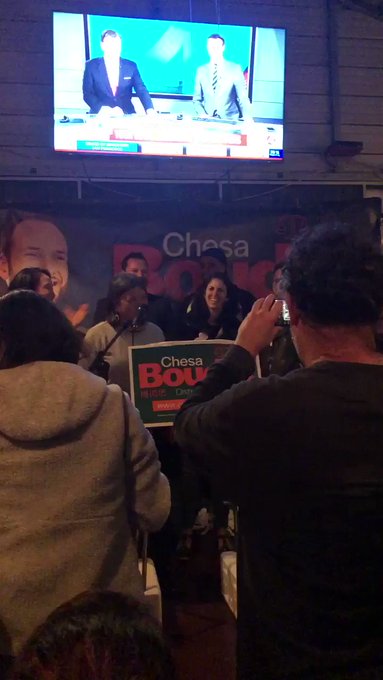
Chesa Boudin's victory as San Francisco's new district attorney has been celebrated as the latest in a growing groundswell for criminal justice reform. (photo: Scott Strazzante/Associated Press)

Son of Jailed Radicals, Reviled by the Police Union. Now, Chesa Boudin Is San Francisco's Top Cop
Vivian Ho, Guardian UK
Ho writes: "Boudin last week won the race for San Francisco district attorney, vowing to bring change to a city with a liberal reputation that it has not always earned."

The son of two leftwing Weather Underground radicals who served as the getaway drivers in a 1981 armored car heist that left two police officers and a guard dead, Boudin last week won the race for San Francisco district attorney, vowing to bring change to a city with a liberal reputation that it has not always earned.
Across the country, progressives ranging from presidential candidate Bernie Sanders to civil rights activist Shaun King celebrated Boudin’s victory as the latest in a growing groundswell for criminal justice reform.
In a way, his victory reflects the sort of world that progressive criminal justice activists across the nation have been trying to build over the past few years: one in which a person’s mistakes do not dictate the rest of their lives – nor the lives of their children.
“Compassion,” Boudin told the Guardian. “That’s something we really need to return to the criminal justice system. For victims, for families of people impacted, for witnesses, for defendants and for their families, and frankly for people who work in the system. Compassion, for everybody whose life is touched by crime.”
For those fighting for criminal justice reform – to end mass incarceration, the criminalization of the poor, and the over-policing of black and brown people in a broken system that now counts more than 2.2 million people behind bars in the US – Boudin’s victory marked a welcome shift in the accepted “tough on crime” norms of politics and public safety. A candidate could win the position of top cop while veering radically left of the usual law-and-order script. A candidate could win taking bold positions: no longer charging gang enhancements, not prosecuting on minor quality of life crimes, creating a unit to look at past wrongful convictions, eliminating cash bail.
A candidate could win without playing it safe on public safety.
“I would talk about Chesa’s candidacy in the early days to people in the city, and they would say things like, ‘He’s incredibly smart, he’s incredibly charismatic, but he can’t win. He can’t win’,” said Lara Bazelon, a University of San Francisco law professor and Boudin supporter. “There’s this thought that there’s a fundamental ceiling on the movement and there are candidates that just can’t win. But that’s not true at all and this race proves it.”
Boudin embraced his rich backstory from the start of his campaign, speaking openly of his parents’ experience with incarceration in campaign ads and stump speeches as a nod to his understanding of the criminal justice system. His parents, Kathy Boudin and David Gilbert, were sent to prison when he was 14 months old, and for all his childhood, the only contact he had with them was behind bars. Gilbert remains in prison in upstate New York – Boudin was flying back from visiting him when he learned that he won the election – while Kathy Boudin was paroled in 2003 and works as an assistant professor at Columbia University.
Boudin was raised in Chicago by Weather Underground founder Bill Ayers, and his wife, Bernardine Dohrn, another operative in the group. He went on to earn a bachelor’s degree from Yale University, two master’s degrees from Oxford University where he was a Rhodes scholar, and a law degree from Yale.
As district attorney, he’ll be top prosecutor, but he has never tried a case. His courtroom experience began on the other side of the aisle, at the public defender’s office, providing legal defense to those who could not afford it. His critics and opponents seized on his distinct resume, with some likening his candidacy to electing a fox to guard the henhouse. 
Boudin rejects the premise. “I look at the work we do at the Hall of Justice, whether as a district attorney or a public defender or a judge or a sheriff’s deputy or juror, in big, broad terms and in trying to provide justice: None of us want to see the people who are arrested today come back into the system in a month or in a year,” Boudin said. “The challenge is finding ways to work collaboratively. We’re not always going to agree with what that’s going to look like, but I think there are going to be tremendous ways for us to do that.”
Now the race is won, district attorney-elect Boudin will have the power to determine the kind of law enforcement that takes place in the city. By directing which cases his line prosecutors will and will not charge, Boudin ultimately decides the type of cases police officers pursue.
In San Francisco, the police union had long carried political clout and historically balked against any district attorney’s reform efforts. Former district attorney George Gascón – previously a San Francisco police chief – assembled a blue ribbon panel to look into systemic bias within the police force after racist and bigoted text messages between 14 police officers emerged in a federal corruption case (several more police officers were later implicated in another separate racist and bigoted texting scandal). The union, the San Francisco Police Officers Association (POA), responded by attacking Gascón on a statewide ballot initiative he co-authored that reduced some nonviolent felonies to misdemeanors – a ballot initiative that 80% of San Franciscans voted for and passed in November 2014.
In this election, the POA and other law enforcement groups spent $650,000 in polling and attack ads to defeat Boudin. But the days of the POA being untouchable appear to be over. At Boudin’s election night party, city lawmaker Sandra Lee Fewer, whose husband is a retired San Francisco police officer, led the crowd in a chant: “Fuck the POA! Fuck the POA! Fuck the POA!”
Fewer later released a statement saying she was sorry if the rank-and-file members of the police department perceived her actions as against them, but refused to apologize to the POA.
“The days of civility, and ‘we shouldn’t say these things about the POA’, that doesn’t fly in San Francisco anymore,” said Jason McDaniel, a political scientist at San Francisco State University.
But as district attorney, Boudin will have to find a way work with this police department – and perhaps, at times, this police union. “There’s a big difference between the POA leadership and the rank-and-file officers on the street, and I look forward to visiting every police station and listening to what police officers have to say,” Boudin said in an interview. “I’m open to working with the POA leadership too. I recognize there’s room to disagree and still work together. I know they don’t expect that our policies will make San Francisco safer, but I hope to persuade them over time that I’m right.”
It’s Boudin’s detail-specific policies that give criminal justice activists hope for the direction of the movement. In a time when the term “progressive prosecutor” gets tossed around often – Boudin provided a template for what it truly meant to be a progressive prosecutor, Bazelon said.
“One of the things that Chesa was really successful in doing was explaining how much daylight was between him and the other three candidates,” she said. “What they tried to do was say, ‘We’re all about these reform ideas’. But he was going a step further every time. He ran on a platform of, ‘I’m going to establish an immigration unit in my office; I’m going to start a wrongful conviction unit and review excessive sentences; I’m going to offer restorative justice to any victim that wants it’. These are really bold proposals, and people really responded to that.”
And the fact that he was successful, despite heavy opposition from law enforcement groups, signaled a change in the politics of public safety. It is becoming more widely accepted that the criminal justice system as it has existed in past years is broken in ways that disproportionately affect poor communities of color. No longer are voters as easily swayed by the fearmongering that the law enforcement groups deployed against Boudin, characterizing him as soft on crime.
“That tough-on-crime rhetoric did work once,” said John Crew, a former American Civil Liberties Union lawyer and local activist. “It’s why we have mass incarceration, it’s why we have such extreme racial disparities. But they tried to use it and it backfired so spectacularly, and I think it’s one of the reasons why Chesa Boudin got elected.”
Just this year, San Francisco agreed to pay Jamal Trulove $13.1m after a federal civil jury found that the police had coerced a witness into identifying him as the suspect. He was wrongfully convicted under the tenure of California senator and Democratic presidential candidate Kamala Harris’ as district attorney, and spent six years in prison. Trulove, an actor and activist, endorsed Boudin. Harris endorsed Boudin’s main opponent, who worked as a prosecutor under Harris.
Times have changed.

“As a district attorney, people often want to know what charges are you going to file, what punishment are you going to seek,” Boudin said. “But context is so important. That’s one of the things I’ve learned from my lifetime of visiting jails and prisons, and my work as a public defender. Often we only have a tiny window into what has happened in a particular case. You only see the video, or you only read the police report that is a couple witnesses’ version of events. You have to understand the big picture context. That’s the only way to prevent the people who did it from doing it again.”

READ MORE

An Evo Morales supporter confronts Bolivian police in La Paz. (photo: Natacha Pisarenko/AP)

A Week After the Coup in Bolivia, There's Still No Proof of Electoral Fraud
Kevin Cashman, Jacobin
Cashman writes: "Mainstream commentators continue to assert that Evo Morales oversaw a fraudulent election in Bolivia that led to his resignation. But the 'resignation' was a coup - and there's still no proof the election was even fraudulent."
READ MORE

Tourists walk with their luggage near Rialto bridge in Venice, Italy. (photo: Stefano Mazzola/Awakening/Getty Images)

Venice's Devastating Floods Are the 'Canary in a Coal Mine' for Coastal Cities Worldwide
Denise Chow, NBC News
Chow writes: "For Venetians, water is a way of life. It surrounds the city, ebbing and flowing, and at certain times of the year - usually in the fall - the tide swells, spilling water into the narrow streets and swamping the grand piazzas."
READ MORE

Update My Monthly Donation


Tuesday, June 11, 2019

‘It’s Seen by Indigenous Activists as a Template for Similar Confrontations Around the Globe’ - CounterSpin interview with Reynard Loki on indigenous oil victory


FAIR

‘It’s Seen by Indigenous Activists as a Template for Similar Confrontations Around the Globe’ - CounterSpin interview with Reynard Loki on indigenous oil victory

view post on FAIR.org

Janine Jackson interviewed Reynard Loki about an indigenous environmental victory in Ecuador for the June 7, 2019, episode of CounterSpin. This is a lightly edited transcript.

MP3 Link
Janine Jackson:  The story was brief but compelling: The indigenous Waorani in Ecuador were fighting to keep the government from auctioning off their land, and with it their lives and culture, to oil companies, and were actually being heard in court. A Waorani leader is cited, saying: “Our fight is not just a fight about oil. This is a fight about different ways of living, one that protects life and one that destroys life.”
Why didn’t I see what looks like a Reuters wire piece picked up in a major daily?, you might wonder. Then you see the tag at the bottom that explains that the article is from the Thomson Reuters Foundation, described as the “charitable arm” of Thomson Reuters, that covers “humanitarian news.” In other words, the fight over whether extractive industry is permitted to erase and endanger communities, as part of the despoiling of the region known as the lungs of the planet, is news—but not news news.
Joining us now to talk about a case that in reality brings together some of the most important questions of the day is Reynard Loki, editor and chief correspondent of the Earth | Food | Life project of the Independent Media Institute. He joins us now by phone from here in town. Welcome to CounterSpin, Reynard Loki.
Reynard Loki: Thanks for having me, Janine.
JJ: As you report in your recent article on this, which I first saw on Common Dreams, the fight between indigenous communities and oil companies in Ecuador has been going on for many years now. But this April 26 court ruling, and recent demonstrations in support of it, have reference to particular actions by Ecuador, going back to 2012. Can you just walk us through what the April ruling said, and some of the context in which it came?
Reynard Loki
Reynard Loki: “If this landmark ruling—and it is a landmark ruling, make no mistake—does hold up to appeal, then there will be a big celebration in Ecuador, and around the world, for those who support indigenous rights and the environment.”
RL: The April 26 ruling was by a three-judge panel in the Pastaza territory, which is where the Waorani people live, along with several other indigenous people. The Waorani actually sued three government bodies in Ecuador earlier this year—the Ministry of Energy and Non-Renewable Natural Resources, the secretary of Hydrocarbons and the Ministry of Environment—for basically undertaking what they claimed, successfully, were faulty consultations with their community, back in 2012, before the government listed their land for sale in an international oil auction.
Those consultations were held because the Ecuadorian constitution requires that indigenous people are given free, prior, informed consultation regarding plans or programs for prospecting and marketing non-renewable resources located on their land, which could have a cultural or environmental impact on them.
And the judges ruled that those consultations were improper; they were done in bad faith, they failed to properly inform the Waorani of the risks and impacts of the government’s plans to auction off their territory, and really didn’t take into consideration at all the different kinds of cultures and traditional decision-making methods that the Waorani and other indigenous people have, versus the Ecuadorian government’s version.
Basically, the auctioning off of those lots is indefinitely disrupted. However, it is a bit tentative, because I just heard today, actually, somebody at Amazon Frontlines, a nonprofit group in Ecuador that is working with the indigenous population there, that the appeal date has been set for July 1. So if this landmark ruling—and it is a landmark ruling, make no mistake—does hold up to appeal, then there will be a big celebration in Ecuador, and around the world, for those who support indigenous rights and the environment.
JJ: Let me just ask you about that consultation process. The Ecuadorian constitution, as you say, says that indigenous communities have a right to free, prior, informed consultation. And the ruling didn’t say just that the state didn’t, and oil companies didn’t, consult with Waorani, but that they sort of “fake consulted,” they sort of pretended to honor that responsibility, but then they didn’t, really.
But I just want to ask you, not even cynically, one would want to ask: Well, does “consultation,” even though it sounds very good, does it include the right to say no? Are we talking about preserving the right to consult, or preserving the right to oppose environmental destruction?
RL: That’s a great question. I think the answer to that question is going to be found out in the appeals process.
It is a bit vague-sounding in the constitution, it really just gives “free, prior and informed consultation,” known as FPIC, within a reasonable period of time. But if they can prove that the government plans for prospecting and marketing renewable resources that are located on their land, do have an environmental and cultural impact on them, it would probably run afoul of that piece  of the constitution.
But your listeners may also be aware that Ecuador is very unique in the sense that they have now, since 2008 when they rewrote their constitution, they became the first country to recognize the rights of nature, constitutionally.
So really, they are, on one hand, on the cutting edge of protecting nature, nature rights, environmental conservation, constitutionally based. So that part has not been considered yet, to my knowledge, in the courts, but that could be a constitutional crisis on two fronts—not just the free, prior, informed consultation angle, but also the fact that it would be running afoul of protecting nature, and the rights of nature chapter in the constitution acknowledges that nature and all of its life forms has the right to persist and maintain and regenerate its vital cycles.
Oil production clearly does not allow for that, as we’ve seen in Ecuador, where oil has been being drilled since at least the late ’60s, when Texaco struck oil in the northeastern province there, but also in Peru, where studies have shown that oil production has led to dramatic and potentially permanent changes in the chemistry of the waters of the Amazon River.
So there are two constitutional frontiers within Ecuador, when it comes to trying to get oil from the ground. But there are also two other laws, there are international laws, that the lawyers for the Waorani and the other indigenous people could call upon. One is Convention 169 of the International Labour Organization, which was ratified by Ecuador in 1998, and the other is the UN Declaration of Rights of Indigenous People, which was adopted by Ecuador in 2007. Both of those agreements require signatories to consult with this indigenous population properly before touching their land.
JJ: It’s so fascinating, because in some ways, Ecuador is very special, the fact that you can have the environment named as a defendant in a court proceeding. And yet it’s cutting-edge. It’s not just unique; it’s kind of where the world is going, one would hope, in some ways. So I guess I would say, even though Ecuador is a special context, this still could be a meaningful precedent.
RL:  Well, yeah, this could be a meaningful precedent, not only for Ecuador, but because this type of argument now can be used in this particular court case, it’s being seen by indigenous activists as a template that can be used in similar confrontations around the globe.
New Yorker: An Uncommon Victory for an Indigenous Tribe in the Amazon
New Yorker (5/15/19)
JJ: There was a piece in the New Yorker by Rachel Riederer, but in general, US corporate media had crickets on this story that is so important. Independent, smaller, noncommercial media was really where it’s at, despite the high-profile palaver we hear from elite media about climate disruption.
And for myself, I think it’s partly because, not to put too fine a point on it, the climate of corporate media is one in which indigenous people who can end a court proceeding by singing, as the Waorani have done, are ultimately an unserious anachronism. And corporations getting what they want is, in this climate, an ultimately benign inevitability.
And I would say that the changes needed to protect the Waorani, to protect the Amazon, to protect the planet and all of us—they’re also changes about what stories we tell right and who we listen to.
RL: Yeah, that’s a great point you bring up, Janine, and obviously something that your organization FAIR is obviously on the cutting edge of reporting on.
And I’m sure you probably have seen the recent Nation article about why the New York Times and the Washington Post are producing “native advertising”—and that phrase is so crazy to me, because of the double entendre with the word “native”—because that is really advertorials for big oil that the New York Times and the Washington Post are producing. Obviously, you can’t get those big news organizations to cover stuff when they are clearly in bed with the oil majors.
JJ: Right. I think there’s also a matter of perspective; I can hear people saying: “Ecuador is a small country, they should get to stand toe-to-toe with other oil-producing countries. They ought to get the power of their resources.”
And so you have to angle it differently, and say: “Well, when we say ‘Ecuador,’ who are we talking about? How are those resources and the riches from them, if you will, distributed?” It all kind of depends which way you slice it, I think, if you’re trying to tell the story.
RL: Yeah, and if you’re talking about Ecuador’s resources, we should not forget that Ecuador is one of five Andean nations, including Venezuela, Colombia, Peru and Bolivia, that together represent nearly a fourth of the planet’s total biodiversity. In fact, the Galápagos Islands, which is on Ecuadorian territory, has the densest biodiversity on Earth.
So that’s a resource that Ecuador has that most nations around the planet do not have. And something that I would tell President Lenín Moreno, who has been really pushing aggressively for oil production in his country—mind you, he did sign the Paris Climate Agreement in 2017, but then the following year, he was really pushing private/public partnerships to develop oil and mining—but biodiversity, the biodiversity in Ecuador, is a tourist draw. So that is something that if they can develop a sustainable, eco-friendly tourism platform that expands on their tourism, I think they could lean on that.
JJ: It’s just a matter of choices. If you’re writing to readers in Wisconsin, if you’re writing to readers in New York, if you’re writing to readers anywhere, there’s no need to present this fight between the Waorani and oil companies in Ecuador as if it’s a local or a very specific or particular story; it really is about everybody.
RL: That is a central point, Janine; I’m glad you brought that up, because it really is more than a local issue, it’s more than a regional issue. It really is a global issue. If you believe your life is touched by climate change and the loss of biodiversity on the planet, then this is an issue that should be central to you. It’s frustrating and sad that the major news organizations will not cover something that is so important, that should be on the front page.
Common Dreams: How Indigenous Peoples Won a Landmark Victory Protecting the Amazon From Oil Drilling
Common Dreams (5/30/19)
JJ: Right. Well, let me just say, finally, you make clear in your piece that the fight is not over; you’ve just announced that the government has already said they’re going forward with the appeal, and have a date for it.
But we also know from other situations that sometimes just holding up deals can be meaningful; investors can get squirrelly, and it can change the dynamic of things. So I don’t want us to undersell the meaningfulness, no matter what happens, of the stay, anyway, that the Waorani people won in this provincial court in Ecuador.
RL: Absolutely. One hundred percent agreed.
JJ: We’ve been speaking with artist-journalist Reynard Loki. He’s editor and chief correspondent of Earth | Food | Life; that’s a project of the Independent Media Institute. Reynard Loki, thank you so much for joining us this week on CounterSpin.
RL: Thank you, Janine.


FAIR/Fairness & Accuracy In Reporting
124 W. 30th Street, Suite 201
New York NY 10001
USA


Wednesday, January 9, 2019

‘People Are Mobilizing Against This Crackdown’ - CounterSpin interview with Chip Gibbons on defending dissent


FAIR

‘People Are Mobilizing Against This Crackdown’ - CounterSpin interview with Chip Gibbons on defending dissent

view post on FAIR.org

Janine Jackson interviewed Chip Gibbons about defending dissent for the January 4, 2019, episode of CounterSpin. This is a lightly edited transcript.
MP3 Link
Janine Jackson: Welcome to CounterSpin, your weekly look behind the headlines. I’m Janine Jackson.
This week on CounterSpin: A new year means a chance to take a look at where we’re at, and where we hope to go, including thinking about what makes our work possible: the freedom to speak our criticism of the powerful out loud, to protest, to communicate with one another about how to demand the better world we know is possible.
Corporate media serve up a lot of palaver about free speech, but when people actually act on it, media elites use their megaphones to dismiss and deride, to circumscribe conversation to make it appear that ideas that threaten their interests aren’t serious ideas, and the people fighting for them are marginal or dangerous.
The power is with us, and our ability to speak and to hear one another. Holding on to that ability is just another part of the work we have to do.
We talked about that with Chip Gibbons, policy and legislative counsel at the group called Defending Rights & Dissent. That conversation’s coming up right now on CounterSpin.
***
As we look to the year ahead, one thing is certain: There will be cause for protest, and there will be protest—big and little, in the streets, in the courts, in schools and in workplaces. People will be looking to express their opposition, criticism and concern about the actions and the policies of the powerful.
The freedom from fear required for that expression is something to be valued. It relies on work—ongoing work—defending and promoting and defining our right to dissent, making that right a living thing.
Here to discuss what that work looks like right now is Chip Gibbons, policy and legislative counsel at Defending Rights & Dissent. He joins us now by phone from Washington, DC. Welcome back to CounterSpin, Chip Gibbons.
Chip Gibbons: Always a pleasure to be on your program. I’m glad to be back.
JJ: Well, I asked you—
CG: Ecstatic to be back!
JJ: Thank you, thank you! I asked you to think about the year ahead and to look at the landscape, if you will, of civil liberties, and suggest what you see as some of the salient challenges that we’re facing in this country. And one of the first things you mentioned was something I think people may associate with McCarthyism, in other words with the past, and that’s FBI surveillance. What is it that you’re seeing that should be cause for alarm?
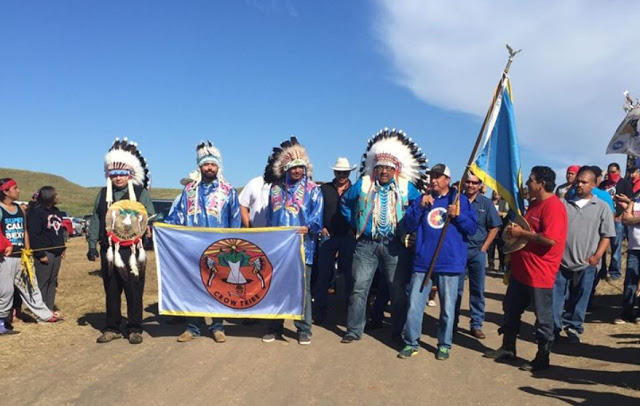
Water Protectors at Standing Rock from the Crow tribe (photo: Your Call)
Water Protectors from the Crow nation at Standing Rock (photo: Your Call)
CG: The thing about FBI surveillance for a lot of people—including incredibly astute people who are aware of civil liberties issues—is that they do associate it with the past, like you mentioned. They think about the McCarthy Era, they think about COINTELPRO, and they think that no longer happens. But the thing about it is that even after the reforms of the 1970s, the FBI has continuously and without interruption engaged in surveillance of dissent. So it’s an issue every year.
In the last year, we had a number of disturbing revelations. We know the FBI put out a threat assessment on “black identity extremism.” If you’ve never heard of “black identity extremism,” that’s because it’s a term made up by the FBI. But it essentially argued that if African-Americans get too upset about police racism, they could be a threat to law enforcement, and tries to make this connection between legitimate grievances about police violence, police racism, and violence against police officers. And that’s clearly part of a long history of the FBI spying on black dissent.
We also know, in the last year, that the FBI has made house calls to student activists who support Palestinian rights, to Cuban-Americans who opposed the US embargo, to a number of other groups as well, Standing Rock water protectors. And we were, at Defending Rights & Dissent in the late Obama era, pointing out that, through FOIA, we knew that the FBI had spied on Occupy Wall Street; they had spied on School of the Americas Watch and Black Lives Matter. There was another revelation in the Guardian last week, about more FBI surveillance on nonviolent environmentalists.
So it’s just a sort of continuous deluge of new revelations about who the FBI is spying on this week. So it’s always something to be aware of.
JJ: You at Defending Rights & Dissent say something that sounds so simple, but it’s so critical: that free expression, free assembly and free association aren’t just rights; they’re tools. They’re what we use to fight back against any and all abuses.
So free assembly is a tool for organizing for social change, which is why it’s so critical that we see this slippage where, you know, in some places like Virginia, police are taking classes on social movements, as though protest itself is a policing issue. Protesting itself is being almost defined as a crime.
CG: Yeah. I think that’s a really important point. Our point of analysis at Defending Rights & Dissent is to generally try to challenge restrictions or affronts to social movements. Anytime you see a successful social movement or a growing social movement that challenges the status quo, the status quo strikes back.
And we’ve seen that with the wave of anti-protest bills that have been popping up all across the nation since January of 2017. These are bills that make it easier to charge someone with felony rioting, they impose collective liability on demonstrators, they remove liability for running over protesters with cars. There’s a number of disturbing mechanisms here.
But the thing that is interesting is these bills almost always follow outbreaks of protest. So you’ll see a state where there’s a police killing, and the officer gets off. And then people rightfully take to the streets to demand an end to the racism, an end to the police violence. And the response of the legislators is to pass, or try to pass, new laws attacking protesters.
You saw this after Standing Rock, and you’re seeing this pop up all across the country with critical infrastructure bills, which are bills that impose very severe penalties for sabotaging critical infrastructure. And if you listen to just that, that sounds really bad, like, “Oh God, critical infrastructure and sabotage!”
JJ: Right.
CP: But what they are targeting is nonviolent protest against pipelines. So in some cases, trespassing on pipeline property—or just nonviolent civil disobedience near a pipeline, nothing destructive—falls under the definition of “critical infrastructure sabotage.” And then you’re facing a huge criminal penalty.
These are popping up in states where there are pipelines being built and there’s opposition to them. They’re pushed by ALEC, the notorious right-wing bill mill. They have their own model critical infrastructure bill, that also imposes conspirator liability on groups that supposedly facilitate these protests. So that’s going after the big environmental groups and making sure they don’t provide any support to the Standing Rock protesters going forward.
And the other thing we keep seeing—and this has been for some time—is attacks on the movement for Palestinian freedom. Congress, in its lame-duck session, apparently strongly considering putting an unconstitutional bill in the appropriations bill, called the Israel Anti-Boycott Act, which criminalizes certain boycotts of Israel, specifically those that are called for by nongovernment organizations. So if the UN Human Rights Council says “boycott settlements,” it would be a crime to promote or comply with that.
And that bill’s been blocked for two years, due to the outcry from First Amendment experts, from Palestinian freedom advocates, from really across the spectrum. But there’s openly plans to possibly try to get it put in the appropriations bill. So whatever happens with that, I don’t think that issue’s going away. I think you’re going to continue to see that pop up in different states.
The good news is, first of all, I can attest that activists have fought back against proposed bills and won, and have stopped them from being passed through grassroots pressure.
But even in states where they have passed, you’ve seen lawsuits challenging them. There was a lawsuitin Kansas, where a woman who was a Mennonite, whose church, the Mennonite Church, boycotts settlement products. She contracted with the state to teach science teachers how to teach science better. And she was denied the contract, because she wouldn’t sign an oath to not boycott Israel. She sued, and she was granted preliminary injunction.
An attorney in Arizona, who represents indigent clients in prison, had a similar situation. In that case, there also was a preliminary injunction.
And what a preliminary injunction means is that a judge has looked at the facts and has decided the plaintiffs are most likely to prevail on the merits, and that they would suffer irreparable harm if the bill is not blocked from being enforced. And a deprivation of First Amendment rights is always considered to be an irreparable harm.
So what courts are saying is that boycotting for Palestinian human rights is an expressive activity, it’s political speech, and therefore it’s protected by the First Amendment.
And in the last week, we saw two new lawsuits filed against these state bills: a very interesting one in Arkansas, brought by the Arkansas Times, which doesn’t take a position in favor of BDS, but because the University of Arkansas advertises in their newspaper, the state was trying to make them sign the no-boycott Israel pledge. And as journalists, they said, “This is outrageous. This is a loyalty oath. We’re not signing this.” And they’re suing.
And a speech pathologist in Texas, who lost her job working with children ages 3 to 11, is bringing a similar suit. If Kansas and Arizona are any prediction, I would say they’re going to probably have the same outcome. Hopefully.
JJ: Right, and in all of these cases we have to be mindful of language around “security,” for example, around “sabotage,” when it comes to BDS language around “antisemitism,” coming in to take over a situation which is really about free speech or about free assembly.
You know, when Donald Trump was elected, millions of Americans were outraged and were opposed. Some of those people marched at the inauguration to show their opposition. Some of those were then thrown in jail and threatened with decades of prison time, and I know that the way those J20 protesters were treated affected people’s feelings about how they would themselves express themselves.
And we’ve seen it almost become divisive, you know, “OK, I’ll wear a pink hat. But wait? You’re going to chant at someone whose policies are pulling children from their parents, you’re going to chant at them while they’re eating in a restaurant?”
And we’re almost fighting ourselves over how politely to respond to outrageous policies. And that is based on fear. It’s based on our fear of what will happen if we go out in the street.

Chip Gibbons
Chip Gibbons: “If you say, ‘Hey, I want to censor First Amendment activity of people I don’t like,’ that’s a little bit suspect. But if you say, ‘Hey, there’s terrorist mobs descending on the streets. We gotta defend ourselves,’ you’re more likely to get somewhere with that framing.”
CG: Sure. I think that’s a valid point, and I think one of the most shocking things from the J20 trial was the use of collective liability. I mean, I sat through the opening arguments in the first trial of defendants, and Jennifer Kerkhoff, the assistant US attorney, said to the jury, “I don’t think any of these people engaged in property destruction. I don’t think any of them are at an organizing meeting. But because they were in this march”—and in DC, you don’t need a permit to have a protest march—“because they’re at this march, where somebody else may or may not have engaged in property destruction, they’re guilty as part of a criminal conspiracy to riot.” So a trend that I think we might see more of is this attempt to impose collective liability on people.
And I think you’re really right about the language. I mean, where we see these anti-protest bills being proposed, we see people comparing protesters to terrorists.  And in the last couple of months, you’ve seen this narrative about “mobs” and rioters, where peaceful protesters are akin to rioting, or they’re a mob. And that narrative, it builds the momentum for policing of protest. Because if you say, “Hey, I want to censor First Amendment activity of people I don’t like,” that’s a little bit suspect. But if you say, “Hey, there’s terrorist mobs descending on the streets. We gotta defend ourselves,” you’re more likely to get somewhere with that framing.
JJ: Right.
CG: And in, I believe it was Minnesota, the police union was pushing for a bill that would have taken away driver liability for “unintentionally” running over protesters. If you ran over other non-protesters, you still have liability, but if you ran over a protester, no liability.
When In These Times asked the Police Union why they were pushing for this bill, they said, “Well, everyone knows George Soros is paying people to riot.”
JJ: Wow.
CG: And at Defending Rights & Dissent, you might find this shocking, but we’ve always gotten some hate mail from time to time, if you can believe that. And in the past, it was always when we would do things about Islamophobia or for immigrants’ rights, and Black Lives Matter occasionally, but now I’m starting to see it for really just any sort of defense of the right to assemble.
So, you know, the National Park Service was considering really ridiculous restrictions on the right to assemble in DC. And I got all this hate mail, like, “Oh, you’re just supporting rioters.”
And it’s like, well, this regulation is not for rioters, it is for permitted protest. The permitting process does not—you can’t get a permit to get a riot. So that’s totally irrelevant here. But I saw the Washington Times make that same argument.
So you have all these people who are whipped up about these nonexistent riots that are going on. And now they’re willing to defend restrictions on even peaceful protest. And you want to avoid the good protester/bad protester dichotomy, but it is interesting to see how people are willing to accept—because of this bizarre narrative that George Soros is paying protesters—all kinds of restrictions.
JJ: Behind everything.
It’s interesting that you note that the legislation says if you run over someone who’s not a protester, you still have that liability, which sort of screams out that it’s political. And it reminds me of the anti-BDS bills, which say if you’re a business that happens not to do business with or buy products from Israel or the settlements, you’re not going to be punished. But if you say you’re not going to buy products from or do business with Israel or the settlements, well, then you can be punished, because that’s political. It seems so clearly to almost shine a light on the fact that what is being censored is political speech.
CG: Many of the anti-boycott bills define “boycott” as politically motivated, I believe, and it’s like, oh, so you’re literally going for political speech. The interesting thing is that Airbnb decided to stop doing listings in the settlements. And I believe Illinois, which has one of these anti-BDS bills, told Airbnb they were in violation of the state anti-BDS law, which was an interesting development; that you have a company that doesn’t want to do business in the settlements, and I believe the Israeli government said they were going to report them to multiple states. And then some of these states came out and were like, “You’re in violation of our law.”
JJ: It’s very interesting, because we don’t restrict corporations’ abilities to do whatever they want in so many other arenas.
CG: But if you comply with the Geneva Conventions, that’s taking it a little bit too far.
JJ: That’s going to be a problem.
CG: You can destroy our elections, bust up unions, pollute the Earth, but if you comply with the Geneva Conventions, I’m sorry, we have to limit business sometimes.
JJ: We’ve got to draw a line somewhere. Well, speaking of narrative, I wanted to ask you about something that I know that you’ve written about. We started out talking about FBI surveillance, and I know that for many people “FBI” means J. Edgar Hoover, it means COINTELPRO, it means trying to interfere with Martin Luther King’s marriage and all manner of skulduggery and dark associations.
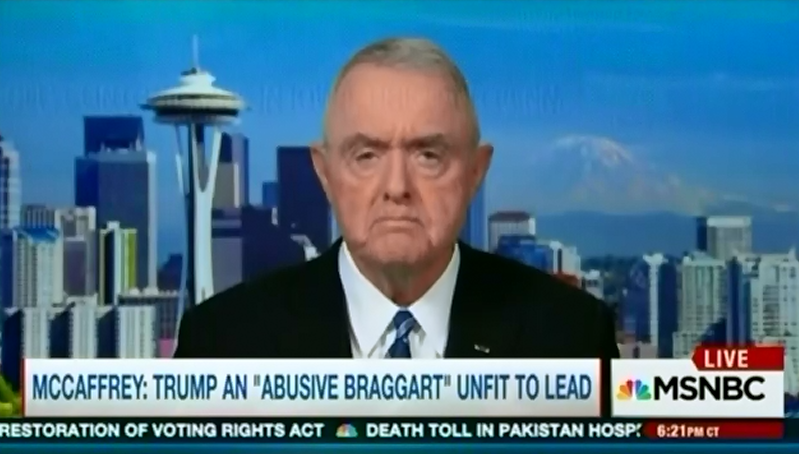
McCaffrey: Trump an 'Abusive Braggart' Unfit to Lead
Barry McCaffrey on MSNBC (8/9/16) (screengrab: MMFA)
And yet Donald Trump has twisted around relationships for folks who hew strongly to the idea of “the enemy of my enemy is my friend.” And in 2018, we saw, for example, MSNBC bringing on Barry McCaffrey, an ex-general who cheerled for the Iraq invasion. He’s on MSNBC because now he’s an expert, apparently, on Trump and Putin.
Over on CNN, we had Anderson Cooper chatting it up nicely with ex-National Intelligence Director James Clapper, who perjured himself in the Senate by denying NSA bulk surveillance. But now he’s on CNN, talking about the lack of ethics in the Trump White House.
We’re seeing a rehabilitation of some forces that we need to keep looking at critically. There’s kind of a weird thing going on.
CG: George W. Bush has been rehabilitated.
JJ: Absolutely. He’s a painter, isn’t he, a beautiful painter?
CG: He’s a painter. And the one thing about George W. Bush is, you may have disagreed with him, but at least he respected our democratic norms. And you hear people say this, and you’re like, He ran an international program of disappearance and torture and he gets a prize for respecting norms? What about the norm about not torturing? Whatever happened to that one? Oh, George W. Bush eroded it. Thank you. Thank you. It’s really sort of disturbing.
You see this valorization of the security state as this sort of bulwark against Trump’s descent into tyranny. And I understand why people are concerned about Donald Trump. There are allegations that he engaged in criminal activity. Whenever there are allegations like that, I think they should be investigated seriously. I think election interference is something we should take seriously, and should be investigated seriously.
But on the flip side of that is both this sort of bizarre valorization of the security state, and you look at someone like James Comey, who presided over an organization that was engaged in putting agent provocateurs in the Muslim community, and getting people to agree to nonexistent terror plots and then arresting them when they did so. And in Donald Trump’s second Muslim ban executive order, he cites two of these made-up FBI plots as his reason for banning Muslims.
Or James Comey who touted the “Ferguson effect,” saying that protests against police violence were causing a nonexistent crime uptick, which is one of the central narratives of the Trump—Sessions is gone now, but the Trump/Sessions worldview — is this idea that we’re descending into crime because people are protesting. So the FBI legitimised, for decades, much of the worldview of Donald Trump, and helped to set the stage for a demagogue like that.
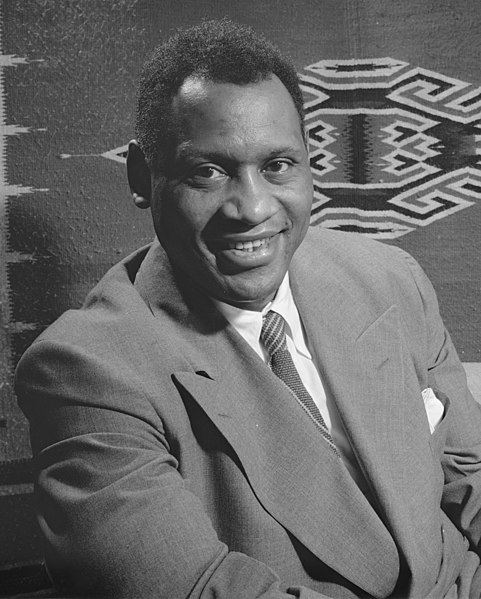
Paul Robeson (photo: Gordon Parks)
And the other thing that I’m very concerned about—I’ve interestingly enough, been reading a book about Paul Robeson, which has disturbing parallel to the present—is you see this narrative coming up that the Russians are trying to promote divisive movements, in order to sow divisions. And the type of divisive movements are protests against racism. And there’s never any consideration that, you know, maybe racism is divisive? Maybe police killing people and getting away with it is divisive? It’s always, “How dare you march against this?”
And there’s allegations that the Russians were engaged in voter suppression of African-Americans. And if that’s the case, that’s very deplorable. But it’s really important that we move away from this narrative that paints social movements as divisive and thus bad. I mean, anytime you challenge racism or the status quo, yes, people are going to consider that contentious. That is good. And it doesn’t change the fact, if there are Russian troll farms publicizing police killings, that these are happening, and that people are angry about them. I mean, it’s actually kind of racist to assert that black people are only upset about the racism they face every day because the Russians got them all worked up.
JJ: Everything was fine until then.
CG: We never had racism. We had democratic norms like the security state. We all trusted it. It was a wonderful time to be alive.
JJ: Absolutely. And then it all got muddled up.
Well, you at Defending Rights & Dissent, I said this before, the idea that the free expression and the free assembly and association that we’re talking about, that they are tools for social change, that they are rights that have to be preserved in themselves because we use them for other things.
And for me, I will never understand, on some level, why we don’t see the press corps leading the charge on these things, why we don’t see a proactive defense of these rights from the press corps. Now I understand, I wasn’t born yesterday, I know how corporate media work.  But in this era of “Democracy Dies in Darkness” and all of that, I really would look for journalists to be talking about J20 every day, talking about even Julian Assange , talking about whistleblowers, talking about the protection of our ability to have the conversation, whether or not you agree with it. The threat seems so clear to me that I really would like to see so much more from journalists.
CG: Yeah. There are still very courageous, independent journalists, and there are courageous programs like yours. So it’s not all hopeless.
JJ: Not at all, in terms of independent media.
CG: I do wish our friends in the corporate media would do a better job, much of the time.
JJ: Yeah.

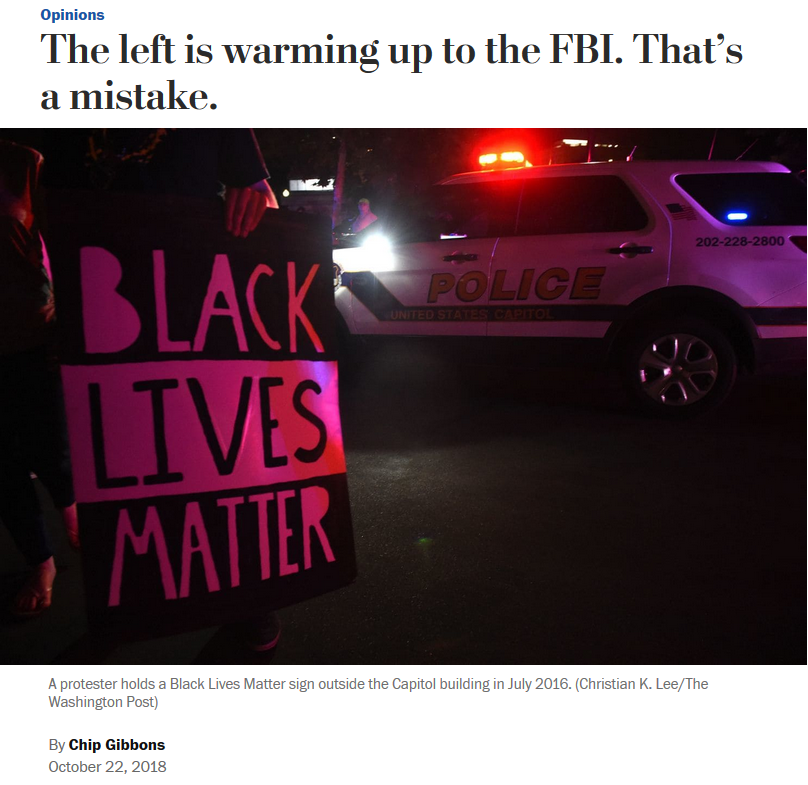
WaPo: The Left Is Warming Up to the FBI
Washington Post (10/22/18)
CG: They are oftentimes very much willing to repeat these narratives. There’s not always an interest in civil liberties stories. I have to give the Washington Post some credit for publishing my op-ed on the FBI—
JJ: Sure.
CG: —which they asked me to write. They found me; I didn’t ever dream that they would want to publish something like that.
So there are occasional good acts, and I think we should praise them. But also when we see the media failing to live up to its responsibilities, I think we should be vocal about that as well.
JJ: The independent media, I think is really showing its importance at this time, because that’s where we can look to see a lot of the stories that then might bubble up, if you will, to other outlets.
CG: That’s very true.
JJ: Let me just ask you, we were going, I know, to talk about whistleblowers in particular. In a time when institutions that are powerful are getting better at shrouding themselves from scrutiny, sometimes one of the only ways that you can learn what is happening is from a whistleblower, is from someone who is inside, making a decision to reveal what’s going on within their institution.
And, again, this is a thing that on paper everyone says, “Yes, it’s very important.” But when people actually do it, they don’t necessarily get the support and the reception and the protection that they deserve.
CG: This is a very dark time for whistleblowers. I mean, Trump hates dissent. He hates whistleblowing. But the previous administration, Barack Obama, the former constitutional lawyer, normalized using the Espionage Act against whistleblowers. So trying people who give information to the media for espionage was a practice that the Obama administration engaged in.
Prior to that, there’d only been three such charges and one conviction under the Espionage Act for whistleblowers. The one person who was convicted during the Reagan years, Bill Clinton pardoned him, at the urging of Daniel Patrick Moynihan, because they considered it such a bizarre anomaly to do this. And then Obama made the Espionage Act the go-to statute for going against whistleblowers.
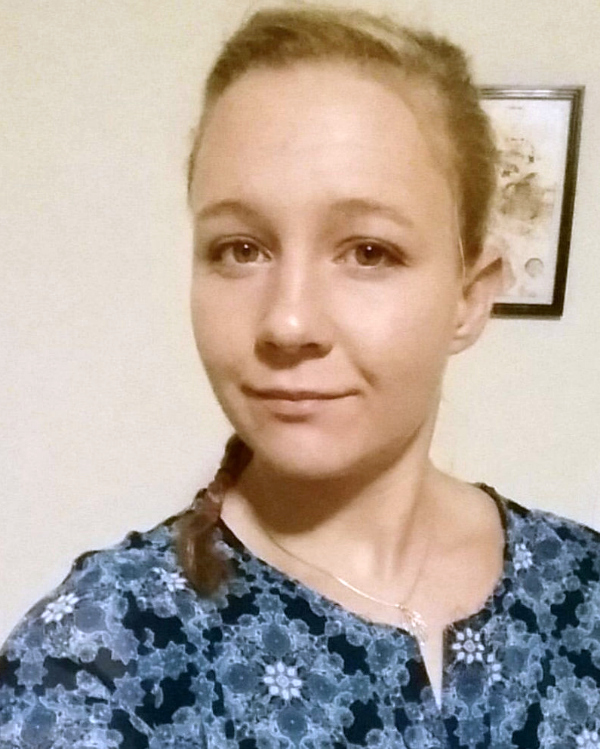
Reality Winner
Reality Winner
And now Trump has used it twice, against Reality Winner and against Terry Albury. We know there is a sealed indictment against Julian Assange. And I know that many people are critical of some of the things he’s tweeted, and his political associations in the last couple of years, and I find some of them troubling myself, but that doesn’t change the fact that if we’re going to prosecute Julian Assange for releasing information, then that’s an assault on the press.
I mean, the New York Times’ general counsel has said that if you prosecute Assange under the Espionage Act—and we don’t know if that’s what the indictment’s about or not; there’s a number of theories as to what it could be about—that would open the door to prosecuting the New York Times.
So even if you hate Julian Assange, this would be the biggest attack on press freedom in the post-World War II era, if they went after him under the Espionage Act. And it’s worth pointing out that the Obama administration considered it, and they thought that was going too far, even for them.
Will Trump be the administration who takes us to that level? Maybe. Let’s hope not.
JJ: Let me just ask you, finally, because obviously we see these predations on our civil liberties and our civil rights: I also see—and I might be Pollyanna—but I see folks on to it. I see folks who are brave. I see folks who are understanding that dissent is critical, and they’re willing to do it, and they’re willing to take it on. And I just wonder—I know you were talking about getting hate calls, but do you see a change, in terms of activity on the part of regular folks, in terms of a willingness to politically engage?
CG: I think there’s more interest in this issue than there was two or three years ago. I think that there’s always been a lot of attacks on dissent. I think the last two years, there’s been a massive escalation, and it’s been clearly, clearly about smashing social movements.
And I think a lot of people see that for what it is, and they’re speaking out. They’re very angry. They’re not happy with the way things are, and they’re even less happy with when they say that, they then face repression. So I think there is, if there’s a silver lining here, it’s that I think that people are mobilizing against this crackdown.
And that’s what it will take to beat it, is the people mobilizing.
JJ: We’ve been speaking with Chip Gibbons, policy and legislative counsel at Defending Rights & Dissent. You can find out about their work and be part of it online at RightsAndDissent.org. Chip Gibbons, thank you so much for joining us.
CG: Always a pleasure.
***
JJ: That’s it for CounterSpin for this week. CounterSpin is produced by FAIR, the national media watch group based in New York, online at FAIR.org. The show’s engineered by Alex Noyes. I’m Janine Jackson. Thanks for listening to CounterSpin.


FAIR/Fairness & Accuracy In Reporting
124 W. 30th Street, Suite 201
New York NY 10001
USA