Dear Friend,
An Iran hawk who advocated killing general Qassim Soleimani, US Secretary of State Mike Pompeo has ordered his diplomats to limit contacts with militant Iranian exile and opposition groups that support either regime change or greater rights for ethnic groups like Kurds and Arabs.
Kindly support honest journalism to survive. https://countercurrents.org/subscription/
If you think the contents of this news letter are critical for the dignified living and survival of humanity and other species on earth, please forward it to your friends and spread the word. It's time for humanity to come together as one family! You can subscribe to our news letter here http://www.countercurrents.org/news-letter/.
In Solidarity
Binu Mathew
Editor
Countercurrents.org
US backs off support for regime change in Iran
by Dr James M Dorsey
An Iran hawk who advocated killing general Qassim Soleimani, US
Secretary of State Mike Pompeo has ordered his diplomats to limit contacts with militant Iranian exile and opposition groups that support either regime change or greater rights for ethnic groups like Kurds and Arabs.
An Iran hawk who advocated killing general Qassim Soleimani, US Secretary of State Mike Pompeo has ordered his diplomats to limit contacts with militant Iranian exile and opposition groups that support either regime change or greater rights for ethnic groups like Kurds and Arabs.
Coming on the back of the Soleimani killing, Mr. Pompeo’s directive appears to put an end to the Trump administration’s hinting that it covertly supports insurgent efforts to at the very least destabilize the Iranian government if not topple it.
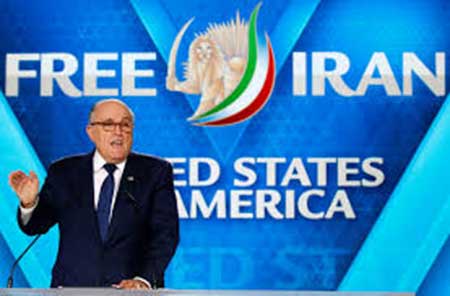
A litmus test of the directive by Mr. Pompeo, known to have a close relationship with Donald J. Trump, is likely to be whether the president’s personal lawyer, Rudolph Giuliani, distances himself from the controversial National Council of Resistance of Iran (NCRI), an offshoot of the Mujahedeen-e-Khalq, a group that was taken off the US Treasury’s list of designated terrorists several years ago.
Mr. Giuliani is a frequent, well-paid speaker at gatherings of the group that has built a significant network among Western political elites. The council and the Mujahedeen openly call for regime change in Iran.
The Mujahedeen were moved with US assistance from their exile base in Iraq to a reportedly Saudi-funded secretive facility in Albania.
A New Jersey-based lobbying firm hired by the NCRI, Rosemont Associates, reported last year in its filing as a foreign agent frequent email and telephone contact on behalf of its client with the US embassy in the Albanian capital of Tirana as well as Brian Hook, the US Special Representative for Iran, and Gabriel Noronha, an aide to Mr. Hook.
In his directive, Mr. Pompeo said that “direct US government engagement with these groups could prove counterproductive to our policy goal of seeking a comprehensive deal with the Iranian regime that addresses its destabilizing behaviour.”
The secretary went on to say that Iranian opposition groups “try to engage US officials regularly to gain at least the appearance of tacit support and enhance their visibility and clout.”
Mr. Pompeo’s cable, while keeping a potential negotiated deal with Iran on the table, does not stop other US government agencies from covertly supporting the various groups, that also include Arab Struggle Movement for the Liberation of al-Ahwaz (AMLA), the Komala Party of Iranian Kurdistan, and the Kurdish Democratic Party of Iran (KDPI).
Iran, which has long believed that the United States, alongside Saudi Arabia and Israel, supported the Mujahedeen as well as ethnic militants that intermittently launch attacks inside Iran, is likely to take a wait-and see-attitude towards Mr. Pompeo’s directive that could be seen as a signal that the Trump administration is not seeking regime change.
The timing of the directive is significant. Iran responded to the killing of Mr. Soleimani with carefully calibrated missile attacks on US facilities in Iraq in a bid to create an environment in which backchanneling potentially could steer the United States and Iran back to the negotiating table.
While it was uncertain that one round of escalated tensions would do the trick, potential efforts were not helped by the death of Oman’s Sultan Qaboos bin Said al Said, a key interlocutor who has repeatedly helped resolve US-Iranian problems and initiated contacts that ultimately led to the 2015 international agreement that curbed Iran’s nuclear program.
In his directive, Mr. Pompeo, referring to Komala, acknowledged that “Iran’s regime appears to assess that the United States and/or Israel support this group of militant Kurds.”
Iranian perceptions were reinforced not only by calls for regime change by senior figures like Mr. Giuliani and Saudi prince Turki al-Faisal, a former head of the kingdom’s intelligence service and ex-ambassador to Britain and the United States, but also the appointment in 2018 of Steven Fagin as counsel general in Erbil in Iraqi Kurdistan.
Shortly before moving to Erbil, Mr. Fagin met In Washington as head of the State Department’s Office of Iranian Affairs, with Mustafa Hijri, leader of the KDPI as it stepped up its attacks in Iranian Kurdistan.
Iranian perceptions were further informed by the appointment of John Bolton, Mr. Trump’s since departed national security advisor and like Mr. Giuliani a frequent speaker at NCRI events, who publicly advocates support of ethnic insurgencies in Iran in a bid to change the regime.
As Mr. Trump’s first director of the Central Intelligence Agency, Mr. Pompeo named Michael D’Andrea, a hard-charging, chain-smoking covert operations officer, alternatively nicknamed the Dark Prince or Ayatollah Mike, whose track record includes overseeing the hunt for Osama Bin Laden, as head of the CIA’s Iran operations.
The appointment was followed by publication by a Riyadh-based think tank believed to be close to crown prince Mohammed bin Salman of a study for Saudi support for a low-level Baloch insurgency in Iran. Prince Mohammed vowed around the same time that “we will work so that the battle is for them in Iran, not in Saudi Arabia.”
Pakistani militants have claimed that Saudi Arabia had stepped up funding of militant madrassas or religious seminaries in the Pakistani province of Balochistan that allegedly serve as havens for anti-Iranian fighters.
The New York Times reported this week that aides to Prince Mohammed had in the past discussed with private businessmen the assassination of Mr. Soleimani, an architect of Iran’s regional network of proxies, and other Iranians as well as ways of sabotaging the country’s economy.
Mr. Pompeo’s directive is unlikely to persuade Iran that Washington has had a change of heart. Indeed, it hasn’t. Mr. Trump maintains his campaign of maximum pressure and this week imposed additional sanctions on Iran.
Nonetheless, potentially taking regime change off the table facilitates backchanneling that aims at getting the two nations to talk again.
Dr. James M. Dorsey is a senior fellow at Nanyang Technological University’s S. Rajaratnam School of International Studies, an adjunct senior research fellow at the National University of Singapore’s Middle East Institute and co-director of the University of Wuerzburg’s Institute of Fan Culture
A podcast version of this story is available on Soundcloud, Itunes, Spotify, Stitcher, TuneIn, Spreaker, Pocket Casts, Tumblr, Podbean, Audecibel, Patreon and Castbox.
Iran’s accidental downing of a Ukrainian plane is already being used to smear MH-17 skeptics
by Max Parry
Shamefully, Iran’s admission of guilt in the PS752 downing is already being used by establishment propagandists to discredit skeptics and conflated with similar contested past events like MH17 in order to intimidate dissenting voices from speaking up in the future.
When the Pentagon confirmed the assassination of Iranian Major General Qasem Soleimani, U.S. President Donald Trump took to social media to post a single image of the American flag to the adulation of his followers. Unfortunately, most Americans are ignorant of the other flag synonymous with U.S. foreign policy, that of the ‘false flag’ utilized to deceive the public and stir up support for endless war abroad. While the chicken hawk defenders of Trump’s reckless decision to murder one of the biggest contributors in the defeat of ISIS salivated over possible war with Iran, their appetite was spoiled by Tehran’s retaliatory precision strikes of two U.S. bases in Iraq that deliberately avoided casualties while in accordance with the Islamic Republic’s right to self defense under Article 51 of the United Nations charter. The reprisal successfully deescalated the crisis but sent a clear message Iran was willing to stand up to the U.S. with the backing of Russia and China, while Washington underestimated Tehran which forewarned the Iraqi government of its impending counterattack so U.S. personnel could evacuate.
In the hours following the ballistic missile strikes, reports came in that a Boeing 737 international passenger flight scheduled from Tehran to Kiev, Ukraine had crashed shortly after takeoff from Imam Khomeini International Airport, killing all 176 passengers and flight crew on board. Initial video of the crash of Ukrainian International Airlines Flight 752 (PS752) showed that the aircraft was already in flames while descending to the ground, leading to speculation it was shot down amid the heightened political crisis between Iran and Washington. In the days following, a second obscure video surfaced which only increased this suspicion. Meanwhile, Western governments quickly concluded that an anti-aircraft surface-to-air missile brought PS752 down and were eager to point the finger at Iran before any formal investigation. Many people, including this author, were admittedly skeptical as to how a plane taking off from Tehran could have been mistaken five hours after the strikes in Iraq.
Nevertheless, those with reservations turned out to be wrong when days later the Islamic Revolutionary Guard Corps (IRGC) came clean that its aerospace forces made a “human error” and accidentally shot the passenger plane down after mistaking it for a incoming cruise missile when it flew close to a military base during a heightened state of alert in anticipation of U.S. attack. Many have noted that Iran’s honorable decision to take responsibility for the catastrophe is in sharp contrast with Washington’s response in 1988 when the U.S. Navy shot down Iran Air Flight 655 scheduled from Tehran to Dubai over the Strait of Hormuz in the Persian Gulf, killing all 290 occupants, after failing to cover it up. Just a month later, Vice President George H.W. Bush would notoriously state he would “never apologize for the United States of America. Ever. I don’t care what the facts are.” Although he was not directly referring to the incident, one can only imagine what the reaction would be if Iranian President Hassan Rouhani were to say the same weeks after shooting down the Ukrainian plane, let alone an American one. Predictably, Tehran’s transparency has gone mostly unappreciated while the Trump administration is already trying to use the disaster to further demonize Iran.
Oddly enough, Ukrainian International Airlines is partly owned by the infamous Ukrainian-Israeli oligarch, politician and energy tycoon Igor Kolomoisky, who was notably one of the biggest financiers of the anti-Russian, pro-EU coup d’etat which overthrew the democratically elected government of Viktor Yanukovych in 2014. Kolomoisky is also a principal backer of current Ukrainian President Volodymyr Zelensky whose dubious phone call with Trump resulted in the 45th U.S. president’s impeachment last month. In another astounding coincidence, Kolomoisky’s Privat Group is believed to control Burisma Holdings, the Cypress-based company whose executive board 2020 presidential candidate Joe Biden’s son Hunter was appointed to following the Maidan junta. The former Vice President admitted that he bribed Ukraine into firing its top prosecutor who was looking into his son’s corruption by threatening to withhold $1 billion in loan guarantees.
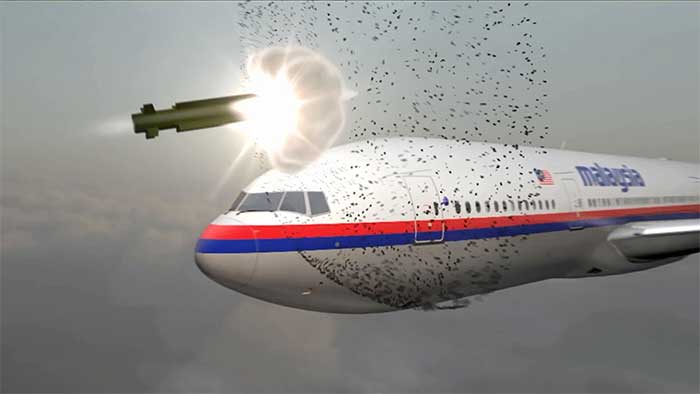
Kolomoisky, AKA “the Chameleon”, is one of the wealthiest people in the ex-Soviet country and was formerly appointed as governor of an administrative region bordering Donbass in eastern Ukraine following the 2014 putsch. He has also funded a battalion of volunteer neo-Nazi mercenaries fighting alongside the Ukrainian army in the War in Donbass against Russian-speaking separatists which the military aid temporarily withheld by the Trump administration that was disputably contingent upon an investigation of Biden and his son goes to. In 2014, another infamous plane shootdown made international headlines when Malaysian Airlines Flight 17 (MH17) scheduled from Amsterdam to Kuala Lumpur was shot down over the breakaway Donetsk People’s Republic (DPR) in eastern Ukraine, killing all 298 passengers and crew.
From the get-go, the Obama administration was adamant that the missile which shot down the Boeing 777 came from separatist rebel territory. However, Malaysian Prime Minister Mahathir bin Mohamad denounced the charges brought against the Russian and Ukrainian nationals indicted in the NATO-led investigation, dismissing the entire probe as a politically motivated effort predetermined to scapegoat Moscow and exclude Malaysian participation in the inquiry from the very beginning. Mohamad is featured in the excellent documentary MH17: Call for Justice made by a team of independent journalists which contests the NATO-scripted narrative and reveals that the Buk missile was more likely launched from Ukrainian Army-controlled territory than the DPR. One of Kolomoisky’s hired guns could also have been responsible.
Shamefully, Iran’s admission of guilt in the PS752 downing is already being used by establishment propagandists to discredit skeptics and conflated with similar contested past events like MH17 in order to intimidate dissenting voices from speaking up in the future. The Bellingcat ‘investigative journalism’ collective which made its name incriminating Moscow for the MH17 tragedy are the principle offenders. Bellingcat bills itself as an ‘independent’ citizen journalism group even though its founder Eliot Higgins is employed by the Atlantic Council think tank which receives funding from NATO, the U.S. State Department, the National Endowment for Democracy (NED), George Soros’ Open Society Foundation NGO, and numerous other regime change factories. Despite its enormous conflict of interest, Bellingcat remains highly cited by corporate media as a supposedly reputable source. At the outset, nearly everything about the PS752 tragedy gave one déjà vu of the MH17 disaster, including the rush to judgement by Western governments, so it was only natural for many to distrust the official narrative until more facts came out.
None of this changes that the use of commercial passenger jets as false flag targets for U.S. national security subterfuge is a verifiable historical fact, not a ‘conspiracy theory.’ In 1997, the U.S. National Archives declassified a 1962 memo proposed by the Joint Chiefs of Staff and Department of Defense for then-Secretary of State Robert McNamara entitled “Justification for U.S. Military Intervention in Cuba.” The document outlined a series of ‘false flag’ terrorist attacks, codenamed Operation Northwoods, to be carried out on a range of targets and blamed on the Cuban government to give grounds for an invasion of Havana in order to depose Fidel Castro. These scenarios included targets within the U.S., in particular Miami, Florida, which had become a haven of right-wing émigrés and defectors following the Cuban Revolution. In addition to the sinking of a Cuban refugee boat, one Northwoods plan included the staging of attacks on a civilian jet airliner and a U.S. Air Force plane to be pinned on Castro’s government:
“8. It is possible to create and incident which will demonstrate convincingly that a Cuban aircraft has attacked and shot down a chartered civil airliner enroute from the United States to Jamaica, Guatemala, Panama or Venezuela. The destination would be chosen only to cause the flight plan route to cross Cuba. The passengers could be a group of college students off on a holiday or any grouping of persons with a common interest to support chartering a non-scheduled flight.
9) It is possible to create an incident which will make it appear that Communist Cuban MIGs have destroyed a USAF aircraft over international waters in an unprovoked attack.”
Although Operation Northwoods was rejected by then-U.S. President John F. Kennedy which many believe was a factor in his subsequent assassination, Cuban exiles with the support of U.S. intelligence would later be implicated in such an attack the following decade with the bombing of Cubana Airlines Flight 455 in 1976 which killed all 73 passengers and crew on board. In 2005, documents released by the National Security Archive showed that the CIA under then-director George H.W. Bush had advanced knowledge of the plans of a Dominican Republic-based Cuban exile terrorist organization, the Coordination of United Revolutionary Organizations (CORU), at the direction of former CIA operative Luis Posada Carriles to blow up the airliner. The U.S. later refused to extradite Carriles to Cuba to face charges and although he never admitted to masterminding the bombing of the jet, he publicly confessed to other attacks on tourist hotels in Cuba during the 1990s and was later arrested in 2000 for attempting to blow up an auditorium in Panama trying to assassinate Castro.
In 1962, the planners of Operation Northwoods concluded that such deceptive operations would shift U.S. public opinion unanimously against Cuba.
“World opinion and the United Nations forum should be favorably affected by developing the international image of Cuban government as rash and irresponsible, and as an alarming and unpredictable threat to the peace of the Western Hemisphere.”
The same talking points are used by the U.S. government to demonize Iran today. Initially, some Western intelligence sources also concluded that it was a malfunction or overheated engine that brought PS752 down in corroboration with the Iranian government’s original explanation until the narrative abruptly shifted the following day. That they were so quick to hold Iran accountable without any investigation gave the apparent likelihood that PS752 could have fallen prey to a Northwoods-style false flag operation designed to further isolate Iran and defame its leaders after they took precautions to avoid U.S. casualties in their retaliatory strikes for the killing of Soleimani. Maintaining the image of Iran as a nefarious regime is crucial in justifying hawkish U.S. policies toward the country and Iran’s noted restraint in its retaliation put a dent in that impression, so many were suspicious and rightly so.
It was also entirely plausible that U.S. special operations planners could have consulted the Northwoods playbook replacing Cuba with Iran and the right-wing gusanos who were to assist the staged attacks in Miami with the Iranian opposition group known as Mujahedin e-Khalq (MEK/People’s Mujahedin of Iran) to do the same in Tehran. In July of last year, Trump’s personal lawyer and former New York City Mayor Rudolph Giuliani gave a paid speech at the cult-like group’s compound in Albania where he not only referred to the group as Iran’s “government-in-exile” but stated the U.S’s explicit intentions to use them for regime change in Iran. The MEK enjoys high level contacts in the Trump administration and the group was elated at his decision to murder Soleimani in Baghdad.
From 1997 until 2012, the MEK was on the State Department’s list of terrorist organizations until it was removed by the Obama administration after its expulsion from Iraq in order to relocate the group to fortified bases in Albania and the NATO protectorate of Kosovo. The latter disputed territory is a perfect fit for the rebranded group having been founded by another deregistered foreign terrorist organization, the al-Qaeda linked Kosovo Liberation Army (KLA), whose leader, Hashim Thaçi, presides over the partially-recognized state. The MEK are no longer designated as such despite the State Department’s own account of its bloody history:
“During the 1970s, the MEK staged terrorist attacks inside Iran to destabilize and embarrass the Shah’s regime; the group killed several US military personnel and civilians working on defense projects in Tehran. The group also supported the takeover in 1979 of the US Embassy in Tehran. In April 1992 the MEK carried out attacks on Iranian embassies in 13 different countries, demonstrating the group’s ability to mount large-scale operations overseas.”
Declassified documents revealing the sinister plans in Operation Northwoods which shockingly made it all the way to the desk of the president of the United States and the foreknowledge of Cubana Airlines Flight 455 are just two examples of solid proof that false flag attacks against civilian passenger planes are a part of the Pentagon’s modus operandi as disclosed in its own archives and there is no reason to believe that such practices have been discontinued. That the U.S. is still cozy with “former” terror groups like MEK seeking to repatriate is good reason to believe its use of militant exiles for covert operations like those from Havana has not been retired. If there were jumps to conclusions that proven serial liars could be looking for an excuse to stage an attack to lay the blame on Iran, it is only because the distinct probability was overwhelming. Even so, a stopped clock strikes the right time twice per day and that is all Iran’s acknowledgment of its liability proves — that even the world’s most unreliable and criminal sources in Washington and Langley can be accurate sometimes, even if by accident. Stay skeptical.
Max Parryis an independent journalist and geopolitical analyst. His work has appeared in Counterpunch, Global Research, Dissident Voice, Greanville Post, OffGuardian, American Herald Tribune and more. Max may be reached at maxrparry@live.com
How to Hide an Empire – A History of the Greater United States
by Jim Miles
Review of How to Hide an Empire – A History of the Greater United States by Daniel
Immerwahr.
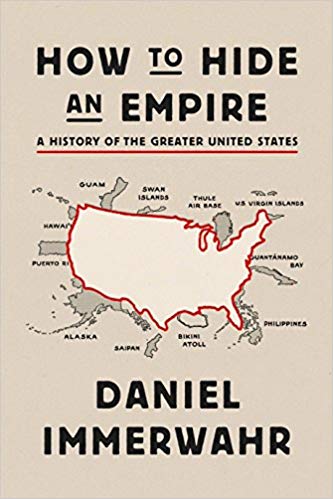
How to Hide an Empire – A History of the Greater United States. Daniel Immerwahr. Farrer, Straus and Giroux, New York, 2019.
The Greater United States of the title is not just the contiguous states of the mainland plus insets for Alaska and Hawaii, but includes many of the smaller – and not small – territories and possessions held by the U.S. around the world. It is “seeing a familiar history differently” from the perspective of what were and are considered territories or possessions. It is a story of land, slavery, economics, the military, and technology leading to globalization of trade, transport and communications, supported by a global network of military bases. How to Hide an Empire is an intriguing read into a history that is only touched upon in passing if at all in mainstream presentations.
Racism
The overall theme of the book as it explores the many different areas involved is that of racism. It is not stated overtly as such, but in each historical episode, from each archival story, racism always plays a role, in the typical words about savages and lesser races needing to be civilized (at best) or simply to be done away with if recalcitrant (quite common!).
It starts with the first settlers to North America, following the expansion of the U.S. across the continent. The land, in general, went from wilderness, to Indian Territory, to a pre-state territory and finally into statehood. It then looks at the first overseas expansions with the Spanish-American war of which very little is known in its true light.
A fair bit of time is spent on this war, describing how the U.S. did not really win the war as Spain was already losing to the revolutions already occurring in Cuba, the Philippines and other colonies. They found their excuse to intervene, sort of supported the successful guerilla fighters, then once victorious turned against them in order to install their own colonial apparatus to control the savages.
From this larger war, How to Hide and Empire goes through the interesting unknown histories of some smaller possessions, mostly rocky dry islets for guano, a late 19th century chemical needed for agriculture. This introduces what Immerwahr calls the “pointillist” empire, the many small islets and locations (e.g. Guantanamo, Okinawa) scattered around the world for mostly strategic military purposes. Kidnapping, racism, and exploitation accompanied these acquisitions.
How to hide an empire
After racism as a theme, the main idea of the book, a hidden empire, is obvious, and the answer is also obvious. The first is simply to ignore it: these histories are seldom if ever mentioned in the mainstream media or even in alternate media; the education system presents its histories in terms of defining dates and glorified names and supposed victories.
But above all the cultures of the people involved are destroyed. The language is forbidden, and children are removed to schools where they cannot speak their native language. They are then inculcated with the dominant myth of their needing enlightenment or civilization or in most early cases Christianity. Another manner to destroy the culture is by changing laws to give the colonial/administrative government power over all aspects of life, civilian and military. Voting rights play significantly into this with laws on property, language, and education affecting people’s right to vote.
Empire
“Foreign prisons, walled compounds, hidden bases, island colonies, GPS antenna stations, pinpoint strikes, networks, planes and drones – these are the locales and instruments of the ongoing war on terror. This is the shape of power today.”
There is no question in this presentation that the U.S. is and always was an empire. Today it has changed from the landholding empires of the previous centuries European empires to that of an integrated economic, technological, surveillance empire. Yet, for all that, “Territory still matters today…the history of the United States is the history of empire.”
Writing style
Immerwahr’s writing is a very well presented anecdotal style creating an interesting personal history of the different areas. When discussing the guano story, significant for U.S. agriculture, he presents the story of Fritz Haber who later discovered how to fix nitrogen from the air, thus relieving pressure on the exhausted guano islets. He later created the poison gases used in WW I.
His wife Clara, a gifted scientist in her own right, supposedly distraught over something in their marriage, committed “suicide”, but knowing how these things usually work out today, she was probably murdered by Haber, who then went on to create Zyklon A and Zyklon B, the latter used in the German gas chambers.
Immerwahr’s writing includes many little interconnected stories such as this to present a highly readable and interesting ‘unseen’ history of U.S. overseas possessions. It is well worth the read for both those introducing themselves to the concept to the U.S. as empire, and those who already know it.
Jim Miles is a Canadian educator and a regular contributor/columnist of opinion pieces and book reviews for The Palestine Chronicle. Miles’ work is also presented globally through other alternative websites and news publications.
Amidst the darkness we are living in the age of Protests
by Badre Alam Khan
Presently most of the countries are witnessing massive protests, agitations, and public demonstrations across the world around the issues of economic inequality, corruptions, political freedom, and suppression of democratic rights including the police brutality. The ongoing protests on said issues in the countries like, Hong Kong, Chile, Lebanon, Egypt, Iraq, and other West Asia regions could be cited as cases in point here
Not Just Citizenships, Our Conscience and Ethics Too Are Put To Test
Co-Written by Debmalya Nandy and NIlakshi Bhattacharyya
While the country is going through great economic slow down, the rural joblessness is on the rise, The GDP figures are falling in each quarters and
there are fundamental issues of people’s basic and elementary needs still to be resolved, the country is engaging in a regressive debate at the end of which there is no light.
A Karmayogi In Suicide Country
by Moin Qazi
Inspired by this trend and responding to his own inner calling, Tanveer Mirza decided to give up a secure career. He spent the better part of his life cruising along a well-paying corporate career when he decided to change track and switch gears. He decided to focus on empowering rural communities and mentoring young entrepreneurs among them. Mirza qualified in agricultural technology and management from G. B. Pant University of Agriculture and Technology.




 ednesday’s classified Hill briefing on the assassination of Iranian commander Qassem Soleimani seems to have gone poorly for the White House. According to Republican Senator Mike Lee, Trump administration officials not only failed to fully justify Trump’s strike but also suggested they would have had no trouble assassinating the supreme leader of Iran without prior authorization, as well. Earlier, Lee had described the meeting as “the worst briefing I’ve seen, at least on a military issue.”


