Search This Blog

Translate

Blog Archive

Middleboro Review 2

NEW CONTENT MOVED TO MIDDLEBORO REVIEW 2

Toyota

Since the Dilly, Dally, Delay & Stall Law Firms are adding their billable hours, the Toyota U.S.A. and Route 44 Toyota posts have been separated here:

Route 44 Toyota Sold Me A Lemon


Showing posts with label war. Show all posts

Monday, January 13, 2020

an update on Iran


VoteVets


The updates coming out of Washington, D.C. around our attacks on Iran just keep getting worse. Check out this headline from The New York Times just yesterday:
It’s more clear than ever -- Trump acted impulsively, and against American policy, when he ordered the assassination of a top military official in Iran. Worse, he put American troops at more risk, as a result.

He didn’t have justification at the time and has not produced any evidence since then that Suleimani or anyone else was planning imminent attacks on U.S. embassies that couldn’t be handled with diplomacy.

VoteVets is the largest outside spending group representing veterans and military families, so it’s up to us to take every step possible to hold Donald Trump and his administration to account for endangering Americans and Iraqi allies with his reckless and erratic foreign policy decisions.

This Wednesday is our first fundraising deadline of 2020 — donate $10 today to help fuel our work to remove Trump — by votes in the Senate or votes in the states — and meet our first goal of the year of $50,000.

CONTRIBUTE


Even $10 can make a difference.

Right away, we’ll put every cent of your contribution to work — by supporting veterans running for Senate like Mark Kelly in Arizona, Cal Cunningham in North Carolina and MJ Hegar in Texas.

Then, we’ll make your donation count by supporting Amy McGrath’s campaign to send Mitch McConnell packing once and for all, by airing digital and television ads where other groups can’t.

And we’ll even send your donation to help Jaime Harrison unseat warmonger and Trump-enabling Lindsey Graham in South Carolina.

Our brand is strong. But how wide our reach can be completely depends on hitting our goals and gathering the resources we need to fight in competitive races — and win. Donate $10 today to help us get hit our goal of $50,000 now.

CONTRIBUTE
Thank you for your support. We could not do this work without you.
—VoteVets.org


PAID FOR BY VOTEVETS PAC
Not authorized by any candidate or candidate's committee


The Ulterior Motives of the Anti-War Right


Reader Supported News
12 January 20
It's Live on the HomePage Now:
Reader Supported News


Mike Lee and Rand Paul. (photo: Alex Wong/Getty Images)
Osita Nwanevu, The New Republic
Nwanevu writes: "Liberal critics of Trump's Iran belligerence got bipartisan support this week, but they should watch out for their sudden allies' agendas."


ednesday’s classified Hill briefing on the assassination of Iranian commander Qassem Soleimani seems to have gone poorly for the White House. According to Republican Senator Mike Lee, Trump administration officials not only failed to fully justify Trump’s strike but also suggested they would have had no trouble assassinating the supreme leader of Iran without prior authorization, as well. Earlier, Lee had described the meeting as “the worst briefing I’ve seen, at least on a military issue.”
“They had to leave after 75 minutes,” he told the press afterward, “while they were in the process of telling us that we need to be good little boys and girls and run along and not debate this in public.” Senator Rand Paul agreed. “I see no way in the world you could logically argue that an authorization to have war with Saddam Hussein has anything to do with having war with people currently in Iraq,” he said.
Lee and Paul’s outspokenness has been unsurprising. Both have condemned military intervention in the Middle East and voiced support for restoring congressional war-making authority for some time now. Lee, in particular, has been a leader of efforts to withdraw American support for Saudi Arabia’s war in Yemen; Paul has joined him in this endeavor. But while the pair have garnered media attention for standing apart from their Republican colleagues, reducing their opposition to Trump’s strike to a simple anti-war stance obscures the nature of the right’s rift on foreign policy.
It’s true that their criticisms of Trump stood out all the more within a discourse on Soleimani’s assassination that has been colored by rhetoric from conservatives even more grotesque than the bluster Trump offered in his own defense. In an appearance on Lou Dobbs Tonight this week, Republican Congressman Doug Collins, ranking member of the House Judiciary Committee, intimated that Democrats critical of Trump were, in essence, terrorist sympathizers. “They’re in love with terrorists,” he said breezily. “They mourn Soleimani more than they mourn our Gold Star families who are the ones who suffered under Soleimani.”
On Thursday, the National Republican Congressional Committee effectively endorsed this rhetorical approach by confronting members of the Democratic caucus with the question of whether Soleimani was a terrorist. Those who ignored the question were recorded in videos the NRCC’s Twitter account captioned gleefully. “Soleimani was responsible for the deaths of hundreds of Americans,” one read, “but @GilCisnerosCA can’t bring himself to acknowledge he was a terrorist or that America is safer with him gone.”
Republicans are following the lead of the conservative press. On Tuesday, for instance, former Trump adviser Sebastian Gorka mused that Iran’s counterattack on bases holding American personnel was a good thing, in that it potentially opened the door to a larger conflict. “Paradoxically, we should welcome what they have decided to do,” he said, “because now they have done in the open what they have been doing against us and our friends for decades in the asymmetric warfare domain.” The next day, Fox’s Pete Hegseth managed to outdo Gorka’s bloodlust:
What better time than now to say, we’re starting the clock, you’ve got a week, you’ve got X amount of time before we start taking out your energy production facilities. We take out key infrastructure. We take out your missile sites. We take out nuclear developments.…

We take out port capabilities. Or, you know what, take out a Quds headquarters while you’re at it, if you want. I understand that’s not a popular idea. I don’t want boots on the ground, I don’t want occupation, I don’t want endless war. But Iran has been in endless war with us for 40 years. Either we put up and shut up now and stop it, or we kind of wait, go back to the table, and let them dither while they attempt to continue to develop the capabilities to do precisely what they said they want to do.
What’s emerged in the days since Soleimani’s assassination is a clear split, not just between a handful of Republican critics of intervention like Paul and Lee and the conservative establishment, but within the institutions of the conservative establishment itself, including Fox News. Tucker Carlson, for instance, has spent the week condemning Trump’s strike. “There are an awful lot of bad people in this world,” he said last Friday. “We can’t kill them all, it’s not our job. Instead, our government exists to defend and promote the interests of American citizens. Period.” This was the kind of messaging that earned him his largest-ever audience on Tuesday night.
It would be easy to chalk the growing constituency for anti-interventionism on the right to Trump’s erratic, on-and-off promotion of a populist isolationism during his 2016 run. But a Republican divide on foreign policy had already begun to emerge well before he arrived on the scene. Lee and Paul, for instance, had inveighed against intervention in Syria and Libya during the Obama administration. In the long lead-up to the 2016 presidential primary, old comments Paul had made criticizing the neoconservative consensus, including remarks that Vice President Dick Cheney had been motivated by Halliburton to back the war in Iraq and that a nuclear Iran would not pose a threat to Israel, were unearthed by conservatives and seen as a liability for his anticipated campaign—so much so that Paul defended himself in a 2014 Time magazine piece titled, “I Am Not an Isolationist.” Among other things, that broadside criticized Obama for not acting “more decisively and strongly against ISIS.” The next year, Paul voiced support for arming the Kurds.
All of this might feel like ancient history, but there are two things about Paul’s and Lee’s records that are of particular importance now. The first, of course, is that both Paul and Lee ultimately opposed the Iran nuclear deal. In fact, both joined 45 other Republican senators in sending a letter to Iran arguing that the Obama administration lacked the authority to broker a real deal, a move that was widely seen as an effort to undermine negotiations. The second thing, which is more significant as a guide for the future of Republican foreign policy, is that both Paul and Lee have been ambivalent at best on certain relevant questions of immigration policy.
Paul, for instance, opposed the resettlement of Syrian refugees in the United States and defended Trump’s Muslim travel ban. “You don’t have a right to come here,” he told The Guardian in January 2017. “We have a right to make rules on who comes.” Lee initially responded to the ban with “technical questions” for the White House and has since been a defender of the constitutionality of Trump’s efforts. After the Supreme Court upheld a version of the travel ban in June 2018, Lee affirmed his approval to The Deseret News. “It is not the place of the Supreme Court to question the wisdom of a presidential action,” he said, “but rather to resolve disputes as to whether such an action was lawful and constitutional.”
Anyone who doubts the relevance of those stances should take a closer listen to the rhetoric being offered against Trump’s strike by voices like Carlson, who drew a connection between the risk of war with Iran and undocumented immigrants immediately after news of Soleimani’s assassination broke last week:
[T]he very people demanding action against Iran tonight, the ones telling you the Persian menace is the greatest threat we face, are the very same ones demanding that you ignore the invasion of America now in progress from the south. The millions, the tens of millions, of foreign nationals living among us illegally; the torrent, more significantly, of Mexican narcotics that has killed and disabled entire generations of Americans—nobody cares, in case you haven’t noticed.
Carlson refers to the Iranians as “Persian” because he and others on the right see the world through the lens of civilizational conflict. As Carlson has suggested himself, he came to oppose the war in Iraq not only because it was strategically unwise, but because he came to believe the Iraqi people were too inferior to care about. “Iraq is a crappy place filled with a bunch of, you know, semi-literate primitive monkeys,” he said in 2008. “That’s why it wasn’t worth invading.”
This attitude, combined with anxieties that chaos in the Middle East could drive more refugees from the region to the U.S., as well as anti-Semitic theories about Jews puppeteering the world’s major powers as agents of Israel, drove much of the opposition from the far right to Trump’s strike in Syria in 2017. For example, the white nationalist site VDare accused Trump of fostering an “anti-West, pro-terrorist foreign policy.” It was thus unsurprising, in the wake of Soleimani’s assassination, to read Richard Spencer, once again, repudiating his former support for Trump.
Lee and Paul now regularly pair up with progressives such as Bernie Sanders, Alexandria Ocasio-Cortez, and Ro Khanna on anti-war measures. These collaborations are to the good as long as progressives keep in mind that the widening gulf on the right between old-fashioned interventionists and isolationists of various stripes has emerged for reasons not fully reducible to diverging assessments of the war in Iraq and the costs of American empire. Any alliances between those who oppose war because they recognize the common humanity of innocents abroad and those who oppose war precisely because they do not will always be uneasy. If the anti-war right is ever assured that conflicts abroad and the sustenance of American hegemony can be maintained without the risk of refugees fleeing to the U.S.—and without putting boots on the ground, thanks to American technological power—these alliances will also be short-lived.


Former U.S. Rep. Gabby Giffords (D-AZ). (photo: Activist: Portraits of Courage/KK Ottesen)

Gabby Giffords | There Is Only One Side When It Comes to Gun Violence
Gabby Giffords, YES! Magazine
Ottesen writes: "Former U.S. Congresswoman Gabrielle Giffords, a Democrat from Arizona, retired from Congress after she was shot in the head at point-blank range during a congressional event in her district in 2011. Six people died and 12 others were injured."
READ MORE

Defense secretary Mark Esper, right, departs after a briefing on developments with Iran at the Capitol on 8 January. (photo: Alexander Drago/Reuters)
Richard Luscombe, Guardian UK
Luscombe writes: "Seeking to explain Donald Trump’s claim that Iran was planning attacks on four American embassies before the US killed Iranian Gen Qassem Suleimani in a drone strike, defense secretary Mike Esper found himself in the dangerous position of contradicting the president."
After the classified briefing on Wednesday, Senator Mike Lee of Utah voiced rare Republican criticism of the president.
“I didn’t hear anything about [the four embassies claim],” Lee told CNN on Sunday, appearing to back up Schiff’s assertion. “And several of my colleagues have said the same so that was news to me. It certainly wasn’t something I recall being mentioned at the classified briefing.”

Pompeo has claimed Congress was briefed fully on the rationale for the strike on Suleimani, “the most perilous chapter so far in Trump’s three years in office”, according to a detailed chronology of the crisis published by the New York Times on Saturday.

The Kentucky senator Rand Paul was more blunt than his fellow Republican on NBC’s Meet the Press, claiming Pompeo had given “contradictory information”.


Affordable Care Act supporters gathered outside of the Supreme Court ahead of a 2015 ruling on the law’s tax subsidies. (photo: Mark Wilson/Getty Images)

Katelyn Burns, Vox
Burns writes: "Democrats have asked the Supreme Court to hear a case that could determine the fate of Obamacare. The Trump administration wants the court to wait."
In briefs filed Friday to the Supreme Court in a lawsuit that seeks to overturn the law in its entirety, the US Department of Justice and a separate group of Republican state attorneys general both asked the court not to take on the case this year.
The case carries heavy implications for the US health care system, and for the 2020 elections as well. Should the Republican plaintiffs succeed in getting the ACA struck down, the Urban Institute estimates that about 20 million people in the US will lose their health insurance. And the result of a Supreme Court ruling could have stark effects on both Democratic and Republican pitches to voters ahead of November’s elections.
The case — Texas v. United States — began in 2018, when Texas (joined by a group of Republican-led states) challenged Obamacare’s constitutionality in federal court, specifically attacking a 2017 update to the ACA which wiped out the individual mandate. Vox’s Ian Milhiser explained the plaintiffs’ argument:
The Texas plaintiffs challenge part of a law that literally does nothing. It requires people who do not have health insurance to pay zero dollars. So no one has standing to challenge the zeroed-out mandate.
The plaintiffs claim they get around this problem by pointing to the way the statutory language laying out the individual mandate is structured. Briefly, it’s divided into several subsections. The first says that most individuals “shall” carry health insurance, the second says that people who fail to buy insurance will pay a tax penalty, and the third sets the amount of that penalty — which, again, is now zero dollars.
Though the penalty for not having insurance is absolutely nothing, the plaintiffs claim that they are still bound by the language saying that they “shall” carry insurance — and therefore are injured by a law that commands them to do something they don’t want to do.
Judge Reed O’Connor, a North Texas-based federal judge who has ruled in several key conservative cases over recent years, found in favor of the plaintiffs in 2018, ostensibly striking down the ACA, pending appeals. An appeals process did indeed move forward, with the Court of Appeals for the Fifth Circuit agreeing last December that the individual mandate is unconstitutional, but deciding that the case must be sent back to O’Connor for further consideration.
While Trump’s DOJ has sided with the plaintiffs in the case, several Democratic-controlled states and the Democratic-controlled House of Representatives have stepped in to defend the law in court. Following the decision in the court of appeals, Democratic attorneys petitioned the Supreme Court to take up the case on an expedited basis. It was to this petition that Republicans responded on Friday, asking the justices to wait to take up the case.
It may seem odd that Democrats would want a Supreme Court that could well rule to end Obamacare to do so sooner rather than later, and that Republicans would ask it to hold off doing so. But in the context of the 2020 elections, the stances of each party begin to make more sense.
Health care looms large again in the 2020 elections
Studies have shown that Americans — including Republicans — like the benefits the ACA has given them. For example, a 2018 Kaiser Family Foundation study found that 80 percent of Republicans like the ACA’s provision that lowers the cost of prescription drugs for those on Medicare, and that 58 percent of Republicans like that it stopped insurance companies from denying coverage based on preexisting conditions.
Overall, the foundation found that 52 percent of Americans approved of the ACA as of November 2019, and that 56 percent feared they, or someone they knew, would lose coverage if the Supreme Court overturned the law.
Essentially, while the ACA is commonly targeted by the president and his allies in Congress, the law itself is fairly popular, and at least some of its provisions are overwhelmingly popular.
This makes removing it a somewhat dangerous proposition for Republicans, particularly those in Congress that rely on broad bases of support to retain their seats. In the 2018 midterm elections, Democrats worked to exploit the tension between the public’s view of the ACA and GOP lawmakers’, making healthcare a key issue — a strategy seen as being crucial to the Democrats’ eventual victory in retaking the House of Representatives.
Thanks to Texas v. United States, Democrats see an opening for a similar strategy in 2020. If the Supreme Court were to uphold the ACA, Democrats would be able to campaign as the party that defended Obamacare. If it were to be overturned, then Democrats would cast the GOP as the party that dumped 20 million people off their health insurance in an election year.
It is in Republicans’s best interests to avoid that lose-lose scenario, and therefore they have asked the court not to take up the case in the first place.
“The lawfulness of the act is undoubtedly a matter of the utmost national importance, but the current petitions do not justify immediate, emergency review by the court,” said the brief filed by the attorney general of Texas and officials in 17 other states.
The Supreme Court has not yet signaled how it will proceed. It would take just four justices to agree to take the case, and all five of the justices who ruled to uphold the law the last time the ACA’s constitutionality was in question at the court are still on the bench.


(photo: Richard Heathcote/Getty Images)

Joe Jurado, The Root
Jurado writes: "Any Olympic athlete thinking of taking a knee or raising a fist in Tokyo during the 2020 Olympic Games may have to think twice."
EXCERPT:
In their statement, the IOC talks about how the Olympics were designed to be apolitical and any gestures that prove otherwise destroy the dignity of competition. One quote states: 
When an individual makes their grievances, however legitimate, more important than the feelings of their competitors and the competition itself, the unity and harmony as well as the celebration of sport and human accomplishment are diminished.”

Which, to be frank, is some big colonialist energy. Many of the athletes participating come from countries that are currently fighting for their freedom or in the midst of political unrest. I think showing solidarity with your people and their struggle might mean a little more to them than vague notions of “competition” and “celebration of sport.” If the committee truly believes sports are apolitical then clearly they just haven’t been paying attention this whole time.


Flowers and candles are placed in front of the portraits of the flight crew members of the Ukraine International Airlines Boeing 737-800 plane that crashed in Iran, at a memorial at the Boryspil International airport outside Kiev, Ukraine January 11, 2020. (photo: Valentyn Ogirenko/Reuters)

Protesters Across Iran Demand Leaders Quit After Military Admits Downing Plane
Parisa Hafezi, Reuters
Hafezi writes: "Protests erupted across Iran for a second day on Sunday, piling pressure on the leadership after the military admitted it had mistakenly shot down a Ukrainian airliner at a time when Tehran had feared U.S. air strikes."
READ MORE

Singer Djuena Tikuna. (photo: Djuena Tikuna)

Indigenous Artists From the Amazon Use Art for Environmental Advocacy
Debora Menezes, Mongabay
Menezes writes: "The image is striking: a cross representing the first Mass held in Brazil by the Portuguese colonizers stands over a pile of Guarani brand sugar bags spilling blood out onto the floor. Above the red pool, a sign reads, 'Eu sou Guarani Kaiowá,' or 'I am Guarani Kaiowá.'"


Sunday, January 12, 2020

Hamilton Nolan | The Democrats Must Become a Real Anti-War Party


Reader Supported News
12 January 20

Is Reader Supported News a "Material Thing?"
Americans covet "material things." We shell out billions annually for "stuff." But apparently social justice and change are not material things to be coveted and paid for, presumably? So tens of thousands come here daily and lend no support?
Winning this battle will - absolutely, positively - require your participation.
Get on the bus folks.
Marc Ash
Founder, Reader Supported News
Sure, I'll make a donation!

Update My Monthly Donation

If you would prefer to send a check:
Reader Supported News
PO Box 2043
Citrus Hts, CA 95611


Reader Supported News
11 January 20
It's Live on the HomePage Now:
Reader Supported News


Hamilton Nolan | The Democrats Must Become a Real Anti-War Party
Anti-war activists protest in front of the White House in Washington, D.C., January 4, 2020. (photo: Andrew Caballero-Reynolds/AFP/Getty Images)
Hamilton Nolan, Guardian UK
Nolan writes: "Geopolitically speaking, we are the bad guys. The United States government, that is. The extent to which this is true fluctuates somewhat from administration to administration, but in the postwar decades it has been a fairly reliable judgment."
READ MORE

Protesters rallying against Donald Trump's travel ban policy. (photo: NBC News)

The Trump Administration Has Been Preparing to Expand the Travel Ban to Up to Seven More Countries, Documents Reveal
Hamed Aleaziz, BuzzFeed
Aleaziz writes: "The Trump administration has been preparing to expand its travel ban - which bars individuals from seven countries from entering the US - to restrict certain immigrants from several more nations around the world, according to internal government documents obtained by BuzzFeed News."
READ MORE

Soldiers. (photo: PA)

Tom Engelhardt | The Global War of Error: No, That's Not a Typo
Tom Engelhardt, TomDispatch
Engelhardt writes: "Yes, our infrastructure stinks, our schools are failing, this country's a nightmare of inequality, and there's a self-promoting madman in the White House, so isn't it time to take pride in the rare institutional victories America has had in this century?"
READ MORE

A Honduran family stands next to the border fence after they turned themselves in to Border Patrol agents. (photo: John Moore/Getty Images)

Lawsuit Alleges Child Abuse and Neglect After Trump Administration Family Separation
Nathaniel Weixel, The Hill
Weixel writes: "Two fathers who were separated from their children at the U.S.-Mexico border as a result of the Trump administration's policies are suing the government for $12 million, claiming the children were subject to abuse and neglect while in federal custody."
READ MORE

A predator drone. (photo: Veronique de Viguerie/Getty Images)

US Strike on Iranian Commander in Yemen the Night of Suleimani's Assassination Killed the Wrong Man
Alex Emmons, The Intercept
Emmons writes: "On the night the U.S. assassinated Iranian Maj. Gen. Qassim Suleimani by drone strike, the U.S. launched a similar operation to kill a top Iranian commander in Yemen, a U.S. official told The Intercept."

The operation was aimed at killing Abdul Reza Shahlai, the commander of the Yemen division of Iran’s elite Quds Force, near the Yemeni capital Sana’a. Shahlai survived, but a lower-level Quds Force operative was killed, and Shahlai went into hiding, the official said. Shortly thereafter, Iranian state TV reportedly announced the death of a Quds Force operative named Mohammad Mirza in “one of the fields of Resistance Front.”
Shahlai is a senior operator in the Quds Force, the external operations arm of Iran’s Islamic Revolutionary Guard Corps. He was sanctioned by the U.S. in 2008 for his role in operations against the United States in Iraq, and the U.S. has accused him of coordinating a 2011 plot to assassinate the former Saudi ambassador to the U.S., Adel al-Jubeir, at a restaurant in Washington, D.C. Shahlai has since been placed in charge of the Quds Force division responsible for aiding the Houthi militia in its war against Saudi-led intervention in Yemen, the official said.
The strike was first reported by the Washington Post. The White House referred The Intercept to the Department of Defense, which did not respond to a request for comment in time for publication.
The Trump administration had contemplated killing Shahlai for three years, as a means of deterring further Iranian support for the Houthis in Yemen, the U.S. official told The Intercept. But the attempt to assassinate him on the night of January 2 seems to undercut the government’s stated rationale for killing Suleimani, who U.S. officials have repeatedly described as posing “an imminent threat” to U.S. forces in Iraq.
Shahlai is unlikely to have posed a similar threat in Sana’a, where the U.S. evacuated its embassy compound in 2013. The U.S. conducts operations and drone strikes against Al Qaeda in the Arabian Peninsula in Yemen, but does not have personnel in the north of the country, which is controlled by the Houthis and where Sana’a is located.
“Congress needs answers,” tweeted Rep. Ro Khanna, D.-Calif., who has been critical of the U.S. role in the Saudi-led intervention. “What was the full extent of the Trump administration’s plans to kill Iranian officials? How does the attempted killing in Yemen have anything to do with an imminent threat?”
Since the beginning of Yemen’s civil war, a small number of Iranians have provided weapons and training to the Houthis. In March 2014, a coalition led by Saudi Arabia and the United Arab Emirates launched a U.S.-backed intervention aimed at removing the Houthis from power and restoring the previous Yemeni president, Abd Rabbu Mansour Hadi. In the four years since, the situation has devolved into a war of attrition fueled by international proxies that has given rise to one of the world’s worst humanitarian crises.
Congress has not authorized U.S. military action against Iran, so members are likely to question the legal basis for a strike against Shahlai. Congress did, however, recently pass a bipartisan resolution directing President Donald Trump to withdraw U.S. forces from “hostilities” in Yemen. Trump vetoed the resolution, but it marked a clear desire on the part of Congress to end American support for Saudi-led operations in the country.
The Trump administration has characterized its strike on Suleimani as an act of self-defense, saying that the commander was planning imminent attacks against dozens and possibly hundreds of Americans. But following classified briefings on Capitol Hill, numerous lawmakers from both parties claimed that the administration had failed to present direct evidence of an “imminent threat,” even when they asked repeatedly and directly.
The strike on Suleimani came in the midst of escalating hostilities between American forces and Iranian-backed militias in Iraq. As tensions rose last month, a rocket attack by an Iran-backed group called Kataib Hezbollah killed one American contractor and wounded four American servicemembers. Days later, the U.S. retaliated by bombing five Kataib Hezbollah positions, killing 24 people and wounding 50, according to a Hezbollah spokesperson. In the following days, members of the militia and their supporters stormed the fortified U.S. embassy compound in Baghdad. No one was killed, but the security situation remained tense.
Following the strike on Suleimani, the U.S. sent a letter to the U.N. Security Council, saying that the U.S. had “undertaken certain actions in the exercises of its inherent right of self-defense,” and that the actions “include” the operation to kill Suleimani, leaving open the possibility that the U.S. conducted other strikes that night.

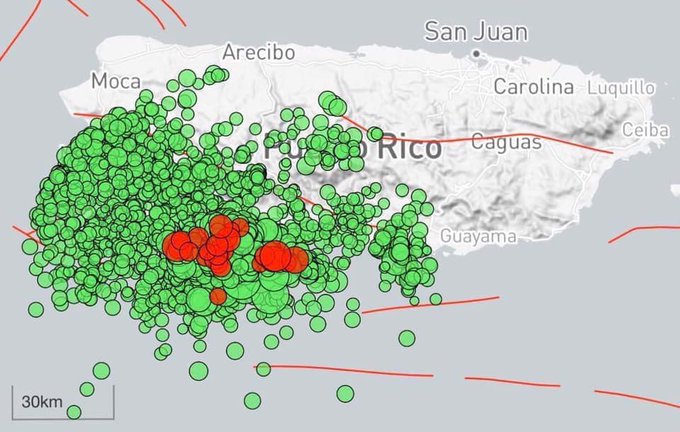
A girl cycles past a home that partially collapsed after an earthquake hit Guanica, Puerto Rico. (photo: Carlos Giusti/AP)

Earthquake of Magnitude 6 Shakes Puerto Rico Again
teleSUR
Excerpt: "A new earthquake of a magnitude of 6 Saturday shook Puerto Rico, a country which since Friday afternoon records aftershocks of different intensity after the 6.4 earthquake that hit the island last Tuesday and caused one death, about 2,000 refugees, and thousands of damaged homes."
EXCERPT:
The RPSR has registered more than a dozen aftershocks so far. The most outstanding of them was recorded at 18.30 local time on Friday, with magnitude 5.2. ​​​​​​​
Although its epicenter was ​​​​​​​located at sea, it was felt strongly throughout the Puerto Rican territory, where panic scenes were recorded again among the population.​​​​​​​​​​​​​​

A bushfire in Australia. (photo: Getty Images)

Climate Change Fueled the Australia Fires. Now Those Fires Are Fueling Climate Change
Maddie Stone, Grist
Stone writes: "Australia is in the midst of a devastating wildfire season that is being exacerbated by climate change. But the fires, which have been burning for months and could rage on for months to come, are also impacting the earth's climate in several ways. Some of those impacts are well understood, while others lie at the frontiers of scientific research."
The most obvious climatic impact of the fires is that they’re spewing millions of tons of heat-trapping carbon dioxide into the atmosphere, contributing to a vicious feedback loop of heat and flame. But the fires are also kicking up lots of soot, creating a smoke plume that’s circling the globe and could hasten the melting of any glaciers it comes in contact with. Preliminary evidence suggests some of that smoke has even made its way into an upper layer of the atmosphere called the stratosphere, buoyed aloft by rare, fire-induced thunderclouds. That, too, could have subtle but far-reaching climate impacts.
The fires, which started burning at the end of Australia’s winter, raged across the eastern half of the country throughout the spring and kicked into high gear in the country’s populous southeast over the last few weeks. They’re a disaster of an unprecedented nature.
Exceptionally hot, dry, gusty weather, brought on by recurring ocean and atmospheric dynamics and amplified by the warming and drying effects of human-caused climate change, has made it all too easy for an errant match or a lightning strike to explode into a raging inferno. Which is exactly what’s been happening. To date, the Guardian estimates that more than 26 million acres of land have burned nationwide — a region larger than Indiana. That includes over 12 million acres in New South Wales alone, a dubious new record for the state.
Much of the land that’s burning is covered in eucalyptus forest, although flames have also razed farmlands, grasslands, heathlands, and even some patches of Queensland’s subtropical rainforests, said Lesley Hughes, an ecologist and climate scientist at Macquarie University in Sydney. Whatever the fuel source, the net effect on the atmosphere is a massive release of ash, dust, and a cocktail of different gases, including carbon dioxide.
From the start of September through early January, the wildfires released around 400 million tons of CO2, which is roughly the same amount the UK emits in an entire year, according to Mark Parrington, a senior scientist with the European Centre for Medium-Range Weather Forecasts. That’s not a record, he said, noting that considerably more carbon was emitted in 2011 and 2012, when very large fires raged across Australia’s northern territory and out west. But in New South Wales, this year’s wildfire emissions are off the charts.
By any measure, 400 million tons is a significant chunk of heat-trapping gases that will get mixed into the atmosphere, fueling more global warming. “It’s a great example of a positive feedback of climate change,” Hughes said. “It all comes together, unfortunately.”
In addition to carbon pollution, the fires are producing, well, regular air pollution. Since early November, vast smoke plumes have been wafting from eastern Australia all the way across the Pacific to the shores of South America. Just this week, Parrington said, forecasts from the Copernicus Atmosphere Monitoring Service showed carbon monoxide from wildfire smoke creeping into the South Atlantic, a “really clear indicator of just how intense those fires have been.”
As the smoke circumnavigates the globe, some of it is passing over New Zealand’s alpine glaciers, turning them an eerie caramel color. Lauren Vargo, a glaciologist at Victoria University of Wellington who recently traveled through New Zealand’s Southern Alps, said that the soot is “really clear and obvious” and that “most of the ice on the South Island” is likely to have been impacted. Vargo is currently studying aerial photographs of New Zealand’s glaciers going back to the 1970s. In 40 years of records, she hasn’t seen anything comparable.
Soot on glaciers does more than spoil hiking photos. It reduces the reflectivity, or albedo, of ice, allowing it to absorb more sunlight, which can hasten its melt, said Marie Dumont, the deputy scientific director of the French Meteorological Service’s Snow Research Center. Exactly how much extra melt New Zealand’s browning glaciers will experience over the coming weeks and months is unclear, but the fact that the color change is occurring during the summer, when the sunlight is fiercer and there’s less chance of fresh snow falling, isn’t a good sign.
“It’s super likely that it will accelerate the melt” of these glaciers, Dumont said, “at least for this year.” She added that she wouldn’t be surprised to see a similar, albeit smaller effect on some Patagonian glaciers, given that the wildfire smoke is passing over South America.
“With ice, when we are seeing a color change, it means the change in albedo is about 10 percent,” Dumont said. “That’s already huge. Even a 2 to 3 percent change is a lot.”
Not all of the wildfire smoke is settling on the earth’s surface. More of it is lingering 3 to 4 miles up in the troposphere, Parrington said, scattering light and resulting in ominous reddish sunsets. Where the smoke is densest, it’s likely impacting the weather, said Robert Field, a climate and atmospheric scientist at Columbia University. Over hard-hit parts of Australia, Field said he wouldn’t be surprised if temperatures are 10 to 20 degrees F lower on dense smoke days as soot blocks incoming sunlight. He emphasized, however, that any such effects will be very temporary.
Where the smoke might have a more far-reaching impact is in the stratosphere, a very dry, very cold part of the atmosphere that starts around 6 miles up and is home to fast-flowing jet stream winds. Pollution from the earth’s surface doesn’t often reach the stratosphere, but recent satellite data shows that Australia’s wildfire smoke has hit this lofty mark, a fact that speaks to “the power and intensity of the fires,” according to Claire Ryder, a research fellow at Reading University’s meteorology department.
The most likely explanation, she said, is fire-induced thunderclouds.
Also known as pyrocumulonimbus clouds, these menacing-looking storms, which form when heat from intense wildfires creates a powerful updraft, can blast particles into the stratosphere in a manner similar to a volcanic eruption. Over the past few weeks, the wildfires in southeastern Australia have spawned a series of pyrocumulonimbus events that Neil Lareau, a fire weather researcher at the University of Nevada Reno, called “really superlative.”
The smoke that’s reached the stratosphere may linger there for weeks to months, Ryder said. But exactly what impact it’ll have is an open scientific question.
Volcanic eruptions, she said, shoot tiny sulfate aerosols into the stratosphere. These particles reflect sunlight and can trigger temporary cooling at the earth’s surface. By contrast, fire smoke contains carbon-rich organic matter, including particles that are brown, gray, and even black in color. Black carbon, in particular, is a potent absorber of sunlight, and whether its presence in stratospheric soot will ultimately have a warming or cooling effect on the planet is unknown.
It will likely be years before scientists have teased out the full impact of this year’s wildfire season on the climate — first, the fires need to end. But it’s clear the effects have rippled far beyond Australia’s borders. As fire seasons become longer and more intense across the world, understanding this complex web of planetary impacts will only become more urgent.