Search This Blog

Translate

Blog Archive

Middleboro Review 2

NEW CONTENT MOVED TO MIDDLEBORO REVIEW 2

Toyota

Since the Dilly, Dally, Delay & Stall Law Firms are adding their billable hours, the Toyota U.S.A. and Route 44 Toyota posts have been separated here:

Route 44 Toyota Sold Me A Lemon


Showing posts with label wildfires. Show all posts

Sunday, January 19, 2020

FOCUS: Greta Thunberg Warns World Leaders 'Haven't Seen Anything Yet' Ahead of Davos Protests


Reader Supported News
18 January 20

What all this hoopla over fundraising is all about is a basic budget for the organization. It a simple thing, a straight forward thing and something that, when ignored creates large immediate problems.
It’s funding, getting it squared away is not a crime, it’s a necessity.
In earnest.
Marc Ash
Founder, Reader Supported News


If you would prefer to send a check:
Reader Supported News
PO Box 2043
Citrus Hts, CA 95611


Reader Supported News
18 January 20
It's Live on the HomePage Now:
Reader Supported News

Sure, I'll make a donation!

FOCUS: Greta Thunberg Warns World Leaders 'Haven't Seen Anything Yet' Ahead of Davos Protests
Greta Thunberg. (photo: Getty Images)
Marina Depetris and Cecile Mantovani, Reuters
Excerpt: "Swedish activist Greta Thunberg marched with 10,000 protesters in the Swiss city of Lausanne on Friday and said 'you have not seen anything yet' before some head to Davos next week to challenge the global financial elite to fight climate change."

The 17-year-old, who launched the #FridaysforFuture movement that has sparked worldwide protests, denounced a lack of government action to cut heat-trapping emissions before it is too late.
“So, we are now in a new year and we have entered a new decade and so far, during this decade, we have seen no sign whatsoever that real climate action is coming and that has to change,” Thunberg said in a speech in Lausanne.
“To the world leaders and those in power, I would like to say that you have not seen anything yet. You have not seen the last of us, we can assure you that. And that is the message that we will bring to the World Economic Forum in Davos next week.”
Protesters held signs including “Wake up and Smell the Bushfires” and “It is late but it is not too late”.
Hundreds will take trains over the weekend and then march to Klosters near Davos, the annual gathering of world political and business leaders that Thunberg is attending for the second year in a row and will take part in two panel events.
Climate change and environmental destruction top the risks highlighted by global decision-makers in a survey ahead of the 2020 gathering of the global elite.
This year’s meeting of 3,000 includes U.S. President Donald Trump who once described climate change as a “hoax” and whose administration in November filed paperwork to withdraw the United States from the Paris Agreement, the first formal step in a one-year process to exit the pact to fight climate change.
The latest World Economic Forum annual meeting takes place against the backdrop of some of Australia’s worst ever bushfires. While the government there has avoided making a link to climate change, the fires have deepened public concern about the heating of the planet.
Last year was the Earth’s second-hottest since records began, and the world should brace itself for more extreme weather events like Australia’s fires, the U.N. World Meteorological Organization said on Wednesday.
“We are...an alliance that is organizing next week in 20 countries to say ‘time is up’ to the World Economic Forum in Davos. Time is up,” a Kenyan activist, Njoki Njoroge Njehu, told the crowd in Lausanne.
“It is time to abolish billionaires. It is time to abolish billionaires, because we cannot afford them, the planet cannot afford billionaires,” she said.

Update My Monthly Donation


Sunday, January 12, 2020

Hamilton Nolan | The Democrats Must Become a Real Anti-War Party


Reader Supported News
12 January 20

Is Reader Supported News a "Material Thing?"
Americans covet "material things." We shell out billions annually for "stuff." But apparently social justice and change are not material things to be coveted and paid for, presumably? So tens of thousands come here daily and lend no support?
Winning this battle will - absolutely, positively - require your participation.
Get on the bus folks.
Marc Ash
Founder, Reader Supported News
Sure, I'll make a donation!

Update My Monthly Donation

If you would prefer to send a check:
Reader Supported News
PO Box 2043
Citrus Hts, CA 95611


Reader Supported News
11 January 20
It's Live on the HomePage Now:
Reader Supported News


Hamilton Nolan | The Democrats Must Become a Real Anti-War Party
Anti-war activists protest in front of the White House in Washington, D.C., January 4, 2020. (photo: Andrew Caballero-Reynolds/AFP/Getty Images)
Hamilton Nolan, Guardian UK
Nolan writes: "Geopolitically speaking, we are the bad guys. The United States government, that is. The extent to which this is true fluctuates somewhat from administration to administration, but in the postwar decades it has been a fairly reliable judgment."
READ MORE

Protesters rallying against Donald Trump's travel ban policy. (photo: NBC News)

The Trump Administration Has Been Preparing to Expand the Travel Ban to Up to Seven More Countries, Documents Reveal
Hamed Aleaziz, BuzzFeed
Aleaziz writes: "The Trump administration has been preparing to expand its travel ban - which bars individuals from seven countries from entering the US - to restrict certain immigrants from several more nations around the world, according to internal government documents obtained by BuzzFeed News."
READ MORE

Soldiers. (photo: PA)

Tom Engelhardt | The Global War of Error: No, That's Not a Typo
Tom Engelhardt, TomDispatch
Engelhardt writes: "Yes, our infrastructure stinks, our schools are failing, this country's a nightmare of inequality, and there's a self-promoting madman in the White House, so isn't it time to take pride in the rare institutional victories America has had in this century?"
READ MORE

A Honduran family stands next to the border fence after they turned themselves in to Border Patrol agents. (photo: John Moore/Getty Images)

Lawsuit Alleges Child Abuse and Neglect After Trump Administration Family Separation
Nathaniel Weixel, The Hill
Weixel writes: "Two fathers who were separated from their children at the U.S.-Mexico border as a result of the Trump administration's policies are suing the government for $12 million, claiming the children were subject to abuse and neglect while in federal custody."
READ MORE

A predator drone. (photo: Veronique de Viguerie/Getty Images)

US Strike on Iranian Commander in Yemen the Night of Suleimani's Assassination Killed the Wrong Man
Alex Emmons, The Intercept
Emmons writes: "On the night the U.S. assassinated Iranian Maj. Gen. Qassim Suleimani by drone strike, the U.S. launched a similar operation to kill a top Iranian commander in Yemen, a U.S. official told The Intercept."

The operation was aimed at killing Abdul Reza Shahlai, the commander of the Yemen division of Iran’s elite Quds Force, near the Yemeni capital Sana’a. Shahlai survived, but a lower-level Quds Force operative was killed, and Shahlai went into hiding, the official said. Shortly thereafter, Iranian state TV reportedly announced the death of a Quds Force operative named Mohammad Mirza in “one of the fields of Resistance Front.”
Shahlai is a senior operator in the Quds Force, the external operations arm of Iran’s Islamic Revolutionary Guard Corps. He was sanctioned by the U.S. in 2008 for his role in operations against the United States in Iraq, and the U.S. has accused him of coordinating a 2011 plot to assassinate the former Saudi ambassador to the U.S., Adel al-Jubeir, at a restaurant in Washington, D.C. Shahlai has since been placed in charge of the Quds Force division responsible for aiding the Houthi militia in its war against Saudi-led intervention in Yemen, the official said.
The strike was first reported by the Washington Post. The White House referred The Intercept to the Department of Defense, which did not respond to a request for comment in time for publication.
The Trump administration had contemplated killing Shahlai for three years, as a means of deterring further Iranian support for the Houthis in Yemen, the U.S. official told The Intercept. But the attempt to assassinate him on the night of January 2 seems to undercut the government’s stated rationale for killing Suleimani, who U.S. officials have repeatedly described as posing “an imminent threat” to U.S. forces in Iraq.
Shahlai is unlikely to have posed a similar threat in Sana’a, where the U.S. evacuated its embassy compound in 2013. The U.S. conducts operations and drone strikes against Al Qaeda in the Arabian Peninsula in Yemen, but does not have personnel in the north of the country, which is controlled by the Houthis and where Sana’a is located.
“Congress needs answers,” tweeted Rep. Ro Khanna, D.-Calif., who has been critical of the U.S. role in the Saudi-led intervention. “What was the full extent of the Trump administration’s plans to kill Iranian officials? How does the attempted killing in Yemen have anything to do with an imminent threat?”
Since the beginning of Yemen’s civil war, a small number of Iranians have provided weapons and training to the Houthis. In March 2014, a coalition led by Saudi Arabia and the United Arab Emirates launched a U.S.-backed intervention aimed at removing the Houthis from power and restoring the previous Yemeni president, Abd Rabbu Mansour Hadi. In the four years since, the situation has devolved into a war of attrition fueled by international proxies that has given rise to one of the world’s worst humanitarian crises.
Congress has not authorized U.S. military action against Iran, so members are likely to question the legal basis for a strike against Shahlai. Congress did, however, recently pass a bipartisan resolution directing President Donald Trump to withdraw U.S. forces from “hostilities” in Yemen. Trump vetoed the resolution, but it marked a clear desire on the part of Congress to end American support for Saudi-led operations in the country.
The Trump administration has characterized its strike on Suleimani as an act of self-defense, saying that the commander was planning imminent attacks against dozens and possibly hundreds of Americans. But following classified briefings on Capitol Hill, numerous lawmakers from both parties claimed that the administration had failed to present direct evidence of an “imminent threat,” even when they asked repeatedly and directly.
The strike on Suleimani came in the midst of escalating hostilities between American forces and Iranian-backed militias in Iraq. As tensions rose last month, a rocket attack by an Iran-backed group called Kataib Hezbollah killed one American contractor and wounded four American servicemembers. Days later, the U.S. retaliated by bombing five Kataib Hezbollah positions, killing 24 people and wounding 50, according to a Hezbollah spokesperson. In the following days, members of the militia and their supporters stormed the fortified U.S. embassy compound in Baghdad. No one was killed, but the security situation remained tense.
Following the strike on Suleimani, the U.S. sent a letter to the U.N. Security Council, saying that the U.S. had “undertaken certain actions in the exercises of its inherent right of self-defense,” and that the actions “include” the operation to kill Suleimani, leaving open the possibility that the U.S. conducted other strikes that night.

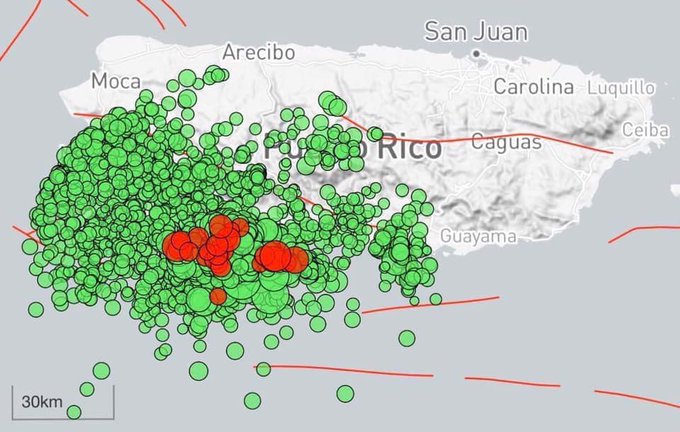
A girl cycles past a home that partially collapsed after an earthquake hit Guanica, Puerto Rico. (photo: Carlos Giusti/AP)

Earthquake of Magnitude 6 Shakes Puerto Rico Again
teleSUR
Excerpt: "A new earthquake of a magnitude of 6 Saturday shook Puerto Rico, a country which since Friday afternoon records aftershocks of different intensity after the 6.4 earthquake that hit the island last Tuesday and caused one death, about 2,000 refugees, and thousands of damaged homes."
EXCERPT:
The RPSR has registered more than a dozen aftershocks so far. The most outstanding of them was recorded at 18.30 local time on Friday, with magnitude 5.2. ​​​​​​​
Although its epicenter was ​​​​​​​located at sea, it was felt strongly throughout the Puerto Rican territory, where panic scenes were recorded again among the population.​​​​​​​​​​​​​​

A bushfire in Australia. (photo: Getty Images)

Climate Change Fueled the Australia Fires. Now Those Fires Are Fueling Climate Change
Maddie Stone, Grist
Stone writes: "Australia is in the midst of a devastating wildfire season that is being exacerbated by climate change. But the fires, which have been burning for months and could rage on for months to come, are also impacting the earth's climate in several ways. Some of those impacts are well understood, while others lie at the frontiers of scientific research."
The most obvious climatic impact of the fires is that they’re spewing millions of tons of heat-trapping carbon dioxide into the atmosphere, contributing to a vicious feedback loop of heat and flame. But the fires are also kicking up lots of soot, creating a smoke plume that’s circling the globe and could hasten the melting of any glaciers it comes in contact with. Preliminary evidence suggests some of that smoke has even made its way into an upper layer of the atmosphere called the stratosphere, buoyed aloft by rare, fire-induced thunderclouds. That, too, could have subtle but far-reaching climate impacts.
The fires, which started burning at the end of Australia’s winter, raged across the eastern half of the country throughout the spring and kicked into high gear in the country’s populous southeast over the last few weeks. They’re a disaster of an unprecedented nature.
Exceptionally hot, dry, gusty weather, brought on by recurring ocean and atmospheric dynamics and amplified by the warming and drying effects of human-caused climate change, has made it all too easy for an errant match or a lightning strike to explode into a raging inferno. Which is exactly what’s been happening. To date, the Guardian estimates that more than 26 million acres of land have burned nationwide — a region larger than Indiana. That includes over 12 million acres in New South Wales alone, a dubious new record for the state.
Much of the land that’s burning is covered in eucalyptus forest, although flames have also razed farmlands, grasslands, heathlands, and even some patches of Queensland’s subtropical rainforests, said Lesley Hughes, an ecologist and climate scientist at Macquarie University in Sydney. Whatever the fuel source, the net effect on the atmosphere is a massive release of ash, dust, and a cocktail of different gases, including carbon dioxide.
From the start of September through early January, the wildfires released around 400 million tons of CO2, which is roughly the same amount the UK emits in an entire year, according to Mark Parrington, a senior scientist with the European Centre for Medium-Range Weather Forecasts. That’s not a record, he said, noting that considerably more carbon was emitted in 2011 and 2012, when very large fires raged across Australia’s northern territory and out west. But in New South Wales, this year’s wildfire emissions are off the charts.
By any measure, 400 million tons is a significant chunk of heat-trapping gases that will get mixed into the atmosphere, fueling more global warming. “It’s a great example of a positive feedback of climate change,” Hughes said. “It all comes together, unfortunately.”
In addition to carbon pollution, the fires are producing, well, regular air pollution. Since early November, vast smoke plumes have been wafting from eastern Australia all the way across the Pacific to the shores of South America. Just this week, Parrington said, forecasts from the Copernicus Atmosphere Monitoring Service showed carbon monoxide from wildfire smoke creeping into the South Atlantic, a “really clear indicator of just how intense those fires have been.”
As the smoke circumnavigates the globe, some of it is passing over New Zealand’s alpine glaciers, turning them an eerie caramel color. Lauren Vargo, a glaciologist at Victoria University of Wellington who recently traveled through New Zealand’s Southern Alps, said that the soot is “really clear and obvious” and that “most of the ice on the South Island” is likely to have been impacted. Vargo is currently studying aerial photographs of New Zealand’s glaciers going back to the 1970s. In 40 years of records, she hasn’t seen anything comparable.
Soot on glaciers does more than spoil hiking photos. It reduces the reflectivity, or albedo, of ice, allowing it to absorb more sunlight, which can hasten its melt, said Marie Dumont, the deputy scientific director of the French Meteorological Service’s Snow Research Center. Exactly how much extra melt New Zealand’s browning glaciers will experience over the coming weeks and months is unclear, but the fact that the color change is occurring during the summer, when the sunlight is fiercer and there’s less chance of fresh snow falling, isn’t a good sign.
“It’s super likely that it will accelerate the melt” of these glaciers, Dumont said, “at least for this year.” She added that she wouldn’t be surprised to see a similar, albeit smaller effect on some Patagonian glaciers, given that the wildfire smoke is passing over South America.
“With ice, when we are seeing a color change, it means the change in albedo is about 10 percent,” Dumont said. “That’s already huge. Even a 2 to 3 percent change is a lot.”
Not all of the wildfire smoke is settling on the earth’s surface. More of it is lingering 3 to 4 miles up in the troposphere, Parrington said, scattering light and resulting in ominous reddish sunsets. Where the smoke is densest, it’s likely impacting the weather, said Robert Field, a climate and atmospheric scientist at Columbia University. Over hard-hit parts of Australia, Field said he wouldn’t be surprised if temperatures are 10 to 20 degrees F lower on dense smoke days as soot blocks incoming sunlight. He emphasized, however, that any such effects will be very temporary.
Where the smoke might have a more far-reaching impact is in the stratosphere, a very dry, very cold part of the atmosphere that starts around 6 miles up and is home to fast-flowing jet stream winds. Pollution from the earth’s surface doesn’t often reach the stratosphere, but recent satellite data shows that Australia’s wildfire smoke has hit this lofty mark, a fact that speaks to “the power and intensity of the fires,” according to Claire Ryder, a research fellow at Reading University’s meteorology department.
The most likely explanation, she said, is fire-induced thunderclouds.
Also known as pyrocumulonimbus clouds, these menacing-looking storms, which form when heat from intense wildfires creates a powerful updraft, can blast particles into the stratosphere in a manner similar to a volcanic eruption. Over the past few weeks, the wildfires in southeastern Australia have spawned a series of pyrocumulonimbus events that Neil Lareau, a fire weather researcher at the University of Nevada Reno, called “really superlative.”
The smoke that’s reached the stratosphere may linger there for weeks to months, Ryder said. But exactly what impact it’ll have is an open scientific question.
Volcanic eruptions, she said, shoot tiny sulfate aerosols into the stratosphere. These particles reflect sunlight and can trigger temporary cooling at the earth’s surface. By contrast, fire smoke contains carbon-rich organic matter, including particles that are brown, gray, and even black in color. Black carbon, in particular, is a potent absorber of sunlight, and whether its presence in stratospheric soot will ultimately have a warming or cooling effect on the planet is unknown.
It will likely be years before scientists have teased out the full impact of this year’s wildfire season on the climate — first, the fires need to end. But it’s clear the effects have rippled far beyond Australia’s borders. As fire seasons become longer and more intense across the world, understanding this complex web of planetary impacts will only become more urgent.


Wednesday, January 1, 2020

CC News Letter 01 Jan - Warming Ocean Currents Affect Weather and Environment


Dear Friend,

The ocean warming is  killing the kelp beds in the waters by the island of Tasmania.  Australia’s giant kelp beds are literally being cooked by the ocean.  The kelp rising in 30-foot high stalks has been habitat for rare ocean life through recorded history.  Once present along the whole length of Tasmania’s east coast, now little is left — just in the cooler waters bordering the southern tip.

Dr Binoy Kampmark writes from Australia, "Australian towns are starting to sound like besieged forts and desperate holdouts.  The Victorian seaside town of Mallacoota has been elevated to something like a First World War Verdun against the onslaught of fire.  Thousands had gathered on Tuesday at the boat ramp.  Pictures of a blood red sky have been taken, most notably that of Allison Marion’s picture of her son, Finn.  But will the flames pass?  The question is never far away from those engaged.  For those directly fighting the flames, deaths are accumulating.  Men like
Sam McPaul of the Morven Rural Fire Brigade have become the fallen warriors of hoses and salvation."

Kindly support honest journalism to survive. https://countercurrents.org/subscription/

If you think the contents of this news letter are critical for the dignified living and survival of humanity and other species on earth, please forward it to your friends and spread the word. It's time for humanity to come together as one family! You can subscribe to our news letter here http://www.countercurrents.org/news-letter/.

In Solidarity

Binu Mathew
Editor
Countercurrents.org


Warming Ocean Currents Affect Weather and Environment
Co-Written by Meena Miriam Yust & Arshad M. Khan


The ocean warming is also killing the kelp beds in the waters by the island of Tasmania.  Australia’s giant kelp beds are literally being cooked by the ocean.  The kelp rising in 30-foot high stalks has been habitat for
rare ocean life through recorded history.  Once present along the whole length of Tasmania’s east coast, now little is left — just in the cooler waters bordering the southern tip.

Co-Written by Meena Miriam Yust & Arshad M. Khan
If one can imagine looking at our globe from the South Pole end, one can observe the ocean currents circulating water across the oceans.
First one would notice a current all the way around the perimeter of the Antarctic.  A surface current circulates clockwise but there is also a deep undercurrent in the same direction.  Branches then lead off towards the different oceans serving as a global conveyor belt mixing the waters.
A deep current pushes its way between the east coast of Africa and Madagascar emerging as the monsoon surface current across the Indian ocean to India before looping back to supplement another current along Africa’s west coast.  This eventually crosses the Atlantic to form the Gulf Stream drift recrossing the Atlantic to warm Britain and southern Scandinavia.  Currents also loop the Pacific.
In an early Islamic map the system is clarified.  The currents serve as global arteries that redistribute heat, salt and carbon around the globe.  Is it climate change slowing the system, mitigating its tempering effects?  It has slowed by about 15 percent in the last half-century.
One consequence is the worsening Indian Ocean dipole effect where contrasting sea surface temperatures in the warmer western (Arabian Sea area) and cooler eastern end near Indonesia affect climate.  This year has seen one of the strongest dipoles on record, a 2C difference.  The result is more storms for East Africa leading to cooler, wetter weather, while at the other end Australia suffers extreme heat and raging bush fires far worse than usual.  No ordinary fire but a 50-meter high firewall engulfed the homes, according to a shocked homeowner in a vivid description of what happened.  The uncontrollable fires continue with the hope they will burn themselves out.
The ocean warming is also killing the kelp beds in the waters by the island of Tasmania.  Australia’s giant kelp beds are literally being cooked by the ocean.  The kelp rising in 30-foot high stalks has been habitat for rare ocean life through recorded history.  Once present along the whole length of Tasmania’s east coast, now little is left — just in the cooler waters bordering the southern tip.
And the effects of global warming are everywhere.  The Arctic tundra’s permafrost is melting from Alaska through Russia’s Siberia.  At 57 degrees Fahrenheit, Chicago has just experienced the second warmest Christmas on record i.e. since 1871; the day following was 56 F and the hottest December 26 ever.  New Jersey’s winters are so warm, its lakes no longer freeze.
Fish follow their instincts but are also in trouble.  When the water turns too warm, they move, collapsing known fisheries.  Worse, an abrupt change can decimate numbers.  Fisheries in widely separated countries such as Japan, Angola and Uruguay are affected.
While the Philippines suffers a dozen and more severe storms annually, this year it has been hit by Super-Typhoon Mangkut in September with winds gusting to 255 km/h (160 mph).  That is equivalent to a Category 5 (most severe) Atlantic storm.  Then on December 3, it was struck by Typhoon Kammuri, followed not long thereafter by Typhoon Phanfone … tragically on Christmas Eve and Christmas Day turning celebration into anguish.  Aside from the loss of crops and damage to infrastructure, the typhoons kill dozens of people, if not more, and can displace hundreds of thousands who take time to repair their lives.
Climate change (or more accurately warming) and the weather and its consequences remain inextricably linked.  So are we humans, the principal catalysts of this Anthropocene age
Meena Miriam Yust is an attorney based in Chicago, Illinois.  Educated at Vassar College and Case Western Reserve University School of Law, she published a draft Migratory Insect Treaty with commentary in the Case Western Reserve Journal of International Law.
Arshad M. Khan is a retired US- based professor and occasional commentator. Educated at King’s College London, OSU and The University of Chicago, he has a multidisciplinary background.
Originally published by CommonDreams.org

Australia Burns: Fireworks, Bush Fires and Denial
by Dr Binoy Kampmark


The Morrison government, despite the calamities, would not let up in its boastful assertions on environmental soundness.  Energy minister Angus Taylor, who is Australia’s de facto environment minister (that portfolio has little relevance in Australia, except for granting mining approvals) took to The Australian to claim that the country had a record that should make people proud.  “Australia meets and beats its emissions-reduction targets, every time.”    The Kyoto targets were outdone by 129 million tonnes; the 2020 targets will be met by 411 million tonnes.

As 2020 approached, the sense that the barbarians were not only at the gates but had breached the walls of indifference had come to the fore.  But these were not conventional human forms; rather, they were the agents of conflagration, driving people to the sea, forcing them from homes and consuming territories the size of small countries.  Australia was burning.
Then it became clear that the barbarians might have been among us all along, the dedicated wreckers of the biosphere, the climate change denialists who cling to a tradition highlighted by the smug authors of Genesis 1:26: that the non-human world is there for the conquest of humanity.  Unfortunately for the smug scribblers of the Bible, the earth has not been too compliant in this regard.
As the continent scorched, the annual, exorbitant display of Sydney’s fireworks that mark the opening of the new year seemed a touch vulgar.  This was not a time to be solemn or mournful; the bread and circuses had to continue coming.  The presenters of the ABC’s New Year’s Eve show attempted to put on a brave face, turning it to a donations run for those who had suffered loss in the bush fires.  Even as they did, a floating haze was evident; Sydney could not escape from the reality that it was surrounded by flames.
Australian towns are starting to sound like besieged forts and desperate holdouts.  The Victorian seaside town of Mallacoota has been elevated to something like a First World War Verdun against the onslaught of fire.  Thousands had gathered on Tuesday at the boat ramp.  Pictures of a blood red sky have been taken, most notably that of Allison Marion’s picture of her son, Finn.  But will the flames pass?  The question is never far away from those engaged.  For those directly fighting the flames, deaths are accumulating.  Men like Sam McPaul of the Morven Rural Fire Brigade have become the fallen warriors of hoses and salvation.
The Morrison government, despite the calamities, would not let up in its boastful assertions on environmental soundness.  Energy minister Angus Taylor, who is Australia’s de facto environment minister (that portfolio has little relevance in Australia, except for granting mining approvals) took to The Australian to claim that the country had a record that should make people proud.  “Australia meets and beats its emissions-reduction targets, every time.”  The Kyoto targets were outdone by 129 million tonnes; the 2020 targets will be met by 411 million tonnes.
But the technique of such praise is always slanted; Australia was positively virtuous in climate change policy, yet was only “responsible for only 1.3% of global emissions, so we can’t single-handedly have a meaningful impact without the co-operation of the largest emitters such as China and the US.”
Australia had been fighting climate change as dedicated troopers against the odds.  Pity that the odds were themselves compounded by his government’s own scepticism at the very idea that disastrous burning events might be an effect of climate change.  Selective accounting is the panacea sought in this regard, and Taylor does so by picking figures that exclude, for instance, emissions from the fossil fuels Australia digs and exports.  Like an arms exporter with an amoral compass and a mind for the selective, the claim here is that Australia cannot be responsible for what others do with the earth’s loot, despite actually providing them in the first place.
Those actually versed with export and production figures tend to raise their eyebrows when Taylor takes to the podium of praise.   Frank Jotzo, director of the Centre for Climate and Energy Policy at the ANU Crawford School of Public Policy, was politely damning.  “I would characterise [Taylor’s article] as a selective use of statistics that make Australia’s emissions trajectory look good, when in reality it does not look good at all.”
A study by Climate Analytics published in July 2019 does much to shred the Taylor worldview in this regard.  As the authors note with severity, “Australia is the world’s largest coal (thermal + metallurgical) exporter, accounting for 29% of traded coal globally in 2016 and will soon be the world’s largest natural gas (LNG) exporter.  As a consequence, Australia’s global carbon footprint is very significant, with exported fossil fuel emissions currently representing around 3.6% of global emissions.”
Hardly insignificant, and even more damnable considering that Australia is in the big league when it comes to per capita emissions of carbon, including exports.  China, for instance, is surpassed by a factor of 9; the US by 4, India by 37.
The prime minister is proving unconvincing in his efforts to fight the storm.  A tweeted statement from Scott Morrison gave the impression that this was merely another housekeeping exercise to complete, the fires manageable interruptions to the perfect Australian life.  “Federal Government, especially our Defence Forces, are working together with the Victorian Government to respond to Victorian bushfires.  VIC CFA are leading the response.”  He noted how both he and the Victorian premier had been in “regular contact” admitting that, “Reports of persons unaccounted for are very distressing.”
His new year address sank like an unprized lead balloon.  He conceded that 2019 had not been without difficulties.  “But the one thing we an always celebrate in Australia is that we live in the most amazing country on earth and the wonderful Aussie spirit that means we always overcome whatever challenges that we face that we always look optimistically into your future.”  Australia remained exemplary as a “place to raise kids”.  The disasters, on the other hand, have not been singular.  “Whatever our trials, whatever disasters have befallen us, we have never succumbed to panic.”  A true man of advertising, to the last.
Dr. Binoy Kampmark was a Commonwealth Scholar at Selwyn College, Cambridge.  He lectures at RMIT University, Melbourne.  Email: bkampmark@gmail.com


Who is Archbishop Atallah Hanna, and Why Israel Hates him
by Dr Ramzy Baroud


Hanna has served as the Head of the Sebastia Diocese of the Greek Orthodox Church in Jerusalem since 2005. Since then, he has used his leadership position to advocate for Palestinian unity in all of its manifestations. Expectedly, Hanna has been on Israel’s radar for many years, as this kind of leadership is problematic from the viewpoint of a hegemonic political and military power that requires utter and absolute submission.


The Guru that never was
by Karthik Ramanathan


Given that Sadguru's video has become part of the propaganda arsenal of the administration, it makes sense to publish my takedown in some greater detail so ordinary people can understand with clarity the crimes and the coverup by Modi and his supporters. I also hope that activists and others concerned about CAA and reaching out to people of India to resist
the legislations, will freely use this response in discussion assuming of course, they find the points raised here to be worthwhile.


State Sponsored Statelessness in India in the Age of ‘Sophia’
by Lirar Pulikkalakath


It was on 9 December 2019, the previous day of International Human Rights Day, the lower house (Lok Sabha) of Indian parliament passed the Citizenship (Amendment) Bill (CAB), 2019 with a considerable majority. The upper house (Rajya Sabha) passed the CAB on 11 December 2019, just one day after International Human Rights Day. With this amendment in its citizenship law of 1955, India became one of the few (perhaps the only if excludes Israel) countries to include religion as a criterion for citizenship.


It Is Time For The United Nations To Initiate A Referendum In The North And East Of Sri Lanka
by Kumarathasan Rasingam


Taking into consideration the statements by the Sri Lankan President and the top officials regarding justice to the Tamils seems to be a deadlock. The only way out from this is to initiate a UN sponsored referendum in the North and East of Sri Lanka, for which the co-sponsored countries of the UNHRC Resolution 30/1 and other member countries in the UNHRC should support this move to force Sri Lanka to honor and implement the 30/1 Resolution in good faith and within a short time-frame.


Celebrate Womanhood…!!
by Sonali Chanda


You find her giving your birth,
Even though you try to corrupt her,
She is the most vigorous icon in the Earth,
that may adore you or smash you,
according to your will..