Search This Blog

Translate

Blog Archive

Middleboro Review 2

NEW CONTENT MOVED TO MIDDLEBORO REVIEW 2

Toyota

Since the Dilly, Dally, Delay & Stall Law Firms are adding their billable hours, the Toyota U.S.A. and Route 44 Toyota posts have been separated here:

Route 44 Toyota Sold Me A Lemon


Showing posts with label India. Show all posts

Thursday, January 23, 2020

CC News Letter 23 Jan - FAQ on CAA, NPR, NRC


Dear Friend,

FAQ on CAA, NPR, NRC


John Scales Avery announces the publication of a book, which reviews the development of engineering, from ancient times to the present. The book may be freely downloaded and circulated. This book is part of a series on cultural history. 


Kindly support honest journalism to survive. https://countercurrents.org/subscription/

If you think the contents of this news letter are critical for the dignified living and survival of humanity and other species on earth, please forward it to your friends and spread the word. It's time for humanity to come together as one family! You can subscribe to our news letter here http://www.countercurrents.org/news-letter/.

In Solidarity

Binu Mathew
Editor
Countercurrents.org


What Is CAA, NPR, NRC? What Is Its Impact On Indian Citizens?
by Syed Azharuddin


FAQ on CAA, NPR, NRC


Lives In Engineering
by John Scales
Avery


John Scales Avery announces the publication of a book, which reviews the development of engineering, from ancient times to the present. The book may be freely downloaded and circulated. This book is part of a series on cultural history. 


Review: “One World Digital Dictatorship” by Soren Korsgaard – Digital Nightmare
by Dr Gideon Polya


Danish writer Soren Korsgaard (editor of Crime & Power) has written a very long and detailed account entitled “One World Digital Dictatorship” that describes the accelerating movement  by both Western-style democracies and one-party states (notably China) towards world-wide Digital Dictatorship (Digital Imprisonment) involving mass data collection on everyone, mass surveillance, facial recognition-based tracking, crypotocurrency-based cashless societies, and
social credit-based disempowerment.


New government in Lebanon still failing to diffuse protests as many raise slogan: Revolution, Revolution
by Countercurrents Collective


More than three months of political blockade have passed since protests in Lebanon erupted. A new government has sworn-in. Still violent protests continue with call for an end to corruption, economic woes and sectarian politics. Protesters have called for a “Week of Rage”. Protesters on Tuesday chanted “Revolution, Revolution:.


PG&E: Monopoly Power and Disasters by the Rich 1%
Co-Written by Peter Phillips & Tim Ogburn


The Pacific Gas and Electric Company (PG&E) has diverted over $100 million from safety and maintenance programs to executive compensation at the same time it has
caused an average of more than one fire a day for the past six years killing over 100 people.

Co-Written by Peter Phillips & Tim Ogburn
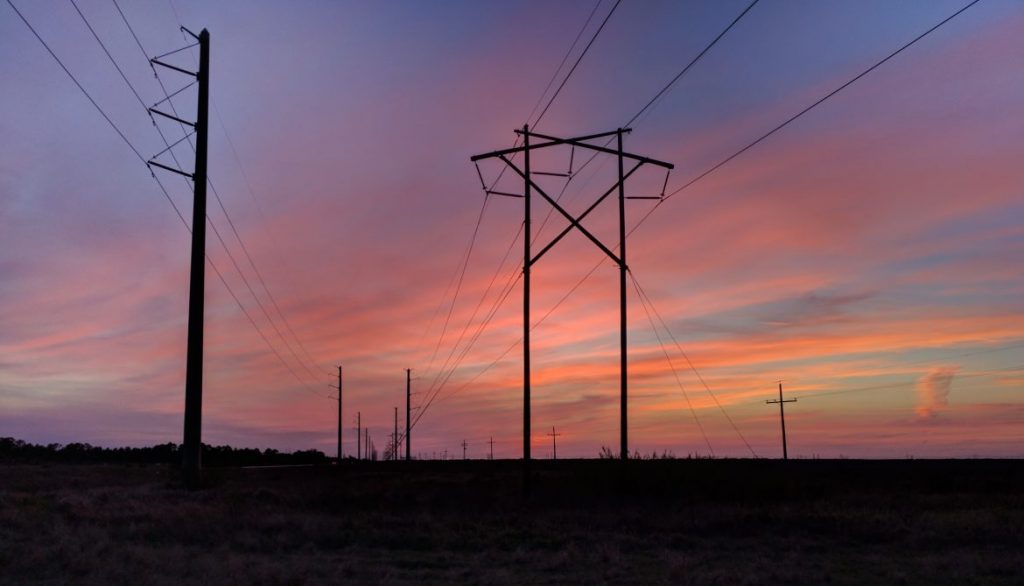
The Pacific Gas and Electric Company (PG&E) has diverted over $100 million from safety and maintenance programs to executive compensation at the same time it has caused an average of more than one fire a day for the past six years killing over 100 people.
PG&E is the largest privately held public utility in the United States. A new research report shows that 91% of PG&E stocks are held by huge international investment management firms, including BlackRock and Vanguard Group. PG&E is an ideal investment for global capital management firms with monopoly control over five million households paying $16 billion for gas and electric in California. The California Public Utility Commission (PUC) has allowed an annual return up to 11%.
Between 2006 and the end of 2017, PG&E made $13.5 billion in net profits. Over those years, they paid nearly $10 billion in dividends to shareholders, but found little money to maintain safety on their electricity lines. Drought turned PG&E’s service area into a tinderbox at the same time money was diverted from maintenance to investor profits.
A 2013 Liberty Consulting report showed that 60% of PG&E’s power lines were at risk of failure due to obsolete equipment and 75% of the lines lacked in-line grounding. Between 2008 and 2015, the CPUC found PG&E late on thousands of repair violations. A 2012 report further revealed that PG&E illegally diverted $100 million from safety to executive compensation and bonuses over a 15-year period.
PG&E has caused over 1,500 fires in the past six years. PG&E electrical equipment has sparked more than a fire a day on average since 2014—more than 400 in 2018—including wildfires that killed more than 100 people.
In October 2017, multiple PG&E linked fires (Tubbs, Nuns, Adobe fires and more) in Northern California scorched more than 245,000 acres, destroyed or damaged more than 8,900 homes, displaced 100,000 people and killed at least 44.
In November, 2018, the PG&E caused Camp fire burned 153,336 acres, killing 86 people, and destroying 18,804 homes, business, and structures. The towns of Paradise and Concow were mostly obliterated. Overall damage was estimated at $16.5 billion.
PG&E has caused some $50 billion in damages from massive fires started by their failed power lines. They filed bankruptcy in January 2019 to try to shelter their assets. PG&Es 529 million shares went from a high of $70 per share in in 2017 to a low of $3.55 in 2019. Shares are currently trading at $10.55 with zero returns.  At this point PG&E actually owes more in damages then the net worth of the company.
All but two members of the board of director resigned in early 2019, and the CEO was replaced. A new board of directors was elected by an annual stockholders meeting in June of 2019. PG&E now has a board of directors whose primary interest in 2020 is returning PG&E stock values to $50-70 range and returning to annual dividend payments in the 8-11% rate.
The new PG&E management took widespread aggressive action during the fire-season of 2019 shutting down electric power to over 2.5 million people statewide. Nonetheless, a high voltage power line malfunctioned in Sonoma county lead to the Kincade fire that burned 77,758 acres destroying 374 structures, and forced the evacuation 190,000 Sonoma county residents. Estimated damages from this fire are $10.6 billion.
The fourteen new PG&E directors were essentially hand-picked by PG&Es major stockholder firms like Vanguard Holdings 2019 (47.5 million shares 9.1%) and BlackRock (44.2 million shares 8.5%). A new PG&E Director, Meridee Moore, SF area founder & CEO of $2 billion Watershed Asset Management, is also a board member of BlackRock.
Only three of the new fourteen directors live in PG&Es service area (four if we count the newly appointed CEO from Tennessee). One board member lives the LA area. The remainder of the board live outside California, including three from Texas, two from the mid-west and the remaining four from New York or east coast states. Pending PG&E Bankruptcy court approval, new directors are slated to receive $400,000 each in annual compensation.
Ten of the new 2020 directors have direct current links with capital investment management firms. The remainder have shown proven loyalty experience on behalf of capital utility investors making the entire PG&E board a solid united group of capital investment protectors, whose primary objective is to return PG&E stock values to pre-2017 highs with a 11% return on investment. They claim that wide-spread blackouts will be needed for up to ten years.
All fourteen PG&E board members are in the upper levels of the 1% richest in the world. As millionaires with elite university educations, the PG&E board holds little empathy for the millions of Californians living paycheck to paycheck burdened with some of the highest utility bills in the country. PG&E shuts off gas and electric to over 250,000 families annually for late payments.
The PG&E 2020 board is in service to transnational investment capital. This creates a perfect storm for the continuing transfer of capital from the 99% to the richest 1% in the world, all with uncertain  blackouts, serious environmental damage, widespread fires, with multiple deaths and injuries.
We need to liquidate PG&E for the criminal damages it has afflicted on California. The “PG&E solution” is to manage PG&E democratically on the basis of human need, rather than private profit. It is time to take a stand for a publicly owned California Gas and Electric Company as the way to reverse the transfer of wealth to the global 1% and provide Californians with safe, low-cost and more renewable energy. All power to the people!
For the full report with all PG&E board names see:  www.projectcensored.org/pge
Peter Phillips, Political Sociologist at Sonoma State University; author Giants: The Global Power Elite, (New York: Seven Stories Press, 2018); past director of Project Censored; co-author/editor of fourteen Censored yearbooks, 1997 to 2011; co-author of Impeach the President, (New York: Seven Stories Press, 2007); and winner of the Dallas Smythe Award from the Union for Democratic Communications.
Tim Ogburn, 20-year manager for the California EPA; founder and co-chair of the Environmental Industry Coalition of the United States in Washington, D.C.; published in numerous technical and trade journals regarding public/private partnerships; International Environmental Technology consultant in India, Philippines, Malaysia, Thailand, Egypt, and Israel; Consultant to USAID, US Department of Commerce, U.S. State Department; and has given Congressional Presentations on the environmental technology industry before Congress.
Originally published in Project Censored


Abiy Ahmed: Nobel Peace laureate who faces unrest at home
by Nizar K Visram


When the 2019 Nobel Peace Prize laureate, Ethiopian Prime Minister Abiy Ahmed, was in Oslo for the award ceremony, eyebrows were raised when he declined to attend any event where he would be asked questions in public. Organizers expected him to meet the international press in keeping with the Nobel tradition, but his spokeswoman cited “pressing domestic issues” and his “humble disposition.”
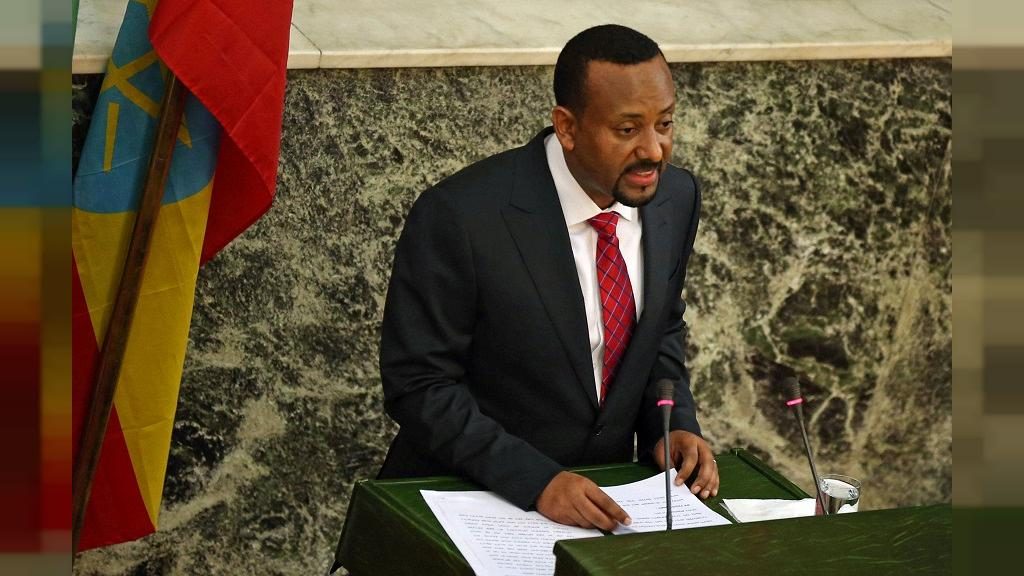
When the 2019 Nobel Peace Prize laureate, Ethiopian Prime Minister Abiy Ahmed, was in Oslo for the award ceremony, eyebrows were raised when he declined to attend any event where he would be asked questions in public. Organizers expected him to meet the international press in keeping with the Nobel tradition, but his spokeswoman cited “pressing domestic issues” and his “humble disposition.”
The secretary of the Nobel committee, Olav Njolstad, called the decision “highly problematic”, noting that a “free press and freedom of expression are essential conditions for a lasting peace in a democracy”. He said the committee would “very much have wanted Abiy to engage with the press during his stay in Oslo”.
Abiy is not the only Nobel laureate that failed to “engage with the press”. The former US president Barrack Obama also declined to meet the press when he accepted the peace prize in 2009. Perhaps they were both avoiding one pertinent question: Was the decision to award them the prize not taken prematurely and hastily?
The Norwegian Nobel Committee said Abiy Ahmed was awarded the prize for his “decisive initiative to resolve the long-running border conflict with neighbouring Eritrea.” It extolled his “efforts to achieve peace and international cooperation.”
Abiy has been lauded for “tearing down the wall” with Eritrea, thus ending two decades of hostility with the neighboring country.  Two months after entering the office, he declared that he would fully accept the terms of a peace agreement with Eritrea.
He flew to Eritrea and hugged President Isaias Afwerki, launching a peace process between the two countries that went to war from 1998 to 2000. More than 80,000 people were killed and hundreds of thousands displaced during the military conflict.
The two leaders then signed a peace deal, establishing diplomatic ties, resuming communication and air travel and lifting border restrictions. Border disputes, however, are not fully resolved. Some border crossings were opened with colorful ceremonies, only to be reclosed.
Immediately after his appointment as head of ruling EPRDF party and prime minister in April 2018, Abiy launched the policy of Medemer  (togetherness or inclusiveness), under which he lifted the state of emergency and put an end to the torture chambers, while firing bigwigs accused of corruption
Abiy also lifted a ban on political parties, released thousands of political prisoners, including journalists and bloggers, and unblocked more than 260 blogs. He also opened the door to exiled political activists, while enacting amnesty laws, repealing repressive NGO and media acts. Ethiopia jumped 40 places in the 2019 World Press Freedom Index compiled by Reporters Without Borders.
Abiy also appointed a gender-balanced cabinet, with 50 percent of women ministers, woman chairperson of the National Election Board, woman head of federal Supreme Court, and the first woman head of state in the country’s modern history.  He appointed a peace and reconciliation commission to deal with past abuses.
Amnesty International acknowledged the reforms undertaken by Abiy’s government but called upon the prime minister to revise the country’s anti-terrorism law to avoid rolling back progress made since he took office.
“The use of Ethiopia’s anti-terrorism proclamation to arbitrarily arrest journalists is completely out of step with reforms witnessed in the country,” Seif Magango, Amnesty’s deputy director for East Africa, said. “This law must be revised to align with international standards and must no longer be used to harass journalists.”
Abiy Ahmed inherited a state that controlled the “commanding heights” of the economy under the “development model” championed by former prime minister, Meles Zenawi. He backed away from Zenawi’s model, leaving the doors open to the Wall Street and its financial institutions.
Within no time, Abiy fell into “chronic foreign currency shortage,” and he resorted to loans and grants from the West and rulers of Saudi Arabia, the United Arab Emirate and Qatar. Soon after Abiy became prime minister he signed a deal for $3 billion with the United Arab Emirate, to “strengthen military cooperation”.
In October 2018, the World Bank approved a total of $1.2 billion for what they call structural adjustment. National Bank of Ethiopia’s Governor, Yinager Dessie said: “They have given us some objectives that have to be met every year for another $1 billion, as the government follows through on its commitment to economic reforms.”
Such funding often goes into unproductive expenditures, saddling the country with audios debt, austerity measures and further IMF and World Bank incursion. This way the country becomes beholden to the global conglomerates.
It wasn’t a bolt from the blue, therefore, when Ethiopians learnt that Abiy was planning a multibillion dollar privatisation of major public enterprises such as Ethio Telecom, Ethiopian Electric, Ethiopian Airlines, and Ethiopian Shipping & Logistics Services Enterprise.
Arrangements are reportedly being made to sell off a 49 per cent stake in Ethio Telecom, the largest telecoms company in Africa, with customer base of 65 million subscribers, and over 22,000 employees. Its annual operating income is $103 mill, with net income of $ 46 mill. The Shipping Enterprise has annual revenue of $ 484 mill.
One state-owned corporation earmarked for privatization is Ethiopian Airlines, the national flag carrier that was launched in 1946 when most of the African nations were under the colonial yoke. Today, its success is taken as a symbol of Ethiopia’s strength. It has a profit of $ 110 mill and revenue of $ 1.5 bill.
It is the largest national airline in Africa and amongst the highly successful public enterprises globally. It is arguably Ethiopia’s most profitable and well-managed public undertaking, with some 110 modern aircraft and over 100 world destinations. Not surprisingly, the airline has clinched several regional and international honours.
Abiy’s policy is divestment of such national treasure, while liberalizing labor law. He is also expected to hand over industrial, tourism, agricultural and mineral sectors. Ethiopia has rich mineral deposits, especially gold whose extraction is contracted to companies from the West and Saudi Arabia.
Besides gold, there are also deposits of platinum, copper, potash, natural gas and tantalum, a corrosion resistant mineral used in electronic components. Other minerals include niobium, cement, salt, gypsum, clay, shale, and soda ash. Not unexpectedly, therefore, foreign firms have their eyes on Ethiopia.
In fact, the US trade delegations are reportedly ready to pounce on the profitable state-owned airline. At the same time, the German development minister complained that his country should not lay back and watch the US and China “take hold of Africa.” German president and industrialists have already visited Addis Ababa to sign a memorandum of understanding between the Volkswagen Group and the Ethiopian Investment Commission.
At the 2019 World Economic Forum in Davos, Abiy declared his commitment to the neoliberal model.  He reaffirmed this in an interview with the Financial Times. The international elites and corporate media have hailed Abiy’s rise to power and his reforms as the dawn of a new era of “freedom and prosperity” for Ethiopia.
Foreign investors have pledged to provide $500 million for two industrial parks, on condition that Ethiopian government reserves a third of the projected 100,000 jobs for refugees. This was approved by Abiy in January 2019, thus supplying refugees to work in the foreign owned enterprises. A local neo-liberal newspaper justified this model by saying: “The one prime opportunity Ethiopia can offer investors is low-cost labor. Taking that away will just drive investment elsewhere”
Thus, the country has the Pizza Hut, where a pizza sells for about US$15, in a society where millions barely survive on less than US$1 per day, while ten tycoons own $25 billion.
Reaping super profit on cheap labor is described as “prime opportunity for investors”. The International Trade Unions Confederation (ITUC) denounced such super exploitation of labor in Ethiopia.
One official “justification” for the rush to sell the assets is that the country may use the proceeds to pay off government-guaranteed debts issued by lenders. Thus, selling sugar factories and the country’s telecommunications monopoly would enable the government to recapitalize state-owned enterprises so they can repay borrowings. This was said by the National Bank Governor.
And head of the National Planning and Development Commission, Fitsum Assefa, said: “With liberalization and privatization, definitely some money will be raised and that will definitely be used to repay the banks – such a move will also help the liquidity”
Abiy Ahmed was appointed prime minister after people revolted against his predecessor. Yet, his own term has not been entirely peaceful. The country has been haunted by ethnic and regional conflicts which have claimed hundreds of lives and seen 3.5 million people displaced since 2015. Since Abiy came to power such conflicts have been on the rise.
According to the Human Rights Watch (HRW), 1.4 million people were displaced in the first half of 2018. That is a global record, the rights group observed. According to the UN report, over two million were displaced, while hundreds were killed.
During protests that erupted in October 2019, Abiy’s spokesperson put the death toll at over 78, with 409 people detained. The dead included 50 from the Oromo ethnic group, the country’s largest, while 20 were from the Amhara group, the second largest. Five of the dead were police officers. This was conceivably the most serious crisis during Abiy’s term in office so far
Ethnic-based unrests that erupted end of 2019 took religious form. Thousands of Muslims across Ethiopia protested the burning of four mosques in the Amhara region.  The December 20 attacks in Motta town, more than 350 kilometers north of Addis Ababa, also targeted Muslim-owned businesses.
Amhara regional officials said they arrested 15 suspects in connection with the attacks. Police commander Jemal Mekonnen told state media the attacks appeared to be triggered by news of a fire that broke out in an Orthodox church a few days earlier.
Ethnic nationalism now stands in the way of Prime Minister Abiy Ahmed’s reforms.  He himself reportedly survived an assassination attempt, while his new book on Medemer was burnt by protesters in eastern Ethiopia. While he was attending Russian-African summit in Sochi, his home was torched
Ethiopian prosecutors have charged five suspects with an attempt to kill Prime Minister Abiy in a grenade attack at a rally in June 2019. The attack killed two people and injured more than 100.
Meanwhile, Abiy is facing mounting criticism from people who accuse him of stifling the press, and issuing the controversial Anti-Terrorism Proclamation, which they say is aimed at repressing dissidents. Amnesty International has cautioned that Ethiopia’s ethnic, linguistic and religious divergences “threaten instability and further human rights abuses”.
Abiy himself admitted that what began as protests against his government has quickly taken ethnic and religious dimension.
(Nizar Visram is Tanzanian writer and commentator. He can be contacted at nizar1941@gmail.com )


On 124th Birth Anniversary Of Subhash Chandra Bose, How Hindutva Gang Back-Stabbed Netaji
by Shamsul Islam


RSS-BJP rulers of India have been trying to show off as great fan of Netaji. But Indians
must know what role ideological parents of today’s RSS/BJP played against Netaji and INA. Hindu Mahasabha and RSS which always had prominent lawyers on their rolls made no attempt to defend the INA accused at Red Fort trials.


Adivasis and Indigenous People in India Condemn the Decision of Adani and Australian Governments on Mining and Displacement
Press Release


We the following Adivasi organisations in India unanimously condemn the decision of the Queensland government to extinguish title of over 1385 hectares in Wangan and Jalingou country in Australia for the proposed Adani coal mine in Queensland’s Galilee Basin. We are shocked to understand that such a decision affecting the indigenous people of Australia was made without even any public announcement.
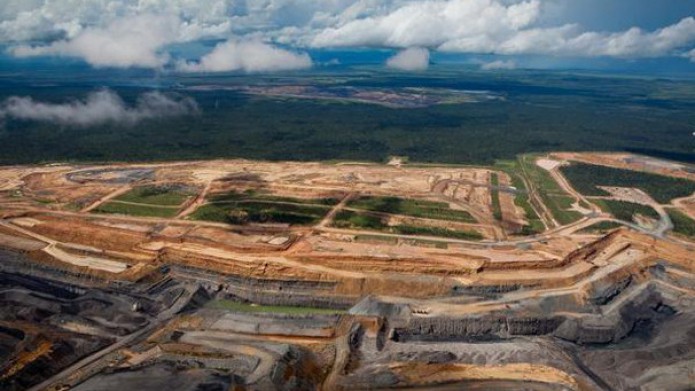
We the following Adivasi organisations in India unanimously condemn the decision of the Queensland government to extinguish title of over 1385 hectares in Wangan and Jalingou country in Australia for the proposed Adani coal mine in Queensland’s Galilee Basin. We are shocked to understand that such a decision affecting the indigenous people of Australia was made without even any public announcement. We note with great pain that an Indian industrialist is responsible for threatening the lives of indigenous people in Australia, removing them from their own traditional lands, for which they had enjoyed their community rights for generations. With Adani stepping into their territories, these indigenous people will become trespassers to their own lands, restricting their involvement even the basic rituals for their ancestors.
What is extremely repulsive is to note that without the subsidies of 4.4 billion dollars from the Australian governments for Adani’s project, the project would become unviable. The Central and State Governments in India are also following the same model. The model is: `Support the rich with money that belongs to people and wipe out the poor’. This model of development economics needs much more sharper public criticism and scrutiny.
We hereby express our heartfelt solidarity to the struggle carried out by the Wangan & Jalingou Council leader Adrian Burragubba and other representatives of the indigenous people in this region. We call upon all organisations of indigenous all over the world to express their solidarity and support to the indigenous people struggling for their basic rights in Australia. Adivasis and indigenous people all over the world is facing such invasions into their lands, causing displacement, human rights violations and environmental destruction. While coordinating the solidarity concerns of adivasis in India on this issue, the India Greens Party (IGP) has called for international solidarity of all like-minded individuals and organisations to generate pressure on Adani and the Australian governments to withdraw their decision causing great harm to environment and indigenous people. The question `Development for whom and at whose cost’ is becoming more and more grave issue, especially when the governments and corporates behave in an utterly irresponsible manner, without the basic concern for the earth, its inhabitants and its environment, said the representatives of the India Greens Party (IGP). The party has also asked for wider dissemination of these issues among all sections of people who are concerned about the future of healthy planet.
1) All India Adivasi Mahasabha
2) National Adivasi Andolan
3) All India Union of Forest Working People
4) Jharkhand Jungle Bachao Andolan, Jharkhand
5) Rajya Moola Adivasi Vedike Karnataka
6) Eruliga Aranyavasi Kshemabrivridhi Sanga, Kanakapura, Karnataka
7) Soliga Abhivraddi Sangha, Chamarajanagar.
8) Jilla Budakattu Krishikara Sangha, Chickkamangalore.
9) Adivasi Art
10) Anti-Jindal & Anti-POSCO Movement, Odisha
11) Budakattu Krishikara Sangha Kodagu.
12) Budakattu Krishikara Sangha ,Periyapatana, Mysore District,
13) Tamilaga Adivasi Amaippukalin Kootamaippu (TAAK)
14) Jharkhand Jungle Bachav Andolan, Jharkhand
15) Jharkhand Indigenous peoples Forum, Jharkhand.
16) Odisha Paramparik Krushak Sangathan (OPKS), Odisha
17) Anamalai Adivasi Movement, Tamil Nadu



Monday, January 20, 2020

CC News Letter 20 Jan - Richest 1% own more than twice as much wealth as 6.9 billion people, says report


Dear Friend,


A super-rich one percent of the world’s population has accumulated twice as much wealth as the remaining 90 percent, said a new report by Oxfam, a global charity. The report has been released on January 20, 2020 on the eve of the World Economic Forum in Davos, Switzerland.


Kindly support honest journalism to survive. https://countercurrents.org/subscription/

If you think the contents of this news letter are critical for the dignified living and survival of humanity and other species on earth, please forward it to your friends and spread the word. It's time for humanity to come together as one family! You can subscribe to our news letter here http://www.countercurrents.org/news-letter/.

In Solidarity

Binu Mathew
Editor
Countercurrents.org


Voice of the world capitalist system from Davos
by Farooque Chowdhury


The World Economic Forum (WEF) Switzerland meeting beginning from
January 21 has become one of the voices of the world capitalist system as it considers itself “the foremost creative force for engaging the world’s top leaders […] to shape global, regional and industry agendas […].” But, with capitalism as the dominating force in the world, what can be shaped other than destruction of lives on this planet? Shall the Davos elites question capitalism?

  1. INTRODUCTION
With usual high hope and promise, the Davos annual ritual is on the stage. But, the promise and hope appear false.
The World Economic Forum (WEF) Switzerland meeting beginning from January 21 has become one of the voices of the world capitalist system as it considers itself “the foremost creative force for engaging the world’s top leaders […] to shape global, regional and industry agendas […].” But, with capitalism as the dominating force in the world, what can be shaped other than destruction of lives on this planet? Shall the Davos elites question capitalism?
The meet and the WEF’s Global Risk Report are two of the significant weather-meters to gauge the weather the system is bumping into. Many capitans of the capitalist system express their perception about the situation they are facing – “the most pressing issues on the global agenda”. These are actually the fear and the uncertainty the system is failing to get rid of. The participants include the world’s top politicians, academics, and business and NGO leaders.
The 2020 meeting theme is “Stakeholders for a Cohesive and Sustainable World”. Its cherished commitment is “to improve the state of the world”. A capitalist world system can never be cohesive and sustainable and it can’t improve the world as the system breeds incoherence and chaos. The system itself is the evidence.
  1. THE HOPELESS CONDITION
The Davos Report – Global Risks Report 2020 (GRR 2020) – fails to hide the hopeless condition the world capitalist system is experiencing. The report’s “The Fraying Fundamentals” chapter cites the facts:
Stagnation
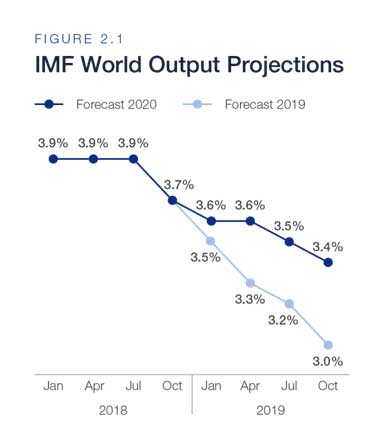
Downward pressure on the global economy from macroeconomic fragilities and financial inequality continued to intensify in 2019. The global economy is at increasing risk of stagnation. Tense geo-economic and geopolitical landscape, and domestic challenges have exacerbated uncertainty. There’s, according to the IMF-speak, “synchronized slowdown” – weakened growth among the world’s economies. A gradual deceleration was already underway. The slowdown of the world economy has further materialized. By the third quarter of 2019, six of the world’s largest seven economies (Japan is the exception), which together represent more than half of global production, had decelerated. The outlook is also precarious for other G20 economies. Most of these economies are growing at a rate below 2%. There’s risk of a prolonged slowdown of the world economy. The IMF has lowered its last five estimates of world output for 2019 and expected a growth rate of 3.0% – a sharp decline from 3.6% in 2018 and the slowest since the 1.7% contraction in 2009. For 2020, the IMF had also downgraded its forecast from 3.7% to 3.4% [The figure 2.1].
Source: IMF, 2018 and 2019, World Economic Outlooks and quarterly updates, cited in the GRR 2020
Slowing trade
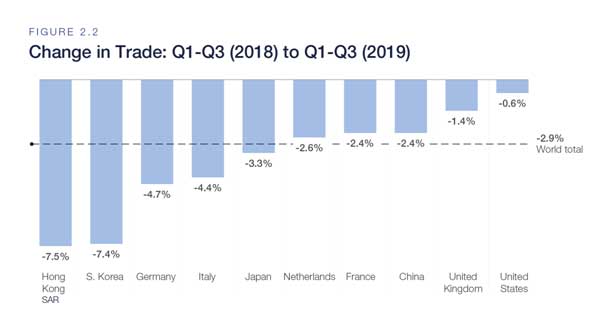
“Nationalist” policies are challenging low trade barriers, fiscal prudence and strong global investment. Rising trade barriers, lower investment and high debt are straining economies around the world. Global trade is slowing down. World Trade Organization (WTO) data for the first three quarters of 2019 show that total world merchandise trade decreased 2.9% from the previous year. It decreased in the world’s top ten traders. [The figure 2.2] Reduced trade volumes are largely the result of what the WTO has called “historically high levels of trade restrictions”. Turning trade to a weapon of rivalry may persist.
Source: WEF estimates from WTO data, https://data.wto.org/, accessed on January 8, 2020, cited in the GRR 2020
Decreased FDI
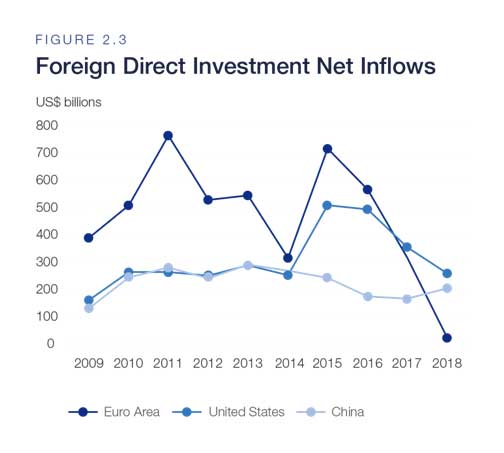
Globally, investment has been affected by low expected returns, uncertainty about economic policy in major economies, and ongoing and emerging geopolitical tensions. Foreign Direct Investment (FDI) remains lower than it was before the 2008-’09 crisis. It has decreased for the last three years. In 2018, net FDI inflows were down 38% compared to 2017, and less than half of the level, they were in 2015. The sharpest decline has been in the euro area [the figure 2.3], where less appealing yields, lower production and uncertainty surrounding Brexit have led net FDI inflows to the region to fall to a record low since the euro was adopted in 1999.
Source: World Bank OpenData, “Foreign direct investment, net inflows (BoP, current US$) – Euro area, World, United States, China, Japan”, https://data.worldbank.org/indicator/BX.KLT.DINV.CD.WD?end=2018&locations=CN-XC-US&start=2009&view=chart, accessed on December 15, 2019, cited in the GRR 2020
High debt
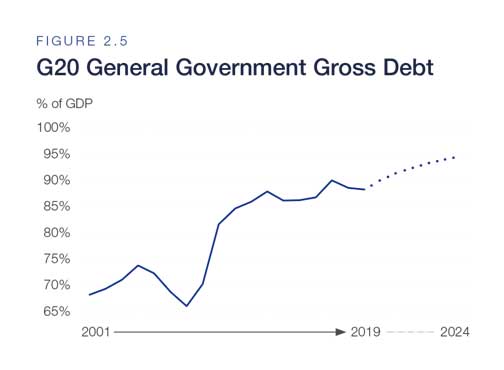
Private and public debt has been accumulating since the crisis. According to the IMF, the global ratio of debt-to-GDP increased by 11 percentage points between 2009 and 2017. Across G20 economies, public debt is expected to reach 90% of GDP in 2019 – the highest level on record – and to grow even more, to 95% in 2024 [the figure 2.5]. Private debt has built up on the basis of lower interest rates – particularly in China and the US, where more than 40% of total private debt is located. In the second quarter of 2019, non-financial corporate debt reached 156% of GDP in China. In the US, non-financial corporate debt reached 47% of GDP in the third quarter – the highest level ever recorded – according to Federal Reserve Bank of St. Louis data. The IMF has listed “rising corporate debt burdens” as a key vulnerability in the global financial system.
Source: WEF estimates with data from IMF DataMapper, https://www.imf.org/external/datamapper/GGXWDG_NGDP@WEO/OEMDC/ADVEC/WEOWORLD, accessed on December 15, 2019, cited in the GRR 2020
Tools unavailable
There’s a risk that the tools previously used to brake economic slides may no longer be available. Financial market stress and strained public finances are creating uncertainty as to whether conventional monetary and fiscal policy instruments could be as effective in the future.
Monetary constraints
Interest rate cuts have fostered higher debt and riskier rent-seeking, which affect financial market stability. In 2019, most central banks persistently cut interest rates to very, sometimes historically, low levels. In the US, the Fed lowered its target interest rate from 2.50% in December 2018 to 1.75% currently. The European Central Bank (ECB) cut its deposit rate to a historic low of -0.50% in September 2019. The Bank of Japan’s deposit rate has remained at -0.10% since February 2016. Such low rates raise concerns about the soundness of banking systems. The ECB has warned that decreasing profits are challenging Europe’s banking sector; in the second quarter of 2019, European banks yielded an average return-to-equity of 7.0%, compared to 12.1% in the US.
The role and reach of monetary policies are also challenged by wider factors such as technological change, climate change and rising inequality.
Fiscal constraints
The margin for fiscal stimulus in most of the world’s main economies has narrowed. Public debt in 15 of the 20 largest economies has increased every year since the 2008–’09 crisis.
Deteriorated business confidence
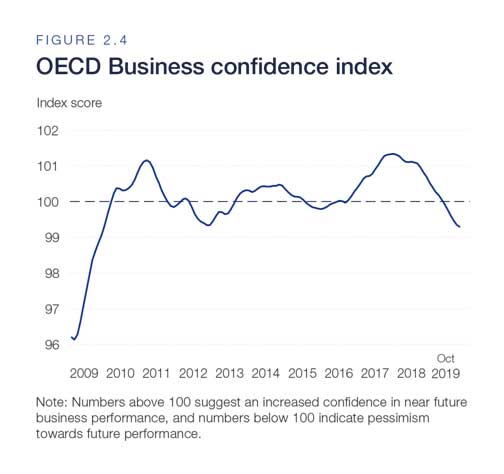
Business confidence has deteriorated during 2019. The Business confidence index – constructed by the Organisation for Economic Co-operation and Development (OECD) using production data and business sentiment to anticipate future performance – signals that the state of the global economy is expected to worsen in the short term. At the time of writing the GRR 2020, the index had declined for 14 consecutive months, dropping below the no-change threshold for the first time since 2016 and reaching a 10-year low in October of last year [the figure 2.4].
Source: OECD Data, Business confidence index, https://data.oecd.org/leadind/ business-confidence-index-bci.htm, accessed on January 3, 2020, cited in the GRR 2020
Note: Numbers above 100 suggest an increased confidence in near future business performance, and numbers below 100 indicate pessimism towards future performance.
Inequality
Concern about inequality underlies recent social unrest on almost every continent. Domestic income inequality has risen in many countries, particularly in advanced economies, and reached historical highs in some. The OECD reports “income inequality in OECD countries is at its highest level for the past half century.” Many of those protesting have long been excluded from their country’s wealth and share frustration that the elite have captured gains at the expense of others.
Inequality hinders growth and damages macroeconomic fundamentals, as the IMF has pointed out: it slows down economic activities and casts doubt on a country’s stability. This damages investor confidence and undermines political capital – both fundamental conditions for prosperity, especially in times of economic volatility. In France, for example, the persistence of the “gilets jaunes” movement had caused businesses more than US$11.4 billion in losses by December 2019. The protests in Chile cost businesses over US$1.4 billion. “[S]ocial incidents dealt [Hong Kong] a very severe blow”.
The profound political consequences of inequality can also undermine economic growth by making a country harder to govern – in ways ranging from legislative impasses to complete government paralysis. This risk is accentuated by the decentralized and spontaneous nature of recent demonstrations: with pop-up protests, it is difficult for governments to negotiate with demonstrators and develop concrete measures to meet their demands.
Weak public finances could aggravate already hard-felt social tensions. The European sovereign debt crisis has shown that drastic fiscal corrections and public austerity measures can shrink the welfare state with political and social consequences that many governments would be neither willing nor able to incur.
Failed systems
Systems have failed to promote economic advancement for all. Profound citizen discontent – born of disapproval of the way governments are addressing economic and social challenges – has sparked protests throughout the world. There’s a widespread domestic discontent with current economic systems, perceived to be rigged and unfair.
Polarization and confrontation
The Global Risks Perception Survey finds “economic confrontations” and “domestic political polarization” as the top risks in 2020. “Economic confrontations between major powers” is the most concerning risk for 2020.
According to the survey participants, “recession in a major economy” most likely to increase in 2020.
The survey finds, “protectionism regarding trade and investment” and “populist and nativist agendas” most likely to increase through 2020.
The WEF’s Executive Opinion Survey finds, “fiscal crises” are the top-rated risk for businesses globally over the next 10 years.
The WEF’s expert community perceives, “domestic political polarization” most likely to increase in 2020.
Prolonged slowdown
With this background, the GRR 2020 said:
“Unless the global economic system is reformed to be more socially conscious, the twin risks of prolonged slowdown and stronger defiance towards the current economic model will continue to exacerbate each other.”
  1. POINTS MISSED
In today’s capitalist world system, there’ll be slowdowns, and these will be prolonged. The factors behind these slowdowns are within the system. The system breeds the factors. The GRR 2020 talks about stagnation, slowing of trade, etc. The point the elite-minds miss is: “mature monopoly capitalist economy as one that is subject to, and indeed dominated by, a basic contradiction: the very growth of its productive potential puts insuperable obstacles in the way of making full use of available human and material resources for the satisfaction of the needs of the great mass of the population. What this means is (1) that in the absence of sufficiently powerful counteracting forces, the normal state of the system in its monopoly capitalist phase is determined by the interaction of the tendency to stagnation and the forces acting counter to this tendency.” (Paul M Sweezy and Harry Magdoff, The Irreversible Crisis, “”Stagnation and the financial explosion”, Monthly Review Press, New York, 1988)
And, the elites aspire for, as the report said, “a prompt and smooth transition to a more cohesive and sustainable model of ‘stakeholder capitalism’.”
The issue of public debt demands a brief observation made more than 150 years ago: “The public debt becomes one of the most powerful levers of primitive accumulation. As with the stroke of an enchanter’s wand, it endows barren money with the power of breeding and thus turns it into capital, without the necessity of its exposing itself to the troubles and risks inseparable from its employment in industry or even in usury.” (Marx, Capital, vol. I, Progress Publishers, Moscow, erstwhile USSR, 1977)
With contradiction within, contradiction with the labor, contradiction with the great masses of people, the capitalist system can never turn cohesive and sustainable. Similarly, its transition will never be smooth as the system itself continues creating hurdles on the path of its transition, which is nothing but the system’s dissolution. Moreover, the term “stakeholder capitalism” needs no elaboration as capitalists and their retinues are its primary stakeholders. Other than this parasitic group, none, the people, the labor has any stake in the system. The latest Oxfam report – Time to care, Unpaid and underpaid care work and the global inequality crisis – narrates a small fragment about the nature of this parasitic group. It’s horrible, it’s shameful, it’s beyond all ethical standards of all ages!
With this “holy” aspiration – “stakeholder capitalism” – the Davos elites are getting engaged with seven key themes that include “Healthy Futures”, “How to Save the Planet”, “Better Business”, “Beyond Geopolitics” and “Tech for Good”. Their discussions include “Averting a Climate Apocalypse” and “How to Turn Protest into Progress”.
With capitalism dominating the planet, there’s no healthy future of this planet. This planet’s only future that looms over the horizon is apocalypse as long as capitalism is the world system as the system’s only survival mode is destroy everything around. The system can’t survive without ever expansion, and it can’t expand without destroying all around. As long as there’s imperialism, there’s imperialism’s never-ending hunger for survival, there’s no scope for going beyond geopolitics. But, the GRR 2020 doesn’t look into that fact. It’s identifying risks partially, but declining to look at roots of the risks – a real dream in a real world. The elites like to dwell within this dream.
Mainstream likes to play with words, and dislikes to dig truths. That’s to hoodwink the commoners. So, one of the foremost tasks is to tear down covers of mystery the mainstream puts on facts concerning life, on issues in economy and politics. Its play with terms like public debt, cohesion, sustainable, interest is to be exposed. The brutal facts with the terms are to be discussed among the commoners. These discussions will help expose hollowness of the mainstream.
Despite use of tricky terms, the GRR 2020 fails to hide the reality as it admits failure to promote economic advancement for all, citizens’ profound discontent with current economic systems perceived to be rigged and unfair. The mainstream-mouth is uttering the facts. That’s the “beauty” of the GRR 2020. The reality doesn’t allow the elites to hide all facts. However, it “beautifies” itself by hiding its ugly class character, notorious class partisanship and political power.
Note: All statements not cited are quoted from the GRR 2020.
Farooque Chowdhury writes from Dhaka.


Richest 1% own more than twice as much wealth as 6.9 billion people, says report
by Countercurrents Collective


A super-rich one percent of the world’s population has accumulated twice as much wealth as the remaining 90 percent, said a new report by Oxfam, a global charity. The report has been released on January 20, 2020 on the eve of the World Economic Forum in Davos, Switzerland.

 
A super-rich one percent of the world’s population has accumulated twice as much wealth as the remaining 90 percent, said a new report by Oxfam, a global charity. The report has been released on January 20, 2020 on the eve of the World Economic Forum in Davos, Switzerland.
The gap between the filthy rich and the rest of humanity has reached grotesque proportions, according to the report.
The report, Time to Care, focuses on the largely unpaid care work many women and girls take upon themselves.
The report said: The world’s top 22 richest men have now more wealth than all the women in Africa.
It added: At the bottom of the economy, women and girls, especially women and girls living in poverty and from marginalized groups, are putting in 12.5 billion hours every day of care work for free, and countless more for poverty wages. Their work is essential to our communities. It underpins thriving families and a healthy and productive workforce.
The report said: This great divide is based on a flawed and sexist economic system that values the wealth of the privileged few, mostly men, more than the billions of hours of the most essential work – the unpaid and underpaid care work done primarily by women and girls around the world. Tending to others, cooking, cleaning and fetching water and firewood are essential daily tasks for the wellbeing of societies, communities and the functioning of the economy. The heavy and unequal responsibility of care work perpetuates gender and economic inequalities.
It said: This broken economic model has accumulated vast wealth and power into the hands of a rich few, in part by exploiting the labor of women and girls, and systematically violating their rights.
Only 2,153
There are only 2,153 billionaires in the world, according to the report, but their wealth matches that of more than 4.6 billion people, or about 62 percent of the world’s population, estimated to stand at 7.7 billion.
The gap between the wealthy and all those who fare less well looks even more prominent if to compare the combined income of the richest of the rich – the top one percent – to that of some 6.9 billion people.
According to the report, the one-percenters boast more twice as much wealth as nearly 90 percent of the global population.
It said: At the top of the global economy a small elite are unimaginably rich. Their wealth grows exponentially over time, with little effort, and regardless of whether they add value to society.
Tax the rich
Oxfam said: The only way to tackle inequality is to raise taxes. Taxing additional 0.5 percent of wealth of the top 1 percent over the next decade will provide governments with enough funds to create 117 million of jobs in health, education, elderly care and other sectors.
It said: Governments must act now to build a human economy that is feminist and values what truly matters to society, rather than fuelling an endless pursuit of profit and wealth. Investing in national care systems to address the disproportionate responsibility for care work done by women and girls and introducing progressive taxation, including taxing wealth and legislating in favor of carers, are possible and crucial first steps
It added: One reason for these outsized returns is a collapse in taxation of the super-rich and the biggest corporations because of falling tax rates and deliberate tax dodging. At the same time, only 4% of global tax comes from taxation of wealth, and studies show that the super-rich avoid as much as 30% of their tax liability. Extremely low corporate taxation helps them cream the profits from companies where they are the main shareholders; between 2011 and 2017 average wages in G7 countries increased by 3%, while dividends to wealthy shareholders grew by 31%.
While Oxfam did not call any names in its report, it appeared to have taken a thinly-veiled jab at Amazon CEO and founder of Blue Origin space company Jeff Bezos, the on-and-off planet’s richest man, who, however, slipped to the second place this week, behind the chairman and CEO of French luxury giant LVMH Bernard Arnault.
Less than $5.50 a day
The report cited World Bank estimates: Almost half of the world’s population lives on less than $5.50 a day, and the rate of poverty reduction has halved since 2013.
The Oxfam report said: Many people are just one hospital bill or failed harvest away from destitution. Inequality is one of the major reasons for this; a huge share of global income growth consistently accrues to those at the top, leaving those at the bottom further and further behind.
The report cites Thomas Piketty and his team: Between 1980 and 2016, the richest 1% received 27 cents of each dollar of global income growth. This was more than twice the share of the bottom 50%, who secured only 12 cents of every dollar.
The report said:
  • If you saved $10,000 a day since the building of the pyramids in Egypt, you would have one-fifth the average fortune of the 5 richest billionaires.
  • If everyone were to sit on their wealth piled up in $100 bills, most of humanity would be sitting on the floor. A middle-class person in a rich country would be sitting at the height of a chair. The world’s two richest men would be sitting in outer space.
  • The monetary value of women’s unpaid care work globally for women aged 15 and over is at least $10.8 trillion annually – three times the size of the world’s tech industry.
  • The very top of the economic pyramid sees trillions of dollars of wealth in the hands of a very small group of people, predominantly men. Their wealth is already extreme, and our broken economy concentrates more and more wealth into these few hands.
  • Recently some commentators have asked whether it would be better for the world to ‘abolish billionaires’, suggesting that they are a sign of economic sickness rather than economic health.
  • It has been estimated that one-third of billionaire wealth exists because of inheritance. Such levels of inheritance have created a new aristocracy that undermines democracy. Once secured, the fortunes of the super-rich take on a momentum of their own; the wealthiest people can simply sit back and watch their wealth grow, with the help of highly paid accountants who have delivered them an average annual return of 7.4% on their wealth over the last ten years. Despite admirably committing to give his money away, Bill Gates is still worth nearly $100bn, which is twice what he had when he stood down as head of Microsoft.
  • As well as doing care work for free at home, many poor women also work providing care for others, for example as domestic workers, who are among the most exploited workers in the world. Just 10% of domestic workers are covered by general labor laws to the same extent as other workers, and only around half enjoy equal minimum wage protection. More than half of all domestic workers have no limits on work hours under national law. In the most extreme cases of forced labor and trafficking, domestic workers find themselves trapped in people’s homes with every aspect of their lives controlled, rendering them invisible and unprotected. It is estimated that globally, the 3.4 million domestic workers in forced labor are being robbed of $8bn every year, equating to 60% of their due wages.
  • Recognize unpaid and poorly paid care work, which is done primarily by women and girls, as a type of work or production that has real value.
  • Reduce the total number of hours spent on unpaid care tasks through better access to affordable and quality timesaving devices and care-supporting infrastructure.
  • Redistribute unpaid care work more fairly within the household and simultaneously shift the responsibility of unpaid care work to the state and the private sector.
  • Represent the most marginalized caregivers and ensure that they have a voice in the design and delivery of policies, services and systems that affect their lives. Change is possible. From Engna Legna Besdet bringing together Ethiopian domestic workers in Lebanon, to the Domestic Workers Rising campaign in South Africa, women are demanding change and claiming their rights. And governments are starting to listen. Uruguay’s groundbreaking national integrated care enshrines the right to care and be cared for, as well as care workers’ rights, and New Zealand introduced a celebrated wellbeing budget in 2019. But more action is needed.
  • Over the past decade leading academics, and even mainstream economic institutions such as the IMF, have produced robust evidence of the corrosive effects of inequality. Affected communities, activists, women’s rights organizations and faith leaders have spoken out and have campaigned for change around the world. Recent protests, for example against inequality and climate chaos, from Chile to Germany, are huge.
  • Mainstream economic meetings, such as those of the IMF and the World Economic Forum, have placed economic inequality on their agendas time and again. However, the inequality crisis remains fundamentally unaddressed. The reality is that most world leaders are still pursuing policy agendas that drive greater gaps between the haves and the havenots. Leaders like President Trump in the USA and President Bolsonaro in Brazil are exemplars of this trend, offering regressive policy menus like tax cuts for billionaires, obstructing measures to tackle the climate emergency or turbo charging racism, sexism and hatred of minorities. Crucially, today’s economic system is built on sexism.
Recommendations
Oxfam has proposed the following six actions to help realize the rights of carers and to start closing the gap between unpaid and underpaid care workers and the wealthy elite who have profited most from their labor.
The report’s recommendations are:
1)Invest in national care systems to address the disproportionate responsibility for care work done by women and girls:
Governments must invest in cross-governmental national care systems, in addition to investing in and transforming existing public services and infrastructure. National care systems must include the provision of universal access to safe water, sanitation and domestic energy systems, and investments to deliver universal childcare, eldercare and care for people with disabilities. These should also include access to quality healthcare and education, as well as the provision of universal social protection, such as pensions and child benefits. As part of national care systems governments must ensure a minimum of 14 weeks of paid maternity leave and the progressive realization of one year of paid parental leave, including a phase of use-it-or-lose-it paternity leave.
2)End extreme wealth to end extreme poverty: Extreme wealth is a sign of a failing economic system. Governments must take steps to radically reduce the gap between the rich and the rest of society and prioritize the wellbeing of all citizens over unsustainable growth and profit, to avoid a world that caters only to a privileged few and consigns millions of people to poverty. Governments must take bold and decisive steps by taxing wealth and high incomes and cracking down on loopholes and the inadequate global tax rules that allow rich corporations and individuals to escape their tax responsibilities.
3)Legislate to protect the rights of all carers and secure living wages for paid care workers:
As part of their national care systems, governments must ensure legal, economic and labor market policies are in place to protect the rights of all carers and paid care workers, in both formal and informal sectors and monitor their implementation. This must include ratifying ILO Convention 189 on the protection of domestic workers and policy to ensure that all care workers are paid a living wage and working towards the elimination of gender wage gaps.
4) Ensure that carers have influence on decision-making processes:
Governments must facilitate the participation of unpaid carers and care workers in policy-making fora and processes at all levels, and invest resources into collecting comprehensive data that can better inform policymaking and evaluate the impact of policies on carers. This should be alongside consulting women’s rights actors, feminist economists and civil society experts on care issues, and increased funding for women’s organizations and movements working to enable their participation in decision-making processes. These measures are important building blocks of national care systems.
5) Challenge harmful norms and sexist beliefs:
Harmful norms and sexist beliefs that see care work as the responsibility of women and girls lead to an unequal gendered distribution of care work, and perpetuate economic and gender inequality. As part of their national care systems governments need to invest resources to challenge these harmful norms and sexist beliefs, including through advertising, public communication and legislation. Further, men need to step up to equally fulfill their responsibilities on care work to address the disproportionate amount of care done by women within households and communities.
6) Value care in business policies and practices: Businesses must recognize the value of care work and sustain the wellbeing of workers. Further, they should support the redistribution of care through the provision of benefits and services such as crèches and childcare vouchers and ensure living wages for care providers. Companies and business should assume their responsibility for contributing to achieving the Sustainable Development Goals by paying their fair share of taxes, implementing family-friendly employment practices such as flexible working hours and paid leave, and using progressive advertising and public communication to challenge the gendered distribution of care work.
A broken economy
The report said:
“If the economic system is left to distribute the fruits of growth so unevenly, we will never eliminate poverty.”
“Unequal and unbridled growth is also unsustainable and makes it impossible to live within the environmental boundaries of our planet.”
“Economic inequality is also built on gender inequality, and the majority of those at the bottom of the economic pyramid are women. Women and girls are more likely to be found in poorly paid and precarious employment, and they do the bulk of unpaid and underpaid care work.”
“The dominant model of capitalism actively exploits and drives traditional sexist beliefs that disempower women and girls, counting on them to do this work, but refusing to value them for it.”
Commenting on the findings, Oxfam India CEO Amitabh Behar said that while unpaid or poorly paid care work mostly done by women serves as the “hidden engine” that fuels the global economy, “broken economies are lining the pockets of billionaires and big business at the expense of ordinary men and women.”


Break The Silence And Speak Up For The People Of Palestine
by Jafar M Ramini


We try, Dr King. We Palestinians try our very best to forgive the cruelty and trespasses of our Zionist enemy against us. But, unfortunately the more we forgive and the more we accommodate the more we are crushed and denied even the air we breathe. This suffocation of human life was recognised clearly by Dr King when he said: “The ultimate tragedy is not the oppression and cruelty by the bad people but the silence over that by the good people.” In the memory of this icon of civil liberty I beseech all the good people of the world to break that silence and speak up for the people of Palestine.

The third Monday of January every year has been designated a national holiday in the USA to honour the memory of slain civil rights leader, Dr Martin Luther King Jr. — who was assassinated April 4, 1968 in Memphis. This honour was proposed during the Reagan era in 1986 but it was not recognised nationally until the year 2000. Even now there is still resistance in a few southern states of the USA.
The injustice and cruelty that was meted out to the black Americans for generations was nothing short of inhuman. Let us call it by what it actually was. Abject slavery. But, when you look at the short history of the USA, the blacks in America fared much better than the indigenous tribes who were slaughtered en masse. Some estimates put the numbers at between 10 – 15 million. From the one million remaining, at least 80 tribes disappeared between 1900 and 1957, and 80% of all remaining people had been killed through total wiping out of their culture ,habitat, disease, or murder.
So much for the Land of The Free and Home of the Brave.
Dr King’s intellect, his fight for the right of his people to live a dignified, free life and his capacity to forgive was legendary.
As he so memorably said, “He who is devoid of the power to forgive is devoid of the power to love.”
We try, Dr King. We Palestinians try our very best to forgive the cruelty and trespasses of our Zionist enemy against us. But, unfortunately the more we forgive and the more we accommodate the more we are crushed and denied even the air we breathe. This suffocation of human life was recognised clearly by Dr King when he said:
“The ultimate tragedy is not the oppression and cruelty by the bad people but the silence over that by the good people.”
In the memory of this icon of civil liberty I beseech all the good people of the world to break that silence and speak up for the people of Palestine.
Jafar M Ramini is a Palestinian writer and political analyst, based in London, presently in Perth, Western Australia. He was born in Jenin in 1943 and was five years old when he and his family had to flee the terror of the Urgun and Stern gangs. Justice for the people of Palestine is a life-long commitment.


Watching Mississippi Masala on the eve of Martin Luther King Day
by Zeenat Khan


In contemplating his words against the backdrop of this historic day — on the eve of Martin Luther King Day,
the movie Mississippi Masala came to mind. I remembered how unfairly Demetrius was treated in the 1991 film for the color of his skin. The points about racism Dr. King so movingly espoused motivated me to watch it again after many years.


‘Success’ as Trickster: Sweden as Cautionary Tale
by Robert Snefjella


In the curious case of Sweden, by ditching free speech and honest discussion, and elevating intellectual deformity, and becoming vassal to and closely allied with international depravity, the centuries-long Swedish capacity for independent sensible innovation and pragmatism, sometimes ingenious, sometimes verging into wisdom, has been disabled. And common sense, that indispensable multifaceted individual and group potential capacity, is severely handicapped within the context of inadequate discussion and absurdities promoted and critical information withheld.


Guantánamo’s Indelible
Legacy
Co-Written by Karen J. Greenberg & Joshua L. Dratel


Instead of remaining an offshore anomaly, Guantánamo has moved incrementally onshore and that is undeniably its indelible legacy.


Western ‘Political Correctness’ Does Not Make All People Equal
by Andre Vltchek


In the West, there is a new wave of political correctness at work: it is all about one’s sexual orientation; who has sex with whom, and how.Suddenly, the mass media in London, Paris and New York is greatly concerned about who has the right to change his or her sex, and who does not want to belong to any ‘traditional’ gender bracket.


RSS Seeks Madras High Court Help For Erasing Its Violent Anti-Muslim Heritage: A Fit Case For Perjury
by Shamsul Islam


The Madras High Court, presently, is seized of an interesting matter. RSS needs its help to hide its criminal attitude towards Indian Muslims such as calling for ethnic cleansing of Indian Muslims. According to the press reports, “P. Chandrasekaran, secretary of the Chennai chapter of Rashtriya Swayamsevak Sangh (RSS), a writ petition has been filed in the Madras High Court by objecting to a sentence in the latest Class X social science textbook of State board schools (published by the government of Tamil Nadu) that the Hindu Mahasabha as well as the RSS had taken a “pronounced anti-Muslim stance during the days that led to partition of the country on religious lines in the pre-Independence era"


Hindutva: Get Egg on Your Face and Say ‘I am Loving it’
by Subhash Gatade


Prime Minister Narendra Modi’s attempt to further his deeply-sectarian and divisive agenda at Belur Math, global headquarters of the Ramakrishna Mission founded by Swami Vivekananda, has backfired. His controversial defence of the Citizenship Amendment Act (CAA) 2019 at the historic math in which he invoked Vivekananda himself has enraged a broad spectrum of people and formations. The CAA is, of course, the most contentious piece of legislation independent India has ever had, and it has sparked protests across the country.


Ramchandra Guha’s history of balancing facts only help the Hindutva forces
by Vidya Bhushan Rawat


Ramchandra Guha is quite dangerous and ‘expert’ in balancing thing. His problems with Congress are manifold but many ‘experts’ feel that if they
criticise the Sangh Parivar, it is their duty to criticise Congress more than them. Ram Chandra Guha has done that in past. I dont know why Rahul Gandhi should come in the picture.


“Don’t fund our eviction”: honey-collecting tribe pleads with US government
Press Release


Two tribal communities famed for their honey-gathering skills have written to the US authorities urging them to scrap support for a conservation project that could lead to the tribe’s eviction from their ancestral forests.


Two tribal communities famed for their honey-gathering skills have written to the US authorities urging them to scrap support for a conservation project that could lead to the tribe’s eviction from their ancestral forests.
The villagers, members of India’s Jenu Kuruba (“honey collectors”) tribe, object to the US Fish and Wildlife Service funding a project in Karnataka state, home to the Nagarhole Tiger Reserve, which was created on their tribal lands.
The project is a partnership with Wildlife Conservation Society-India. Its first objective is to “facilitate government-sponsored, voluntary relocation of forest-interior families to new sites outside the forest.” But the Jenu Kuruba are determined to stay in their forests, and view U.S. government money being used in this way as “Aiding and abetting the government and WCS’s plans to evict us from our forests.”
Other Jenu Kuruba people were previously evicted from Nagarhole, where WCS-India has worked for decades. They told Survival that they were pressured to “voluntarily relocate” after their lives in the forest were rendered impossible, and they were left with no choice. One described it as “a kind of torture.”
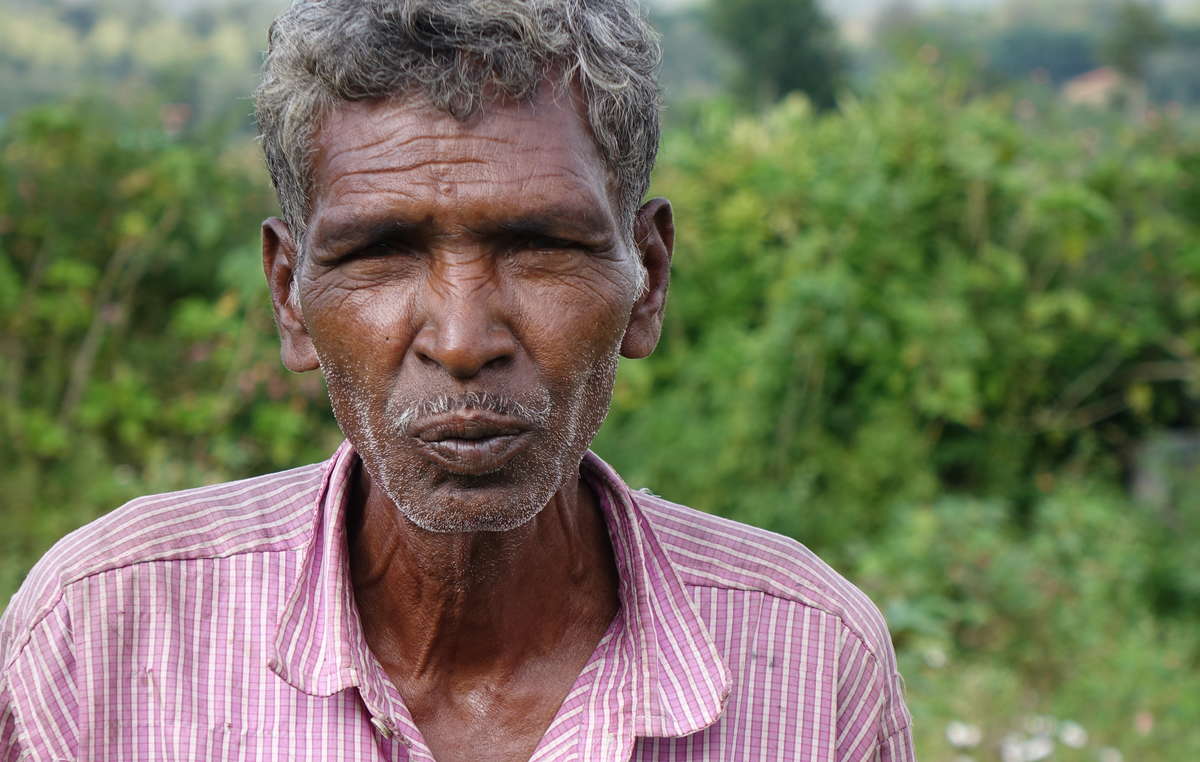
Gurumala, a Jenu Kuruba man who was evicted from Bandipur Tiger Reserve around 30 years ago.
© F Longo/ Survival 2019

Gurumala, a Jenu Kuruba man who was evicted from a nearby tiger reserve 30 years ago, told Survival: “Our children were once independent and free; the whole community was their teacher. After the government came, we lost so much, they moved us out of the forest and restricted our lives. Now our children who grow up here have no freedom. I’m sad that our children have to live like this. I feel very sad that I have to tell our children and grandchildren about our way of life as if it were just a story from the past.”
The WCS is the parent organization of the Bronx Zoo. One of its founders, Madison Grant, was a notorious eugenicist and author of “The Passing of the Great Race”, a book Hitler referred to as his “bible.”
Survival’s research into Indian government-sponsored “voluntary relocations” of tribal people from tiger reserves has found them to be forced evictions, and so illegal under Indian and international law.
The letter comes just weeks after members of the US government’s House Committee on Natural Resources started to investigate WCS’s role in conservation grants tied to human rights abuses. In December the committee wrote to WCS President and CEO, Christián Samper requesting information “related to WCS’s awareness of the occurrence of human rights abuses, funding for eco-guards or law-enforcement that committed human rights abuses, and policies addressing the rights of indigenous and local peoples.”
A member of the US Congress has also submitted a law that would prohibit the government from funding international conservation groups that fund or support human rights violations.
Survival International Director Stephen Corry said today: “Tribal people have long been considered disposable and just “in the way” by big conservation NGOs who want to kick them off their land. But now at least some of them are able to lobby the government funders behind the schemes, which usually do a worse job of conservation than the original inhabitants themselves. Governments shouldn’t fund illegal land grabs and conservation NGOs must learn to treat people with respect. Times are changing.”
For more information and images, contact our press office: