Search This Blog

Translate

Blog Archive

Middleboro Review 2

NEW CONTENT MOVED TO MIDDLEBORO REVIEW 2

Toyota

Since the Dilly, Dally, Delay & Stall Law Firms are adding their billable hours, the Toyota U.S.A. and Route 44 Toyota posts have been separated here:

Route 44 Toyota Sold Me A Lemon


Showing posts with label John Scales Avery. Show all posts

Thursday, January 23, 2020

CC News Letter 23 Jan - FAQ on CAA, NPR, NRC


Dear Friend,

FAQ on CAA, NPR, NRC


John Scales Avery announces the publication of a book, which reviews the development of engineering, from ancient times to the present. The book may be freely downloaded and circulated. This book is part of a series on cultural history. 


Kindly support honest journalism to survive. https://countercurrents.org/subscription/

If you think the contents of this news letter are critical for the dignified living and survival of humanity and other species on earth, please forward it to your friends and spread the word. It's time for humanity to come together as one family! You can subscribe to our news letter here http://www.countercurrents.org/news-letter/.

In Solidarity

Binu Mathew
Editor
Countercurrents.org


What Is CAA, NPR, NRC? What Is Its Impact On Indian Citizens?
by Syed Azharuddin


FAQ on CAA, NPR, NRC


Lives In Engineering
by John Scales
Avery


John Scales Avery announces the publication of a book, which reviews the development of engineering, from ancient times to the present. The book may be freely downloaded and circulated. This book is part of a series on cultural history. 


Review: “One World Digital Dictatorship” by Soren Korsgaard – Digital Nightmare
by Dr Gideon Polya


Danish writer Soren Korsgaard (editor of Crime & Power) has written a very long and detailed account entitled “One World Digital Dictatorship” that describes the accelerating movement  by both Western-style democracies and one-party states (notably China) towards world-wide Digital Dictatorship (Digital Imprisonment) involving mass data collection on everyone, mass surveillance, facial recognition-based tracking, crypotocurrency-based cashless societies, and
social credit-based disempowerment.


New government in Lebanon still failing to diffuse protests as many raise slogan: Revolution, Revolution
by Countercurrents Collective


More than three months of political blockade have passed since protests in Lebanon erupted. A new government has sworn-in. Still violent protests continue with call for an end to corruption, economic woes and sectarian politics. Protesters have called for a “Week of Rage”. Protesters on Tuesday chanted “Revolution, Revolution:.


PG&E: Monopoly Power and Disasters by the Rich 1%
Co-Written by Peter Phillips & Tim Ogburn


The Pacific Gas and Electric Company (PG&E) has diverted over $100 million from safety and maintenance programs to executive compensation at the same time it has
caused an average of more than one fire a day for the past six years killing over 100 people.

Co-Written by Peter Phillips & Tim Ogburn
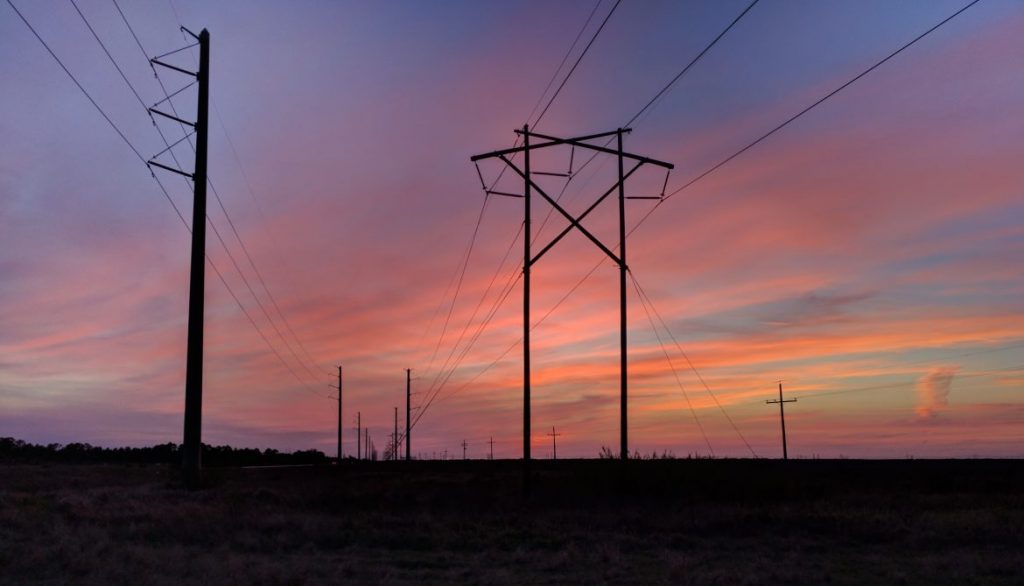
The Pacific Gas and Electric Company (PG&E) has diverted over $100 million from safety and maintenance programs to executive compensation at the same time it has caused an average of more than one fire a day for the past six years killing over 100 people.
PG&E is the largest privately held public utility in the United States. A new research report shows that 91% of PG&E stocks are held by huge international investment management firms, including BlackRock and Vanguard Group. PG&E is an ideal investment for global capital management firms with monopoly control over five million households paying $16 billion for gas and electric in California. The California Public Utility Commission (PUC) has allowed an annual return up to 11%.
Between 2006 and the end of 2017, PG&E made $13.5 billion in net profits. Over those years, they paid nearly $10 billion in dividends to shareholders, but found little money to maintain safety on their electricity lines. Drought turned PG&E’s service area into a tinderbox at the same time money was diverted from maintenance to investor profits.
A 2013 Liberty Consulting report showed that 60% of PG&E’s power lines were at risk of failure due to obsolete equipment and 75% of the lines lacked in-line grounding. Between 2008 and 2015, the CPUC found PG&E late on thousands of repair violations. A 2012 report further revealed that PG&E illegally diverted $100 million from safety to executive compensation and bonuses over a 15-year period.
PG&E has caused over 1,500 fires in the past six years. PG&E electrical equipment has sparked more than a fire a day on average since 2014—more than 400 in 2018—including wildfires that killed more than 100 people.
In October 2017, multiple PG&E linked fires (Tubbs, Nuns, Adobe fires and more) in Northern California scorched more than 245,000 acres, destroyed or damaged more than 8,900 homes, displaced 100,000 people and killed at least 44.
In November, 2018, the PG&E caused Camp fire burned 153,336 acres, killing 86 people, and destroying 18,804 homes, business, and structures. The towns of Paradise and Concow were mostly obliterated. Overall damage was estimated at $16.5 billion.
PG&E has caused some $50 billion in damages from massive fires started by their failed power lines. They filed bankruptcy in January 2019 to try to shelter their assets. PG&E’s 529 million shares went from a high of $70 per share in in 2017 to a low of $3.55 in 2019. Shares are currently trading at $10.55 with zero returns.  At this point PG&E actually owes more in damages then the net worth of the company.
All but two members of the board of director resigned in early 2019, and the CEO was replaced. A new board of directors was elected by an annual stockholders meeting in June of 2019. PG&E now has a board of directors whose primary interest in 2020 is returning PG&E stock values to $50-70 range and returning to annual dividend payments in the 8-11% rate.
The new PG&E management took widespread aggressive action during the fire-season of 2019 shutting down electric power to over 2.5 million people statewide. Nonetheless, a high voltage power line malfunctioned in Sonoma county lead to the Kincade fire that burned 77,758 acres destroying 374 structures, and forced the evacuation 190,000 Sonoma county residents. Estimated damages from this fire are $10.6 billion.
The fourteen new PG&E directors were essentially hand-picked by PG&E’s major stockholder firms like Vanguard Holdings 2019 (47.5 million shares 9.1%) and BlackRock (44.2 million shares 8.5%). A new PG&E Director, Meridee Moore, SF area founder & CEO of $2 billion Watershed Asset Management, is also a board member of BlackRock.
Only three of the new fourteen directors live in PG&E’s service area (four if we count the newly appointed CEO from Tennessee). One board member lives the LA area. The remainder of the board live outside California, including three from Texas, two from the mid-west and the remaining four from New York or east coast states. Pending PG&E Bankruptcy court approval, new directors are slated to receive $400,000 each in annual compensation.
Ten of the new 2020 directors have direct current links with capital investment management firms. The remainder have shown proven loyalty experience on behalf of capital utility investors making the entire PG&E board a solid united group of capital investment protectors, whose primary objective is to return PG&E stock values to pre-2017 highs with a 11% return on investment. They claim that wide-spread blackouts will be needed for up to ten years.
All fourteen PG&E board members are in the upper levels of the 1% richest in the world. As millionaires with elite university educations, the PG&E board holds little empathy for the millions of Californians living paycheck to paycheck burdened with some of the highest utility bills in the country. PG&E shuts off gas and electric to over 250,000 families annually for late payments.
The PG&E 2020 board is in service to transnational investment capital. This creates a perfect storm for the continuing transfer of capital from the 99% to the richest 1% in the world, all with uncertain  blackouts, serious environmental damage, widespread fires, with multiple deaths and injuries.
We need to liquidate PG&E for the criminal damages it has afflicted on California. The “PG&E solution” is to manage PG&E democratically on the basis of human need, rather than private profit. It is time to take a stand for a publicly owned California Gas and Electric Company as the way to reverse the transfer of wealth to the global 1% and provide Californians with safe, low-cost and more renewable energy. All power to the people!
For the full report with all PG&E board names see:  www.projectcensored.org/pge
Peter Phillips, Political Sociologist at Sonoma State University; author Giants: The Global Power Elite, (New York: Seven Stories Press, 2018); past director of Project Censored; co-author/editor of fourteen Censored yearbooks, 1997 to 2011; co-author of Impeach the President, (New York: Seven Stories Press, 2007); and winner of the Dallas Smythe Award from the Union for Democratic Communications.
Tim Ogburn, 20-year manager for the California EPA; founder and co-chair of the Environmental Industry Coalition of the United States in Washington, D.C.; published in numerous technical and trade journals regarding public/private partnerships; International Environmental Technology consultant in India, Philippines, Malaysia, Thailand, Egypt, and Israel; Consultant to USAID, US Department of Commerce, U.S. State Department; and has given Congressional Presentations on the environmental technology industry before Congress.
Originally published in Project Censored


Abiy Ahmed: Nobel Peace laureate who faces unrest at home
by Nizar K Visram


When the 2019 Nobel Peace Prize laureate, Ethiopian Prime Minister Abiy Ahmed, was in Oslo for the award ceremony, eyebrows were raised when he declined to attend any event where he would be asked questions in public. Organizers expected him to meet the international press in keeping with the Nobel tradition, but his spokeswoman cited “pressing domestic issues” and his “humble disposition.”
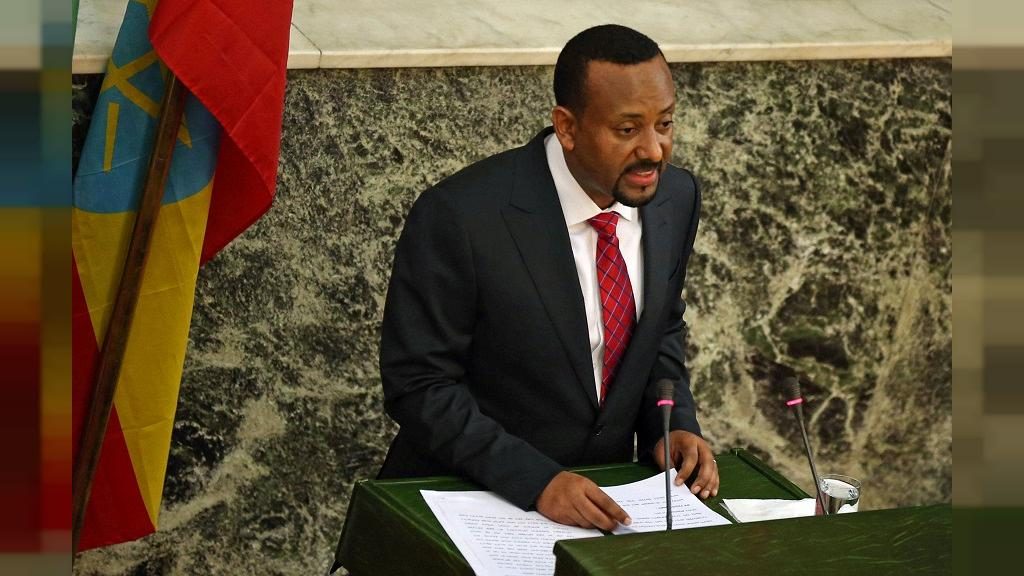
When the 2019 Nobel Peace Prize laureate, Ethiopian Prime Minister Abiy Ahmed, was in Oslo for the award ceremony, eyebrows were raised when he declined to attend any event where he would be asked questions in public. Organizers expected him to meet the international press in keeping with the Nobel tradition, but his spokeswoman cited “pressing domestic issues” and his “humble disposition.”
The secretary of the Nobel committee, Olav Njolstad, called the decision “highly problematic”, noting that a “free press and freedom of expression are essential conditions for a lasting peace in a democracy”. He said the committee would “very much have wanted Abiy to engage with the press during his stay in Oslo”.
Abiy is not the only Nobel laureate that failed to “engage with the press”. The former US president Barrack Obama also declined to meet the press when he accepted the peace prize in 2009. Perhaps they were both avoiding one pertinent question: Was the decision to award them the prize not taken prematurely and hastily?
The Norwegian Nobel Committee said Abiy Ahmed was awarded the prize for his “decisive initiative to resolve the long-running border conflict with neighbouring Eritrea.” It extolled his “efforts to achieve peace and international cooperation.”
Abiy has been lauded for “tearing down the wall” with Eritrea, thus ending two decades of hostility with the neighboring country.  Two months after entering the office, he declared that he would fully accept the terms of a peace agreement with Eritrea.
He flew to Eritrea and hugged President Isaias Afwerki, launching a peace process between the two countries that went to war from 1998 to 2000. More than 80,000 people were killed and hundreds of thousands displaced during the military conflict.
The two leaders then signed a peace deal, establishing diplomatic ties, resuming communication and air travel and lifting border restrictions. Border disputes, however, are not fully resolved. Some border crossings were opened with colorful ceremonies, only to be reclosed.
Immediately after his appointment as head of ruling EPRDF party and prime minister in April 2018, Abiy launched the policy of Medemer  (togetherness or inclusiveness), under which he lifted the state of emergency and put an end to the torture chambers, while firing bigwigs accused of corruption
Abiy also lifted a ban on political parties, released thousands of political prisoners, including journalists and bloggers, and unblocked more than 260 blogs. He also opened the door to exiled political activists, while enacting amnesty laws, repealing repressive NGO and media acts. Ethiopia jumped 40 places in the 2019 World Press Freedom Index compiled by Reporters Without Borders.
Abiy also appointed a gender-balanced cabinet, with 50 percent of women ministers, woman chairperson of the National Election Board, woman head of federal Supreme Court, and the first woman head of state in the country’s modern history.  He appointed a peace and reconciliation commission to deal with past abuses.
Amnesty International acknowledged the reforms undertaken by Abiy’s government but called upon the prime minister to revise the country’s anti-terrorism law to avoid rolling back progress made since he took office.
“The use of Ethiopia’s anti-terrorism proclamation to arbitrarily arrest journalists is completely out of step with reforms witnessed in the country,” Seif Magango, Amnesty’s deputy director for East Africa, said. “This law must be revised to align with international standards and must no longer be used to harass journalists.”
Abiy Ahmed inherited a state that controlled the “commanding heights” of the economy under the “development model” championed by former prime minister, Meles Zenawi. He backed away from Zenawi’s model, leaving the doors open to the Wall Street and its financial institutions.
Within no time, Abiy fell into “chronic foreign currency shortage,” and he resorted to loans and grants from the West and rulers of Saudi Arabia, the United Arab Emirate and Qatar. Soon after Abiy became prime minister he signed a deal for $3 billion with the United Arab Emirate, to “strengthen military cooperation”.
In October 2018, the World Bank approved a total of $1.2 billion for what they call structural adjustment. National Bank of Ethiopia’s Governor, Yinager Dessie said: “They have given us some objectives that have to be met every year for another $1 billion, as the government follows through on its commitment to economic reforms.”
Such funding often goes into unproductive expenditures, saddling the country with audios debt, austerity measures and further IMF and World Bank incursion. This way the country becomes beholden to the global conglomerates.
It wasn’t a bolt from the blue, therefore, when Ethiopians learnt that Abiy was planning a multibillion dollar privatisation of major public enterprises such as Ethio Telecom, Ethiopian Electric, Ethiopian Airlines, and Ethiopian Shipping & Logistics Services Enterprise.
Arrangements are reportedly being made to sell off a 49 per cent stake in Ethio Telecom, the largest telecoms company in Africa, with customer base of 65 million subscribers, and over 22,000 employees. Its annual operating income is $103 mill, with net income of $ 46 mill. The Shipping Enterprise has annual revenue of $ 484 mill.
One state-owned corporation earmarked for privatization is Ethiopian Airlines, the national flag carrier that was launched in 1946 when most of the African nations were under the colonial yoke. Today, its success is taken as a symbol of Ethiopia’s strength. It has a profit of $ 110 mill and revenue of $ 1.5 bill.
It is the largest national airline in Africa and amongst the highly successful public enterprises globally. It is arguably Ethiopia’s most profitable and well-managed public undertaking, with some 110 modern aircraft and over 100 world destinations. Not surprisingly, the airline has clinched several regional and international honours.
Abiy’s policy is divestment of such national treasure, while liberalizing labor law. He is also expected to hand over industrial, tourism, agricultural and mineral sectors. Ethiopia has rich mineral deposits, especially gold whose extraction is contracted to companies from the West and Saudi Arabia.
Besides gold, there are also deposits of platinum, copper, potash, natural gas and tantalum, a corrosion resistant mineral used in electronic components. Other minerals include niobium, cement, salt, gypsum, clay, shale, and soda ash. Not unexpectedly, therefore, foreign firms have their eyes on Ethiopia.
In fact, the US trade delegations are reportedly ready to pounce on the profitable state-owned airline. At the same time, the German development minister complained that his country should not lay back and watch the US and China “take hold of Africa.” German president and industrialists have already visited Addis Ababa to sign a memorandum of understanding between the Volkswagen Group and the Ethiopian Investment Commission.
At the 2019 World Economic Forum in Davos, Abiy declared his commitment to the neoliberal model.  He reaffirmed this in an interview with the Financial Times. The international elites and corporate media have hailed Abiy’s rise to power and his reforms as the dawn of a new era of “freedom and prosperity” for Ethiopia.
Foreign investors have pledged to provide $500 million for two industrial parks, on condition that Ethiopian government reserves a third of the projected 100,000 jobs for refugees. This was approved by Abiy in January 2019, thus supplying refugees to work in the foreign owned enterprises. A local neo-liberal newspaper justified this model by saying: “The one prime opportunity Ethiopia can offer investors is low-cost labor. Taking that away will just drive investment elsewhere”
Thus, the country has the Pizza Hut, where a pizza sells for about US$15, in a society where millions barely survive on less than US$1 per day, while ten tycoons own $25 billion.
Reaping super profit on cheap labor is described as “prime opportunity for investors”. The International Trade Unions Confederation (ITUC) denounced such super exploitation of labor in Ethiopia.
One official “justification” for the rush to sell the assets is that the country may use the proceeds to pay off government-guaranteed debts issued by lenders. Thus, selling sugar factories and the country’s telecommunications monopoly would enable the government to recapitalize state-owned enterprises so they can repay borrowings. This was said by the National Bank Governor.
And head of the National Planning and Development Commission, Fitsum Assefa, said: “With liberalization and privatization, definitely some money will be raised and that will definitely be used to repay the banks – such a move will also help the liquidity”
Abiy Ahmed was appointed prime minister after people revolted against his predecessor. Yet, his own term has not been entirely peaceful. The country has been haunted by ethnic and regional conflicts which have claimed hundreds of lives and seen 3.5 million people displaced since 2015. Since Abiy came to power such conflicts have been on the rise.
According to the Human Rights Watch (HRW), 1.4 million people were displaced in the first half of 2018. That is a global record, the rights group observed. According to the UN report, over two million were displaced, while hundreds were killed.
During protests that erupted in October 2019, Abiy’s spokesperson put the death toll at over 78, with 409 people detained. The dead included 50 from the Oromo ethnic group, the country’s largest, while 20 were from the Amhara group, the second largest. Five of the dead were police officers. This was conceivably the most serious crisis during Abiy’s term in office so far
Ethnic-based unrests that erupted end of 2019 took religious form. Thousands of Muslims across Ethiopia protested the burning of four mosques in the Amhara region.  The December 20 attacks in Motta town, more than 350 kilometers north of Addis Ababa, also targeted Muslim-owned businesses.
Amhara regional officials said they arrested 15 suspects in connection with the attacks. Police commander Jemal Mekonnen told state media the attacks appeared to be triggered by news of a fire that broke out in an Orthodox church a few days earlier.
Ethnic nationalism now stands in the way of Prime Minister Abiy Ahmed’s reforms.  He himself reportedly survived an assassination attempt, while his new book on Medemer was burnt by protesters in eastern Ethiopia. While he was attending Russian-African summit in Sochi, his home was torched
Ethiopian prosecutors have charged five suspects with an attempt to kill Prime Minister Abiy in a grenade attack at a rally in June 2019. The attack killed two people and injured more than 100.
Meanwhile, Abiy is facing mounting criticism from people who accuse him of stifling the press, and issuing the controversial Anti-Terrorism Proclamation, which they say is aimed at repressing dissidents. Amnesty International has cautioned that Ethiopia’s ethnic, linguistic and religious divergences “threaten instability and further human rights abuses”.
Abiy himself admitted that what began as protests against his government has quickly taken ethnic and religious dimension.
(Nizar Visram is Tanzanian writer and commentator. He can be contacted at nizar1941@gmail.com )


On 124th Birth Anniversary Of Subhash Chandra Bose, How Hindutva Gang Back-Stabbed Netaji
by Shamsul Islam


RSS-BJP rulers of India have been trying to show off as great fan of Netaji. But Indians
must know what role ideological parents of today’s RSS/BJP played against Netaji and INA. Hindu Mahasabha and RSS which always had prominent lawyers on their rolls made no attempt to defend the INA accused at Red Fort trials.


Adivasis and Indigenous People in India Condemn the Decision of Adani and Australian Governments on Mining and Displacement
Press Release


We the following Adivasi organisations in India unanimously condemn the decision of the Queensland government to extinguish title of over 1385 hectares in Wangan and Jalingou country in Australia for the proposed Adani coal mine in Queensland’s Galilee Basin. We are shocked to understand that such a decision affecting the indigenous people of Australia was made without even any public announcement.

We the following Adivasi organisations in India unanimously condemn the decision of the Queensland government to extinguish title of over 1385 hectares in Wangan and Jalingou country in Australia for the proposed Adani coal mine in Queensland’s Galilee Basin. We are shocked to understand that such a decision affecting the indigenous people of Australia was made without even any public announcement. We note with great pain that an Indian industrialist is responsible for threatening the lives of indigenous people in Australia, removing them from their own traditional lands, for which they had enjoyed their community rights for generations. With Adani stepping into their territories, these indigenous people will become trespassers to their own lands, restricting their involvement even the basic rituals for their ancestors.
What is extremely repulsive is to note that without the subsidies of 4.4 billion dollars from the Australian governments for Adani’s project, the project would become unviable. The Central and State Governments in India are also following the same model. The model is: `Support the rich with money that belongs to people and wipe out the poor’. This model of development economics needs much more sharper public criticism and scrutiny.
We hereby express our heartfelt solidarity to the struggle carried out by the Wangan & Jalingou Council leader Adrian Burragubba and other representatives of the indigenous people in this region. We call upon all organisations of indigenous all over the world to express their solidarity and support to the indigenous people struggling for their basic rights in Australia. Adivasis and indigenous people all over the world is facing such invasions into their lands, causing displacement, human rights violations and environmental destruction. While coordinating the solidarity concerns of adivasis in India on this issue, the India Greens Party (IGP) has called for international solidarity of all like-minded individuals and organisations to generate pressure on Adani and the Australian governments to withdraw their decision causing great harm to environment and indigenous people. The question `Development for whom and at whose cost’ is becoming more and more grave issue, especially when the governments and corporates behave in an utterly irresponsible manner, without the basic concern for the earth, its inhabitants and its environment, said the representatives of the India Greens Party (IGP). The party has also asked for wider dissemination of these issues among all sections of people who are concerned about the future of healthy planet.
1) All India Adivasi Mahasabha
2) National Adivasi Andolan
3) All India Union of Forest Working People
4) Jharkhand Jungle Bachao Andolan, Jharkhand
5) Rajya Moola Adivasi Vedike Karnataka
6) Eruliga Aranyavasi Kshemabrivridhi Sanga, Kanakapura, Karnataka
7) Soliga Abhivraddi Sangha, Chamarajanagar.
8) Jilla Budakattu Krishikara Sangha, Chickkamangalore.
9) Adivasi Art
10) Anti-Jindal & Anti-POSCO Movement, Odisha
11) Budakattu Krishikara Sangha Kodagu.
12) Budakattu Krishikara Sangha ,Periyapatana, Mysore District,
13) Tamilaga Adivasi Amaippukalin Kootamaippu (TAAK)
14) Jharkhand Jungle Bachav Andolan, Jharkhand
15) Jharkhand Indigenous peoples Forum, Jharkhand.
16) Odisha Paramparik Krushak Sangathan (OPKS), Odisha
17) Anamalai Adivasi Movement, Tamil Nadu





Wednesday, November 20, 2019

CC News Letter 20 Nov - Military and police crackdown on gas plant blockade in Bolivia, 2 dead


Dear Friend,


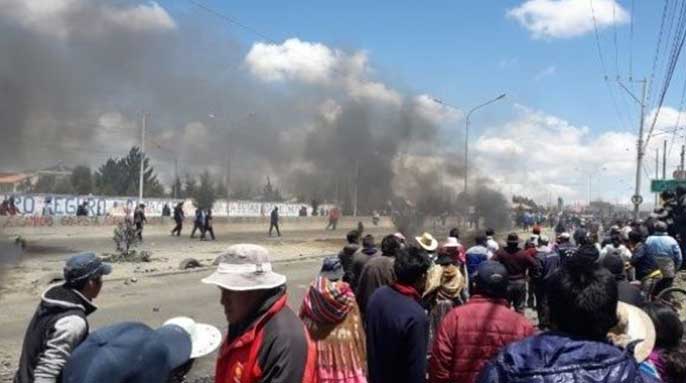
With armored vehicles and helicopters, Bolivian military forces and police used tear gas to crack down on protesters blocking access to a major gas plant, operated by state-run YPFB, in El Alto city on Tuesday. Helicopters flew above roads around the Senkata gas plant while heavily armed police dispersed protesters with tear gas and bullets. The number of dead was 2 while many were injured. Another report said that four protesters were killed. The information could not be confirmed. Mounting violence in Bolivia has seen over 20 people killed.

John Scales Avery announces the publication of a book entitled “FIGHTING FOR AMERICA’S SOUL” It describes the efforts of US progressives to save the values and institutions on which their country was founded. The book may be freely downloaded

Kindly support honest journalism to survive. https://countercurrents.org/subscription/

If you think the contents of this news letter are critical for the dignified living and
survival of humanity and other species on earth, please forward it to your friends and spread the word. It's time for humanity to come together as one family! You can subscribe to our news letter here http://www.countercurrents.org/news-letter/.

In Solidarity

Binu Mathew
Editor
Countercurrents.org


Military and police crackdown on gas plant blockade in Bolivia, 2 dead
by Countercurrents Collective


With armored vehicles and helicopters, Bolivian military forces and police used tear gas to crack down on protesters blocking access to a major gas plant, operated by state-run YPFB, in El Alto city on Tuesday. Helicopters flew above roads around the Senkata gas plant while heavily armed police dispersed protesters with tear gas and bullets. The number of dead was 2 while many were injured. Another report said that four protesters were killed. The information could not be
confirmed. Mounting violence in Bolivia has seen over 20 people killed.

With armored vehicles and helicopters, Bolivian military forces and police used tear gas to crack down on protesters blocking access to a major gas plant, operated by state-run YPFB, in El Alto city on Tuesday.
Helicopters flew above roads around the Senkata gas plant while heavily armed police dispersed protesters with tear gas and bullets.
The number of dead was 2 while many were injured. Another report said that four protesters were killed. The information could not be confirmed.
Mounting violence in Bolivia has seen over 20 people killed.
The Inter-American Commission on Human Rights (IACHR) expressed “concern about the actions of the armed forces in the operations carried out in Bolivia since the beginning of the week.”
On Saturday the UN High Commissioner for Human Rights Michelle Bachelet warned about the dangerous path after the deaths in Sacaba, as the situation could ”spin out of control” in Bolivia
President Evo Morales was forced to resign on Nov. 10 after senior army and police chiefs called on him to do so following weeks of right-wing unrest and violence against his October 20 elections victory, in what his government and world leaders have called a coup by opposition forces in the country.
Witch-hunt intensifies
Bolivia’s coup-born government on Monday intensified its attack campaign against the Movement to Socialism (MAS) supporters. They are protesting the coup.
Interior Minister Arturo Murillo of the government-not-legitimized announced the creation of a “special apparatus at the Prosecutor’s Office” to arrest MAS lawmakers for promoting “subversion and sedition”.
Upon hearing this announcement, President-in-exile Evo Morales announced that Murillo’s decision would increase political persecution against those citizens who are fighting the regime headed by the self-proclaimed interim president Jeanine Anez.
An example of the sort of violence that the Anez government is encouraging occurred early on Tuesday when Mario Chore was arrested by the military who wanted him to confess he was a MAS militant.
He was arrested at the request of Maria Alvarez, a right-wing politician who felt upset because she thought Chore was filming her at a square where a demonstration was taking place.
Police raid homes
On Tuesday morning, the Bolivian student group GEA denounced that the police were raiding homes in search of evidence to link students with marches carried out on Monday.
“At this time two more raids on homes of People’s Congress militants are also taking place,” the GEA group reported.
Farmers and kids attacked
Last night, police attacked a peaceful vigil by farmers, kids and elderly people in Cochabamba.
“They began to repress us by throwing tear gas but the people are united,” National Confederation of Indigenous Female Farmers spokesperson Maribel Avalos said and added that “Anez is racist.”
La Resistencia reported: The vigil was intervened by the police, following orders from the Interior Minister Murillo, who said he would have a hard hand with the seditious alternative media.
“Let them start running, we are going to grab them. We will not allow even one person to continue encouraging sedition​​​​​​​,” Murillo said when he took office on November 14.
As part of her witch-hunt against the Left, self-proclaimed president Anez said that the MAS does not have guaranteed participation in the next elections, for the Supreme Electoral Tribunal “will have to decide whether or not MAS will participate again.”​​​​​​​​​​​​​​
Anez signed a decree whereby the Armed Forces cannot be criminally prosecuted for the actions they deploy to control citizens.
“Personnel of the Armed Forces, who participate in operations for restoring order and public stability, will be exempt from criminal responsibility when, in fulfillment of their constitutional functions, they act in legitimate defense or state of necessity,” the coup-based government’s decree states.
“What does this mean? The new Bolivian government is being overtaken by protests… it has increased its authoritarianism and eliminated guarantees to which citizens are entitled by the rule of law,​​​​​​​” alternative outlet Sin Linea explained.
“In practice, the decree means giving the military a license to kill.”​​​​​​​
68,000 fake twitter accounts
A recent study by Julián Macías Tovar, head of social networks for the Spanish party Podemos, found more than 68,000 fake Twitter accounts have been created to support the coup d’état in Bolivia,.
The specialist found that these false accounts used several labels to work to legitimize the departure of Evo Morales from power and justify violence and repression against demonstrators who reject the coup.
The accounts in this social network have also served to increase the number of followers of the main actors who participated in the anti-democratic outrage, such as the head of the Santa Cruz Civic Committee, Luis Fernando Camacho, and Senator Jeanine Anez, the self-proclaimed interim president.
Analyzing the Twitter conversation about the coup in Bolivia promoted by @LuisFerCamachoV, I can affirm that it is also behind the fraudulent coup in networks with the creation of more than 60,000 false accounts to influence and spread fake news.
Macías Tovar pointed out that Camacho’s account went from 2,000 followers to 130,000 in 15 days, 50,000 of them created in November 2019.
The same thing happened with Anez, who, in that period, went from having 8,000 followers to 150,000, of which 40,000 are newly created accounts.
When analyzing the false accounts of both politicians, Macías Tovar counted more than 68,000 different false accounts, which have not been detected by Twitter. These are still operating, although the social network prohibits the use of robots to amplify messages.
Another study, released on November 13, noted that in just two days 4,000 fake Twitter accounts were created and attempted to position the tag #BoliviaNoHayGolpe. Countercurrents have already used this – 4,000 – news.
After the coup in #Bolivia, in 2 days nearly 4,000 Twitter accounts were created to position the #BoliviaNoHayGolpe tag.
The research was carried out by the political communication specialist Luciano Galup http://bit.ly/2CBVeCH
Although the platform has an anti-spam system and has dedicated itself to closing Chavista and Cuban accounts, it has not reacted to these thousands of false anti-democratic accounts that support the end of Morales’ constitutional government.


Fighting For America’s Soul
by John Scales Avery


John Scales Avery announces the publication of a book entitled “FIGHTING FOR AMERICA’S SOUL” It describes the efforts of US progressives to save the values and institutions on which their country was founded. The book may be freely downloaded


Democratic institutions are in danger
Today there is a deep split in public opinion in the United States. Democratic institutions are in danger from racism and neo-fascism. Progressives are fighting to save the values and institutions on which their country was founded. They are fighting to save America’s soul.
Racism, discrimination and xenophobia
Progressives today would like to eliminate all forms of discrimination, whether based on race, religion, ethnicity, or gender. They are opposed by white nationalist groups, especially in rural areas and among white industrial workers and evangelicals, who fear that their own groups will soon be outnumbered by those who differ from them in ethnicity, race or religion.
Donald Trump has appealed to these fears using rhetoric similar to that of Hitler. According to the testimony of his first wife, he kept a book Hitler’s speeches beside his bedside and studied it diligently. Hitler’s rise to power in Germany probably would not have occurred had it not been for the terrible economic stress produced by the terms of the Versailles Treaty. Working-class white Americans are similarly stressed, and they have chosen a similar leader.
Excessive economic inequality
The United States today is characterized by excessive economic inequality. As Senator Bernie Sanders said, “There is no justice, and I want you to hear this clearly, when the top one-tenth of 1 percent – not 1 percent, the top one-tenth of 1 percent – today in America owns almost as much wealth as the bottom 90 percent.”
Such exaggerated inequality is bad in itself, but it also leads to governmental corruption. Since Citizens United, corporations have been able to make enormous donations to the campaigns of politicians, essentially buying their support. Studies have shown that at present, the wishes of voters matter little in comparison to the wishes of the corporate sponsors of politicians. Because of this, the United States is not a democracy but an oligarchy. Progressives are fighting to change this. They are fighting to save “government of the people, by the people and for the people”. They are fighting for America’s soul.
The military-industrial complex
In his famous farewell address, Dwight D. Eisenhower warned about the power of the military-industrial complex. He said “In the councils of government, we must guard against the acquisition of unwarranted influence, whether sought or unsought, by the Military-industrial complex. The potential for the disastrous rise of misplaced power exists and will persist.”
In another speech, Eisenhower said, “Every gun that is made, every warship launched, every rocket fired signifies, in the final sense, a theft from those who hunger and are not fed, those who are cold and are not clothed. This world in arms is not spending money alone. It is spending the sweat of its laborers, the genius of its scientists, the hopes of its children.”
Today the United States has bases in almost every country of the world, and spends almost a trillion dollars every year on armaments, or more than a trillion, depending on what is included. Aggressive foreign wars, and regime change coups have produced untold suffering, as well as a refugee crisis.
Progressives are fighting to change this. They are fighting for a more  peaceful America. They are fighting for America’s soul.
Secrecy and democracy are incomparable
John Adams wrote: “The jaws of power are always open to devour, and her arm is always stretched out, if possible, to destroy the freedom of thinking, speaking, and writing.”
According to the Nuremberg Principles, the citizens of a country have a responsibility for the crimes that their governments commit. But to prevent these crimes, the people need to have some knowledge of what is going on. Indeed, democracy cannot function at all without this knowledge.
What are we to think when governments make every effort to keep their actions secret from their own citizens? We can only conclude that although they may call themselves democracies, such governments are in fact oligarchies or dictatorships.
We do not know what will happen to Julian Assange. If he dies in the hands of his captors he will not be history’s first martyr to the truth. The ageing Galileo was threatened with torture and forced to recant his heresy, that the Earth moves around the Sun. Galileo spent the remainder of his days in house arrest.
Giordano Bruno was less lucky. He was burned at the stake for maintaining that the universe is larger than it was then believed to be. If Julian Assange becomes a martyr to the truth like Galileo or Bruno, his name will be honored in the future, and the shame of his captors will be remembered too.
Edward Snowden’s revelations showed us the extent of government spying, and the extent of the deep state. Progressives are fighting to make the American government more truthful and open. They are fighting for America’s soul.
A new freely downloadable book
I would like to announce the publication of a book entitled “FIGHTING FOR AMERICA’S SOUL” It describes the efforts of US progressives to save the values and institutions on which their country was founded. The book may be freely downloaded and circulated from the following link:
Other books and articles about  global problems are on these links
I hope that you will circulate the links in this article to friends and contacts who might be interested.
John Scales Avery is a theoretical chemist at the University of Copenhagen. He is noted for his books and research publications in quantum chemistry, thermodynamics, evolution, and history of science. His 2003 book Information Theory and Evolution set forth the view that the phenomenon of life, including its origin, evolution, as well as human cultural evolution, has its background situated in the fields of thermodynamics, statistical mechanics, and information theory. Since 1990 he has been the Chairman of the Danish National Group of Pugwash Conferences on Science and World Affairs. Between 2004 and 2015 he also served as Chairman of the Danish Peace Academy. He founded the Journal of Bioenergetics and Biomembranes, and was for many years its Managing Editor. He also served as Technical Advisor to the World Health Organization, Regional Office for Europe (1988-1997).
http://www.fredsakademiet.dk/ordbog/aord/a220.htm. He can be reached at avery.john.s@gmail.com. To know more about his works visit this link.
http://eacpe.org/about-john-scales-avery/


Dropped Investigations: Julian Assange, Sex and Sweden
by Dr Binoy Kampmark


In the case of Julian Assange, the stench of accusation (never charge) of sexual assault clung stubbornly.  “The road to Belmarsh and 175-years in prison was paved in Stockholm – and so it will be remembered,” tweeted the Defend Assange Campaign. Then came the announcement from the Deputy Director of Public Prosecution Eva-Marie Persson: the Swedish investigation was being laid
to rest.


Occupied Palestine: From BDS To ODS
Co-Written by Kevin Zeese and Margaret Flowers


We titled this article “BDS to ODS” because while this solution must come from the Palestinian people, along with Jews, people in the United States and throughout the world who support peace and justice have an important role to play through the growing BDS campaign to pressure Israel into accepting ODS. This struggle will be won through solidarity between popular movements inside and outside Occupied Palestine.

Co-Written by Kevin Zeese and Margaret Flowers
We spent the last week in Occupied Palestinian Territory, commonly referred to as Israel, where we traveled around the country to visit communities in Jerusalem, Jaffa, Bethlehem, the West Bank, the Nagab, and more.
We call Israel Occupied Palestine because it is not just the West Bank and Gaza that are occupied, but all of historic Palestine, the entire Palestinian nation. Palestinian people do not have equal rights and their communities are constantly encroached upon by settlers pushing them into small, crowded areas. The mistreatment of Palestinians happens right before the eyes of the Israeli Jews. If they do not see it, it is either because they do not want to see it or because they are encouraged not to see it. Just as Jim Crow racism was evident to all in the southern states of the US, apartheid in Palestine is obvious.
This visit deepened our support for the Boycott, Divestment, and Sanctions (BDS) movement because we saw modern apartheid, Jim Crow-segregation laws, ongoing land theft, and ethnic cleansing. For example, we were in Jerusalem when a squadron of fighter jets flew over our heads to bomb the open-air prison of Gaza killing more than 30 people. The Israeli people, media and politicians applauded that, displaying a sickness that runs deep in this colonized land founded on theft, terrorism, and violence.
To end the colonization, there is great hope of developing a movement for the creation of One Democratic State (ODS). This is being organized by a large group of Palestinians and Jews as the formation of two separate states is impossible. ODS envisions a universally equal and democratic nation where minority communities are protected and every person can vote. ODS is the first step to the decolonization and healing of Palestine.
Aida Refugee Camp, photo by Margaret Flowers.
Correcting The Record
Palestinians are disenfranchised:  Occupied Palestine is called a liberal democracy. In reality, while Palestinians are the majority, most of them can’t vote. Out of a total population of twelve million people, five million Jews can vote and five million Palestinians can’t. The remaining two million Palestinians who live in “The 48,” the land between the West Bank and Gaza, can vote but often boycott elections in protest. The dominant parties all support anti-Palestinian policies.
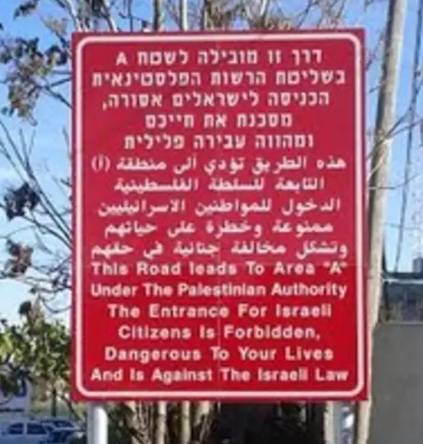
Sign entering Area A, Israeli Citizens Forbidden.


Palestine has hyper-segregation: Palestine can only be described as a modern apartheid state with updated Jim Crow laws. We drove on Jewish-only roads where the color of a person’s license plate determines if they can use the road. There are military checkpoints along these roads. Palestinians are often forced to take long detours to get around the segregated roads and walls. Many Jews never meet a Palestinian because their lives are so segregated.
Under the 1993 Oslo Accords, Occupied Palestine was divided into Areas A, B and C. We visited Bethlehem, classified as Area A, where a sign upon entry warns it is against the law for Israeli-citizens to enter. In Area A, the Palestinian Authority (PA) serves as police and can arrest Israeli-Jews and turn them over to Israeli-police. In Area B, both the PA and Israeli-police have power. And, in Area C, the majority of the country, only the Israeli-police have authority.
Land Theft Against Palestinians Continues: People are often told that no one lived here before 1948 when the occupation of the area by Jewish settlers began. This massive land theft continues today. Although the German Holocaust is used to justify this, the Zionist project began well before then.
Jaffa, above as depicted by Gutman and below as the crowded Arab city that actually existed. Photo by Margaret Flowers.
This false picture is depicted by the well-known Zionist artist Nahum Gutman. His famous painting of the major Arab city of Jaffa showed only sand dunes and a few buildings where hundreds of houses stood.  Today Sir Charles Clore Park covers the remains of this section of the city. Similar tactics have hidden thousands of Palestinian villages that existed before “The Nakba” in 1948.
Forests planted by the Jewish National Fund (JNF), founded in 1901, are still being used to hide the sites of Palestinian villages. We visited the village of Al-Araqib, which has been destroyed 167 times. All that remains is a cemetery built in 1914 and a few residents who hold space under a tree near the cemetery in fear of losing access to it. In Canada, there is a campaign to end the non-profit status of the JNF.
Jaffa was an important Arab port city with a population of 90,000 before 1948 that served as an entry point into Jerusalem and beyond. The first Jewish neighborhoods were built there in the late 19th Century. Tel Aviv, the first Jewish-governed city, began in the early 20th century as a suburb of Jaffa. More than ninety-five percent of the population of Jaffa was expelled by Zionist militias in 1948 and beyond. The remaining residents were confined to an area under guard and forced to operate the port. Between 1947 and 1949, the Nakba terrorized Palestinians and forced 800,000 to flee their homes. The Absentee Property Law was used to seize the homes of those who fled.
Zionist settlers continue encroaching on land in Palestinian neighborhoods. In the historic walled city of Old Jerusalem, they come up from underground tunnels to seize homes in the Palestinian quadrant and put them under armed guards. In Palestinian East Jerusalem, Zionists continue to confiscate houses and land, pushing Palestinians to the other side of the segregation wall where they are crowded into areas without city services. Similar forced urbanization and crowding is occurring throughout Palestine. Gaza is perhaps the most severe example of this. Over the last 50 years, the Israeli government has transferred between 600,000 and 750,000 settlers to the West Bank and East Jerusalem in at least 160 settlements and outposts.
In the West Bank, Jerusalem, and Gaza, this land annexation has made a two-state solution physically impossible. The combination of hundreds of thousands of settlers, Jewish-only roads plus the Expansion (or Annexation) Wall that divides Palestinian communities, and more than 200 checkpoints have severely restricted movement for Palestinians and seized 78% of their country.
A banner hanging in Mea Shearim, a Jewish neighborhood in Jerusalem.
Judaism is not Zionism: In the 1880s, Palestinian Jews amounted to three percent of the total population. They were apolitical and did not aspire to build a Jewish state. We met with Rabbi Meir Hirsch in the Mea Sharim neighborhood of Jerusalem. This tightly-knit ultra-Orthodox Jewish neighborhood has signs posted on the walls that say: ‘A Jew Not a Zionist,’ ‘Zionism is Dying’ and ‘Arabs are Good.’
Hirsch’s family came to Palestine 150 years ago from Russia. His people came to better worship God, not to take land from Palestinians. Hirsch told us about Jacob Israël de Haan, a Dutch-Jew who worked to prevent the 1917 Balfour Declaration and almost succeeded. The Balfour Declaration, issued by the British government, announced support for the establishment of a “national home for the Jewish people” in Palestine. De Haan was assassinated in Jerusalem by the Jewish paramilitary organization Haganah for his anti-Zionist political activities. His murder led to the Neturei Karta movement, which resists Zionism to this day.
Hirsch views Zionism as contradictory to the Jewish religion. His community believes the Torah does not allow Jewish sovereignty of any kind over the Holy Land and those who want to live there must have the approval of the native Palestinian people. Hirsch says that ultra-Orthodox Jews “want to see the end of the Zionist tragedy and the restoration of peace to the Middle East.” His views counter those who claim criticism of Israel is anti-Semitic as, he says, “Judaism and Zionism are as foreign to each other as day and night, good and evil.”
Graffiti made by the graffiti artist Banksy is seen on Israel’s Separation Wall in Abu Dis on August 6, 2005. (Photo by Marco Di Lauro/Getty Images)
One Democratic State
There is a positive path to resolving the conflict between Jews and Palestinians. The path comes from the movement for One Democratic State, which envisions a genuinely just and workable political agreement developed by Palestinians and Jews together.
There has been a marked decline in support for a two-state solution. A poll conducted by the Palestinian Center for Policy and Survey Research from September 11-14, 2019 found only 42% of Palestinians now support the two-state solution. When President Netanyahu entered office a decade ago, that figure was 70%. Similarly, fewer than half of the Jews now support a two-state solution. Further, 63% of Palestinians believe a two-state solution is no longer practical or feasible due to the expansion of the settlements and 83% support the local and international boycott (BDS) movement against Israel.
We met separately with two leaders of this campaign, Awad Abdelfattah, a founder of the Arab Balad Party, and Ilan Pappe, an Israeli historian. Along with many others in the ODS campaign, they seek a multicultural and constitutional democracy in which all people enjoy a common citizenship, a common parliament, and equal civil rights, with constitutional protection granted to national, ethnic and religious views. ODS means equal rights for Palestinians and protection of the rights of Jews.
Their vision includes making the Palestinian ‘right of return’ a reality. Palestinian homes and communities were demolished years ago. According to the Palestinian geographer Salman Abu-Sitta, 85% of Palestinian lands taken in 1948 are still available for resettlement. While more than 530 villages, towns, and urban areas were systematically demolished, their agricultural lands still exist. Other lands lie under public parks and forests. Refugees could actually return, if not to their former homes, at least to the parts of the country where they originated. Palestinian planners could design modern communities for refugees and their descendants in the areas they left with new communities and economic infrastructure that is integrated with other segments of the society. Land redistribution, financial compensation, and equal access to education, training and the economy would enable refugees, like other Palestinians, to achieve economic parity with Jews within a fairly short time.
For Jews, their security will increase by providing constitutional protection of their collective rights. While structures of privilege and domination would be dismantled, the “collective rights” of groups to maintain their community in the framework of a multi-cultural democracy (e.g., communities of ethnic Russians, African asylum-seekers, foreign workers, anti-Zionist ultra-orthodox Jews, and others) give Jews the collective security they need.
ODS views the establishment of a just and working state as requiring: decolonization, restoration, and reconciliation. Decolonization includes ending economic, cultural, political, and legal domination. This means building an egalitarian, inclusive and sustainable society that restores the rights, properties (actual or through compensation), identities and social position of those expelled, excluded and oppressed. This is followed by reconciliation to confront the still-open wounds of the Nakba and the Occupation, and the suffering they have caused.
While the view may sound Utopian to some, in fact, it is the practical path out of the current disaster of Occupied Palestine. Palestine is already one nation. The issue is whether it will be a democratic state with equal rights for all citizens that dismantles the apartheid system or whether it will remain an undemocratic and unequal settler-colonial nation.
We titled this article “BDS to ODS” because while this solution must come from the Palestinian people, along with Jews, people in the United States and throughout the world who support peace and justice have an important role to play through the growing BDS campaign to pressure Israel into accepting ODS. This struggle will be won through solidarity between popular movements inside and outside Occupied Palestine.
We encourage you to visit Occupied Palestine to see and learn for yourself. If you visit Jerusalem, be sure to take the tour offered by Grassroots Jerusalem. They also offer a guide to Palestinian places to stay, shop and eat. Zochrot is an organization that also offers tours and resources about the Nakba. If you are interested in direct service, you can volunteer to assist with the olive harvest or volunteer in places such as the Aida Refugee Camp. They need all sorts of volunteers, especially those who can provide instruction to children in music and arts. Visit Volunteer Palestine to see the many opportunities available.
Kevin Zeese and Margaret Flowers are directors of Popular Resistance


The Olive Branch or The Gun?
by Jafar M Ramini


To all my Palestinian brothers and sisters, no matter where you are, do you think that we should continue raising the olive branch?


A 12-Step Program to Opioid Justice
by Mattea Kramer


Anna Du Puis told me that her
drug use was a search to fill an “internal barren place of desolation.” Raj said OxyContin offered him blissful relief from his difficult childhood as an immigrant in a white neighborhood. In many thousands of cases, opioid addiction resulted from people in chronic pain searching for an answer. Yet there are many kinds of chronic pain, including despair, or a crushing sense of emptiness. Maybe the Sacklers, nightmares of greed as they have been, are in some deeper sense more like us than we’d care to think.


Release of Western Hostages and Prospects of Peace in Afghanistan
by Nauman Sadiq


Three Taliban commanders have been released today, on Tuesday, by the Afghan government as part of a prisoner swap involving two Western hostages. Reportedly, the militant leaders, including senior Taliban leader Anas Haqqani, had landed in Qatar, which hosts the Taliban political office.
In exchange, two university professors identified as US citizen Kevin King and Australian Timothy Weeks were reportedly released later on Tuesday


Why, Indeed, Aren’t Americans Rising Up Like the People of Chile, Lebanon, Iraq, Hong Kong, etc.? A Response to Benjamin and Davies
by Mary Metzger


Yet for the great value of the truth it presents, the article is flawed in that it is undialectical in two respects.  First, that in casting out its net to capture the relations responsible for the people’s failure to rise up against their oppression, they have not cast it wide enough.


Colonialism and Academic Knowledge Production
by Debasish Hazarika


Colonialism is much more than establishing colonies in the non-western world to exploit raw
materials for the western metropolitan centres. It is a system of hegemonic power and domination of the colonized by the colonizers, economic, physical as well as psychological. Colonialism is a product of ‘western’ civilization who is obliged for its internal reason to extend in the world scale, the competition of its antagonistic economic dimension


Media in 2019 : Dissenters versus the banal agitprop in Indian Politics
by Sabah Hussain 


Media being the fourth pillar of democracy, asserting its right space in India but mostly with the wrong agendas, inclining with the rightists and occasionally parleying with the centre right politics. The year of 2019 has been the year of elections, propagandas, media bargaining and the online wars reducing media to a ‘banal agitprop’.


A Harmless Anecdote of a Frivolous Quarrel
by Pitamber Kaushik


A satire


Tasks of Writers-Artists-Intellectuals in The Time of Hindutva Fascism
by Shamsul Islam


With the unleashing of the reign of terror by the RSS/BJP rulers against working-class, peasant organizations, women organizations, student movements, intellectuals, writers, poets and progressive social/political activists, India also witnessed a series of resistance programmes organized by the pro-people cultural organizations in different parts of the country. My address in some of these programmes is reproduced here.


Stand with JNU
by Vidya Bhushan Rawat


Any hike in the fee structure has to happen in negotiations with teachers and student leaders as such exorbitant hike will prove death knell for the dreams of many students hailing from
absolutely poor background. JNU administration and government must act responsibly and negotiate to bring normalcy and stop the situation from deteriorating further.


Build Peace And Friendship On The Foundation Of Kartarpur
Co-Written by Sandeep Pandey and Arundhati Dhuru


It was heartening to hear Narendra Modi praise Imran Khan for facilitating the opening of 4.7 km corridor so that Sikh pilgrims from India could visit the Gurudwara Darbar Sahib at Kartarpur in Pakistan, after a mostly anti-Pakistan narrative first during the general elections and then after the decision related to Jammu and Kashmir was taken by his government.


Rights?
by Mitali Chakravarty


These torn rugged bare feet women at the red light
These walking, stalking in crimson
The worshippers by foam-filled riversides —
Do they too have rights?
Any Rights?


Pegasus
Targeted Persons demand probe from the Parliamentary Standing Committee on Information Technology
Press Release


In a letter sent today to the Parliamentary Standing Committee on Information Technology, 17 persons who were informed by WhatsApp Inc that their electronic devices had been targeted by advanced spyware, Pegasus, have demanded a detailed probe into the cyber-attack that occurred earlier this year.


Democracy, Hindu Majoritarianism and Question of the Socio-economic Rights
by Badre Alam Khan


The public lecture in the memory of Dr. Asghar Ali Engineer has been organized by the Department of Political Science, Jamia, Millia Islamia in collaboration with the Centre for Study of Society and Secularism (Mumbai) on the theme
of “Democracy versus Majoritarianism” on 18th November, 2019 at JMI. The keynote of memorial address was delivered by the eminent left- leaning scholar Prof. Prabhat Patnaik.