Search This Blog

Translate

Blog Archive

Middleboro Review 2

NEW CONTENT MOVED TO MIDDLEBORO REVIEW 2

Toyota

Since the Dilly, Dally, Delay & Stall Law Firms are adding their billable hours, the Toyota U.S.A. and Route 44 Toyota posts have been separated here:

Route 44 Toyota Sold Me A Lemon


Showing posts with label military. Show all posts

Sunday, January 12, 2020

Hamilton Nolan | The Democrats Must Become a Real Anti-War Party


Reader Supported News
12 January 20

Is Reader Supported News a "Material Thing?"
Americans covet "material things." We shell out billions annually for "stuff." But apparently social justice and change are not material things to be coveted and paid for, presumably? So tens of thousands come here daily and lend no support?
Winning this battle will - absolutely, positively - require your participation.
Get on the bus folks.
Marc Ash
Founder, Reader Supported News
Sure, I'll make a donation!

Update My Monthly Donation

If you would prefer to send a check:
Reader Supported News
PO Box 2043
Citrus Hts, CA 95611


Reader Supported News
11 January 20
It's Live on the HomePage Now:
Reader Supported News


Hamilton Nolan | The Democrats Must Become a Real Anti-War Party
Anti-war activists protest in front of the White House in Washington, D.C., January 4, 2020. (photo: Andrew Caballero-Reynolds/AFP/Getty Images)
Hamilton Nolan, Guardian UK
Nolan writes: "Geopolitically speaking, we are the bad guys. The United States government, that is. The extent to which this is true fluctuates somewhat from administration to administration, but in the postwar decades it has been a fairly reliable judgment."
READ MORE

Protesters rallying against Donald Trump's travel ban policy. (photo: NBC News)

The Trump Administration Has Been Preparing to Expand the Travel Ban to Up to Seven More Countries, Documents Reveal
Hamed Aleaziz, BuzzFeed
Aleaziz writes: "The Trump administration has been preparing to expand its travel ban - which bars individuals from seven countries from entering the US - to restrict certain immigrants from several more nations around the world, according to internal government documents obtained by BuzzFeed News."
READ MORE

Soldiers. (photo: PA)

Tom Engelhardt | The Global War of Error: No, That's Not a Typo
Tom Engelhardt, TomDispatch
Engelhardt writes: "Yes, our infrastructure stinks, our schools are failing, this country's a nightmare of inequality, and there's a self-promoting madman in the White House, so isn't it time to take pride in the rare institutional victories America has had in this century?"
READ MORE

A Honduran family stands next to the border fence after they turned themselves in to Border Patrol agents. (photo: John Moore/Getty Images)

Lawsuit Alleges Child Abuse and Neglect After Trump Administration Family Separation
Nathaniel Weixel, The Hill
Weixel writes: "Two fathers who were separated from their children at the U.S.-Mexico border as a result of the Trump administration's policies are suing the government for $12 million, claiming the children were subject to abuse and neglect while in federal custody."
READ MORE

A predator drone. (photo: Veronique de Viguerie/Getty Images)

US Strike on Iranian Commander in Yemen the Night of Suleimani's Assassination Killed the Wrong Man
Alex Emmons, The Intercept
Emmons writes: "On the night the U.S. assassinated Iranian Maj. Gen. Qassim Suleimani by drone strike, the U.S. launched a similar operation to kill a top Iranian commander in Yemen, a U.S. official told The Intercept."

The operation was aimed at killing Abdul Reza Shahlai, the commander of the Yemen division of Iran’s elite Quds Force, near the Yemeni capital Sana’a. Shahlai survived, but a lower-level Quds Force operative was killed, and Shahlai went into hiding, the official said. Shortly thereafter, Iranian state TV reportedly announced the death of a Quds Force operative named Mohammad Mirza in “one of the fields of Resistance Front.”
Shahlai is a senior operator in the Quds Force, the external operations arm of Iran’s Islamic Revolutionary Guard Corps. He was sanctioned by the U.S. in 2008 for his role in operations against the United States in Iraq, and the U.S. has accused him of coordinating a 2011 plot to assassinate the former Saudi ambassador to the U.S., Adel al-Jubeir, at a restaurant in Washington, D.C. Shahlai has since been placed in charge of the Quds Force division responsible for aiding the Houthi militia in its war against Saudi-led intervention in Yemen, the official said.
The strike was first reported by the Washington Post. The White House referred The Intercept to the Department of Defense, which did not respond to a request for comment in time for publication.
The Trump administration had contemplated killing Shahlai for three years, as a means of deterring further Iranian support for the Houthis in Yemen, the U.S. official told The Intercept. But the attempt to assassinate him on the night of January 2 seems to undercut the government’s stated rationale for killing Suleimani, who U.S. officials have repeatedly described as posing “an imminent threat” to U.S. forces in Iraq.
Shahlai is unlikely to have posed a similar threat in Sana’a, where the U.S. evacuated its embassy compound in 2013. The U.S. conducts operations and drone strikes against Al Qaeda in the Arabian Peninsula in Yemen, but does not have personnel in the north of the country, which is controlled by the Houthis and where Sana’a is located.
“Congress needs answers,” tweeted Rep. Ro Khanna, D.-Calif., who has been critical of the U.S. role in the Saudi-led intervention. “What was the full extent of the Trump administration’s plans to kill Iranian officials? How does the attempted killing in Yemen have anything to do with an imminent threat?”
Since the beginning of Yemen’s civil war, a small number of Iranians have provided weapons and training to the Houthis. In March 2014, a coalition led by Saudi Arabia and the United Arab Emirates launched a U.S.-backed intervention aimed at removing the Houthis from power and restoring the previous Yemeni president, Abd Rabbu Mansour Hadi. In the four years since, the situation has devolved into a war of attrition fueled by international proxies that has given rise to one of the world’s worst humanitarian crises.
Congress has not authorized U.S. military action against Iran, so members are likely to question the legal basis for a strike against Shahlai. Congress did, however, recently pass a bipartisan resolution directing President Donald Trump to withdraw U.S. forces from “hostilities” in Yemen. Trump vetoed the resolution, but it marked a clear desire on the part of Congress to end American support for Saudi-led operations in the country.
The Trump administration has characterized its strike on Suleimani as an act of self-defense, saying that the commander was planning imminent attacks against dozens and possibly hundreds of Americans. But following classified briefings on Capitol Hill, numerous lawmakers from both parties claimed that the administration had failed to present direct evidence of an “imminent threat,” even when they asked repeatedly and directly.
The strike on Suleimani came in the midst of escalating hostilities between American forces and Iranian-backed militias in Iraq. As tensions rose last month, a rocket attack by an Iran-backed group called Kataib Hezbollah killed one American contractor and wounded four American servicemembers. Days later, the U.S. retaliated by bombing five Kataib Hezbollah positions, killing 24 people and wounding 50, according to a Hezbollah spokesperson. In the following days, members of the militia and their supporters stormed the fortified U.S. embassy compound in Baghdad. No one was killed, but the security situation remained tense.
Following the strike on Suleimani, the U.S. sent a letter to the U.N. Security Council, saying that the U.S. had “undertaken certain actions in the exercises of its inherent right of self-defense,” and that the actions “include” the operation to kill Suleimani, leaving open the possibility that the U.S. conducted other strikes that night.

A girl cycles past a home that partially collapsed after an earthquake hit Guanica, Puerto Rico. (photo: Carlos Giusti/AP)

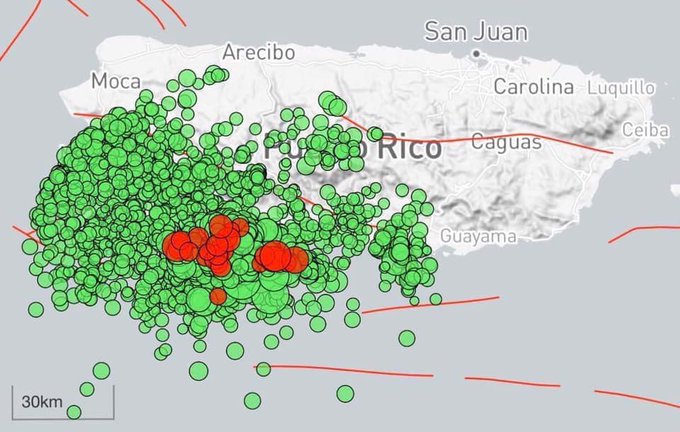
Earthquake of Magnitude 6 Shakes Puerto Rico Again
teleSUR
Excerpt: "A new earthquake of a magnitude of 6 Saturday shook Puerto Rico, a country which since Friday afternoon records aftershocks of different intensity after the 6.4 earthquake that hit the island last Tuesday and caused one death, about 2,000 refugees, and thousands of damaged homes."
EXCERPT:
The RPSR has registered more than a dozen aftershocks so far. The most outstanding of them was recorded at 18.30 local time on Friday, with magnitude 5.2. ​​​​​​​
Although its epicenter was ​​​​​​​located at sea, it was felt strongly throughout the Puerto Rican territory, where panic scenes were recorded again among the population.​​​​​​​​​​​​​​

A bushfire in Australia. (photo: Getty Images)

Climate Change Fueled the Australia Fires. Now Those Fires Are Fueling Climate Change
Maddie Stone, Grist
Stone writes: "Australia is in the midst of a devastating wildfire season that is being exacerbated by climate change. But the fires, which have been burning for months and could rage on for months to come, are also impacting the earth's climate in several ways. Some of those impacts are well understood, while others lie at the frontiers of scientific research."
The most obvious climatic impact of the fires is that they’re spewing millions of tons of heat-trapping carbon dioxide into the atmosphere, contributing to a vicious feedback loop of heat and flame. But the fires are also kicking up lots of soot, creating a smoke plume that’s circling the globe and could hasten the melting of any glaciers it comes in contact with. Preliminary evidence suggests some of that smoke has even made its way into an upper layer of the atmosphere called the stratosphere, buoyed aloft by rare, fire-induced thunderclouds. That, too, could have subtle but far-reaching climate impacts.
The fires, which started burning at the end of Australia’s winter, raged across the eastern half of the country throughout the spring and kicked into high gear in the country’s populous southeast over the last few weeks. They’re a disaster of an unprecedented nature.
Exceptionally hot, dry, gusty weather, brought on by recurring ocean and atmospheric dynamics and amplified by the warming and drying effects of human-caused climate change, has made it all too easy for an errant match or a lightning strike to explode into a raging inferno. Which is exactly what’s been happening. To date, the Guardian estimates that more than 26 million acres of land have burned nationwide — a region larger than Indiana. That includes over 12 million acres in New South Wales alone, a dubious new record for the state.
Much of the land that’s burning is covered in eucalyptus forest, although flames have also razed farmlands, grasslands, heathlands, and even some patches of Queensland’s subtropical rainforests, said Lesley Hughes, an ecologist and climate scientist at Macquarie University in Sydney. Whatever the fuel source, the net effect on the atmosphere is a massive release of ash, dust, and a cocktail of different gases, including carbon dioxide.
From the start of September through early January, the wildfires released around 400 million tons of CO2, which is roughly the same amount the UK emits in an entire year, according to Mark Parrington, a senior scientist with the European Centre for Medium-Range Weather Forecasts. That’s not a record, he said, noting that considerably more carbon was emitted in 2011 and 2012, when very large fires raged across Australia’s northern territory and out west. But in New South Wales, this year’s wildfire emissions are off the charts.
By any measure, 400 million tons is a significant chunk of heat-trapping gases that will get mixed into the atmosphere, fueling more global warming. “It’s a great example of a positive feedback of climate change,” Hughes said. “It all comes together, unfortunately.”
In addition to carbon pollution, the fires are producing, well, regular air pollution. Since early November, vast smoke plumes have been wafting from eastern Australia all the way across the Pacific to the shores of South America. Just this week, Parrington said, forecasts from the Copernicus Atmosphere Monitoring Service showed carbon monoxide from wildfire smoke creeping into the South Atlantic, a “really clear indicator of just how intense those fires have been.”
As the smoke circumnavigates the globe, some of it is passing over New Zealand’s alpine glaciers, turning them an eerie caramel color. Lauren Vargo, a glaciologist at Victoria University of Wellington who recently traveled through New Zealand’s Southern Alps, said that the soot is “really clear and obvious” and that “most of the ice on the South Island” is likely to have been impacted. Vargo is currently studying aerial photographs of New Zealand’s glaciers going back to the 1970s. In 40 years of records, she hasn’t seen anything comparable.
Soot on glaciers does more than spoil hiking photos. It reduces the reflectivity, or albedo, of ice, allowing it to absorb more sunlight, which can hasten its melt, said Marie Dumont, the deputy scientific director of the French Meteorological Service’s Snow Research Center. Exactly how much extra melt New Zealand’s browning glaciers will experience over the coming weeks and months is unclear, but the fact that the color change is occurring during the summer, when the sunlight is fiercer and there’s less chance of fresh snow falling, isn’t a good sign.
“It’s super likely that it will accelerate the melt” of these glaciers, Dumont said, “at least for this year.” She added that she wouldn’t be surprised to see a similar, albeit smaller effect on some Patagonian glaciers, given that the wildfire smoke is passing over South America.
“With ice, when we are seeing a color change, it means the change in albedo is about 10 percent,” Dumont said. “That’s already huge. Even a 2 to 3 percent change is a lot.”
Not all of the wildfire smoke is settling on the earth’s surface. More of it is lingering 3 to 4 miles up in the troposphere, Parrington said, scattering light and resulting in ominous reddish sunsets. Where the smoke is densest, it’s likely impacting the weather, said Robert Field, a climate and atmospheric scientist at Columbia University. Over hard-hit parts of Australia, Field said he wouldn’t be surprised if temperatures are 10 to 20 degrees F lower on dense smoke days as soot blocks incoming sunlight. He emphasized, however, that any such effects will be very temporary.
Where the smoke might have a more far-reaching impact is in the stratosphere, a very dry, very cold part of the atmosphere that starts around 6 miles up and is home to fast-flowing jet stream winds. Pollution from the earth’s surface doesn’t often reach the stratosphere, but recent satellite data shows that Australia’s wildfire smoke has hit this lofty mark, a fact that speaks to “the power and intensity of the fires,” according to Claire Ryder, a research fellow at Reading University’s meteorology department.
The most likely explanation, she said, is fire-induced thunderclouds.
Also known as pyrocumulonimbus clouds, these menacing-looking storms, which form when heat from intense wildfires creates a powerful updraft, can blast particles into the stratosphere in a manner similar to a volcanic eruption. Over the past few weeks, the wildfires in southeastern Australia have spawned a series of pyrocumulonimbus events that Neil Lareau, a fire weather researcher at the University of Nevada Reno, called “really superlative.”
The smoke that’s reached the stratosphere may linger there for weeks to months, Ryder said. But exactly what impact it’ll have is an open scientific question.
Volcanic eruptions, she said, shoot tiny sulfate aerosols into the stratosphere. These particles reflect sunlight and can trigger temporary cooling at the earth’s surface. By contrast, fire smoke contains carbon-rich organic matter, including particles that are brown, gray, and even black in color. Black carbon, in particular, is a potent absorber of sunlight, and whether its presence in stratospheric soot will ultimately have a warming or cooling effect on the planet is unknown.
It will likely be years before scientists have teased out the full impact of this year’s wildfire season on the climate — first, the fires need to end. But it’s clear the effects have rippled far beyond Australia’s borders. As fire seasons become longer and more intense across the world, understanding this complex web of planetary impacts will only become more urgent.






Monday, December 23, 2019

Isaac Chotiner | Why the Editor of Christianity Today Decided to Rebuke Trump


Reader Supported News
22 December 19

These numbers are - far - below what we normally can depend on. We have to confront this head-on.
Really need your attention to donations now.
The situation is quite bad.
Marc Ash
Founder, Reader Supported News


If you would prefer to send a check:
Reader Supported News
PO Box 2043
Citrus Hts
CA 95611


Reader Supported News
22 December 19
It's Live on the HomePage Now:
Reader Supported News


Isaac Chotiner | Why the Editor of Christianity Today Decided to Rebuke Trump
Billy Graham in 1955. (photo: Keystone/Getty Images)
Isaac Chotiner, The New Yorker
Chotiner writes: "This week, the editor of Christianity Today, an evangelical magazine that was founded in the nineteen-fifties by the Reverend Billy Graham, came out against Donald Trump's Presidency."
READ MORE

Pete Buttigieg. (photo: WP)

Buttigieg Is Shocked, Shocked at McKinsey's Transgressions. But It Was Notorious When He Joined It.
Branko Marcetic, In These Times
Marcetic writes: "Early in his political career, 2020 presidential candidate and South Bend Mayor Pete Buttigieg talked proudly of his years at the consulting firm McKinsey & Company-his most 'intellectually informing experience,' at 'a place to learn ... all the things about business I didn't know.'"

EXCERPT:
And in response to the firm’s recent scandals, Buttigieg has noted that he “left the firm a decade ago” and called “what certain people in that firm have decided to do…extremely frustrating and extremely disappointing.”
But McKinsey was mired in high-profile scandals prior to Buttigieg’s decision to work there after graduating from Oxford in 2007—and throughout his time there. It was implicated in the 2001 Enron scandal (among other things, one of the company’s chief executives, Jeffrey Skilling, was a former McKinsey man) and had become notorious as the brains behind countless corporate cost-cutting schemes that slashed jobs, such as the 2007 “Project X” plan, in which Chrysler closed U.S. plants and laid off thousands of factory workers.
Perhaps the most notorious of these was the sprawling insurance scandal that became known as “the McKinsey documents,” in which McKinsey revolutionized the insurance industry to maximize profits at the expense of vulnerable policyholders.
In the early 1990s, Allstate, then one of the country’s biggest auto insurers and looking to pare down how much it was spending on claims, hired McKinsey to do what McKinsey is best-known for doing: cut costs. McKinsey dutifully developed a strategy to “radically alter our whole approach to the business of claims” and boost company profits, which Allstate implemented in 1995. Internal documents released years later showed that McKinsey cast the claims process as a “zero-sum economic game,” where “Allstate gains” and “others must lose,” as one PowerPoint slide put it—the “others” being claimants who had suffered the very misfortunes and disaster their insurance was meant to cushion.
The strategy increased income thirtyfold. Revenue soared from a yearly average of $82 million in the preceding decade to an average of $2.5 billion in the decade that followed. During that time, the amount Allstate paid out per every dollar it charged customers for premiums dropped from around 69 cents to 43.5 cents. By 2007, it had hit a record profit of nearly $5 billion. The strategy was considered such a success that two years later, the program was expanded beyond auto insurance to fire, water and roof damage for homes.
Allstate’s surging profits meant hardship for its customers. Claimants who had diligently paid their premiums for years were suddenly abandoned at precisely the moment of crisis their insurance was meant for. Many received low offers that covered only a fraction of the costs. Some were treated as frauds and potential criminals. Others were tied up in court until they simply gave up on ever recouping their losses.
A host of other insurers also made use of McKinsey. Insurance giant State Farm hired McKinsey in the early 1990s; like Allstate, by 2007, its profits had doubled over 1990s levels.A 2007 analysis by the Sun Herald in Biloxi, Miss., found that between 2002 and 2005 alone, even as eight major hurricanes wreaked destruction along the coast and, particularly, in Florida, the insurance giant’s fire and casualty subsidiary saw its net worth more than double to $7.7 billion and its payouts per premium dollar drop from 70.6 percent to 51.6 percent.
By the time Hurricane Katrina struck land in August 2005, property insurers across the country were operating according to the McKinsey strategy, as the Bloomberg Markets cover story “The Insurance Hoax” later detailed. Reports abounded of insurers low-balling, underpaying, or simply flat-out refusing to fulfill Katrina-related claims. In November 2005, Louisiana Attorney General Charles Foti filed a suit accusing McKinsey and nine other defendants, including Allstate and State Farm, of “rigging the value of policyholder claims and raiding the premiums held in trust by their companies for the benefit of policyholders to cover their losses.” The state accused McKinsey of heading an insurance conspiracy.
The McKinsey-designed insurance strategy was major news through the 2000s. This was thanks to numerous lawsuits by both private attorneys and state officials like Foti, who went to war with Allstate and State Farm on behalf of consumers railroaded by the companies after not just auto collisions and fires, but natural disasters like tornadoes and hurricanes.
They were given a boost by Santa Fe lawyer David Berardinelli, who sued Allstate in 2000 for bad faith denial of an insurance claim, and temporarily obtained 12,500 pages of PowerPoint slides outlining McKinsey’s strategy. Forbidden from copying the documents, Berardinelli took copious notes and published an exposé titled From Good Hands to Boxing Gloves: The Dark Side of Insurance in 2006, the year before Buttigieg joined McKinsey.
Insurers went to extreme lengths to block other damning documents about McKinsey’s advice coming out publicly during lawsuits. Ordered to release internal documents by a Missouri court in 2007, Allstate simply refused and was held in contempt, racking up $25,000-a-day fines that ultimately totaled more than $7 million. It took an order from Florida’s insurance commissioner to finally bring the documents into the light of day, and even then Allstate initially refused, relenting in April 2008 only after Florida suspended it from selling new insurance policies in the state.
The documents made national headlines in outlets like the Chicago Tribune and CNN, which produced a February 2007 report looking at insurers' practice of low-balling claimants. Former claims agents admitted to the network they had offered as little as $50 to policyholders who had suffered bodily injury and used what employees called “the three D’s”: delay, deny and, if it comes to it, defend.
The insurer’s refusal to release the documents was understandable given what their contents revealed. Inside were McKinsey’s PowerPoint slides positing a “zero-sum game” between Allstate and its policyholders. “Leakage” was McKinsey’s term for paying policyholders more than necessary. The company’s bet was that when faced with a “take it or leave it offer,” most claimants would choose to take it, particularly in the midst of the financial insecurity in the wake of an accident. McKinsey advised Allstate that while most customers could be treated with “good hands” (as in the company’s slogan, “You’re in good hands with Allstate”) and get a quick settlement, those who refused the low-ball figures the insurer offered should get the “boxing gloves” treatment and be made to wait three years or more for a resolution.
If policyholders lawyered up, McKinsey counseled that the company “align alligators”—adopt tougher legal action—and then “sit and wait.” Clients fighting Allstate often gave up in the face of years of litigation, local trial attorney David Shapiro told the Sarasota Herald-Tribune. “There are many lawyers who won’t take an Allstate case,” he said.
“[Allstate] pay[s] less than every single insurance company, and they certainly will spend more on litigation,” one former Allstate lawyer told the paper.
McKinsey  also recommended the adoption of a computer program named Colossus to remove the discretion of claims agents in favor of “establishing a new fair market value” for bodily injuries. The program could allegedly be “tuned” to produce low-ball offers from the get-go. McKinsey instructed claims agents “to stay within the Colossus range or below it in most cases.” The program would lead to profits, McKinsey assured Allstate, and “shareholders will notice.”
The long-running scandal raises the question of why Buttigieg, as rival candidate and Hawaii Rep. Tulsi Gabbard put it, “chose to work for a company like McKinsey.” But it also raises another question: How much of the firm’s ethos—putting corporate profits over the health and economic security of the US public with a ruthless, amoral zeal—was internalized by him?
According to Buttigieg, his first client for the firm was the health insurer Blue Cross Blue Shield of Michigan. By his own account, according to the New York Times, the insurer had “had grown in such a way that there was a great deal of duplication and some people didn’t even know what the people working for them were doing.” Two years later, it laid off 10% of its workforce, froze pay for non-union workers and increased its rates.
As the Huffington Post reported, Buttigieg went on to serve as part of a team that recommended cuts to the U.S. Postal Service and the replacement of unionized postal workers with privatized staff. And as the Intercept’s Ryan Grim noted, Buttigieg would later credit his “great experience” at McKinsey with exposing him “to a lot of different ideas and ways of solving problems,” coming to view running the city of South Bend as akin to “running a corporation” and to see its 100,000 residents as “stakeholders.” Buttigieg’s technocratic style of mayordom earned him critics in South Bend, including residents, the director of a local charity for the homeless, and a city council member and now mayoral rival, who complain of top-down, data-driven policies that made life harder for the homeless and accelerated the displacement of communities.
Buttigieg, the Rhodes Scholar, is known for doing his homework. It stretches credulity that he was unaware of the massive insurance scandal engulfing the company before and throughout his years there, one that laid bare the heart of McKinsey’s business strategy: Maximize profits, no matter what the human cost.

Ayabe-Way-We-Tung became the third Little Shell chief in 1872 and quickly began pushing the U.S. government for a reservation that would be his people's homeland. On Friday, his tribe won federal recognition. (photo: National Anthropological Archives/National Museum of Natural History/Smithsonian Institution)

A Big Moment Finally Comes for the Little Shell: Federal Recognition of Their Tribe
Kathleen McLaughlin, The Washington Post
McLaughlin writes: "Almost 130 years after their treaty negotiations with the U.S. government first fell apart, the Little Shell Tribe of Chippewa Indians has at last triumphed."
EXCERPTS:
The Little Shell, with some 5,400 members mostly scattered around Montana, was officially recognized as part of the $738 billion defense bill that the Senate passed Tuesday and President Trump signed Friday. That pen stroke put the group on equal footing with other sovereign Indian nations, in both symbolic and very substantive ways.
“It’s really about dignity, because we’ve been fighting for so long,” said tribal Chairman Gerald Gray, who tracked the bill’s final steps from a meeting of Native American leaders in Billings. “It’s righting a wrong.”
The long and fragmented history of the Little Shell, known for decades as Montana’s landless Native Americans, can now move forward with a more cohesive future. Members will have access to funding and programs like the Indian Health Services, plus a tract of their own land — a reservation, not even one square mile, in a yet-to-be determined spot — with the potential for amenities like a tribal college.
The final push in Congress was bipartisan, led by all three members of the state’s congressional delegation — Sen. Jon Tester, a Democrat, and his two Republican colleagues, Sen. Steve Daines and Rep. Greg Gianforte. And at a ceremony in Helena on Friday, Gov. Steve Bullock (D) announced that the tribe’s flag would fly atop the state Capitol. He called on all Montanans to honor “the strength, endurance and tenacity of the Little Shell people.”


A cell phone tower. (photo: Getty Images)

The Hidden Military Use of 5G Technology
Manlio Dinucci, teleSUR
Dinucci writes: "While the earlier technologies were perfected to create ever more advanced smartphones, 5G is designed not only to improve their performance, but mainly to link digital systems which need enormous quantities of data in order to work automatically. The most important 5G applications will not be intended for civil use, but for the military domain."

EXCERPT:
5G will also be extremely important for the secret services and special forces. It will enable control and espionnage systems which are far more efficient than those we use today. It will improve the lethality of killer drones and war robots by giving them the capacity of identifying, following and targeting people on the basis of facial recognition and other characteristics. The 5G network, as a weapon of high-tech capacity, will also become the target for cyber-attacks and war actions carried out with new generation weapons.
As well as the United States, this technology is under development by China and other countries. The international disagreement concerning 5G is therefore not only commercial. The military implications of 5G are almost entirely ignored, because the critics of this technology, including many scientists, are concentrating their attention on its toxic affects for health and the environment, due to exposure to very low-frequency electromagnetic fields. This engagement is of course of the greatest importance, but must be linked to research on the military use of this technology, financed indirectly by ordinary users. One of its greatest attractions, which favours the dissemination of 5G smartphones, will be the possibility of participating, by subscription, in war games of impressive realism in direct contact with players from all over the world. In this way, without realising it, the players will be financing the preparation for war – but this time it will be a real war.

Burke Denman at home in Santa Fe after his death in 2016. He was buried in a natural grave in New Mexico. (photo: Lyra Butler-Denman/NYT)

The Movement to Bring Funerals Home
Maggie Jones, The New York Times
Jones writes: "Over the last few decades, Boucher has helped more than 100 families take care of loved ones' bodies in the hours and days after death."
READ MORE

Feminist students of the 'Non una di Meno' (Not One Less) group participate in a flash mob in protest against gender violence and patriarchy in Piazza della Minerva at Sapienza University of Rome, Italy. (photo: Simona Granati/Corbis/Corbis/Getty Images]

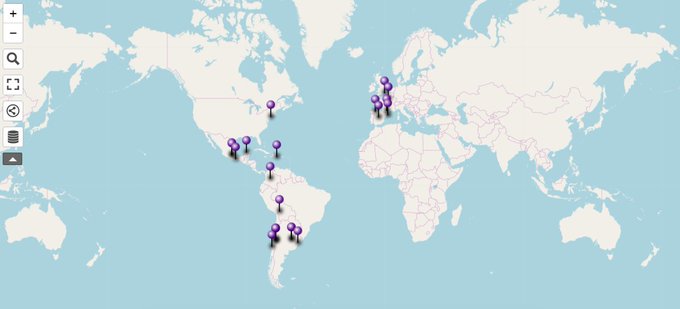
Chile's 'A Rapist in Your Path' Chant Hits 200 Cities
Sandra Cuffe, Al Jazeera
Cuffe writes: "From Santiago to Nairobi and Tijuana to Stockholm, women in hundreds of cities worldwide have executed a Chilean choreographed feminist performance protesting sexual assault, victim-blaming and state violence."

EXCERPT:
"It was impressive how it spread so suddenly, crossing oceans," Isaura Fabra, the Uruguayan feminist who started mapping the phenomenon, told Al Jazeera.
In recent weeks, thousands of women in more than 40 countries have chanted the feminist anthem's core message together: "And the fault was not mine, nor where I was, nor how I was dressed." The performance is an indictment of state and society's perpetuation of rape culture.
The name "A rapist in your path" alludes to "A friend in your path", the official slogan of the Chilean Carabineros police force in the 1980s and 90s, and the lyrics and choreography both include specific references to the Carabineros.
State forces used sexual violence as a component of torture of political dissidents during the 1973-1990 military dictatorship, and allegations of sexual violence by Carabineros and other forces have recently become the subject of renewed attention.
Nationwide mass protests against structural inequality broke out in Chile just over two months ago. The National Human Rights Institute has documented 194 cases of sexual violence by authorities in the context of protests and detentions, and has filed 117 legal motions against authorities for sexual violence, including four cases of rape.


Ibama has attempted to curtail mining activity in the Karapó indigenous territory. (photo: Ibama/Wikimedia Commons)

Illegal Gold Rush Causing 'Irreversible Damage' to Rivers in the Brazilian Amazon
Ana Ionovo, Mongabay
Ionovo writes: "As João Inácio de Assunção's small boat sliced through the clay-colored waters of Rio Fresco in northern Brazil, he recalled a different time when the river was clearer and brimming with fish."

EXCERPTS: 
“Now the fish are dying, they are disappearing,” he said.
Environmentalists point to a surge in illegal gold mining in this corner of the Brazilian Amazon, which has brought along with it a dramatic rise in water pollution and deforestation, as speculators clear swaths of forest along the riverbanks to make way for makeshift mines known as garimpos.
This activity has done “irreversible damage” to the rivers in the region, said Gilberto Santos, who works with the Comissão Pastoral da Terra (CPT) in São Félix do Xingu, an arm of the Catholic Church that strives to advance human rights in rural communities in Brazil.
“There’s always been mining speculation here – but in recent years, it has spread like a fever, ” said Santos. “And the water they are polluting is in small rivers and streams that flow directly into Rio Fresco.”
Local sources say the most dramatic pollution has occurred in Rio Branco, a narrow river that snakes through the adjacent region of Ourilândia do Norte – or Northern Land of Gold – before flowing into the larger Rio Fresco.
The Ourilândia do Norte municipality, most of which was still covered in lush forest a few years ago, has recently seen a sharp rise in clearing: it lost more than 5 percent of its forest cover between 2001 and 2018, according to satellite data from the University of Maryland (UMD). About half of this loss occurred in 2017 and 2018 alone, indicating deforestation in the region may be accelerating.
And there are also signs that this acceleration has kept up this year: preliminary data from UMD indicate deforestation spiked in September and October to more than double the average rate for the same period over the past four years. Satellite images show the bulk of 2019 deforestation is due to mining expansion, much of it clustered around Rio Branco.
Local sources say some illegal miners – known as garimpeiros – dump toxic waste directly into the river. But most of the pollution occurs because the removal of forest and topsoil has badly weakened the banks of Rio Branco, said Daniel Clemente Vieira Rêgo da Silva, adjunct professor at the Federal University of Southern and Southeastern Pará (Unifesspa) in São Félix do Xingu. This means the soil – and the toxins miners use to extract minerals – runs directly into the river when it rains.
“What happens is that you remove this protection,” Rêgo da Silva said. “And we have a big problem with the use of mercury in mining. That soil that is entering the water is rich in mercury and other minerals too.”
While Rêgo da Silva says it’s  difficult to establish a direct link, many environmentalists in the area believe  the mercury is likely a key contributor to the dwindling number of fish in Rio Fresco – a sentiment that some global studies echo. Across Brazil, as much as 221 metric tons of mercury are released into the environment each year due to illegal mining, preliminary studies showed in 2018.
Scientific studies have also found mercury to be detrimental to human health, linking exposure to the element to skin disease, infertility and birth defects. It can also impact river-dwelling communities far beyond the immediate area around a mining site, as contamination travels downstream and the impact becomes amplified up the food chain.
In Pará, the contaminated water flows from one river into the next, eventually reaching São Félix do Xingu. In the open water where Rio Fresco meets Rio Xingu, the blue stream of one flows alongside the muddy currents of the other.
“How can you use the water?” de Assunção wondered. “For whoever lives here, it’s impossible.”
Decades of damage
The decline of Rio Fresco didn’t begin this year with the spike in mining activity in this part of the Brazilian Amazon. Instead, it goes back to the mining rush that gripped the broader Amazon region beginning in the 1970s.
As new roads were built across the Amazon, the path into the mineral-rich lands around Ourilândia do Norte and Tucumã was opened up by miners searching for gold, nickel and iron. In the decades that followed, more and more miners moved into the area, hoping to strike it rich in the illicit gold trade.
Today, there are more than 450 illegal mines in the Brazilian Amazon, according to the Rede Amazónica de Información Socioambiental Georreferenciada (RAISG), a consortium of civil society organizations. Brazilian authorities estimate that 30 metric tons of illegal gold – worth about 4.5 billion reais ($1.1 billion) – are traded each year just in the Tapajós Basin, much of which lies in Pará state.
While mining accounts for  a far smaller proportion of deforestation than cattle ranching or logging, its environmental impact has become clearer – and more worrying – in recent years. A 2017 study found that mining contributed to about 10 percent of deforestation in the Brazilian Amazon between 2005 and 2015. The vast majority of mining-related clearing – about 90 percent – occurred illegally outside mining leases granted by the Brazilian government.
Most often, miners come with heavy machinery, including excavators, that can raze large swaths of forest with ease. Often, they also carve out makeshift airstrips, allowing mining supplies and equipment to be flown into densely forested areas by plane. When the land begins to yield less, they move on to another patch of mineral-rich forest.
Some of the mining in the region is legal but even those operations have run into controversy. Earlier this year, prosecutors suspended a nickel mine owned by mining giant Vale following contamination of a nearby river in the Xikrin indigenous territory. Vale has denied that its mine, which straddles the municipalities of Tucumã and Ourilandia do Norte, is responsible for the contamination.
Meanwhile, the area where illegal miners have recently ramped up their activity overlaps with the Kayapó indigenous territory, a vast region spanning some 3.28 million hectares that is home to several indigenous groups, including some that live in voluntary isolation from the outside world.
In Brazil, it is illegal to mine on indigenous lands – but local sources claim this isn’t stopping illegal garimpeiros from encroaching on the Kayapó territory. Some indigenous people who live on this land have been battling to expel the invaders in recent years. Others have reluctantly tolerated the illegal mining in exchange for a cut of the profits, which they say brings badly-needed funds to their communities.
Deforestation has more than doubled in the Kayapó protected area since 2000, with nonprofit groups pointing to gold mining as the key driver. FUNAI, the government agency tasked with protecting the interests of indigenous people in Brazil, has identified almost 3,000 people contaminated by mining residue in the territory.
Along Rio Fresco, the long-term impacts of mining pollution have also started to become evident. A study done by researchers at Unifesspa, led by Rêgo da Silva, recently found only 21 invertebrate species still living in Rio Fresco. In contrast, there were roughly 45 species in Rio Xingu. Aquatic invertebrates – often the larvae of flying insects – are routinely used by researchers as indicators of waterbody health. 
“This isn’t just an environmental problem – it’s also a social problem,” said Cristian Bento da Silva, an anthropologist with the Instituto de Estudos do Xingu, who is studying the impact of water pollution on the São Félix do Xingu community. “In the early 2000s, it was still possible to fish in Rio Fresco. Now, this river is known as the ‘Dead River’ here.”
As Rio Fresco became more polluted and the number of fish dwindled over the last two decades, de Assunção says many fishermen who relied on its waters have moved further along Rio Xingu in search of more plentiful catch.
“The veterans, the majority have left. Because it became impossible to work as the mining picked up,” he said, noting that there’s also been instances of illness in the community, which he blames on the polluted water.
Advocates and local residents say that the recent uptick in illegal mining and deforestation along Rio Branco and Rio Fresco have spurred fresh concerns about the future of the rivers in this region. A key worry is that the pollution is beginning to seep into Rio Xingu, deepening the damage.
“That’s our big worry here,” Rêgo da Silva said. “We could have a very considerable disequilibrium because Rio Xingu is one of the main rivers here in our region.”
Emboldened force
Many point to the rhetoric of Brazil’s new president Jair Bolsonaro as a key factor that has emboldened illegal miners. The controversial far-right leader – who has his own past as a garimpeiro – has repeatedly railed against land protections as an “obstacle” to mining and development.
Bolsonaro’s government is now pushing forward a controversial bill that would permit mining in indigenous territories and the president has also said he supports opening up the 4.6-million hectare Renca reserve to miners. His predecessor Michel Temer tried to scrap protections on the massive region, which lies across the states of Pará and Amapá, but the move was blocked by a federal judge amid an international outcry.
Environmental enforcement has also been weakened under Bolsonaro’s watch. Earlier this year, he stripped Ibama, Brazil’s environmental agency, of some of its powers and handed over final say on sanctions to a newly established court. Fines for environmental crimes have plummeted since the president assumed office in January to their lowest in a decade.
All of this has resonated with clandestine miners, many of whom are poor and with little education. Local advocates say the president’s words and actions have emboldened many to venture into the Amazon without fear of repercussions.
“This discourse that Amazonia is a place with unlimited natural resources to explore – this discourse is really strong here,” said Bento da Silva. “And so people come to explore the resources of the region without taking any responsibility.”
Government agencies, including Ibama, have carried out operations in the area, aimed at halting this illegal mining. But, with dwindling resources and a vast area to monitor, it has proven difficult to contain the illicit activity.
Ibama has attempted to curtail mining activity in the Karapó indigenous territory. Image by Ibama via Wikimedia Commons (CC BY-SA 2.0).
Cuts to funding at Funai and Ibama have led to the closure of permanent posts in more remote parts of Brazil in recent years, leaving miners free to encroach on indigenous territories and protected areas.
In late October, illegal miners blocked four highways in Pará in protest over enforcement agents damaging mining equipment in the region. One of the blockades, on a key road linking Ourilandia do Norte to São Félix do Xingu, lasted for days.
“They want the government to stop us from being able to destroy equipment – because that’s what really hurts the garimpeiro,” said one source at a government enforcement agency, who asked to remain anonymous because he was not authorized to speak on the matter.
Earlier this year, Bolsonaro sent miners and loggers an encouraging signal when he personally intervened to stop agents from Ibama from destroying equipment confiscated during a raid on a protected area in the state of Rondônia. “It is not the orientation of this government to burn machinery,” he said in a social media video.
The enforcement agency source noted that it has become increasingly difficult to crack down on illegal mining activity in the region as garimpeiros have become bolder. “They have started feeling more powerful. They are hoping both that the government won’t punish them and that their activity will be legalized.”
For de Assunção, meanwhile, it is still unclear how his community will cope with the impact of illegal mining along rivers, especially as garimpeiros show no sign of stepping back from the region. “My livelihood is fish, my food is fish,” he said. “For those of us who live from fish, it’s a big loss.”