Search This Blog

Translate

Blog Archive

Middleboro Review 2

NEW CONTENT MOVED TO MIDDLEBORO REVIEW 2

Toyota

Since the Dilly, Dally, Delay & Stall Law Firms are adding their billable hours, the Toyota U.S.A. and Route 44 Toyota posts have been separated here:

Route 44 Toyota Sold Me A Lemon


Showing posts with label El Salvador. Show all posts

Monday, November 18, 2019

A Century of U.S. Intervention Created the Immigration Crisis


You don't want IMMIGRANTS in the US?
Then why are we supporting US/CIA policies that make other nations HELL HOLES?
This presents some of US/CIA interventions that have caused IMMIGRANTS to flee VIOLENCE......
About this website
MEDIUM.COM
Those seeking asylum today inherited a series of crises that drove them to the border


A Century of U.S. Intervention Created the Immigration Crisis

Those seeking asylum today inherited a series of crises that drove them to the border


Mark Tseng-Putterman
Jun 20, 2018 · 10 min read

A national spotlight now shines on the border between the United States and Mexico, where heartbreaking images of Central American children being separated from their parents and held in cages demonstrate the consequences of the Trump administration’s “zero-tolerance policy” on unauthorized entry into the country, announced in May 2018. Under intense international scrutiny, Trump has now signed an executive order that will keep families detained at the border together, though it is unclear when the more than 2,300 children already separated from their guardians will be returned.
Trump has promised that keeping families together will not prevent his administration from maintaining “strong — very strong — borders,” making it abundantly clear that the crisis of mass detention and deportation at the border and throughout the U.S. is far from over. Meanwhile, Democratic rhetoric of inclusion, integration, and opportunity has failed to fundamentally question the logic of Republican calls for a strong border and the nation’s right to protect its sovereignty.
At the margins of the mainstream discursive stalemate over immigration lies over a century of historical U.S. intervention that politicians and pundits on both sides of the aisle seem determined to silence. Since Theodore Roosevelt in 1904 declared the U.S.’s right to exercise an “international police power” in Latin America, the U.S. has cut deep wounds throughout the region, leaving scars that will last for generations to come. This history of intervention is inextricable from the contemporary Central American crisis of internal and international displacement and migration.
The liberal rhetoric of inclusion and common humanity is insufficient: we must also acknowledge the role that a century of U.S.-backed military coups, corporate plundering, and neoliberal sapping of resources has played in the poverty, instability, and violence that now drives people from Guatemala, El Salvador, and Honduras toward Mexico and the United States. For decades, U.S. policies of military intervention and economic neoliberalism have undermined democracy and stability in the region, creating vacuums of power in which drug cartels and paramilitary alliances have risen. In the past fifteen years alone, CAFTA-DR — a free trade agreement between the U.S. and five Central American countries as well as the Dominican Republic — has restructured the region’s economy and guaranteed economic dependence on the United States through massive trade imbalances and the influx of American agricultural and industrial goods that weaken domestic industries. Yet there are few connections being drawn between the weakening of Central American rural agricultural economies at the hands of CAFTA and the rise in migration from the region in the years since. In general, the U.S. takes no responsibility for the conditions that drive Central American migrants to the border.
U.S. empire thrives on amnesia. The Trump administration cannot remember what it said last week, let alone the actions of presidential administrations long gone that sowed the seeds of today’s immigration crisis. There can be no common-sense immigration “debate” that conveniently ignores the history of U.S. intervention in Central America. Insisting on American values of inclusion and integration only bolsters the very myth of American exceptionalism, a narrative that has erased this nation’s imperial pursuits for over a century.
As the British immigrant rights refrain goes, “We are here because you were there.” The adage holds no less true here and now. It’s time to insist that accepting Central American refugees is not just a matter of morality or American benevolence. Indeed, it might be better described as a matter of reparations.
The following timeline compiles numerous sources to lay out an incomplete history of U.S. military and economic intervention in El Salvador, Honduras, and Guatemala over the past century.

Anti-war marchers at Copley Square on their way to Boston Common to protest U.S. military involvement in El Salvador, on March 21, 1981. Photo by John Tlumacki/The Boston Globe via Getty

El Salvador

1932: A peasant rebellion, led by Communist leader Farabundo Martí, challenges the authority of the government. 10,000 to 40,000 communist rebels, many indigenous, are systematically murdered by the regime of military leader Maximiliano Hernández Martínez, the nation’s acting president. The United States and Great Britain, having bankrolled the nation’s economy and owning the majority of its export-oriented coffee plantations and railways, send naval support to quell the rebellion.
1944: Martínez is ousted by a bloodless popular revolution led by students. Within months, his party is reinstalled by a reactionary coup led by his former chief of police, Osmín Aguirre y Salinas, whose regime is legitimized by immediate recognition from the United States.
1960: A military-civilian junta promises free elections. President Eisenhower withholds recognition, fearing a leftist turn. The promise of democracy is broken when a right-wing countercoup seizes power months later. Dr. Fabio Castillo, a former president of the national university, would tell Congress that this coup was openly facilitated by the United States and that the U.S. had opposed the holding of free elections.
1980–1992: A civil war rages between the military-led government and the leftist Farabundo Martí National Liberation Front (FMLN). The Reagan administration, under its Cold War containment policy, offers significant military assistance to the authoritarian government, essentially running the war by 1983. The U.S. military trains key components of the Salvadoran forces, including the Atlacatl Battalion, the “pride of the United States military team in San Salvador.” The Atlacatl Battalion would go on to commit a civilian massacre in the village of El Mozote in 1981, killing at least 733 and as many as 1,000 unarmed civilians, including women and children. An estimated 80,000 are killed during the war, with the U.N. estimating that 85 percent of civilian deaths were committed by the Salvadoran military and death squads.
1984: Despite the raging civil war funded by the Reagan administration, a mere three percent of Salvadoran and Guatemalan asylum cases in the U.S. are approved, as Reagan officials deny allegations of human rights violations in El Salvador and Guatemala and designate asylum seekers as “economic migrants.” A religious sanctuary movement in the United States defies the government by publicly sponsoring and sheltering asylum seekers. Meanwhile, the U.S. funnels $1.4 million to its favored political parties in El Salvador’s 1984 election.
1990: Congress passes legislation designating Salvadorans for Temporary Protected Status. In 2018, President Trump would end TPS status for the 200,000 Salvadorans living in the United States.
2006: El Salvador enters the Dominican Republic–Central America Free Trade Agreement (CAFTA-DR), a neoliberal export-economy model that gives global multinationals increased influence over domestic trade and regulatory protections. Thousands of unionists, farmers, and informal economy workers protest the free trade deal’s implementation.
2014: The U.S. threatens to withhold almost $300 million worth of Millennium Challenge Corporation (MCC) development aid unless El Salvador ends any preferences for locally sourced corn and bean seeds under its Family Agriculture Plan.
2015: Under the tariff reduction model of CAFTA-DR, all U.S. industrial and commercial goods enter El Salvador duty free, creating impossible conditions for domestic industry to compete. As of 2016, the country had a negative trade balance of $4.18 billion.
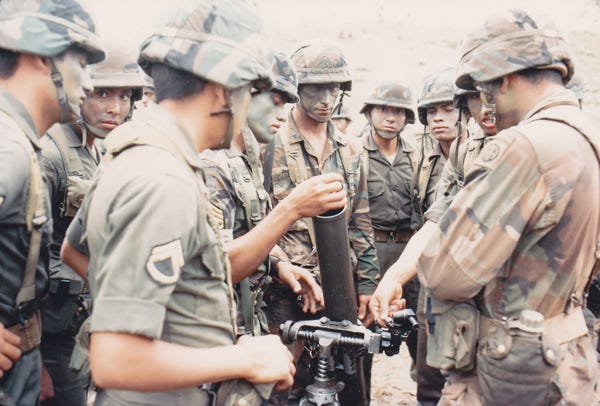
Honduran soldiers operate a mortar for members of the U.S. Army 82nd Airborne Division during a joint exercise, March 1988. (Photo: Department of Defense, NARA)

Honduras

1911: American entrepreneur Samuel Zemurray partners with the deposed Honduran President Manuel Bonilla and U.S. General Lee Christmas to launch a coup against President Miguel Dávila. After seizing several northern Honduran ports, Bonilla wins the Honduran 1911 presidential election.
1912: Bonilla rewards his corporate U.S. backers with concessions that grant natural resources and tax incentives to American companies, including Vaccaro Bros. and Co. (now Dole Food Company) and United Fruit Company (now Chiquita Brands International). By 1914, U.S. banana interests would come to own one million acres of the nation’s best land — an ownership frequently insured through the deployment of U.S. military forces.
1975: The United Fruit Company ( rebranded as the United Brands Company) pays $1.25 million to a Honduran official, and is accused of bribing the government to support a reduction in banana export taxes.
1980s: In an attempt to curtail the influence of left-wing movements in Central America, the Reagan administration stations thousands of troops in Honduras to train Contra right-wing rebels in their guerrilla war against Nicaragua’s Sandinistas. U.S. military aid reaches $77.5 million in 1984. Meanwhile, trade liberalization policies open Honduras to the interests of global capital and disrupt traditional forms of agriculture.
2005: Honduras becomes the second country to enter CAFTA, the free trade agreement with the U.S., leading to protests from unions and local farmers who fear being outcompeted by large-scale American producers. Rapidly, Honduras goes from being a net agricultural exporter to a net importer, leading to loss of jobs for small-scale farmers and increased rural migration.
2009: Left-leaning and democratically elected President Manuel Zelaya, who pursued progressive policies such as raising the minimum wage and subsidizing public transportation, is exiled in a military coup. The coup is staged after Zelaya announces intentions to hold a referendum on the replacement of the 1982 constitution, which had been written during the end of the reign of U.S.-backed military dictator Policarpo Paz García. Honduran General Romeo Vásquez Velásquez, a graduate of the U.S. Army training program known as the School of the Americas (nicknamed “School of Assassins”), leads the coup. The United States, under Hillary Clinton’s Department of State, refuses to join international calls for the “immediate and unconditional return” of Zelaya.
2017: Honduras enters an electoral crisis as thousands of protesters contest the results of the recent presidential election, which many allege was rigged by the ruling party.
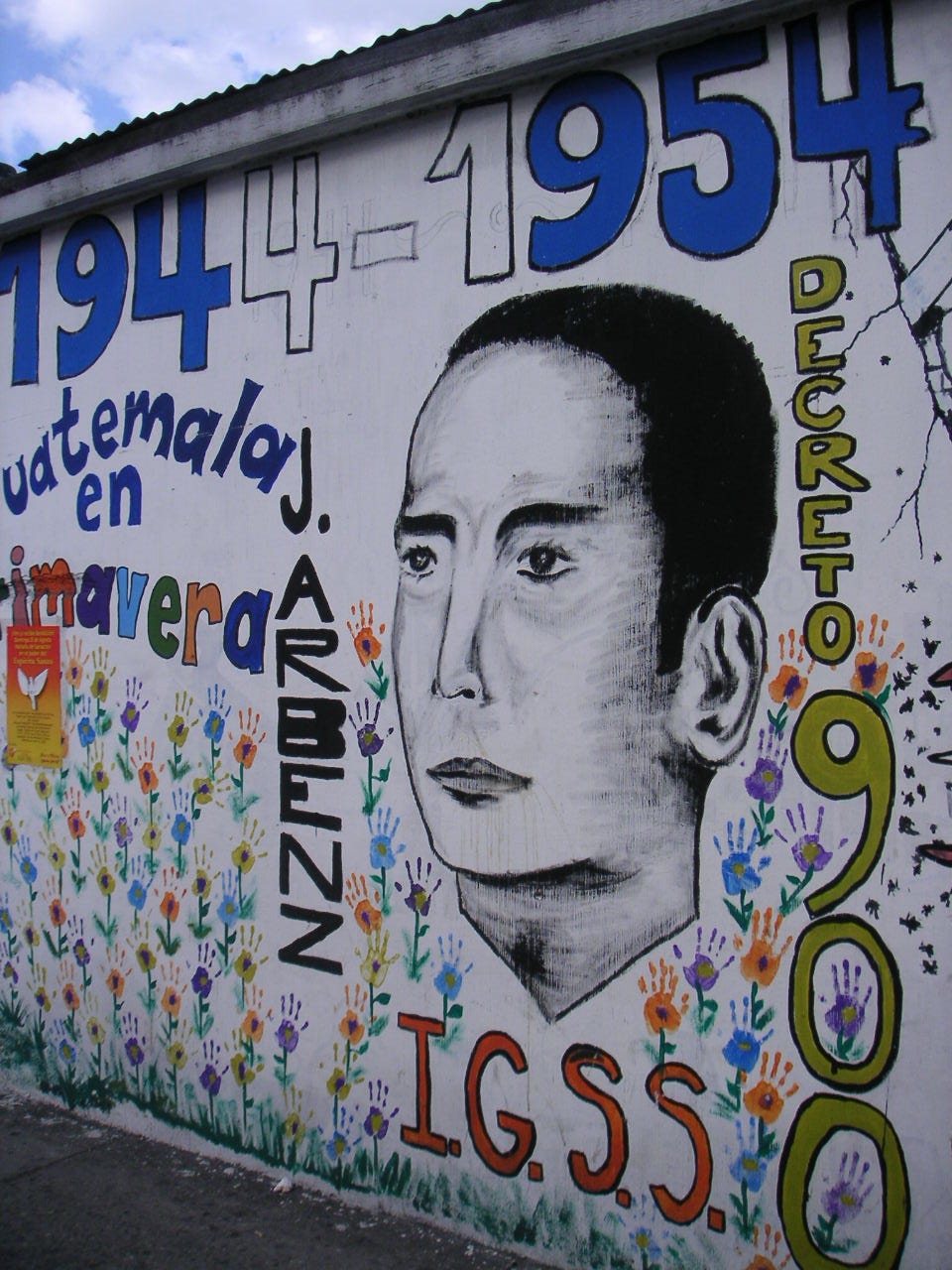
A present-day Guatemala City mural memorializes deposed President Jacobo Árbenz and his historic land reforms. Credit: Soman via Wikimedia Commons/CC BY 2.5

Guatemala

1920: President Manuel Estrada Cabrera, an ally to U.S. corporate interests who had granted several concessions to the United Fruit Company, is overthrown in a coup. The United States sends an armed force to ensure the new president remains amenable to U.S. corporate interests.
1947: President Juan José Arévalo’s self-proclaimed “worker’s government” enacts labor codes that give Guatemalan workers the right to unionize and demand pay raises for the first time. The United Fruit Company, as the largest employer and landowner in the country, lobbies the U.S. government for intervention.
1952: Newly-elected President Jacobo Árbenz issues the Agrarian Reform Law, which redistributes land to 500,000 landless — and largely indigenous — peasants.
1954: Fearing the Guatemalan government’s steps toward agrarian reform and under the influence of United Fruit propagandist Edward Bernays, President Eisenhower authorizes the CIA to overthrow democratically elected President Jacobo Árbenz, ending an unprecedented ten years of democratic rule in the country, colloquially known as the “ten years of spring.” In Árbenz’s place, the U.S. installs Carlos Castillo Armas, whose authoritarian government rolls back land reforms and cracks down on peasant and workers’ movements.
1965: The CIA issues Green Berets and other counterinsurgency advisors to aid the authoritarian government in its repression of left-wing movements recruiting peasants in the name of “struggle against the government and the landowners.” State Department counterinsurgency advisor Charles Maechling Jr. would later describe the U.S.’s “direct complicity” in Guatemalan war crimes, which he compared to the “methods of Heinrich Himmler’s extermination squads.”
1971: Amnesty International finds that 7,000 civilian dissidents have been “disappeared” under the government of U.S.-backed Carlos Arana, nicknamed “the butcher of Zacapa” for his brutality.
1981: The Guatemalan Army launches “Operation Ceniza” in response to a growing Marxist guerrilla movement. In the name of “counterattacks” and “retaliations” against guerrilla activities, entire villages are bombed and looted, and their residents executed, using high-grade military equipment received from the United States. The Reagan administration approves a $2 billion covert CIA program in Guatemala on top of the shipment of $19.5 million worth of military helicopters and $3.2 million worth of military jeeps and trucks to the Guatemalan army. By the mid-1980s, 150,000 civilians are killed in the war, with 250,000 refugees fleeing to Mexico. Military leaders and government officials would later be tried for the genocide of the Maya victims of military massacres.
1982: A second U.S.-backed military coup installs Efraín Ríos Montt as president. Montt is convicted of genocide in 2013 for trying to exterminate the indigenous Maya Ixil.
2006: Ten years after a U.N.-brokered peace deal and the resumption of democratic elections, Guatemala enters the CAFTA-DR free trade deal with the United States. Ninety-five percent of U.S. agricultural exports enter Guatemala duty free.


Sunday, November 17, 2019

The New York Times Editorial Board | Did President Trump Just Earn Himself Another Article of Impeachment?


Reader Supported News
17 November 19

We have a little rally going this morning. We need a few donations. Who has a moment to help?
Thanks in advance to all.
Marc Ash
Founder, Reader Supported News


If you would prefer to send a check:
Reader Supported News
PO Box 2043
Citrus Hts, CA 95611


Reader Supported News
16 November 19
It's Live on the HomePage Now:
Reader Supported News


The New York Times Editorial Board | Did President Trump Just Earn Himself Another Article of Impeachment?
The White House at night. (photo: Susan Walsh/AP)
The New York Times Editorial Board
Excerpt: "Republican defenders of Donald Trump have argued that he withheld congressionally mandated military aid to Ukraine and a promised White House meeting because he wanted assurances that Ukraine's new president, Volodymyr Zelensky, was serious about fighting corruption."

EXCERPT:
David Holmes, an official in the American Embassy in Kiev, testified to lawmakers privately that he had overheard a telephone conversation in which the ambassador to the European Union, Gordon Sondland, assured the American president that his Ukrainian counterpart “loves your ass” and will do “anything you ask him to,” including to open investigations into the family of Mr. Trump’s leading Democratic rival, Joe Biden.
Mr. Holmes said that he overheard the conversation while sitting at a restaurant in Kiev with Mr. Sondland. Mr. Trump was speaking so loudly, Mr. Holmes said, that the ambassador held the phone away from his ear and Mr. Holmes could hear Mr. Trump demanding to know if Mr. Zelensky had committed to the investigations. Thus, apparently, is diplomacy conducted at the highest levels of the Trump administration.

Representative Adam Schiff, the chairman of the Intelligence Committee, interrupted the questioning to let the ambassador know that the president was attacking her.
After reading Ms. Yovanovitch one of the belligerent tweets, Mr. Schiff asked: “What effect do you think that has on other witnesses’ willingness to come forward and expose wrongdoing?”
“Well, it’s very intimidating,” she said, visibly shaken.
Mr. Schiff assured her that “some of us here take witness intimidation very, very seriously.”
Translation: The president may just have earned himself an article of impeachment.
In a refreshing development, the ensuing criticism of Mr. Trump’s Twitter fit was bipartisan. Representative Liz Cheney, Republican of Wyoming, said the president’s tweeting “was wrong.”
“Extraordinarily poor judgment,” said Kenneth Starr, the former independent counsel at the center of President Clinton’s impeachment, on Fox News. “Obviously this was quite injurious.” Fox News’ Bret Baier called it “a turning point in this hearing.”
Even an effort by Republican lawmakers on Friday to clear the president wound up underscoring how indifferent he was to wrongdoing by officials in Ukraine.

Stephen Miller. (photo: Joshua Roberts/Reuters)


Stephen Miller Is No Outlier. White Supremacy Rules the Republican Party
Cas Mudde, Guardian UK
Mudde writes: "This week, the Southern Poverty Law Center (SPLC) published a bombshell article revealing troubling emails that White House senior policy advisor Stephen Miller sent to editors at Breitbart News, the far-right media outlet previously led by Steve Bannon."

EXCERPT:
It also externalizes white supremacy, as if it lives in the margins. But it has been hiding in plain sight within the Republican Party for decades. Miller wrote the emails to Breitbart when he was still an aide to Senator Jeff Sessions, who has been a consistent voice of white supremacy in Congress since 1997. And the Alabama Senator was not alone in Congress either. Representative Steve King has been the most open and unapologetic voice for the cause since 2003. Others, like representatives Louie Gohmert, Paul Gosar, Tom Tancredo and Dana Rohrabacher, might not be as open in their support, but they all encourage white nationalism to varying degrees.
But white supremacy in the Republican party is not limited to just these individual congressmen and women. It runs much deeper than them. White supremacy was at the core of the “Southern Strategy”, dating back to the unsuccessful 1964 presidential campaign of Barry Goldwater, which was formative for the future conservative movement. Perfected by President Richard Nixon, with the help of speechwriter Pat Buchanan, dog whistles to white supremacy have been at the heart of virtually every Republican campaign since the 1970s.
Talking of Buchanan, more than 25 years ago he gave his now famous “culture war” speech at the 1992 Republican convention. While the term has become mainly linked to the religious right, Buchanan is at least as much a white supremacist as a Christian fundamentalist. In many ways, he is the intellectual father of the Trump administration, personifying Mike Pence and Donald Trump in one.
This is why calling for Stephen Miller’s resignation wouldn’t change much. Neither Miller nor Bannon “made” Trump the white-supremacist-in-chief. And Trump is not the only problem either, as Joe Biden seems to believe. He won the Republican primaries, and presidential elections, not despite white supremacy but because of it.

Rep. Max Rose. (photo: Caroline Brehman/CQ-Roll Call/Getty Images)

Two Democrats Are Introducing a Bill to Ban Corporate PACs
Ella Nilsen, Vox
Nilsen writes: "Two moderate House Democrats are introducing a bill aiming to root out corporate influence where it currently thrives: Washington, DC."

EXCERPT:
On Friday, Reps. Max Rose (NY) and Josh Harder (CA) will introduce the “Ban Corporate PACs Act,” which would ban for-profit corporations from being allowed to sponsor, operate, or fund PACs. Vox was given an exclusive first look at the legislation.
The bill’s co-authors see it as a necessary addition to the HR 1 — also known as the “For the People Act” — the vast anti-corruption bill that was House Democrats’ first priority after taking back the majority in 2018. HR 1 passed the House way back in early March, but it has gone nowhere as Senate Majority Leader Mitch McConnell vehemently opposes it.
“We always said HR 1 was just the beginning,” Rose told Vox in an interview. Rose called corporate PACs “legalized bribery” that “should not have a place in this town.”


Salvadorans commemorate the murder of six Jesuit priests and two women at UCA in San Salvador - one of the civil war's most notorious crimes. (photo: Oscar Rivera/EPA/Corbis)


30 Years Ago Today in El Salvador, US-Trained Soldiers Murdered 6 Priests in Cold Blood
Hilary Goodfriend, Jacobin
Goodfriend writes: "Today marks thirty years since the massacre of six Jesuits, their housekeeper, and her daughter by US-trained forces. But US brutality in Latin America isn't a thing of the past: top military officials involved in the coup against Bolivian president Evo Morales were trained by the United States, too."

EXCERPT:

n November 16, 1989, six Jesuit priests, their housekeeper, and her daughter were murdered in their residence on the campus of the Jesuit Central American University (UCA) in San Salvador, El Salvador. Thirty years later, the massacre remains emblematic of the indiscriminate savagery exercised by the servants of the Salvadoran ruling class, the impunity they enjoy, and the devastating legacies of US intervention in the region.
The Jesuit murders drew international outcry, but the victims were only eight of some seventy-five thousand killed and ten thousand more disappeared during the twelve-year civil war (1980–1992). Formally, the conflict pitted the US-backed military dictatorship against the Farabundo Martí National Liberation Front (FMLN) leftist guerillas. But the Salvadoran state tortured and slaughtered civilians with abandon. At the war’s close, a 1993 United Nations Truth Commission report attributed only 5 percent of the bloodshed to the insurgents. The regime and its paramilitaries bore responsibility for the vast majority of the conflict’s deaths, disappearances, and displacements.
The Salvadoran security forces didn’t carry out these horrors alone. They were armed, trained, funded, and advised by the United States. The attack at the UCA was carried out by members of the Atlacatl Battalion, an elite counterinsurgency force trained at the infamous School of the Americas (SOA) in Fort Benning, Georgia. Several members of the military high command who gave the orders and participated in the cover-up were also graduates of that illustrious institution. The best way we can honor the victims of the Jesuit massacre and US-backed atrocities worldwide today is to stop them from recurring by severing the global tentacles of US empire.

The new rule requires U.S. Immigration and Customs Enforcement officers to have a signed judicial warrant if they plan to enter a courthouse to make an arrest. (photo: Newsy)

Oregon Supreme Court Bars Warrantless ICE Courthouse Arrests
Conrad Wilson, Oregon Public Broadcasting
Wilson writes: "Oregon Supreme Court Chief Justice Martha Walters enacted a new rule Thursday that will make it harder for immigration agents to make civil arrests in the state's courthouses."
READ MORE

Saudi Crown Prince Mohammed bin Salman is pictured during a visit to the Pentagon, March 22, 2018. (photo: Cliff Owen/AP)

Saudi Spies Hacked My Phone and Tried to Stop My Activism. I Won't Stop Fighting.
Omar Abdulaziz, The Washington Post
Abdulaziz writes: "In the fight against the online campaigns targeting Saudi citizens, I had a powerful ally and friend in Jamal Khashoggi, who recognized the power of Twitter to shape public opinion in Saudi Arabia and the rest of the Arab world."
Jamal was murdered because he was willing to fight trolls and propaganda with truth and ideas. But we are still learning how far Saudi Arabia — and Crown Prince Mohammed bin Salman — is willing to go to monitor and silence critics online.
Last week, the Justice Department announced that it was charging two former Twitter employees with spying for Saudi Arabia by accessing the company’s information on dissidents on the platform. I was one of the targets.
It’s all been part of a coordinated campaign of harassment. Saudi Arabia, using spyware sold by the Israeli company NSO Group, hacked my phone to read my messages with Jamal, with whom I was working to identify and combat Saudi trolls on Twitter, which we called the “electronic bees.” We were working together to organize an army of volunteers to counter them.
The Saudi government deployed every tactic to get me to drop the project. They arrested my relatives and friends to pressure me. They imprisoned my brothers and asked them to convince me to stop working on our volunteer campaign. Jamal was shocked they had learned about it and asked me to never discuss it publicly.
To understand why they cared so much about protecting their Twitter trolls you have to understand the popularity and importance of Twitter for Saudis.
Since we didn’t have a lot of options for entertainment in Saudi Arabia, we coped with our environment by living a different reality on our smartphones. Twitter soon became crucial to exercise the first element of individual liberty: freedom of expression. The platform’s popularity exploded among Saudis virtually overnight. We lived democratically on Twitter. People posted freely.
Twitter even allowed people to engage with dissidents in exile, something that wouldn’t have been possible before. It also allowed the government to track public opinion. At first the government was responsive. Royal decrees were announced on Twitter. Rumors circulated but also got debunked. Officials faced pressure to be more transparent.
That all changed with the rise of MBS. Saudi Twitter gradually morphed into a propaganda platform, with the government deploying trolls and pressuring influencers to amplify its messages. More than 30 influencers told me that the Saudi government blackmailed them with material obtained by hacking their phones. They were given two options: Tweet propaganda or have your private content, including pictures, released on Twitter.
McKinsey & Company, the consulting firm, prepared a report on how public opinion is shaped on Twitter (according to a source the report was reviewed by MBS but the company denies it was prepared for him). They identified me among the top three most influential users on Twitter. I’m now in exile; another got arrested, and the third user vanished. His tweets were all deleted.
In September 2017, more than 100 Twitter influencers were arrested. The charges were never made public. In December of that year, Jamal tweeted: “Saudi government trolls have a devastating effect on the national public opinion."
In unison, Saudi trolls ridicule free folks and resistance, Jamal added. He worried the propaganda was dividing the country. He is right.
Fake accounts and hired writers spread hatred among Saudis with tribal and racist attacks.
But Twitter is still worth fighting for — it remains the only free platform for many Saudis. After Jamal’s death, my team spent months trying to counter the troll narratives with trending hashtags.
It’s sad to see that Twitter may be one of the factors behind Jamal’s brutal murder. It’s a heartbreaking development because we had so much hope on the platform.
In 2013, Jamal posted: “Someday Twitter will win a Nobel prize.” But now we see it’s slipping into darkness. Will Twitter take measures to protect our public square? Right now I’m worried, but I will continue to fight for free expression, at least online.


Sen. Bernie Sanders. (photo: Chip Somodevilla/Getty)

What Critics of Bernie Sanders' Climate Plan Are Missing
Zoya Teirstein, Grist
Teirstein writes: "Bernie Sander's $16 trillion climate plan, which he calls the Green New Deal, would transition the electricity and transportation sectors to renewable energy by 2030, allegedly create 240,000 jobs a year, and essentially nationalize the nation's power sector."
READ MORE