I had to send this as soon as possible, because I know it’s important to you.
POGO just published a new investigation on the F-35 Joint Strike Fighter—the most expensive weapon system in history, costing taxpayers an average of roughly $158.4 million per aircraft. It’s not just that the program is way over budget and years behind schedule: Pentagon documents show the F-35 is failing to meet a key metric of combat-readiness. So it’s not just an expensive program, it’s an ineffective one.
What we learned about the operational test fleet at California’s Edwards Air Force Base is even more troubling. It is failing dismally to meet the required 80 percent fully mission capable rate—it has averaged only 11 percent since December 2018. And most recently, it received a rating of only 8.7 percent.
A plane that can’t function puts our troops in harm’s way. So as the Pentagon’s budget keeps increasing, we have to sound the alarm about wasteful spending and ineffective weapon systems like the F-35.
It’s long past time for Congress to act to make sure the program serves troops and taxpayers better. So what’s standing in lawmakers’ way? Conflicts of interest: Subcontracting to about 1,500 vendors all over the country to provide parts and services has helped buy the program widespread Congressional support.
Here’s our question for Congress: Are you really prepared to put our brave service members in harm’s way for the sake of your re-election or polling numbers?
Donald Trump loves the F-35 and so does Burlington City Council – that is the real state of the union
his is a story primarily about corrupt practices by the Burlington City Council, in its headlong determination to force a neighboring city to be the base for a weapon of mass destruction, the nuclear capable F-35 fighter-bomber (in development since 1992, first flown in 2000, still not reliably deployable in 2018, at a cost of $400 billion and counting). Yes, the premise itself is corrupt: Burlington owns the airport in South Burlington, so South Burlington has no effective say in how many housing units Burlington destroys in South Burlington to meet environmental standards for imposing the quiet-shattering F-35 jet on a community that doesn’t want it and won’t benefit from it. The entire “leadership” of the state of Vermont, mostly Democrats, has spent more than a decade making this atrocity happen, with widespread media complicity. And you wonder how we got Trump as President.
Opposition to basing the F-35 in a residential neighborhood is at least as old as the mindless official support, and the opposition has been much more articulate, thoughtful, and detailed. Senator Patrick Leahy, a Democrat and Burlington native, has been enthusiastic about militarizing his hometown from the start, treating it as if it should be seen as an honorable piece of pork from the military-industrial complex. Independent senator Bernie Sanders, like Democratic congressman Peter Welch, has hedged slightly in his support, but neither has come close to a cogently articulated position, much less opposition. Governors of both parties have been cheerleaders, especially Peter Shumlin, who took a junket to Florida to listen to an F-35 and decided it wasn’t all that loud (which was shortly before he decided universal healthcare wasn’t all that necessary). Democratic mayor Miro Weinberger, a self-described person-who-builds-things, capsulizes the ostrich view of the F-35, saying, “I think this decision was made a long time ago, and I have not heard a compelling reason to reopen it.” He’s like everyone else in Vermont leadership who has chosen to challenge the Pentagon’s Big Muddy argument (“the big fool said to press on”), regardless of how bogus Pentagon claims have become and despite their lack of compelling reasons to base the F-35 in Vermont.
After decades of falling behind schedule, the Air Force still doesn’t have an F-35 ready to deploy in Vermont before September 2019, if then. With this in mind, F-35 opponents at SAVE OUR SKIES FROM THE F-35s decided to try to get the F-35 question on the ballot for the Burlington town meeting on March 6, 2018.
After drafting the petition, the SOS organizers presented it for approval as to form by the Burlington City Attorney Eileen Blackwood. Blackwood approved it. Volunteers gathered almost 3000 signatures in support of the petition, as approved by Blackwood. In the ordinary course of event, an approved petition with sufficient signatures goes on the ballot as presented.
That’s true even for petitions like the one from the Burlington Anti-War Coalition in 2005 calling for Vermont to bring US forces home from Iraq:
Full Resolution: “Shall the voters of the City of Burlington advise the President and Congress that Burlington and its citizens strongly support the men and women serving in the United States Armed Forces in Iraq and believe that the best way to support them is to bring them home now?”
The city council supported this resolution, it passed in every ward in the city (as well as in 46 other Vermont towns), and it had 65.2% voter support in Burlington. That was easy in 2005, but thirteen years later, with a city council dominated by people calling themselves Progressives and Democrats, the idea of resisting the war machine became, somehow, troubling to at least three city councilors: Republican Kurt Wright, up for re-election, Independent David Hartnett, and council president Jane Knodell, a Progressive whose re-election to the council in 2013 was based in part on opposition to the F-35. She later voted against Progressive proposals to bar the F-35 from Burlington International Airport or to delay any basing decision. A tenured professor of economics at the University of Vermont, Knodell is considered by one fellow councilor “probably the smartest person at the table.” She has acknowledged a desire to be mayor.
Confronted with a resolution that they opposed, Wright, Hartnett, and the “smartest person at the table” decided to abort the democratic process, and to do it dishonestly. They decided, without getting a single citizen’s signature, to put their own petition to the voters, with diametrically opposed effect. They made the city attorney wobbly. The process could hardly have been more corrupt in its intent. None of the three councilors responded to an email inquiry asking, “What are you thinking?”
The SOS petition endorsed by almost 3000 voters is simple and direct:
“Shall we, the voters of the City of Burlington, as part of our strong support for the men and women of the Vermont National guard, and especially their mission to ‘protect the citizens of Vermont,’ advise the City Council to:
1) request the cancellation of the planned basing of the F-35 at Burlington International Airport, and
2) request instead low-noise-level equipment with a proven high safety record appropriate for a densely populated area?”
The SOS website offers 20 support notes and eight citations supporting the rationale of the petition. The Vermont National Guard mission – “protect the citizens of Vermont” – comes from the Guard’s website. SOS argues that “citizens of Vermont” includes the people, mostly poor and/or immigrant, whose houses are being destroyed and lives disrupted for the convenience of a warplane with no relevant mission in the region.
Knodell, Wright, and Hartnett started their hatchet job by chopping out the clause about the Guard’s mission protecting Vermonters. They didn’t say why, just let the collateral damage lie there. They lied by adding a clause at the end, “recognizing there may not be alternate equivalent equipment,” a lie of intent saved from being bold-faced by the inclusion of “may.” This is the Pentagon’s position, that there is no Plan B, but that’s absolutely dishonest. The only reason there’s no Plan B is because the Pentagon has stalled on the issue for years. They could make a Plan B tomorrow if they so chose. The Knodell amendment looks like a deliberate poison pill added in perfect bad faith. That impression is reinforced when you get to the preambulatory “whereas-es” the Knodell team put before the resolution to weaken it further, but enough already.
The Knodell team didn’t just run afoul of honest behavior and reasonable democratic practice. Their plan to put their own resolution in place of a properly prepared one looked to be illegal as well as unconstitutional.
This set up a confrontation for the city council meeting of January 29, at which F-35 opponents were prepared to object to Knodell chicanery loudly and strongly. The outcome was an anticlimax. The council voted 10-2 (Knodell for it) to accept the SOS resolution as presented. Only Wright and Hartnett dissented. Media coverage of the triumph of reasonable due process varied from straightforward to vaguely mocking to somewhat peevish to rather trivializing. None of the coverage talked about the attempted corruption procedure leading up to the vote, much less the corrupt cultural morass that the F-35 successfully masks with its stealth capability. As currently assessed by the Pentagon, the F-35 can’t shoot straight and has more than 200 other deficiencies, but Australia is going ahead buying 100 of them. An Australian military strategic thinker observed dryly: “It’s disappointing that there’s still deficiencies turning up fairly regularly in an aircraft that we’re already going to get about ten years later than we originally thought.”
The March 6 vote on the resolution is only advisory, so even if there is overwhelming support for an alternative to the F-35, what are the odds of such a democratic choice prevailing? This is the Trump era. He’s asking for the next budget to have $716 billion in military spending, and Vermont seems to think getting some of that money is more important than anything else.
William M. Boardman has over 40 years experience in theatre, radio, TV, print journalism, and non-fiction, including 20 years in the Vermont judiciary. He has received honors from Writers Guild of America, Corporation for Public Broadcasting, Vermont Life magazine, and an Emmy Award nomination from the Academy of Television Arts and Sciences.
Reader Supported News is the Publication of Origin for this work. Permission to republish is freely granted with credit and a link back to Reader Supported News.
A Lockheed Martin F-35 Joint Strike Fighter production facility in Fort Worth, Texas. (DoD photo)
The new F-35 Program Executive Officer, Vice Admiral Mat Winter, said his office is exploring the option of leaving 108 aircraft in their current state because the funds to upgrade them to the fully combat-capable configuration would threaten the Air Force’s plans to ramp up production in the coming years. These are most likely the same 108 aircraft the Air Force reportedly needed to upgrade earlier in 2017. Without being retrofitted, these aircraft would become “Concurrency Orphans,” airplanes left behind in the acquisition cycle after the services purchased them in haste before finishing the development process.
Left unsaid so far is what will become of the 81 F-35s purchased by the Marine Corps and Navy during that same period. If they are left in their current state, nearly 200 F-35s might permanently remain unready for combat because the Pentagon would rather buy new aircraft than upgrade the ones the American people have already paid for. What makes this particularly galling is the aircraft that would be left behind by such a scheme were the most expensive F-35s purchased so far. When the tab for all the aircraft purchased in an immature state is added up, the total comes to nearly $40 billion. That is a lot of money to spend on training jets and aircraft that will simply be stripped for spare parts.
The Pentagon and Lockheed Martin have been assuring the American people for years that the price tag for the F-35 is on its way down. Much of that effort was part of the campaign to convince Congress to approve the Economic Order Quantity, or multiple-year block buy of F-35 components. They claimed that would lead to even more cost savings. But it is difficult to be enthusiastic about the prospect of saving $2 billion when the program could potentially have wasted up to ten or perhaps twenty times that amount.
The services will have nearly 800 F-35s either on hand or in the manufacturing pipeline before the design is fully proven through testing under the current plans.
Upgrades are unusually complex for the F-35 because of the design process being used for the program. The program is developing the F-35 in several phases, called blocks. Each block has more capabilities than the earlier version. According to the Lockheed Martin website, Block 1A/1B combined basic training capabilities with some security enhancements. Block 2A remained a training version, with the ability to share data between aircraft. Blocks 2B and 3I are the first versions with any combat capabilities. The only significant difference between 2B and 3I is the aircraft’s computer processor. The first version expected to have full combat capabilities is Block 3F. This version has yet to be completed and is only expected to begin realistic combat testing next year.
The Marine Corps controversially declared Initial Operational Capability with Block 2B aircraft in 2015. But this version is hardly ready for combat. The Pentagon’s testing office has repeatedly said that any pilots flying Block 2B F-35s who find themselves in a combat situation would “need to avoid threat engagement and would require augmentation by other friendly forces.” In other words, the 108 Air Force F-35s in question, or any of the Block 2B aircraft, would need to run away from a fight and have other aircraft come to their rescue.
VERY Expensive Trainers
Getting to the bottom of exactly how much money has been wasted buying potentially combat-incapable fighters is a bit of a challenge. There are various ways to calculate the cost of weapon systems. To make it even more difficult, the numbers have been deliberately obscured by the Pentagon and the defense industry over the years. Using Lockheed Martin’s own numbers for aircraft deliveries, it is possible to make a few calculations to begin to get an idea about how much money may have been spent on these potential concurrency orphans.
The defense industry likes to use the Unit Recurring Flyaway cost. This is just the material cost of the airframe plus the fee to have it put together. This figure sometimes does not include the cost of the engine and it does not include the support and training equipment, spare parts, software upgrades, or contractor fees necessary to actually make the aircraft work.
Under the best case scenario, the only aircraft that would remain concurrency orphans are the 108 Air Force Block 2B and 3I F-35As. Without knowing exactly when the 108 aircraft in question were built, it is impossible to know precisely how much was spent to procure them. But, using publicly available information, it is possible to calculate a reasonably approximate figure since the Air Force acquired its first 108 F-35As in Low Rate Initial Production lots 1-9.
Using the Lockheed Martin/Air Force figures (which are MUCH lower than the real costs) for the first 108 F-35As purchased, the American people spent approximately $14.117 billion to purchase fighter planes that will never be fully combat capable unless the Air Force spends the money to upgrade them.
When you factor in the cost of the engine and the support equipment necessary to acquire an aircraft that is actually capable of operating, the dollar amounts are much different than what the Pentagon and Lockheed Martin advertise. This figure can be called the procurement unit cost.
By simply multiplying the number of aircraft purchased per lot by average procurement unit cost for the corresponding year, the American people spent approximately $21.4 billion for those 108 orphaned F-35As. That is slightly more than has been spent on the entire four-year fight against ISIS.
What remains to be seen is what will happen to all of the Block 2B aircraft remaining in the other services. During the period in question, the Marine Corps purchased approximately 53 Block 2B F-35Bs and the Navy purchased 28 Block 2B F-35C variants. The Project on Government Oversight submitted questions to the F-35 Joint Program Office and Lockheed Martin regarding whether the Navy and Marine Corps aircraft will be upgraded to the fully combat-capable 3F software configuration along with the other concurrency modifications, such as structural reinforcements. So far, no reply has been received from either office. When the costs to purchase all variants of the F-35s bought between 2007 and 2014 (the approximate timeframe the first 108 F-35As were purchased), are added together, taxpayers have spent $39.4 billion.
The Natural Result of Concurrency
The risk that the services would be stuck with less than capable aircraft is one that the Pentagon knowingly took when leaders decided to overlap the development and testing of the program with the production. That overlap is what is known as concurrency.
The F-35 program is one of the most concurrent programs in history. The services will have nearly 800 F-35s either on hand or in the manufacturing pipeline before the design is fully proven through testing under the current plans. This is something former Pentagon Acquisition chief Frank Kendall called “acquisition malpractice.”
While the F-35 program is still technically in “low rate initial production,” this is really only true in a strictly legalistic sense. Lockheed Martin is expected to produce more than 90 F-35s in 2018. This, like the 266 previously bought and contracted for (all U.S. F-35s purchased through 2017), seems to go somewhat beyond the “the minimum needed to provide production representative test articles for operational test and evaluation (OT&E) (as determined by DOT&E for [Major Defense Acquisition Programs] or special interest programs), to establish an initial production base for the system and provide efficient ramp up to full-rate production” standard established in the Department of Defense acquisition regulations.
The danger of purchasing hundreds of aircraft before a program produced a stable and fully tested design has been well known for years. Concurrency, as a RAND Corporation analyst explained in testimony before the House Committee on Government Reform on May 10, 2000, is rooted “in the politics of the acquisition process.” As POGO has pointed out before, this practice serves to limit the available political options for restructuring programs experiencing significant test failures or cost overruns. When the Pentagon makes substantial procurement commitments well before development or testing is complete, it severely increases the political costs of cancelling the program due to all the money already invested and all the jobs already created.
Dr. Michael Gilmore, the now-retired Director of Operational Test and Evaluation, warned that the services would likely have to send aircraft back to the maintenance depots for modification. The list of modifications is already quite extensive. The Air Force lists 213 change items in its FY 2018 budget request. The modifications required go far beyond mere software upgrades. They include serious structural upgrades including fixes to the landing gear, ejection seats, and the aircraft’s bulkhead structures.
Some aircraft would have to undergo this process several times before they could be in the full combat configuration.
This is an expensive process. The Government Accountability Office identified $1.8 billion worth of retrofitting costs to the program in 2016, with $1.4 billion going to already known problems and another $386 million worth of anticipated fixes that had yet to be identified. These figures are almost certainly much lower than the true cost to retrofit the aircraft already purchased because, as the testing process continues, it’s natural that more and more problems will be revealed. The F-35 program is expected to cost $406.5 billion in development and procurement costs alone. The true cost to upgrade the earlier generation aircraft must be much higher than what is being publicly reported if is the Pentagon has deemed it cheaper to purchase more aircraft.
Conclusion
In total, Congress has authorized—and the Pentagon has spent—nearly $40 billion purchasing approximately 189 F-35s that, in their current configuration, will never be able to perform the way they were expected to when taxpayer dollars were used to buy them. This is hardly the right way to do business.
Any future program must abide by the true spirit of the “fly before you buy” business model—unless of course neither Congress nor DoD nor the manufacturers really care about producing an effective and affordable system.
An Examination of Wasteful American Military Spending
In light of Trump's exorbitant defense budget proposal, here's a look at the many ways the military has recently wasted taxpayer dollars.
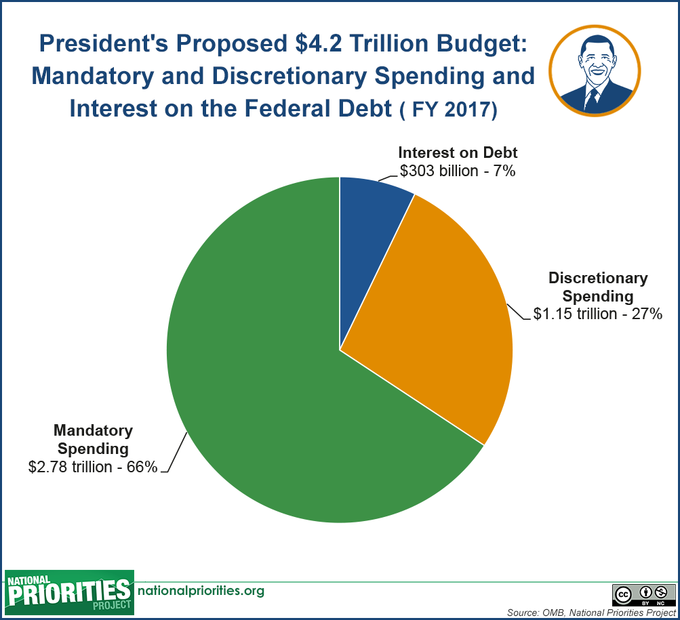
As you’ve probably heard, Donald Trump’s proposed military budget will boost US military spending by $54 billion. With a budget of $610 billion, the US military is already more expensive than the next seven countries combined. If you don’t count those countries, we spend more on our military than the rest of the world combined. The unneeded boost would make the US military industrial complex even larger, and Trump also plans to kill the National Endowment for the Arts and other cultural and humanities-related government groups. For comparison, the NEA has a budget of $148 million, only 0.012% of federal discretionary spending.
But on top of the exorbitant cost of the proposed military budget, there is a ton of waste baked into these hundreds of billions. The Pentagon’s own estimates state that a bureaucratic realignment alone could save $125 billion over five years. Here are some other incredible, ridiculous, and tragic ways that the military wastes taxpayer dollars.
Wishlists
Nowhere in the federal budget process is our absurd deference to the military more evident than with the wishlists built into the federal defense budgeting system.The Defense Department weighs its priorities when budgeting, but then the various branches can add additional "wishlist items" to the budget. If allocated, the wish list money comes directly out of the Treasury. So, even after the DoD has provided their already generous spending models, the actual defense budget can still balloon more as lobbyists go to the individual branches directly.
The F-35
One example of a wishlist purchase was 2016's earmark for $1.33 billion in spendingon eleven F-35 aircrafts. These weapons are known for their budget overruns and chronic system problems. The F-35 is the definition of throwing good money after bad. By 2013, the US had already spent $400 billion on a the plane that couldn't fly at night or in bad weather. Today, the all-in cost of the F-35 project is estimated to be in the trillions of dollars.
Bonus Submarines
Last year's budget also included a $90 billion dollar submarine spending fund that doesn't count against the naval budget. This fund was created because the cost of these new submarines is so massive that it would disrupt the resources allocated tobuild pretty much any other ships if it were in the actual defense budget. The so-called "National Sea-Based Deterrence Fund" comes directly from the Treasury. Some defense experts are even against these special funds, as they complicate that goalsof the actual defense budget. For example, the fund allows for the purchase of more materials to build submarines before the Defense Department has actually approved building them. As one budget watchdog put it, “Shipbuilders, and their friends in Congress, want to reduce the likelihood that any future President, Navy leader or Congress can cut the purchase of the next generation of ballistic missile submarines.”
Wasteful Bases
It is incredibly difficult to convince Congress to close a military base, no matter how unnecessary it may be. The bases are an incredibly visible piece of the local economy, and politicians eyeing reelection know this. Towards the end of Obama's presidency, he asked for a review of bases that could save $2 billion a year. Congress wouldn’t even allow for a review to be conducted. The problem has gotten so bad that the US military has threatened to act if Congress won't. The Pentagon estimates that 22 percent of US military installations are unnecessary for today's forces. If Congress refuses to launch a new BRAC (Base Realignment and Closure) Commission, the military may do it themselves.
The Littoral Combat Ship
Recently, the US shifted the bulk of its fleet to the Pacific Ocean. The Littoral Combat Ship was supposed to play a key role in this shift. The $30 billion program has been one headache after another. Computer failures, generator meltdowns, and even structural cracks are just a few of the program’s many failures. Even if these persistent problems could be solved, naval officers don't think LCS ships will do well in combat. So far, they have been proven right. Of the six active LCS ships, four suffered major breakdowns last year; at least one of these breakdowns occurred on the ship’s maiden voyage. The failure of LCS is so massive that the Navy has ordered a complete overhaul of the program, including retraining engineers involved. Of course, this will require investing even more money in the program. Even when the military admits they were wrong, they are rewarded with more funding.
Guantanamo Bay
The albatross that hung around Obama's neck throughout his time in office continues to plague the defense budget even after he's gone. The cost of keeping Guantanamo Bay open when Obama left office was $454 million a year: $11 million per inmate. Trump has promised to expand Guantanamo, though the base remains a blight on America's reputation abroad and a heinously ineffective expense. This expansion comes despite the ACLU’s analysis that Gitmo has generated over $5 billion in waste.
When this endless election cycle is finally over, and Congress is back in Washington to do the nation’s work, one of the many pressing issues will be passage of a bill to fund the Pentagon for Fiscal Year 2017.
Note that we are saying this is only one of the many issues Congress should be addressing. There are ten other spending bills to be enacted (the twelfth, Military Construction-Veterans Affairs, was passed as part of the Continuing Resolution currently funding government through December 9th). But if there’s one thing we can be certain of, it is that the Congress will make sure the Pentagon gets its money as either a stand-alone spending bill or it will have a full set of new spending figures in some larger piece of “omnibus” legislation.
Betting that this is correct, recently seventy lawmakers sent a letter to the Chair and Ranking Member of the House Appropriations panel who are tasked with negotiating on the FY17 Defense Appropriations bill. They asked them to press for an increase in the number of F-35s purchased in FY17 from the 63 aircraft requested by the Pentagon to 74 aircraft. The eleven additional aircraft would be spread across all three services: five for the Air Force, four for the Navy, and two for the Marines.
It doesn’t surprise us and it shouldn’t surprise you to learn that the lawmakers who signed this letter are mostly members of the “Joint Strike Fighter Caucus” or otherwise represent interests with a major financial stake in the F-35. Or both, since they’re really one and the same. The ringleaders of the effort were Rep. Kay Granger (R-TX) and Rep. John Larson (D-CT). What’s in their districts? Well, the F-35 is being constructed in Granger’s Ft. Worth district and the engines come from Pratt & Whitney in Connecticut.
The House Appropriations Committee version of the Pentagon spending bill included these eleven additional aircraft but the Senate version of the same bill added “only” four more F-35s than the Pentagon requested. So these House Members want the House to demand these eleven additional aircraft when the House and Senate members meet to hammer out differences between the two versions of the bill. Again, we aren’t surprised by this.
But one sentence in the letter jumps out at us. “Increasing the production rate is the single most important factor in reducing future aircraft unit costs.” This is just flat wrong. Increasing overall production numbers can reduce unit cost. But how fast you buy the planes has nothing to do with how much each one costs. Buying more airplanes next year benefits Lockheed Martin, Pratt & Whitney, and the other contractors who work together to produce the F-35. It benefits them, and their shareholders, in the short term. But you can bet that they will also press for more planes to eventually be purchased by all three services. The program is currently planning to purchase a little more than 2400 airframes.
At TCS we have a long history of questioning the staggering cost of the F-35 program. The last thing we think is a smart use of your taxpayer dollars would be to buy more than the current estimate. But you can bet the farm that, if production rates are ramped up earlier than the current Pentagon plan, the contractors will want to sell more airframes when they reach that 2400+ number years earlier than the current plan.
We thought 63 F-35s was too many in the President’s Budget Request, but an increase to 74 airframes is really a bridge too far. We hope the House and Senate conferees inject some fiscal common sense and reject this increase to the F-35 production program.
Quote of the Week:
“The main business of the lame-duck session will be an omnibus spending bill that will fund every branch of the government. Although it will be over 1,000 pages long, congressmen will have only hours to read this budget-busting legislation[…] This is no way to run things. Instead, the House and Senate should follow what is known as “regular order” […and] pass the 12 separate appropriations bills that together fund the government, and send them to the president for a signature.”
• Rep. Thomas Massie (R-KY) on the upcoming lame-duck Congressional session.





 his is a story primarily about corrupt practices by the Burlington City Council, in its headlong determination to force a neighboring city to be the base for a weapon of mass destruction, the nuclear capable