Search This Blog

Translate

Blog Archive

Middleboro Review 2

NEW CONTENT MOVED TO MIDDLEBORO REVIEW 2

Toyota

Since the Dilly, Dally, Delay & Stall Law Firms are adding their billable hours, the Toyota U.S.A. and Route 44 Toyota posts have been separated here:

Route 44 Toyota Sold Me A Lemon


Showing posts with label Jonathan Chait. Show all posts

Thursday, October 3, 2019

FOCUS | Pence: I Participated in the Ukraine Plot but Only as a Patsy


Reader Supported News
03 October 19
It's Live on the HomePage Now:
Reader Supported News

FOCUS | Pence: I Participated in the Ukraine Plot but Only as a Patsy
Vice President Mike Pence. (photo: Peter Summers/Getty)
Jonathan Chait, New York Magazine
Chait writes: "Vice-President Mike Pence is knee-deep in the Ukraine scandal. He is floating the absurd defense that, while he did participate in Trump's plan to extort Ukraine into investigating Joe Biden, he was completely ignorant of what he was doing."


EXCERPT:

Although President Trump “used Pence to tell [Ukrainian president Volodymyr] Zelensky that U.S. aid was still being withheld,” the  Washington Post reports, Pence’s aides insist he had no idea what he was actually being used for. “Officials close to Pence insist that he was unaware of Trump’s efforts to press Zelensky for damaging information about Biden and his son,” the Post notes. Pence, by their accounting, is like a man who delivers a ransom note to a bank teller, failing to place any significance in the fact that the tellers have their hands in the air, the bank patrons are lying on the floor, and the guy who asked him to bring the note to the bank had a mask and a gun.


Pence’s involvement in the plot was extensive. White House officials had him cancel a planned trip to Zelensky’s inauguration. One of Pence’s top advisers was on the July 25 call when Trump made clear his demand that Zelensky open investigations into various Democratic officials, including Biden, whom Trump named on the call. Pence was given the transcript of the call before his September 1 meeting with Zelensky, when he reiterated Trump’s threat.
Pence’s defense is that, even though the readout of Trump’s call with Zelensky was in his briefing materials on his trip to Europe, he did not bother to read it before the meeting. “Officials close to Pence contend that he traveled to Warsaw for a meeting with Zelensky on Sept. 1 probably without having read — or at least fully registered — the transcript,” the Post records.
So Pence didn’t read or understand the vital background information he needed before this important national-security meeting. He didn’t hear the widespread alarm rippling through the administration that Trump was acting improperly. He somehow failed to pick up on Rudy Giuliani’s repeated public boasts — in the New York Times, on Fox News, on Twitter, and in any media he could find — that he was pressuring Ukraine to investigate the Bidens in his personal capacity as Trump’s lawyer. He somehow accepted at face value Trump’s claim of being deeply concerned with corruption in Ukraine despite Trump’s record of greeting corruption in almost every other country he deals with with something ranging from indifference to enthusiasm.
Most amazing, Pence’s defense is that when he delivered Trump’s threat in the meeting with Zelensky, Pence had no idea that “corruption” was code for ordering up investigations of Trump’s domestic enemies. “A top Pence staffer rejected the charge that the vice-president was conveying an inappropriate — or coded — message from the president,” notes an obviously skeptical Post.
If Pence is so ignorant that he could be pulled into an extortion plot without having any idea what he was doing, while missing numerous public and private signs that would have spelled it out, he is too dumb to serve as vice-president or even to be allowed to use metal cutlery. There is no way Pence is quite that stupid.
The Post does not mention that Pence cracked the code himself the day after his meeting with Zelensky. A reporter asked Pence:
Specifically, number one, did you discuss Joe Biden at all during that meeting yesterday with the Ukrainian president? And number two, can you assure Ukraine that the holdup of that money has absolutely nothing to do with efforts, including by Rudy Giuliani, to try to dig up dirt on the Biden family?
Pence replied:
The United States has stood strong with Ukraine, and we will continue to stand strong with Ukraine for its sovereignty and territorial integrity. But as President Trump had me make clear, we have great concerns about issues of corruption …

I mean, to invest additional taxpayer in Ukraine, the president wants to be assured that those resources are truly making their way to the kind of investments that will contribute to security and stability in Ukraine. And that’s an expectation the American people have and the president has expressed very clearly.
To sum up, Pence was asked whether the aid was being held up over the Biden probes, and he answered by reciting the “corruption” party line. Pence knew exactly what he was doing.






Thursday, May 23, 2019

Why Jon Chait Can’t Read


FAIR

Why Jon Chait Can’t Read

view post on FAIR.org

by Jim Naureckas
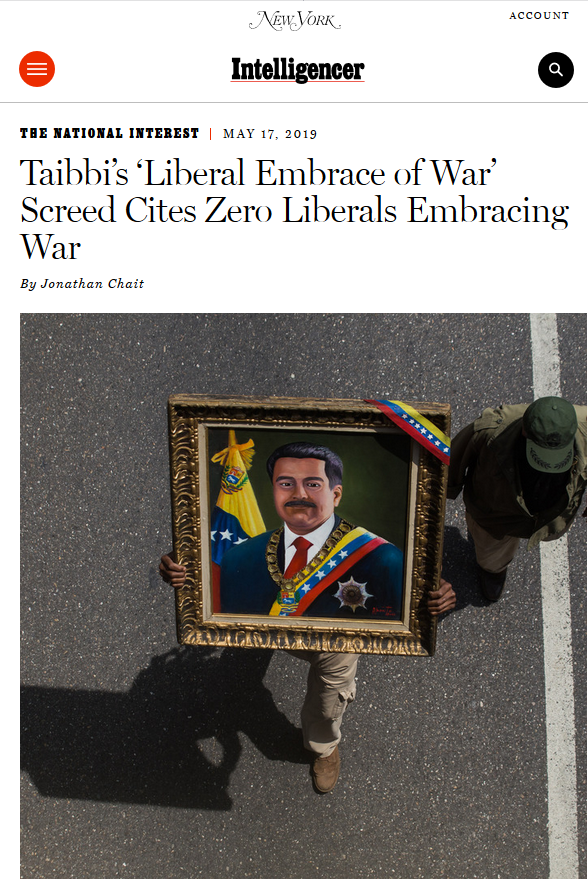
New York: Taibbi’s ‘Liberal Embrace of War’ Screed Cites Zero Liberals Embracing War
Just as an aside, Jonathan Chait’s critique (New York, 5/17/19) of Matt Taibbi is directed almost entirely at the headline of Taibbi’s piece (Rolling Stone, 5/16/19), which as I’m sure Chait is well aware was most likely not written by Taibbi.
New York’s Jonathan Chait (5/17/19) wrote a column attacking Matt Taibbi’s Rolling Stone piece (5/16/19), “The Liberal Embrace of War.” “I have read Taibbi’s story carefully,” Chait assures us—which is good to hear, because based on his treatment of a FAIR study that he discusses as one of Taibbi’s sources, I wouldn’t think he was a very careful reader at all.
Here’s how Chait describes the study—which you can read for yourself on FAIR.org (4/30/19):
The method of the FAIR study is to analyze a selection of commentary on the subject of Venezuela. Every piece that describes Maduro as a strongman or authoritarian is categorized as endorsing “regime change.”
Actually, as study author Teddy Ostrow said, we categorized commentary as endorsing regime change if it “expressed explicit support for the Maduro administration’s ouster.” Seventy-two percent of commentary fell into that category. Contrariwise, we would have categorized commentary as opposing regime change if it explicitly opposed Maduro’s removal—but we didn’t find any commentary that did that.
Chait calls this an “absurdly lax standard”—counting pundits as being pro–regime change if they endorse regime change. He seems especially dismayed that “FAIR’s ‘pro–regime change’ bin” included a piece by Rep. Ro Khanna (Washington Post, 1/30/19), which he claims is there because
it contains a “to be sure” sentence criticizing the regime—“To be sure, Maduro is an authoritarian leader who has presided over unfair elections, failed economic policies, extrajudicial killings by police, food shortages and cronyism with military leaders.”
That passage—which was not quoted by FAIR—was not why we categorized Khanna’s piece as pro–regime change. The passage we did quote was:
The United States should lend its support to diplomatic efforts to find some form of power-sharing agreement between opposition parties, and only until fair elections can take place, so that there is an orderly transition of power.
So we categorized him as pro–regime change, because he wrote that he supports “an orderly transition of power”—in other words, regime change.
Chait is critiquing an imaginary study by FAIR that judged media on whether they “describe[d] Maduro as a strongman or authoritarian.” His problem with this imaginary study “is that Maduro is considered an authoritarian by the entire human rights community.” In other words, FAIR (and Taibbi) are complaining that commentary is one-sided—but commentary should be one-sided. Why would anyone disagree with “the entire human rights community”?
In reality, of course, there is more to the human rights community than Chait imagines. There’s a statement, for example, signed by 70 Latin American scholars and humanitarian activists condemning “US support for an opposition strategy aimed at removing the government of Nicolás Maduro through extra-electoral means”—signed by leaders of such groups as the Alliance for Global Justice, the Center for International Policy, Code Pink , the Center for Economic and Policy Research, the Institute for Policy Studies, the Tricontinental Institute for Social Research and Toward Freedom .
Would Chait disagree with these human rights advocates’ take on Venezuela? Probably—if he had ever seen it. But because he shares the approach of elite media decision-makers—if I disagree with it, there’s no need for it to be heard—he’s very likely unaware of the arguments they make, and certainly has had no real need to ever engage with those arguments.
That’s why, when he is moved to “carefully” respond to a fellow journalist’s critique of their mutual profession, the best he can offer is a caricature of that colleague’s sources. Jonathan Chait doesn’t know how to read critically because agreeing with everyone who matters means you never have to.

You can send a message to  New York  at comments@nymag.com (Twitter:@NYMag). Please remember that respectful communication is the most effective.
Featured image: Photo illustrating from Venezuela illustrating Matt Taibbi’s Rolling Stone piece (5/16/19).


FAIR/Fairness & Accuracy In Reporting
124 W. 30th Street, Suite 201
New York NY 10001
USA


Sunday, July 2, 2017

PAY ATTENTION FOLKS! RSN: Jonathan Chait | Now We Have a Road Map to the Trump Campaign's Collusion With Russia


Reader Supported News
02 July 17
It's Live on the HomePage Now:
Reader Supported News

FOCUS: Jonathan Chait | Now We Have a Road Map to the Trump Campaign's Collusion With Russia 
Donald Trump. (photo: Dominick Reuter/AFP/Getty Images)
Jonathan Chait, New York Magazine
Chait writes: "Most of the commentary surrounding the Russia scandal has treated the possibility that Donald Trump's campaign deliberately colluded with Moscow as remote, unfounded speculation. The new reporting that has broken this weekend suggests instead that this collusion likely did take place."
READ MORE


ost of the commentary surrounding the Russia scandal has treated the possibility that Donald Trump’s campaign deliberately colluded with Moscow as remote, unfounded speculation. The new reporting that has broken this weekend suggests instead that this collusion likely did take place. It provides a road map to the, or perhaps a, likely avenue through which this occurred.

The figure carrying out the operation in question was Peter W. Smith, who died at the age of 81 earlier this year. Smith is hardly a lone kook. He’s an established Republican donor with a demonstrated history in financing ethically murky investigations, such as paying Arkansas state troopers for stories of Bill Clinton’s sexual dalliances.
Smith surfaced earlier in the week in an explosive Wall Street Journal report by Shane Harris, which Harris followed up on Friday night. What really underscores the significance of Harris’s reporting, though, is adetailed account, also published Friday night, by Matt Tait, a British cybersecurity expert who dealt extensively with Smith. Tait’s report makes it clear that Smith had access to Michael Flynn, at the very least, and was working not only to obtain stolen Clinton emails but also to hide the Trump campaign’s involvement.
Tait had established some expertise analyzing Clinton’s emails; Smith, who said he had been contacted by someone who possessed a cache of emails from Clinton’s private server, wanted help validating them. As Tait explains, he warned Smith that Russia had been conducting an attack on the U.S. elections, but Smith appeared completely unconcerned about it. Smith tried to hire Tait for his project and showed him a document creating an independent-looking organization to try to acquire the stolen emails. The document, Tait reports, “detailed a company Smith and his colleagues had set up as a vehicle to conduct the research: ‘KLS Research’, set up as a Delaware LLC ‘to avoid campaign reporting,’ and listing four groups who were involved in one way or another.” This certainly appears like an attempt to mask the Trump campaign’s involvement in the plot.
The document listed a series of high-level Trump campaign officials: Steve Bannon, Kellyanne Conway, Sam Clovis, Lt. Gen. Flynn, and Lisa Nelson. Bannon and Conway, contacted by the Journal, deny any involvement with Smith. But Smith’s comments to Tait indicate a fairly close understanding of Trump campaign internal dynamics. It is possible he was bluffing, but Smith seemed to be displaying authentic insider credentials.
The key to understanding the significance of this report is to put it together with a sentence from Harris’s first story on this in the Journal, which reports that U.S. investigators “have examined reports from intelligence agencies that describe Russian hackers discussing how to obtain emails from Mrs. Clinton’s server and then transmit them to Mr. Flynn via an intermediary.”
So, according to Harris’s reporting, Russians were trying to transmit emails from Clinton’s server. Tait is describing in detail a Republican operative trying to obtain stolen emails from Russia. So we have evidence both of the campaign’s request and Russian efforts to fulfill the request.
Smith is deceased (at an old age, there is no grounds for suspicion about the cause of his death), but Michael Flynn, a figure he reportedly worked for, is very much with us and facing significant legal jeopardy. Flynn’s lawyer has said he has “a story to tell.” This might be part of the story.

Monday, June 20, 2016

RSN: Ralph Nader Still Refuses to Admit He Elected Bush


Reader Supported News
20 June 16

We are far behind where we should be at this stage of the June funding drive.
Most of you have not donated recently. We need your help now.
Quite important.
Marc Ash
Curator, Reader Supported News

If you would prefer to send a check:
Reader Supported News
PO Box 2043
Citrus Hts
CA 95611


It's Live on the HomePage Now: 
Reader Supported News

FOCUS: Jonathan Chait | Ralph Nader Still Refuses to Admit He Elected Bush 
Ralph Nader. (photo: Joyce Naltchayan/AFP/Getty Images) 
Jonathan Chait, New York Magazine 
Chait writes: "Sixteen years have passed since Ralph Nader's third-party candidacy diverted enough left-wing votes to make George W. Bush president. That is enough time for Nader to confess his role in enabling one of the most disastrous presidencies in American history. Instead, Nader has repeated his same litany of evasions." 
READ MORE


Friday, November 13, 2015

RSN: Fighting Terrorism Was the Biggest Weakness of the Bush Administration


It's Live on the HomePage Now:
Reader Supported News

FOCUS: Jonathan Chait | Fighting Terrorism Was the Biggest Weakness of the Bush Administration
President Bush was bad at a lot of the parts of being president, but none worse than fighting terrorism. (photo: Chip Somodevilla/Getty)
Jonathan Chait, New York Magazine
Chait writes: "The impression that Bush was successful, or even especially well-focused, on protecting Americans from terrorism is an inversion of reality, and the fact that it is still asserted with a straight face is the residue of one of the most successful propaganda campaigns in American history."
READ MORE


hen Donald Trump impugned the honor of his brother earlier this year, Jeb Bush proudly fell back on the achievement of the Dubya administration that has endured in public memory, despite his other failures: “He kept us safe.” Even in 2008, at the nadir of Bush’s presidency, Americans still gave him a fair measure of credit in this area. But the impression that Bush was successful, or even especially well-focused, on protecting Americans from terrorism is an inversion of reality, and the fact that it can still be asserted with a straight face is the residue of one of the most successful propaganda campaigns in American history.
Chris Whipple’s revelations about the CIA’s urgent, ignored pleas to focus on the threat from Al Qaeda before 9/11 flesh out an increasingly consistent portrait drawn by Kurt Eichenwald and other reporters. A broad and consistent body of evidence had persuaded intelligence officials that Al Qaeda was poised to carry out a devastating attack against the United States. It was not just the famous August memo, “Bin Laden determined to strike in U.S.” — the one Bush dismissed at the time as ass-covering — but a much longer and more desperate campaign to wake up Bush’s inner circle. Whipple reports, “Months earlier, starting in the spring of 2001, the CIA repeatedly and urgently began to warn the White House that an attack was coming.”
But the Bush White House was dominated by neoconservatives, who were ideologically fixated on the threat posed by states and dismissed the threat of non-state actors. The administration’s defenders tend to gloss over the wee problem of Bush’s abject failure before the attack by treating it as a passing transitional problem, a matter of getting one’s feet wet, often speaking of the Bush presidency as if did not really begin until September 12. This willfully erases the administration’s gross negligence before the attacks.
It also ignores the reality that Bush and his closest advisers clung to their state-focused neoconservative dogma even after the attacks. That is why the administration began planning to invade Iraq immediately — not because they had some sinister conspiracy to distract the public into going along with their scheme, but because their misguided ideology left them unable to comprehend the power of a threat that did not emanate from a state. As Charles Krauthammer, a leading Republican intellectual, wrote in a column weeks after the attacks:
Yes, we need to get Osama bin Laden. Yes, we need to bring down the terrorist networks. But the overriding aim of the war on terrorism is changing regimes. And it starts with the Taliban. Searching Afghan caves for bin Laden is precisely the trap he would wish us to fall into. Terrorists cannot operate without the succor and protection of governments. The planet is divided into countries. Unless terrorists want to camp in Antarctica, they must live in sovereign states.
Krauthammer was expressing the convictions that blinded the Bush administration to the threat of a band of terrorists unmoored from a government. That same blindness caused the Bush administration to woefully mismanage its response. Having surrounded Osama bin Laden and some 2,000 of his most committed fighters in Tora Bora, the Bush administration left the task of killing them to weak Afghan pseudo-allies. The administration was already shifting its military resources and attention to Iraq. After all, the Afghan government had already fallen. Why bother, as Krauthammer scoffed, searching a bunch of caves? There was a government to topple in Iraq.
Of course everything about the Iraq war served to further weaken the American position against terrorism. The invasion, with its chaotic and almost completely unplanned occupation, left an anarchic void that has given rise to a newer and even more virulent Sunni terrorist movement in Iraq’s north, the threat of which has rippled out. The invasion, and revelations of American torture, helped radicalize Muslims against the United States while alienating potential allies.
In retrospect, Bush’s ability to portray himself to America as a committed and triumphant vanquisher of terrorism rested almost entirely on emotional manipulation. Bush standing on the rubble at Ground Zero; Bush throwing a strike at Yankee Stadium before a cheering crowd; Bush landing on an aircraft carrier — it was all brilliant political theater. And it supported a conclusion 180 degrees from reality. Of the manifold failures the Bush administration wrought, its handling of the terrorist threat should rank as the worst.


http://readersupportednews.org/opinion2/277-75/33468-focus-fighting-terrorism-was-the-biggest-weakness-of-the-bush-administration


Monday, September 14, 2015

RSN: Sunny Climate Nonsense


It's Live on the HomePage Now: 
Reader Supported News

FOCUS: Tim DeChristopher | Sunny Climate Nonsense 
Tim DeChristopher. (photo: Peaceful Uprising) 
Tim DeChristopher, Tim DeChristopher's Website 
DeChristopher writes: "Somehow, Jonathan Chait's New York Magazine article entitled 'The Sunniest Climate Change Story You've Ever Read' left me feeling pretty dark. I knew why I was angry at Chait's blatantly ahistorical article that attempted to erase the climate movement from the struggle against climate change." 
READ MORE


Monday, February 9, 2015

RSN: Paul Ryan Visited a Bookstore Once, So I Guess I Misjudged Him


It's Live on the HomePage Now:
Reader Supported News


PROPAGANDA BROADCASTING IS NOT THE FOURTH ESTATE: The fourth estate as envisioned by the framers was a powerful entity - on equal footing with the primary functions of government. The "watchdog" empowered with first amendment protections. But what happens when third party interests become the financial master of the media? The fourth estate becomes the resistance. Support the resistance. / Marc Ash, Founder Reader Supported News


FOCUS: Jonathan Chait | Paul Ryan Visited a Bookstore Once, So I Guess I Misjudged Him
Paul Ryan. (photo: Chip Somodevilla/Getty Images)
Jonathan Chait, New York Magazine
Chait writes: "Paul Ryan recently attacked the Obama administration's economic policies for, supposedly, exacerbating income inequality."
READ MORE


Thursday, January 29, 2015

RSN: The Petulant Entitlement Syndrome of Journalists


It's Live on the HomePage Now:
Reader Supported News


FOCUS: Glenn Greenwald | The Petulant Entitlement Syndrome of Journalists
Glenn Greenwald. (photo: AP)
Glenn Greenwald, The Intercept
Greenwald writes: "As intended, Jonathan Chait's denunciation of the 'PC language police' - a trite note of self-victimization he's been sounding for decades - provoked intense reaction: much criticism from liberals and praise from conservatives (with plenty of exceptions both ways)."
READ MORE

Jonathan Chait | Not a Very PC Thing to Say
Jonathan Chait, New York Magazine
Chait writes: "After political correctness burst onto the academic scene in the late '80s and early '90s, it went into a long remission. Now it has returned. Some of its expressions have a familiar tint, like the protesting of even mildly controversial speakers on college campuses."
READ MORE