Search This Blog

Translate

Blog Archive

Middleboro Review 2

NEW CONTENT MOVED TO MIDDLEBORO REVIEW 2

Toyota

Since the Dilly, Dally, Delay & Stall Law Firms are adding their billable hours, the Toyota U.S.A. and Route 44 Toyota posts have been separated here:

Route 44 Toyota Sold Me A Lemon


Showing posts with label Sen. Claire McCaskill [D-MO]. Show all posts

Sunday, November 30, 2014

What will the Auto Industry tolerate?


At the bottom of the article below is a list of reasonable proposals that would strengthen NHTSA and work to protect consumers from the egregious conduct witnessed recently, whether it's TOYOTA'S FAILURE TO CORRECT SUDDEN UNINTENDED ACCELERATION, GM's ignition switch failures, TAKATA EXPLODING AIRBAGS.

Will the Do-Nothing Congress pass anything sensible?

Will the Auto Industry tolerate reasonable oversight?


Is NHTSA nominee up to the task?

Rosekind first must prove himself to Congress


Mark Rosekind faces a confirmation hearing with lawmakers who have demanded reforms.


By Ryan Beene

Automotive NewsNovember 30, 2014 - 12:01 am ET

WASHINGTON -- As an expert on human fatigue, Mark Rosekind is well-suited to steer the National Highway Traffic Safety Administration toward the era of autonomous driving and connected-car technologies.

But in the near term, Rosekind will have to prove to members of Congress that he is up to the task of revitalizing an agency beset by lapses exposed in the General Motors ignition switch and Takata airbag scandals.

Rosekind will need to address "how to restore the public's trust in America's auto safety watchdog ... the need to implement the cultural change that's needed at the agency" and how it can keep up with the fast-changing auto industry, said Sen. Claire McCaskill, D-Mo., who heads the Senate Commerce Committee's consumer-protection panel.

Rosekind, who was appointed last month to head NHTSA, faces a Senate confirmation process that begins Wednesday and will put him face to face with several lawmakers who have been harshly critical of the agency and demanded reform. NHTSA has been without a Senate-confirmed administrator since January, when David Strickland stepped down and left his deputy, David Friedman, to serve as NHTSA's public face.


McCaskill: How to restore trust


The senators who will pass judgment on Rosekind have proposed several bills that would boost NHTSA's funding and enforcement powers, and they are likely to demand a commensurate level of responsiveness and accountability on the part of the regulator.

A lack of agency resources has been a recurring theme of congressional hearings into the GM and Takata recalls. NHTSA allocates just $10 million a year to its roughly 50 staffers who investigate defects in automobiles, buses, commercial vehicles, heavy-duty trucks and child car seats. By comparison, GM alone hired 35 safety investigators this year to beef up its defect investigation department, on top of the staff it already had, CEO Mary Barra told a U.S. House committee in June.

"NHTSA and Dr. Rosekind will face serious challenges and must do a better job discerning danger in cases like those involving GM ignition switches and Takata airbags, which imperiled drivers long after NHTSA had reason to act," Sen. Richard Blumenthal, D-Conn., said in a statement. "At NHTSA, regulatory capture has created a failure to ask tough questions and has needlessly put lives at risk," he added, referring to the close relationship between the agency and the industry it regulates.
Since 2010, Rosekind has been a member of the National Transportation Safety Board, which investigates major transportation accidents. He was a NASA official in the 1990s, where he led a program to evaluate and prevent the effects of pilot fatigue, and he founded a fatigue-management firm after leaving the agency.

At NHTSA, Rosekind must overcome his limited experience with the auto industry and with running a large organization.

"Given the GM ignition switch and now Takata, I would have expected someone with more of a hands-on experience in vehicle safety," Clarence Ditlow, executive director of the Center for Auto Safety, told Reuters.

But some of NHTSA's outspoken critics were pleased with Rose-kind's nomination. Joan Claybrook, NHTSA's administrator under President Jimmy Carter, called Rosekind "an excellent choice."

"He understands regulation and law enforcement, both of which are critical as the leader of NHTSA," she said. "And he recognizes that regulators are not necessarily popular no matter what they do."
On the docket
 
Lawmakers have introduced several bills this year to improve compliance with and enforcement of federal auto safety laws.
• Motor Vehicle Safety Act of 2014*
Sponsor: Rep. Henry Waxman, D-Calif.
Requires more automaker disclosures about fatal accidents and greater public access to safety reports, increases NHTSA funding for vehicle safety programs, boosts maximum agency fine to $200 million
• Early Warning Reporting System Improvement Act
Sponsor: Sen. Edward Markey, D-Mass.
Requires more automaker disclosures about fatal accidents and greater public access to safety reports, requires NHTSA to upgrade its online databases and provide public notice of all defect investigations
• Motor Vehicle and Highway Safety Enhancement Act
Sponsor: Sen. Claire McCaskill, D-Mo.
Doubles funding for NHTSA's vehicle safety operations over 6 years, raises or eliminates caps on NHTSA fines for violations, gives federal prosecutors more freedom to pursue criminal charges against safety-law violators
• Whistleblower bill
Sponsor: Sen. John Thune, R-S.D.
Provides cash incentives to encourage industry employees to alert officials about faulty products
• Hide No Harm Act
Sponsor: Sen. Richard Blumenthal, D-Conn.
Makes it a crime, punishable by fines and prison time, for an executive to knowingly conceal corporate actions that pose risk of death or serious injury

*Sen. Jay Rockefeller, D-W.Va., introduced a similar bill in the Senate.


Sunday, November 9, 2014

Another GET OUT OF JAIL FREE CARD!


Betsy Benjaminson has written extensively about the CORRUPTION and WIDESPREAD BRIBERY in the AUTO INDUSTRY [in the US, we call it CAMPAIGN CONTRIBUTIONS - they got their money's worth and consumers lost! ]:


Senator Blumenthal: Secret settlements play important role in allowing lethal defects to "fester"


ADDITIONAL POSTS HERE:

Beware of Toyota. Their next victim may be YOU...

Toyota Owners Unite for Resolution Online

Senators seek criminal probe of air bag maker


  • Three senators are calling on the Justice Department to open a criminal investigation of the air bag maker Takata after former employees reported that the Japanese supplier had carried out tests on air bags over a decade ago and found signs of defects, yet did not seek the involvement of federal safety regulators.


  • By Hiroko Tabuchi
    The New York Times
    Posted Nov. 8, 2014 @ 7:41 am


    Three senators are calling on the Justice Department to open a criminal investigation of the air bag maker Takata after former employees reported that the Japanese supplier had carried out tests on air bags over a decade ago and found signs of defects, yet did not seek the involvement of federal safety regulators.

    “These allegations are credible and shocking — plainly warranting a prompt and aggressive criminal probe,” Sens. Richard Blumenthal of Connecticut and Edward J. Markey of Massachusetts, both Democrats, said in a statement, responding to an article in The New York Times on Friday that reported on the employees’ disclosure.

    Four deaths and more than 30 injuries have been linked to the defect, including the death last month of Hien Tran, 51. Law enforcement officers in Florida said she died after her air bag erupted violently in her 2001 Honda Accord.


    Sen. Claire McCaskill, D-Mo., chairwoman of the Senate Committee on Commerce, Science and Transportation, also called for a criminal inquiry. She said in a statement that if the accusations were true, Takata needed “to be held fully accountable, not just with financial penalties, but also with criminal charges.”

    The accusations involve air bags that can rupture when they deploy in an accident, sending shrapnel into the car’s cabin and injuring the driver or passengers, instead of protecting them. Eleven automakers have recalled more than 14 million cars worldwide over the defect, including 11 million cars in the United States.

    The former Takata employees say they took part in the testing of air bags retrieved from scrapyards in 2004, after an air bag ruptured in a Honda Accord that year, injuring the car’s driver. Of the air bags retrieved, two of the air bag inflaters cracked during the tests, a condition that can lead to rupture.

    But instead of alerting federal safety regulators to the possible danger, Takata executives discounted the results and ordered the lab technicians to delete the testing data from their computers and dispose of the air bag inflaters, they said.

    Rep. Fred Upton, R-Mich., chairman of the House Energy and Commerce Committee, said the latest allegations warranted a closer investigation into what Takata, and the automakers that it supplies, knew and when.

    “As the recalls continue and the faulty air bags are replaced, we also need answers about when the danger was discovered and whether it was concealed from regulators, or not adequately understood once the regulators became aware,” Upton said.

    Capitol Hill has also increased pressure on the National Highway Traffic Safety Administration to order automakers to expand recent air bag recalls, some of which have been limited to regions with high humidity because Takata says moisture could play a role in the defect. But in the face of continued uncertainty over the cause of the ruptures, lawmakers and auto safety advocates have called for nationwide recalls.


    http://www.capecodtimes.com/article/20141108/BIZ/141109649/101017/BIZ


    Thursday, August 28, 2014

    RSN: Earthquake Risk Makes California's Diablo Canyon a Fukushima in Waiting, This One May Be Worse, (than Michael Brown)


    It's Live on the HomePage Now:
    Reader Supported News


    Charles Pierce | This One May Be Worse, (than Michael Brown)
    The family of Victor White III. (photo: NBC News/William Widmer)
    Charles Pierce, Esquire
    Pierce writes: "The shooting death of Michael Brown was more than worth every word and every pixel expended on its coverage. However, for sheer brass-balls police bullshit, what's going on down in New Iberia may be even worse than what happened in Ferguson."
    READ MORE

    IMF Chief to Be Investigated for Alleged Role in Political Fraud Case
    Anne Penketh, Guardian UK
    Penketh writes: "The head of the International Monetary Fund, Christine Lagarde, has been charged with 'simple negligence' over her handling of a controversial €400m payout to French business tycoon Bernard Tapie when she was finance minister."
    READ MORE

    McConnell Promises Billionaire Donors He Won't Waste Time On 'Gosh Darn' Minimum Wage Increases
    Josh Israel, ThinkProgress
    Israel writes: "At a Koch Brothers-hosted secret strategy conference of right-wing millionaire and billionaire political activists in June, Senate Minority Leader Mitch McConnell (R-KY) promised that if his party wins control of the United States Senate this November, the Senate will not waste time on things like increasing the minimum wage for people making only about $15,000 annually."
    READ MORE

    ATM Helps Indian Women Quietly Report Rape Without Going to the Police
    Tara Culp-Ressler, ThinkProgress
    Culp-Ressler writes: "In December, a 16-year-old girl in Calcutta was burned alive. Authorities believe she was targeted as punishment for reporting her gang-rape to the police. Two months earlier, on her way home from the police station after notifying cops about the six men who raped her, she was accosted and raped again. The next time the men came for her, they killed her."
    READ MORE

    The Dangers of Deputizing Google to Bust Child Pornographers
    Jack Shafer, Reuters
    Shafer writes: "'Don't be evil' - the first sentence of Google's 'Code of Conduct' - has served as the technology company's corporate motto since its earliest days. But given Google's role in the arrest late last month of a Houston man on child pornography charges, perhaps we've been misreading it. Perhaps the motto is aimed at its customers, as in, 'Don't you be evil or we'll have you busted.'"
    READ MORE

    Missouri US Senator Wants to Tie Federal Funding of Police Departments to Body Cams
    Jonathan Shorman, USA Today
    Shorman writes: "No police department should get federal funds unless they put cameras on officers, Sen. Claire McCaskill says."
    READ MORE

    Karl Grossman | Earthquake Risk Makes California's Diablo Canyon a Fukushima in Waiting
    Karl Grossman, The Ecologist
    Grossman writes: "As aftershocks of the 6.0 Napa earthquake that occurred Sunday in California continued, the Associated Press revealed a secret government report pointing to major earthquake vulnerabilities at the Diablo Canyon nuclear plants which are a little more than 200 miles away and sitting amid a webwork of earthquake faults."
    READ MORE

    Tuesday, March 11, 2014

    RSN: Senate Democrats' All-Nighter Flags Climate Change, et al


    Edward Snowden: 'I Would Do It Again'
    Edward Snowden addressed SXSW from Russia. (photo: SXSW)
    Jon Swaine and Jemima Kiss, Guardian UK
    Excerpt: 'Snowden spoke against the backdrop of an image of the US constitution, which he said he had taken an oath to protect but had seen 'violated on a mass scale' while working for the US government.'
    READ MORE

    Ukraine Crisis: Russia Drafting Counter-Offer to US Demands
    Associated Press
    Excerpt: "Russia has said it is drafting counterproposals to a US plan for a negotiated solution to the Ukraine crisis."
    READ MORE

    Senate Democrats' All-Nighter Flags Climate Change
    Coral Davenport, The New York Times
    Davenport reports: "'Climate change is real. It's here,' Mr. Reid said, adding that it was time to stop acting as if those who ignore it 'have a valid point of view.'"
    READ MORE 
     
     
    “It’s aimed toward the day when something more concrete can be legislated,” said Senator Edward J. Markey, Democrat of Massachusetts, a veteran of climate and clean-energy policy battles.
     
    ...Senator Sheldon Whitehouse, a Rhode Island Democrat and a leading member of the caucus, is planning a trip to Iowa centered on events related to climate change, in the hope of elevating the issue before the 2016 presidential caucuses.
     
    A rising class of younger senators has also begun embracing climate change as an issue, among them Martin Heinrich of New Mexico and Brian Schatz of Hawaii, both Democrats.


    Senate Easily Passes McCaskill's Military Sexual Assault Bill
    Ed O'Keefe, The Washington Post
    O'Keefe reports: "The measure written by Sen. Claire McCaskill (D-Mo.) was approved 97 to 0 - a rare unanimous vote."
    READ MORE

    George Zimmerman Signs Autographs at a Florida Gun Show
    Rebecca Leber, ThinkProgress
    Leber reports: "George Zimmerman, the man who shot and killed Trayvon Martin, was the featured guest at a central Florida gun show this weekend, where he autographed photographs for customers."
    READ MORE

    Thousands Protest in Japan Ahead of Fukushima Anniversary
    Associated Press
    Excerpt: "Participants at the demonstration, one of several planned across cities in Japan, said they would never forget the March 11, 2011, nuclear disaster, the worst since Chernobyl."
    READ MORE


    It's Live on the HomePage Now:
    Reader Supported News

    END MONTHLY FUNDRAISING, BE A MONTHLY DONOR: This will end monthly fund raising. Monthly subscriber/donors put an END to monthly fundraising. 2% of our list would be all it would take. Sign up folks. Let’s move on to more important things. / Marc Ash, Founder Reader Supported News

    Tuesday, September 3, 2013

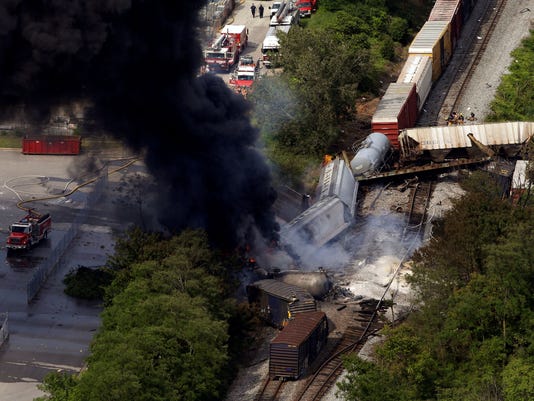
    Your Safety is LAST in HAZARDOUS FREIGHT SHIPMENTS!


    Yet another example of DEMOCRACY FOR SALE!

    Campaign Contributions and LOBBYISTS have prevented sensible safety measures from being adopted.


    What HAZARDOUS FREIGHT is being shipped through Massachusetts communities?


    INFLUENCE GAME: Systems to prevent train crashes delayed decades as industry lobbies for time

    • Article by: JOAN LOWY , Associated Press
    • Updated: September 3, 2013
    WASHINGTON — Despite a rash of deadly train crashes, the railroad industry's allies in Congress are trying to push back the deadline for installing technology to prevent the most catastrophic types of collisions until at least 2020, half a century after accident investigators first called for such safety measures.

    Under a law enacted in 2008, the systems called positive train control or PTC are supposed to be up and running by Dec. 31, 2015. A handful of railroads are expected to meet that deadline. But the rest of the industry says despite spending billions of dollars on the systems, they face logistical and technical hurdles and need more time. Four senators with industry ties recently introduced a bill to extend the deadline another five to seven years.

    The delays show how a powerful industry can stall regulations it doesn't like, even after they're enacted into law. The National Transportation Safety Board has investigated 27 train crashes that took 63 lives, injured nearly 1,200 and caused millions of dollars in damage over the past decade that officials say could have been prevented had the safety system been in place. The NTSB first recommended advanced train control systems in 1970.

    "This is not an issue where the industry is trying to get out of this mandate," said Ed Hamberger, president and CEO of the Association of American Railroads. "We have invested too much in it already, and it is in our best interest to get it done as soon as possible."

    But safety, labor and passenger advocates are skeptical that most railroads will ever implement the system without more government pressure.

    "When they are pushing for a five-year extension with no changes you have to wonder if they aren't hoping that some deregulatory White House will come along before then and just lift the burden," said Ross Capon, president and CEO of the National Association of Railroad Passengers.

    "It's one thing to say we can't get it all done by the end of 2015. It's quite another thing to say we want a blanket, industry-wide pass for five more years," he said. "That's suggestive of bad faith."
    "For every day that it is delayed, the threat of another accident remains," NTSB member Robert Sumwalt said.

    Railroads have invested heavily in making their case to Congress. Last year, the industry spent nearly $47 million lobbying the federal government, according to the political money-tracking website OpenSecrets.org. The industry's 329 registered lobbyists include former Sens. Trent Lott, R-Miss., and John Breaux, D-La., and former Mississippi Gov. Haley Barbour, as well as dozens of former House and Senate aides.

    Sen. John Thune, R-S.D., chief sponsor of the bill to extend the safety deadline, has received $672,836 in political contributions from the railroad industry and associated individuals since 1998. One of his top contributors was DM&E Railroad, based in Sioux City, S.D., which had close ties to the South Dakota GOP. It was acquired by Canadian Pacific Railways in 2008.

    "I think it's important that we as Congress be careful not to impose undue regulation on the railroad industry," especially if regulations sap money needed for infrastructure improvements, Thune told a Senate rail safety hearing in June.

    Sen. Roy Blunt, R-Mo., one of the bill's three original co-sponsors, has received $201,969 in rail industry contributions. Berkshire Hathaway, the parent company of BNSF, the nation's second-largest freight railroad, donated an additional $45,117. Blunt's chief of staff, Glenn Chambers, is the son of prominent railroad industry lobbyist Ray Chambers. Ray Chambers said he doesn't discuss legislation with his son.

    Sen. Claire McCaskill, D-Mo., another co-sponsor, has received $455,995 in rail industry contributions, including $41,768 from Kansas City Southern, which is headquartered in Kansas City, Mo. The third co-sponsor, Sen. Mark Pryor, D-Ark., has received $412,500 in contributions.


    The safety system uses GPS, wireless radio and computers to monitor train position and speed and stop them from colliding, derailing because of excessive speed, entering track where maintenance is being done or going the wrong way because of a switching mistake. It's all aimed at preventing human error, which is responsible for about 40 percent of train accidents.

    Such a system would be "a game changer" for safety, Joseph Szabo, head of the Federal Railroad Administration, told the Senate hearing.

    A dramatic example of the type of accident PTC is designed to prevent occurred in July in Spain when a train traveling twice the speed limit derailed going around a curve, killing 79 people and injuring dozens more.

    The NTSB put a newer version of the technology on its "most wanted" list of safety improvements when the list was created in 1990. The government has been funding demonstration projects for decades.

    After several failed attempts, Congress was prompted to require positive train control by one of the nation's worst train accidents. On Sept. 12, 2008, a Metrolink commuter train struck a freight train head-on near Los Angeles, killing 25 and injuring more than 100.


    Investigators said the Metrolink train's engineer was distracted by text messages, allowing the train to run through a red signal — precisely the type of accident the system is designed to prevent. The law gave railroads seven years and three months to install the technology.
     
    The requirement applies to Amtrak and 25 commuter railroads, which together carry 564 million passengers annually, and the track they share with freight trains. It also applies to freight-only trains and tracks used to transport a category of hazardous materials poisonous to breathe, in response to a 2005 collision of two Norfolk Southern trains in Graniteville, S.C. A chlorine gas tank car was derailed and punctured, releasing a toxic cloud. Nine people were killed and hundreds injured. A textile plant that employed most of the town's residents was severely damaged and closed.


    But pressure from industry has eroded the law's reach. Initial estimates were that positive train control would cover about 70,000 miles of track — less than half the nation's total. Now, that figure has shrunk to 50,000 miles. Regulators have given railroads permission to install less expensive PTC systems that won't prevent certain rear-end and low-speed collisions.

    Freight railroads have campaigned to exclude tracks used only a few times a year to transport poisonous-to-breathe cargo. They also want to reroute trains containing such cargo to track shared with passenger trains, further reducing the amount of freight-only track that has to be equipped with PTC, said Grady Cothen, a former railroad administration official.

    A weakness of the 2008 law is that it doesn't cover other types of dangerous cargo, including crude oil and ethanol, Cothen said. Last month, an unattended train transporting 72 cars of crude oil came loose, hurtling down a 7-mile incline before derailing and igniting in the lakeside Quebec town of Lac-Megantic near the Maine border. The fiery explosion killed 47 people, and destroyed much of the town.

    PTC wouldn't have prevented that accident, but the disaster underscores the risks of such shipments. U.S. railroads moved 178,000 crude oil carloads in the first half of this year — twice the number during the same period last year and 33 times more than during that period in 2009.

    Metrolink and BNSF are on track to meet the deadline. Amtrak is also expected to meet the deadline, but only in its Northeast Corridor between Boston and Washington, and in Michigan.

    While most railroad officials emphasize the train control system's cost, a significant side benefit not figured into cost-benefit calculations is that it can improve the efficiency of railroad operations, saving companies substantial sums, Cothen said.

    PTC requires significant coordination between railroad companies operating on the same tracks since the software they choose must be compatible — a challenge to installation. Freight railroads also are still working on technical specifications, adding to delays. And some commuter railroads are struggling to find the needed radio spectrum to purchase, as well as the money to pay for both positive train control and other pressing repairs.

    Szabo, the Federal Railroad Administration official, said he wants Congress to give the administration authority to grant case-by-case extensions. He said the key is finding an "appropriate balance between keeping feet to the fire" and making sure "it is done safely and reliably."

    EDITOR'S NOTE _ An occasional look at how behind-the-scenes influence is exercised in Washington.