Search This Blog

Translate

Blog Archive

Middleboro Review 2

NEW CONTENT MOVED TO MIDDLEBORO REVIEW 2

Toyota

Since the Dilly, Dally, Delay & Stall Law Firms are adding their billable hours, the Toyota U.S.A. and Route 44 Toyota posts have been separated here:

Route 44 Toyota Sold Me A Lemon


Showing posts with label Ted Cruz. Show all posts

Monday, December 9, 2019

Barbara McQuade | What Congress Should Consider in Drafting Articles of Impeachment


Reader Supported News
09 December 19

Come on folks we can’t do this with out minimal funding. The RSN formula works beautifully with “Reasonable Support.”
With that we accomplish great things.
Hit that donation link please!
Thank you.
Marc Ash
Founder, Reader Supported News


If you would prefer to send a check:
Reader Supported News
PO Box 2043
Citrus Hts
CA 95611


Reader Supported News
09 December 19
It's Live on the HomePage Now:
Reader Supported News

Sure, I'll make a donation!

Barbara McQuade | What Congress Should Consider in Drafting Articles of Impeachment
36/036627-us-capitol-120919.jpg
Barbara McQuade, Lawfare Blog
McQuade writes: "As prosecutors quickly learn, charging documents serve not only to inform the accused of the charges against him or her but also to frame the evidence and persuade fact-finders of the need to hold the accused accountable. With those goals in mind, here is a prosecutor's guide to drafting charges against Trump."
READ MORE

Rudy Giuliani. (photo: Drew Angerer/Getty Images)


Inside Giuliani's Dual Roles: Power-Broker-for-Hire and Shadow Foreign Policy Adviser
Josh Dawsey, Rosalind S. Helderman, Tom Hamburger and Devlin Barrett, The Washington Post
Excerpt: "The dual roles he has embraced are part of what longtime colleagues say has been a transformation of the once-iconic New York mayor into a multimillionaire consultant to powerful figures overseas."
READ MORE

Sports reporter Jill Arrington has struggled to find work since being dismissed by KCBS-TV, a CBS network-owned station in Los Angeles. (photo: Carolyn Cole/Los Angeles Times)

One Year After Moonves' Exit, CBS TV Stations Also Face Harassment and Misogyny Claims
Meg James, Los Angeles Times
James writes: "Jill Arrington was a star in TV sports. Then, four years ago, the former NFL sideline reporter traded national exposure for what she thought would be a more stable job at CBS' television stations in Los Angeles."

EXCERPT:
CBS is not the only broadcaster struggling with business shifts and complaints of ageism. L.A. station KTLA-TV Channel 5, formerly owned by Tribune Media, as well as the cable giant Charter Communications and the Sinclair Broadcast Group have all faced discrimination claims. 
But CBS has a history of complaints, particularly in its treatment of women. In 2000, the company paid $8 million to settle a lawsuit brought by the EEOC, the government agency that polices workplace law compliance. The agency found that women at seven CBS TV stations, including KCBS, endured a hostile work environment that included sexual harassment and retaliation for complaining. About 200 female technicians at CBS stations — camera operators and engineers — were paid less than men and passed over for promotions, the EEOC found.

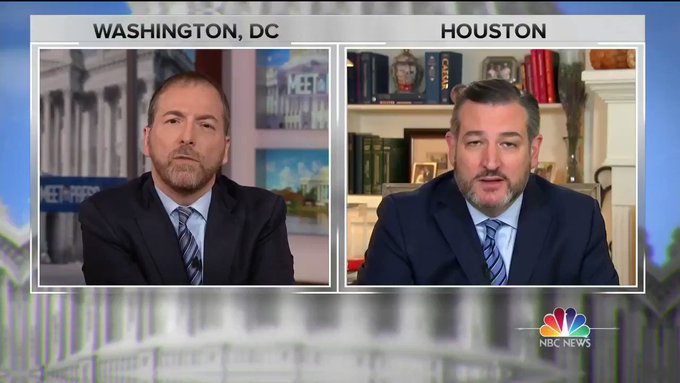
Ted Cruz. (photo: Getty Images)

Ted Cruz Inspires Unintentional Laughter on Meet the Press
Jordan Hoffman, Vanity Fair
Hoffman writes: "Senator Ted Cruz got some laughs during a live broadcast on NBC this weekend. Unfortunately for him he was on Meet the Press not Saturday Night Live."

Cruz, sporting a salt and pepper-ish goatee, squared off against Chuck Todd via satellite to discuss the important issues of the day. Some remarkable things happened. When Todd asked him if he believed that Ukraine meddled in the 2016 presidential election, Cruz said he did, saying there was considerable evidence.
Still hung up on the first part, and with an almost Jack Benny-esque sweep, Todd responded “you do?” Cruz's pause netted chuckles from people off-camera and perhaps even a gasp. Crank the volume and listen for yourself.
Todd took the moment to lace into Cruz, reminding him of the many nasty things Donald Trump said about him during the primary, suggesting that the President is not above creating “a false narrative about somebody in order to help him politically.” Cruz shrugged this off, and, as part of his spin, and said “of course Russia interfered in our election. Nobody looking at the evidence disputes that.”
“The President of the United States does,” Todd reminded him.
Cruz's Sunday morning comedy act inspired no shortage of social media commentary, the best of which came from his old Princeton University roommate, Chernobyl creator Craig Mazin.


Linda Ronstadt arrives for a gala dinner at the state department in Washington DC, on 7 December. (photo: Mike Theiler/Reuters)

Linda Ronstadt Tells Pompeo He Will Be Loved When He 'Stops Enabling Trump'
Martin Pengelly, Guardian UK
Pengelly writes: "At the Kennedy Center Honors dinner in Washington on Saturday night, the US secretary of state, Mike Pompeo, introduced honoree Linda Ronstadt with a play on the title of one of her best-known songs."
READ MORE

Sanna Marin, 34, has been selected to be the new prime minister of Finland. Photograph: Anadolu Agency/Anadolu Agency via Getty Images

Finland Is United as Social Democrats Name Marin to Be Youngest Ever Prime Minister
Kati Pohjanpalo and Leo Laikola, Bloomberg
Excerpt: "Finland is set to get its youngest-ever prime minister. Sanna Marin, 34, won the backing of the Social Democratic Party on Sunday, with 32 votes against 29 for rival Antti Lindtman."
READ MORE


A UK charity has warned of the environmental harm caused by novelty Christmas sweaters, which contain high levels of plastic. (photo: CNN)


Christmas Sweaters Are Adding to Plastic Pollution, Environmental Charity Says
Rory Sullivan, CNN
Sullivan writes: "Most Christmas sweaters are made of plastic and are likely to contribute to plastic pollution in the world's oceans, an environmental charity has warned."
READ MORE

Update My Monthly Donation


Wednesday, September 4, 2019

FOCUS: Garrett Epps | The Proud Boys' Real Target


Reader Supported News
04 September 19
It's Live on the HomePage Now:
Reader Supported News

FOCUS: Garrett Epps | The Proud Boys' Real Target
Portland police officers flank a participant at a free speech rally organized by the right-wing group Patriot Prayer in Portland, Ore., on Sept. 10, 2017. (photo: Mark Peterson/Redux)
Garrett Epps, The Atlantic
Epps writes: "I haven't seen Justice Hans Linde in more than a decade, but I thought of him last Saturday, when I found myself locked in a science museum with frightened parents and children while neofascist thugs marched by."

EXCERPT: 

Although no major political figure has embraced antifa activism, the Republican Party has begun to embrace the Proud Boys. Last fall, the Metropolitan Republican Club invited a Proud Boys leader to speak at a club event. (After the event, two Proud Boys beat four protesters so badly that a jury on Monday convicted two of them on charges of assault and riot.) The Republican activist Roger Stone has said he was initiated as a Proud Boy, and Proud Boys appeared at a federal courthouse when he turned himself in on charges brought by former Special Counsel Robert Mueller. Stone and the Fox News commentator Tucker Carlson posed in the Fox greenroom with two Proud Boys accompanying Stone.
This summer, Republican Senators Ted Cruz and Bill Cassidy are sponsoring a resolution that would designate antifa as a “domestic terrorist group.” No mention of the Proud Boys or any of the other neofascist groups who feel empowered by the ascent of Trump.
But the group’s greatest triumph came on the morning of last Saturday’s march. Trump tweeted, “Major consideration is being given to naming ANTIFA an ‘ORGANIZATION OF TERROR.’ Portland is being watched very closely. Hopefully the Mayor will be able to properly do his job!” One Proud Boy leader hailed the tweet as part of the protest’s aim: “We wanted national attention and we got it,” the organizer Joe Biggs told The Oregonian. “Mission success.”
Linde’s life was shaped by gangs of thugs deployed to shatter democratic order and impose racist dictatorship. Portland provided his family a haven and a life as citizens of a democratic nation.
Now the right has targeted Linde’s haven for destruction. The real target, though, is not Portland or antifa but all of us, and our sense of security that we are free citizens of a democratic nation, free to take our children downtown to play or to assemble peacefully to advocate values that the Republican Party does not approve. That party under Trump is now taking sides in the uneven war in Portland’s streets—and it is taking the dangerously wrong side.


Monday, August 5, 2019

America Is Divided by Education


Image result for mortar board = DEM VOTER


'I love the poorly educated': why white college graduates are deserting Trump


America Is Divided by Education

The gulf between the party identification of white voters with college degrees and those without is growing rapidly. Trump is widening it.


One of the most striking patterns in yesterday’s election was years in the making: a major partisan divide between white voters with a college degree and those without one.

According to exit polls, 61 percent of non-college-educated white voters cast their ballots for Republicans while just 45 percent of college-educated white voters did so. Meanwhile 53 percent of college-educated white voters cast their votes for Democrats compared with 37 percent of those without a degree.

The diploma divide, as it’s often called, is not occurring across the electorate; it is primarily a phenomenon among white voters. It’s an unprecedented divide, and is in fact a complete departure from the diploma divide of the past. Non-college-educated white voters used to solidly belong to Democrats, and college-educated white voters to Republicans. Several events over the past six decades have caused these allegiances to switch, the most recent being the candidacy, election, and presidency of Donald Trump.


Last night’s results confirm that the diploma divide is likely here to stay—especially if the GOP maintains its alignment with Trump and the nationalist, anti-immigrant sentiments he hangs his hat on. The gap is likely to be one of the most powerful forces shaping American politics for decades to come.

The democratic and republican Parties looked a lot different in 1952, when the American National Election Studies—surveys of voters conducted before and after presidential elections—were in their infancy. The Republicans, to some extent, were still regarded as the party of Lincoln, even though they had shifted their focus to courting southern white voters, causing black people to leave the party. Meanwhile, the Democrats were the party of a coalition that pushed for social services—the party of the New Deal. There were far fewer college-educated Americans at the time, but the white Americans who did have degrees tended to vote Republican, and those who didn't sided with the Democrats by a significant margin.

This split was relatively stable for decades and then, steadily, it began to change. “The shift in whites without a college degree away from the Democratic Party begins as the Democratic Party becomes identified as the party of civil rights,” starting in the 1960s, Robert P. Jones, the CEO of the Public Religion Research Institute, told me. Disaffected white southern Democrats, in particular, fled in droves.

Party realignment doesn't happen overnight. Just because some voters swing across the aisle in one election doesn't mean they’ll quit the party they've identified with their entire lives. Still, strong support for the Democrats among whites without a college degree, borne out of economic incentives—and racial resentment—began to wane. In their book, The Rise of Southern Republicans, the scholars Merle Black and Earl Black call this shift the “Great White Switch.”

From the mid-1990s to 2008, the diploma divide was small, if not negligible. Even though the Democrats had become the party of civil rights and a broad, multicultural coalition, they were also still the party of unions, which were largely made up of non-degree-holding whites. Therefore, white people with and without college degrees were equally as likely to be Democrats or Republicans.

But in 2008, the election of Barack Obama, a black man, signaled that the Democrats were becoming the party of progressive racial politics. “Obama’s presidency simplifies the politics of race,” Michael Tesler, an associate professor of political science at UC Irvine, says. “If you were a low-educated white, you were much more likely to know about the partisan differences on race [after Obama] than you were before.”

That change didn’t show up in the party-affiliation data right away, but that’s common, Tesler says. It often takes more than one election for people to switch their party identification. But by 2012, white voters without a college degree were distinctly more likely to vote Republican than those with college degrees.

Read: The women who gave Trump the White House could tip the midterms to Democrats


In the 2016 election, 48 percent of college-educated white voters voted for Trump, compared with 66 percent of non-college-educated white voters. A Marist poll in October of this year found that 55 percent of non-college-educated white voters approved of the job Trump was doing, compared with just 39 percent of college-educated white voters. When Supreme Court Justice Brett Kavanaugh squeaked through a Senate confirmation hearing with a sexual assault allegation in tow, 54 percent of non-college-educated white voters supported him, compared with 38 percent who had gone to college. And the partisan diploma divide held steady last night, reflecting a divide in values between those with degrees and those without.

There’s a question that splits Americans neatly in two. Every year, on its American Values Survey, the Public Religion Research Institute asks Americans whether they “think American culture and way of life has mostly changed for the better, or has it mostly changed for the worse,” since the 1950s. 

Fifty percent of Americans say that it’s gotten better in this year’s poll, and 47 percent say that it has gotten worse.

But for white voters, the answer to that question is split by education level. Fifty-eight percent of college-educated whites this year say that America has gotten better since 1950, while 57 percent of non-college-educated whites say that it’s gotten worse. When President Trump says “Make America great again,” the againis instructive. He’s capitalizing on the nostalgia that non-college-educated white voters have for America’s past. “That harkening back to a supposed golden age where things were better has a really, really strong appeal for whites without a college degree,” Jones said.

That nostalgia, however, is for a time when black Americans and other minority groups had significantly fewer civil rights. And a Republican rhetoric that centers a longing for an era of white prosperity, rife with racist violence against black people, is why it’s impossible to understand the diploma divide without accounting for racial resentment. Needless to say, black Americans and other minority groups aren’t as keen on returning to the past.

When researchers control for voter attitudes on race in addition to white voters’ education level, Tesler says, the diploma divide disappears. No other factor, he says, explains the education gap as well—not economic anxiety, ideology, income, or gender.

David N. Smith, a professor at the University of Kansas, came to a similar conclusion when he and Eric Hanley took a dive into the 2016 American National Election Survey. They found that demographic data such as education are important predictors of which party someone votes for. But “when you bring the attitudes variables into account as well, what emerges is that attitudes loom even larger than demographics,” he told me.

Here’s how he put it: If you look at white people who voted for Trump—both those with college degrees and those without—and identify everybody with a high level of resentment toward minorities, women, and Muslims, as well as those who want an arrogant, assertive leader, there’s almost no one left. The vast majority of Trump voters share those sentiments, the researchers found, regardless of education level.

The GOP has come around to Trump. As my colleague McKay Coppins wrote, “Trump’s conquest of the Republican Party is complete, and the former ‘fringe’ has become so thoroughly intertwined with the ‘establishment’ that the two are virtually indistinguishable.”

The growing diploma divide is less a result of non-college-educated white voters becoming Republicans, and more of college-educated white voters finding that they can’t fully support the party anymore. “What's happened since 2016 is that the low-educated whites have kind of plateaued in their support for the Republicans,” Tesler says. “But you've seen this trend increase [of] high-educated whites [moving] towards the Democrats.”

Smith told me that from 2015 to 2017, the Weidenbaum Center at Washington University in St. Louis conducted a monthly panel survey—where the same statistically significant number of people are interviewed each month—that cataloged Republican attitudes toward Republican candidates. Over time, those who supported Ted Cruz, who called Trump a “sniveling coward” during the campaign, and those who supported Marco Rubio, who called him a “con man,” tended to come around to Trump.

But the voters that stand out, Smith said, are those who initially supported John Kasich. “They, in many instances, agree with Trump on policy issues, but the best data indicates that they are uncomfortable with him personally,” he said. “There are key aspects of his rhetorical style, of his governing style, that they don't like.”

Kasich has been on a crusade in recent weeks combatting the Republican rhetoric around the migrant caravan. “The Lord doesn’t want” America to build walls around around itself, he told CNN. And that wasn’t the first time he’d expressed concern about the state of the Republican party, and its rhetoric, as it has inched closer and closer to Trump. “If the party can't be fixed,” Kasich told Jake Tapper in October 2017, “then I’m not going to be able to support the party. Period. That's the end of it.”

Jones argues that the logic is simple. “The risk that the Republican Party runs by becoming the party that’s opposed to immigration, that’s worried about the country becoming more diverse,” he said, “is that they will turn off college-educated whites.”

But the consequences of the diploma divide are not just evident in the demographics on Election Day. Hidden in that gap is a threat to higher education itself. Last year, Pew issued a sobering survey. 

“Republicans have soured on higher education,” the survey declared, and it threw people into a frenzy.

Sixty-seven percent of Republicans, the survey found, had “some” to “little” confidence in colleges as institutions. A number of factors contribute to this distrust, the rising cost of tuition and the perception of a liberal bent at colleges among them. And if one major party believes that higher education is an engine of liberal indoctrination, and that party’s voters are increasingly likely not to have attended college, the political benefits of an anti–higher education stance are obvious.

That puts the budget lines for public colleges, in particular, at risk. Decades of funding cuts by state governments have already hit the institutions hard. And these cuts, in turn, have driven an increase in tuition costs and more animosity toward higher education. As Michael Grunwald recently wrote in Politico, “The next big Republican culture war will be a war on college.”

As the Republican party continues to cozy up to Trump, whose political career began by questioning the legitimacy of the first black president, and who rests his laurels on hostile anti-immigrant sentiments, more moderate Republicans—who, often, are college educated—will likely continue to flee. And the GOP will have even less of a reason to try to cater to the college set, or to embrace higher education–friendly policies. The diploma divide is wide, and the closer Republicans embrace Trump, the wider it may get.


LINK