Search This Blog

Translate

Blog Archive

Middleboro Review 2

NEW CONTENT MOVED TO MIDDLEBORO REVIEW 2

Toyota

Since the Dilly, Dally, Delay & Stall Law Firms are adding their billable hours, the Toyota U.S.A. and Route 44 Toyota posts have been separated here:

Route 44 Toyota Sold Me A Lemon


Showing posts with label ethanol hazards. Show all posts

Tuesday, November 5, 2013

Railways involved in a rash of accidents, derailments, fires.....


Railways involved in a rash of accidents, derailments, fires in Canada in recent months


Railways involved in a rash of accidents, derailments, fires in Canada in recent months

The aftermath of a Sept. 25 train derailment near Landis, Sask., that spilled oil and forced the closure of a nearby school.

Photograph by: Canadian Press Files , Vancouver Sun, Postmedia file

Serious rail accidents in Canada since May 2013:

Oct. 19: Thirteen CN tanker cars - four laden with crude oil and nine carrying liquefied gas - came offthe rails just after midnight in the hamlet of Gainford, about 80 km. west of Edmonton. A massive fire ensued.

Oct. 17: Residents in the northwest Alberta town of Sexsmith were forced from their homes after four CN rail cars carrying anhydrous ammonia left the rails. The cars remained upright and there were no leaks.

Oct. 7: Four empty tanker cars that had been used to carry jet fuel went offthe track in Brampton, Ont. A CN employee suffered minor injuries and the derailment caused commuter delays for GO Train travellers.

Sept. 25: Seventeen CN rail cars, some carrying flammable petroleum, ethanol and chemicals, came offthe tracks near the village of Landis, in western Saskatchewan, in the middle of the night. A nearby school was closed as hazardous material crews cleaned up spilled oil. No one was injured.

Sep. 11: Eight cars of a CP train carrying a diluting agent used in oil pipelines derailed at a southeast Calgary rail yard. There were no injuries and no leaks from the cars, which were left lying on their sides. More than 140 homes were evacuated briefly.

July 27: A CP locomotive and seven tanker cars carrying oil left the tracks in Lloydminster, which straddles the northern Alberta-Saskatchewan boundary. Some diesel spilled from the locomotive and was contained. RCMP said nothing spilled from the cars, no one was injured and no evacuations were necessary.

July 8: An ammonia leak from a train caused the evacuation of roughly one-quarter of the population of the small northern Ontario town of Gogoma. No one was injured.

July 6: A runaway train of 72 tank cars loaded with crude oil crashed and exploded in the centre of Lac-Mégantic, Que., killing 47 people and destroying half the downtown area. The train, owned by Montreal, Maine & Atlantic Railway, was unmanned at the time.

June 27: Seven cars derailed as a bridge over the flood-swollen Bow River in Calgary collapsed when a CP train tried to cross it. Five cars carried petroleum products, one was filled with ethylene glycol and one was empty. No spills or injuries were reported but Calgary Mayor Naheed Nenshi demanded answers.

June 2: Eleven CP rail cars derailed on a trestle bridge near Wanup, east of Sudbury, Ont. There were no injuries, but the cars were carrying containers of consumer goods and about half of them entered a nearby river, prompting a drinking-water advisory.

May 21: Five cars on a CP train derailed near the village of Jansen in southeastern Saskatchewan and one of them spilled more than 91,000 litres of oil. There were no injuries.


Sunday, September 15, 2013

Wall St. Exploits Ethanol Credits, and Prices Spike

Stop Ethanol Trains Through Our Communities


Wall St. Exploits Ethanol Credits, and Prices Spike


Jay Paul for The New York Times
The Chesapeake, Va., operations of TransMontaigne, an oil and gas transportation company that Morgan Stanley bought in 2006 and which has generated biofuel credits for it.

By GRETCHEN MORGENSON and ROBERT GEBELOFF

It was supposed to help clean the air, reduce dependence on foreign oil and bolster agriculture. But a little known market in ethanol credits has also become a hot new game on Wall Street.

The federal government created the market in special credits tied to ethanol eight years ago when it required refiners to mix ethanol into gasoline or buy credits from companies that do so. The idea was to push refiners to use the cleaner, renewable fuel, or force them to buy the credits.
 
A few worried that Wall Street would set out to exploit this young market, fears the government dismissed. But many people believe that is what happened this year when the price of the ethanol credits skyrocketed 20-fold in just six months, according to an analysis of regulatory documents and interviews with more than 40 people involved in the market, including industry executives, brokers, traders and analysts.
      
Traders for big banks and other financial institutions, these people say, amassed millions of the credits just as refiners were looking to buy more of them to meet an expanding federal requirement. Industry executives familiar with JPMorgan Chase’s activities, for example, told The Times that the bank offered to sell them hundreds of millions of the credits earlier this summer. When asked how the bank had amassed such a stake, the executives said they were told by the bank that it had stockpiled the credits.
 
A spokesman for JPMorgan, when asked about the exchange with the executives, disputed the account, saying the bank does not trade ethanol credits for a profit in the way it trades other securities, but is registered to deal in credits through its energy business. From time to time, the spokesman, Brian J. Marchiony, said in a statement that the bank also purchased credits “on behalf of clients who need to fulfill their E.P.A.-mandated obligations,” though it had not done so in the past year.
 
But other market participants, including Thomas D. O’Malley, chairman of PBF Energy in Parsippany, N.J., identified JPMorgan Chase and other financial institutions as being active sellers of the credits this year. He said the institutions had helped transform an environmental program into a profit machine, contributing to the market frenzy this year. “These things were designed to monitor the inclusion of ethanol in the gasoline pool,” Mr. O’Malley said. “They weren’t designed to become a speculative item. For the life of me I can’t see the justification for it.”
 
While banks are by no means the largest player in ethanol credits, Wall Street’s activity in this market reflects a larger effort by financial institutions to exert their influence over loosely regulated markets for basic commodities, from aluminum to oil. The opacity of the ethanol credit market makes it difficult to determine the extent to which large financial actors have profited.
 
The banks say they have far less influence in the market than others are suggesting, and are doing nothing wrong. But the activities, while legal, could have consequences for consumers. In the end, energy analysts say, the outcome will be felt at the gas pump — as the higher cost of the ethanol credits gets tacked onto the price of a gallon of gasoline. (The credits, which cost 7 cents each in January, peaked at $1.43 in July, and now are trading for 60 cents.)
 
The Valero Energy Corporation, a refiner that owns thousands of gas stations, says the squeeze in ethanol credits might cost it $800 million. PBF Energy, also a refiner, puts its bill at about $200 million. A review by The Times of a federal registry of nearly 1,500 businesses and individuals in the renewable fuel market found big Wall Street banks as well as a handful of people with troubled legal histories among the participants. Several high-profile cases of fraud have emerged.
 
Scott Mixon, the acting chief economist of the Commodity Futures Trading Commission, said in an interview Friday that the issue of banks’ involvement in this market was something the agency was tracking and might look into more deeply because of the ethanol component. The commission regulates the commodities futures market, including trading in ethanol and gasoline.
      
Though the ethanol credits are traded by many major investment houses, they were created not on Wall Street but in Washington, on Capitol Hill and at the Environmental Protection Agency. At its inception, the so-called Renewable Fuel Standard was promoted as a means to reduce the nation’s reliance on foreign oil, fight global warming and provide a boost to farmers. The rules call for a set amount of ethanol, most of which is made from corn, and other renewable fuels to be blended with fossil fuels each year, with quotas assigned to individual refiners and importers.
 
Great article! Read the rest here:
 

Monday, August 12, 2013

Freight Trains

Massachusetts communities have NO control over the hazardous cargo.

This horrific tragedy highlights the threats posed by RAIL FREIGHT SHIPMENTS and the lack of regulations.


What insurance coverage is required in US?

Tanker cars are owned by the shippers and other freight cars are owned by railroads. Railroads are “common carriers” which must carry these shippers’ cargoes, even though they have no control over the safety standards of the tanker cars carrying them.


VIDEO

How the oil spill is being cleaned at Lac-Mégantic
Reporter Kim Mackrael joins Hannah Sung to discuss the oil spill at Lac-Mégantic and efforts to clean it up


VIDEO

How will the MM&A bankruptcy affect the families of Lac-Mégantic victims?
Justin Giovannetti joins Hannah Sung to discuss how the Montreal, Maine & Atlantic bankruptcy filing will affect families' and businesses' lawsuits against the railway.


Crews work in the area of the derailed tanker cars in Lac-Mégantic on July 14, 2013. The train derailment and subsequent fires and explosions destroyed much of the downtown area of the picturesque Quebec town. (Peter Power/The Globe and Mail)

Canadian Transportation Agency approved MM&A’s coverage

LAC-MEGANTIC, QUE. — The Globe and Mail


Sunday, July 21, 2013

Ethanol Trains in Your Community?


How many communities could cope with this level of emergency and the massive water consumption? How many are prepared?
What can we possibly do in large derailments when fire departments are asking - what is in the cars, cannot get the foam to where it is needed, lucky it happened at night in an area where there are less people ..

Train derailment, Hayes, Kansas Tuesday, July 16
http://hdnews.net/news/Trainfollow072113

Train wreck, fire under investigation

7/21/2013


By RANDY GONZALES

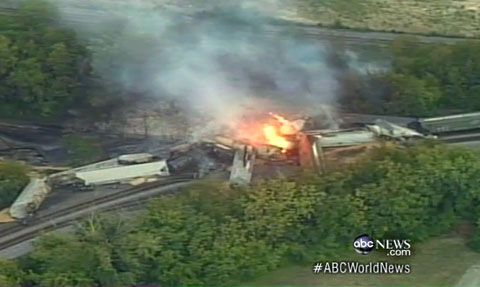
In the chaotic first minutes after a Union Pacific freight train derailed early Tuesday morning, the first order of business for the Hays Fire Department was to determine what was contained in the 18 cars that were derailed.

A train bound for Denver from Salina with three locomotives and 79 cars was diverted off the main track and collided into the rear of a stationary train on a side track at approximately 1:25 a.m. at the rail yard near the railroad crossing at Eighth and Vine. Ten cars from the main train derailed, as did four cars from the sitting train and four cars located next to the sitting train on an adjacent spur.

"In the accident that happened, you have all these train cars derail, in a big pile -- what's in the pile? That's the key," said Hays Fire Chief Gary Brown. "We're sitting there in the dark, massive fire and black smoke, and a big pile of twisted rail car wreckage. What is in the pile that's burning? That's the question we try to answer."

Freight trains carry a list of the contents in the cars they are transporting, but in their haste to get out of the locomotive, the three crew members did not have that list. Not long after, however, Union Pacific faxed a list of contents.

The train contained 20 cars carrying ethanol -- a volatile, flammable liquid. None of those cars derailed, but the fire department wanted to contain the fire so it didn't spread to those cars, Brown said.

"If an ethanol car was leaking, it would probably have a running fire that would be difficult to contain and control," Brown said. "As the fuel came out, we would just try to prevent it from spreading to other things."

It was Brown's understanding the ethanol cars in Tuesday's derailment were full.

"If the car fails when it's full, it's called a Boiling Liquid Expanding Vapor Explosion," Brown said. "It'll fail, and that burning liquid will spread."

The Hays Fire Department, assisted by the Ellis County Rural Fire Department, the Ellis Fire Department and Victoria Fire Department, was able to prevent that from happening in Tuesday's accident. Firefighters poured 5,000 gallons of water per minute on the fire for an estimated five-and-a-half hours.

"The bottom line, if it's an ethanol car involved in a wreck, you want to keep it cool so it doesn't blow up," Brown said.

Hays Water Plant Superintendent Jim Cooper estimated 1,650,000 gallons of water was used to douse the blaze. He said it took about two days for the city to recover from the high water usage in fighting the fire.

"Most of that water came out of reserves," Cooper said. "We were flowing right at 300,000 gallons a minute, and even at that, we lowered our Sternberg tower by about 10 feet, probably took 4 feet or so out of the north tower, took a foot-and-a-half, 2 feet out of our reservoirs. That's where most of that water came from."

Initially, the fire department brought in the airport crash truck, which has the greatest foam-making capability. However, the truck couldn't get the foam to every place the fire was burning.
"Plan B was to keep everything cool, and let the fire burn itself out," Brown said.

The National Transportation Safety Board had three investigators on the scene Tuesday. A final report on what caused the accident could take as long as 18 months, said NTSB spokesman Keith Holloway.

There will be several areas investigators will examine, including looking at the rail cars in the accident and their contents, inspecting the train rails, gathering dispatch information, and interviewing the crew.

"That's all part of what they do once they are on the scene," Holloway said.

The main rail line reopened Tuesday evening. Once NTSB clears the scene, Union Pacific can begin cleanup at the site, said UP spokesman Mark Davis.

"Cleanup-wise, could take up to several weeks," Davis said.

The city was fortunate in where the accident took place, Brown said.

"If there's a good place to have a train derailment and fire, this was probably a good place, because at that time of night there were very little people around; the businesses were not occupied, traffic was light," Brown said.

"Obviously, it would have been different if it had been further into the downtown area. There would have been a greater problem for us to deal with. So, that worked in our favor."


http://hdnews.net/news/Trainfollow072113


Monday, July 15, 2013

Governor Vetoes Legislation That Would Have Halted Ethanol Trains


Governor Vetoes Legislation That Would Have Halted Ethanol Trains

Governor calls for a two year moratorium to allow development of disaster response plans

Posted by stannenb on Jul 14, 2013.

 
Governor Deval Patrick Friday vetoed legislation that would have effectively ended a plan by Global Petroleum to complete their "virtual pipeline", the rail transport of ethanol from the midwest to their storage and blending facility in Chelsea. This rail route would bring ethanol unit trains - mile long assemblages of 60-80 tanker cars - through densely populated communities of eastern Massachusetts including Cambridge, Somerville, Chelsea and Revere.

In order to complete their rail route, Global's terminal required significant rehabilitation and modernization and, due to its location on the banks of the protected tidelands of Chelsea Creek, Global needed a "Chapter 91" license from the state Department of Environmental Protection (DEP). The legislation vetoed by Patrick would have prohibited the DEP from issuing a Chapter 91 license to any ethanol blending and storage facility located near a dense population center, a categorization that would have included Global. Prior to this veto, Global had announced that, due to community concerns, it was withdrawing its current Chapter 91 application.

Citing no examples, Patrick's veto message states that the vetoed legislation would "have the effect of significantly constraining the transport of ethanol in Massachusetts" and "interfere with marine terminal operations and potentially impact existing licenses throughout the state."

Patrick's message recommends, instead, two actions.

First, the permanent ban on Chapter 91 licenses would be replaced with a two year moratorium on "the addition of new routes of ethanol transport by rail in certain port areas."

Second, this two year moratorium would be used by the Massachusetts Emergency Management Agency (MEMA) to "develop a comprehensive ethanol transport response plan for all municipalities that accommodate the transport of ethanol by rail." Patrick's proposed legislation would mandate that MEMA develop a methodology by which the "entity transporting ethanol by rail" would be assessed the costs of developing the plan as well as the funding for the risk mitigation methods called for in the plan.

Far from being an effort to force rail companies to pay the actual costs of the transportation of hazardous materials, the legislation instructs municipalities and agencies to apply for federal grants for funding the measures needed to keep their populations safe. Patrick's veto message does not address the specifics of this funding mix, nor does it explain why it calls federal funding for safety measures "subsidies" for the municipalities when it remains taxpayer dollars subsidizing the costs of private transport of hazardous materials.

Despite the setback for Boston-area activists, their victory would not have stopped ethanol trains from continuing to enter Massachusetts at the New York border, run through the state to Worcester and turning south to Providence, RI. Patrick's safety and funding proposal, directed at the entire state, addresses concerns of other communities through which ethanol transport would have continued.

The ethanol industry exists due to a Federal mandate requiring the blending of biofuels with gasoline and supported by favorable tax treatment. As drought in the midwest have increased the price of corn and gasoline usage has decreased, the economic viability of ethanol has been increasingly questioned.

In June, a bipartisan group of Senators introduced the "The Renewable Fuel Standard Repeal Act", saying that the ethanol mandate is increasing the cost of both food and fuel, and that the Federal government's unwillingness to suspend the mandate in light of the midwest drought forced them to call for its repeal.

http://cctvcambridge.org/EthanolTrains6


Sunday, July 14, 2013

Massachusetts: Every Community with Freight Lines Needs to Read This!

Middleboro was blind-sided recently by the state's plans to re-introduce 'high speed' commuter trains on old freight lines.

Let's not be blind-sided by what's traveling through our neighborhoods.

Too many have accepted the false rhetoric that oversight/regulation/enforcement stifles business and we have allowed government to be slashed and deregulated, jeopardizing our safety.

It's time to protect ourselves and our communities!

This could be US!


A very useful and insightful commentary regarding rail transport of hazardous materials from a former rail engineer. Please read

http://www.montrealgazette.com/touch/story.html?id=8652746


Opinion: As a former rail engineer, I need to speak out

By James Goodrich, The Gazette July 12, 2013


http://www.montrealgazette.com/opinion/Opinion+former+rail+engineer+need+speak/8652746/story.html


Saturday, July 6, 2013

BREAKING NEWS: Horrifying Train Derailment

We simply CANNOT allow Ethanol Trains to travel through densely populated Massachusetts cities for this reason.

See information below and PLEASE, call the Governor's Office to sign the legislation.


BREAKING: Major fire after train carrying oil derails in Quebec town near Canada-US border


Fire erupts after train derailment in Quebec
Quebec town is evacuated after a train carrying petroleum products derailed and exploded
causing a massive fire.


http://samuel-warde.com/2013/07/breaking-major-fire-after-train-carrying-oil-derails-in-quebec-town-near-canada-us-border/


Explosions rocks Quebec town of Lac-Megantic after train derailment. Hundreds of people were evacuated from the downtown core, large amount of fuel spilled into the Chaudière River, State of Maine has been called in to help to contain the fire in Quebec.

After all the hard work we have done, the amendment must be signed into law. Call and ask the Governor to SIGN THE ETHANOL AMENDMENT INTO LAW! (617) 725-4005
 
 
Initial reports --

Explosions rock Quebec town of Lac-Megantic after train derailment

 
http://www.theprovince.com/news/Train+derailment+sparks+major+fire+LacMegantic+Quebec/8625239/story.html


Sunday, June 30, 2013

Ethanol Trains in your neighborhood?

Is your community protected? Probably not.

Mayor ‘Pissed Off’ With Norfolk Southern Over Lack of Communication

Norfolk Southern is seeking a state permit to increase offloading from 14 to 30 rail cars per day at its Alexandria facility.

Alexandria Mayor Bill Euille said Tuesday he plans to do everything within his power to oppose Norfolk Southern's request to double the number of rail cars offloaded per day at its ethanol transfer facility near the Van Dorn Street Metro station.


Norfolk Southern filed for a permit with the Virginia Department of Environmental Quality to increase offloading from the current 14 rail cars to 30 cars per day. Increased emissions under the plan mean Norfolk Southern will need an air quality permit to expand the scale of operations at the facility at 1000 S. Van Dorn St.

Euille said he plans to bring a resolution before City Council next month opposing any expansion, then meet with Norfolk Southern and Virginia environmental officials to make a case against the proposal.

“This is doubling the cars from the current level of 14 to 30, and that is certainly something we feel is an environmental and safety issue, particularly considering that that facility is near a residential neighborhood, and we have an elementary school nearby,” Euille said.

He added: “This is too much of an increase for that part of the neighborhood, and at this juncture, with my role as mayor and with City Council and with the community, we will do everything within our power to oppose this expansion.”

Euille also took issue with the fact that Norfolk Southern failed to notify city officials of its plans after filing for the state permit, even though the city has no real official role in the matter. Euille told Patch he was “pissed off” about the lack of communication.

The transfer facility has been the site of past spills, including a 100-gallon ethanol spill in February. City leaders have requested that the state Department of Environmental Quality hold an informational meeting and a public hearing on Norfolk Southern’s proposal and a public comment period of at least 60 days.

In a statement issued Tuesday, Norfolk Southern spokesman Robin Chapman said the company has “considered the possibility” of expanding the Alexandria facility, depending on market conditions, but has not yet decided to implement the plan.

“Recognizing that a state air quality permit would be required to proceed with an expansion, the company wants to be able to act quickly to future market conditions and chose to apply to the DEQ for a permit ahead of the need,” he stated. “Appropriate safety measures would be designed into such a facility, but a design does not now exist.”

Chapman said Norfolk Southern didn’t tell Alexandria officials about its plans because the company knew the state would notify the city as part of the permitting process.

Bill Hayden, spokesman for the state Department of Environmental Quality, said it usually takes 90 days to issue a permit after all materials have been submitted. He did not know when Norfolk Southern filed its application.

“We're waiting for all the materials to make sure the application is complete,” Hayden said. “We have not made that determination yet, that the application is complete.”

Read more:
  • Norfolk Southern Asks for Ethanol Offloading Increase
  • Ethanol Spill at Norfolk Southern Transloading Facility
  • Norfolk Southern to Notify Fire Department First as Part of Emergency Response Plan
  • Norfolk Southern Fails to Notify Fire Department of Spill


http://westendalexandria.patch.com/groups/politics-and-elections/p/mayor-pissed-off-over-no-communication-with-norfolk-southern


Friday, May 31, 2013

Stop Ethanol Trains through Densely Populated Neighborhoods

Middleboro just got blind-sided by high-speed rail on a track previously used for slow-moving freight, mostly in the middle of the night.

There are no limits for where these trains might eventually travel - this makes us all vulnerable.

Please add your name --  


Stop Ethanol Trains through Densely Populated Neighborhoods

  • Target: Governor Deval Patrick
  • Sponsored by: Jovanna Garcia Soto
  • I am a tax-paying stakeholder and am deeply concerned about Global Petroleum’s proposal to bring large volumes of ethanol by train to their Revere facility (60-120-car trains, two to three times per week, 280.8 million to 468 million gallons annually).

    There are hundreds of thousands of residents, businesses, organizations, churches, health care institutions, schools and other important community resources along the proposal's routes. More than fifty cities and towns are likely to be affected including Cambridge, Somerville, Everett, Chelsea, East Boston, and Revere.


    Tuesday, April 9, 2013

    Global Petroleum: Jeopardizing Public Safety Across Massachusetts

    Global Petroleum's proposal jeopardizes Massachusetts communities from West to East!

    Please add your name to this new petition below:

    Stop Ethanol Trains through Densely Populated Neighborhoods

    Stop Ethanol Trains through Densely Populated Neighborhoods

  • Target: Governor Deval Patrick
  • Sponsored by: Jovanna Garcia Soto


  • I am a tax-paying stakeholder and am deeply concerned about Global Petroleum’s proposal to bring large volumes of ethanol by train to their Revere facility (60-120-car trains, two to three times per week, 280.8 million to 468 million gallons annually).

    There are hundreds of thousands of residents, businesses, organizations, churches, health care institutions, schools and other important community resources along the proposal's routes. More than fifty cities and towns are likely to be affected including Cambridge, Somerville, Everett, Chelsea, East Boston, and Revere.

    Ethanol is highly combustible and an accident in densely populated neighborhoods would put thousands at risk, without possibility of evacuation from a resulting fire.

    We call on you, the Governor of Massachusetts, to listen to the concerns of the Commonwealth’s taxpayers and STOP THIS PROPOSAL.

    PETITION

    Previous articles:

    Inferno fears halt ethanol train - Speak Out!


    Ethanol in your neighborhood

    Are Ethanol Trains Coming To Your Community?

    Ethanol in your neighborhood?

    Boston and Albany Railroad
    Logo

    System map
    
    http://en.wikipedia.org/wiki/Boston_and_Albany_Railroad


    Under a plan by Waltham-based Global Partners LP, about 1.7 million gallons of ethanol would be carried on a freight train that is 60 cars long twice a week through two dozen communities, including Cambridge, Somerville, East Boston, Everett and Chelsea, ending at a waterside shipping center in Revere.
     
    A 2011 study commissioned by the state Department of Environmental Protection found ethanol is now the most hazardous substance being transported by rail in the United States.

    On July 11, a 98-car train carrying ethanol partly derailed and exploded north of downtown Columbus, Ohio. The train was reportedly traveling below the speed limit in the middle of the night, and just two people were hurt. Investigators are trying to determine the cause.