Search This Blog

Translate

Blog Archive

Middleboro Review 2

NEW CONTENT MOVED TO MIDDLEBORO REVIEW 2

Toyota

Since the Dilly, Dally, Delay & Stall Law Firms are adding their billable hours, the Toyota U.S.A. and Route 44 Toyota posts have been separated here:

Route 44 Toyota Sold Me A Lemon


Showing posts with label food contamination. Show all posts

Tuesday, July 9, 2019

Asian Seafood Raised On Antibiotics And Pig Feces Approved For U.S Consumption


About this website
AWARENESSACT.COM
I know most of the things we hear about farmed fish or seafood, in general, these days is far from positive but this is something…


I know most of the things we hear about farmed fish or seafood, in general, these days is far from positive but this is something we all need to know about. Have you ever wondered what some of these sea creatures are being fed on those ‘farms?’
A lot of the seafood we eat here in the United States comes from China and other Asian countries. The thing with seafood coming from China and so forth is that most of the sea creatures are fed using unconventional feed such as pig feces. While you might have heard this before chances are you didn’t get any proper explanation and so that is why this article is being brought forth. For quite a few years now this subject/situation has been making its rounds online, but most people don’t realize how true it actually is.
The idea that the fish we are eating was raised on things like pig feces is not something that sits well with anyone. Even back in 2012 Bloomberg Markets Magazine wrote on the topic and did verify that it was in fact happening and is a very common practice in some parts of Asia. They even went so far as to describe the sanitary conditions at fish factories in Vietnam as if flies are literally crawling all over baskets of shrimp constantly.
This is a bit stomach churning as Vietnam ships hundreds of thousands of shrimp to the US each year. To top that off the FDA doesn’t inspect all of the seafood we import, how could they? They only inspect about 2 percent of what we take in leaving a lot of bumps along the way. While you might think 2 percent is a lot when you look at places like Canada or the EU who inspect anywhere from 15-50 percent you can tell we are clearly behind in the times.
“Imported seafood may carry risks in terms of food safety because the FDA does not have the resources to proactively and regularly inspect foreign facilities, and it relies on product testing as a last resort,” said Love. To minimize the risks of seafood imports and to raise U.S. testing standards to match those of other countries, the authors recommend that the FDA budget be expanded to allow for more exhaustive testing and hiring of more inspectors.
Asia’s shrimp also relies on antibiotics big time when it comes to controlling diseases among them. This producing a risk of antibiotic-resistant pathogens being present in the final product. Back in 2008, Don Kraemer from the FDA at the time actually warned before Congress that there was clear scientific evidence that drug residues DO make it into the fish that we eat. While this might not be enough to make everyone check the source of their seafood I hope it puts the thought in the minds of at least some people.
For more information please feel free to check out the video below, it covers far more than you might ever imagine. What do you think about all of this? I for one think sanitation and overall conditions of the farms our food comes from should be more regulated somehow, perhaps in the future that will be more possible.


LINK


Wednesday, April 24, 2013

The Horrifying Destruction of Food Safety

Tom Philpott presents the distressing future of our food supply ---

USDA Ruffles Feathers With New Poultry Inspection Policy


| Wed Apr. 24, 2013
 

The Obama administration is on the verge of dramatically scaling back the US Department of Agriculture's oversight of the nation's largest chicken and turkey slaughterhouses—while also allowing companies to speed up their kill lines.

Currently, each factory-scale slaughterhouse has four USDA inspectors overseeing kill lines churning out up to 140 birds every minute. Under the USDA's new plan, a single federal inspector would oversee lines killing as many as 175 birds per minute. That would mean there are three fewer inspectors for a production line running 25 percent faster. (The line rates at turkey slaughterhouses are, for obvious reasons, slower, but would also be sped up under the new rules).

After the idea was floated last year, it was met by massive pushback from food-safety and worker advocates, who argued that the combination of more speed and fewer inspectors would lead to dangerous conditions for both consumers and workers.

Since then, the proposal has been caught in the federal rulemaking process. But on April 10, the administration released a prospective USDA budget indicating that the agency plans to implement the new rules by September 2014. And in testimony before the House Appropriations Subcommittee on Agriculture on April 16, Vilsack said the rules would be finalized "very soon," declaring that the plan "will allow the poultry industry to continue to be profitable, and allow us [the USDA] to save some money as well."

Indeed, according to a 2012 statement, the department expects to save $90 million over three years by firing inspectors. Meanwhile, the USDA calculates that by increasing kill line speeds, the plan will save the poultry industry more than eight times as much, or $256.6 million each year. That windfall would accrue mainly to four large companies—Tyson, Pilgrim's Pride (now mostly owned by JBS), Purdue, and Sanderson. Together, they slaughter nearly 60 percent of the chicken consumed in the US. (Another four companies, led by Butterball, slaughter 55 percent of turkeys.)

The USDA insists that the new system will improve poultry product safety. In his recent testimony, Vilsack said his department expects the new system will prevent "somewhere between three and five thousand foodborne illnesses" per year. Interestingly, Vilsack's numbers are less optimistic than other recent claims from department officials: Just a year ago, Alfred Almanza, administrator of the Food Safety and Inspection Service (FSIS), wrote that the plan would "help prevent an estimated 5,200" from getting sick.

The USDA is right that poultry product safety could stand improving. In an analysis of the Food & Drug Administration's latest tests of retail meat, Environmental Working Group found that 81 percent of ground turkey and 39 percent of chicken wings, breasts, and thighs tested contained antibiotic-resistant bacteria.

How would speeding up the kill line and removing all but one inspector improve this dreadful situation? Under current rules, multiple USDA inspectors monitor the kill line for "visible defects"—feces, bruises, blemishes, blood, and the like. But the department insists that's time poorly spent, focusing on the outward cosmetic appearance of the carcasses—quality control issues that the USDA argues should be the slaughterhouse's responsibility. Under the new rules, company employees would instead be in charge of visually inspecting the line and removing defective birds. To control pathogens, the poultry plants would be allowed to conduct "online reprocessing"—that is, dousing all the bird carcasses that pass through the line, "whether they are contaminated or not," with water laced with chlorine and other antimicrobial chemicals. Beyond that, the lone USDA inspector would randomly select 20 to 80 birds per shift to test them for defects. That would represent a tiny fraction of the birds processed over the course of an eight-hour shift; in a single hour, a kill line operating at the new high speed would spit out more than 10,000 carcasses.

Since the late '90s, the USDA has been running a pilot program testing the rules at 20 slaughterhouses, and claims that the results have been sterling. But last year, Food & Water Watch used the Freedom of Information Act to obtain six months' worth of recent inspection documents from participating slaughterhouses. The results, as I reported at the time, were alarming, and don't suggest that the factories' own employees are effectively inspecting the birds.
Here's Food & Water Watch:
Company employees miss many defects in poultry carcasses. The inspection category that had the highest error rate was 'Other Consumer Protection 4' for dressing defects such as feathers, lungs, oil glands, trachea and bile still on the carcass. The average error rate for this category in the chicken slaughter facilities was 64 percent and 87 percent in turkey slaughter facilities. In one turkey slaughter facility, nearly 100 percent of samples found this category of defect.
From March to August 2011, 90 percent of the defects found by the USDA inspectors involved "visible fecal contamination that was missed by company employees." Yuck.

You don't have to resort to FOIA to question the USDA's claim that the new system will cut down on illnesses from eating poultry: In its publicly available 2011 evaluation of the pilot program, the USDA found that finished birds at pilot facilities were more likely to test positive for salmonella. And two of the 20 pilot facilities—a Tyson factory in Clarksville, Arkansas, and a Golden Rod Broilers one in Cullman, Alabama—failed the USDA's latest test for salmonella standards. According to Food & Water Watch, that 10 percent failure rate—granted, drawn from a small sample size—is higher than the industry's overall rate.

If the USDA is making shaky claims around food safety, it's not making any claims on worker safety, over which it has no mandate. In his House testimony, Vilsack didn't have much to say on the topic: "We've attempted to address those [worker-safety] concerns by suggesting that this gives us a chance to study that issue."

But the new rules would force workers to wield sharp knives and make repetitive motions at a kill line that, with 35 more birds going by each minute, would running 25 percent faster. Tragically, the federal agency that might have something to say about those conditions, the Occupational Safety and Health Administration (OSHA), doesn't. As a fresh, devastating report from the Southern Poverty Law Center on poultry workers shows, slaughterhouses exist in a worker-protection limbo:
Despite OSHA’s responsibility to ensure worker safety, it has no mandate to regulate processing line speeds to protect workers. The U.S. Department of Agriculture (USDA) is the only agency that currently regulates line speeds. But the USDA’s regulations are designed to guard against contamination of the product, not to protect workers from hazardous conditions.
Even under current line speeds, workers are regularly harmed. Citing OSHA figures, the SPLC reports that 5.9 percent of the poultry workers are injured each year, 50 percent more than the national average. And the report shows that workers routinely face intimidation and might think twice about reporting an injury. Here's the SPLC, describing current conditions on kill lines:
The processing line that whisks birds through the plant moves at a punishing speed. Over three-quarters of workers said that the speed makes their work more dangerous. It is a predominant factor in the most common type of injuries, called musculoskeletal disorders. But if the line seems to move at a pace designed for machines rather than people, it should come as no surprise. Plant workers, many whom are immigrants, are often treated as disposable resources by their employers. Threats of deportation and firing are frequently used to keep them silent.
The Obama administration has clearly expressed the benefits of its new plan: minor savings for the government, major savings for Big Poultry. Testifying before Congress last year, Cass Sunstein—then serving as the famously regulation-averse chief of Obama's Office of Information and Regulatory Affairs—hailed the poultry-slaughter proposal as an example of the administration's will to unburden industry of "cumbersome, outdated" regulation. The costs, though, don't appear to have been reckoned with adequately, if at all.


Tom Philpott

Food and Ag Blogger
Tom Philpott is the food and ag blogger for Mother Jones. For more of his stories, click here. To follow him on Twitter, click here. RSS

If You Liked This, You Might Also Like...

Monday, January 28, 2013

Contaminating the food supply

The peer-reviewed article referenced below solidifies the anecdotal stories of livestock deaths after exposure to fracking chemicals.

There is every reason to believe this is what it is doing to humans.

Thanks Dick Cheney for your backroom energy deals!

From: Elizabeth Royte, The Ecologist, More from this Affiliate
Published January 28, 2013

Livestock falling ill in fracking regions, raising concerns about food


While scientists have yet to isolate cause and effect, many suspect chemicals used in drilling and hydrofracking (or "fracking") operations are poisoning animals through the air, water, or soil.


Last year, Michelle Bamberger, an Ithaca, New York, veterinarian, and Robert Oswald, a professor of molecular medicine at Cornell's College of Veterinary Medicine, published the first and only peer-reviewed report to suggest a link between fracking and illness in food animals.

The authors compiled 24 case studies of farmers in six shale-gas states whose livestock experienced neurological, reproductive, and acute gastrointestinal problems after being exposed—either accidentally or incidentally—to fracking chemicals in the water or air. The article, published in New Solutions: A Journal of Environmental and Occupational Health Policy, describes how scores of animals died over the course of several years.

The death toll is insignificant when measured against the nation’s livestock population (some 97 million beef cattle go to market each year), but environmental advocates believe these animals constitute an early warning.

Exposed livestock "are making their way into the food system, and it's very worrisome to us," Bamberger says. "They live in areas that have tested positive for air, water, and soil contamination. Some of these chemicals could appear in milk and meat products made from these animals."

In Louisiana, 17 cows died after an hour's exposure to spilled fracking fluid, which is injected miles underground to crack open and release pockets of natural gas. The most likely cause of death: respiratory failure.

In New Mexico, hair testing of sick cattle that grazed near well pads found petroleum residues in 54 of 56 animals.

In northern central Pennsylvania, 140 cattle were exposed to fracking wastewater when an impoundment was breached. Approximately 70 cows died, and the remainder produced only 11 calves, of which three survived.

In western Pennsylvania, an overflowing wastewater pit sent fracking chemicals into a pond and a pasture where pregnant cows grazed: Half their calves were born dead. Dairy operators in shale-gas areas of Colorado, Pennsylvania, West Virginia, and Texas have also reported the death of goats.

Drilling and fracking a single well requires up to 7 million gallons of water, plus an additional 400,000 gallons of additives, including lubricants, biocides, scale- and rust-inhibitors, solvents, foaming and defoaming agents, emulsifiers and de-emulsifiers, stabilizers and breakers. At almost every stage of developing and operating an oil or gas well, chemicals and compounds can be introduced into the environment.

Continue reading at The Ecologist.

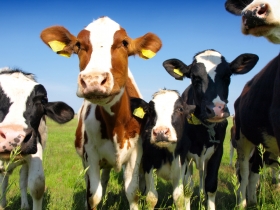
Livestock image via Shutterstock.

http://www.enn.com/top_stories/article/45524