Search This Blog

Translate

Blog Archive

Middleboro Review 2

NEW CONTENT MOVED TO MIDDLEBORO REVIEW 2

Toyota

Since the Dilly, Dally, Delay & Stall Law Firms are adding their billable hours, the Toyota U.S.A. and Route 44 Toyota posts have been separated here:

Route 44 Toyota Sold Me A Lemon


Showing posts with label methane gas. Show all posts

Monday, August 29, 2016

RSN: Donald Trump in the Bayou: The Tea Party, a Sinkhole in Louisiana, and the Contradictions of American Political Life


There are videos of Sinkhole in Louisiana and the environmental destruction....


It's Live on the HomePage Now:
Reader Supported News

FOCUS: Arlie Russell Hochschild | Donald Trump in the Bayou: The Tea Party, a Sinkhole in Louisiana, and the Contradictions of American Political Life
Donald Trump and his running mate, Indiana governor Mike Pence, right, help to unload supplies for flood victims during a tour of the flood damaged area in Gonzales, Louisiana. (photo: Max Becherer/AP)
Arlie Hochschild, TomDispatch
Hochschild writes: "Sometimes you have to go a long, long way to discover truths that are distinctly close to home. Over the last five years, I've done just that - left my home in iconically liberal Berkeley, California, and traveled to the bayous of Tea Party Louisiana to find another America that, as Donald Trump's presidential bid has made all too clear, couldn't be closer to home for us all."
READ MORE

Contribute to RSN
Become a Fan of RSN on Facebook and Twitter


Tuesday, May 31, 2016

RSN: Danger Below? New Properties Hide Abandoned Oil and Gas Wells


A capped oil well. (photo: David Samson/The Forum)


Danger Below? New Properties Hide Abandoned Oil and Gas Wells

By Stephanie Joyce, NPR
31 May 16

n 2007, Rick Kinder was working for a contractor, building a house in southern Colorado. The workers had just finished putting in all the doors, windows and sealing the house. Kinder and a colleague were working in the crawlspace, hanging insulation.
"And we just heard this big roar and then a big boom, and it threw us against the walls, and it just blew the whole top of the roof off," Kinder says.
He and his colleagues didn't know it, but they were building on top of an abandoned gas well that was leaking methane — an odorless and highly explosive gas. No one was killed in the explosion, but the blast sent Kinder into cardiac arrest. He ended up having a quadruple bypass.
"And I lost probably a third of my heart, the muscle," he says.
In many parts of the country, areas that are now full of houses and schools and shopping centers were once oil and gas fields. You wouldn't know it by looking, but hidden underground, there are millions of abandoned wells.
New development happening on top of those old wells can create a dangerous situation.
No Systematic Monitoring Of Leaks
In most states, there is no requirement for homeowners to be notified about abandoned oil and gas wells on their properties.
Jeff Parsek bought his house in a neighborhood of cul-de-sacs and suburban ranch homes on the south side of Fort Collins, Colo., in 2004. He had no idea that state records show there is an abandoned well in his driveway until he was asked by NPR.
But unlike other homeowners who responded with curses and slammed doors, Parsek was unfazed by the news. "If it started to emit something, then I might [be worried], but to this point I'm not concerned," he says.
The trouble is that it might be hard to know if the wells were emitting something. When a well stops producing commercial quantities of oil and gas, companies "abandon" it, usually by filling the well with cement to stop the flow of gas and fluids. The industry considers that the end of a well's life.
"It's not rocket science to plug these wells," says Mark Watson, Wyoming's oil and gas supervisor. "It's a hole in the ground that's pretty deep. You set cement, and cement lasts a long time."
The belief that a well is dead once it's plugged means there is no systematic monitoring for leaks. We simply don't know what percent of abandoned wells are leaking — but we do know that at least in a handful of cases, it's happened, as it did to Kinder.
Locations Of Old Wells Poorly Mapped
Kinder had worked in the oil and gas industry for nearly 30 years. If anyone were going to recognize an old well site, it would be him.
"There were no signs, no nothing there that would give us an indication that somebody had built there or had done some work," he says.
Across the U.S., from Pennsylvania to Texas to California, there are millions of abandoned wells. But their locations are either unmapped or poorly mapped. Rob Jackson, a researcher at Stanford University, says keeping track of them is a low priority.
"When a state sees a well is plugged, they typically put a check mark by that well in a database, or in a file somewhere, and they don't do anything for the most part," he says.
Unless a well starts leaking fluids or a house blows up, the assumption is that everything is fine. Jackson says it's partly an issue of states not having the resources to monitor the wells.
"But I also think the states aren't that interested in some cases, in many cases, in the data," he says. "I'm not sure that they really want to know."
A No-Build-Zone Around Old Wells
In the Canadian province of Alberta, it's a different story. Theresa Watson, an engineering consultant and former Alberta energy regulator, started pushing for better tracking, monitoring and regulation of abandoned wells back in the early 2000s. That was when people started to move into rural areas that were once oil and gas fields.
"If you don't measure it, you don't know what kind of risk you have," Watson says. "I mean, ignorance is bliss, I guess, but I think most people will tell you that they'd want to know."
Watson recommended not only monitoring abandoned wells near homes, but also outright prohibiting construction on top of them.
"From the public safety perspective, even a slow leak into a building can cause an explosion hazard," she says.
Alberta now has a 15-foot no-build zone around abandoned wells. Similar rules are lacking in most of the U.S., even as new development is encroaching on old oil and gas fields in places like the Front Range of Colorado.
State oil and gas regulators say the situation is out of their hands.
"We really try to discourage the construction on top of old wells," says Stuart Ellsworth, engineering manager for the Colorado Oil and Gas Conservation Commission.
But he says any actual prohibition is up to local governments that permit development. In turn, many of those local governments see abandoned wells as the state's problem.
For those who can potentially be affected by these wells, just having rules that will protect them is a priority. Kinder says he doesn't care who ends up making rules about building on top of abandoned wells — he just wants somebody to do it.
"Somebody needs to be held accountable for it," he says. "To me, the most important thing is it doesn't happen to somebody else. It doesn't need to happen to somebody else."


Sunday, December 27, 2015

RSN: LA Gas Leak Growing Into Environmental Disaster


LA Gas Leak Growing Into Environmental Disaster
Joby Warrick, The Washington Post
Warrick writes: "A runaway natural gas leak from a storage facility in the hills above Los Angeles is shaping up as a significant ecological disaster, state officials and experts say, with more than 150 million pounds of methane pouring into the atmosphere so far and no immediate end in sight."
READ MORE


Los Angeles mayor Eric Garcetti, accompanied by SoCal Gas officials, visits the Aliso Canyon facility in the Porter Ranch neighborhood of Los Angeles to look at drilling of a relief well to stem a gas leak at an adjacent well in an underground storage field, Wednesday, December 2, 2015. (photo: Irfan Khan/Los Angeles Times/AP)


 runaway natural gas leak from a storage facility in the hills above Los Angeles is shaping up as a significant ecological disaster, state officials and experts say, with more than 150 million pounds of methane pouring into the atmosphere so far and no immediate end in sight.
The rupture within a massive underground containment system — first detected more than two months ago — is venting gas at a rate of up to 110,000 pounds per hour, California officials confirm. The leak already has forced evacuations of nearby neighborhoods, and officials say pollutants released in the accident could have long-term consequences far beyond the region.
Newly obtained infrared video captures a plume of gas — invisible to the naked eye — spouting from a hilltop in the Aliso Canyon area above Burbank, like smoke billowing from a volcano. Besides being an explosive hazard, the methane being released is a powerful greenhouse gas, more potent than carbon dioxide in trapping heat in the lower atmosphere.
Scientists and environmental experts say the Aliso Canyon leak instantly became the biggest single source of methane emissions in all of California when it began two months ago. The impact of greenhouse gases released since then, measured over a 20-year time frame, is the equivalent of emissions from six coal-fired power plants or 7 million automobiles, environmentalists say.
“It is one of the biggest leaks we’ve ever seen reported,” said Tim O’Connor, California climate director for the Environmental Defense Fund, a nonprofit group that obtained the video. “It is coming out with force, in incredible volumes. And it is absolutely uncontained.”
The gas is pouring from an underground storage field owned by the Southern California Gas Co. The facility, the largest of its kind on the West Coast, contains billions of cubic feet of natural gas, stored under pressure to supply the company’s 20 million customers. While the exact cause of the leak is unknown, company officials believe the problem began when an underground well casing failed, allowing the pressurized gas to push through geological cracks to the surface near the community of Porter Ranch.
About 1,700 homes and two schools were evacuated because of the leak, as noxious odors settled over Porter Ranch, about 20 miles from downtown Los Angeles. California officials have aided the company in a series of efforts to stop the leak, but the state officials say it could be weeks or months before the gas flow is halted.
The gas company has pledged in statements to “execute all possible efforts” to plug the leak.
“SoCalGas recognized the impact this incident is having on the environment,” company president Dennis V. Arriola said in a letter last week to Gov. Jerry Brown (D). ). The company has drilled a relief well while also pouring a brine solution and other materials into the damaged well in an attempt to seal it, so far without significant results.
The company’s losses in natural gas alone are estimated in the tens of millions of dollars, with total damages likely to exceed that figure many times over. A number of neighbors already have filed lawsuits, part of a growing outcry that includes calls for the company to close the facility altogether.
The leak is a setback to California’s efforts to reduce emissions blamed for climate change. The Brown administration is seeking to implement the country’s toughest standards on greenhouse-gas emissions by promoting renewable energy and strengthening measures to prevent methane from escaping from refineries, pipelines and storage facilities.
“We’ve been working to terminate leaks,” Dave Clegern, a spokesman for the California Air Resources Board, said in an interview. “This has been distressing to watch.”
While the leak is unusually large, scientists and environmental groups have long sought to call attention to the problem of methane emissions from oil and gas operations.
The Obama administration announced proposed regulations over the summer to cut down on methane leaks from drilling and storage, citing concerns about the climatic impact of the   approximately 7­ million tons of methane lost to the atmosphere from industrial sources in the United States each year. Pound for pound, methane is about 25 times more potent as a greenhouse gas than carbon dioxide as a greenhouse gas.
Adam Brandt, an assistant professor at Stanford University’s Institute for the Environment, said substantial leaks can sometimes go completely undetected.
“Even large leaks can be hard to find if they occur away from populated areas,” Brandt said. “ One important step forward for sustainability will be to design ways to quickly detect and fix these large leaks soon after they happen.”

Saturday, October 24, 2015

RSN: With Abandoned Gas Wells, States Are Left With the Cleanup Bill, UN Official: World Bank a 'Human-Rights-Free Zone', Documents: Arizona Tried to Illegally Import Lethal Injection Drug, FDA Stopped Shipment


It's Live on the HomePage Now: 
Reader Supported News

Paul Krugman | Hillary's Loops 
Paul Krugman. (photo: The New York Times) 
Paul Krugman, The New York Times 
Krugman writes: "Until recently, Clinton's press coverage was almost completely dominated by three kinds of negative stories: emails, declining poll numbers, and Biden speculation." 
READ MORE
Bernie Sanders: 'We Need to End the War on Drugs' 
Jon Blistein, Rolling Stone 
Blistein writes: "Bernie Sanders called for an end to the destructive war on drugs and said he was 'not unfavorably disposed to moving towards the legalization of marijuana' on Jimmy Kimmel Live! Wednesday." 
READ MORE
Obama Defends Black Lives Matter: The Black Community Isn't 'Making This Up' 
Maya Rhodan, TIME 
Rhodan writes: "President Obama defended the Black Lives Matter movement during a panel discussion Thursday, saying the campaign's grievances are based in truth." 
READ MORE
Documents: Arizona Tried to Illegally Import Lethal Injection Drug, FDA Stopped Shipment 
Astrid Galvan, Associated Press 
Galvan writes: "Arizona tried to illegally import a lethal injection drug that's not approved in the U.S. but never obtained it after federal agents stopped the shipment at the Phoenix airport, according to documents obtained by The Associated Press." 
READ MORE
UN Official: World Bank a 'Human-Rights-Free Zone' 
Natasja Sheriff, Al Jazeera America 
Sheriff writes: "The World Bank has consistently refused to address issues of human rights, adopting instead an outdated and incoherent approach in order to avoid them, according to a damning report to be presented to the General Assembly on Friday by Philip Alston, the U.N. special rapporteur on extreme poverty and human rights." 
READ MORE
US Spied on Israel in 2012 Fearing Iran Strike 
Adam Entous, The Wall Street Journal 
Entous writes: "The U.S. closely monitored Israel's military bases and eavesdropped on secret communications in 2012, fearing its longtime ally might try to carry out a strike on Fordow, Iran's most heavily fortified nuclear facility." 
READ MORE
With Abandoned Gas Wells, States Are Left With the Cleanup Bill 
Stephanie Joyce, NPR 
Joyce writes: "After the methane industry collapse, there were almost 4,000 wells in Wyoming that the company responsible walked away from. Now, the state has to pay the price." 
READ MORE


Tuesday, June 30, 2015

CorpWatch: Pemex Secretly Expanding Fracking In Mexico, Say Activists


Pemex Secretly Expanding Fracking In Mexico, Say Activists
by Richard Smallteacher, CorpWatch Blog
June 26th, 2015

Cartoon by Khalil Bendib
Petróleos Mexicanos (Pemex), the state owned oil company, is quietly expanding operations to extract oil from shale deposits in six Mexican states. However, the company has failed to disclose its use of a controversial technology called fracking and explain the potential environmental impacts to local communities, say activists.

The Mexican government estimates that there are as much as 141 trillion cubic feet of viable shale gas reserves in Mexico, almost nine times greater than “conventional gas” reserves. In order to get at these deep underground reserves of gas and oil, Pemex has turned to new fracking technologies developed in the U.S. that involves boring holes deep into the earth and then blasting out millions of gallons of water, sand and hazardous chemicals to split up rock and extract the gas contained inside.

Over 900 fracking wells have been drilled around the country – notably in Veracruz in the south is as well in the neighboring states of Oaxaca and Puebla. The Burgos Basin, a shale formation that lies under three northern states that border Texas – Coahuila, Nuevo León and Tamaulipas – has also been targeted for exploration. Ultimately Pemex hopes to expand Mexican shale production to 45 percent of total output by 2026.

“We don’t know a thing about it,” Gabino Vicente, a local politician in Santa Úrsula, Oaxaca, told Inter Press News Service. “Normally, companies do not provide information to the local communities; they arrange things in secret or with some owners of land by means of deceit, taking advantage of the lack of money in the area.”

“Farmers are upset because they were not informed about what would happen to their land,” Ruth Roux, director of the Social Research Centre at the Autonomous University of Tamaulipas, told the news agency. “They’re starting to see things changing around them. (They) complain that their land fills up with water (and that) the land isn’t producing like before.”

Just as in other countries around the world, from Britain to South Africa, a local resistance movement is building quickly.

The Mexican Alliance Against Fracking presented a 14,000 signature petition to the Mexican parliament last July and staged protests in the capital city that drew an estimated 60,000 people. However, they were unable to stop Enrique Peña Nieto, the president of Mexico, from signing into law an energy bill that allows foreign investment and fracking in the country.

A few politicians have taken up this matter. “It is important that more Mexicans should know the truth about fracking,” Oaxaca Senator Benjamín Robles Montoya from the center left Party of the Democratic Revolution (PRD), wrote on his public Facebook page. “It is an issue that should concern and distress everyone.”

“(Fracking) will have devastating consequences in the state of Chihuahua, from the intensive use of water and its contamination, and from methane emissions that produce 21 times more greenhouse gases than does carbon dioxide,” Chihuahua Senator Javier Corral from the center right National Action Party told Frontera NorteSur. “Over there (Chihuahua), where rain is not plentiful, how will they bring the (water) necessary for drilling a well?”

Water contamination is just one of the reported impact of fracking. Ruperto de la Garza, a geologist at the Gestoría Ambiental y de Riesgos consultancy, published a report last year that showed a statistical correlation between the fracking and earthquakes in Mexico with a large spike in such events in the state of Nuevo León.

“The one thing that has changed is the introduction of fracking. There is no other explanation,” Garza told the Global Post. His findings are consistent with research into earthquakes and fracking in eight U.S. states like Oklahoma, Texas and New Mexico. /

Mexican activists are now working to educate local communities about the extent of undisclosed fracking by Pemex. Last month CartoCrítica, an organization dedicated to the research and design of maps for use by civil society, released details of hundreds of fracking wells around the country.

Slowly activists are starting to slowly change popular attitudes to the technology. On June 21, activists from 11 Mexican states gathered in Papantla, Veracruz, (where 172 fracking wells have been drilled) to sign a joint statement to resist fracking among other destructive trechnologies. “Our lands, territories, rivers, basins, health and life are not commodities,” they wrote in their declaration. “The peoples of the mountains, valleys, plains and coasts will not allow entry to any project of death (hydroelectric, watershed diversions, pipelines, mining, deforestation, fracking or transgenic) to our territories.”


http://www.corpwatch.org/article.php?id=16038


Tuesday, October 14, 2014

Daily Kos: NASA: Methane hot spot in U.S. is triple the size of previous estimates


Vote Republican and associate with these Wackos?

The more you learn....the more repugnant they become!

And these clowns are still focused on OBAMACARE?


Daily Kos Recommended


Idaho Gov. Butch Otter
attribution: Butch Otter Facebook
Republican Gov. Butch Otter


Methane hot spot in the Southwest United States

Screenshot of Agenda Project ad showing CDC budget cuts.
Screenshot from the Agenda Project's ad.
Log in or sign up for Daily Kos, the nation's largest progressive community.

Sign up to receive the Daily Kos Recommended email by clicking here.

Thanks for all you do,
The Daily Kos team

P.S. Please help keep Daily Kos strong by chipping in $3.

Wednesday, May 8, 2013

Horrifying Implications!

If Right-Wing Clowns and well-funded Dirty Energy Lobbyists hadn't created such propaganda, maybe this would have been addressed. Maybe Americans would even comprehend the severity of this issue if they possessed an adequate education in science.

Al Gore addressed the 'tipping point' in his book that if you weren't focused on mocking the science, we might have addressed.

Today...right now...because we have allowed ourselves to be blinded by Dirty Energy, the best we can hope for is to prevent this from getting as catastrophic as it could be.

We have jeopardized our planet for greed and politics. How truly pathetic!

Miss R•EVOLutionaries
President Obama -- you need to start listening!! How about golfing with some client scientists instead of oil execs?
"Senior US government officials are to be briefed at the White House this week on the danger of an ice-free Arctic in the summer within two years.

The meeting is being organised by a US brains trust on the Arctic consisting of Nasa's acting chief scientist, Gale Allen, the director of the US National Science Foundation, Cora Marett, as well as representatives from the US Department of Homeland Security and the Pentagon.

This is the latest indication that US officials are increasingly concerned about the international and domestic security implications of climate change."
http://www.guardian.co.uk/environment/earth-insight/2013/may/02/white-house-arctic-ice-death-spiral


White House warned on imminent Arctic ice death spiral

National security officials worried by rapid loss of Arctic summer sea ice overlook threat of permanent global food shortages

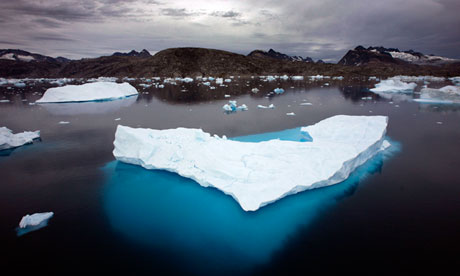
Why is the sea ice in the Arctic melting?
The melting of sea ice in the Arctic has caught the eye of the US Department of Homeland S
ecurity and the Pentagon. Photograph: John Mcconnico/AP
 
Senior US government officials are to be briefed at the White House this week on the danger of an ice-free Arctic in the summer within two years.

The meeting is being organised by a US brains trust on the Arctic consisting of Nasa's acting chief scientist, Gale Allen, the director of the US National Science Foundation, Cora Marett, as well as representatives from the US Department of Homeland Security and the Pentagon.

This is the latest indication that US officials are increasingly concerned about the international and domestic security implications of climate change.

Senior scientists advising the US government at the meeting include 10 Arctic specialists, including marine scientist Prof Carlos Duarte, director of the Oceans Institute at the University of Western Australia.

In early April, Duarte warned that the Arctic summer sea ice was melting at a rate faster than predicted by conventional climate models, and could be ice free as early as 2015 - rather than toward the end of the century, as the UN Intergovernmental Panel on Climate Change (IPCC) projected in 2007. He said:
"The Arctic situation is snowballing: dangerous changes in the Arctic derived from accumulated anthropogenic green house gases lead to more activities conducive to further greenhouse gas emissions. This situation has the momentum of a runaway train."
Duarte is lead author of a paper published last year in Nature Climate Change documenting how "tipping elements" in the Arctic ecosystems leading to "abrupt changes" that would dramatically impact "the global earth system" had "already started up". Duarte and his team concluded: "We are facing the first clear evidence of dangerous climate change."


New NASA satellite imagery from March 2013 reveals massive cracks in ice connecting Beaufort Gyre region to Alaska

New research suggests that the Arctic summer sea ice loss is linked to extreme weather. Rutgers University climate scientist Jennifer Francis points to the phenomenon of "Arctic amplification", where:
"The loss of Arctic summer sea ice and the rapid warming of the Far North are altering the jet stream over North America, Europe, and Russia. Scientists are now just beginning to understand how these profound shifts may be increasing the likelihood of more persistent and extreme weather."
Extreme weather events over the last few years apparently driven by the accelerating Arctic melt process - including unprecedented heatwaves and droughts in the US and Russia, along with snowstorms and cold weather in northern Europe – have undermined harvests, dramatically impacting global food production and contributing to civil unrest.

US national security officials have taken an increasing interest in the destabilising impact of climate change. In February this year, the US Department of Defense (DoD) released its new Climate Change Adaptation Roadmap, which noted that global warming will have:
"... significant geopolitical impacts around the world, contributing to greater competition for more limited and critical life-sustaining resources like food and water."
The effects of climate change may:
"Act as accelerants of instability or conflict in parts of the world... [and] may also lead to increased demands for defense support to civil authorities for humanitarian assistance or disaster response, both within the United States and overseas … DoD will need to adjust to the impacts of climate change on its facilities, infrastructure, training and testing activities, and military capabilities."
The primary goal of adaptation is to ensure that the US armed forces are "better prepared to effectively respond to climate change" as it happens, and "to ensure continued mission success" in military operations - rather than to prevent or mitigate climate change.
While the DoD is also concerned about the Arctic, the focus is less on risks than on opportunities:
"The Department is developing cooperative partnerships with interagency and international Arctic stakeholders to collaboratively address future opportunities and potential challenges inherent in the projected opening of the Arctic."
Arctic "stakeholders" include US, Russian, Canadian, Norwegian and Danish energy firms, which are scrambling to exploit the northern polar region's untapped natural wealth. The region is estimated to hold a quarter of the world's remaining undiscovered oil and gas reserves, sparking concerted efforts by these countries to expand their Arctic military presence.

The US Homeland Security Department's Climate Change Roadmap released last year raised similar issues, warning that climate change "could directly affect the Nation's critical infrastructure", as well as aggravating "conditions that could enable terrorist activity, violence, and mass migration".
On the Arctic, the report highlights the imperative to protect US resource interests by increasing regional military penetration:
"Melting sea ice in the Arctic may lead to new opportunities for shipping, tourism, and resource exploration, but the increase in human activity may require a significant increase in operational capabilities in the region in order to safeguard lawful trade and travel and to prevent exploitation of new routes for smuggling and trafficking."
A public statement in response to news of the White House's Arctic briefing released on Tuesday by the UK-based Arctic Methane Emergency Group (AMEG) - a group of international climate scientists – called on governments to recognise that the dramatic loss of summer sea ice in the Arctic would amplify the types of extreme weather events that have already affected the world's major food basket regions, undermining global food production for the foreseeable future with serious consequences for international security.

The group, which includes among its founding members leading Arctic specialists such as Prof Peter Wadhams, head of the Polar Ocean Physics Group at Cambridge University, stated that:
"The weather extremes from last year are causing real problems for farmers, not only in the UK, but in the US and many grain-producing countries. World food production can be expected to decline, with mass starvation inevitable. The price of food will rise inexorably, producing global unrest and making food security even more of an issue."
The AMEG statement adds that governments should consider geoengineering techniques - large-scale technological interventions in the climate system - to "cool the Arctic and save the sea ice" in order to avert catastrophe. Critics point out, however, that untested geoengineering technologies could have damaging unintended impacts on ecosystems, and that a regulatory framework is needed before embarking on major projects.

Dr Nafeez Ahmed is director of the Institute for Policy Research & Development and author of A User's Guide to the Crisis of Civilisation: And How to Save It.

• This article was amended on 7 May 2013. The original said the meeting was attended by Nasa's acting chief scientist, Gale Allen, the director of the US National Science Foundation, Cora Marett, as well as representatives from the US Department of Homeland Security and the Pentagon. It was in fact organised by a US brains trust that includes those parties.

http://www.guardian.co.uk/environment/earth-insight/2013/may/02/white-house-arctic-ice-death-spiral

Saturday, April 20, 2013

The Facts on Fracking etc. ......


The Facts on Fracking


In this March 29, 2013 photo, a worker helps monitor water pumping pressure and temperature, at an Encana Oil & Gas (USA) Inc. hydraulic fracturing and extraction site, outside Rifle, in western Colorado. (AP Photo/Brennan Linsley)

Hydraulic fracturing or fracking — a method of extracting natural gas from underground shale formations — has become a contentious issue across America, especially in New York, Pennsylvania, West Virginia and Ohio, states that sit on top of the Marcellus Shale, the largest known deposit of shale gas in America. The shale formation could contain nearly 500 trillion cubic feet of gas — enough to power all American homes for 50 years. Oil and mining companies want to get the gas out, but environmentalist groups say the process is not safe. Here are the facts:

What is fracking, and how is it used?

Hydraulic fracturing is a 60-year-old technology. In the 1940s, oil and gas companies learned that pressurized water, sand and chemicals could be injected into a shale formation to loosen the shale and release gas and oil. The chemicals dissolve minerals and kill bacteria, and the sand props open the fractures in the shale so the gas or oil can be released. In the 1990s, oil engineers in Texas began combining fracking techniques with horizontal drilling, using higher volumes of pressurized water and chemical cocktails to release natural gas trapped in shale formations that hadn’t been reachable through vertical drilling.

What are the benefits of fracking?

In the past decade, the use of fracking has transformed America’s energy industry. In 2000, shale gas made up one percent of America’s gas supplies; in 2011 it was 25 percent. Natural gas is cleaner than America’s other two primary sources of energy, coal and oil, and, while more expensive than coal, is far cheaper than oil.

The shale boom has also helped regions that are suffering economically, creating 72,000 jobs in Pennsylvania between 2009 and 2011.

What are the risks of fracking?

The chemicals that are injected into shale deposits during fracking in the U.S. include acids, detergents and poisons that can be harmful if they seep into drinking water. Trucking and storage accidents have caused spills of fracking fluids and the salty water used — called brine — also resulting in contaminated drinking water. Gas companies often do not disclose the composition of their fracking chemical cocktails, making it difficult to monitor the risks of each fracking project. Methane gas can also escape during fracking, creating the possibility of dangerous explosions.

After the fracking process, deposits of radioactive elements and huge concentrations of salt are left in the earth’s surface; in order to dispose of these deposits gas companies inject them into deep wells, in some cases triggering small earthquakes, as has already happened in eight U.S. locations. New Pennsylvania regulations enacted in 2011 require gas companies to recycle 90 percent of the briny water by reusing it to frack more shale.

Fracking allows us to burn what was until recently an unreachable fossil fuel reservoir, which leads to the release of more carbon dioxide into the atmosphere. In addition to the natural gas itself, both the methane gas that is a byproduct of extraction and the carbon dioxide that is created through burning that methane are greenhouse gases and contribute to global warming.

The New York State debate

Of the states over the Marcellus Shale formation, fracking is already underway in Ohio, Pennsylvania and West Virginia. Fracking is also being used to reach gas in states beyond the Marcellus deposit, notably North Dakota and Texas. But New York state policymakers have not yet decided whether fracking should be allowed in their state.

In September 2011, the New York State Department of Environmental Conservation released its recommendations for how the state can allow fracking without endangering New Yorkers with contaminated drinking water. The DEC recommended that fracking not take place within 2,000 feet of public drinking supplies or within 500 feet of private wells, unless approved of by the landowner.

The proposed rules would also ban fracking within the New York City and Syracuse watersheds. In March 2013, the Democrat-dominated State Assembly approved a two-year moratorium on fracking from the state’s southern border with Pennsylvania to the Catskills until there is “conclusive scientific evidence” on possible health and environmental risks. Conventional drilling, which uses shallower wells and far less water than high-volume fracking, has gone on for decades in New York.

Outside the U.S.

The practice is controversial outside of America as well. France and Bulgaria have the largest shale reserves in Europe; France banned fracking in 2001 due to environmental concerns, and Bulgaria banned it in 2012. Environmentalists are looking for similar bans in England and Poland.


Related Features


http://billmoyers.com/content/the-facts-on-fracking/


Sunday, November 25, 2012

Chesapeake Energy: Nah! Not our fault!

How many states have laws protecting their citizens?

http://www.facebook.com/photo.php?fbid=511288868889432&set=a.194724580545864.46567.107699875915002&type=1&theater
So much methane fizzes from Sherry Vargson’s tap that she can light it like a stove. The contamination began, she says, after Chesapeake Energy drilled on her Pennsylvania farm. The company denies responsibility. “I keep about three windows open year-round so we don’t blow up,” Vargson says.

http://ngm.nationalgeographic.com/2012/12/methane/thiessen-photography?source=hp_dl1_ngm_methane_gas201320121125#/07-contaminated-tap-water-670.jpg

Dangerous fracking? Naahhh, what could go wrong? We need jobs! ~Emine
So much methane fizzes from Sherry Vargson’s tap that she can light it like a stove. The contamination began, she says, after Chesapeake Energy drilled on her Pennsylvania farm. The company denies responsibility. “I keep about three windows open year-round so we don’t blow up,” Vargson says.

http://ngm.nationalgeographic.com/2012/12/methane/thiessen-photography?source=hp_dl1_ngm_methane_gas201320121125#/07-contaminated-tap-water-670.jpg

Dangerous fracking? Naahhh, what could go wrong? We need jobs! ~Emine

Tuesday, September 4, 2012

What's under the ice?

If you understand this, you'll understand why this is horrifying!


A new study suggests that there's more to fear from Antarctic melting than sea level rise. If the Antarctic ice sheet melts, it could release huge amounts of methane, a greenhouse gas significantly more powerful than CO2.

Read more: http://science.time.com/2012/08/29/antarctica-a-greenhouse-gas-hotspot/

 We can't afford to let it get that far, and we will do everything we can to stop it.


Saturday, June 23, 2012

Cuomo: 'Governor, What Color Will the Sky Be Over New York?

Worth watching!

New Anti-Fracking Film by Gasland's Josh Fox Targets Cuomo: 'Governor, What Color Will the Sky Be Over New York?'


POSTED: By Jeff Goodell


Gov. Andrew Cuomo of the great state of New York, I’d like you to meet Josh Fox. As you may know, Josh, who is 39, wrote and directed a film called Gasland, which I’m sure is at the top of your Netflix queue. In 2010, the film was nominated for an Academy Award for Best Feature Documentary and helped bring the world’s attention to the dangers of hydraulic fracturing, aka fracking. To put it another way, Josh is the guy who is largely responsible for the political minefield that you now find yourself tip-toeing through as you consider whether or not to lift the moratorium on fracking in New York State.

FYI, Josh is working on a sequel for HBO, called Gasland 2, which will be out later this year. But meanwhile, he has written and directed The Sky Is Pink – a short (18-minute) film that is, well, just for you, governor. You can watch it below.

I know fracking is a subject you've been giving a lot of thought to recently. In 2008, your predecessor, David Paterson, signed the moratorium on fracking in New York State, pending environmental review. Since then, we have all learned a lot about the risks of fracking – about how the toxic chemicals used can migrate into drinking water, about how methane can leak out of well casements, about the danger of disposing of billions of gallons of polluted wastewater the process produces. I know you have had teams of scientists from the New York State Department of Environmental Conservation studying all this. I‘m sure you have had teams of lobbyists from big gas companies like Chesapeake Energy pushing you and your team hard to declare fracking "safe" and to lift the moratorium ASAP.

Last week, someone in your administration – I won’t try to guess who! – leaked details of your administration’s plan to allow fracking to the New York Times. I’ll give you this: You didn’t allow Chesapeake and the other gas industry thugs to roll you entirely; among other things, the plan limits fracking to five counties in the southern tier of the state and places restrictions on drilling near drinking water supplies. Obviously, you're trying to appear rational and pragmatic about all this, talking about following "the science" while balancing economic development with environmental and public health concerns.

Well, guess what? When it comes to fracking, there isn’t much "science" to follow yet – there’s mostly just industry-funded propoganda. Not only that, but there are a whole lot of people in your state who don’t want you to balance anything. They’ve seen what has happened in Pennsylvania where the gas companies have run wild and they fear that once the drillers get their bits into the ground in New York, it’s a mad rush to ruin.

This reaction from Maya van Rossum, the Delaware Riverkeeper – the Delaware River is part of the New York watershed – is pretty typical: "How can Governor Cuomo consider allowing shale gas development when the state’s environmental study is so riddled with holes and unaddressed pollution and public health issues? How can Governor Cuomo allow shale gas drilling in New York when he can see how many citizens and communities are getting sick, hurt and traumatized from the practice in other states? And how can New York pretend it is safe to drill in some counties and not in others – especially when science shows the pollution problems are the result of drilling and fracking shale formations, not where or how deep these well bores go?"

Fred LeBrun, a political columnist at the Albany Times Union, noticed that you seemed taken aback by the ferocity of the reaction to your proposal: "Once the story of the state's supposed plan was in play, the governor went out of his way to neither confirm nor deny it was correct, yet he couldn't stop talking around it while never really saying anything. At least not believable. "What came out was vintage Cuomo's Deli, where you can get any cold cut you want as long as it's baloney, sliced anyway you want to hear it."

These are treacherous waters for you, governor. Remember all the trouble your dad had with the anti-nuke activists on Long Island in the 1980s? Fracking could be a similar quagmire for you, especially given your immodest aspirations to the Oval Office.

Anyway, the guy you really gotta come to terms with is Josh Fox. Because this little film about the troubles with fracking in New York is pretty damn good. Among other things, he’s got some damning info from the industry on well failures that you might want to have a look at. Whatever you think of the film, one thing is for sure: It’s gonna be seen by a lot of people – a lot of voters, governor. So as you ponder how and when to lift the ban on fracking in New York, give it a look. Journalists like myself will be interested to hear your response to the question Josh addresses to you at the end of the film: "Governor Cuomo, what color will the sky be over New York?"


http://www.rollingstone.com/politics/blogs/national-affairs/new-anti-fracking-film-by-gaslands-josh-fox-targets-cuomo-governor-what-color-will-the-sky-be-over-new-york-20120620#ixzz1yeJa7m2A