Search This Blog

Translate

Blog Archive

Middleboro Review 2

NEW CONTENT MOVED TO MIDDLEBORO REVIEW 2

Toyota

Since the Dilly, Dally, Delay & Stall Law Firms are adding their billable hours, the Toyota U.S.A. and Route 44 Toyota posts have been separated here:

Route 44 Toyota Sold Me A Lemon


Showing posts with label pesticide exposure. Show all posts

Sunday, October 27, 2013

Killer fungus endangering bats spreads to Cape

Several years ago, amidst the mosquito hysteria in Plymouth County, the pesticide spraying decimated the bat population. [Spraying was at dusk and dawn, prime hours for bat predation of mosquitoes.] 

While we previously could enjoy prime mosquito hours unaffected, their absence has been noted.  [The aerial spraying not only decimated bat populations, but other mosquito predators as well.]

Maybe at some point, we'll have the common sense to re-think our application of chemical pesticides.

http://www.wbrcouncil.org/Departments/Mosquito-Abatement/Natural-Mosquito-Killers


Killer fungus endangering bats spreads to Cape


By Patrick Cassidy
October 27, 2013

BARNSTABLE — Proving its ability to reach even the most far-flung and atypical locations, a killer fungus that has decimated bat populations across the Northeast over the past seven years arrived on Cape Cod last winter in an unlikely carrier.

Although the region is not a major hub for hibernating bats, the furry fliers travel to the Cape during the summer, feasting on mosquitoes and other insects humans commonly consider a nuisance.

A year ago, a handful of northern long-eared bats were found locally suffering from white-nose syndrome, which thrives in the moist, cold caves where many bats hibernate, forcing them from their torpor and into the cold weather, typically resulting in death.

"They're dehydrating as well as being starved," said Lynn Miller, director of wildlife rehabilitation at the Cape Wildlife Center in Barnstable.

The syndrome confirmed in the long-eared bats was not only a first for the deadly fungus in the region but also for the species of bat being found on the Cape, said Miller.

As part of a series of Halloween-themed events at the center today, Miller and other staff are kicking off "Year of the Bat" to get the word out about the white-nose syndrome's effect on the bats of the Cape and beyond.

"It has flattened the populations, and it continues to move south and west," Miller said. "Last year, I didn't see bats in the air."

The rehabilitation center is trying to make itself a go-to resource for bats, including educational programs and participation in a survey of bats on the Cape, and also plans to build a free-standing bat aviary to give them a place to fly and gain strength before being released. Last week center staff moved three big brown bats into a specially reinforced screened enclosure in the attic of a barn used for species susceptible to rabies such as coyotes and raccoons.

The bats, one of which was found in Falmouth and another in Framingham, were weak but not suffering from white-nose syndrome when they were brought to the center, facility director Deborah Millman said.

The Framingham bat, which was transferred to the Cape through the state's Division of Fisheries and Wildlife and Tufts University School of Veterinary Medicine Wildlife Clinic, was pregnant, Millman said. Although one of the babies died, the other survived and is doing well, she said.

Inside their new home, the bats were placed in a bat box hung near an open window covered with webbing to keep them from getting out but let their winged dinner in. Branches were arranged along the walls of the enclosure so the bats could crawl back up to the box if they needed to, but it left plenty of flight space. A light dangled from the tented ceiling to attract insects at night.

"We will take your bugs," Miller said.

Staff at the center also set up a camera to track the bats' progress during the night, Millman said.

Big brown bats typically hibernate in attics, making the species less prone to the white-nose syndrome, said Thomas French, assistant director for the state Division of Fisheries and Wildlife's Natural Heritage and Endangered Species Program.

"The ones that go to mines and caves, they died," he said.

For the little brown bat, which congregates in caves and mines in the western part of the state and elsewhere during the winter, the combination of cold weather and moisture has been deadly, French said.

In Massachusetts and other states, mortality among little brown bats since white-nose syndrome was first found in the United States in February 2006 has been as high as 98 percent, French said.

Bats that roost in trees, such as the hoary, red and silver-haired, aren't affected by the disease, he said.

The Cape has never had a substantial number of hibernating bats because of a lack of large spaces with the appropriate temperatures, French said.

"It's got to be a place that never freezes," he said.

The northern long-eared bats may have been hibernating in storm drains, French said.

If a homeowner finds a colony of bats in their home, they shouldn't evict them during the winter when they will die, or during the middle of the summer when baby bats may be present, French said. The fall and spring are the best time to remove bats from the home, which can be done by finding out how they are getting in and setting up a one-way door so that they can leave but can't come back, he said.

Homeowners can also set up a bat box nearby so the animals have someplace to go.

Both French and the staff at the Cape Wildlife Center hope homeowners will do what they can to help bats, which serve a useful purpose in keeping insect populations in check.

Homeowners who find bats that appear injured should be careful but try to get the animal to the Wildlife Center, she said.

Using gloves and avoiding contact with the animal is especially important because of rabies concerns. A Marstons Mills man died from the disease in 2012 after being bitten by a bat.

But, for the time being, bats appear to be in more danger than humans.

French is hopeful some members of the species most affected by white-nose syndrome will survive and be the start of a resistant population like those in Europe, where the fungus is believed to have originated. So far, however, there is little anyone can do to stop it, French said.

"The question is will it spread all the way to the Pacific Coast and how far south will it go," French said.


http://www.capecodonline.com/apps/pbcs.dll/article?AID=/20131027/NEWS/310270337/-1/NEWSLETTER100

Wednesday, October 23, 2013

Argentina Is Using More Pesticide Than Ever Before. And Now It Has Cancer Clusters.

Interesting article by Tom Philpott......

[Eye-opening graphs available in link below.]

Argentina Is Using More Pesticide Than Ever Before. And Now It Has Cancer Clusters.


| Wed Oct. 23, 2013
 

Argentina's agricultural transformation over the past 20 years—from prime producer of grass-finished beef to one of the globe's genetically modified crop-producing powerhouses—is often hailed as triumph of high-tech ag. Starting in the 1970s and accelerating recently, high crop prices and various government policies inspired ranchers in the fertile Pampas and Chaco regions to plow up pasture—releasing large amounts to carbon in the process—to plant soybeans, mainly for export markets. In the mid-1990s, when Monsanto rolled out its soybean seeds engineered to resist herbicide, Argentina's new crop farmers were early adapters (see chart to the right).

Sergio H. Lence, "The Agricultural Sector in Argentina: Major Trends and Recent Developmebts," 2010

Today, Argentina is the globe's third-largest soy producer—and nearly 100 percent of its soy crop is genetically altered. The trend has certainly benefited the GMO seed and agrichemical industry—as the below charts show, herbicide, pesticide, and fertilizer use has soared over the past 15 years.

But what about the people who live in the country's agricultural regions? A recent article by Associated Press reporters Michael Warren and Natacha Pisarenko paints a grim picture of life in the farm belt in the age of industrial corn and soy:

In Santa Fe, cancer rates are two times to four times higher than the national average. In Chaco, birth defects quadrupled in the decade after biotechnology dramatically expanded farming in Argentina.

The story quotes a pediatrician and neonatologist names Medardo Avila Vazquez, who has been moved to found a group called Doctors of Fumigated Towns. "We've gone from a pretty healthy population to one with a high rate of cancer, birth defects, and illnesses seldom seen before," he tells Warren and Pisarenko.

GMO seed giant Monsanto—whose soybean and corn seeds engineered to withstand its own herbicide, Roundup (glyphosate), blanket the nation's farmland—denies responsibility for the possible link between agrichemicals and rising rates of health disorders, the AP writers report. The company "does not condone the misuse of pesticides or the violation of any pesticide law, regulation, or court ruling," A Monsanto spokesperson told Warren and Pisarenko.


Even so, Warren and Pisarenko found pesticide use to be at best lightly regulated. "With soybeans selling for about $500 a ton, growers plant wherever they can, often disregarding Monsanto's guidelines and provincial law by spraying with no advance warning, and even in windy conditions," they write.

Meanwhile, provincial restrictions against spraying too close to residential areas are often honored in the breach. The AP story features multiple accounts of people coming into direct contact with agrichemical sprays—just because they lived near farm fields. In one town, teachers reported students getting doused by chemical sprayers during class. In another, a government study found pesticide traces in the blood of 80 percent of children.

The authors make clear that one major driver of Argentina's surging herbicide use is that weeds there have developed resistance to Monsanto's flagship herbicide, Roundup. Just as they've done in the US, farmers there have responded by jacking up their doses of Roundup and adding "much more toxic poisons, such as 2,4,D, which the US military used in 'Agent Orange' to defoliate jungles during the Vietnam War."

Even Roundup's reputation as a relatively benign agrichemical has come under fire from Argentine researchers alarmed at the effect this chemical deluge might be having on people. In a 2010 paper, a research team led by the University of Buenos Aires professor Andrés E. Carrasco found that "injecting a very low dose of glyphosate [Roundup's active ingredient] into embryos can change levels of retinoic acid, causing the same sort of spinal defects in frogs and chickens that doctors increasingly are registering in communities where farm chemicals are ubiquitous," Warren and Pisarenko report. Monsanto disputes the study's findings, claiming they were undermined by flawed methodology and "unrealistic exposure scenarios."

Meanwhile, the epidemiological evidence—health assessments people living near chemical-intensive farms—is unsettling. In the Chaco region, a study of 2,051 people in six towns turned found "significantly more diseases and defects in villages surrounded by industrial agriculture than in those surrounded by cattle ranches," the AP reports. "In Avia Terai, 31 percent said a family member had cancer in the past 10 years, compared with 3 percent in the ranching village of Charadai."

It's worth noting that that Argentina's Pampas region—another place where both chemical use and rates of cancer and birth defects have risen—is widely known for its highly productive form of traditional agriculture, which produces top-quality grass-finished meat and a surplus of grain as well. Michael Pollan described it in his famous 2009 essay "Farmer-in-Chief":
There, in a geography roughly comparable to that of the American farm belt, farmers have traditionally employed an ingenious eight-year rotation of perennial pasture and annual crops: after five years grazing cattle on pasture (and producing the world’s best beef), farmers can then grow three years of grain without applying any fossil-fuel fertilizer. Or, for that matter, many pesticides: the weeds that afflict pasture can’t survive the years of tillage, and the weeds of row crops don’t survive the years of grazing, making herbicides all but unnecessary.
Pollan even help up the Pampas system as a model for reforming our own chemically ravenous agriculture: "There is no reason—save current policy and custom—that American farmers couldn’t grow both high-quality grain and grass-fed beef under such a regime through much of the Midwest."
But he added, presciently, that "today’s sky-high grain prices are causing many Argentine farmers to abandon their rotation to grow grain and soybeans exclusively, an environmental disaster in the making."

Tom Philpott

Food and Ag Correspondent
Tom Philpott is the food and ag correspondent for Mother Jones. For more of his stories, click here. To follow him on Twitter, click here. RSS |

If You Liked This, You Might Also Like...

Saturday, April 20, 2013

“Dance of the Honey Bee”


“Dance of the Honey Bee”

April 19, 2013
Bill presents and introduces the short documentary “Dance of the Honey Bee.” Narrated by Bill McKibben, the film takes a look at the determined, beautiful and vital role honey bees play in preserving life, as well as the threats bees face from a rapidly changing landscape. “Not only are we dependent on the honey bee for much of what we eat,” says Bill, “there is, of course, a grace and elegance they bring to the natural world that would diminish us all were they to disappear.”
Producer, Director, Photographer & Editor: Peter Nelson.

 Narrator: Bill McKibben. Original music: John Powell. Audio: Merce Williams.
Intro Producer: Lena Shemel. Intro Editor: Paul Desjarlais.

http://billmoyers.com/segment/%E2%80%9Cdance-of-the-honey-bee%E2%80%9D/

Wednesday, April 10, 2013

We have so totally saturated our household and work environments with chemicals, attempting to identify the culprit is a challenge.

In our efforts to smell nice, sleep on sheets artificially perfumed to smell like 'outdoors,' remove wrinkles, mousse our hair with unidentifiable slime, put bizarre chemicals on our nail-beds to be absorbed, irrationally pursue an unnaturally green lawn, rid our house and air of naturally occuring bugs the composition of which we don't comprehend and accept whatever advertised insanity is marketed, do we wonder why we and our kids get sick?


Steward Health Care has defended its 'laundering practice,' going around endless circles that were unintended. When I protested an 'allergy,' assurances were offered of preferential treatment and special linens, ignoring that the offending allergens become airborne and effect a compromised community.

Manufacturers of household chemicals, laundry detergent and common household products are not required to disclose their ingredients, making elimination or avoidance impossible.

While Monsanto has justifiably become the target of recent concern, how are we to avoid chemical exposure?


The 'household products' we use are solely simple, commonly available products - vinegar, baking soda and so on. Any other ideas?


What Every Parent Should Know About Monsanto

by Toni Nagy
image copyright unknown

Keeping our children from harm in today’s chemically-saturated world is one of the great challenges of modern parenting. The more I read the news, the more I want to look for toddler-sized quarantine suits on Etsy, but the most proactive way I can protect my daughter is to keep myself educated on these issues — even if that means I get forehead wrinkles from excessive worry. In addition to the health of my child, I fear for the ecological health of the planet. Last time I checked, Earth is the only place we have to live, and what kind of future am I providing for my daughter if I am not cognizant of how my life, and the decisions of my government, effect our environment? That is why every parent should be aware of the Monsanto Protection Act and what it means for their family.

When President Obama signed the Monsanto Protection Act, many citizens were outraged by this blatant violation of the Constitution. By approving this act, Obama has allowed Monsanto to exist above the law, since genetically modified seeds are now protected from any litigation involving health risks. That is strange, right? If you were confident in your product, why would you be concerned about lawsuits involving health risks? You may wonder how this applies to you, considering you don’t buy Monsanto-Oh’s for breakfast, but essentially, you are. Monsanto’s genetically engineered corn, soy, wheat and beet crops have infiltrated our entire food system, and you could be eating their products every day and not even realizing it.
Many people, including children, have developed deadly allergies to peanuts and other food products. Imagine the trauma for a child who has to deal with their mortality every time they eat — how terrifying for the affected kids and their parents. According to PBS.org, “Some critics of GM foods feel that the possibility exists that those genetically modified food crops may unintentionally introduce a new allergen — for example, a fish gene can be put into a plant…. ” Although I am fan of sushi, I don’t really think it is necessary to cross-breed it with my strawberries — especially considering the potential adverse reaction. PBS then goes on to explain, “Another potential hazard is the possibility that bacteria in our guts could pick up antibiotic-resistant genes found in many GM foodstuffs… in principle, it could exacerbate the already worrisome spread of disease-causing bacteria that have proven able to withstand our antibiotics.”

Beyond frightening and unforeseen potential consequences to human health, there are some serious ecological effects we can’t afford to ignore. Traditionally, farmers around the world have saved seeds in order to cultivate a variety of strands to help maintain bio-diversity, particularly heirloom varieties, some of which may have been developed hundreds of years ago or more. Monsanto requires farmers to sign contracts on their seed that cannot legally be used the next season, and therefore the farmers have to purchase new seed annually. These GMO seeds are used only in monocrop farming type operations, which are not environmentally friendly or sustainable for their own reasons even without the GMOs, pesticides, and petrochemical fertilizer. So when you drive cross-country, one-third of the time you will be staring at corn and soy fields making you wish the Children of the Corn will emerge and eat your eyeballs directly out of your sockets. Massive fields with one crop, created from one seed, become very susceptible to pests — hence the creation of pesticides. And because there is no crop-rotation to replenish fields, the pesticides often continue to build up over time.

I know organic is a bit more expensive, but that is largely because organic farmers don’t receive the subsidies that GM farmers do. It is not like organic farmers are blinged out in diamonds because of all their profit from kale. They are barely scraping by trying to compete in a marketplace dominated by agribusiness. And think of it this way — until the 1940s the whole world ate organic all the time.

Because that was all there was. Of course this is a very complicated issue because millions of people are dependent on GM crops to survive, but as an individual with purchasing power, how you spend your money will dictate where the market will start to lean. Supporting local farmers and getting involved with CSA‘s (community supported agriculture) will keep your costs down. And, of course, the more people who buy food grown without GMOs, the more companies will move in that direction.

It can be difficult to make an assessment for yourself of the personal and environmental risks of genetically engineered crops, because both the pro and con sides of the argument are very impassioned. You can find massive amounts of research pointing you in either direction, and that in and of itself should be a major warning sign. That the long-term consequences of these products are not yet understood means that we, the consumers, are essentially the test subjects of a global experiment involving our entire food system. What kind of responsible scientist uses humans as their guinea pigs? Not to throw the mice and rats under the bus, but I would much prefer we test on them for a few decades instead of using our children.
Toni Nagy

- Blogger, tonibologna.com

Follow Toni Nagy on Twitter: www.twitter.com/tonibolognamind


About Fritz Kreiss

Fritz Kreiss is the founding head of Occupy Monsanto. He has a history in natural health, nutrition, herbal medicine, Eastern Medicine, acupuncture, kinesiology, physiology, and many years of practice as a professional massage therapist and teacher.


Saturday, January 5, 2013

New Pesticide Link to Parkinson's

Below is the latest link to Parkinson's disease which highlights the need for caution in their application --

From: David A Gabel, ENN
Published January 4, 2013

New Connection Links Parkinson's Disease with Pesticide Exposure

 
Scientific evidence already has connected pesticide exposure with an increased risk of Parkinson's disease. Chemicals like paraquat, maneb, and ziram, commonly found in pesticides have been found in farmworkers and others living and working near the fields, and are tied to an increase in the disease. New research has identified another chemical from pesticides, benomyl, that is linked to Parkinson's. The toxic effects of benomyl are still found in the environment, even 10 years after the chemical was banned by the EPA. This chemical triggers a series of cellular events leading to Parkinson's.

Parkinson's is a degenerative disorder of the central nervous system. The most obvious symptoms are involuntary shaking, rigidity, slower movement, and difficulty walking or walking with a gait. As it advances, it can lead to dementia, sensory, sleep, and emotional problems. Famous individuals who suffer from the disease include actor Michael J. Fox and boxer Muhammad Ali.

Benomyl exposure begins the process of Parkinson's by blocking the enzyme called ALDH, which is an enzyme responsible for preventing a toxin called DOPAL from accumulating in the brain. If the enzyme is blocked, DOPAL in the brain will eventually damage neurons and increase the risk of the disease.

For three decades, benomyl was used widely in pesticides in the USA. Evidence began to arise identifying its toxic effects including tumors, brain malfunction, carcinogenesis, and reproductive disorders. Benomyl was banned in 2001.

The new research conducted at the University of California, Los Angeles (UCLA) made the connection between benomyl and Parkinson’s. Most importantly, they identified the target enzyme, ALDH. This enzyme can be the focus of future research. If there is a way to prevent ALDH from being blocked by bodily contaminants, then the DOPAL could never build up and damage the nervous system.

"We've known that in animal models and cell cultures, agricultural pesticides trigger a neurodegenerative process that leads to Parkinson's," said Bronstein, who directs the UCLA Movement Disorders Program. "And epidemiologic studies have consistently shown the disease occurs at high rates among farmers and in rural populations. Our work reinforces the hypothesis that pesticides may be partially responsible, and the discovery of this new pathway may be a new avenue for developing therapeutic drugs."

The study has been published in the Proceedings of the National Academy of Sciences
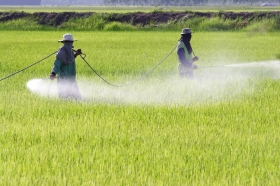
Pesticide Spraying image via Shutterstock


http://www.enn.com/top_stories/article/45416