Priceless!
Showing posts with label Koch-roaches. Show all posts
Showing posts with label Koch-roaches. Show all posts
Tuesday, November 5, 2013


Saturday, October 19, 2013
![From @[216484961711918:274:Steve Marmel]. Give his page a LIKE!
www.aattp.org](https://scontent-a-lga.xx.fbcdn.net/hphotos-prn2/s403x403/1381737_616447898397398_434592431_n.png)
Friday, October 18, 2013
How the 16-Day Government Shutdown Significantly Impacted Health and the Environment
When I listen to the Tea Party Jackasses defend the Shutdown and argue their mindless position for the Koch Brothers, the damage their failed economics has caused is simply indefensible.
Those same Tea Party Jackasses have no comprehension of the policies and functions government fulfills.
The Tea Party Jackasses would defend the march to become nothing more than a Banana Republic and join hands with the Dirty Energy Koch Brothers because they haven't figured out that they've been used. Check this out: The 1 percent played Tea Party for suckers
If you have insomnia, check these out:
By Frances Beinecke
After 16 long days, the government shutdown has finally come to an end. It is relief to know that hundreds of thousands public servants can return to work and that critical programs protecting our health and the environment will fully function once again. But any sense of reassurance is tempered by two simple facts: we never should have been here in the first place, and we could easily be in the same position again in January.

Political extremists pushed our nation to the brink out of sheer obstinance. House Speaker Boehner (R-OH) could have ended this days ago by simply letting the full House vote on reopening the government. Instead, he declared himself a willing hostage to the radical wing of his party. The shutdown caused real damage. It undermined critical efforts to protect the air we breathe, the water we drink and the places we love.
The reopening of the government and avoiding default are obviously good news. But the deal that allowed it to happen should be a signal to the environmental community to gird for the battles ahead.
The deal puts off the big fights for just a couple of months. House Republicans had a long list of anti-environmental provisions they threatened to add to the debt limit before the Affordable Care Act became their single-minded focus, and they could be part of the brinksmanship next time around.
These destructive riders include approving the Keystone XL pipeline for dirty tar sands oil and requiring all coastal waters to be leased for offshore drilling. There’s also the proposal to destroy the regulatory system by requiring Congressional approval for all new environmental and other safeguards.
We could also face another battle over spending. House Republicans have voted this year for draconian cuts in environmental programs and for continuing the “sequester” that eats away at the capabilities of all agencies. GOP lawmakers are likely to push these bad ideas going into the upcoming budget talks. The federal budget should not be balanced by slashing the services the public depends upon.
People who care about health and the environment must be vigilant in the coming months. We have to let lawmakers know how much we value government programs that safeguard the air we breathe, the water we drink and the places we love.
The past 16 days revealed just how critical those efforts are and how quickly they can be undermined. Here is a brief list how the government shutdown eroded environmental protection.
Tainted Chickens Come Home to Roost
One week into the shutdown, the government issued an alert that a major salmonella outbreak that had already struck nearly 300 people in 18 states. While the Agriculture Department’s Food Safety and Inspection Service remained largely on the job, furloughs hit the national foodborne detection services at the Centers for Disease Control and Prevention (CDC) hard. Indeed, CDC experts had to be called back to cope with the outbreak. At the Food and Drug Administration, all inspections of imported food stopped during the shutdown, despite the fact that the U.S. imports about 80 percent of the seafood and more than 20 percent of produce Americans eat.
Cleanup of Toxic Chemicals at Superfund Sites Halted
Cleanup work on many of the 800 contaminated federal Superfund sites stopped during the shutdown. Now countless people will have to put up with toxic waste longer. People like those living in Lockport, NY, where the U.S. Environmental Protection Agency (EPA) is finalizing a plan to relocate homeowners because of PCB, lead and other contaminants. Or Doylestown, PA, where residents are waiting for soil excavation to begin at the contaminated ChemFab property, which polluted nearby well water with TCE, a chemical linked to liver, kidney and lung cancer.
National Parks and Wildlife Refuges Put Off Limits
The shutdown prevented Americans from visiting our public lands in parks and refuges across the country. It will be easy to reopen those iconic places, but it will be nearly impossible to recover the ruined family vacations, the once-in-a-lifetime rafting trips down the Colorado River and the lost economic activity from hundreds of thousands of tourists, hunters and fishermen. Visitors typically spent $13 billion a year within 60 miles of the national parks, but gateway communities got very little business during the shutdown—which for many fell right during their peak season.
Nuclear Safety Personnel Furloughed; What Could Go Wrong?
The Nuclear Regulatory Commission (NRC), had to send all but about 300 of its 3,900 workers home. It cancelled all emergency preparedness exercises and routine inspections of nuclear materials and waste licensees, among many functions. Among the ongoing projects put on hold by the shutdown: the NRC’s oversight of safety upgrades to nuclear power plants that were ordered after the 2011 nuclear disaster in Fukushima, Japan. That accident involved meltdowns and radioactive releases from multiple reactors that are similar in design to many U.S. reactors.
Shutdown Forced the EPA to Hit the Brakes
The agency charged with keeping pollution out of our air and water nearly ground to a halt when about 94 percent of its staff was furloughed. That meant permits couldn’t be issued, no one was checking to ensure environmental laws are being followed at factories and other industrial facilities, and work on safeguards came to a standstill.
http://ecowatch.com/2013/10/17/government-shutdown-impacted-health-and-environment/
Those same Tea Party Jackasses have no comprehension of the policies and functions government fulfills.
The Tea Party Jackasses would defend the march to become nothing more than a Banana Republic and join hands with the Dirty Energy Koch Brothers because they haven't figured out that they've been used. Check this out: The 1 percent played Tea Party for suckers
If you have insomnia, check these out:
Have you had enough?
Tea Party Shows Racist Roots at White House Protest
Red states discover the pain of paying their own way
Why Giving Republican Bullies a Bloody Nose Isn’t Enough
The Republican Taliban Hoped you wouldn't notice......
Inside the Republican Suicide Machine
Thank you Senator Sanders!
The Koch Brothers’ ‘Samson Option’
Will Republicans Force Seniors, Veterans, the Poor Pay for their failures?
Getting ready for the next election!
Finding Common Ground In The Midst Of A Shutdown
Koch-Roaches....ALEC....Cape Wind Opposition....Climate Change Deniers...DIRTY ENERGY....have you figured it out?
This, that and Tea Baggers
Tea Party Jackasses
The U.S. can no longer compete and is not competing because of this level of extremism. Will the Tea Baggers figure out they were used?
The U.S. can no longer compete and is not competing because of this level of extremism. Will the Tea Baggers figure out they were used?
How the 16-Day Government Shutdown Significantly Impacted Health and the Environment
By Frances Beinecke
After 16 long days, the government shutdown has finally come to an end. It is relief to know that hundreds of thousands public servants can return to work and that critical programs protecting our health and the environment will fully function once again. But any sense of reassurance is tempered by two simple facts: we never should have been here in the first place, and we could easily be in the same position again in January.
House Speaker John Boehner (R-OH).
Political extremists pushed our nation to the brink out of sheer obstinance. House Speaker Boehner (R-OH) could have ended this days ago by simply letting the full House vote on reopening the government. Instead, he declared himself a willing hostage to the radical wing of his party. The shutdown caused real damage. It undermined critical efforts to protect the air we breathe, the water we drink and the places we love.
The reopening of the government and avoiding default are obviously good news. But the deal that allowed it to happen should be a signal to the environmental community to gird for the battles ahead.
The deal puts off the big fights for just a couple of months. House Republicans had a long list of anti-environmental provisions they threatened to add to the debt limit before the Affordable Care Act became their single-minded focus, and they could be part of the brinksmanship next time around.
These destructive riders include approving the Keystone XL pipeline for dirty tar sands oil and requiring all coastal waters to be leased for offshore drilling. There’s also the proposal to destroy the regulatory system by requiring Congressional approval for all new environmental and other safeguards.
We could also face another battle over spending. House Republicans have voted this year for draconian cuts in environmental programs and for continuing the “sequester” that eats away at the capabilities of all agencies. GOP lawmakers are likely to push these bad ideas going into the upcoming budget talks. The federal budget should not be balanced by slashing the services the public depends upon.
People who care about health and the environment must be vigilant in the coming months. We have to let lawmakers know how much we value government programs that safeguard the air we breathe, the water we drink and the places we love.
The past 16 days revealed just how critical those efforts are and how quickly they can be undermined. Here is a brief list how the government shutdown eroded environmental protection.

Tainted Chickens Come Home to Roost
One week into the shutdown, the government issued an alert that a major salmonella outbreak that had already struck nearly 300 people in 18 states. While the Agriculture Department’s Food Safety and Inspection Service remained largely on the job, furloughs hit the national foodborne detection services at the Centers for Disease Control and Prevention (CDC) hard. Indeed, CDC experts had to be called back to cope with the outbreak. At the Food and Drug Administration, all inspections of imported food stopped during the shutdown, despite the fact that the U.S. imports about 80 percent of the seafood and more than 20 percent of produce Americans eat.
Cleanup of Toxic Chemicals at Superfund Sites Halted
Cleanup work on many of the 800 contaminated federal Superfund sites stopped during the shutdown. Now countless people will have to put up with toxic waste longer. People like those living in Lockport, NY, where the U.S. Environmental Protection Agency (EPA) is finalizing a plan to relocate homeowners because of PCB, lead and other contaminants. Or Doylestown, PA, where residents are waiting for soil excavation to begin at the contaminated ChemFab property, which polluted nearby well water with TCE, a chemical linked to liver, kidney and lung cancer.
National Parks and Wildlife Refuges Put Off Limits
The shutdown prevented Americans from visiting our public lands in parks and refuges across the country. It will be easy to reopen those iconic places, but it will be nearly impossible to recover the ruined family vacations, the once-in-a-lifetime rafting trips down the Colorado River and the lost economic activity from hundreds of thousands of tourists, hunters and fishermen. Visitors typically spent $13 billion a year within 60 miles of the national parks, but gateway communities got very little business during the shutdown—which for many fell right during their peak season.
Nuclear Safety Personnel Furloughed; What Could Go Wrong?
The Nuclear Regulatory Commission (NRC), had to send all but about 300 of its 3,900 workers home. It cancelled all emergency preparedness exercises and routine inspections of nuclear materials and waste licensees, among many functions. Among the ongoing projects put on hold by the shutdown: the NRC’s oversight of safety upgrades to nuclear power plants that were ordered after the 2011 nuclear disaster in Fukushima, Japan. That accident involved meltdowns and radioactive releases from multiple reactors that are similar in design to many U.S. reactors.
Shutdown Forced the EPA to Hit the Brakes
The agency charged with keeping pollution out of our air and water nearly ground to a halt when about 94 percent of its staff was furloughed. That meant permits couldn’t be issued, no one was checking to ensure environmental laws are being followed at factories and other industrial facilities, and work on safeguards came to a standstill.
http://ecowatch.com/2013/10/17/government-shutdown-impacted-health-and-environment/
Wednesday, October 16, 2013
The Furies Never End
Interesting perspective on the lunatic fringe of the Republican Party:

Sen. Ted Cruz (R-TX) is the latest in a long line government saboteurs. (photo: AP)

 he great government shutdown of 2013 was barely a day old, and already blue America was running out of comic put-downs to hurl at the House's wrecking crew. Not content with "morons" and "dunderheads," Jon Stewart coined new epithets for the occasion (e.g., "bald-eagle fellators").
Politicians you wouldn't normally confuse with Don Rickles joined in too—not just the expected Democrats like Harry Reid, who had opted for "banana Republicans," but blue-state Republicans like Devin Nunes of California, who dismissed his own congressional peers as "lemmings with suicide vests."
Sen. Ted Cruz (R-TX) is the latest in a long line government saboteurs. (photo: AP)
The Furies Never End
15 October 13
The shutdown crisis is nothing we haven't seen before.A good portion of America has been trying to sabotage the government for almost our entire history.
he great government shutdown of 2013 was barely a day old, and already blue America was running out of comic put-downs to hurl at the House's wrecking crew. Not content with "morons" and "dunderheads," Jon Stewart coined new epithets for the occasion (e.g., "bald-eagle fellators"). Politicians you wouldn't normally confuse with Don Rickles joined in too—not just the expected Democrats like Harry Reid, who had opted for "banana Republicans," but blue-state Republicans like Devin Nunes of California, who dismissed his own congressional peers as "lemmings with suicide vests."
Implicit in this bipartisan gallows humor was an assumption shared by most of those listening: The non-legislating legislators responsible for the crisis are a lunatic fringe—pariahs in the country at large and outliers even in their own party. They're "a small faction of Republicans who represent an even smaller fraction of Americans," as the former Obama speechwriter Jon Favreau put it in the Daily Beast. By this line of reasoning, all that kept them afloat was their possession of just enough votes in their divided chamber to hold the rest of America temporarily hostage to their incendiary demands.
Would that this were so, and that the extralegal rebellion against the Affordable Care Act, a Supreme Court - sanctified law of the land, would send the rebels, not the country, off a cliff. Off the cliff they may well have gone in this year's failed coup, but like Wile E. Coyote, they will quickly climb back up to fight another day. That's what happened after the double-header shutdowns of 1995 - 96, which presaged Newt Gingrich's beheading but in the long run advanced the rebels' cause. It's what always happens. The present-day anti-government radicals in Congress, and the Americans who voted them into office, are in the minority, but they are a permanent minority that periodically disrupts or commandeers a branch or two of the federal government, not to mention the nation's statehouses.
Their brethren have been around for much of our history in one party or another, and with a constant anti-democratic aim: to thwart the legitimacy of a duly elected leader they abhor, from Lincoln to FDR to Clinton to Obama, and to resist any laws with which they disagree. So deeply rooted are these furies in our national culture that their consistency and tenacity should be the envy of other native political movements.
Yet we keep assuming the anti-government right has been vanquished after its recurrent setbacks, whether after the Clinton-impeachment implosion or the Barry Goldwater debacle of 1964 or the surrender at Appomattox. A Democratic victory in the 1982 midterms was all it took for David Broder, then the "dean" of Beltway pundits, to write off Reaganism as "a one-year phenomenon."
When polls showed a decline in support for the tea-party brand last year, it prompted another round of premature obituaries. But the ideological adherents of tea-party causes, who long predate that grassroots phenomenon of 2009, never went away, whatever they choose to label themselves. In recent months, both The Wall Street Journal and the Washington Post had to scramble to assemble front-page stories spotting a tea-party comeback. Even so, it took only one week into the shutdown for a liberal pundit at the Post to declare that we were witnessing "the tea party's last stand."
That last stand has been going on for almost 200 years. At the heart of the current rebels' ideology is the anti-Washington credo of nullification, codified by the South Carolina politician John C. Calhoun in the 1830s and rarely lacking for avid followers ever since. Our inability to accept the anti-government right's persistence is in part an astonishing case of denial. The Gingrich revolution, the Ur-text for this fall's events, took place less than twenty years ago and yet was at best foggily remembered as the current calamity unfolded. There's also a certain liberal snobbery at play: We don't know any of these radicals, do we?
In truth we do. The name of David Koch, among the bigger bankrollers of the revolution, is plastered over half of Manhattan, it sometimes seems. And beyond New York, the distance between the crazies and the country as a whole is not quite as vast as many blue-state Americans assume. The rebels' core strongholds are the 80 Republican districts whose House members signed an August letter effectively calling on John Boehner to threaten a government shutdown if Obamacare was not aborted. Analysts have been poring over these districts' metrics for weeks looking for evidence of how alien they are to the American mainstream. The evidence is there, up to a point. The 80 enclaves predictably have a higher percentage of non-Hispanic whites than the nation (75 percent vs. 63 percent) and a lower percentage of Hispanics (10.8 vs. 16.7 nationwide). But even those contrasts aren't quite as stark as one might have imagined, especially given that most of these districts have been gerrymandered by state legislatures to be as safely Republican as possible. To complicate the picture further, fifteen of the offending districts have a larger percentage of Hispanics than the country does, and 24 have a proportionately larger black population. The 80 districts also come reasonably close to the national norm in median household income ($47,535 vs. $50,502) and percentage of college graduates (24.6 vs. 28.5). The percentage of high-school graduates in the rebel districts is actually a smidgen higher than that of the country (86.6 vs. 85.9).
Of course, the gang of 80 who fomented this revolt are predominantly white men, and their districts are mostly clustered in the South, the Sun Belt, and the Midwest. But the same could be said of most of the GOP caucus. For Republicans to claim that this cabal of 80 legislators represents a mutant strain—"a small segment who dictate to the rest of the party," in the words of a prominent GOP fund-raiser, Bobbie Kilberg—is disingenuous or delusional. (Kilberg herself has raised money for Paul Ryan and Eric Cantor.) This "small segment" accounts for a third of the 232 members of the House Republican caucus. Lunatics they may be, but the size of their cohort can't be minimized as a fringe in the context of the wider GOP. And they wield disproportionate clout because the party's so-called moderates let them—whether out of fear of primary challenges from the right, opportunism, or shared convictions that are not actually moderate at all.
According to Robert Costa of National Review, the go-to reporter on internal GOP congressional machinations, there are more than a hundred moderates among the party's House ranks. Where are they, exactly? Even Peter King, the Long Island Republican who sees himself as their standard-bearer, has essentially called them cowards. "They will talk, they will complain," he says, "but they've never gone head-to-head" with the rebels. If the recent events couldn't rouse them to action—assuming they exist—it's hard to imagine what ever would. Costa's estimate notwithstanding, the fact remains that until the middle of last week only 24 Republican members of the House publicly affirmed they would vote for a "clean" resolution to reopen the government—a head count even smaller than the 49 who bucked their party to vote for Hurricane Sandy relief. It's the sad little band of vocal moderates, not the gang of 80, that is the true "small segment" of the GOP.
The radicals' power within the party has been stable for nearly two decades. The current ratio of revolutionaries to the Republican House caucus is similar to that of the 104th Congress of 1995 - 96, where the revolt was fueled by 73 freshmen out of a GOP class of 236. For all the lip service being paid this fall to memories of Gingrich's short-lived reign as the Capitol's Robespierre, some seem to forget just how consistent that Washington train wreck was with this one in every way. On MSNBC, Andrea Mitchell went so far as to categorize the current House insurgents' Senate godfather, Ted Cruz, as a rare new pox on the body politic—the adherent of "a completely different strategy than almost anyone we've ever seen come to Washington." Really? The political tactics and ideological conflicts are the same today as they were the last time around. Back then, the GOP was holding out for a budget that would deeply slash government health-care spending (in that case on Medicare) and was refusing to advance a clean funding bill that would keep the government open. The House also took the debt ceiling hostage, attaching a wish list of pet conservative causes to the routine bill that would extend it. That maneuver prompted Moody's, the credit-rating agency, to threaten to downgrade Treasury securities, and Wall Street heavies like Felix Rohatyn to warn of impending economic catastrophe. The secretary of the Treasury, Robert Rubin, juggled funds in federal accounts to delay default much as his protégé Jacob Lew was driven to do in the same Cabinet position now. Leon Panetta, then Clinton's chief of staff, accused the Republicans of holding "a gun to the head of the president and the head of the country" and likened their threats to "a form of terrorism." (And this was before terrorism became an everyday word in America.) The internal political dynamics in both parties were similar as well. Gingrich has a far stormier temperament than Boehner, but like the current speaker, he could have trouble keeping control of his own caucus and waltzed into a shutdown scenario without having any idea of an endgame, let alone an escape route. President Clinton, like President Obama, held firm rather than capitulating to the House's extortionists, betting that public opinion would force them to cave.
To fully appreciate the continuity between then and now, one need look no further than the Third District of Indiana. It is currently represented by the most conspicuous goat of the 2013 uprising, Marlin Stutzman, whose declaration in the shutdown's early going was a ready-made Onion gag: "We're not going to be disrespected. We have to get something out of this. And I don't know what that even is." Those who think Stutzman represents a new breed minted in the Obama era would be advised to recall his immediate predecessor in the same seat, Mark Souder. "We didn't come here to raise the debt limits," Souder said during the 1995 shutdown, insisting that "some of the revolution has to occur," for "otherwise, why are we here?" (This is the same northeastern-Indiana constituency, by the way, that gave America Dan Quayle.)
The midterm elections of 1994 were in retrospect the tipping point driving American politics today—not because of the shutdowns that ensued in the next two years, however, or the fact that Republicans took control of the House for the first time in 40 years. Rather, it's that 1994 marked the culmination of the migration of the old Confederacy from the Democratic Party to the GOP. That shift had started in 1964, when Barry Goldwater pried away states from the old solid Democratic South with his opposition to the Civil Rights Act, and it accelerated with the advent of Richard Nixon's "southern strategy" of pandering to racists at the end of that decade. But for an interim quarter-century after that, the old Dixiecrats were dispersed in both major parties, rather than coalescing in one. The 1994 election was the first since Reconstruction in which the majority of the old South's congressional representation went into the Republican column.
This shift wasn't fully appreciated at the time. When the Gingrich gang staged its sequel to the shutdowns of '95 and '96—the self-immolating overreach of the Clinton impeachment in '98—Dan Carter, a preeminent historian of the civil-rights era, told the Times that he was "surprised that there's been so little discussion" of how "the southernization of the Republican Party" had shaped events.
"Maybe it's like the purloined letter," he said. "It's sitting there on the shelf right in front of you, so you don't see it."
What southernization brought with it was the credo of Calhoun, the "Great Nullifier," whose championing of states' rights and belief in a minority's power to reject laws imposed by a congressional majority (whether over taxes or slavery) presaged the secessionism of the Civil War (which Calhoun didn't live to see) and the old southern Democrats' resistance to desegregation a century later. It's Calhoun's legacy that informs the current House rebels' rejection of Obamacare and their notion that they can pick and choose which federal agencies they would reopen on a case-by-case basis.
When Calhoun's precepts found a permanent home in the GOP in the nineties—under the aegis of a new generation of southern Republican leaders typified by Gingrich and Trent Lott (a typical Democratic convert)—the animus was directed at Bill Clinton, a president who happened to be both white and southern. It was inevitable that when a black president took office, the racial fevers of secessionist history would resurface and exacerbate some of the radicals' rage. One of the House's current nullifiers, Lynn Westmoreland of Georgia, called the Obamas "uppity" during the 2008 campaign, smeared Huma Abedin as a Muslim Brotherhood mole, and voted against a new Justice Department initiative to investigate unsolved crimes of the civil-rights era. Another, Jeff Duncan, a former Strom Thurmond intern who represents the patch of South Carolina that was Calhoun's ancestral home, has likened what he sees as slack border control to "allowing any kind of vagrant, or animal, or just somebody that's hungry, or somebody that wants to do your dishes for you, to come in." This kind of thinking is all too representative of that small but effective racialist-nativist subset within the GOP rebel bloc that will doom immigration reform and is working furiously to erect new barriers to minority voting in a swath of states.
But to brand this entire cohort as racist is both incorrect and reductive. It underestimates their broader ideological sway within their party. The unifying bogeyman for this camp is the federal government, not blacks or Hispanics, and that animus will remain undiminished after Obama's departure from the White House. Though Andrew Jackson—under whom Calhoun served as vice-president—dismissed the ideology of nullification as "subversive" of the Constitution, it has always been wrapped in patriotic rationalizations, as it is now. In Ecstatic Nation, a new book about the decades bracketing the Civil War, Brenda Wineapple writes that even the South's secessionists "saw themselves as protecting the Constitution, not tearing it apart." Or as Jefferson Davis, speaking like a born tea-partyer, claimed: "We are upholding the true doctrines of the Federal Constitution." Whatever the bottom line of Washington's current battle, the nullification of federal laws is growing as a cause at the grass roots. Of the 26 states that are refusing the federal Medicaid expansion—at the price of denying their poorest citizens health care—23 of them have GOP governors. That's a bigger slice of America than can be found in the map of the 80 districts of the defund-Obamacare brigade.
How and where will this rebellion end? After a week of shutdown, Gallup found that the GOP's approval rating had dropped to the lowest level (28 percent) for either party since the question was first asked in 1992. But there is no political incentive for the incumbent rebels in safe districts to retreat. "They may think of us as extremists here," said Mark Souder when serving as a foot soldier in the Gingrich rebellion of 1995, "but none of us are extremists at home." Playing Russian roulette with the debt ceiling of the despised federal Leviathan is even more of a plus in such overwhelmingly Republican enclaves today. A current House freshman, Ted Yoho of Florida, thinks nothing of publicly cheering on the "tsunami" of a default as a follow-up to the mere "tremor" of the shutdown. Now, as over the past century and a half, these revolutionaries aren't going to disappear no matter what short-term punishment may be visited on their national party in 2014 or 2016 or both. Nor is their money going to run out. A donor like Kilberg may not write them checks, but the Koch brothers will.
Some Democrats nonetheless cling to the hope that electoral Armageddon will purge the GOP of its radicals, a wish that is far less likely to be fulfilled now than it was after Goldwater's landslide defeat, when liberalism was still enjoying the last sunny days of its postwar idyll. This was also the liberal hope after Gingrich's political demise of 1998. But his revolution, whatever its embarrassments, hypocrisies, and failures, did nudge the country toward the right: It's what pushed Clinton to announce in his 1996 State of the Union address that "the era of big government is over" and to adopt policy modulations that tamped down New Deal - Great Society liberalism. The right has only gained strength within the GOP ever since. Roughly half of the party's current House population was first elected in 2010 or 2012, in the crucible of the tea-party revolt. While it's Beltway conventional wisdom that these Republicans don't know how to govern, the real issue is that they don't want to govern. That's their whole point, and they are sticking to it.
Dwindling coastal Republicans of the nearly extinct George H.W. Bush persuasion like Peter King nonetheless keep hoping that the extremists will by some unspecified alchemy lose out to the adults in their party. Tune in to Morning Joe, that echo chamber of Northeast-corridor greenroom centrism hosted by Joe Scarborough, a chastened former firebrand of the Gingrich revolution, and you'll hear the ultimate version of this fantasy: Somehow Chris Christie will parlay his popularity in the blue state of New Jersey into leading the national party back to sanity and perhaps even into the White House.
To believe this you not only have to believe in miracles, but you also have to talk yourself into buying the prevailing bipartisan canard, endorsed by King and Obama alike, that the radicals are just a rump within the GOP ("one faction of one party in one house of Congress," in the president's reckoning). In reality, the one third of the Republican House caucus in rebel hands and the electorate it represents are no more likely to surrender at this point than the third of the states that seceded from the Union for much the same ideological reasons in 1860 - 61. Unless and until the other two thirds of the GOP summons the guts to actually fight and win the civil war that is raging in its own camp, the rest of us, and the health of our democracy, will continue to be held hostage.
These articles below were offered by RSN as well. Consider subscribing and supporting to read their great slection:
Debt Talks in Disarray as House
Balks
Jonathan Weisman, The New York Times
Weisman reports: "After the failure of the House Republican leadership to find enough support for its latest proposal to end the fiscal crisis, the Senate's Democratic and Republican leaders immediately restarted negotiations to find a bipartisan path forward."
READ MORE
Jonathan Weisman, The New York Times
Weisman reports: "After the failure of the House Republican leadership to find enough support for its latest proposal to end the fiscal crisis, the Senate's Democratic and Republican leaders immediately restarted negotiations to find a bipartisan path forward."
READ MORE
Who Controls the House GOP?
Rosalind S. Helderman, Jackie Kucinich, The Washington Post
Helderman and Kucinich report: "As evening fell over the Capitol, it was increasingly clear who had control over the House GOP: no one."
READ MORE
Rosalind S. Helderman, Jackie Kucinich, The Washington Post
Helderman and Kucinich report: "As evening fell over the Capitol, it was increasingly clear who had control over the House GOP: no one."
READ MORE
Separate and Unequal Voting in Arizona and
Kansas
Ari Berman, The Nation
Berman reports: "In its 2013 decision in Arizona v. The Inter Tribal Council of Arizona, the Supreme Court ruled 7-2 that Arizona's proof of citizenship law for voter registration violated the 1993 National Voter Registration Act (NVRA)."
READ MORE
Ari Berman, The Nation
Berman reports: "In its 2013 decision in Arizona v. The Inter Tribal Council of Arizona, the Supreme Court ruled 7-2 that Arizona's proof of citizenship law for voter registration violated the 1993 National Voter Registration Act (NVRA)."
READ MORE
Sunday, October 13, 2013
Pulling the Strings of the GOP Shutdown
If you're patting yourself on the back that you're such an independent Tea Party thinker that you endorse the Morally Bankrupt tactics of a handful of Extremists, you might want to review how much DIRTY ENERGY KOCH MONEY is supporting the groups you're following.
Maybe your thinking isn't as independent as you thought.
Maybe your thinking isn't as independent as you thought.
The Ten Hardline Conservatives Pulling the Strings of the GOP Shutdown
October 11, 2013
Much of the coverage of the government showdown has focused on a relatively small group of hardline conservatives within the Republican caucus who have backed their party’s leaders into a fight they didn’t want.
As Ryan Lizza noted in The New Yorker, these lawmakers mostly represent very safe, heavily Republican and disproportionately white districts that don’t look much like the rest of the country. Many of those on the front lines are recent arrivals to Capitol Hill, and they’re pushing a leadership they see as having been too willing to compromise with Democrats in the past.
It’s an important angle. Yet it also obscures what should be an obvious question: Since when do freshmen senators or one- or two-term reps push their congressional leadership around? Historically, it’s been the reverse. And since when does a newcomer to the Senate such as Ted Cruz (R-TX) have the right to tell House Republicans what to do? If there’s only a relatively small group of lawmakers who think defunding the law is a dandy idea, why has every budget resolution with such a provision won more than 200 Republican votes in the House of Representatives during the showdown? Why is this supposedly silent majority of Republicans so docile? Why don’t they push back?
 The answer lies in the clout wielded by an extensive web of non-governmental conservative groups supported by mountains of dark money. Those groups see the Affordable Care Act as an existential threat to their worldview and their party and have waged a multipronged campaign to kill it in its cradle. Theirs is the ultimate inside/ outside strategy: They fund primary challenges from the right by upstart candidates against incumbents they view as insufficiently pure. When those true believers get into office, these groups promote them relentlessly to the party’s activist base – filling their re-election coffers with donations by portraying them as courageous mavericks fighting against ossified “RINOS” (Republicans in Name Only). They mount “public education” campaigns and buy ad blitzes, and they coordinate messaging among friendly voices within the conservative media.
According to a report by Sheryl Gay Stolberg and Mike McIntire in The New York Times, a coalition of these groups has been plotting a budget crisis to shut down Obamacare for months.
So just looking at the rank-and-file members of the “suicide caucus” isn’t enough – it’s like focusing on the marionette rather than the puppet-master.
Check out our interactive feature to meet some of the key people pulling the strings.

http://billmoyers.com/2013/10/11/the-ten-hardline-conservatives-pulling-the-strings-of-the-gop-shutdown/
As Ryan Lizza noted in The New Yorker, these lawmakers mostly represent very safe, heavily Republican and disproportionately white districts that don’t look much like the rest of the country. Many of those on the front lines are recent arrivals to Capitol Hill, and they’re pushing a leadership they see as having been too willing to compromise with Democrats in the past.
It’s an important angle. Yet it also obscures what should be an obvious question: Since when do freshmen senators or one- or two-term reps push their congressional leadership around? Historically, it’s been the reverse. And since when does a newcomer to the Senate such as Ted Cruz (R-TX) have the right to tell House Republicans what to do? If there’s only a relatively small group of lawmakers who think defunding the law is a dandy idea, why has every budget resolution with such a provision won more than 200 Republican votes in the House of Representatives during the showdown? Why is this supposedly silent majority of Republicans so docile? Why don’t they push back?
View Interactive: Who's pulling the strings? Illustrations by Joe Fournier
According to a report by Sheryl Gay Stolberg and Mike McIntire in The New York Times, a coalition of these groups has been plotting a budget crisis to shut down Obamacare for months.
Shortly after President Obama started his second term, a loose-knit coalition of conservative activists led by former Attorney General Edwin Meese III gathered in the capital to plot strategy. Their push to repeal Mr. Obama’s health care law was going nowhere, and they desperately needed a new plan.With a broad, well-funded campaign, these groups have effectively shifted the balance of power in conservative Washington away from Republican leaders on the Hill and onto a cadre of true believers who will go to any length to destroy a modest set of health care reforms that, just 20 years ago, the very same conservative movement was itself advancing.
Out of that session, held one morning in a location the members insist on keeping secret, came a little-noticed “blueprint to defunding Obamacare,” signed by Mr. Meese and leaders of more than three dozen conservative groups.
It articulated a take-no-prisoners legislative strategy that had long percolated in conservative circles: that Republicans could derail the health care overhaul if conservative lawmakers were willing to push fellow Republicans — including their cautious leaders — into cutting off financing for the entire federal government.
So just looking at the rank-and-file members of the “suicide caucus” isn’t enough – it’s like focusing on the marionette rather than the puppet-master.
Check out our interactive feature to meet some of the key people pulling the strings.
Related Features
http://billmoyers.com/2013/10/11/the-ten-hardline-conservatives-pulling-the-strings-of-the-gop-shutdown/
Saturday, October 12, 2013

Thursday, October 10, 2013
The Koch Brothers’ ‘Samson Option’
Robert Parry's insight is always impressive!
The Koch Brothers’ ‘Samson Option’
Exclusive: The fiscal crisis in Washington is not simply a threat to economic and government stability, as serious as that is. It is a premeditated scheme to carve out a new constitutional structure that gives the Koch Brothers and other right-wing billionaires the power to void the democratic process, writes Robert Parry.
By Robert Parry
The Koch Brothers and other right-wing billionaires who provoked the government shutdown and now are angling for an even more devastating credit default see themselves as the people who deserve to rule the United States without interference from lesser citizens, especially those with darker-colored skin.
Their “masters of the universe” world view is that they or their daddies or their daddies’ daddies were the ones who “built America” and, thus, it’s their right to tear down the remarkable edifice of U.S. law, politics and economics created over the past two-plus centuries — if the country’s less-deserving inhabitants insist on raising taxes on the rich to fund programs benefiting the poor and the middle class.
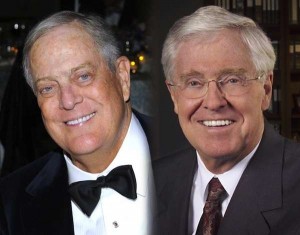
That is what we’re watching now, what might be called the Koch Brothers’ “Samson Option,” pulling down the temple to destroy their enemies even if doing so is also destructive to them and their fortunes.
Charles and David Koch and other right-wing billionaires and near-billionaires are blind with anger after wasting millions of dollars on Mitt Romney, Karl Rove and the Republican Party in a failed attempt to defeat Barack Obama, the Democrats and health-care reform. These were the guys who smirked knowingly when Romney sneered at “the 47 percent” of Americans who receive some government help; they got snappish when Obama called them “fat cats”; they demanded the honorific title of “job creators.”
Then, they had to sit in their plush party rooms waiting to celebrate Romney’s victory only to be frustrated by a coalition of voters led by African-Americans, Hispanics, Asian-Americans and young urban whites who are comfortable in a more diverse country.
Despite all the money and electoral tricks, the Koch Brothers and friends failed to block the reelection of the first African-American president; they watched the Democrats defy the odds and retain the Senate; and they barely managed to hold onto a slender Republican House “majority” through aggressive gerrymandering and other anti-democratic anomalies that overcame the GOP’s loss in the popular vote of about 1½ million ballots.
To make matters worse, these rich white guys had to listen to endless commentary about the coming demographic changes and the need for Republicans to improve their image with racial and ethnic minorities. Through a blinding rage, the Right’s billionaires plotted revenge.
Plotting Obama’s Downfall
Of course, many pragmatic rich folk understand how the extraordinary U.S. system – built by the sweat and ingenuity of countless “average Americans” and protected by the blood of heroic common citizens – has made their fortunes possible. These patriotic multi-millionaires cringe at the spectacle of a U.S. government shutdown and panic at the thought of defaulting on U.S. debt.
But the right-wing billionaires and their political front groups welcome the current chaos. Indeed, they began planning today’s fiscal crisis as soon as their stunning defeat of last November sank in. Rather than behave as a loyal opposition, the Right started plotting soon after Obama took the oath of office a second time, as the New York Times reported:
“Shortly after President Obama started his second term, a loose-knit coalition of conservative activists led by former Attorney General Edwin Meese III gathered in the capital to plot strategy.
Their push to repeal Mr. Obama’s health care law was going nowhere, and they desperately needed a new plan.
“Out of that session, held one morning in a location the members insist on keeping secret, came a little-noticed ‘blueprint to defunding Obamacare,’ signed by Mr. Meese and leaders of more than three dozen conservative groups. It articulated a take-no-prisoners legislative strategy that had long percolated in conservative circles: that Republicans could derail the health care overhaul if conservative lawmakers were willing to push fellow Republicans — including their cautious leaders — into cutting off financing for the entire federal government. …
“To many Americans, the shutdown came out of nowhere. But interviews with a wide array of conservatives show that the confrontation that precipitated the crisis was the outgrowth of a long-running effort to undo the law, the Affordable Care Act, since its passage in 2010 — waged by a galaxy of conservative groups with more money, organized tactics and interconnections than is commonly known. …
“Groups like Tea Party Patriots, Americans for Prosperity and FreedomWorks are all immersed in the fight, as is Club for Growth, a business-backed nonprofit organization. Some, like Generation Opportunity and Young Americans for Liberty, both aimed at young adults, are upstarts. Heritage Action is new, too, founded in 2010 to advance the policy prescriptions of its sister group, the Heritage Foundation.
“The billionaire Koch brothers, Charles and David, have been deeply involved with financing the overall effort. A group linked to the Kochs, Freedom Partners Chamber of Commerce, disbursed more than $200 million last year to nonprofit organizations involved in the fight. Included was $5 million to Generation Opportunity, which created a buzz last month with an Internet advertisement showing a menacing Uncle Sam figure popping up between a woman’s legs during a gynecological exam.”
The Right also has relied on its well-financed propaganda machine to obscure for millions of Americans what is actually underway in Washington. The curtain on that was lifted briefly on Sunday with the recognition that the Democrats agreed to the budget terms demanded by House Speaker John Boehner, who then double-crossed them.
On TV interview shows, Boehner conceded that he had struck a deal with the Democrats in which the Senate would accept the lower House budget figures, which included the so-called “sequester” cuts, in exchange for passage of a continuing resolution to keep the government going.
Reneging on a Deal
As the Times reported, “the speaker acknowledged that in July he had gone to the Senate majority leader, Senator Harry Reid … and offered to have the House pass a clean financing resolution. [Boehner’s] proposal would have set spending levels $70 billion lower than Democrats wanted, but would have no contentious add-ons like changing the health-care law. Democrats accepted, but they say Mr. Boehner then reneged under pressure from Tea Party conservatives.”
So, Boehner had laid out terms for a deal that the Democrats disliked but agreed to accept, only to see Boehner pocket their major concession, tack on a host of new demands including stopping health-care reform, and then berating them with the “talking point” that it was the Democrats who wouldn’t negotiate.
There was also the point that House Republicans had refused for six months to appoint members of a conference committee to hammer out budget differences between the House and Senate.
If not for the powerful right-wing media which continues to repeat the “Democrats won’t negotiate” mantra, the American public would have no doubt who provoked the current crisis. But what’s even more significant is what this right-wing strategy means to the future of American democracy.
The position of the Koch Brothers and other right-wing plutocrats is that democracy itself is the problem. It’s bad enough that they have to listen to views that they disagree with; they certainly shouldn’t have to sit back and watch these lesser beings elect leaders and enact policies that involve raising taxes on the rich to provide benefits to other Americans.
While reflective of “free-market” extremism, this right-wing view also has a racial component, since the Right’s billionaires have relied on Tea Party foot soldiers to fight these political wars – and many of those white populist right-wingers are attracted by neo-Confederate ideology, i.e. the supposed “rights” of states to ignore federal mandates, especially those designed to help blacks, Hispanics and other minorities.
“States’ rights” have had a long and grim history in the United States, touted from the early years of the Republic as necessary to defend slavery, then leading to the Civil War and to a near-century of Jim Crow racial segregation.
After the civil rights movement of the 1960s, opportunistic Republicans, such as Richard Nixon and Ronald Reagan, saw their chance to snatch the South by playing to white resentment against integration. So, they played up their commitment to “states’ rights” and were rewarded by switching the Deep South from the Democrats to the GOP.
Danger of Fair Elections
Today, however, the Right fears that the nation’s demographic changes could mean that fair elections would end frequently with the selection of candidates who favor stronger federal action to address problems confronting the nation and the world, from the economic risk posed by the concentration of wealth in the top one percent to the existential threat posed by global warming.
An energetic federal government is needed to address these challenges. If the Great American Middle Class is to survive, Congress will have to raise taxes on the rich and invest that money in national infrastructure, cutting-edge research, affordable education, expanded health care and other domestic programs. If global warming is to be slowed and eventually reversed, the federal government must move quickly to reduce carbon dioxide and other emissions while revamping the U.S. energy system.
But the Right wants to prevent such government activism. So, it has developed strategies to give more weight to the votes of white Republicans and less weight to the votes of blacks, Hispanics and other groups that tend to go Democratic. That’s why organizations supported by the Koch Brothers and other right-wing billionaires have backed Republican efforts to impose strict voter ID laws, reduce voting hours and aggressively gerrymander congressional districts to lump Democratic votes in one while ensuring solid Republican majorities in others.
The Right is implementing a strategy as old as the southern poll tax and literacy tests for blacks, i.e. the need to negate post-Civil War amendments that guaranteed equal rights under the law and the right to vote regardless of the color of a person’s skin.
Today’s right-wing strategy follows the thinking of urbane conservative William F. Buckley, who explained in 1957 – when Martin Luther King Jr. and other civil rights leaders were agitating for enforcement of post-Civil War provisions – that “The white community in the South is entitled to take such measures as are necessary to prevail, politically and culturally, in areas in which it does not predominate numerically.”
Now the Buckley doctrine is being applied nationwide. But the problem for the Right is that even with all the voter suppression and shorter voting hours creating nightmarish lines especially in minority neighborhoods, the American people still reelected Barack Obama and favored Democrats over Republicans for Congress.
Thanks to gerrymandering and other anti-democratic moves, the Right still has a tenuous foothold through its control of the House and can count on the Senate GOP minority to filibuster nearly everything.
However, for the Right to have the power to implement policies of its choice, a new strategy was needed. It surfaced first in 2011 with the threat to default on the nation’s debt, which coerced President Obama into accepting severe cuts in federal spending, called the “sequester.”
Now, in 2013, the Republican Right has doubled down on that strategy, merging a government shutdown with an impending credit default in an effort to extort more concessions from Obama and the Democrats. But the larger goal is to create a new constitutional structure in which the Right, regardless of its minority status, gets to dictate what the federal government can and cannot do.
To make this strategy work, however, requires a readiness to play Samson and to pull down the temple on your enemies as well as yourself. That appears to be the extreme option that the Koch Brothers and their fellow right-wing billionaires have chosen. If they can’t rule America, they will reduce the country to economic rubble through a fiscal crisis and a premeditated financial collapse.
Then, perhaps out of the rubble, a chastened American people will emerge to accept their subordinate position in this new plutocratic structure. In the future, they will know better than to do something that the Koch Brothers and their right-wing friends don’t like.
All that stuff about a government of the people, by the people and for the people will finally have perished from the earth. [For more on this topic, see Consortiumnews.com's "America's Government by Extortion."]
Investigative reporter Robert Parry broke many of the Iran-Contra stories for The Associated Press and Newsweek in the 1980s. You can buy his new book, America’s Stolen Narrative, either in print here or as an e-book (from Amazon and barnesandnoble.com). For a limited time, you also can order Robert Parry’s trilogy on the Bush Family and its connections to various right-wing operatives for only $34. The trilogy includes America’s Stolen Narrative. For details on this offer, click here.
http://consortiumnews.com/2013/10/08/the-koch-brothers-samson-option/
By Robert Parry
The Koch Brothers and other right-wing billionaires who provoked the government shutdown and now are angling for an even more devastating credit default see themselves as the people who deserve to rule the United States without interference from lesser citizens, especially those with darker-colored skin.
Their “masters of the universe” world view is that they or their daddies or their daddies’ daddies were the ones who “built America” and, thus, it’s their right to tear down the remarkable edifice of U.S. law, politics and economics created over the past two-plus centuries — if the country’s less-deserving inhabitants insist on raising taxes on the rich to fund programs benefiting the poor and the middle class.
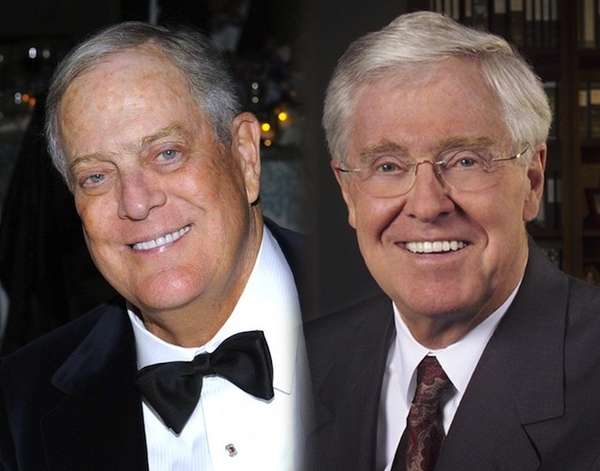
Oil billionaires David and Charles Koch.
That is what we’re watching now, what might be called the Koch Brothers’ “Samson Option,” pulling down the temple to destroy their enemies even if doing so is also destructive to them and their fortunes.
Charles and David Koch and other right-wing billionaires and near-billionaires are blind with anger after wasting millions of dollars on Mitt Romney, Karl Rove and the Republican Party in a failed attempt to defeat Barack Obama, the Democrats and health-care reform. These were the guys who smirked knowingly when Romney sneered at “the 47 percent” of Americans who receive some government help; they got snappish when Obama called them “fat cats”; they demanded the honorific title of “job creators.”
Then, they had to sit in their plush party rooms waiting to celebrate Romney’s victory only to be frustrated by a coalition of voters led by African-Americans, Hispanics, Asian-Americans and young urban whites who are comfortable in a more diverse country.
Despite all the money and electoral tricks, the Koch Brothers and friends failed to block the reelection of the first African-American president; they watched the Democrats defy the odds and retain the Senate; and they barely managed to hold onto a slender Republican House “majority” through aggressive gerrymandering and other anti-democratic anomalies that overcame the GOP’s loss in the popular vote of about 1½ million ballots.
To make matters worse, these rich white guys had to listen to endless commentary about the coming demographic changes and the need for Republicans to improve their image with racial and ethnic minorities. Through a blinding rage, the Right’s billionaires plotted revenge.
Plotting Obama’s Downfall
Of course, many pragmatic rich folk understand how the extraordinary U.S. system – built by the sweat and ingenuity of countless “average Americans” and protected by the blood of heroic common citizens – has made their fortunes possible. These patriotic multi-millionaires cringe at the spectacle of a U.S. government shutdown and panic at the thought of defaulting on U.S. debt.
But the right-wing billionaires and their political front groups welcome the current chaos. Indeed, they began planning today’s fiscal crisis as soon as their stunning defeat of last November sank in. Rather than behave as a loyal opposition, the Right started plotting soon after Obama took the oath of office a second time, as the New York Times reported:
“Shortly after President Obama started his second term, a loose-knit coalition of conservative activists led by former Attorney General Edwin Meese III gathered in the capital to plot strategy.
Their push to repeal Mr. Obama’s health care law was going nowhere, and they desperately needed a new plan.
“Out of that session, held one morning in a location the members insist on keeping secret, came a little-noticed ‘blueprint to defunding Obamacare,’ signed by Mr. Meese and leaders of more than three dozen conservative groups. It articulated a take-no-prisoners legislative strategy that had long percolated in conservative circles: that Republicans could derail the health care overhaul if conservative lawmakers were willing to push fellow Republicans — including their cautious leaders — into cutting off financing for the entire federal government. …
“To many Americans, the shutdown came out of nowhere. But interviews with a wide array of conservatives show that the confrontation that precipitated the crisis was the outgrowth of a long-running effort to undo the law, the Affordable Care Act, since its passage in 2010 — waged by a galaxy of conservative groups with more money, organized tactics and interconnections than is commonly known. …
“Groups like Tea Party Patriots, Americans for Prosperity and FreedomWorks are all immersed in the fight, as is Club for Growth, a business-backed nonprofit organization. Some, like Generation Opportunity and Young Americans for Liberty, both aimed at young adults, are upstarts. Heritage Action is new, too, founded in 2010 to advance the policy prescriptions of its sister group, the Heritage Foundation.
“The billionaire Koch brothers, Charles and David, have been deeply involved with financing the overall effort. A group linked to the Kochs, Freedom Partners Chamber of Commerce, disbursed more than $200 million last year to nonprofit organizations involved in the fight. Included was $5 million to Generation Opportunity, which created a buzz last month with an Internet advertisement showing a menacing Uncle Sam figure popping up between a woman’s legs during a gynecological exam.”
The Right also has relied on its well-financed propaganda machine to obscure for millions of Americans what is actually underway in Washington. The curtain on that was lifted briefly on Sunday with the recognition that the Democrats agreed to the budget terms demanded by House Speaker John Boehner, who then double-crossed them.
On TV interview shows, Boehner conceded that he had struck a deal with the Democrats in which the Senate would accept the lower House budget figures, which included the so-called “sequester” cuts, in exchange for passage of a continuing resolution to keep the government going.
Reneging on a Deal
As the Times reported, “the speaker acknowledged that in July he had gone to the Senate majority leader, Senator Harry Reid … and offered to have the House pass a clean financing resolution. [Boehner’s] proposal would have set spending levels $70 billion lower than Democrats wanted, but would have no contentious add-ons like changing the health-care law. Democrats accepted, but they say Mr. Boehner then reneged under pressure from Tea Party conservatives.”
So, Boehner had laid out terms for a deal that the Democrats disliked but agreed to accept, only to see Boehner pocket their major concession, tack on a host of new demands including stopping health-care reform, and then berating them with the “talking point” that it was the Democrats who wouldn’t negotiate.
There was also the point that House Republicans had refused for six months to appoint members of a conference committee to hammer out budget differences between the House and Senate.
If not for the powerful right-wing media which continues to repeat the “Democrats won’t negotiate” mantra, the American public would have no doubt who provoked the current crisis. But what’s even more significant is what this right-wing strategy means to the future of American democracy.
The position of the Koch Brothers and other right-wing plutocrats is that democracy itself is the problem. It’s bad enough that they have to listen to views that they disagree with; they certainly shouldn’t have to sit back and watch these lesser beings elect leaders and enact policies that involve raising taxes on the rich to provide benefits to other Americans.
While reflective of “free-market” extremism, this right-wing view also has a racial component, since the Right’s billionaires have relied on Tea Party foot soldiers to fight these political wars – and many of those white populist right-wingers are attracted by neo-Confederate ideology, i.e. the supposed “rights” of states to ignore federal mandates, especially those designed to help blacks, Hispanics and other minorities.
“States’ rights” have had a long and grim history in the United States, touted from the early years of the Republic as necessary to defend slavery, then leading to the Civil War and to a near-century of Jim Crow racial segregation.
After the civil rights movement of the 1960s, opportunistic Republicans, such as Richard Nixon and Ronald Reagan, saw their chance to snatch the South by playing to white resentment against integration. So, they played up their commitment to “states’ rights” and were rewarded by switching the Deep South from the Democrats to the GOP.
Danger of Fair Elections
Today, however, the Right fears that the nation’s demographic changes could mean that fair elections would end frequently with the selection of candidates who favor stronger federal action to address problems confronting the nation and the world, from the economic risk posed by the concentration of wealth in the top one percent to the existential threat posed by global warming.
An energetic federal government is needed to address these challenges. If the Great American Middle Class is to survive, Congress will have to raise taxes on the rich and invest that money in national infrastructure, cutting-edge research, affordable education, expanded health care and other domestic programs. If global warming is to be slowed and eventually reversed, the federal government must move quickly to reduce carbon dioxide and other emissions while revamping the U.S. energy system.
But the Right wants to prevent such government activism. So, it has developed strategies to give more weight to the votes of white Republicans and less weight to the votes of blacks, Hispanics and other groups that tend to go Democratic. That’s why organizations supported by the Koch Brothers and other right-wing billionaires have backed Republican efforts to impose strict voter ID laws, reduce voting hours and aggressively gerrymander congressional districts to lump Democratic votes in one while ensuring solid Republican majorities in others.
The Right is implementing a strategy as old as the southern poll tax and literacy tests for blacks, i.e. the need to negate post-Civil War amendments that guaranteed equal rights under the law and the right to vote regardless of the color of a person’s skin.
Today’s right-wing strategy follows the thinking of urbane conservative William F. Buckley, who explained in 1957 – when Martin Luther King Jr. and other civil rights leaders were agitating for enforcement of post-Civil War provisions – that “The white community in the South is entitled to take such measures as are necessary to prevail, politically and culturally, in areas in which it does not predominate numerically.”
Now the Buckley doctrine is being applied nationwide. But the problem for the Right is that even with all the voter suppression and shorter voting hours creating nightmarish lines especially in minority neighborhoods, the American people still reelected Barack Obama and favored Democrats over Republicans for Congress.
Thanks to gerrymandering and other anti-democratic moves, the Right still has a tenuous foothold through its control of the House and can count on the Senate GOP minority to filibuster nearly everything.
However, for the Right to have the power to implement policies of its choice, a new strategy was needed. It surfaced first in 2011 with the threat to default on the nation’s debt, which coerced President Obama into accepting severe cuts in federal spending, called the “sequester.”
Now, in 2013, the Republican Right has doubled down on that strategy, merging a government shutdown with an impending credit default in an effort to extort more concessions from Obama and the Democrats. But the larger goal is to create a new constitutional structure in which the Right, regardless of its minority status, gets to dictate what the federal government can and cannot do.
To make this strategy work, however, requires a readiness to play Samson and to pull down the temple on your enemies as well as yourself. That appears to be the extreme option that the Koch Brothers and their fellow right-wing billionaires have chosen. If they can’t rule America, they will reduce the country to economic rubble through a fiscal crisis and a premeditated financial collapse.
Then, perhaps out of the rubble, a chastened American people will emerge to accept their subordinate position in this new plutocratic structure. In the future, they will know better than to do something that the Koch Brothers and their right-wing friends don’t like.
All that stuff about a government of the people, by the people and for the people will finally have perished from the earth. [For more on this topic, see Consortiumnews.com's "America's Government by Extortion."]
Investigative reporter Robert Parry broke many of the Iran-Contra stories for The Associated Press and Newsweek in the 1980s. You can buy his new book, America’s Stolen Narrative, either in print here or as an e-book (from Amazon and barnesandnoble.com). For a limited time, you also can order Robert Parry’s trilogy on the Bush Family and its connections to various right-wing operatives for only $34. The trilogy includes America’s Stolen Narrative. For details on this offer, click here.
http://consortiumnews.com/2013/10/08/the-koch-brothers-samson-option/
Sunday, October 6, 2013
Koch-Roaches....ALEC....Cape Wind Opposition....Climate Change Deniers...DIRTY ENERGY....have you figured it out?
Koch....Tea Party...ALEC....Heartland....climate change deniers....DIRTY ENERGY.... DEREGULATION.....Federalist Society....think the Tea Baggers will ever figure it out?

Wednesday, October 2, 2013
To the Tea Party Jackasses that think it doesn't matter.....
It matters!
And this is only the beginning.
And this is only the beginning.
Today’s news from Sen. Bernie Sanders (I-Vt.):
No End in Sight to Government Shutdown: Lawmakers and the White House dug in Tuesday for a long fight as the first federal government shutdown in nearly two decades showed no signs of breaking. The closure, triggered by a congressional fight over President Obama’s health care law, means 800,000 federal workers were off the job on Tuesday. Sen. Bernie Sanders said shutdown effects ranged from cancer patients not getting care they need to FBI agents are not reporting to work. Seventeen out of 30 staffers who work for U.S. Sen. Bernie Sanders are off the job today, the Burlington Free Press reported.
No Surrender, Sanders Says: The process of closing down large parts of the U.S. government was under way on Tuesday after frantic rounds of late-night political sparring failed to avert the first federal shutdown in nearly two decades. Democrats in Congress hold Republicans to blame for using underhand ...methods to overturn a health care law passed by Congress, upheld by the Supreme Court and endorsed by voters at the last presidential election. “If we surrender to hostage-taking tonight,” Sen. Sanders said in The Guardian, “these guys would be back within a couple of weeks without a shadow of a doubt. What we are dealing with tonight is an extraordinary anti-democratic act.”
Hostage Crisis: “People may disagree about the Affordable Care Act, but it is wrong for right-wing Republicans to ignore the results of the last election and hold the American people hostage by threatening to shut down the government unless they get their way,” Sen. Sanders said in the St. Albans Messenger.
Closure Impact: Sen. Sanders said the government closure could be “devastating.” In Vermont, passport offices like one in St. Albans could close, people applying for federally-backed mortgages will face delays, programs to help small businesses and Head Start might shut down, and people applying for Social Security, Medicare and veterans’ benefits will face a significantly slower process, the Bennington Banner reported. The same article said Gov. Peter Shumlin expects only minor disruptions.
Americans are ‘Disgusted’: In an interview with WPTZ-TV, Sanders said “people are angry, they're upset and they're frustrated. They have every reason to be. What people want is for Congress to address the issues that are facing the American people and that's creating jobs and raising the minimum wage, dealing with the affordability of college and they're disgusted by what they're seeing.” Sen. Sanders told WCAX-TV that House Republicans are “holding the American people hostage.”
Continue reading here: http://www.sanders.senate.gov/
No End in Sight to Government Shutdown: Lawmakers and the White House dug in Tuesday for a long fight as the first federal government shutdown in nearly two decades showed no signs of breaking. The closure, triggered by a congressional fight over President Obama’s health care law, means 800,000 federal workers were off the job on Tuesday. Sen. Bernie Sanders said shutdown effects ranged from cancer patients not getting care they need to FBI agents are not reporting to work. Seventeen out of 30 staffers who work for U.S. Sen. Bernie Sanders are off the job today, the Burlington Free Press reported.
No Surrender, Sanders Says: The process of closing down large parts of the U.S. government was under way on Tuesday after frantic rounds of late-night political sparring failed to avert the first federal shutdown in nearly two decades. Democrats in Congress hold Republicans to blame for using underhand ...methods to overturn a health care law passed by Congress, upheld by the Supreme Court and endorsed by voters at the last presidential election. “If we surrender to hostage-taking tonight,” Sen. Sanders said in The Guardian, “these guys would be back within a couple of weeks without a shadow of a doubt. What we are dealing with tonight is an extraordinary anti-democratic act.”
Hostage Crisis: “People may disagree about the Affordable Care Act, but it is wrong for right-wing Republicans to ignore the results of the last election and hold the American people hostage by threatening to shut down the government unless they get their way,” Sen. Sanders said in the St. Albans Messenger.
Closure Impact: Sen. Sanders said the government closure could be “devastating.” In Vermont, passport offices like one in St. Albans could close, people applying for federally-backed mortgages will face delays, programs to help small businesses and Head Start might shut down, and people applying for Social Security, Medicare and veterans’ benefits will face a significantly slower process, the Bennington Banner reported. The same article said Gov. Peter Shumlin expects only minor disruptions.
Americans are ‘Disgusted’: In an interview with WPTZ-TV, Sanders said “people are angry, they're upset and they're frustrated. They have every reason to be. What people want is for Congress to address the issues that are facing the American people and that's creating jobs and raising the minimum wage, dealing with the affordability of college and they're disgusted by what they're seeing.” Sen. Sanders told WCAX-TV that House Republicans are “holding the American people hostage.”
Continue reading here: http://www.sanders.senate.gov/

Monday, September 30, 2013
The 1 percent played Tea Party for suckers
It's always baffling when the Wealthy like the Koch Brothers convince Americans with their Think Tank funded propaganda to vote against their best interests.
Why would any reasonable person oppose the Affordable Care Act unless they've been propagandized? [After all, Massachusetts has Romney-Care and the sky didn't fall.]
Here's an explanation......
 Enlarge
On Election Day, November 2, 2010, more than eight million Americans voted for congressional candidates who claimed to represent the Tea Party and its grassroots insurgency against the federal government. Most of the Tea Party candidates won. Their victory marked a sea change in American government. Even before the winners were sworn in, reporters began to refer to the 112th Congress as “the Tea Party Congress.” On the day of the swearing-in, the prominent Tea Party backer David
Koch likened the electoral success of the Tea Party to the American Revolution. “It’s probably the best grassroots uprising since 1776 in my opinion,” he said.
The proposals of the new Congress had little in common with the revolutionary slogans of 1776, but many of them would be familiar to activists who had participated in the grassroots uprisings on behalf of the rich in the twentieth century.
On January 5, for example, House Republicans introduced a “balanced budget amendment” that was really a tax limitation amendment—modeled on the precedents that the National Taxpayers Union and the National Tax Limitation Committee had furnished in the 1970s. A flurry of other balanced budget amendment bills followed. On January 23, Senate Republicans, led by Orrin Hatch, introduced a tax limitation/balanced budget amendment bill of their own that was even more restrictive.
The next day, Representatives Steve King (R-IA) and Rob Woodall (R-GA) introduced a one-sentence proposal to repeal the Sixteenth Amendment. On March 15, 2011, Representative Ron Paul (R-TX) introduced the Liberty Amendment, precisely as Willis Stone drafted it in 1956.
And throughout the session, Republicans introduced bill after bill to cut top income tax rates and make estate tax repeal permanent. Many of these tax proposals were regressive enough that they might have made even an Andrew Mellon blush. But they would have warmed the heart of J. A. Arnold if he could have lived to see them. They could almost have been copied from the 1927 program of the American Taxpayers’ League.
Thanks in part to proposals like these, the Tea Party Congress is likely to be remembered as one of the most conservative Congresses in American history. Scholars have described this rightward turn in Congress as “historic,” as “a new phase in the extreme ideological polarization of U.S. politics,” and as a “historically unprecedented development.” And they have pointed to unprecedented conditions to explain it. The historic segmentation of media markets is said to have allowed voters to surround themselves in closed and ideologically extreme social worlds. The influx of money into politics following the Supreme Court’s decision in Citizens United v. Federal Election Commission, 558 U.S. 50 (2010), is said to have given an edge to ultraconservative candidates whose policy proposals flatter the pocketbook interests of the very richest Americans.
Some new conditions like these are surely part of the explanation for how such radically inegalitarian tax policy proposals came to dominate the policy agenda of Congress. But these new conditions cannot be the whole story, because so many of the proposals themselves are old: not founding-fathers old, but early-twentieth-century old. They are the harvest of a century of rich people’s movements.
Why Rich People’s Movements Now?
What can we say about the sources of this new radicalism, and how long it is likely to be with us? The answers depend on a proper understanding of the history of rich people’s movements.
Even commentators who recognize that the Tea Party has historical roots might be forgiven for thinking those roots do not go very deep. Social scientists have noticed other movements that share many of the hallmarks of rich people’s movements—including the use of protest tactics by relatively affluent people; the fact that the activists were already fully enfranchised participants in the political system; and the fact that these activists seem to demand the preservation of comfortable consumer lifestyles, rather than the realization of some utopian vision of the future—and have argued that these are distinguishing characteristics of late-twentieth-century social movements. An influential body of scholarship on “new social movements” argues that protest movements took on these characteristics in postindustrial economies of the late twentieth century because economic development had made earlier agrarian and industrial class conflicts passé. The rising incomes of even ordinary wage earners made the late-twentieth-century United States into a consumer society. It is small wonder, to this way of thinking, that some protest movements today consist of affluent consumers protesting their taxes, rather than wage earners protesting their poverty. Another body of scholarship argues that the professionalization of social movement organizations in the late twentieth century made possible a mainstreaming of social protest, by taming the more disruptive protesters and by standardizing tactics so that they became easier for ordinary citizens to learn and apply in new contexts. Some scholars have also credited, or blamed, the mass media for the spread of social movements to the middle classes. Television, for example, brought images of the 1960s protest movements to middle-class households around the country, and thereby taught a new style of politics to previously staid suburbanites. All of these scholars describe how the economic and technological transformations of the twentieth century made the social movement repertoire available to ever-more affluent people. It is tempting to see the rich people’s movements of our time as the endpoint of these transformations—the newest new social movement, the capstone on the social movement society, or the last ripple in the widening circle of people who have appropriated and repurposed the political techniques of the poor.
Whatever the uses of theories like these for explaining the emergence of new social movements in the late twentieth century, they would miss the mark in accounting for rich people’s movements, because rich people’s movements are not that new. When the Texas tax clubs under the leadership of J. A. Arnold mobilized for tax cuts in the top brackets, they were not expressing the demands of suburban consumers in a postindustrial economy; they were advocating for the interests of rural bankers in a predominantly agrarian economy. When Edward Rumely and Vivien Kellems first began to commit civil disobedience in protest against the federal income tax, television had not yet brought images of the Civil Rights movement into the homes of millions of Americans. For much of the twentieth century, these movements relied on tactics that were decidedly old-fashioned even for their times. In the 1940s, Rumely used direct mail techniques to bypass existing civic associations and recruit directly, because that was the model that he had learned in the Progressive Party. In the 1950s, Kellems organized through women’s clubs, argued on the basis of constitutional rights, and attempted to inspire imitators through civil disobedience, because those were the techniques she had learned from the fight for woman suffrage. In the 1960s, Willis Stone recruited supporters for the Liberty Amendment through fraternal organizations and veterans’ organizations, because those were the organizations in which he had acquired his own civic education after the First World War. The tactics of all of these activists hearkened to the early decades of the twentieth century because these social movement entrepreneurs acquired their skills and organizing experience in social movement organizations of that era.
Many activists in rich people’s movements know that their movements have deeper roots in the early twentieth century. In particular, they have often portrayed their movements as reactions to the so-called revolution of 1913. The ratification of the Sixteenth Amendment, according to these activists, was a turning point in the history of the United States. It marked the end of limited government and the beginning of a new era of expanding federal power. If any great social change of the twentieth century paved the way for rich people’s movements, according to this story, it was not economic growth or the development of the postindustrial economy or the development of new communications technologies, but the growth of the federal budget; and that development, the story goes, was set in motion by the Sixteenth Amendment.
This activist story also gets the causal dynamics wrong. It is true that rich people’s movements would not have emerged in the absence of federal taxes on income and wealth. But such movements are not inevitable just because the Constitution authorizes progressive taxes. They did not emerge in direct response to the ratification of the Sixteenth Amendment. To contemporaries, there was no “revolution of 1913.” It was not until after World War I that the dramatic consequences of the new federal income tax became clear. Nor did these movements grow in lock-step with the long-term expansion of the federal budget.
By comparing the campaigns described in this book, we can see instead that rich people’s movements arose episodically in response to immediate policy threats. The particular policies that provoked protest were heterogeneous. The top statutory tax rates on income and wealth nevertheless give us a crude but serviceable index of policy threats to the rich. By fixing our attention on the timing of new campaigns, the figure illustrates the simple point that activists started these campaigns in the wake of policy threats. It was not heavy taxes that caused protest. It was rapid tax increases on the rich that did.
Two late-twentieth-century campaigns look like exceptions to the rule, but these exceptions are more apparent than real. The campaign to revive a tax limitation amendment in 1978, for example, began at a time when top rates of federal income and estate tax were stable. However, activists launched this campaign at that time in order to capitalize on an influential movement for state and local property tax limitation; and that movement was triggered by policy changes that produced a rapid increase in local property taxes. The revival of a campaign for estate tax repeal in 1993, at a time when estate tax rates had not changed for almost a decade, also looks like an exception to the rule. However, the activists who inaugurated that campaign were responding to a proposed increase in the estate tax, and their movement gained adherents when a previously scheduled expiration of the top tax rate was revoked. Even these campaigns were triggered by policy threats.
History teaches us that policy threats are necessary conditions for the emergence of rich people’s movements. Such threats help to explain not just when people felt aggrieved enough to protest taxes on the rich, but also who felt aggrieved enough to support tax cuts for the rich. In every case, the pool of potential recruits extended well below the top tax brackets. The non-rich sympathizers, however, always had particular reasons to see top tax rates as threatening—from the farm mortgage bankers of 1924 who feared that high tax rates advantaged their competitors, to the married women of 1952 who saw that they were subject to higher marginal tax rates than their husbands, to the upper-middle-income taxpayers of 1978 who saw that inflation could push them into higher income tax brackets.
Many people like these campaigned for tax cuts in the top brackets because they believed they were also protecting their own economic security.
These movements took advantage of the structure of political opportunities established by the American constitutional order, which may help to explain why they seem so distinctively American. In Western Europe, affluent people who feared taxes on the rich in the twentieth century sometimes started new political parties. But they rarely used the sort of populist tactics employed in the United States, and they never made the sort of constitutional arguments that characterized the American movement. Perhaps it is unsurprising that the American rich and their allies turned to social movement organizing and interest group lobbying instead of third-party politics; the combination of direct presidential elections, single-member districts, and the winner-takes-all electoral system make it difficult for small political parties to achieve anything in the United States. But there is more to the explanation than that. These political institutions merely create obstacles to founding new political parties. They do not dictate which alternative to party politics will be pursued by threatened people.
Why did policy threats to the rich provoke grassroots movements instead of conventional interest-group lobbying? Given the ease with which many rich people have secured selective tax privileges by back-room lobbying, the choice to pursue universalistic benefits for all rich people by means of public grassroots lobbying campaigns is puzzling. The solution to this puzzle is tradition. The rich and their allies joined grassroots social movement campaigns because that is what they were recruited and taught to do by experienced movement entrepreneurs. Those entrepreneurs were passing on tactical skills and lore that they had learned in other movements. To call this set of political practices a tradition is to say that it is more than merely a recurrent phenomenon. It is to say that similar patterns recur because people learn from and imitate the past.
It may be that all social movements rest on a bedrock of tradition. For rich people’s movements, however, the existence of a social movement tradition was almost certainly indispensable. Short-term causes such as policy threats were necessary, but not sufficient, conditions to explain mobilization. Social movement tactics have a history; they must be passed down in order to become available to particular people at a particular time. It is doubtful whether rich people’s movements would exist at all today if activists did not have a long movement tradition to draw on.
Under What Conditions Do They Win?
The history of rich people’s movements may also tell us about their prospects for victory in the future. Even the wildest optimists in the Tea Party Caucus probably did not expect their proposals to become law, at least as long as the Democratic Party retained the presidency and the majority in the Senate. But the comparison of past rich people’s movements shows that such radical proposals may influence policies even when they are not enacted. Rich people’s movements in the twentieth century made extreme demands that made moderate groups appear comparatively reasonable. Sometimes they also used tactics that threatened public order—for example, by calling on businesses to disobey the Internal Revenue Service, or plausibly threatening to call a constitutional convention that could throw American politics into turmoil—and thereby permitted moderate conservatives to sell their own preferred policies as ways to co-opt an unruly movement and restore order. The Tea Party may have similar effects. Its activists have not won the war against the income tax, nor are they likely to repeal the Sixteenth Amendment. By keeping radical tax proposals on the policy agenda, however, they have positioned a radical flank for battles to come.
The history of rich people’s movements shows that the mobilization of a radical flank can indeed influence the shape of federal tax policy. Influential Republican politicians sometimes felt compelled to propose tax cuts in order to obviate the need for more radical proposals to repeal the Sixteenth Amendment. The Republican chairman of the House Ways and Means Committee, Daniel Alden Reed of New York, made this argument explicitly to his collegues in 1944. “[T]he movement to limit federal tax rates by constitutional amendment should be noted,” he wrote; “One way to meet this issue is by voluntary Congressional action to establish moderate tax rate levels.” So did the presidential candidate Dwight David Eisenhower in 1952, when he wrote that “a prudent and positive administration should be able to approach the goal which the amendment seeks without the difficulty and dangers involved in the adoption or continuing operation of such an amendment to our Constitution.” There is no evidence that rich people’s movements had any direct influence on legislation under these leaders. But in a handful of other instances, including the Revenue Act of 1926, the ERTA of 1981, and the EGTRRA of 2001, there is evidence—in the timing of the laws, in the geographic distribution of legislators’ support, and in the statements of some members of Congress—that at least some provisions of the law were intended as responses to movement demands. These acts legislated some of the largest tax cuts in American history. So it is that rich people’s movements, through their influence on the ERTA and the EGTRRA, made a small but real contribution to the growing income inequality—the rise of the so-called 1 percent—that is one of the most important social changes of our time.
Sometimes rich people’s movements had an impact, but at other times, the radical rich found themselves isolated and powerless. Their failure to influence policy is most evident in the case of the Sixteenth Amendment repealers. The activists of the American Taxpayers’ Association and the Committee for Constitutional Government tried for two decades to bend federal tax policy toward greater inequality, with no measurable success. Their peak years of mobilization corresponded to the years when federal income tax rates were highest, and yet there is little evidence that they were able to pull top tax rates down. It is possible that these movements may have exercised a kind of diffuse cultural influence, and thereby helped to restrain policymakers by swaying public opinion against progressive taxation; perhaps federal revenues would have grown even more rapidly in the absence of their grassroots pressure. History does not give us a comparison case that would provide the critical test of this hypothesis. But it is clear that, in many instances, their efforts had no immediate impact.
Consider the Liberty Amendment campaign. The peak years of the Liberty Amendment Committee coincided with one of the biggest income tax cuts in American history, but the activists could claim no credit for the Kennedy-Johnson tax cuts. Their radical posture condemned them to stand on the sidelines while liberal technocrats cut rich people’s taxes.
Why were these movements sometimes so influential and other times so impotent? The comparison of campaigns shows that geographically dispersed grassroots mobilization made a difference.
Activists sometimes had particular influence when they were able to mobilize in congressional swing districts, as when the tax clubs swayed the votes of Representatives Green and Garner in 1926. As the comparisons across states have shown, policy crafting was also crucial for allowing these activists to get tax cuts for the rich on the policy agenda. Some tax cuts for the rich could not get a serious hearing because they were too politically costly. Activists had the greatest impact when they were willing to craft their policy demands to obscure these costs, and package their favored tax cuts with additional policy benefits for new allies.
But to move beyond agenda access to influence legislation required more than clever policy crafting.
It also required a critical mass of ideological allies in Congress and the presidency. There were only three presidents in the last century who allied themselves openly with rich people’s movements—Calvin Coolidge, Ronald Reagan, and George W. Bush—and it was during their administrations that these movements exercised the greatest sway over legislative outcomes. The late-twentieth-century movement for estate tax repeal provides a critical test of presidential influence. Activists managed to get the Death Tax Elimination Act through both houses of Congress, only to have it vetoed by President Bill Clinton in 2000. Estate tax repeal would become law the following year, when President Bush signed the EGTRRA. The support of the president made the difference.
The program of the party that controlled Congress mattered too. Both the Revenue Act of 1926 and the EGTRRA of 2001 passed Congress when it was united under conservative Republican control.
The ERTA of 1981 does not quite fit this pattern. It was passed by a divided Congress, with the help of some Democratic votes in the House. Even in this case, however, it was near-unanimous Republican support that made it possible; and congressional Democrats were under extraordinary pressure from a popular Republican president and an assertive grassroots campaign that nearly called a constitutional convention.
Rich people’s movements, in short, may influence policy when their partisan allies have control of elected policymaking bodies. For this reason, the most important legacy of rich people’s movements for American politics may be the capture of the Republican Party by veteran activists of these movements in the twenty-first century. This also may be the most important lesson of rich people’s movements for students of other American social movements. Sociologists know that activists are most likely to win collective benefits from policymakers when those policymakers are their partisan allies. But our most successful theoretical models of social movements persist in treating the party in power as an external condition, like the weather. The lesson that social movement scholars have drawn from their studies is that a movement may be most influential when its grassroots campaign is timed to match a window of political opportunity opened by its partisan allies in office. The most astute activists in twentieth-century rich people’s movements saw the same historical pattern, but they drew a different conclusion. The lesson they drew was not that they should time their actions carefully, or wait for partisan allies to show up and open a window of political opportunity. It was that they should take over a political party.
The Century of Rich People’s Movements
The first century of rich people’s movements is over. Rich people’s movements emerged in response to big wartime increases in the progressive rates of income tax and estate tax; comparable tax increases are almost unimaginable today. The most influential social movement entrepreneurs who led these movements acquired their skills in social movement organizations of the Progressive Era, and those movements and organizations are mostly long gone too. Rich people’s movements have been thoroughly institutionalized and thereby tamed. Many former activists are now well entrenched in the Republican Party and its allied think tanks, and their tactics are now correspondingly oriented toward inside lobbying. Some movement goals remain unrealized only because they are nigh unachievable. The barriers to amending the Constitution are so high, for example, that the Sixteenth Amendment will almost certainly remain unrepealed. For all of these reasons, it is tempting to think that the story told here is at an end.
I think it is much more likely that the story of rich people’s movements is just beginning. The Tea Party may prove to have been a flash in the pan. The long-term trends, however, suggest that something like it will be back. The population of the United States is growing older. The cost of caring for our elders and our sick loved ones continues to rise. For these reasons, the pressure on the federal budget is unlikely to abate. Pressure on the budget means that pressure for tax increases is unlikely to go away; and the threat of tax increases, in turn, is likely to stimulate more protest. Even when a tax increase can be targeted to a narrow segment of the richest Americans, it is likely to provoke a broader backlash, if people lower in the income distribution believe that this policy change signals further tax increases to come. People need not be dupes in order to protest on behalf of others who are richer than they are. The activists and supporters of rich people’s movements were defending their own real interests, as they saw them. A tax increase on the richest 1 percent may be perceived by many upper-middle-income property owners as the first step in a broader assault on property rights. When it is so perceived, we can expect a movement in defense of the rich.
Knowledge of the history of rich people’s movements will not allow us to predict the date when these movements will arise, or who exactly will join them. Such movements do not arrive like clockwork, any more than tax increases do. What we can predict is that some people will be ready to protest when policy threats come. We can also predict that some skilled movement entrepreneurs will be ready to help them organize. The proliferation of professional tax protest organizations since the 1970s has given rise to a generation of skilled movement entrepreneurs whose experience in rich people’s movements equips them for future campaigns. When policy threats make people ready to protest, there will be no shortage of movement entrepreneurs who have the skills and the mailing lists to recruit them.
No doubt the rich people’s movements of the future will also surprise us. They will exploit new technologies and organizing techniques. They will draw on some very old arguments and policy ideas, but they will recombine them and thereby invent some new ones. They will craft their policy proposals to recruit strange-bedfellows coalitions, just as their predecessors did. We can be confident that they will also continue to have all of the characteristics that so baffled observers of rich people’s movements in the twentieth century. They will use the traditional tactics of the poor on behalf of tax cuts for the rich. They will behave like outsiders, but demand policies designed to benefit people who are consummate insiders in American politics. They will include many protesters who look unusually well heeled, and who will demand collective benefits for people even better off than themselves.
Rich people’s movements have a permanent place in the American political bestiary. As long as one of our great political parties is programmatically allied with the radical rich, it is safe to predict that rich people’s movements will continue to influence public policy in ways that preserve—and perhaps even increase—the extremes of inequality in America.
Reprinted from “Rich People’s Movements” by Isaac William Martin with permission from Oxford University Press USA. Copyright 2013 Oxford University Press USA and published by Oxford University Press USA. (www.oup.com/us). All rights reserved.
http://www.salon.com/2013/09/07/the_1_percent_played_tea_party_for_suckers/
Why would any reasonable person oppose the Affordable Care Act unless they've been propagandized? [After all, Massachusetts has Romney-Care and the sky didn't fall.]
Here's an explanation......
The 1 percent played Tea Party for suckers
When the super-rich feel threatened, they foment grass-roots uprising on their behalf. Here's why it always works
 Enlarge
On Election Day, November 2, 2010, more than eight million Americans voted for congressional candidates who claimed to represent the Tea Party and its grassroots insurgency against the federal government. Most of the Tea Party candidates won. Their victory marked a sea change in American government. Even before the winners were sworn in, reporters began to refer to the 112th Congress as “the Tea Party Congress.” On the day of the swearing-in, the prominent Tea Party backer David
Koch likened the electoral success of the Tea Party to the American Revolution. “It’s probably the best grassroots uprising since 1776 in my opinion,” he said.
The proposals of the new Congress had little in common with the revolutionary slogans of 1776, but many of them would be familiar to activists who had participated in the grassroots uprisings on behalf of the rich in the twentieth century.
On January 5, for example, House Republicans introduced a “balanced budget amendment” that was really a tax limitation amendment—modeled on the precedents that the National Taxpayers Union and the National Tax Limitation Committee had furnished in the 1970s. A flurry of other balanced budget amendment bills followed. On January 23, Senate Republicans, led by Orrin Hatch, introduced a tax limitation/balanced budget amendment bill of their own that was even more restrictive.
The next day, Representatives Steve King (R-IA) and Rob Woodall (R-GA) introduced a one-sentence proposal to repeal the Sixteenth Amendment. On March 15, 2011, Representative Ron Paul (R-TX) introduced the Liberty Amendment, precisely as Willis Stone drafted it in 1956.
And throughout the session, Republicans introduced bill after bill to cut top income tax rates and make estate tax repeal permanent. Many of these tax proposals were regressive enough that they might have made even an Andrew Mellon blush. But they would have warmed the heart of J. A. Arnold if he could have lived to see them. They could almost have been copied from the 1927 program of the American Taxpayers’ League.
Thanks in part to proposals like these, the Tea Party Congress is likely to be remembered as one of the most conservative Congresses in American history. Scholars have described this rightward turn in Congress as “historic,” as “a new phase in the extreme ideological polarization of U.S. politics,” and as a “historically unprecedented development.” And they have pointed to unprecedented conditions to explain it. The historic segmentation of media markets is said to have allowed voters to surround themselves in closed and ideologically extreme social worlds. The influx of money into politics following the Supreme Court’s decision in Citizens United v. Federal Election Commission, 558 U.S. 50 (2010), is said to have given an edge to ultraconservative candidates whose policy proposals flatter the pocketbook interests of the very richest Americans.
Some new conditions like these are surely part of the explanation for how such radically inegalitarian tax policy proposals came to dominate the policy agenda of Congress. But these new conditions cannot be the whole story, because so many of the proposals themselves are old: not founding-fathers old, but early-twentieth-century old. They are the harvest of a century of rich people’s movements.
Why Rich People’s Movements Now?
What can we say about the sources of this new radicalism, and how long it is likely to be with us? The answers depend on a proper understanding of the history of rich people’s movements.
Even commentators who recognize that the Tea Party has historical roots might be forgiven for thinking those roots do not go very deep. Social scientists have noticed other movements that share many of the hallmarks of rich people’s movements—including the use of protest tactics by relatively affluent people; the fact that the activists were already fully enfranchised participants in the political system; and the fact that these activists seem to demand the preservation of comfortable consumer lifestyles, rather than the realization of some utopian vision of the future—and have argued that these are distinguishing characteristics of late-twentieth-century social movements. An influential body of scholarship on “new social movements” argues that protest movements took on these characteristics in postindustrial economies of the late twentieth century because economic development had made earlier agrarian and industrial class conflicts passé. The rising incomes of even ordinary wage earners made the late-twentieth-century United States into a consumer society. It is small wonder, to this way of thinking, that some protest movements today consist of affluent consumers protesting their taxes, rather than wage earners protesting their poverty. Another body of scholarship argues that the professionalization of social movement organizations in the late twentieth century made possible a mainstreaming of social protest, by taming the more disruptive protesters and by standardizing tactics so that they became easier for ordinary citizens to learn and apply in new contexts. Some scholars have also credited, or blamed, the mass media for the spread of social movements to the middle classes. Television, for example, brought images of the 1960s protest movements to middle-class households around the country, and thereby taught a new style of politics to previously staid suburbanites. All of these scholars describe how the economic and technological transformations of the twentieth century made the social movement repertoire available to ever-more affluent people. It is tempting to see the rich people’s movements of our time as the endpoint of these transformations—the newest new social movement, the capstone on the social movement society, or the last ripple in the widening circle of people who have appropriated and repurposed the political techniques of the poor.
Whatever the uses of theories like these for explaining the emergence of new social movements in the late twentieth century, they would miss the mark in accounting for rich people’s movements, because rich people’s movements are not that new. When the Texas tax clubs under the leadership of J. A. Arnold mobilized for tax cuts in the top brackets, they were not expressing the demands of suburban consumers in a postindustrial economy; they were advocating for the interests of rural bankers in a predominantly agrarian economy. When Edward Rumely and Vivien Kellems first began to commit civil disobedience in protest against the federal income tax, television had not yet brought images of the Civil Rights movement into the homes of millions of Americans. For much of the twentieth century, these movements relied on tactics that were decidedly old-fashioned even for their times. In the 1940s, Rumely used direct mail techniques to bypass existing civic associations and recruit directly, because that was the model that he had learned in the Progressive Party. In the 1950s, Kellems organized through women’s clubs, argued on the basis of constitutional rights, and attempted to inspire imitators through civil disobedience, because those were the techniques she had learned from the fight for woman suffrage. In the 1960s, Willis Stone recruited supporters for the Liberty Amendment through fraternal organizations and veterans’ organizations, because those were the organizations in which he had acquired his own civic education after the First World War. The tactics of all of these activists hearkened to the early decades of the twentieth century because these social movement entrepreneurs acquired their skills and organizing experience in social movement organizations of that era.
Many activists in rich people’s movements know that their movements have deeper roots in the early twentieth century. In particular, they have often portrayed their movements as reactions to the so-called revolution of 1913. The ratification of the Sixteenth Amendment, according to these activists, was a turning point in the history of the United States. It marked the end of limited government and the beginning of a new era of expanding federal power. If any great social change of the twentieth century paved the way for rich people’s movements, according to this story, it was not economic growth or the development of the postindustrial economy or the development of new communications technologies, but the growth of the federal budget; and that development, the story goes, was set in motion by the Sixteenth Amendment.
This activist story also gets the causal dynamics wrong. It is true that rich people’s movements would not have emerged in the absence of federal taxes on income and wealth. But such movements are not inevitable just because the Constitution authorizes progressive taxes. They did not emerge in direct response to the ratification of the Sixteenth Amendment. To contemporaries, there was no “revolution of 1913.” It was not until after World War I that the dramatic consequences of the new federal income tax became clear. Nor did these movements grow in lock-step with the long-term expansion of the federal budget.
By comparing the campaigns described in this book, we can see instead that rich people’s movements arose episodically in response to immediate policy threats. The particular policies that provoked protest were heterogeneous. The top statutory tax rates on income and wealth nevertheless give us a crude but serviceable index of policy threats to the rich. By fixing our attention on the timing of new campaigns, the figure illustrates the simple point that activists started these campaigns in the wake of policy threats. It was not heavy taxes that caused protest. It was rapid tax increases on the rich that did.
Two late-twentieth-century campaigns look like exceptions to the rule, but these exceptions are more apparent than real. The campaign to revive a tax limitation amendment in 1978, for example, began at a time when top rates of federal income and estate tax were stable. However, activists launched this campaign at that time in order to capitalize on an influential movement for state and local property tax limitation; and that movement was triggered by policy changes that produced a rapid increase in local property taxes. The revival of a campaign for estate tax repeal in 1993, at a time when estate tax rates had not changed for almost a decade, also looks like an exception to the rule. However, the activists who inaugurated that campaign were responding to a proposed increase in the estate tax, and their movement gained adherents when a previously scheduled expiration of the top tax rate was revoked. Even these campaigns were triggered by policy threats.
History teaches us that policy threats are necessary conditions for the emergence of rich people’s movements. Such threats help to explain not just when people felt aggrieved enough to protest taxes on the rich, but also who felt aggrieved enough to support tax cuts for the rich. In every case, the pool of potential recruits extended well below the top tax brackets. The non-rich sympathizers, however, always had particular reasons to see top tax rates as threatening—from the farm mortgage bankers of 1924 who feared that high tax rates advantaged their competitors, to the married women of 1952 who saw that they were subject to higher marginal tax rates than their husbands, to the upper-middle-income taxpayers of 1978 who saw that inflation could push them into higher income tax brackets.
Many people like these campaigned for tax cuts in the top brackets because they believed they were also protecting their own economic security.
These movements took advantage of the structure of political opportunities established by the American constitutional order, which may help to explain why they seem so distinctively American. In Western Europe, affluent people who feared taxes on the rich in the twentieth century sometimes started new political parties. But they rarely used the sort of populist tactics employed in the United States, and they never made the sort of constitutional arguments that characterized the American movement. Perhaps it is unsurprising that the American rich and their allies turned to social movement organizing and interest group lobbying instead of third-party politics; the combination of direct presidential elections, single-member districts, and the winner-takes-all electoral system make it difficult for small political parties to achieve anything in the United States. But there is more to the explanation than that. These political institutions merely create obstacles to founding new political parties. They do not dictate which alternative to party politics will be pursued by threatened people.
Why did policy threats to the rich provoke grassroots movements instead of conventional interest-group lobbying? Given the ease with which many rich people have secured selective tax privileges by back-room lobbying, the choice to pursue universalistic benefits for all rich people by means of public grassroots lobbying campaigns is puzzling. The solution to this puzzle is tradition. The rich and their allies joined grassroots social movement campaigns because that is what they were recruited and taught to do by experienced movement entrepreneurs. Those entrepreneurs were passing on tactical skills and lore that they had learned in other movements. To call this set of political practices a tradition is to say that it is more than merely a recurrent phenomenon. It is to say that similar patterns recur because people learn from and imitate the past.
It may be that all social movements rest on a bedrock of tradition. For rich people’s movements, however, the existence of a social movement tradition was almost certainly indispensable. Short-term causes such as policy threats were necessary, but not sufficient, conditions to explain mobilization. Social movement tactics have a history; they must be passed down in order to become available to particular people at a particular time. It is doubtful whether rich people’s movements would exist at all today if activists did not have a long movement tradition to draw on.
Under What Conditions Do They Win?
The history of rich people’s movements may also tell us about their prospects for victory in the future. Even the wildest optimists in the Tea Party Caucus probably did not expect their proposals to become law, at least as long as the Democratic Party retained the presidency and the majority in the Senate. But the comparison of past rich people’s movements shows that such radical proposals may influence policies even when they are not enacted. Rich people’s movements in the twentieth century made extreme demands that made moderate groups appear comparatively reasonable. Sometimes they also used tactics that threatened public order—for example, by calling on businesses to disobey the Internal Revenue Service, or plausibly threatening to call a constitutional convention that could throw American politics into turmoil—and thereby permitted moderate conservatives to sell their own preferred policies as ways to co-opt an unruly movement and restore order. The Tea Party may have similar effects. Its activists have not won the war against the income tax, nor are they likely to repeal the Sixteenth Amendment. By keeping radical tax proposals on the policy agenda, however, they have positioned a radical flank for battles to come.
The history of rich people’s movements shows that the mobilization of a radical flank can indeed influence the shape of federal tax policy. Influential Republican politicians sometimes felt compelled to propose tax cuts in order to obviate the need for more radical proposals to repeal the Sixteenth Amendment. The Republican chairman of the House Ways and Means Committee, Daniel Alden Reed of New York, made this argument explicitly to his collegues in 1944. “[T]he movement to limit federal tax rates by constitutional amendment should be noted,” he wrote; “One way to meet this issue is by voluntary Congressional action to establish moderate tax rate levels.” So did the presidential candidate Dwight David Eisenhower in 1952, when he wrote that “a prudent and positive administration should be able to approach the goal which the amendment seeks without the difficulty and dangers involved in the adoption or continuing operation of such an amendment to our Constitution.” There is no evidence that rich people’s movements had any direct influence on legislation under these leaders. But in a handful of other instances, including the Revenue Act of 1926, the ERTA of 1981, and the EGTRRA of 2001, there is evidence—in the timing of the laws, in the geographic distribution of legislators’ support, and in the statements of some members of Congress—that at least some provisions of the law were intended as responses to movement demands. These acts legislated some of the largest tax cuts in American history. So it is that rich people’s movements, through their influence on the ERTA and the EGTRRA, made a small but real contribution to the growing income inequality—the rise of the so-called 1 percent—that is one of the most important social changes of our time.
Sometimes rich people’s movements had an impact, but at other times, the radical rich found themselves isolated and powerless. Their failure to influence policy is most evident in the case of the Sixteenth Amendment repealers. The activists of the American Taxpayers’ Association and the Committee for Constitutional Government tried for two decades to bend federal tax policy toward greater inequality, with no measurable success. Their peak years of mobilization corresponded to the years when federal income tax rates were highest, and yet there is little evidence that they were able to pull top tax rates down. It is possible that these movements may have exercised a kind of diffuse cultural influence, and thereby helped to restrain policymakers by swaying public opinion against progressive taxation; perhaps federal revenues would have grown even more rapidly in the absence of their grassroots pressure. History does not give us a comparison case that would provide the critical test of this hypothesis. But it is clear that, in many instances, their efforts had no immediate impact.
Consider the Liberty Amendment campaign. The peak years of the Liberty Amendment Committee coincided with one of the biggest income tax cuts in American history, but the activists could claim no credit for the Kennedy-Johnson tax cuts. Their radical posture condemned them to stand on the sidelines while liberal technocrats cut rich people’s taxes.
Why were these movements sometimes so influential and other times so impotent? The comparison of campaigns shows that geographically dispersed grassroots mobilization made a difference.
Activists sometimes had particular influence when they were able to mobilize in congressional swing districts, as when the tax clubs swayed the votes of Representatives Green and Garner in 1926. As the comparisons across states have shown, policy crafting was also crucial for allowing these activists to get tax cuts for the rich on the policy agenda. Some tax cuts for the rich could not get a serious hearing because they were too politically costly. Activists had the greatest impact when they were willing to craft their policy demands to obscure these costs, and package their favored tax cuts with additional policy benefits for new allies.
But to move beyond agenda access to influence legislation required more than clever policy crafting.
It also required a critical mass of ideological allies in Congress and the presidency. There were only three presidents in the last century who allied themselves openly with rich people’s movements—Calvin Coolidge, Ronald Reagan, and George W. Bush—and it was during their administrations that these movements exercised the greatest sway over legislative outcomes. The late-twentieth-century movement for estate tax repeal provides a critical test of presidential influence. Activists managed to get the Death Tax Elimination Act through both houses of Congress, only to have it vetoed by President Bill Clinton in 2000. Estate tax repeal would become law the following year, when President Bush signed the EGTRRA. The support of the president made the difference.
The program of the party that controlled Congress mattered too. Both the Revenue Act of 1926 and the EGTRRA of 2001 passed Congress when it was united under conservative Republican control.
The ERTA of 1981 does not quite fit this pattern. It was passed by a divided Congress, with the help of some Democratic votes in the House. Even in this case, however, it was near-unanimous Republican support that made it possible; and congressional Democrats were under extraordinary pressure from a popular Republican president and an assertive grassroots campaign that nearly called a constitutional convention.
Rich people’s movements, in short, may influence policy when their partisan allies have control of elected policymaking bodies. For this reason, the most important legacy of rich people’s movements for American politics may be the capture of the Republican Party by veteran activists of these movements in the twenty-first century. This also may be the most important lesson of rich people’s movements for students of other American social movements. Sociologists know that activists are most likely to win collective benefits from policymakers when those policymakers are their partisan allies. But our most successful theoretical models of social movements persist in treating the party in power as an external condition, like the weather. The lesson that social movement scholars have drawn from their studies is that a movement may be most influential when its grassroots campaign is timed to match a window of political opportunity opened by its partisan allies in office. The most astute activists in twentieth-century rich people’s movements saw the same historical pattern, but they drew a different conclusion. The lesson they drew was not that they should time their actions carefully, or wait for partisan allies to show up and open a window of political opportunity. It was that they should take over a political party.
The Century of Rich People’s Movements
The first century of rich people’s movements is over. Rich people’s movements emerged in response to big wartime increases in the progressive rates of income tax and estate tax; comparable tax increases are almost unimaginable today. The most influential social movement entrepreneurs who led these movements acquired their skills in social movement organizations of the Progressive Era, and those movements and organizations are mostly long gone too. Rich people’s movements have been thoroughly institutionalized and thereby tamed. Many former activists are now well entrenched in the Republican Party and its allied think tanks, and their tactics are now correspondingly oriented toward inside lobbying. Some movement goals remain unrealized only because they are nigh unachievable. The barriers to amending the Constitution are so high, for example, that the Sixteenth Amendment will almost certainly remain unrepealed. For all of these reasons, it is tempting to think that the story told here is at an end.
I think it is much more likely that the story of rich people’s movements is just beginning. The Tea Party may prove to have been a flash in the pan. The long-term trends, however, suggest that something like it will be back. The population of the United States is growing older. The cost of caring for our elders and our sick loved ones continues to rise. For these reasons, the pressure on the federal budget is unlikely to abate. Pressure on the budget means that pressure for tax increases is unlikely to go away; and the threat of tax increases, in turn, is likely to stimulate more protest. Even when a tax increase can be targeted to a narrow segment of the richest Americans, it is likely to provoke a broader backlash, if people lower in the income distribution believe that this policy change signals further tax increases to come. People need not be dupes in order to protest on behalf of others who are richer than they are. The activists and supporters of rich people’s movements were defending their own real interests, as they saw them. A tax increase on the richest 1 percent may be perceived by many upper-middle-income property owners as the first step in a broader assault on property rights. When it is so perceived, we can expect a movement in defense of the rich.
Knowledge of the history of rich people’s movements will not allow us to predict the date when these movements will arise, or who exactly will join them. Such movements do not arrive like clockwork, any more than tax increases do. What we can predict is that some people will be ready to protest when policy threats come. We can also predict that some skilled movement entrepreneurs will be ready to help them organize. The proliferation of professional tax protest organizations since the 1970s has given rise to a generation of skilled movement entrepreneurs whose experience in rich people’s movements equips them for future campaigns. When policy threats make people ready to protest, there will be no shortage of movement entrepreneurs who have the skills and the mailing lists to recruit them.
No doubt the rich people’s movements of the future will also surprise us. They will exploit new technologies and organizing techniques. They will draw on some very old arguments and policy ideas, but they will recombine them and thereby invent some new ones. They will craft their policy proposals to recruit strange-bedfellows coalitions, just as their predecessors did. We can be confident that they will also continue to have all of the characteristics that so baffled observers of rich people’s movements in the twentieth century. They will use the traditional tactics of the poor on behalf of tax cuts for the rich. They will behave like outsiders, but demand policies designed to benefit people who are consummate insiders in American politics. They will include many protesters who look unusually well heeled, and who will demand collective benefits for people even better off than themselves.
Rich people’s movements have a permanent place in the American political bestiary. As long as one of our great political parties is programmatically allied with the radical rich, it is safe to predict that rich people’s movements will continue to influence public policy in ways that preserve—and perhaps even increase—the extremes of inequality in America.
Reprinted from “Rich People’s Movements” by Isaac William Martin with permission from Oxford University Press USA. Copyright 2013 Oxford University Press USA and published by Oxford University Press USA. (www.oup.com/us). All rights reserved.
http://www.salon.com/2013/09/07/the_1_percent_played_tea_party_for_suckers/
Subscribe to:
Posts (Atom)


