Search This Blog

Translate

Blog Archive

Middleboro Review 2

NEW CONTENT MOVED TO MIDDLEBORO REVIEW 2

Toyota

Since the Dilly, Dally, Delay & Stall Law Firms are adding their billable hours, the Toyota U.S.A. and Route 44 Toyota posts have been separated here:

Route 44 Toyota Sold Me A Lemon


Showing posts with label airbag shrapnel. Show all posts

Wednesday, December 3, 2014

Takata Resists Midnight Deadline to Expand Airbag Recall....


Takata Takes No Action on Demand to Expand Recall of Faulty Airbags

Facing a midnight deadline to expand a recall of defective airbags, Takata, the Japanese auto supplier, had not taken any action Tuesday night on the demand by United States regulators.
 
The National Highway Traffic Safety Administration gave the company an ultimatum last week, to expand the recall beyond a limited geographic region to the rest of the nation or face further legal action and potential penalties. It gave Takata until midnight, Eastern United States time, to comply.
 
But in a statement released Tuesday morning, Takata’s chief executive, Shigehisa Takada, offered no indication that the company would make such a move.
 
“We recognize that N.H.T.S.A. has urged Takata and our customers to support expansions of the current regional campaigns in the United States,” he said. When asked to clarify its statement, the company offered no further details.
In a prepared statement for a hearing before a House congressional panel on Wednesday, however, a Takata executive said that the company believed that public safety was best served if limited geographic areas of high humidity “remain the priority for the replacement of suspect inflaters.”
Photo


Shrapnel holes in a Honda driver’s-side airbag made by Takata. The airbags can explode violently when they deploy.Credit Gary Cameron/Reuters
 
In a statement late Tuesday, David J. Friedman, deputy administrator of the agency, said Takata’s response was disappointing, and added: “Takata shares responsibility for keeping drivers safe and we believe anything short of a national recall does not live up to that responsibility. We will review Takata’s response in full to determine next steps.”
 
The company’s response is likely to set up a showdown at the hearing, where a Takata representative is scheduled to testify, as are executives from Honda, Toyota and B.M.W. Lawmakers have been calling for more aggressive action on recalling and repairing the defective airbags, including at a Senate hearing on Nov. 20. Mr. Friedman is also expected to testify.
 
The agency originally agreed in June to a limited recall that covered Florida, Hawaii, Puerto Rico and the Virgin Islands. But regulators pushed for a national recall after learning of an airbag rupture in August in a 2007 Ford Mustang that injured the driver. That episode was in North Carolina, a state that was excluded from the regional recall.
 
Eleven carmakers have recalled over 14 million cars worldwide, including more than 11 million in the United States, to repair the airbags. At least five deaths have been linked to the airbags, which can explode violently when they deploy, sending metal fragments into the cabin. All occurred in vehicles made by Honda, Takata’s largest customer.
OPEN Graphic

Graphic: Takata Airbag Recalls: Affected Vehicles

Honda and Toyota on Tuesday called for the auto industry to independently test Takata airbag inflaters that had been the subject of recalls, to supplement testing being undertaken by Takata.
 
“Toyota is seeking industrywide coordination in support of a yet-to-be-named independent engineering analysis expert to test airbag inflaters,” the company said in a statement. “Independent testing will allow the affected automakers to share test results and analyses, and better understand how best to implement recall repairs.
 
A Toyota representative will also appear before the House committee on Wednesday. Abbas Saadat, a regional product safety executive for Toyota North America, wrote in House testimony, made available ahead of the hearing, that the company wanted “additional assurances about the integrity and quality of Takata’s manufacturing processes, particularly in light of previous experiences.”
 
Mr. Takada, in his statement, addressed some concerns that senators had raised in the Nov. 20 hearing. He said that the company had hired two former transportation secretaries, Rodney E. Slater and Norman Y. Mineta, to serve as special counsels and that it was forming a quality assurance panel, which would prepare a report on the company’s current manufacturing procedures.
Continue reading the main story

Danger in the Steering Wheel

Eleven carmakers, including Toyota, Honda, Nissan, Mazda, Ford, Chrysler and BMW, have recalled more than 14 million cars worldwide, including more than 11 million in the United States, to fix a defect in airbags made by the Takata Corporation. Some have ruptured, sending metal fragments into the car.


INFLATER/CANISTER
PROPELLANT
Cutaway view
INFLATER/CANISTER
STEERING WHEEL
AIRBAG
HOW IT WORKS:
Inside the canister, pellets of a propellant based on ammonia nitrate, a common compound used in fertilizer, are ignited and generate the nitrogen gas that inflates the airbag in a fraction of a second.
THE PROBLEM:
Takata has said manufacturing problems, together with exposure to moisture in cars in humid regions, can cause the propellant to degrade. This can make the propellant burn too strongly when the airbag is deployed, rupturing the inflater and sending metal fragments into the car’s interior and injuring the driver or passengers.


The panel, which will be led by Samuel K. Skinner, who was also a transportation secretary before becoming chief of staff under President George H. W. Bush, is reminiscent of an internal audit that General Motors ordered this year to examine how it had failed to disclose a deadly defect for more than a decade. It was unclear whether Takata’s panel would scrutinize past events.
 
The company also said it would work with other manufacturers to “expand the flexibility of Takata’s replacement program,” which could help increase production of parts to repair vehicles. Mr. Takada said the company was “examining the possible use of competitor products as replacement wherever safe and feasible.”
 
The use of other suppliers is a concession to concerns raised at the Senate hearing last month. Senator Richard Blumenthal, Democrat of Connecticut, said that Takata’s production of 300,000 replacement parts a month — with a goal of eventually increasing production to 450,000 parts a month — was too low. He encouraged Takata to use other suppliers to help increase production.
 
Also facing criticism over the scope of the Takata recall is Chrysler. In a letter to the company’s chief executive last week, the safety agency urged Chrysler to expand its recall to include a broader region by Dec. 1. The automaker replied a day later, explaining that it would consider the decision and “make a determination promptly following its review” on Tuesday.
 
When asked, the company did not say whether a decision had yet been made.


http://www.nytimes.com/2014/12/03/business/takata-resists-midnight-deadline-to-expand-airbag-recall.html?_r=1


Tuesday, December 2, 2014

EXPLODING TAKATA AIRBAGS: "....We feel like this issue is endless.”


Airbag explosion in scrapyard has Japan weighing more recalls

December 2, 2014 - 6:12 am ET

TOKYO (Bloomberg) -- Japan’s investigation into dangerous airbags is leading to a remote scrapyard in the central Gifu prefecture, where the explosion of a car model not included in current recalls suggests automakers may have to yet again expand their safety campaigns.

In the latest incident, an airbag from Takata Corp., the Tokyo-based company at the center of the crisis, deployed with such force that it shattered the windshield and sprayed metal shards on the floor of the Toyota Motor Corp. subcompact, said Akihiro Wakayama, a manager at the Chikamatsu Shokai Co. scrapyard.

The explosion last month sounded “like a gunshot” and was “two to three times” louder than normal, he said.

Japan’s transport ministry is investigating the cause of the malfunction to determine whether more vehicles need to be recalled. The 2003 Toyota WiLL Cypha wasn’t among the 2.6 million subject to safety campaigns in Japan.

“I was surprised once again because the unusual explosion occurred in a vehicle that we were told to be safe,” Wakayama, 43, said in an interview in the city of Seki in central Japan. “That made me think we really don’t know what we can trust to do our work safely.”

The airbag in the Toyota was the seventh to have ruptured at scrapyards in Japan since June 2012, where 350,000 of the devices made by Takata were evaluated and recycled every year, according to transport ministry official Masato Sahashi. The previous six ruptures -- four in Honda Motor Co.’s Fit and two in Toyota’s Corolla -- were reported around July 2012 and led to an additional 3 million vehicles being recalled globally.

Toyota said last week that it is still investigating the issue.

Special order

Takata is facing global investigations into the safety of its airbags. The company has submitted its response to a 36-question special order by the National Highway Traffic Safety Administration, spokesman Toyohiro Hishikawa said by phone.

NHTSA had said the supplier needed to respond by Dec. 1 or face a $35 million fine. The order sought information on factory quality control, use of contaminated or improperly formulated propellant and a complete accounting of deaths and injuries, among other questions.

Takata also faces a hearing by the U.S. House Energy and Commerce Committee on Wednesday and must respond by Dec. 2 to NHTSA’s demand that driver’s side airbag recalls be expanded nationwide.

Recycling law

As part of Japan’s Automobile Recycling Law implemented in 2005, dismantlers are required to deploy or remove the airbags before scrapping the vehicles. They are asked to report any malfunction during the process to automakers to investigate whether a recall is needed.

The transport ministry is requiring carmakers to report any scrapyard ruptures as soon as possible and has set up a group that meets daily with Takata to monitor the progress of the recalls. The ministry doesn’t have statistics on the percentage of recalls that originated from malfunction reports from scrapyards.

Takata’s airbags are linked to at least four deaths in Honda Motor Co. vehicles in the U.S., where the National Highway Traffic Safety Administration is trying to determine why the devices are deploying with too much force and shooting metal shrapnel at vehicle occupants.

Malaysian death

Last month, Honda reported a death in Malaysia, raising concerns about more cases in emerging markets where safety reporting standards and regulatory oversight are laxer.

About 13 million vehicles have been called back by 11 carmakers globally to date over Takata’s airbags. In Japan, four ruptures were reported in vehicles in use, though there were no injuries or fatalities because the seats were not occupied when the airbags deployed.

“It’s not clear where the crisis is heading,” said Satoshi Yuzaki, who oversees stock market research at Takagi Securities Co. in Tokyo. “Takata hasn’t assured us they have everything under control and keeps dealing with new recalls. We don’t see light at the end of tunnel yet.”

Kikko Takai, Takata spokeswoman, said that determining the root cause of the malfunction is the company’s top priority and reiterated an apology for the “inconvenience and trouble” caused.

Piecemeal approach

The U.S. traffic safety regulator has said Takata's piecemeal approach to fixing a potentially deadly flaw in millions of cars is insufficient.

The company is expected to extend its regional recall of driver-side airbags to the entire U.S., the Nikkei reported today, without saying where it got the information. Takata earlier had pushed back against calls by NHTSA to broaden the safety campaigns.

Back at Wakayama’s scrapyard in Japan, about 30 to 40 vehicles bought from used-car dealers are brought in to be scrapped each day.

Since the recalls escalated in the past year, the workers check to see if the vehicles are on the recall lists for defective airbags, which are removed and returned to the automakers as they’re considered too dangerous to detonate.

Despite the checks, cases like the Toyota WiLL Cypha occasionally slip through. In an earlier incident, metal shrapnel from a ruptured airbag installed in a Nissan Cube penetrated the windshield and punched a hole in the ceiling of the hall where the detonation took place. After that, the workers took to covering the cars with thick blankets.

“I tell our workers to be cautious no matter what cars you’re working on,” said Wakayama, the scrapyard manager. “They can’t seem to find the root cause, which makes people like us who have to deal with airbags anxious. We feel like this issue is endless.”


http://www.autonews.com/article/20141202/OEM11/141209961/airbag-explosion-in-scrapyard-has-japan-weighing-more-recalls


Sunday, November 2, 2014

Faulty air bags spur lawsuit


You stand a better chance of being injured by a TAKATA AIR BAG than getting EBOLA!


Your vehicle will be recalled ONLY if it was purchased in these areas.....


The national law firm that negotiated one of the largest class-action settlements ever against an automaker has filed suit against Japanese auto parts supplier Takata Corp. and Honda Motor Co. over the installation of faulty air bag inflators in millions of vehicles in the United States.
 
The complaint, filed Thursday in federal court in Los Angeles by Hagens Berman Sobol Shapiro, seeks class-action status and claims Takata cut corners to build cheaper air bags and that Honda purchased the parts to slice its manufacturing expenses.
The lawsuit alleges "the result is that instead of saving lives, faulty Takata air bags in Honda automobiles are killing and maiming drivers and passengers involved in otherwise minor and survivable accidents."
 
The lawsuit seeks to collect economic damages for vehicle owners — including reimbursement for the decline in value of millions of cars allegedly caused by the air bag scandal.
 
The Berman firm has successfully negotiated similar claims, including a $1.6-billion class-action settlement with Toyota that is among the largest paid by an automaker. It applied to numerous suits claiming damages caused by safety defects related to incidents of unintended acceleration in the automaker's vehicles.
 
Like this latest case, that lawsuit did not address personal injury and wrongful-death claims.
 
The Seattle firm also was recently named co-lead counsel in the class-action lawsuit against General Motors over faulty ignition switches and loss of vehicle value.
 
In the Takata case, the suspect air bags were assembled with or included parts made in two Takata factories in the U.S. and Mexico. They were installed in vehicles made by Honda, Toyota, Mazda, Nissan, Mitsubishi, Subaru, Chrysler, Ford and BMW — with Honda vehicles making up the bulk of the list.
 
Automakers have already recalled many of the cars with the suspect air bags.
 
The lawsuit seeks to represent drivers who purchased or leased a Honda vehicle with a defective Takata air bag and that has been subject to an air bag-related warning or recall.
 
"Honda has not been served with the lawsuit and can't comment on it at this time," spokesman Chris Martin said. "We are focused on the core issue of repairing our customer vehicles."


Friday, October 31, 2014

Are you SAFE? Disabling AIR BAGS? You're kidding, right?


Betsy Benjaminson, the Whistle Blower that TOYOTA is bullying, wrote a great piece about this issue:

Senator Blumenthal: Secret settlements play important role in allowing lethal defects to "fester"


TOYOTA settled cases of SUDDEN UNINTENDED ACCELERATION with CONFIDENTIALITY AGREEMENTS to silence parties and patted itself on the back for avoiding the cost of RECALLS,  ignoring those who were killed or injured, families that were destroyed.


The fix for exploding airbags may be more deadly than the problem

October 31, 2014


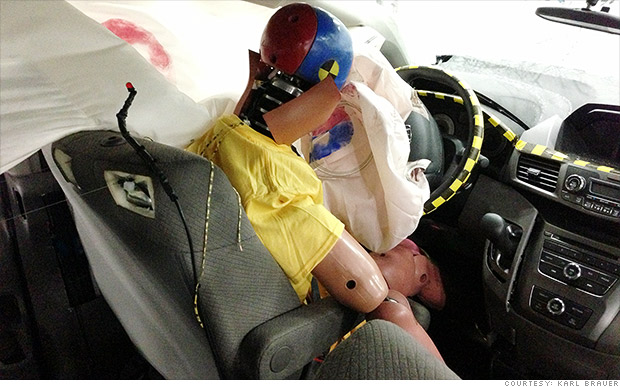
airbag dummy


NEW YORK (CNNMoney)

This is one fix for recalled vehicles that might be more deadly than the problem.


Eight million vehicles made by 10 different automakers have been recalled due to flawed airbags that can explode and hit passengers with shrapnel. The problem: The airbag manufacturer Takata doesn't have enough replacement airbags to fix all the recalled cars.


Not all the manufacturers involved have said how they'll handle the expected shortage. But Toyota has said that it plans to disable defective airbags once it runs out of replacements as it repairs the 800,000 cars it has recalled.
"It's something we're prepared to do, an indication of how seriously we take the problem," said Toyota (TM) spokeswoman Cindy Knight.

Related: Airbag recall could expand

Not everyone thinks this is a good idea, since only a small percentage of the defective airbags are likely to explode in a crash. More people could be killed due to disabled airbags than by the defective airbags, said the Center for Auto Safety's executive director Clarence Ditlow.

"You save more lives by leaving the airbags in place than you would lose lives by the airbag exploding," Ditlow said. Even if a driver is wearing a seatbelt, he said, airbags can provide life-saving protection in a crash.

Related: Honda, Takata sued over exploding airbags

Toyota (TM) says the recalled airbags are only on the passenger side of it's cars. If it disables an airbag, it will put a sticker on the dashboard advising people not to ride in the front passenger seat until its replaced. And it stressed that disabling the airbags is just a temporary solution until a replacement can be installed.

Toyota has gotten permission from the National Highway Traffic Safety Administration to disable the airbags, which otherwise would be illegal. Both Toyota and NHTSA are pushing to get owners to bring their cars in to be serviced, whether or not Toyota runs out of replacement airbags.

Bringing a recalled car in for service is always voluntary for owners. About a third of recalled cars are never repaired, according to industry estimates. But if Toyota goes ahead with its plans, drivers who bring their cars in will be told that disabling the airbags is the best solution for their problem.

Other automakers affected by the recall may also run into a shortage of replacements.

Related: Honda CEO takes pay cut over recalls

Five million vehicles made by Honda Motor (HMC) have been hit by the recall, but the automaker has declined to say whether it will disable the flawed airbags if or when it runs out of replacements.

The company is working to get enough of the replacement airbags, according to Honda spokesman Chris Martin, and that it has not yet asked NHTSA for permission to disable any air bags.

General Motors has recalled 80,000 autos for this airbag problem and the company says it won't disable them if it runs out of replacements.


VIDEO ON LINK


Exploding airbags spark fears


"We're in pretty good shape on replacement parts at the moment," said GM spokesman Alan Adler. "But if and when we run out of parts, our plan is to give owners loaner vehicles. We would not disable the airbag."

There have been four deaths and dozens of serious injuries tied to the exploding airbags, according to the Center for Auto Safety, all in Honda and Accura cars built by Honda Motor (HMC).

NHTSA is pushing Takata to step up efforts to produce replacement bags. But Takata did not return repeated requests for comment as to when it will be able to supply enough replacement airbags to repair all 8 million cars.

Related: 566,000 Dodges and Jeeps recalled


http://money.cnn.com/2014/10/31/autos/exploding-airbag-fix/