Search This Blog

Translate

Blog Archive

Middleboro Review 2

NEW CONTENT MOVED TO MIDDLEBORO REVIEW 2

Toyota

Since the Dilly, Dally, Delay & Stall Law Firms are adding their billable hours, the Toyota U.S.A. and Route 44 Toyota posts have been separated here:

Route 44 Toyota Sold Me A Lemon


Showing posts with label higher ocean temperatures. Show all posts

Wednesday, December 4, 2013

The 2014 Shrimp Season In The Gulf Of Maine Has Been Canceled

Will we wake up?

The 2014 Shrimp Season In The Gulf Of Maine Has Been Canceled

By Joanna M. Foster on December 4, 2013
 
Northern shrimp being hauled in during the 2012 Gulf of Maine season
CREDIT: A.P. Images

They’re small and sweet, beloved by locals and tourists alike, and will soon be indefinitely unavailable. The Northern shrimp population in the Gulf of Maine has officially collapsed and a moratorium on shrimping is being recommended for the 2014 season. Restaurants in Maine are rushing to get their hands on whatever is left over from last year’s catch.

The Atlantic States Marine Fisheries Commission announced the news Tuesday after voting unanimously to halt shrimping for the upcoming season.

The Gulf of Maine Northern shrimp fishery has never been big. But the season, usually between December and May, helps make ends meet for Maine fisherman during otherwise difficult winter months, before the lobsters and tourists arrive. In 2012, the value of the Gulf catch was about $5.1 million. Historically, as much as 25 million pounds of shrimp have been caught in the Gulf of Maine.

The last time the fishery had to shut down, way back in 1977, just 1 million pounds of shrimp were landed. Regulators closed the fishery the following year, and since then, shrimp populations have rebounded to record highs.

The problem looks bleaker this time around. The annual shrimp survey in 2012 revealed the lowest abundance of adults ever recorded in the survey’s thirty-year history.

“I think everyone was startled by what we saw in 2012, and there was a lot of pressure to close down the fishery for the 2013 season,” said John Annala, Chief Scientific Officer at the Gulf of Maine Research Institute. “The survey this summer found just 20 percent of the 2012 record low, so it has fallen off incredibly sharply.”

Perhaps most worrying is the fact that juvenile shrimp have not been picked up in a survey since 2010. Northern shrimp live about five years, so the lack of younger shrimp for three years straight may mean empty nets for years to come.

“During the last ten years the water temperature in the Gulf of Maine has been running about 2.5 degrees Celsius or about 5 degrees Fahrenheit warmer than the previous one hundred year average,” Annala said. “We don’t know what the thermal threshold of this species is, but the Gulf of Maine has always been the southernmost extreme of their range, so we probably don’t have much wiggle room.”

Even if Northern shrimp prove themselves to be more heat tolerant than scientists predict, the warmer waters in the Gulf of Maine are proving deadly to the shrimp’s food supply, tiny zooplankton. Last spring, the usual surge in plankton never happened. Many species of plankton are also at the southernmost end of their thermal tolerance. Warmer waters are also making the Gulf more hospitable to shrimp predators like dogfish and red hake.

“Decisions like this one show how fishermen are on the front lines of the battle against climate change,” said Michael Conathan, Director of Ocean Policy at the Center for American Progress in a phone interview. “This is not a nebulous, maybe-someday-in-the-future problem. This is unchecked carbon pollution affecting livelihoods here in Maine today.”

Shrimp aren’t the only valuable marine resource imperiled by warmer waters in the Gulf of Maine. Lobsters, which are the economic backbone of many coastal communities, have been heading northward in recent years in search of colder water. These iconic crustaceans are also much more vulnerable to a deadly shell disease as temperatures rise.

http://thinkprogress.org/climate/2013/12/04/3021451/maine-shrimp-season-closed/


Tuesday, November 26, 2013

The greatest single threat facing the planet.....

Too many simply don't 'get it'!
Phytoplankton are half of the organic matter produced on Earth.


vvvvv
The fight back against Australia's climate denial.


Did you hear about the actions against UBS on Monday telling them to stop funding mountaintop removal coal mining in Appalachia? 14 people were arrested doing these amazing banner drops, and stunts, and 8 are still in jail as of Tuesday afternoon.

Please SHARE the story of these courageous activists.

You can also help get them out of jail by donating to their legal fund here: http://bit.ly/Ltg4zF Their court date isn't until January 8th, so let's help get them out before that!

Check out our page for more amazing photos and information about Monday's actions.
 
 
Did you hear about the actions against @[218020061613734:274:UBS] on Monday? 14 people were arrested, and 8 are still in jail as of Tuesday afternoon.

Please SHARE the story of these courageous activists.

You can also help us get them out of jail by donating to their legal fund here: http://bit.ly/Ltg4zF Their court date isn't until January 8th, so let's help get them out before that!

Check out our page for more amazing photos and information about Monday's actions.
Did you hear about the actions against UBS on Monday? 14 people were arrested, and 8 are still in jail as of Tuesday afternoon. Please SHARE the story of these... courageous activists. You can also help us get them out of jail by donating to their legal fund here: http://bit.ly/Ltg4zF Their court date isn't until January 8th, so let's help get them out before that! Check out our page for more amazing photos and information about Monday's actions.See More


Sunday, October 6, 2013

The Destruction of the Oceans


The review says there is growing evidence that the oceans are losing oxygen.
 
 
Article image
 
 
Marine scientists say the state of the world’s oceans is deteriorating more rapidly than anyone had realized, and is worse than that described in last month’s UN climate report from the Intergovernmental Panel on Climate Change (IPCC).
 
They say the rate, speed and impacts of ocean change are greater, faster and more imminent than previously thought—and they expect summertime Arctic sea ice cover to have disappeared in about 25 years.
 
Their review, produced by the International Program on the State of the Ocean (IPSO) and the International Union for the Conservation of Nature (IUCN) and published in the journal Marine Pollution Bulletin, agrees with the IPCC that the oceans are absorbing much of the warming caused by carbon dioxide and other greenhouse gases.
 
But it says the impact of this warming, when combined with other stresses, is far graver than previous estimates. The stresses include decreasing oxygen levels caused by climate change and nitrogen run-off, other forms of chemical pollution, and serious overfishing.
 
“The health of the ocean is spiraling downwards far more rapidly than we had thought,” said Professor Alex Rogers of the University of Oxford, IPSO’s scientific director. “We are seeing greater change, happening faster and the effects are more imminent than previously anticipated.”
Screen Shot 2013-10-04 at 1.27.14 PM
“What these latest reports make absolutely clear is that deferring action will increase costs in the future and lead to even greater, perhaps irreversible, losses,” said IUCN’s Professor Dan Laffoley.


The review says there is growing evidence that the oceans are losing oxygen. Predictions for ocean oxygen content suggest a decline of between one and seven percent by 2100.
 
The loss is occurring in two ways: through the broad trend of decreasing oxygen levels in tropical oceans and areas of the North Pacific over the last 50 years, and because of the “dramatic” increase in coastal hypoxia (low oxygen) associated with eutrophication, when excessive nutrient levels cause blooms of algae and plankton.
 
The first is caused by global warming, the second by increased nutrient runoff from agriculture and sewage.
 
The authors are also concerned about the growing acidity of the oceans, which means “extremely serious consequences for ocean life, and in turn for food and coastal protection.”
 
The Global Ocean Commission reported recently that acidification would make up to half of the Arctic Ocean uninhabitable for shelled animals by 2050.
 
“At high latitudes pH levels are decreasing faster than anywhere else because water temperatures are lower, and the water is becoming more acidic,” Professor Rogers told the Climate News Network. “Last year, for the first time, mollusks called sea butterflies were caught with corroded shells.”
 
When atmospheric carbon dioxide (CO2) concentrations reach 450-500 parts per million (ppm) coral reefs will be eroded faster than they can grow, and some species will become extinct. Projections are for concentrations to reach that level by 2030-2050: in May they passed 400 ppm for the first time since measurements began in 1958.
 
With the ocean bearing the brunt of warming in the climate system, the review says, the impacts of continued warming until 2050 include reduced seasonal ice zones and increasing stratification of ocean layers, leading to oxygen depletion.
 
It also expects increased releases from the Arctic seabed of methane, a greenhouse gas at least 23 percent more potent than CO2 (the releases were not not considered by the IPCC); and more low oxygen problems.
 
Another stress identified is overfishing. Contrary to claims, the review says, and despite some improvements, fisheries management is still failing to halt the decline of key species and damage to ecosystems. In 2012 the UN’s Food and Agriculture Organization said 70 percent of world fish populations were unsustainably exploited.
 
The scientists say world governments must urgently reduce global CO2 emissions to limit temperature rise to under two degrees Celsius—something which would mean limiting all greenhouse gas emissions to 450 ppm.
 
They say current targets for carbon emission reductions are not enough to ensure coral reef survival and to counter other biological effects of acidification, especially as there is a time lag of several decades between atmospheric CO2 emissions and the detection of dissolved oceanic CO2.
 
Potential knock-on effects of climate change, such as methane release from melting permafrost, and coral dieback, mean the consequences for human and ocean life could be even worse than presently calculated. The scientists also urge better fisheries management and an effective global infrastructure for high seas governance.
http://www.nationofchange.org/urgent-warning-scientists-health-oceans-spiraling-downwards-1381072525


Friday, September 27, 2013

Rising ocean temps draw diverse species to Northeast

Interesting consequence of Global Warming:

Rising ocean temps draw diverse species to Northeast
PORTLAND, Maine — Fish commonly found in warm ocean waters to the south have become more common in New England as ocean temperatures rise.
 
In the past two years, fishermen in Southern New England have seen an increase in croaker, cobia and spot, species more commonly found in waters off the mid-Atlantic. Certain types of skates and blue crabs are also becoming more numerous, fishermen say.
 
In the colder Gulf of Maine waters north of Cape Cod, black sea bass have become more prevalent the past two summers. Longfin squid, which are found primarily south of Cape Cod, were present in Maine waters during the 2012 summer, resulting in new fisheries and markets being developed for the season.
 
Before last year, lobsterman David Cousens of South Thomaston, Maine, had seen only one ocean sunfish in nearly 40 years of pulling traps. This summer he has seen a bunch of them, sometimes days in a row.
 
Cousens even found some sea horses in his traps last summer. Scientists say there have also been reports of triggerfish and filefish — colorful species that look more suited to an aquarium — and juvenile snowy grouper, which is normally found in the Caribbean or off the southern U.S.
 
"There's no question the Gulf of Maine is changing rapidly," Cousens said. "Stuff you've never seen in your lifetime that you would think would take 200 or 300 years to slowly change has happened in the past 20 or 30 years — the last 10 years, really. It's scary, but what are you going to do about it? You can't stop global warming."
 
Ocean temperatures worldwide are rising rapidly, with some of the fastest warming taking place in the northwest Atlantic Ocean.
 
Temperatures off the Northeast U.S. hit an all-time high during the ocean heat wave of 2012, affecting virtually all ocean life.
 
Atlantic cod and many other commercially valuable fish in New England have been shifting northeast from their historical distribution centers in recent years because of warming waters.
 
Warm water was blamed for lobsters shedding their shells far earlier than usual last year, leading to a glut that created havoc within the industry.
 
At the same time, species that normally live in warmer waters are showing up with greater frequency off New England, scientists say, largely because of rising ocean temperatures. Other factors, such as fishing pressure and environmental changes including increased acidification and lower salinity levels, are believed to be at play.
 
Third-generation fisherman Rodman Sykes, who fishes out of Point Judith, R.I., said he's been catching more barndoor and clear-nose skates and torpedo rays.
 
And dockside workers have reported seeing mahi mahi swim by.
 
The fish aren't abundant enough yet to make money from. But in time, he said, fishermen in Southern New England could benefit financially from the newcomers.
 
"But I'm more fearful for the guys down south who might be losing some of their opportunities," Sykes said. "Maybe something will replace them, or they'll become more spread out. Or maybe they'll come up here and go back down there for the winter."
 
Many of the warmer-water species that are now becoming more common have been coming to New England for years but in smaller numbers, said Mike Fogarty, chief of the ecosystem assessment program at the National Oceanic and Atmospheric Administration's Northeast Fisheries Science Center in Woods Hole, Mass.
 
Those that made it to New England would typically die in years past when the waters got cold in the winter, he said, but more of them are now surviving because of the temperatures.
 
A study written by Fogarty and other researchers that appeared in the journal Science this month concludes that climate change has resulted in shifts in where and at what depths many marine species are found throughout U.S. and Canadian waters. The shifts have not been uniform and are most likely caused by local climate conditions.
 
As the fish migrate, fishermen will need to adapt with new fishing gear or new approaches to harvesting the commercially valuable species, said Jon Hare, a fisheries oceanographer at the Northeast Fisheries Science Center's laboratory in Narragansett, R.I.
 
Regulators are going to have to figure out how best to manage the fish. And scientists are going to have to answer new questions on the changing ecosystem as shifting distribution patterns result in a new mingling of species.
 
After seeing so many changes the past couple of years, fishermen are asking themselves what's next.
 
"I guess we'll have to see what happens and adapt, but who knows?" Cousens said. "I don't really know what the answer is. I know I can't snap my fingers and change anything."


Thursday, September 26, 2013

Faux Pause: Ocean Warming, Sea Level Rise And Polar Ice Melt Speed Up, Surface Warming To Follow

Great graphics! Click on link below to view.
As expected, warming just keeps speeding up.

Faux Pause: Ocean Warming, Sea Level Rise And Polar Ice Melt Speed Up, Surface Warming To Follow

By Joe Romm on September 25, 2013


Decadal surface-air temperature (°C) via average of datasets maintained by the HadCRU, NOAA and NASA.

“Global Warming Has Accelerated In Past 15 Years, New Study Of Oceans Confirms,” as we reported back in March. And “Greenland Ice Melt Up Nearly Five-Fold Since Mid-1990s, Antartica’s Ice Loss Up 50% In Past Decade,” as we reported last November. Another study that month found “sea level rising 60% faster than projected.”

And yet much of the media believes climate change isn’t what gets measured and reported by scientists, but is somehow a dialectic or a debate between scientists and deniers. So while 2010 was the hottest year on record and the 2000s the hottest decade on record, we are subject to nonsensically framed stories like this one from CBS, headlined “Controversy over U.N. report on climate change as warming appears to slow.”

The drama-driven junkies of the MSM apparently think that the most newsworthy thing in the once-every-several-years literature review by hundreds of the world’s leading scientists is that people who make a living denying climate science … wait for it … deny climate science. That CBS story actually begins, “Climatologists and climate-change deniers agree on at least one thing this week: everyone is awaiting the landmark U.N. report on climate change that will be presented at next week’s meeting of the Intergovernmental Panel on Climate Change (IPCC).” Stop the presses! No, please, stop the damn presses already if you are an editor or reporter who thinks deniers deserve equal billing with scientists.

Because the media keeps making the same faux pas about the faux pause, scientists and science writers have had to debunk it repeatedly. Anyone in the media who insists on buying into the false dialectic MUST read the new piece at Real Climate by climatologist Stefan Rahmstorf, the Mother Jones piece by Chris Mooney, this piece by Tamino, and almost anything at Skeptical Science (such as this or this).

Let me extract the key points and figures. Back in July, scientist Dana Nuccitelli summarized a new study, “Distinctive climate signals in reanalysis of global ocean heat content“:
  • Completely contrary to the popular contrarian myth, global warming has accelerated, with more overall global warming in the past 15 years than the prior 15 years. This is because about 90% of overall global warming goes into heating the oceans, and the oceans have been warming dramatically.
  • As suspected, much of the ‘missing heat’ Kevin Trenberth previously talked about has been found in the deep oceans. Consistent with the results of Nuccitelli et al. (2012), this study finds that 30% of the ocean warming over the past decade has occurred in the deeper oceans below 700 meters, which they note is unprecedented over at least the past half century.
  • Some recent studies have concluded based on the slowed global surface warming over the past decade that the sensitivity of the climate to the increased greenhouse effect is somewhat lower than the IPCC best estimate. Those studies are fundamentally flawed because they do not account for the warming of the deep oceans.
  • The slowed surface air warming over the past decade has lulled many people into a false and unwarranted sense of security.
For more on the myth of a low climate sensitivity (or the myth that climate sensitivity is the same as projected future warming), see this post. In reality, the best science says that the Earth’s actual sensitivity to carbon pollution is probably on the high side.
The bottom line is provided by Rahmstorf at RealClimate:
The heat content of the oceans is growing and growing. That means that the greenhouse effect has not taken a pause and the cold sun is not noticeably slowing global warming….
The increase in the amount of heat in the oceans amounts to 17 x 1022 Joules over the last 30 years. That is so much energy it is equivalent to exploding a Hiroshima bomb every second in the ocean for thirty years.
Before discussing the explosive ocean heat data, Tamino and Rahmstorf make an important point about recent warming. Here is the plot of the NASA temperature data:


gisstrend12

“Since 1975, global average surface air temperature has increased at a rate of 0.17 deg.C/decade,” Tamino notes. “But the rate of increase hasn’t been perfectly constant over that entire time span. As a matter of fact, there’s a 15-year time span during which the rate is notably different. Fifteen whole years!!!”

Rahmstorf replied to one journalist who asked whether there’s a real slowdown or “Do the IPCC authors feel pressured to write about it just because skeptics are making so much noise about it?”
You’d have to ask them but it is quite possible. I think a lot of the interest in this topic in the science community has been triggered by the public debate about it. If you look at the 15-year period up to 2006, the warming trend was almost twice as high as normal (namely 0.3 °C per decade) but nobody cared (you can see a graph with this trend line here [or above]. We published a paper in Science in 2007 where we noted this large trend, and as the first explanation for it we named natural variability. There is a certain asymmetry in that 15 years of high trend don’t raise much interest, whilst 15 years of low trend do. The reason is that interest groups strongly push the latter.
What’s surprising is not that deniers and confusionists keep pushing their denial and confusion — that is, after all, their job — but that much of the mainstream media keeps buying what they are selling.

Let’s return to the speed up in ocean heat content:


Change in heat content in upper 2000 meters (6500 feet) of world’s oceans. Source: NOAA
Rahmstorf, who is Head of Earth System Analysis at the Potsdam Institute for Climate Impact Research, explains:
The amount of heat stored in the oceans is one of the most important diagnostics for global warming, because about 90% of the additional heat is stored there (you can read more about this in the last IPCC report from 2007). The atmosphere stores only about 2% because of its small heat capacity. The surface (including the continental ice masses) can only absorb heat slowly because it is a poor heat conductor. Thus, heat absorbed by the oceans accounts for almost all of the planet’s radiative imbalance.
Here’s a graphic illustration of that via Skeptical Science:

where GW is going
 
A visual depiction of how much global warming heat is going into the various components of the climate system for the period 1993 to 2003, calculated from IPCC AR4 5.2.2.3
What does that mean for our understanding of climate change? Again, here’s Rahmstorf:
If the oceans are warming up, this implies that the Earth must absorb more solar energy than it emits longwave radiation into space. This is the only possible heat source. That’s simply the first law of thermodynamics, conservation of energy. This conservation law is why physicists are so interested in looking at the energy balance of anything. Because we understand the energy balance of our Earth, we also know that global warming is caused by greenhouse gases – which have caused the largest imbalance in the radiative energy budget over the last century.
If the greenhouse effect (that checks the exit of longwave radiation from Earth into space) or the amount of absorbed sunlight diminished, one would see a slowing in the heat uptake of the oceans. The measurements show that this is not the case.
Rahmstorf also notes that “Completely independently of this oceanographic data, a simple correlation analysis (Foster and Rahmstorf ERL 2011) showed that the flatter warming trend of the last 10 years was mostly a result of natural variability, namely the recently more frequent appearance of cold La Niña events in the tropical Pacific and a small contribution from decreasing solar activity.”

You can see the effect of La Niña “directly in the following figure, without any statistical analysis”:


Annual global temperature (El Niño years in red and La Niña years in blue)
As you can see, “both the red El Niño years and the blue La Niña years are getting warmer, but given that we have lately experienced a cluster of La Niña years the overall warming trend over the last ten years is slower.” This is the noise “associated with natural variability, not a change in the signal of global warming.”
And, as it turns out, just last month a major study published in Nature confirmed that “the slowing rise in global temperatures during recent years has been a result of prevalent La Niña periods in the tropical Pacific.” The abstract of that study explains:
Our results show that the current hiatus is part of natural climate variability tied specifically to a La Niña like decadal cooling.
Thus there are, as Rahmstorf notes, “at least three independent lines of evidence that confirm we are not dealing with a slowdown in the global warming trend, but rather with progressive global warming with superimposed natural variability.”

And let’s not forget another key indicator of accelerating warming — the accelerating melting of the great ice sheets as documented in the most comprehensive analysis of satellite altimetry, interferometry, and gravimetry data sets to date:

IceSheetSLR

Warming of the whole globe (as opposed to the thin surface layer) has sped up. When the rate of surface warming returns to the trendline, I wonder if the media will report that global warming has accelerated.

For those interested in the full sized graphics, click on this link:
http://thinkprogress.org/climate/2013/09/25/2562441/faux-pause-ocean-warming-speed-up/


Thursday, September 12, 2013

Power Plant Carbon Emissions revealed

Great report that highlights the need for focusing on reduction through energy efficiency.

Power Plant Carbon Emissions revealed

Brayton Point is one of the state's worst polluters

Wednesday, July 24, 2013

Attack of the Cannibal Lobsters

Fascinating information about the impacts of global warming and overfishing - click on link for additional information...

Here Is a Video of One Lobster Eating Another Lobster


Warming seas turn our favorite crustaceans into cannibals.

| Wed Jul. 24, 2013


Monday, October 29, 2012

Catastrophic Weather and Ignorance


From: 350.org
350.org shared a photo.
Hurricane Sandy will be arriving on the East Coast in a matter of hours, so we're re-posting this.

Sandy is now the largest Atlantic hurricane by width ever measured. Storm surges are already higher than in last year's Hurricane Irene.

That's after the hottest summer in North American history, a massive drought and record Arctic melting. This is not a coincidence.
A storm unlike any that meteorologists have ever seen is heading for the East Coast of the United States. We're hoping that it won't be so bad, but if it is, we'll know why.

The media is not doing a good job reporting this part of the story -- SHARE this and connect the dots between climate change and extreme weather, even if they won't!

Sources: http://www.wunderground.com/tropical/?index_region=at, http://www.climatecentral.org/news/historic-frankenstorm-hurricane-sandy-taking-aim-at-mid-atlantic-northeast-15161, http://thinkprogress.org/climate/2012/10/26/1097391/climate-change-frankenstorm-beyond-strange-unprecedented-bizarre/


From the album: Timeline Photos
By 350.org
A storm unlike any that meteorologists have ever seen is heading for the East Coast of the United States. We're hoping that it won't be so bad, but if it is, we'll know why.

The media is not doing a good job reporting this part of the story -- SHARE this and connect the dots between climate change and extreme weather, even if they won't!
 
 
Bill McKibben joined meteorologist Jeff Masters and Climate Scientist Greg Jones this morning to discuss the connections between stronger storms and climate change. Do yourself a favor and listen all the way through--fascinating stuff.

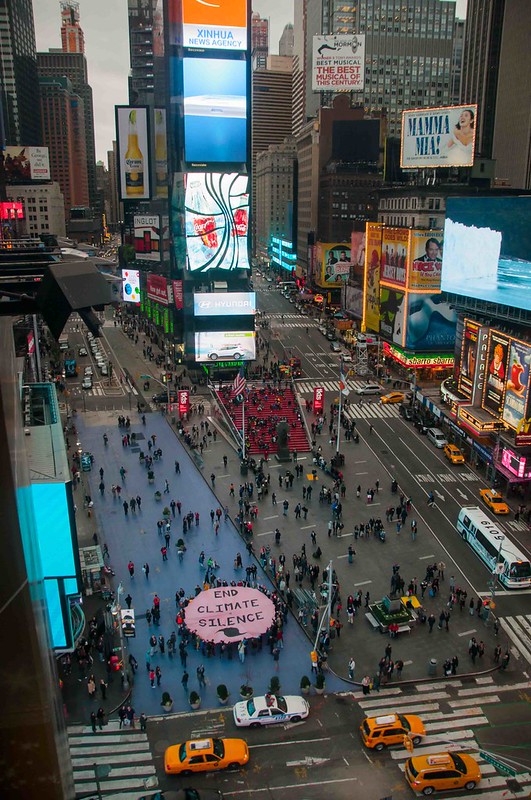
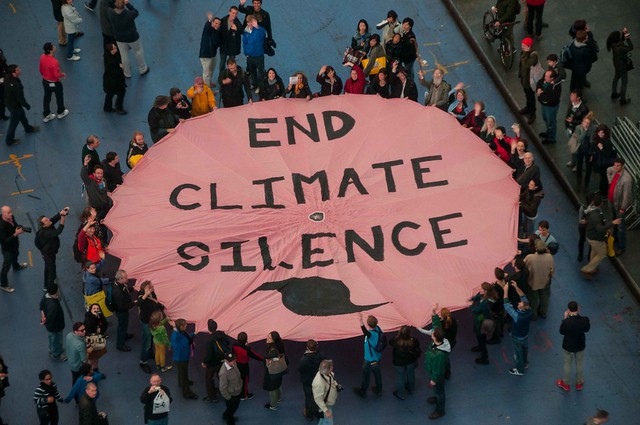
350.org Activists Unfurl Giant “End Climate Silence” Banner in Times Square

A big crowd of volunteers joined 350.org in Times Square this afternoon to unfurl a giant parachute with the message “End Climate Silence” and an image of a hurricane.
"Meteorologists have called this 'the biggest storm ever to hit the U.S. mainland,' which is a reminder of how odd our weather has been in this hottest year in American history,” said 350.org founder Bill McKibben. “But mainly it's a reminder of how much we need to take care of each other when disaster strikes--we hope everyone will pitch in with the Red Cross, and with local relief efforts. Community is our greatest source of energy, and our cleanest!"
Photo: Adam Welz
 
As Hurricane Sandy barrels down on the East Coast, scientists are connecting the dots between increasingly extreme weather and global warming. Yet for most of this year’s presidential election, the words “climate change” have gone unmentioned. The issue was not raised in a presidential debate for the first time since 1988.
 
Scientists warn that climate change is loading the dice for extreme weather events like Hurricane Sandy. The Earth’s average global temperature has risen between 1.5 and 2 degrees Fahrenheit over the past century and the warmer temperatures mean that the atmosphere holds about 4% more moisture than it did in 1970, leading to greater rainfall.

Photo: Adam Welz

According to leading hurricane tracker and weatherman Jeff Masters, water temperature in the mid-Atlantic this year is 5°F warmer than average, allowing hurricanes to travel farther north and contributing to “an unusually large amount of water vapor available to make heavy rain.”

The recent string of extreme weather events -- especially the drought, heat wave, and wildfires that ravaged much of the United States this summer -- is making Americans more concerned about climate change. According to a recent report by the Yale Project on Climate Change Communications, 70% of Americans now say they believe global warming is a reality, the highest level since 2008.

This November 7, 350.org is launching a 20-city nationwide tour called “Do The Math” to connect the dots between extreme weather, climate change, and the fossil fuel industry, which is not only driving climate change but blocking the clean energy solutions that could solve the crisis. More information is available at math.350.org.

[Video includes Mitt Romney's buffoonery at the Republican Convention which does nothing beyond perpetuating ignorance.]