Search This Blog

Translate

Blog Archive

Middleboro Review 2

NEW CONTENT MOVED TO MIDDLEBORO REVIEW 2

Toyota

Since the Dilly, Dally, Delay & Stall Law Firms are adding their billable hours, the Toyota U.S.A. and Route 44 Toyota posts have been separated here:

Route 44 Toyota Sold Me A Lemon


Showing posts with label David Kelley. Show all posts

Wednesday, August 9, 2017

U.S. Asks Judge to Dismiss Toyota Acceleration Case as Monitoring Ends


U.S. Asks Judge to Dismiss Toyota Acceleration Case as Monitoring Ends


REUTERS

AUG. 8, 2017

WASHINGTON — The U.S. Department of Justice on Tuesday asked a federal judge to dismiss a criminal charge against Toyota Motor Corp after the Japanese automaker completed three years of monitoring as part of a $1.2 billion settlement over claims of sudden unintended acceleration in its vehicles.

The request, filed in federal court in Manhattan, should bring to an end Toyota's legal woes stemming from its admission that it misled U.S. consumers by concealing and making deceptive statements about the extent of sudden acceleration problems in 2009 and 2010.

In 2014, the world's second-largest automaker paid what was then a record fine for a car company to settle the case and reached a deferred prosecution agreement with the Justice Department. That agreement included three years of oversight by an independent monitor, which ended on Monday.

Former U.S. attorney David Kelley, who acted as the monitor, declined to comment, citing confidentiality rules.

Toyota spokesman Scott Vazin said the automaker was pleased the government confirmed Toyota's compliance with the terms of the deferred prosecution agreement and was moving to dismiss the case.

"Over the past three years, we have worked hard in the spirit of continuous improvement to make Toyota a stronger company that serves its customers better," he said.

In bringing charges, the Justice Department said that Toyota minimized problems, misled regulators and provided inaccurate information to Congress in the scandal linked to at least five deaths.


In 2014, U.S. District Judge William Pauley said the case presented a "reprehensible picture of corporate misconduct" and expressed hope the government would ultimately hold responsible decision-makers at Toyota accountable. "This, unfortunately, is a case that demonstrates that corporate fraud can kill," he said.In 2014, U.S. District Judge William Pauley said the case presented a "reprehensible picture of corporate misconduct" and expressed hope the government would ultimately hold responsible decision-makers at Toyota accountable. "This, unfortunately, is a case that demonstrates that corporate fraud can kill," he said.

Ultimately, the Justice Department did not bring criminal charges against current or former Toyota executives.

The $1.2 billion settlement was the largest penalty levied by the United States on an auto company until Volkswagen AG admitted to diesel emissions fraud earlier this year and paid $4.3 billion in fines.

Toyota made significant changes to its safety practices after the recall crisis that briefly forced it to halt sales of nearly half of its vehicles in 2010 and led to company president Akio Toyoda appearing before Congress to apologize.

Toyota settled other related suits, including an agreement covering as many as 22 million current and former Toyota owners over sudden acceleration claims valued at as much as $1.63 billion. There are still some individual civil claims pending in California.

Ultimately, the Justice Department did not bring criminal charges against current or former Toyota executives.

The $1.2 billion settlement was the largest penalty levied by the United States on an auto company until Volkswagen AG admitted to diesel emissions fraud earlier this year and paid $4.3 billion in fines.

Toyota made significant changes to its safety practices after the recall crisis that briefly forced it to halt sales of nearly half of its vehicles in 2010 and led to company president Akio Toyoda appearing before Congress to apologize.

Toyota settled other related suits, including an agreement covering as many as 22 million current and former Toyota owners over sudden acceleration claims valued at as much as $1.63 billion. There are still some individual civil claims pending in California.

(Reporting by David Shepardson in Washington and Jonathan Stempel in New York; Editing by Bill Rigby)

https://www.nytimes.com/reuters/2017/08/08/business/08reuters-toyota-settlement.html


Sunday, November 16, 2014

Hmmm...TOYOTA TACTICS?


Charlene M. Blake (@charleneblake)
Does #Toyota illegally obtain credit reports or violate HIPAA laws in order to discredit or defame its own customers? pic.twitter.com/3MR0Ermwv3

Download the official Twitter app here


THE LEMON LADY'S EXPERIENCE IS POSTED HERE:

Independent Monitor


It seems NOTHING STOPS TOYOTA! NOT EVEN THE LAW!


JUST MY OPINION....AT THE MOMENT!


Tuesday, October 28, 2014

Independent Monitor


On October 17, 2014, the letter below was sent to David Kelley, an attorney who has been appointed the Independent Monitor of TOYOTA as part of the $1.2 BILLION settlement with the Department of Justice, TOYOTA'S GET OUT OF JAIL FREE CARD!
[The letter below was sent without the images or highlighting.]


David N. Kelley, Esq.

Independent Monitor

Cahill Gordon & Reindel LLP

80 Pine Street

New York, NY 10005-1702


Re: TOYOTA DEFECT INVESTIGATION & TAMPERING


Dear Mr. Kelley:


April 23, 2012, I purchased a NEW 2012 Prius C from Route 44 Toyota located in Raynham, MA, at the time incorrectly believing TOYOTA would be responsive to problems with their vehicles.


I am simply a CONSUMER!


My 2012 TOYOTA Prius C had 600 miles on the odometer as I drove out of a parking garage.


The vehicle experienced such a significant jolt [NO NOISE] I initially believed my TOYOTA had been struck in the rear and subsequently realized the jolt was caused by the vehicle itself transitioning from the battery to its gas engine.


When TOYOTA called that evening and I shared my experience, I was instructed to call the dealership to have the vehicle checked.


Initially, the dealership refused to make an appointment, assuring me this was NORMAL OPERATION even though it was not previously experienced. Major jolt from transitioning?


A short time later, while approaching a STOP SIGN at a Public School Crossing, I applied the BRAKES, and as the pedal traveled to the floor, a dash light flashed on while the TOYOTA continued to travel through the STOP SIGN.


I subsequently drove SLOWLY to my home and had the vehicle towed to the dealership.

I was assured there were "NO COMPUTER ERROR MESSAGES."


I was informed a TOYOTA SERVICE PERSON would examine and test drive my 2012 Prius C but was prevented from being present.


When I subsequently attempted to retrieve my vehicle, the brake pedal again traveled to the floor which I have come to understand is NOT acceptable behavior.


I left my TOYOTA at the dealership to have it examined again and was informed this is how electronic brakes operate and I just needed to get 'used to it.'


It is now my understanding once the ignition has been shut off and turned on or the battery disconnected, all computer error messages are erased.


I refused to drive a TOYOTA that experienced unpredictable behavior in less than a month of operation and less than 1,000 miles on the odometer. I left the vehicle on the dealer's property and filed a complaint. How can any driver operate a 2012 TOYOTA Prius C with unpredictable behavior?


When I cleaned the vehicle out and retrieved its license plates in August 2012, I reported to my attorney at that time the ODOMETER read ~ 600 miles.


I knew at that time my vehicle had been tampered with while in the custody of the dealership.

I did NOT turn on the ignition, but merely turned the key to the accessory position.

I subsequently became aware of NHTSA's process to Petition for Defect Investigation which I filed because I firmly believe there are 2 separate issues:


1. my refusal to drive a TOYOTA vehicle in which I would jeopardize the safety of others

2. the safety of other TOYOTA owners if there is a safety/software defect


When NHTSA arrived at the dealership to examine and test drive the vehicle, it had been sitting for almost a year, its battery was dead and required replacement.


That would delete any error messages.


You will note NHTSA has documented subsequent TAMPERING with the ODOMETER, posted in the Federal Register in JULY 2014.


https://www.cfr-ebooks.com/register/2014/Jul/31/2014-17984.pdf

Denial of Motor Vehicle Defect Petition, DP13-002, 44487-44491 [2014-17983]


DEPARTMENT OF TRANSPORTATION

National Highway Traffic Safety

Administration

Denial of Motor Vehicle Defect Petition,

DP13–002


If there was nothing found wrong with my TOYOTA, why was its odometer TAMPERED with?


You will note the inclusion of information about a 'HILL HOLD FEATURE,' yet when the BRAKE FAILURE was experienced, I was operating on a FLAT SURFACE, there were never any bells or whistles noted.

This matter goes far beyond the egregious conduct by NHTSA and TOYOTA.


Subsequent to filing a lawsuit, I discovered the dealership, Route 44 Toyota had violated the FCRA [Fair Debt Collections Practices Act] and illegally requested a credit report on the day I presented payment in full for the vehicle. 


In addition, Route 44 Toyota requested my credit report on the day [October 2012] they discovered my vehicle on their property with no license plates on it.


Route 44 Toyota also illegally requested a credit report of a disinterested 3rd party on that date.


We did NOT travel to the dealership, request credit or undertake any action enumerated under FCRA.


When I filed a complaint with TOYOTA, it was ignored.


When I posted my experience on 'dealerrater', a web site which provides the dealership with a two week time frame to remedy a consumer problem prior to making it publicly available, I was threatened with a SLAPP suit by the dealership's attorney, Daniel Viera.


In my complaint, I sought to have the purchase price of my 2012 TOYOTA Prius C refunded along with other associated costs.


Instead, I have been stalked, spied upon, my medical records shared [for which 2 agencies are currently investigating HIPAA violations] and more.


It is now more than two years since the complaint was filed and TOYOTA's attacks continue, while the deposition process remains incomplete.


Attorney Keith Rose has traveled to and from Albany, NY, requiring 4 hours to Plymouth, MA, 4 hours back to Albany for nonsensical reasons.


During the first year, Attorney Rose had profuse 'scheduling conflicts' which reflects TOYOTA's DILLY, DALLY, DELAY, STALL & BILL 'EM tactics. 
 
 
[THE KING OF CONFLICT!]

Each time, Attorney Rose stands before the court, he presents bizarre and fictional versions of this matter.


I am a simple consumer who mistakenly purchased a new 2012 TOYOTA Prius C.


Instead of making the vehicle function properly, I have been attacked, discredited, stalked,.....


 my medical records shared....,


....my sobriety and drug use challenged, illegally obtained credit reports abused, my privacy invaded and more.


As a consumer, I have been strong-armed, stalked and attacked for protesting a DEFECTIVE TOYOTA vehicle.


Since the Federal Register Denial was posted in July 2014 [while strangely the Public Comment period ended in April 2014] this matter does seem to fall within your jurisdiction.


Other TOYOTA owners are stuck with these malfunctioning vehicles because they have no recourse and it's time to make things right for consumers.


[JUST MY OPINION...AT THE MOMENT!]

Tuesday, October 21, 2014

Straight From TOYOTA'S Corporate Playbook!


TOYOTA tortured a jury with 4 WEEKS' of TRIAL.....


.....tried to BLAME THE VICTIM, and the jury didn't buy it!


That after 4 YEARS OF DELAY! [DILLY DALLY DELAY STALL & BILL 'EM straight from TOYOTA CORPORATE PLAYBOOK!]


Jury says Toyota must pay reality TV star $12 million for crash injury


Sunday, September 14, 2014

Toyota's Smoking Gun


New 'Runaway Toyota' Case Tests DOJ's Integrity


Junko Yoshida

MADISON, Wis. — Just as the memory of Toyota's unintended acceleration cases began to fade, at least in the minds of the media and a few million thus far unaffected Toyota owners, in comes Robert Ruginis to dredge it all up again.
 
Ruginis, a Bristol, Rhode Island-based embedded systems engineer, filed a petition letter on Thursday, September 11, to the National Highway Traffic Safety Administration (NHTSA) about multiple low-speed surge events involving his wife's 2010 Toyota Corolla. The Ruginis case poses for Toyota the danger that the public and government regulators will remember that the Japanese automotive giant has never really addressed the root cause of unintended acceleration in its vehicles.

Ruginis is now asking the NHTSA to investigate "low-speed surging in the 2006-2010 Toyota Corolla with ETCS-i, in which the brakes fail to stop the vehicle in time to prevent a crash," according to the petition letter he filed Thursday.

In a move that could make the matter more high-profile, Ruginis is taking the matter to the lawyer designated as "independent monitor" as part of Toyota's deferred prosecution agreement with the government over the automaker's handling of unintended-acceleration claims.
In his letter to David Kelley, the independent monitor, Ruginis wrote:
I am writing to inform you that Toyota Motor North America may already have broken the terms of the March 2014 deferred prosecution agreement by making misleading statements and concealing information on a safety issue related to unintended acceleration. I request that you investigate my case.

To recap, Toyota was fined $1.2 billion earlier this year, as part of a deferred prosecution agreement with the Department of Justice. Toyota recalled 8.1 million cars, but says no cause was ever found except floor mats that can trap acceleration pedals and drivers who hit the accelerator when they thought they were pushing the brake.

The experience Ruginis and his wife have had with their Corolla -- bought new in May 2010 -- tells a very different story.

In a letter Ruginis wrote to NHTSA, he noted: "The MY2010 Corolla was subject to the floor mat entrapment and sticky accelerator recalls. The dealership applied the 'sticky pedal' remedy in February, before we purchased the vehicle. The floor mat remedy was applied in November 2010."

The Ruginis family's troubles with their new Corolla began almost immediately after they bought it.

In an interview with EE Times, Ruginis explained that he returned the car to the dealer twice before his wife crashed into another car in a parking lot in June this year. Both times, Toyota technicians claimed there was nothing wrong with the car.

As he told a story of the accident on June 8, 2014 in his petition letter to NHTSA, Ruginis wrote:
At the time of the crash, a sunny, temperate afternoon, my wife, Kathleen Ruginis, was making a slow, right hand turn to ease into a parking space on High Street in Bristol, Rhode Island. Her foot was on the brake, when the vehicle surged forward and crashed into an unoccupied parked Jeep in front of it. Fortunately, no one was injured.

Enough smoking gun

  Having already complained twice, Robert and Kathleen Ruginis realized this crash was not an isolated incident.

After the crash, Ruginis got in touch with Sean Kane, a well-known auto-safety expert. Kane, of Safety Research & Strategies, found 164 complaints from NHTSA's files that appear to relate to similar problems in Toyotas.

Kane told EE Times that the Ruginis case is "stunning" for several reasons.

First is Ruginis's background. Now an independent consultant focused on consumer electronics, he spent 35 years working on embedded systems. His experience ranged from a position at "Chrysler working on new engine control systems to Milton Bradley's Advanced R&D creating new electronic toys and games, to Raytheon working on Navy sonar and acoustic systems, to Hasbro creating an electronic engineering group to support the complete electronic product cycle from advanced R&D to production," according to Ruginis. In short, Kane thinks that a man who has spent his career with embedded systems ought to know when an embedded system goes haywire.

Second, noted Kane, Kathleen Ruginis's statements have been very clear and consistent. They are verified by a passenger in the car at the time of the crash.

Finally, a readout of the vehicle's Event Data Recorder (EDR) "is consistent to a 'T' to Kathleen's statements," according to Kane.

Kane sees "enough smoking gun" here to make this case "a real standout."

EDR readout in question

It's important to note, however, that EDR data isn't conclusive proof, as Kane explains. The EDR used in cars is not the same quality of so-called black boxes used in aviation. As Ruginis himself pointed out in his petition letter, "We are fortunate, because many parking lot crashes do not generate enough force to activate the EDR, and others produce inconclusive EDR results."

The EDR investigation report whose copy Ruginis received from Bosch, the EDR reader's manufacturer, illustrates what happened in the car going back five seconds before the crash.

The EDR readout shows that at the moment the airbag module made the decision whether to deploy (about the time of the impact), voltage going to the accelerator pedal was 0.78 (at idle), the brake was engaged, yet both the speed of the vehicle and engine RPM doubled in less than two seconds.
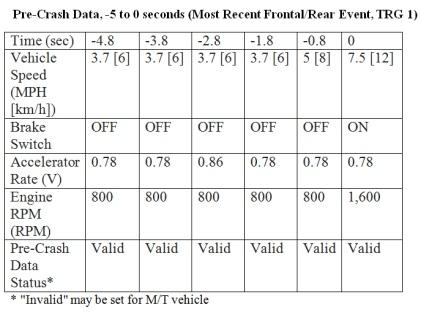
It shows the car's speed at 3.7 miles per hour and the brake switch 'off,' At 0.8 the brake switch is still off but then at 0 seconds, or point of impact, the car's speed increases to 7.5 miles an hour and the engine's RPM doubles from 800 to 1600. The data shows at that time the brake switch was 'on.'
It shows the car’s speed at 3.7 miles per hour and the brake switch “off," At 0.8 the brake switch is still off but then at 0 seconds, or point of impact, the car’s speed increases to 7.5 miles an hour and the engine’s RPM doubles from 800 to 1600. The data shows at that time the brake switch was “on.”


How different parties — NHTSA, Toyota and Ruginis — interpreted the EDR readouts (although Toyota initially simply ignored the data) has become the bone of contention, prompting Ruginis to file the petition to NHTSA and write to the independent monitor.

As Ruginis saw the EDR data, he explained to EE Times:
 
Our car was going 3.7mph the engine speed was 800RPM, the accelerator was not being pressed, the brake was not pressed and the Jeep was 14.78 feet away (my calculation of distance)
 
1.8 seconds later the car was going 7.5mph the engine speed was 1600RPM, the accelerator was not pressed, and the brake was pressed when the collision occurred
How could anyone anticipate that your vehicle speed will double in less than 1.8 seconds if you are not pressing the accelerator?

NHTSA, which did not originally agree with the interpretation above, issued a statement saying it will review Ruginis’ letter, after the petition was filed, according to Kane.

In its initial response to Ruginis’ request, Toyota made no reference to the EDR readout. The company wrote a dismissive letter, noting they didn’t find anything wrong with either the accelerator pedal or the brake.

The accelerator pedal was thoroughly inspected and found to move smoothly with no restrictions or binding. There was no interference or obstruction found with the operation of the accelerator pedal. When the accelerator pedal was released it would always return to the idle position. The brake components were in good condition with no damage or leaks. The floor mat was properly anchored. The vehicle was test driven for 16 miles, at various speeds and road conditions with several accelerating and braking maneuvers being conducted and all systems performed properly with no unusual or unexpected reactions observed.

When Ruginis subsequently followed up with Toyota, questioning why Toyota’s report had disregarded the EDR readout, Toyota simply wrote back:

Based on our inspection of your vehicle it has been determined the incident was not the result of any type of manufacturing or design defect.

Toyota’s failure to address the EDR readout triggered Ruginis’ petition to NHTSA and his contact with the independent monitor.

Curiously, after the petition letter was filed, Toyota “discovered” the EDR readout. It issued a statement Thursday saying, "The vehicle's Event Data Recorder (EDR) conclusively demonstrates that the brake pedal was not depressed until less than 0.8 of a second before impact."

The statement further said: "Toyota also thoroughly inspected and test drove Mrs. Ruginis' vehicle, which revealed no issues, and was unable to duplicate the phenomenon described. This data supports our conclusion that this was not a sudden unintended acceleration event but a collision that resulted from late braking, which is not unique to drivers of Toyota vehicles."

In a nutshell, Toyota is falling back on a familiar alibi: driver error.

Kane noted the paradox that Toyota, which at first overlooked the EDR readout, later interpreted the EDR data to blame the crash on the driver’s depressing the brake pedal too late to avoid the accident.

“You can’t cherry pick the data like that,” Kane said, “using it when it is convenient to them, and ignoring it when it was inconvenient.”

According to Ruginis, David Kelly, the independent monitor, has agreed to a meeting next Wednesday. Stating that a monitor is “to ensure that Toyota is accurately depicting safety and ethics of what they are doing,” Kane said that this will be Kelly’s first test as a watchdog.

Kane was not optimistic. “We will know that the independent monitor’s position is just legal window-dressing.”

— Junko Yoshida, Chief International Correspondent, EE Times Circle me on Google+

Related posts:


Friday, September 12, 2014

New Toyota sudden acceleration claim surfaces


New Toyota sudden acceleration claim surfaces


A Rhode Island man is taking an unusual — and high profile — approach in trying to bring attention to his wife's 2010 Toyota Corolla that he says has a dangerous habit of accelerating on its own.

He's not only taking his case to the National Highway Traffic Safety Administration, but to the lawyer who was designated to be the "independent monitor" as part of Toyota's deferred prosecution agreement with the government over its handling of unintended-acceleration claims.

In letters dated Thursday, Robert Ruginis of Bristol, R.I., alleges Toyota may have broken terms of its agreement by "concealing a safety issue and making misleading statements." He enlisted the help of Sean Kane, a well-known auto-safety expert, who rounded up more than 150 complaints from NHTSA's files that appear to relate to similar problems in Toyotas.

The cases stand out because most involve allegations of unintended acceleration during braking or at slow speeds, not the fear of high-speed runaway cars that were at the heart of the scandal that enveloped Toyota starting in 2009. Toyota was fined $1.2 billion earlier this year. It recalled 8.1 million cars, but says no cause was ever found except floor mats that can trap acceleration pedals and drivers who pushed the accelerator when they thought they were pushing the brake.

Ruginis, in an interview, says the car had the problem almost immediately after it was bought in
2010. At low speeds, the engine accelerated when she stepped on the brake. He says they took the car to the dealer twice to complain about the problems. In both cases, they were told that they couldn't find a problem, that it was most likely shifting in the transmission.

Then, this past June, she had a minor accident. Ruginis' wife was making a right turn with her foot on the brake when the car surged forward, striking an unoccupied, parked Jeep, he says.

He says he contacted Toyota for an inspection of the Event Data Recorder, or EDR. Ruginis, a computer engineering consultant, says the readout validated that his wife's foot had been on the brake and that the car accelerated.

Reached for comment, Toyota says in a statement it was the driver's fault for depressing the brake pedal too late to avoid an accident.

"The vehicle's Event Data Recorder (EDR) conclusively demonstrates that the brake pedal was not depressed until less than 0.8 of a second before impact," the statement reads. "Toyota also thoroughly inspected and test drove Mrs. Ruginis' vehicle, which revealed no issues, and was unable to duplicate the phenomenon described. This data supports our conclusion that this was not a sudden unintended acceleration event but a collision that resulted from late braking, which is not unique to drivers of Toyota vehicles."

Kane, of Safety Research & Strategies, says NHTSA also reviewed the data. NHTSA issued a statement saying it will review Ruginis' letter.

But Kane, in an e-mail, asks, "How does Toyota explain the vehicle and engine speeding up when she is braking — late or not?" Even if the accelerator and brake were pressed at the same time, he says the outcome is hard to explain away without unintended acceleration as a factor.

Meanwhile, some of the briefs of reports culled by Kane from NHTSA's files include:

•"The contact was driving 20 miles per hour when the engine exhibited an unusual increase in RPMs. The contact stated that when depressing the brakes, the RPMs would either decrease or increase rapidly. The vehicle was taken to the dealer and the contact was informed that the RPMs were operating normally."

•"The contact stated that while turning into a parking lot with his foot on the brake, all of a sudden the vehicle accelerated on its own. ... The vehicle barely missed striking a pedestrian and then crashed into a convenience store wall."

•"The contact owns a 2006 Toyota Corolla. The contact applied the brakes, the vehicle abnormally accelerated and crashed into a vehicle in front of him."

As for Ruginis, he still has the Corolla. He says he's stuck: His wife is afraid to drive it, and he doesn't want to sell it knowing it could have a problem.

In his letters, Ruginis asks NHTSA to investigate the issue further. Separately, he asks New York attorney David Kelley, the independent monitor, to assess whether Toyota's statement regarding car safety are accurate, at least in his case.

"Something is wrong here," he says.


http://www.usatoday.com/story/money/cars/2014/09/11/toyota-corolla-nhtsa-unintended-acceleration/15477263/


Bristol couple requests investigation by federal safety agency


Bristol couple requests investigation by federal safety agency