Search This Blog

Translate

Blog Archive

Middleboro Review 2

NEW CONTENT MOVED TO MIDDLEBORO REVIEW 2

Toyota

Since the Dilly, Dally, Delay & Stall Law Firms are adding their billable hours, the Toyota U.S.A. and Route 44 Toyota posts have been separated here:

Route 44 Toyota Sold Me A Lemon


Showing posts with label Barbara Schwarz. Show all posts

Friday, January 8, 2016

Possible Toyota Sudden Unintended Acceleration Crash Kills Five, Injures Three In California


Possible Toyota Sudden Unintended Acceleration Crash Kills Five, Injures Three In California


ONTARIO, Calif., — A deadly New Year’s Eve crashthat claimed the lives of five people in Ontario, Calif., has attracted the attention of federal transportation safety investigators after reports emerged that the offending vehicle – a  Yaris – started to speed out of control.
The report could reignite concerns of sudden unintended acceleration in Toyota vehicles, a that potentially affected millions of vehicles in the U.S. as early as 2007, causing unexpected high-power acceleration and crashes.
A spokesman for the National Highway Traffic Safety Administration (NHTSA) told CBS News that it sent a special crash investigations team to the -area city to work with specialists from the  Highway Patrol in inspecting the Yaris.
The crash occurred just after 7 p.m. after the Yaris “began to accelerate uncontrollably” while driving east on the Interstate 10, the San Bernardino Sheriff’s Department reported. The driver of the Yaris was “unable to stop or slow the car” and drove off the interstate at the Vineyard Avenue exit in Ontario, colliding with a Toyota Solara that, according to one witness, just pulled out of a gas station.
The crash killed all four occupants of the Solara and a seven-year-old boy who was riding in the speeding Yaris. The driver of the Yaris, along with a 16-year-old boy and a 12-year-old girl who were passengers, are being treated for injuries at Loma Linda Medical Center in Loma Linda, Calif.
The Los Angeles Times reported that the boy died in a nearby emergency room. The other four victims in the Solara died at the scene. They were identified as Matthew Pusateri, 29, of Mission Viejo; Anthony Flores, 30, of Hemet; Jeffrey Willey, 29, of Huntington Beach; and Monica Flores, 37, of Arcadia.


In late 2009, Toyota began recalling vehicles affected by the sudden unintended acceleration defect, which it insisted stemmed from floor mat jams. Critics, independent engineers, and safety experts, however, blamed the problem on an electronic glitch in the vehicles’ operating systems. Recalls were extended into 2010, with approximately 5.2 million vehicles recalled for the “floor mat” problem and an additional 2.3 million vehicles for defective accelerator pedals. Nearly 2 million vehicles were affected by both recalls.


Beasley Allen  were involved in  surrounding the Toyota sudden unintended acceleration from the beginning. They alleged the problem was actually bigger: the software in the Toyota that controlled the electronic throttle system was poorly designed and did not conform to industry standards.

In October 2013, Beasley Allen lawyers went to trial on behalf of the family of Jean Bookout. She was injured and her passenger Barbara Schwarz was killed in a September 2007 crash involving a Toyota Camry. The jury’s verdict in this landmark acceleration case — awarding $3 million in compensatory damages and finding that the plaintiffs were entitled to punitive damages — not only led Toyota to settle the case for a confidential amount before the jury could determine the amount of punitive damages, but caused Toyota to try to reach a global settlement of the hundreds and hundreds of cases pending in multidistrict litigation proceedings.


Sunday, September 27, 2015

Complex Car Software Becomes the Weak Spot Under the Hood


Complex Car Software Becomes the Weak Spot Under the Hood


Shwetak N. Patel looked over the 2013 Mercedes C300 and saw not a sporty all-wheel-drive sedan, but a bundle of technology.

There were the obvious features, like a roadside assistance service that communicates to a satellite. But Dr. Patel, a computer science professor at the University of Washington in Seattle, flipped up the hood to show the real brains of the operation: the engine control unit, a computer attached to the side of the motor that governs performance, fuel efficiency and emissions.

To most car owners, this is an impregnable black box. But to Dr. Patel, it is the entry point for the modern car tinkerer — the gateway to the code.

“If you look at all the code in this car,” Dr. Patel said, “it’s easily as much as a smartphone if not more.”


New high-end cars are among the most sophisticated machines on the planet, containing 100 million or more lines of code. Compare that with about 60 million lines of code in all of Facebook or 50 million in the Large Hadron Collider


Chris Gerdes, a professor of mechanical engineering at Stanford, next to a car modified with self-driving technology at the Center for Automotive Research. Professor Gerdes says today’s cars "are reaching biological levels of complexity." CreditJason Henry for The New York Times

“Cars these days are reaching biological levels of complexity,” said Chris Gerdes, a professor of mechanical engineering at Stanford University.

The sophistication of new cars brings numerous benefits — forward-collision warning systems and automatic emergency braking that keep drivers safer are just two examples. But with new technology comes new risks — and new opportunities for malevolence.

The unfolding scandal at Volkswagen — in which 11 million vehicles were outfitted with software that gave false emissions results — showed how a carmaker could take advantage of complex systems to flout regulations.

Carmakers and consumers are also at risk. Dr. Patel has worked with security researchers who have shown it is possible to disable a car’s brakes with an infected MP3 file inserted into a car’s CD player. A hacking demonstration by security researchers exposed how vulnerable new Jeep Cherokees can be. A series of software-related recalls has raised safety concerns and cost automakers millions of dollars.

Cars have become “sealed-hood entities with complicated computers and modules,” said Eben Moglen, a Columbia University law professor and technologist. “All of this is deeply nontransparent. And all of this is grounds for cheating of all sorts.”

The increasing reliance on code raises questions about how these hybrids of digital and mechanical engineering are being regulated. Even officials at the National Highway Traffic Safety Administration acknowledge that the agency doesn’t have the capacity to scrutinize the millions of lines of code that now control automobiles.

One option for making auto software safer is to open it to public scrutiny. While this might sound counterintuitive, some experts say that if automakers were forced to open up their source code, many interested people — including coding experts and academics — could search for bugs and vulnerabilities. Automakers, not surprisingly, have resisted this idea.

“There’s no requirement that anyone except the car companies looks at the code,” says Philip Koopman, an associate professor at the department of electrical and computer engineering at Carnegie Mellon University. “Computers can now exert almost complete control over your car. But if that software misbehaves, there’s nothing you can do.”

Fear of Hacking


Andy Greenberg steered a 2014 white Jeep Cherokee down a highway in St. Louis, cruising along at 70 miles per hour. Miles away, two local hackers, Charlie Miller and Chris Valasek, sat on a leather couch at Mr. Miller’s house, laptops open, ready to wreak havoc.

As Mr. Greenberg sped along, both hands on the wheel, his ride began to go awry. First, the air-conditioning began blasting. Then an image of the hackers in tracksuits appeared on the digital display screen. Rap music began blaring at full volume, and Mr. Greenberg could not adjust the sound. The windshield wipers started and cleaning fluid sprayed, obstructing his view. Finally, the engine quit.

Mr. Greenberg was on a highway with no shoulder. A big rig blew past, blaring its horn.

“I’m going to pull over,” Mr. Greenberg said. “ ’Cause I have PTSD.”

The episode was in fact a stunt orchestrated by the hackers and Mr. Greenberg, a writer for Wired magazine, to demonstrate the Jeep’s very real vulnerabilities. The article appeared on July 21.

Days later, Fiat Chrysler, the maker of Jeep, announced a recall of 1.4 million vehicles to fix the flaws the hackers had identified — the first known recall intended to address a possible hacking threat.

Though automakers say they know of no malicious hacking incidents so far, the risks are real. Stefan Savage, a computer security professor at the University of California, San Diego, said that automakers were “in a state of panic” over the prospect. “They are trying to figure out what to do, quickly,” he said.

“Cars already have very complex computer systems across the board,” said Elliot Garbus, vice president for transportation at Intel, the computer chip maker, which has a fast-growing autos division. “We’re at the beginning of this evolution, and there’s a question of how do we do a better job of securing the vehicle from cyberthreats, and those threats are significant.”

Aware of the threats, most major carmakers have started to explore the idea of sharing critical information about security. General Motors last year appointed a chief product cybersecurity officer, the first automaker to create such a position.

Tesla has hired a new security chief from Google, who previously oversaw security for the Chrome web browser. And in early August, the company began offering $10,000 to outsiders who find security problems. (It had been giving $1,000.) “We are hiring!” the automaker wrote on a whiteboard at Def Con, a premier computer hackers’ conference in Las Vegas, in announcing the prize.


A student works on a computer hooked up to self-steering car at the center.CreditJason Henry for The New York Times


At the same conference, Tesla’s chief technology officer awarded the company’s commemorative “challenge coins” to two computer researchers. The researchers had revealed how to plug into the Tesla S computer system, unlock the sedan and stop the car under certain conditions — vulnerabilities that the company says are now patched.

Congress has moved to pressure automakers to more urgently address such risks. In July, Senator Edward J. Markey, Democrat of Massachusetts, and Richard Blumenthal, Democrat of Connecticut, introduced new legislation that would require cars sold in the United States to meet tough standards of protection against computer attacks.

While a future of malevolent hackers taking over steering wheels across the land still feels a bit like science fiction, more mundane issues are already turning up. Recalls over software are mounting. In July, Ford said that it would recall 432,000 Focus, C-Max and Escape vehicles because of a software bug that could keep the cars’ engines running even after drivers tried to shut them off. Ford dealers will update the software to fix the flaw, the automaker has said.

And last month, Toyota recalled 625,000 hybrid cars over a software malfunction that could bring the cars to a sudden stop; it recalled 1.9 million Prius hybrid cars last year for a similar problem.

Of course, software isn’t always the cause of flaws. One of the deadliest defects discovered in the last few years did not arise in chips or code: It was a mechanical problem with the ignition switch in some General Motors cars.


Hidden in Code


Software has made cars better. In fact, without software innovations, automakers could not meet tightening emissions standards in the United States, said Mr. Gerdes, the Stanford professor.

When a new car is stopped at a light, or in gridlock, for example, its engine might rev without prompting from the driver. That might feel like unintended acceleration to the driver, but inside what Mr. Gerdes called “the chemical plant” in your car, tightly controlled reactions are taking place. The internal emissions system has realized that the catalyst is getting cool, and if it gets cool, it won’t be as effective at reducing emissions. So the brains of the car command the engine to rev, creating hotter exhaust that keeps the catalyst warm.

And as the Volkswagen case has shown, these complexities create openings for automakers to game the system. Software in many of the German carmaker’s diesel engines was rigged to fool emissions tests. The cars equipped with the manipulated software spewed as much as 40 times the pollution allowed under the Clean Air Act during normal driving situations. Volkswagen executives admitted to officials in the United States that diesel cars sold in the country had been programmed to sense when emissions were being tested, and to turn on equipment that reduced them.

The German automaker got away with this trick for years because it was hidden in lines of code. It was only after investigations by environmental groups and independent researchers that Volkswagen’s deception came to light.

Errors in software, too, can be notoriously difficult to identify.

Jean Bookout was driving a 2005 Camry eight years ago on an Oklahoma highway when the car accelerated through an intersection and slammed into an embankment. Ms. Bookout, then 76, was injured, and her passenger, the 70-year-old Barbara Schwarz, died.

Experts who reviewed the source code for Toyota’s electronic throttle system — and testified in a lawsuit arising from the Oklahoma case — found that it contained bugs.

They also testified that Toyota had failed to follow proper coding rules and protocols. The resulting code, as one expert described it, was “spaghetti.”

An Oklahoma jury awarded $3 million in compensation to the plaintiffs. Toyota settled before the jury could consider awarding additional damages; to this day, the carmaker disputes that its electronic throttle system is flawed.

Enlisting the Public


Nat Beuse heads the office of vehicle safety research at N.H.T.S.A., the nation’s auto safety regulator. At a sprawling research lab in East Liberty, Ohio, a team of engineers from Mr. Beuse’s office are hacking into vehicles, tracking down safety defects as well as vulnerabilities that might allow an outsider to manipulate the critical functions of a car, like its brakes or steering.

It was in Ohio that the agency confirmed that a patch meant to fix the Jeep hacking would actually work. Now, N.H.T.S.A. investigators at the test facility are looking for vulnerabilities in other systems.

The agency is also testing a standard for writing code recently developed by the automakers. And it is studying whether black boxes in cars that record data, like a vehicle’s speed in a crash, can be programmed to record electronic faults.


But Mr. Beuse acknowledges that checking the millions of lines of code in automobiles is too gargantuan a task for regulators. In some cases, automakers can use two or three different versions of code in the same model year, he said.

“Whether you can actually police every little piece of software and electronics in a vehicle — I think the scope of that question is too large almost to answer,” he said. “What we’re focused on are very, very critical systems that affect safety — steering, throttle, braking and anything to do with battery systems.”

One model that N.H.T.S.A. has studied is the one now used by the Federal Aviation Administration, which regulates commercial aircraft. The F.A.A. dispatches representatives to plane manufacturers to directly oversee the software design process for the critical systems that control flying.

“They go in periodically, and say, ‘Show me what you’re doing and convince me that you’re doing a good job — or else I’m not signing off, and it’s not going in an airplane,’ ” Mr. Koopman of Carnegie Mellon said. “Can you tailor this so that it works for the car business? That’s a question I don’t have an answer for. But it’s clearly an option.”

If it were to carry out those inspections, N.H.T.S.A. would need skilled people. The agency estimates that it has 0.3 staff members for every 100 fatalities in automobile crashes; the F.A.A. has at its disposal over 10,000 staff members for every 100 fatalities on commercial aircraft, according to N.H.T.S.A.

“Companies are trying to use state-of-the-art software,” said Mr. Gerdes of Stanford. “If you are going to attempt to regulate that, you need to have similar expertise in-house, and that can be challenging from a recruiting and compensation and talent perspective.”

Given the challenges of regulating complex software, some experts are calling for automakers to put their code in the public domain, a practice that has become increasingly commonplace in the tech world. Then, they say, automakers can tap the vast skills and resources of coding and security experts everywhere to identify potential problems.

“We should be allowed to know how the things we buy work,” Mr. Moglen of Columbia University said. “Let’s say everybody who bought a Volkswagen were guaranteed the right to read the source code of everything in the car,” he said.

“Ninety-nine percent of the buyers would never read anything. But out of the 11 million people whose car was cheating, one of them would have found it,” he said. “And Volkswagen would have been caught in 2009, not 2015.”

Automakers aren’t buying the idea.

Fiat Chrysler’s security chief, Scott G. Kunselman, told the hackers in the Jeep incident that it would be inappropriate and irresponsible for them to publish technical details about the breach because it would amount to a how-to guide for criminals to remotely attack a vehicle, according to a summary of the correspondence provided by the company. The company declined to make Mr. Kunselman available for an interview.

Volkswagen, through its trade association, has been one of the most vocal and forceful opponents of an exemption to a copyright rule that would allow independent researchers to look at a car’s source code, said Kit Walsh, staff attorney at the Electronic Frontier Foundation, a nonprofit advocacy group for user privacy and free expression.

“If copyright law were not an impediment,” he said, “then we could have independent researchers go in and look at the code and find this kind of intentional wrongdoing, just as we have independent watchdogs that check vehicle safety with crash-test dummies.”

“Keeping source code secret does not prevent attacks,” Mr. Koopman of Carnegie Mellon said. “Either the code is vulnerable or it’s not.”

In the past, the Environmental Protection Agency has sided with automakers and opposed making automotive code public. There is a community of computer car tinkerers who tweak code to improve performance. The E.P.A.’s logic was that car owners might try to reprogram their cars to beat emissions rules.

The Volkswagen trickery has turned that argument on its head. The agency declined to comment on the copyright issue, and on Friday it announced it would conduct additional emissions testing on carmakers.

“Is the problem of individuals modifying their cars individually more serious than the risk of large-scale cheating by manufacturers?” said Mr. Moglen of Columbia.

Senator Blumenthal, a co-sponsor of the computer security bill, said that he would approach the E.P.A. about opening access to vehicle source code so that deceit could be prevented. Automakers “should not prevent the government or consumers from fixing their software,” Mr. Blumenthal said.

“The reality is that more and more decisions, including decisions about life and death, are being made by software,” Thomas Dullien, a well-known security researcher and reverse engineer who goes by the Twitter handle Halvar Flake, said in an email. “But for the vast majority of software you interact with, you are not allowed to examine how it functions,” he said.

“The misbehavior of Volkswagen’s cars would have been easily spotted,” he said, “if someone had looked at the code.”

Nick Wingfield contributed reporting.

A version of this article appears in print on September 27, 2015, on page BU1 of the New York edition with the headline: The Weak Spot Under the Hood. 


http://www.nytimes.com/2015/09/27/business/complex-car-software-becomes-the-weak-spot-under-the-hood.html?_r=0


Thursday, August 6, 2015

Toyota Owner Asks NHTSA To Revisit Sudden Acceleration Problems


Toyota Owner Asks NHTSA To Revisit Sudden Acceleration Problems


The National Highway Transportation Safety Administration () is now looking into a driver’s claim of  at low speeds in  Motor Corp. vehicles. The driver petitioned the agency for a defect investigation. ’s Office of Defects Investigation (ODI) is looking into the request by the unnamed petitioner, who claims his 2009 Lexus ES350 accelerated suddenly and crashed while his wife was trying to park the car in February 2015. After analyzing the petition,  will decide whether or not to investigate. Up to 42,833 ES350s would be affected if a defect is found, according to .
The petitioner pointed to two other complaints involving a 2009 Camry and 2010 Corolla as showing a “troubling similarity” in event data recorders indicating acceleration issues at low speeds. He asked the agency to “acquire ALL the data on low-speed sudden acceleration that  currently has and constitute a panel to study this problem.” The petition is not the first to call for an investigation of unintentional acceleration at low speeds in  vehicles.
In May,  turned down a similar request by petitioner Robert Ruginis, saying it had not been able to replicate a surge at low speed in his 2010  Corolla. In September 2014, Ruginis asked the agency to look into 2006-10 Corollas after his wife crashed into a parked vehicle. Ruginis claimed that an event data recorder readout showed his Corolla had accelerated after his wife applied the brake. Ruginis had claimed  never investigated low-speed , but the agency replied in its denial of the petition that it had been working on the issue for more than a decade.
 says it conducted three defect investigations from 2003 to 2009 and looked into allegations in five defect investigation requests on . The agency apparently believed the cause of some of the incidents was a sticky gas pedal or floor mat that could trap the pedal in a depressed position. I heard that theory before in an Oklahoma City courtroom and it gives me some concern. Surely, it couldn’t be a computer problem that is causing the sudden accelerations like we found to be the problem in the Bookout case.
In 2010,  teamed up with the National Aeronautics and Space Administration (NASA) to further investigate low-speed acceleration incidents. The two agencies released a report in 2011 that found no defect in ’s electronic throttle control system and attributed the incidents to driver error. But  issued recalls of millions of cars and trucks in 2009 and 2010 after reports that several vehicles had experienced unintended acceleration. Our firm was heavily involved in the litigation that exposed ’s wrongful conduct and deliberate cover-up of a known defect in its electronic throttle control system.
After the verdict in the Bookout case, things began to fall in place. In July 2013,  received final approval for the $1.1 billion  with a proposed class of 23 million U.S.  drivers, alleging they had suffered economic loss over the acceleration issue. In March 2014, a New York federal judge accepted ’s $1.2 billion deferred prosecution agreement with the U.S. Department of Justice. That was because the automaker had hidden known defects that caused vehicles to accelerate suddenly. The court said the case “demonstrates that corporate fraud can kill.” The Bookout trial in Oklahoma City handled by our firm was the one single event that brought about all of the above. Hopefully,  will change its position in the current sudden acceleration matter and do the right thing. Our experience with this automaker revealed that it is a master of cover up and deceit.
Source: Law360.com

http://www.jerebeasleyreport.com/2015/08/toyota-owner-asks-nhtsa-to-revisit-sudden-acceleration-problems/


Friday, April 10, 2015

Landmark Toyota verdict exposes cover up says Jere Beasley


Beasley Allen Report host Gibson Vance welcomes Beasley Allen Law Firm founder Jere L. Beasley to the program to discuss a recent landmark jury verdict in a case of wrongful death and serious injury linked to Toyota sudden unintended acceleration. Toyota recalled more than 8 million vehicles worldwide in 2009 and 2010 after reports that sudden unintended acceleration resulted in crashes involving serious injury and death. Toyota blamed the problem on faulty floor mats, sticky accelerator pedals and even driver error. But the real problem all along has been a defective electronic throttle control system (ETCS). Mr. Beasley says Toyota knew before the first recalls that there was a problem with the ETCS, as early as 2004. "When you go back and look at the beginning of this problem, they knew about the problem, that's the real tragedy," Beasley says. "Toyota knew."

The jury in the recent case tried in Oklahoma City determined that defects in the Camry's electronic throttle control system were directly responsible for a 2005 Camry's sudden acceleration and resulting crash where the driver was seriously injured and a passenger killed. The jury in that case returned a multi-million dollar compensatory damages award and determined that punitive damages were warranted. However, the case was settled before the jurors had a chance to determine the amount of punitive damages to be awarded. The amount of that settlement was confidential.


Beasley Allen  
Landmark Toyota verdict exposes cover up says Jere Beasley. Mr. Beasley says Toyota knew before the first recalls that there was a problem with the Electronic Throttle Control System, in regards to sudden unintended acceleration, as early as 2004. "When you go back and look at the beginning of this problem, they knew about the problem, that's the real tragedy."


YUP!


Saturday, January 31, 2015

TOYOTA's Expert LIES UNSUCCESSFULLY, Paid $1.4 MILLION!


Doesn't this beat all?


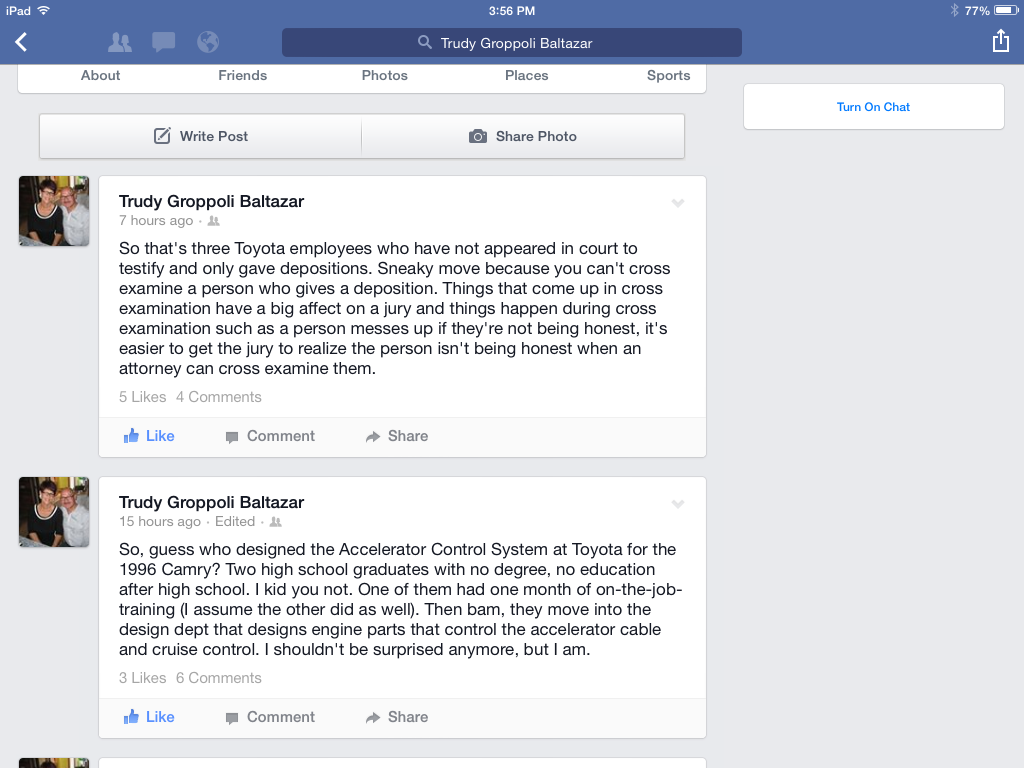
Thanks go to Trudy Baltazar for documenting TOYOTA'S ANTICS!


Bob Hilliard Startled Courtroom in 1996 Toyota Camry Liability Lawsuit


http://trulinespublishing.com/2015/01/31/bob-hilliard-startles-courtroom-1996-toyota-camry-liability-lawsuit/


Let's not forget that TOYOTA BLAMED THE DRIVER in Oklahoma [Bookout & Schwarz] and couldn't explain SKID MARKS indicating the DRIVER tried to slow the RUNAWAY TOYOTA!


When the jury didn't believe TOYOTA'S LIES, TOYOTA rushed to settle with a confidentiality agreement. We'll never know what lives are worth to TOYOTA!


Wednesday, October 22, 2014

Toyota....RUNNING SCARED?


This insincere phony baloney came to the U.S. pretending to correct TOYOTA'S PROBLEMS after TOYOTA LIED!


After losing the Oklahoma Case - Jean Bookout and Barbara Schwarz - jury threw the book at TOYOTA, TOYOTA rushed to settle with a CONFIDENTIALITY AGREEMENT, rushed to settle with DOJ.....


Barbara Schwarz, a passenger,  called her husband BEFORE SHE DIED and told him JEAN COULDN'T STOP THE CAR!


Barbara Schwarz was a nice lady, sorely missed by her family.


STRAIGHT FROM THE TOYOTA CORPORATE PLAYBOOK, TOYOTA BLAMED THE VICTIM!

TOYOTA couldn't explain the SKID MARKS Jean Bookout left as she attempted to STOP HER RUNAWAT TOYOTA!  


AFTER TOYOTA'S DILLY, DALLY, DELAY, STALL & BILL 'EM TACTICS, now TOYOTA is rushing to settle more cases because they know JURIES ARE BECOMING LESS SYMPATHETIC!


TOYOTA, THE PUPPET MEISTER directed the DILLY DALLY DELAY STALL & BILL 'EM law firms to fulfill TOYOTA's DREAMS! ....at the expense of TOYOTA'S VICTIMS!


Toyota Reaches 145 Unintended Acceleration Injury Settlements

According to a joint status report filed last week in California federal court, Toyota Motor Corp. has resolved more than half of nearly 250 individual unintended acceleration lawsuits that have been consolidated in multidistrict litigation (MDL) titled In re: Toyota Motor Corp. Unintended Acceleration Marketing, Sales Practices and Products Liability Litigation.

The joint status report was filed by attorneys for both the plaintiffs and the defendants and was meant to update the presiding judge on the success of the Intensive Settlement Process (ISP). “The ISP is continuing to make good progress as the parties attempt to resolve the various personal injury, wrongful death and/or property damage cases pending before this Court and in other Courts,” the joint status report says.


According to the joint status report, 109 of 168 cases pending in the MDL have been resolved and 36 out of 78 unintended acceleration lawsuits pending in coordinated state proceedings have been resolved. The participation rate is 91 percent, the parties say. Only 11 parties in the MDL and 11 in the coordinated state proceedings have not requested ISP.

This status update was filed less than a year after Toyota began to negotiate settlements with hundreds of plaintiffs who had filed personal injury, property damage and wrongful death claims that allegedly stemmed from the unintended acceleration defect.

Because each Toyota unintended acceleration lawsuit is being negotiated individually, the total value of the settlements will not be known until all of the cases have been resolved. The parties must first seek certification from the special master in the MDL after it is determined they complied with the requirements of the ISP.


The Toyota unintended acceleration class action lawsuit was originally filed in 2010 by plaintiffs who alleged their Toyota vehicles would accelerate without warning due to defects in the electronic throttle control systems. In 2009 and 2010, the auto maker recalled millions of vehicles that reportedly suffered from the unintended acceleration defect.

Toyota agreed to pay $1.1 billion to settle economic loss claims for Class Members who suffered depreciation due to the unintended acceleration defect. Despite some objections from Class Members, a federal judge gave final approval to the Toyota unintended acceleration settlement in July. However, this settlement only provided benefits for vehicle depreciation, not injury, property damage or wrongful death claims.

Under the terms of the Toyota economic loss class action settlement, the auto maker agreed to provide cash benefits to eligible Class Members as well as offer brake override installation for certain recalled vehicles.

The plaintiffs are represented by Lieff Cabraser Heimann & Bernstein LLP and Robinson Calcagnie Robinson Shapiro Davis Inc., among others.

The Toyota Unintended Acceleration Class Action Lawsuit is In re: Toyota Motor Corp. Unintended Acceleration Marketing, Sales Practices and Products Liability Litigation, Case No. 8:10-ml-02151, in the U.S. District Court for the Central District of California, Southern Division.


Parris Boyd
October 21, 2014

Coverup King and admitted-crook Toyota has been runnin’ scared ever since it lost that landmark unintended acceleration case in Oklahoma last October, and is now being allowed to ignore compelling evidence of electronic defects presented at that trial. I’ve been blogging about the “Toyota Way” for quite some time – search “Beware of Toyota. Their next victim may be YOU…”


Charlene BlakeOctober 21, 2014

Toyota is #1 in cases of sudden unintended acceleration and FORD is #2. The current unintended acceleration plaguing newer vehicles is the electronically-induced type. The engine throttle control systems depend on computer software to command them. Sometimes glitches occur…like in some of your other electronic devices…which can cause the command to be different than what you desire.

The evidence of the glitch is often undetectable after the vehicle is restarted. Unfortunately, the EDR (black box) is not always accurate as shown by expert Dr. Antony Anderson in his analysis of a 2012 Toyota Highlander. The EDR results indicated the driver was not braking when she was doing so. The EDR results are inconsistent.

The key to avoiding a horrific crash during a SUA event is whether or not the vehicle has an effective fail-safe in the event a glitch occurs. If it does not, as in the case of the glitch-prone Toyota ETCS-i, then the vehicle may become a runaway with an ineffective means to stop it. Unfortunately, the safety standards aren’t as strict in automobiles as they are in airplanes. Some manufacturers have more effective fail-safes than others. In the case of Toyota, an embedded software expert, Michael Barr (see Oklahoma Bookout vs. Toyota court case involving a 2005 Camry) found that an electronic glitch could induce a SUA event. Another expert, Dr. Henning Leidecker, found that a SUA event could also be triggered by “tin whisker” formation, particularly in 2002-2006 Toyota Camry vehicles.

SUA events have been DEADLY for vehicle occupants as well as pedestrians and people in storefronts, buildings, and even homes. The numbers of such crashes are ever-increasing with the advent of the very complex ELECTRONIC throttle control systems.

With the increase in such serious vehicle crashes, there is a concerted effort to show driver “pedal misapplication” or a “medical condition” or some other reason for the incident…anything other than a vehicle defect. Investigators aren’t scrutinizing the buggy electronic throttle control software or other conditions that can elicit a terrifying sudden unintended acceleration incident. They usually just examine the *mechanical* causes which tend to be just red herrings in these cases. Investigators simply don’t have the expertise to find such electronic glitches. In fact, the staff at the NHTSA, National Highway Traffic Safety Administration, do not have this very specialized training!

Think of it…the next step in electronically-controlled vehicles seems to be so-called “self-driving cars.” Do YOU want to be in a such a vehicle when there is no evidence that strict safety standards, particularly in the throttle control system’s software, have been adhered to? Will you just BLINDLY trust the automaker (criminally-investigated and nearly-prosecuted Toyota and soon-to-be GM and others?) to come through for you and your family’s safety *on its own*?

A recently published Huffington Post article by Jonathan Handel,

How Do We Know Driverless Cars Are Safe? Google Says ‘Trust Us’

Posted: 07/01/2014 7:23 pm EDT Updated: 07/02/2014 1:48 pm EDT speaks to these very issues and poses tough questions about Google’s “driverless” vehicles. Educate yourself carefully before you put your faith in automakers who have knowingly lied to their customers and the government for decades. Study the issue of vehicle electronic sudden unintended acceleration and ask WHY we aren’t seeing it addressed publicly. WHY is blame placed on the driver with little more than speculation about which pedal was used or with little more than an assumption on medical condition. This is being done *even when the drivers steadfastly cite a VEHICLE PROBLEM as the cause of the crash. Absence of proof is not proof of absence of a serious ELECTRONIC computer glitch or other electronically-caused SUA.
 
  • azar Hadi

  •  
    October 21, 2014
    Since Toyota lost the case Bookout vs Toyota in Oklahoma, it rushed to settle cases of sudden unintended acceleration out of court. It is very obvious to me that the problem with Toyota/Lexus has not fixed. It is almost daily that I read about Toyota/Lexus flying into buildings, day cares, store fronts and in many case into other cars and all Toyota does blames the out of control accident on elderly, teens, medical issues, texting, or anything else they can come up with. I am a victim of Lexus sudden unintended acceleration which has changed my life in the past 10 years, 8 out 10 years have been involved in surgeries after surgeries.


    Sudden Unintended Acceleration is real, it happened to me in 2005. I had purchased a brand new 2004 ES 330 Lexus while sitting at the red light my car took off like a rocket going through the red light. By the time I realized what was happening my car was going over 100 miles an hour and I realized that I did not have brake and I could hear the accelerator revving. All I was able to do hold on to the wheel trying to avoid hitting people . All I could think that my car was going to kill people.

    I was so fortunate that no one was kill and what eventually happened I end up on the other side of the street hitting a SUV head on totaling both cars. The dashboard fell on my legs and crushed both legs severely. The SUV driver had some minor damages. As the result of my Lexus suddenly accelerating, I have had 24 surgeries and more in future. My left leg will have to be amputated above the knee since surgery can not do any good anymore and my right ankle will have to be fused since I am in sever pain. I hope Toyota stops the lies and do something with its defective, out of control cars.
    Azar Hadi Brannan


    http://topclassactions.com/lawsuit-settlements/lawsuit-news/42554-toyota-reaches-145-unintended-acceleration-injury-settlements/#comment-145218


    just my opinion...at the moment,,,

    Tuesday, October 21, 2014

    Straight From TOYOTA'S Corporate Playbook!


    TOYOTA tortured a jury with 4 WEEKS' of TRIAL.....


    .....tried to BLAME THE VICTIM, and the jury didn't buy it!


    That after 4 YEARS OF DELAY! [DILLY DALLY DELAY STALL & BILL 'EM straight from TOYOTA CORPORATE PLAYBOOK!]


    Jury says Toyota must pay reality TV star $12 million for crash injury